Advanced
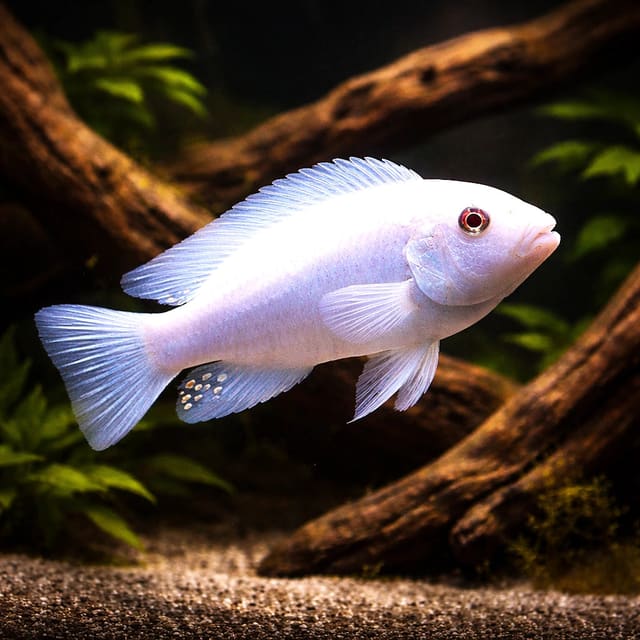
Albino Golden Mbuna (Melanochromis auratus albino)
24–28°C · pH 7.6–8.8 · 205L
£9.99

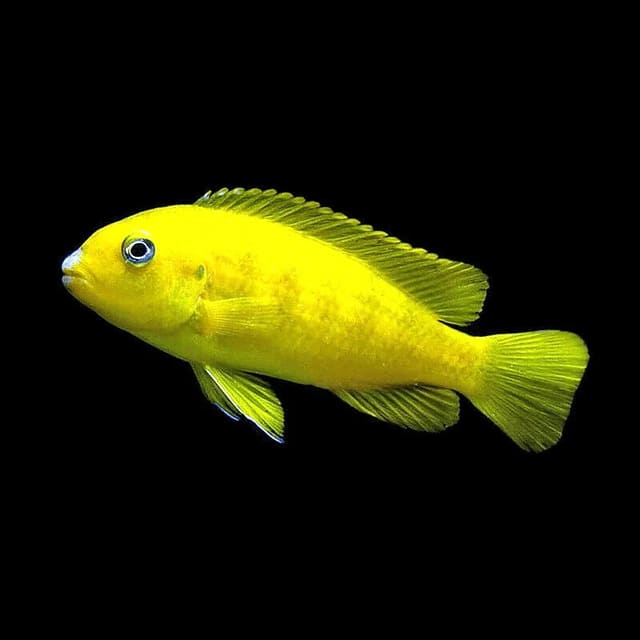
Yellow Elongatus Cichlid is an active, territorial Lake Malawi mbuna trade form for a mature, carefully planned rocky aquarium. One unsexed fish is supplied per quantity at the trade-listed approximate 4-5 cm dispatch size; sex, exact size, adult colour and locality are not guaranteed.
Chindongo cf. elongatus
Shoaling fish: kept in a group they feel safer, stay calmer and show their best colour.
Yellow Elongatus Cichlid is an active, territorial Lake Malawi mbuna trade form for a mature, carefully planned rocky aquarium. One unsexed fish is supplied per quantity at the trade-listed approximate 4-5 cm dispatch size; sex, exact size, adult colour and locality are not guaranteed.
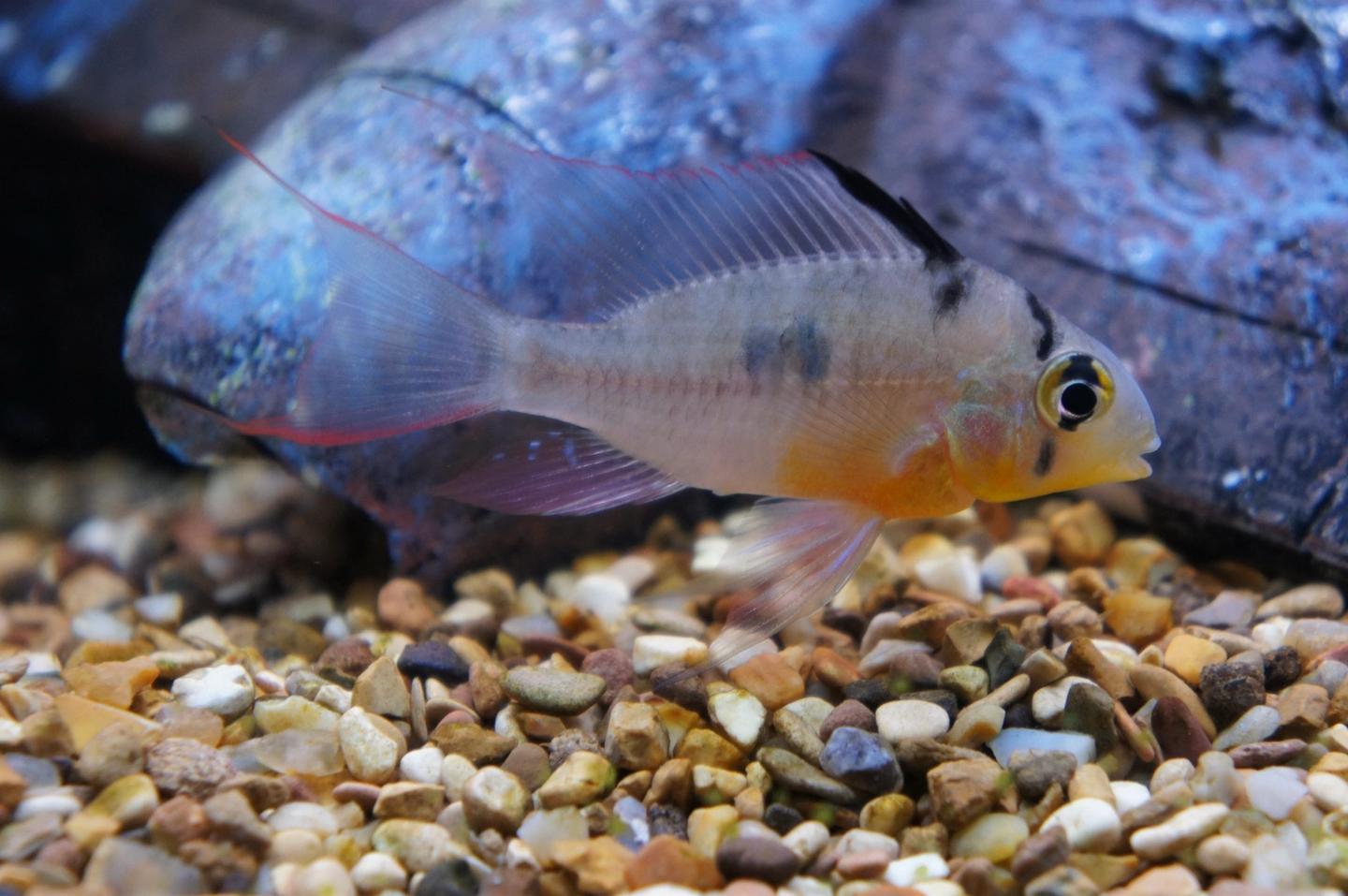
Cichlids are a family of roughly 1,800 accepted species, not one care type. Before buying, identify the exact species and source, then compare adult measurement, usable tank dimensions, social system, territory, tested water, diet and an exit plan. No family-wide minimum tank, water range or tank-mate list is safe.
Maintain these water conditions for optimal health and vibrant colors
Yellow Elongatus Cichlid (Chindongo cf. elongatus) is an active yellow-and-dark rock-dwelling mbuna trade form for a mature Lake Malawi aquarium. It is best chosen for its territorial behaviour, strong colour contrast and constant movement around rocks, not as a peaceful yellow fish for a general tropical community.
One quantity buys one live, unsexed fish. The supplier lists an approximate dispatch size of 4-5 cm. This is a young-stock handling grade, not an exact measurement for every individual and not the adult size. No sex, pair, exact colour, collection locality, breeder, wild or captive origin, or future breeding result is guaranteed.
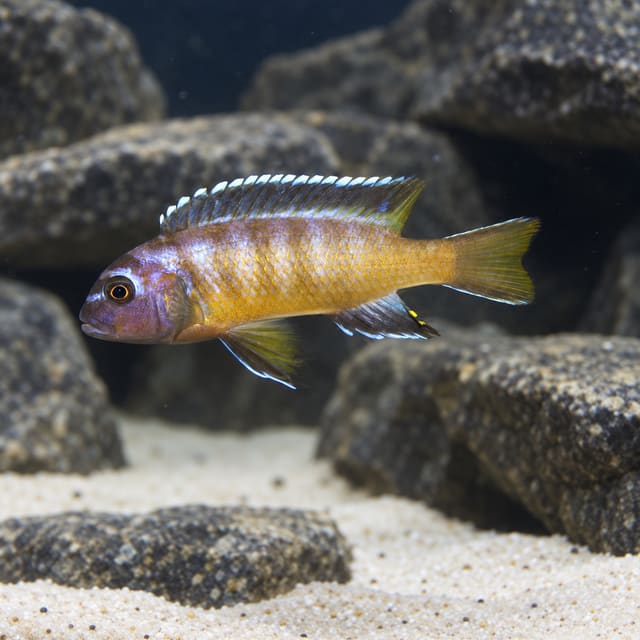
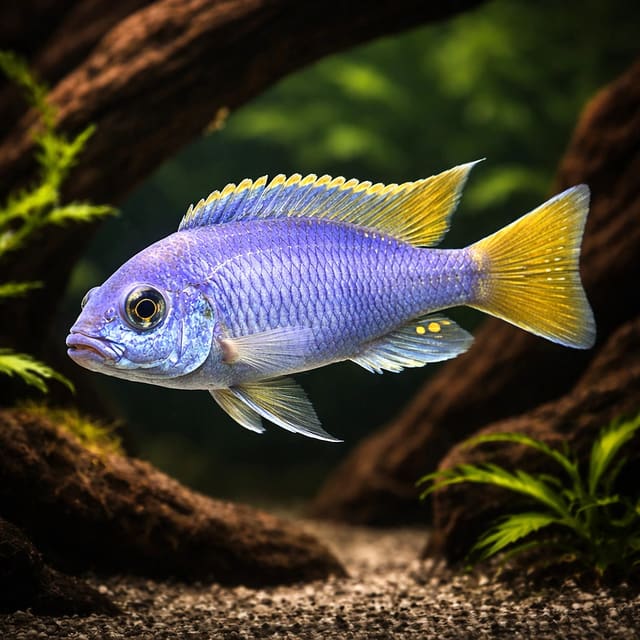
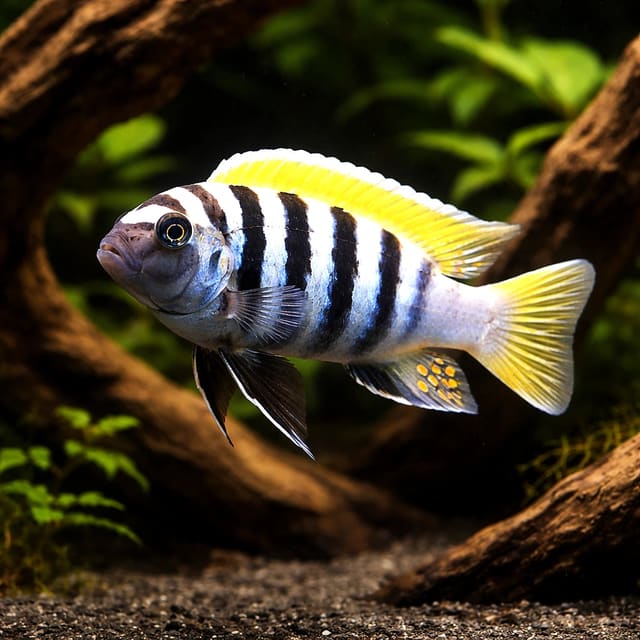
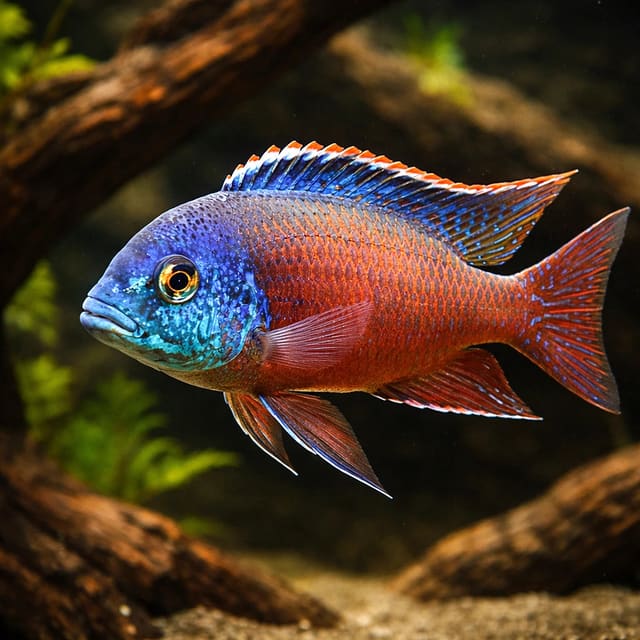
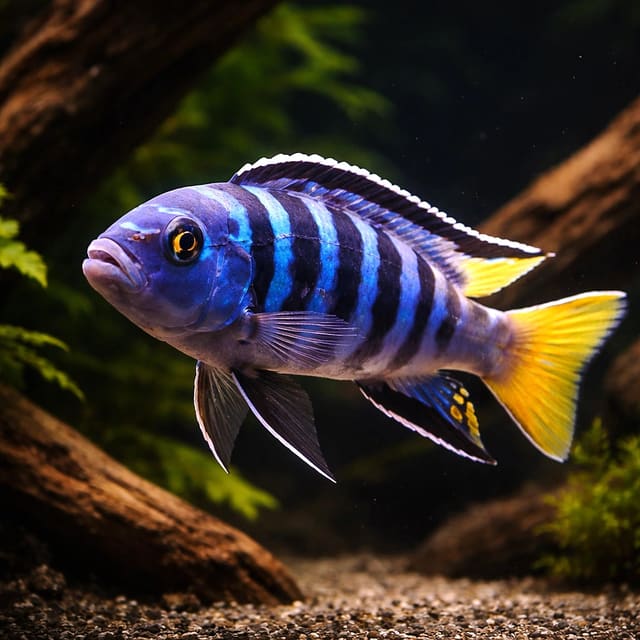
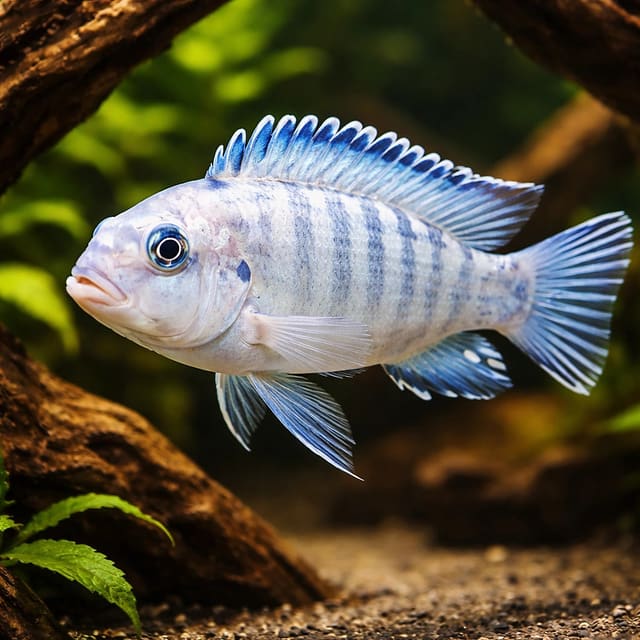
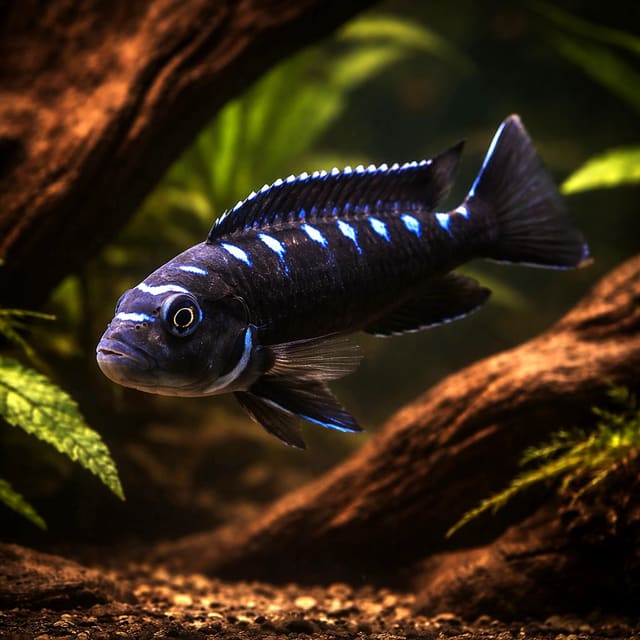
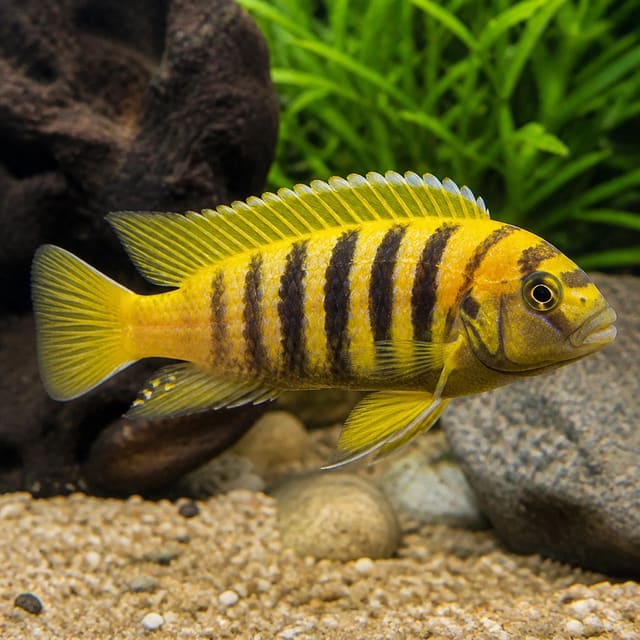
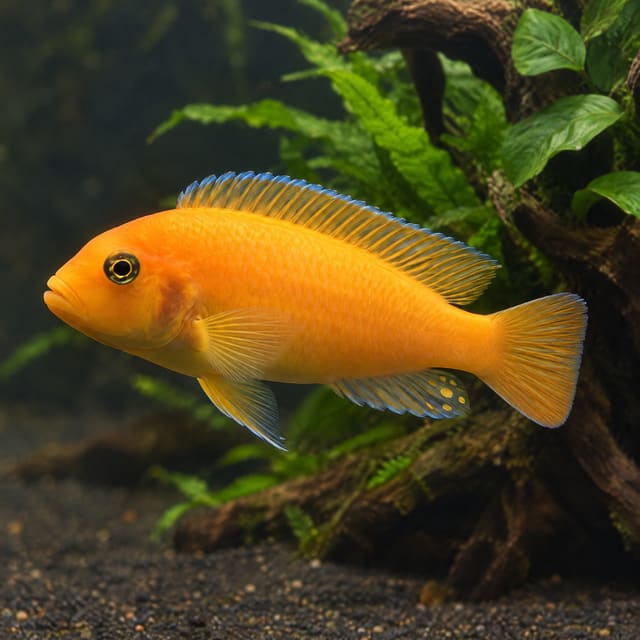
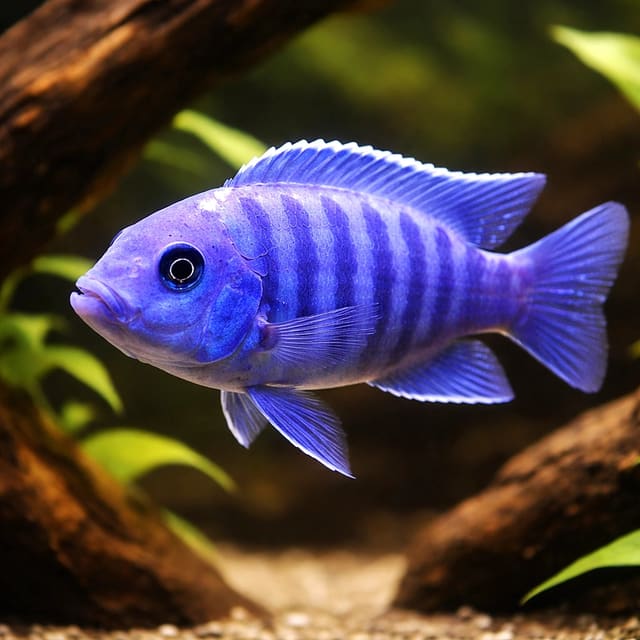
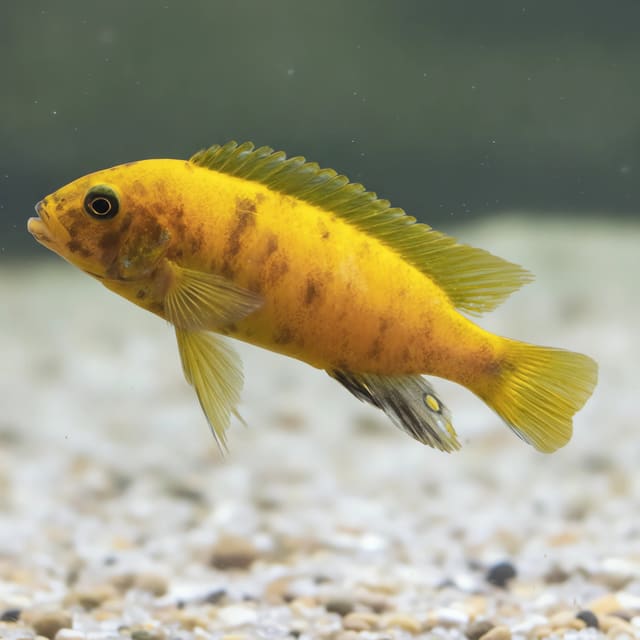
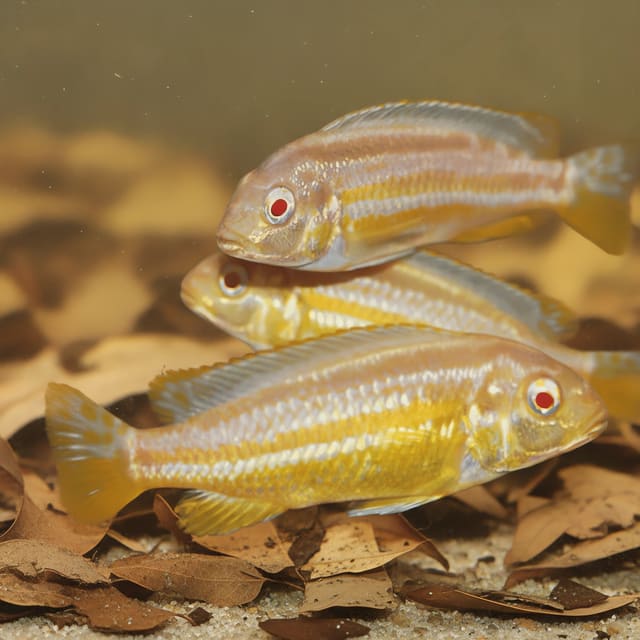
Reference images are not the individual fish received. Colour changes with maturity and conditions; a scene showing two fish does not change the one-unsexed-fish sale unit.
The supplier calls this stock Pseudotropheus / elongatus yellow. That label is useful trade history, but Pseudotropheus elongatus is not the current valid combination for the formally described species. A 2016 revision of the old elongatus species group created the genus Chindongo and transferred the valid species to Chindongo elongatus.
The revision matters because the historical elongatus group was not one interchangeable aquarium fish. It contained multiple related forms and formally distinct species. Accurate identification can depend on morphology and locality information that cannot be recovered from a colour name or a generic reference image.
This product therefore uses Chindongo cf. elongatus. The abbreviation "cf." means "compare with". It records that the trade fish is being compared with C. elongatus without pretending that the supplier has provided a voucher specimen, collection locality, diagnostic examination or genetic result. This is more informative than repeating an old genus uncritically and more honest than presenting exact species identity as certain.
Eschmeyer's Catalog of Fishes currently lists Chindongo elongatus (Fryer, 1956) as valid and records it from Lake Malawi. FishBase also treats that valid species as a shallow-water, rock-associated mbuna. Those references support the biological context used in this care guide; they do not turn an unlocalised commercial shipment into a scientifically verified specimen.
A precise Latin label is only useful when the evidence supports it. Chindongo cf. elongatus preserves the familiar elongatus identity while making the supplier's missing locality and lineage evidence visible.
FishBase describes valid Chindongo elongatus from shallow, sediment-free rocky habitat in Lake Malawi, commonly around small rocks. It records feeding by combing loose algae from the biocover. In aquarium language, that natural surface community is often called aufwuchs: algae, microbes and fine organic or animal material associated with submerged rock.
The habitat description explains why this fish should not be planned like an open-water community cichlid. Rocks are feeding surfaces, shelters, visual barriers and territory boundaries. A bare aquarium can leave subordinate fish continuously visible to a dominant individual, while one decorative cave can become a single defended bottleneck.
Research comparing Lake Malawi ecotypes describes rock-dwelling mbuna as aggressively territorial, with males courting and spawning over rocky substrate. Aquarium behaviour varies between individuals, sexes and social settings, but territoriality is not an unusual fault to be trained away. It is a core husbandry consideration that should shape aquarium length, rock layout, stocking and the keeper's separation plan.
Natural-history data also helps correct a common feeding oversimplification. Wild C. elongatus is associated with algae-combing, but studies of herbivorous rock-dwelling Malawi cichlids show ecological and dietary variation among species. The useful aquarium lesson is to provide an algae-rich, controlled mbuna diet. It is not scientifically accurate to claim that every trace of animal-derived protein is forbidden.
The trade expectation is a yellow to golden body with darker markings and contrasting dark fin areas. The exact expression may change with age, sex, maturity, social rank, health, stress, lighting and background. Young fish may not show the final adult pattern, and a newly transported fish can look paler or darker while settling.
The supplier does not supply a named collection locality or documented line. Do not use colour alone to infer that this fish is a particular geographic population. Other mbuna can carry yellow, black or barred patterns, and names within the aquarium trade have not always followed formal revisions consistently.
Sex is not selected. Juvenile Malawi cichlids may not show reliable external sex differences, and egg spots, body depth or early colour are not conclusive for every individual. This listing does not offer a male, female, pair or pre-arranged harem option.
FishBase records a maximum of 9.5 cm standard length for valid Chindongo elongatus. Standard length is measured to the base of the tail fin, so total length is greater. The figure is a published species reference, not a promise that an unlocalised trade-form fish will stop at exactly 9.5 cm. Plan space using adult behaviour and biomass, not only the dispatch measurement.
| Listing detail | What it means | What is not promised |
|---|---|---|
| Quantity 1 | One live, unsexed fish | Not a pair, trio or group |
| Approx. 4-5 cm | Trade-listed dispatch grade | Not an exact length for every fish or the adult size |
| Yellow Elongatus | Recognisable aquarium trade identity | No certified locality, line or exact adult colour |
| Chindongo cf. elongatus | Evidence-aware scientific comparison | Not specimen-level confirmation of valid C. elongatus |
| Unsexed | Either sex may be supplied | No male-to-female ratio or breeding pair |
| Reference gallery | Not an individual-fish or quantity record | Not the exact animal, reliable scale or retail quantity |
This fish suits a keeper who is deliberately building or maintaining a Lake Malawi setup and understands cycling, hard alkaline water, territorial cichlid behaviour and adult stocking. It is not a suitable impulse addition to a newly filled tank or a way to add yellow colour to a peaceful community.
Before ordering, confirm that the aquarium is fully cycled, structurally able to hold the intended rockwork and large enough for the complete adult community. Test ammonia, nitrite, nitrate, pH, GH, KH and temperature. A pH reading by itself does not show that the biological filter is mature or that hardness will remain stable.
Consider what will happen if one fish is persistently attacked. A divider, separate cycled aquarium or safe return and rehoming plan may be needed. Moving rocks after a serious conflict can interrupt established territories, but it is not a guaranteed cure when the aquarium is too small or the stock mix is incompatible.
A well-planned mbuna aquarium is active and rewarding. A poorly planned one can produce chronic chasing, hidden fish, fin damage and declining water quality. The difference is usually preparation rather than the attractiveness of the fish at the point of sale.
A mature aquarium of at least about 200 litres with a 120 cm or longer footprint is a prudent starting point for this listing. OATA uses 200 litres as general guidance for a reasonable Malawi cichlid community. It is not a species-specific experimental threshold and should not be interpreted as permission to fit any number or combination of mbuna into exactly 200 litres.
Length and front-to-back depth matter because they create distinct territories and escape routes. A tall aquarium with the same nominal litres can offer less useful floor and rock frontage. Heavy rockwork also displaces water, so the labelled tank volume is not the final water volume after substrate and stone are installed.
The final requirement depends on adult fish count, sex balance, species mix, individual aggression, filtration, oxygen, rock displacement and maintenance. A larger aquarium provides more layout options and a wider margin for waste and conflict, but size alone cannot rescue a fundamentally incompatible community.
For a broader planning overview, read the Lake Malawi cichlid planning guide before choosing the rest of the stock. Calculate adult size and behaviour across the whole community rather than buying each fish in isolation.
Create a complex rockscape with several routes through, around and behind the structure. Use ledges, narrow passages and broken lines of sight so a chased fish can disappear from view rather than being pinned against the glass. Distribute useful territory across the aquarium instead of building one central pile surrounded by empty space.
Rockwork must be mechanically stable. Mbuna dig and can remove substrate from beneath a stone. Place major structural pieces securely on the tank base or on a suitable load-spreading support before adding loose substrate. Do not balance a heavy rock on sand and assume it will remain fixed after months of excavation.
Leave enough open water for swimming and enough access for maintenance. Avoid sealed pockets where food and waste accumulate without flow. Check that no opening narrows into a trap as the fish grows.
Rearranging some decor before adding a planned group can reduce the advantage held by established fish, but the method is not magic. Observe closely during and after introduction. If a fish cannot feed, rest or leave a territory, intervene rather than waiting for the community to "sort itself out".
Fine sand is practical because mbuna dig and move it naturally, but the material must be clean, fish-safe and free from sharp fragments. Coral sand or another calcareous material can help support hardness and alkalinity where source water needs it. In already hard water, it may push mineral levels higher than intended, so test rather than adding it automatically.
Do not use substrate chemistry as a substitute for a consistent water-change recipe. The aquarium, replacement water and any buffering stone should work together predictably. Large unexplained differences between tap and tank water make maintenance harder.
Plants are optional. Mbuna may dig them up, eat soft growth or claim the area around them. Tough plants attached to rock can sometimes persist, but a planted display should not reduce the rock structure or water movement needed by the fish.
Plan around stable hard alkaline water, secure rockwork and territory management rather than recreating a gallery background. Plants and wood should not reduce the space or circulation the fish needs.
| Parameter | Conservative working guide | How to use it |
|---|---|---|
| Temperature | 23-26°C | Keep stable and well oxygenated; avoid rapid heating or cooling |
| pH | 7.5-8.5 | Use a consistent hard-water system, not rapid pH chemicals |
| GH | 9-19 dGH | Test source and aquarium water and avoid sudden mineral shifts |
| KH | OATA general Malawi guide: 10-15 dKH | Use as group-level context; measure the actual aquarium trend |
| Ammonia | 0 mg/L | Any detectable result requires immediate investigation |
| Nitrite | 0 mg/L | Confirms the biological filter is processing this toxic stage |
| Nitrate | Keep low and stable | Control stocking and feeding and use regular matched water changes |
FishBase publishes 22-25°C, pH 7.5-8.0 and 9-19 dGH for valid C. elongatus. OATA's broader Malawi care guidance uses 23-27°C, pH 8.0-8.6 and 12-18 dGH. The practical guide above draws on both sources; it is not their exact numerical intersection or a locality-specific stock-water certificate.
Do not chase a decimal with repeated chemical correction. A stable, mineralised aquarium that matches the current stock water reasonably is safer than a rapid swing to a generic target. Ask for the holding water before dispatch when possible and prepare the receiving tank in advance.
Test source water seasonally. UK tap-water hardness can vary by area and treatment source, and a reading from an old forum post does not describe your tap. If mineral salts or buffers are required, mix and test replacement water outside the aquarium before use.
Mbuna are active fish and a Malawi community can create a high waste load. Use biological filtration sized for the intended adult stock, with strong circulation and visible surface movement. The goal is clean, oxygen-rich water without a narrow jet that prevents normal swimming.
Cycle the aquarium before fish are added. A complete cycle processes a controlled ammonia source to nitrite and then nitrate without leaving detectable ammonia or nitrite. A bottle of bacteria can support the process, but it does not make an untested new aquarium instantly safe.
Arrange outlets so water moves around and through the rockscape. Check for debris pockets during maintenance. Additional aeration is useful in warm weather, heavily stocked systems and deep rock layouts where circulation is difficult.
Rinse mechanical media when flow falls and preserve biological media during cleaning. Do not replace every cartridge or sterilise all media at once. Use dechlorinated water for maintenance and keep the filter running whenever practical.
Oxygen problems can appear before a routine test shows high ammonia. Rapid gill movement, gathering near the surface, poor appetite or unusual lethargy require immediate checks of temperature, flow, aeration and water quality.
Use a quality mbuna staple with a strong algae and plant component as the foundation. The Tropical Malawi Mbuna Flakes listing is one relevant food option, but the portion and complete diet still need to match the fish and the community.
Offer small portions that the fish consume promptly. One or two controlled feeds a day is more useful than a large meal that leaves fragments among rocks. Observe body condition and waste output. Persistent leftovers feed bacteria and raise the burden on filtration.
Spirulina-containing flakes or pellets, quality herbivore or mbuna formulations and occasional suitable vegetable material can provide variety. Read the complete formulation rather than judging food by the picture on the tub. Rotate foods gradually and store them cool and dry.
Rock-dwelling Malawi cichlids occupy varied feeding niches, and even algae-associated surface material is not chemically pure plant matter. The safer rule is to avoid routine rich, fatty or inappropriate feeding, especially large portions of foods poorly suited to an algae-grazing mbuna, while using a balanced specialist diet.
| Food role | Examples | Practical use |
|---|---|---|
| Main diet | Complete high-quality mbuna flake or small pellet | Choose an algae-rich formulation and feed controlled portions |
| Plant and algae variety | Spirulina foods and suitable blanched vegetable in small amounts | Rotate; remove uneaten soft food before it spoils |
| Occasional supplementary nutrition | Purpose-made Malawi food with a balanced ingredient profile | Use cautiously; do not make rich food the daily foundation |
| Natural grazing | Algae and biofilm on safe mature rock surfaces | Useful behaviour and enrichment, not a complete captive diet by itself |
| Avoid | Large fatty meals, mammal meat, stale food and chronic overfeeding | Reduces digestive and water-quality risk |
A swollen abdomen, stringy waste, loss of appetite or isolation is not automatically one disease. Causes can include inappropriate feeding, parasites, infection, stress, obstruction or poor water quality. Test the aquarium and seek a diagnosis before dosing medication.
Short, consistent feeding routines and regular maintenance are more reliable than periodic fasting used to compensate for overfeeding. If one fish is prevented from eating by aggression, adding more food can pollute the aquarium without solving the social problem.
Expect active patrols, display, chasing and defence of rock areas. Some interaction is normal, but continuous pursuit, torn fins, cornering, inability to feed or a fish remaining dark and hidden are welfare problems. Observe the entire aquarium, including after lights come on and around feeding.
Colour resemblance can matter. Research on Lake Malawi cichlids has found aggression biases towards similarly coloured males in some mbuna. That does not produce a universal colour chart, but it is a reason to assess the actual fish rather than assuming two different species names guarantee peace.
Do not rely on one dominant cave. Build multiple territories and visual interruptions. Introduce planned groups carefully, quarantine new fish and consider rearranging some rockwork immediately before introduction. Keep a close watch for several days rather than judging compatibility after ten calm minutes.
"Overstocking" is sometimes recommended to spread aggression in Malawi aquariums. It can alter how one aggressor focuses on a target, but it also increases oxygen demand, waste, disease transmission and maintenance pressure. It is a specialist stocking technique, not permission to ignore adult space or filtration.
Rockwork, group introductions and stocking density can influence aggression, but individual fish can still become dangerous. Always retain a practical way to separate or rehome an animal.
There is no universal number of Yellow Elongatus that is safe in every aquarium. The supplier sells unsexed young fish, so a promised ratio such as one male to three females cannot be delivered reliably through this listing. Buying four does not guarantee one male and three females.
A multi-female group can reduce the attention directed at one female in some mbuna setups, but sex, individual aggression and territory distribution still matter. A group can contain multiple males, all females or uncertain juveniles. Plan for that uncertainty before purchase.
Build a written adult-stock list. Include expected adult dimensions, diet, water requirements, relative aggression, colour similarity and preferred territory. Then decide whether the aquarium has enough space and filtration. Avoid adding fish one at a time merely because each product page sounds compatible in isolation.
Introduce less aggressive fish before strongly territorial species where appropriate, but do not use a general rule without considering the actual animals. Quarantine, health and the established community can change the safest order.
Compatibility is conditional. Carefully selected robust Lake Malawi cichlids may share a suitable aquarium, and some keepers use appropriate Synodontis catfish in larger setups. None is automatically safe with this fish simply because it comes from Africa or tolerates alkaline water.
Avoid small peaceful community fish, shrimp, slow long-finned fish and species requiring soft acidic water. Do not mix with a delicate fish and expect rockwork to remove the mismatch. Dietary conflict matters too: a community that requires frequent rich feeding can undermine the mbuna diet.
Peacock cichlids and haps are not one uniform compatibility category. Many are less suited to relentless mbuna aggression or have different feeding strategies. A carefully designed specialist aquarium can differ from a random mixture sold as "Malawi cichlids".
Related elongatus-type forms deserve special care when line identity matters. Similar fish can be difficult to identify after they mature together, and offspring may lose traceable locality or trade-line information. The aquarium hobby benefits when uncertain fish are labelled honestly rather than sold later under a more precise name.
| Possible companion | Recommendation | Reason |
|---|---|---|
| Planned robust mbuna community | Conditional | Requires matching water, diet, footprint, territories and close observation |
| Same Yellow Elongatus trade form | Conditional | Sex is uncertain and conspecific aggression may be strong |
| Similar elongatus/locality forms | Keep separate for line control | Identification and offspring provenance can become unclear |
| Peacocks and haps | Specialist assessment | Temperament and dietary mismatches can create chronic stress |
| Suitable Lake Malawi Synodontis | Possible in an adequate aquarium | Adult size, caves, feeding and bioload must still match |
| Small community fish or shrimp | Avoid | Chasing, injury and predation risk |
| Soft-water species | Avoid | Incompatible long-term chemistry |
Check temperature, filter flow, breathing and social behaviour every day. A subordinate fish can decline between weekly water tests. Count the fish at feeding and look behind rocks where an injured animal may hide.
OATA recommends at least a weekly 25 percent partial water change as a general Malawi routine. Use that as a starting framework, then adjust from stocking, nitrate, feeding and the stability of your source water. Heavily stocked aquariums may require more frequent changes.
Match replacement water for temperature and mineral character, dechlorinate it and add it without undermining rocks. Sudden large shifts in pH, GH, KH or temperature can be stressful even when the final number falls inside a published range.
Vacuum accessible waste, but do not destabilise the whole rockscape at every change. Clean filter media in removed aquarium water when practical and stagger major maintenance. Check pumps and air lines for reduced output.
| Frequency | Check | Action |
|---|---|---|
| Daily | Temperature, flow, breathing, appetite and aggression | Intervene when a fish cannot feed, rest or escape |
| At feeding | Body condition and leftovers | Reduce portions and remove persistent waste |
| Weekly | Ammonia, nitrite, nitrate, pH, GH and KH trend | Compare with the aquarium's normal record |
| Water-change day | Replacement temperature and mineral consistency | Dechlorinate, match and add safely |
| As needed | Filter flow and debris pockets | Rinse mechanical media and improve circulation without sterilising the system |
| Seasonally | Heat, room cooling and source-water variation | Prepare extra aeration and test new water before problems develop |
Cycle and mature the aquarium before ordering. Secure the rockwork, test the water and decide how the new fish will be quarantined and introduced. Do not plan to keep it in the shipping bag while a tank finishes cycling.
Read the current live-fish delivery process, Live Arrival Guarantee and ordering FAQ before dispatch. Delivery timing depends on the livestock schedule, postcode, courier coverage and safe conditions. This product page does not promise an unconditional delivery day.
Be available for the parcel. Inspect the sealed bag and follow the published arrival evidence instructions before opening where required. Keep the packaging until the fish has been checked and contact the team promptly if anything is wrong.
Dim the aquarium lights and compare transport and tank temperature. Follow the supplied acclimation instructions and avoid adding transport water to the display aquarium. Do not leave a fish sitting for hours in an opened bag; gas exchange after opening can change water chemistry.
Release near cover and observe breathing, balance and the response of established fish. A new mbuna may hide while settling, but persistent attack needs intervention. Feed lightly at first and test the water if behaviour looks abnormal.
A separate cycled quarantine aquarium gives time to observe appetite, waste, breathing, skin, fins and behaviour without exposing the established community. Match hard alkaline conditions and provide inert hiding structures that can be cleaned. Quarantine is not safe if the container is uncycled, poorly oxygenated or too small for normal movement.
Use separate nets and siphons where possible. Watch for white spots, excess mucus, flashing, clamped fins, rapid breathing, hollow body condition and abnormal waste. Do not medicate routinely without a reason; some treatments affect biological filtration or require different dosing in hard water.
Before moving the fish to the display, compare water parameters. A long quarantine in different chemistry can make the final transfer a second major adjustment. Introduce with the lights low and monitor established territories closely.
Mbuna are maternal mouthbrooders. In a successful spawning, the female takes fertilised eggs into her mouth and carries the developing brood. Courtship and spawning behaviour do not prove that fry will survive or that the adults are a compatible pair.
This listing supplies one unsexed fish. It does not guarantee a female, male, pair, fertility or breeding result. At the trade-listed 4-5 cm grade, visual sexing may remain uncertain. Do not buy two and assume they form a pair.
A brooding female may eat less and need relief from harassment, but moving or handling her can also cause stress. Prepare a plan before breeding occurs and use reliable specialist guidance for the actual aquarium and line.
Line identity is especially important in the revised elongatus group. If you intend to distribute offspring under a scientific or locality name, keep documented parents and do not mix uncertain lookalikes. Offspring from unlocalised trade stock should remain labelled as such.
Never release aquarium fish, fry, plants or water into the wild. Rehome surplus fish responsibly or speak with a specialist retailer. Release can harm the animal and native ecosystems.
A healthy settled mbuna should hold itself normally, breathe without obvious effort, show interest in food and use the aquarium confidently while still respecting territories. Colour can change with rank and stress, so combine appearance with appetite, posture and social behaviour.
Warning signs include persistent hiding, darkening or paling combined with poor appetite, clamped fins, rapid breathing, repeated flashing, white spots, excess mucus, damaged fins, swelling, hollowing, stringy waste or loss of balance. Aggression can produce secondary infection, and disease can make a fish more likely to be targeted.
Start troubleshooting with measured facts: temperature, ammonia, nitrite, nitrate, pH, GH, KH, filter flow, recent additions, feeding and aggression. Do not diagnose "Malawi bloat" from any swollen abdomen and immediately add random medication.
Separate a severely attacked fish when it cannot recover in the display. A hospital aquarium needs stable matched water, heat, oxygen and shelter. Follow medicine instructions precisely and check whether carbon, ultraviolet equipment or water hardness changes treatment use.
Browse the Lake Malawi and Victoria cichlid collection to compare current stock. The listings below share geographic, taxonomic or visual context, but they are not automatic tank mates. Read each product's current identity, adult requirements and sale unit before combining fish.
| Listing | Useful comparison | Important caution |
|---|---|---|
| Yellow Elongatus Mbuna | This listing; yellow-and-dark elongatus trade form | Unlocalised, unsexed and potentially highly territorial |
| Coral Red Saulosi Mbuna | Another Chindongo trade listing | Different identity; do not treat it as the same fish |
| Maingano Cichlid | Dark striped mbuna comparison | Colour and aggression interactions still require planning |
| Yellow Lab Cichlid | Common yellow Malawi cichlid comparison | A different species and often a different temperament profile |
| Yellow-tail Acei Cichlid | Another Malawi cichlid with yellow colour contrast | Different adult behaviour and space use |
| Demasoni Cichlid | Related Chindongo context | Known territoriality; not a casual companion recommendation |
| Mpanga elongatus-type cichlid | Historical elongatus-group trade context | Do not mix when preserving clear line identity matters |
One quantity buys one live, unsexed fish. A scene showing two fish does not mean a pair or two fish are included.
The supplier lists an approximate dispatch size of 4-5 cm. This is a handling grade rather than an exact measurement, and it is not the adult size.
The valid species formerly known as Pseudotropheus elongatus is Chindongo elongatus. Because this stock has no locality or specimen-level evidence, the listing uses Chindongo cf. elongatus to show careful comparison rather than false certainty.
The reference image is not the individual fish received. Colour and pattern vary with maturity, condition, social status and individual fish; it does not guarantee sex or exact stock identity.
Reliable visual sexing may not be possible at this size, and the supplier does not offer a sexed option. Body colour, bars or egg spots in a young fish are not a guarantee of sex.
Use a mature aquarium of at least about 200 litres with a 120 cm or longer footprint as a prudent starting point. The complete stock mix, displaced volume from rockwork, adult biomass and aggression may make a larger aquarium necessary.
A conservative working guide is 23-26°C, pH 7.5-8.5 and 9-19 dGH, with zero ammonia and nitrite. Ask about current stock water and avoid rapid changes simply to hit one published number.
Not always. The substrate must be clean, fish-safe and compatible with the intended chemistry. Calcareous material can support hardness in some systems, but it does not replace testing and can push already hard tap water higher than intended.
Use a high-quality mbuna staple with a strong algae and plant component, offered in small controlled portions. Natural mbuna diets vary, so the page avoids the inaccurate absolute claim that every animal-protein ingredient is forbidden.
Start with adequate footprint, secure complex rockwork, several visual barriers, compatible stock and strong filtration. Monitor individuals and keep a separation plan; overstocking is not a substitute for water quality or space.
Some keepers combine robust mbuna, but no pairing is automatically safe. Yellow Labs differ in identity and often temperament; aquarium size, individual behaviour, colour resemblance, sex and territory design must all be assessed.
Do not assume so. Many peacocks, haps and community species have different feeding, behaviour or water needs and may be stressed or injured by territorial mbuna. Build a species-by-species plan rather than mixing by label.
There is no safe universal number. The supplier sells unsexed young fish, so a promised male-to-female ratio is not available. Decide only after planning the full adult community, footprint, territories, filtration and fallback housing.
Mbuna are maternal mouthbrooders and may spawn in suitable conditions, but one unsexed fish is not a breeding pair. Sex, fertility, spawning, incubation, fry survival and offspring identity are not guaranteed.
The historical elongatus group includes multiple related forms and revised species. Similar fish can be difficult to identify and may produce untraceable offspring, so keep locality and lineage records separate when they matter.
Cycle and mature the aquarium before ordering, test the water, secure the rockwork and read the current delivery and Live Arrival Guarantee terms. Be available for the parcel and follow the arrival evidence instructions.
This listing separates formal taxonomy, species data, behavioural research and practical trade-welfare guidance. Evidence about valid C. elongatus is used as a reference, not as proof that an unlocalised supplier fish has been identified to specimen level.
Last reviewed: 14 July 2026. Taxonomy, supplied water and practical husbandry information can change. When current holding water differs from a generic guide, prioritise a safe transition, stable tested conditions and direct welfare observation.
No reviews for this item yet. Bought one? Honest reviews only, good or bad.
What customers say about ordering from us
I have a small group of long finned mountain minnows. So was delighted to be able to order ten of this variety to increase the genetics in my tank . The ones I recieved are healthy but it’s to early to give a verdict on wether they are of a long finned type since they are small currently.
Gordon Walker · 23 Sept 2026
100% success travel and "installation". Pleased with quality of purchase. The Siamese fighter a bit "shy" so have not yet seen him at his best yet but looking good. Happy customer. GG
George E Garratt · 21 Sept 2026
Reviews of our shop, collected by Judge.me, an independent third-party review collector. Newest first.