Moderate
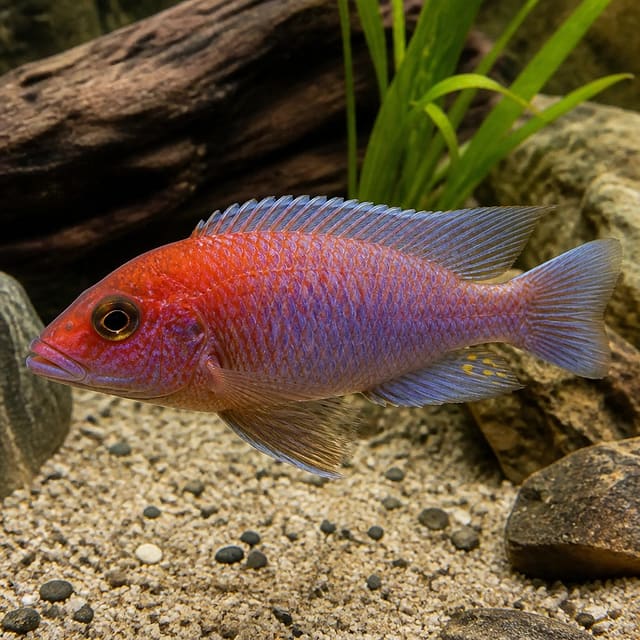
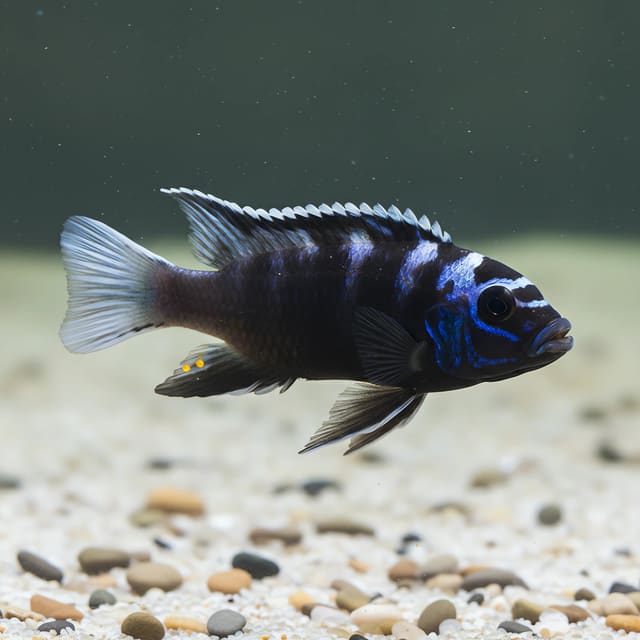
Acei Cichlid (Pseudotropheus sp. “acei”)
24–26°C · pH 7.5–8.5 · 300L
£7.99

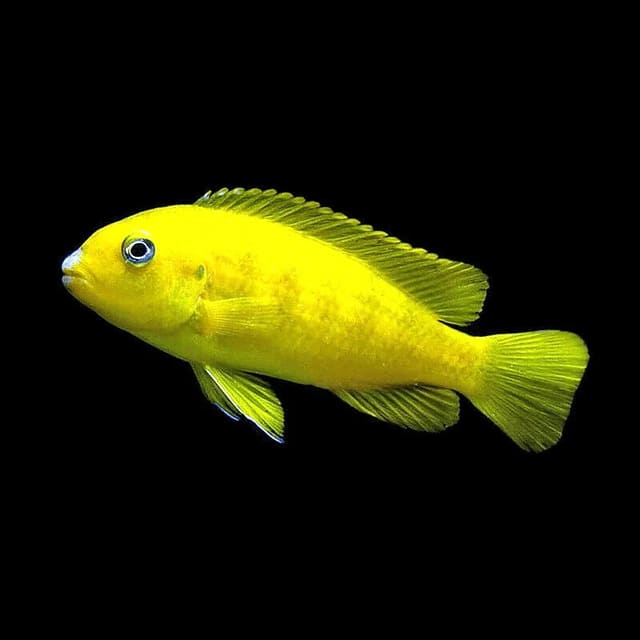
The Albino Golden Mbuna (Melanochromis auratus albino) is an aggressive, territorial Lake Malawi cichlid for an established rocky aquarium of at least 205 litres. One purchase supplies one fish in the selected 4–5 cm or 5–6 cm dispatch size; plan for up to 11 cm adult length and screen companions carefully.
Adult size is the maximum length this species reaches at full maturity (scientific sources). The livestock you receive will be younger and smaller — pick a size above for the actual shipping size. Product-photo provenance and any image-specific limitations are stated on the listing.
Melanochromis auratus
Shoaling fish: kept in a group they feel safer, stay calmer and show their best colour.
The Albino Golden Mbuna (Melanochromis auratus albino) is an aggressive, territorial Lake Malawi cichlid for an established rocky aquarium of at least 205 litres. One purchase supplies one fish in the selected 4–5 cm or 5–6 cm dispatch size; plan for up to 11 cm adult length and screen companions carefully.
Adult size is the maximum length this species reaches at full maturity (scientific sources). The livestock you receive will be younger and smaller — pick a size above for the actual shipping size. Product-photo provenance and any image-specific limitations are stated on the listing.
Cichlids are a family of roughly 1,800 accepted species, not one care type. Before buying, identify the exact species and source, then compare adult measurement, usable tank dimensions, social system, territory, tested water, diet and an exit plan. No family-wide minimum tank, water range or tank-mate list is safe.
Maintain these water conditions for optimal health and vibrant colors
The Albino Golden Mbuna is the albino form sold under the accepted species name Melanochromis auratus. It belongs to the cichlid family, Cichlidae, and the wild species is endemic to Lake Malawi in Africa. The word mbuna is useful here because it identifies the rock-dwelling Malawi group whose aquariums are organised around caves, territories, hard alkaline water and carefully managed aggression.
This is one of the most aggressive and territorial mbuna, so we class its care level as advanced. That assessment reflects the decisions the keeper must make: provide the right aquarium footprint, build separate rocky zones, choose companions by temperament and pattern as well as water requirements, and respond early when aggression changes. It is unsuitable for a conventional peaceful community.
FishBase records a maximum of 11 cm total length for male or unsexed Melanochromis auratus. Seriously Fish uses a separate planning reference of 110 mm standard length, then sets an absolute minimum aquarium of about 205 litres with a 120 × 45 cm base because of the species’ aggression. Use the 11 cm maximum when checking clearances around caves, but treat floor area and territorial structure as the decisive aquarium constraints.
| Suits | Not suited to |
|---|---|
| Advanced Malawi cichlid keepers | Beginners |
| Rocky aquariums of about 205 litres or more | Small or tall, narrow aquariums |
| A base of at least 120 × 45 cm | Conventional peaceful communities |
| Hard, alkaline water at 24–28°C | Peace-loving Peacocks or Utaka |
| Carefully screened Malawi companions | Other Melanochromis species |
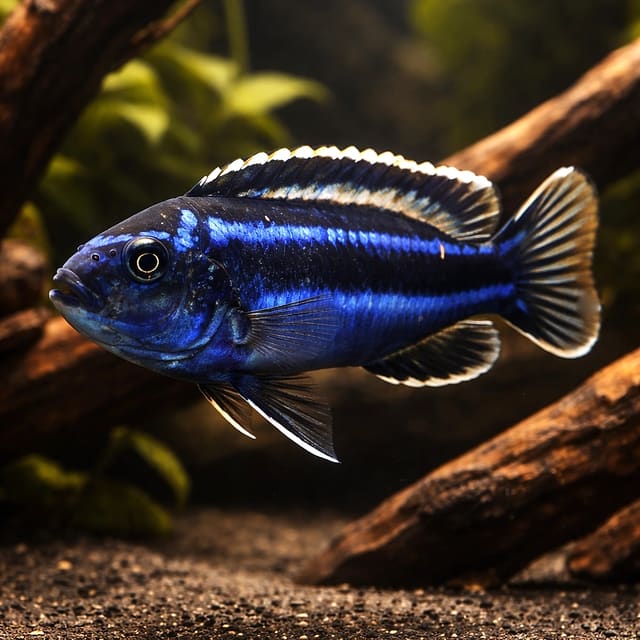
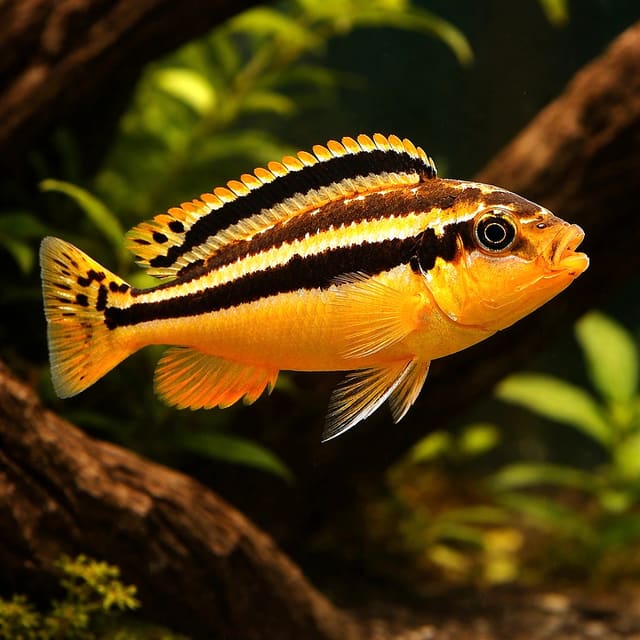
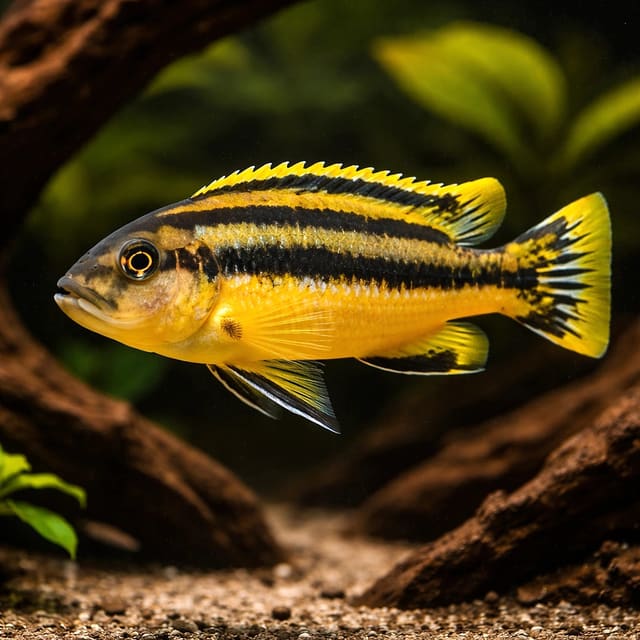
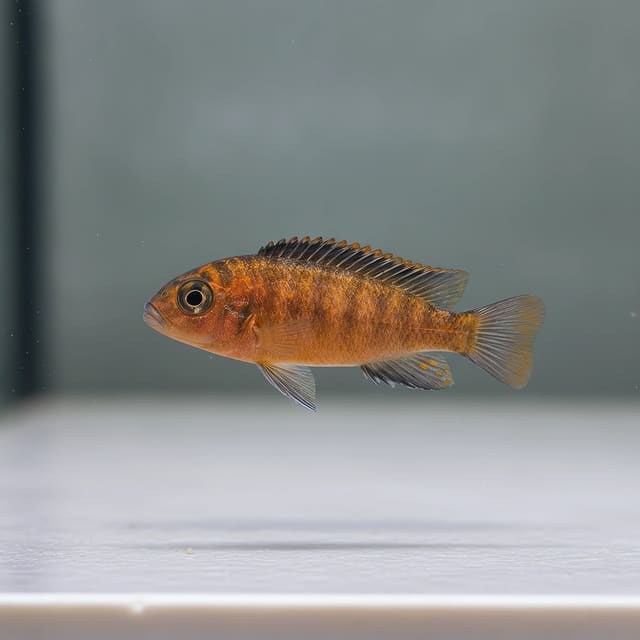
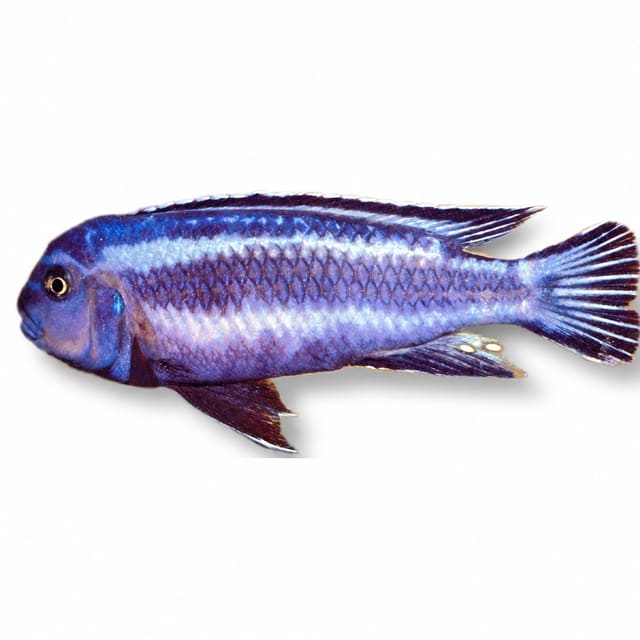
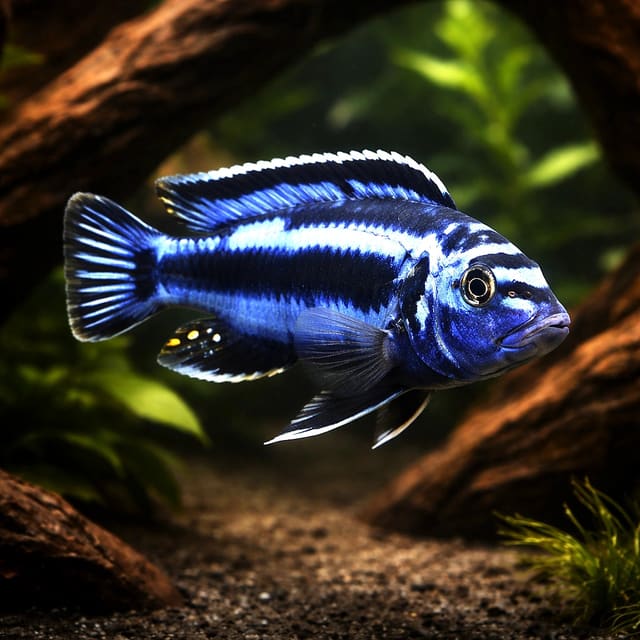
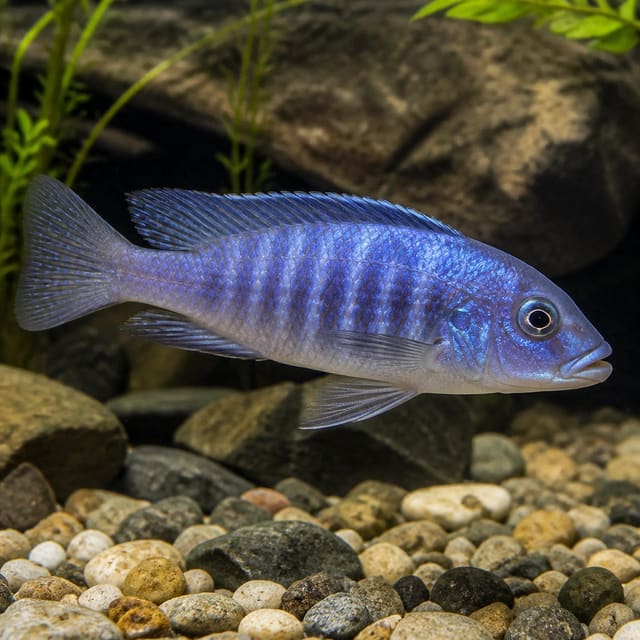
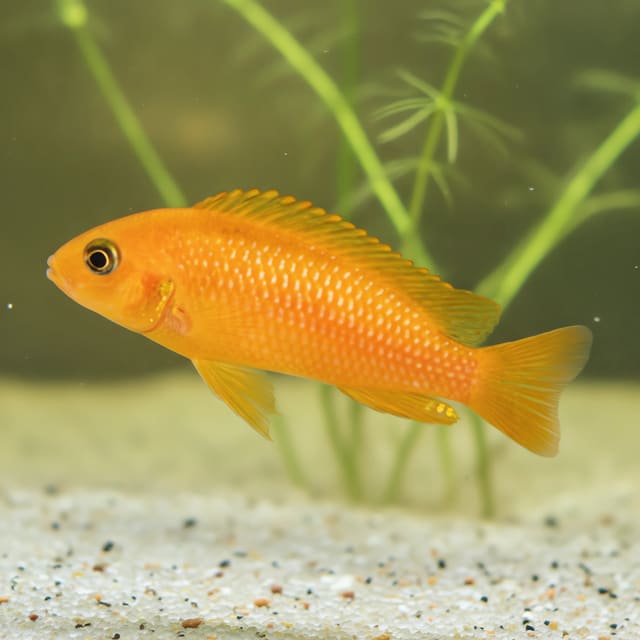
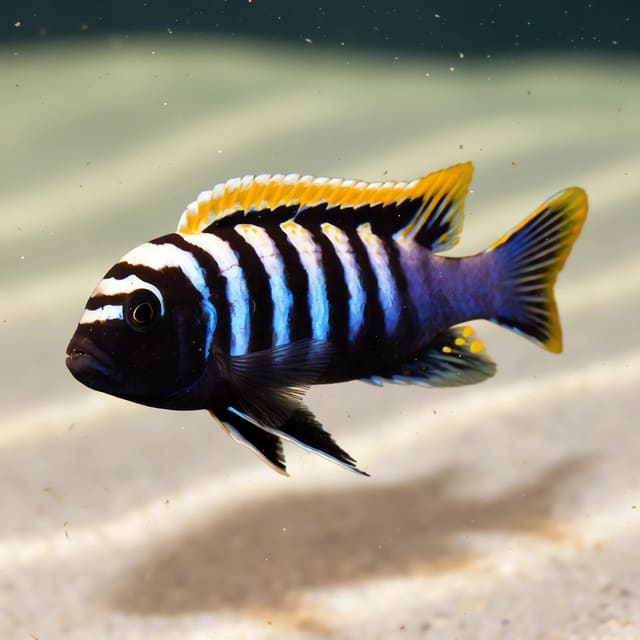
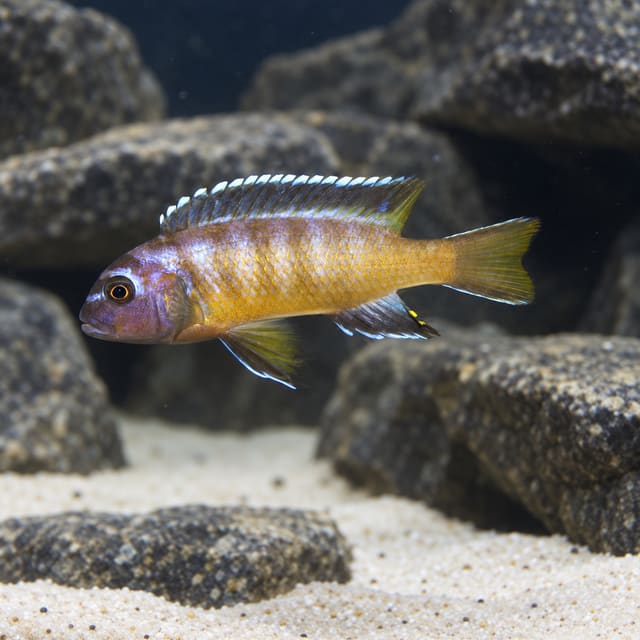
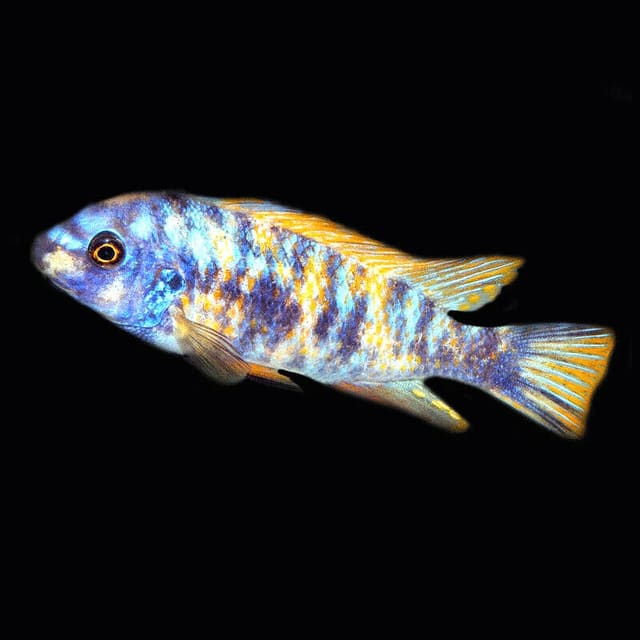
The representative photograph shows three fish with red eyes and pale gold-and-white horizontal stripes above sand and brown leaves. The gallery images are representative of this type of animal rather than photographs of the exact animal supplied, so colours can look slightly different from the live animal. Plan the aquarium from the species’ adult needs and behaviour rather than using the photograph to judge sex, age or final appearance.
One purchase quantity supplies one animal of the selected option. The live size selector lists 4–5 cm and 5–6 cm dispatch sizes; use it when making your choice. The size you select is the size supplied, not the adult size.
A smaller dispatch grade does not create a smaller adult aquarium requirement. For example, choosing a 4–5 cm fish means the animal is supplied within that grade, while the aquarium must still be planned around an adult reference of up to 11 cm, a base of at least 120 × 45 cm and about 205 litres. The larger dispatch grade changes the size at arrival, not the species’ territorial character or long-term space requirement.
| Size detail | What it means |
|---|---|
| 4–5 cm | One fish in the selected dispatch grade |
| 5–6 cm | One fish in the selected dispatch grade |
| Purchase quantity | Each unit adds one animal |
| Adult planning | Use up to 11 cm and the full adult setup |
| Sex | Controlled only by an explicitly sexed option |
Sex is guaranteed only when the selected option explicitly states male or female. This Albino Golden Mbuna listing has no sex-guaranteed option. Dispatch size, colour and the representative gallery image do not identify the sex supplied. Mature colour differences can be complicated by dominant, subordinate, stressed and older individuals, so visual appearance is not a substitute for an explicitly sexed retail option.
Have the aquarium mature, filtered, tested and fully arranged before choosing a delivery date. Confirm that ammonia and nitrite are both 0 mg/l and that the intended stocking plan can accommodate another highly territorial fish. Read the current delivery and Live Arrival Guarantee policy for dispatch days, delivery details and the claim process.
Use an aquarium of at least 120 × 45 cm at the base and about 205 litres. The species guidance describes this as an absolute minimum because aggression, rather than body length alone, creates the space requirement. A tall, narrow aquarium may hold a similar volume but still provide too little horizontal territory, so check the base dimensions as well as the litre figure.
Arrange much of the aquarium as piles of rocks that form caves, leaving small areas of open water between them. Use several piles, entrances and routes rather than one continuous wall with a single dominant entrance, giving the fish multiple caves and areas to occupy.
A sandy substrate suits the recommended arrangement. Malawi cichlids will often dig and rearrange the substrate, so treat plants as optional rather than as the main territorial structure. Rock caves must do the practical work of creating cover and dividing the aquarium.
| Area | Function |
|---|---|
| Rock piles | Create caves and divide territories |
| Gaps between rocks | Provide routes and small open-water areas |
| Separate rocky zones | Provide more than one area to occupy |
| Sandy substrate | Supports the recommended mbuna layout |
| Open surface movement | Supports strong oxygenation |
Look along the aquarium from both ends. Check that there is more than one usable cave and route, and that open areas do not force every fish through the same narrow passage.
Complete this arrangement before introduction. If an established hierarchy later focuses aggression on one territory, rearranging the décor can help disrupt ownership and make all fish find new positions. Keep the design functional: caves, open gaps, oxygenated water and separate rocky areas matter more than decorative complexity.
For routine aquarium care, use 24–28°C, pH 7.6–8.8 and 10–25 dGH. These are working ranges for Melanochromis auratus, not targets to chase from one edge to the other. Measure the aquarium you actually have, keep it within range and avoid making repeated adjustments merely to reach a preferred-looking midpoint.
OATA’s Malawi cichlid sheet gives broad group guidance of 23–27°C, pH 8.0–8.6, 12–18 dGH and 10–15 dKH; it also sets ammonia and nitrite at 0 mg/l and nitrate at no more than 20 mg/l above the normal tap-water level. For this fish, retain the wider routine species range of 24–28°C, pH 7.6–8.8 and 10–25 dGH while using OATA’s waste limits and testing schedule to manage water quality.
| Reading | Action |
|---|---|
| Temperature | Keep within 24–28°C |
| pH | Keep within 7.6–8.8 |
| General hardness | Keep within 10–25 dGH |
| Ammonia | Maintain at 0 mg/l |
| Nitrite | Maintain at 0 mg/l |
| Nitrate | Keep within 20 mg/l above the tap-water baseline |
Use our water chemistry guide to understand what each measurement means. Record the tap-water nitrate as well as the aquarium result because the limit is expressed relative to that baseline. The water matcher can then compare your measured aquarium values with the stated ranges.
Test at least weekly and also test promptly when feeding, breathing, swimming, colour or aggression changes. A number inside the temperature or pH range does not cancel out detectable ammonia or nitrite; all parts of the water-quality check must pass together.
A mature biological filter is essential. The RSPCA explains that fish release toxic ammonia and that a working biological filter supports bacteria which convert ammonia to nitrite and then to the safer nitrate. This process makes filtration part of the life-support system rather than simply a way to make the water look clear.
At about 205 litres, the species guidance recommends turnover of four to five times the aquarium volume each hour. That calculation gives a filter rating of 820–1,025 litres per hour. Use the same multiplication for a larger aquarium: aquarium litres × 4 gives the lower planning figure, while litres × 5 gives the upper figure.
| Worked figure | Result |
|---|---|
| 205 litres × 4 | 820 litres per hour |
| 205 litres × 5 | 1,025 litres per hour |
| Filter role | Biological waste processing and water movement |
| Oxygenation | Strong surface movement and aggressive aeration |
Malawi communities are often stocked densely to spread aggression, and OATA therefore recommends an oversized filter and aggressive aeration for the group. Increased stocking also increases feeding and waste, so aggression management must never be separated from filtration capacity. If the planned population rises, review biological capacity and oxygenation rather than assuming the original equipment remains adequate.
Prepare and mature the aquarium so beneficial bacteria are established before the fish arrives. Our first tropical tank guide explains the setup and maturation sequence. The practical acceptance test remains measurable: ammonia and nitrite must both be 0 mg/l before introduction.
Check the filter for blockages during weekly maintenance. If the filter needs cleaning, do not run it under the tap because any chlorine or chloramine present may kill the beneficial bacterial population established in the media. Instead, rinse it lightly in aquarium water removed during a partial water change.
Melanochromis auratus accepts many foods, but vegetable matter should form a large proportion of the diet. Use spirulina flakes, an algae-based food and a quality dried product as practical staples. Blanched spinach is a fresh option, while live and frozen foods may supplement rather than replace the vegetable-led foundation.
Avoid reducing the feeding plan to the single word “herbivore”. The useful instruction is proportional: most of what goes into the aquarium should be vegetable or algae based, with suitable live or frozen varieties acting as supplements. That approach keeps an occasional supplement from becoming the main meal.
Feed twice a day and offer only what the fish can eat within a few minutes. Watch the whole aquarium rather than only the most dominant individual. A territorial fish may reach food first, while another remains behind rockwork; distribute the portion so you can see whether every intended fish is able to feed.
| Food role | Food choices |
|---|---|
| Main vegetable component | Spirulina flakes and algae-based food |
| Dried staple | A quality dried product |
| Fresh vegetable | Blanched spinach |
| Supplement | Suitable live or frozen varieties |
| Schedule | Twice daily; eaten within a few minutes |
Stop adding food before uneaten material accumulates. Surplus food breaks down and adds waste, increasing pressure on the biological filter and making ammonia, nitrite and nitrate control harder. The correct portion is therefore defined by what the fish consume within a few minutes, not by a fixed pinch that ignores fish number, appetite or competition.
Use feeding as an observation point. Reduced intake or loss of interest is one of OATA’s warning signs, especially when it appears alongside altered breathing, swimming, colour, hiding or aggression. If one fish repeatedly misses both daily feeds because it cannot leave cover, treat that as a stocking and territory problem rather than simply adding more food.
At least once every week, carry out a partial water change of 25%. At the 205-litre planning volume, 25% is 51.25 litres, so a nominal 205-litre aquarium gives a useful worked estimate of about 51 litres. Base the actual change on the water volume you maintain and use a siphon to remove solid waste from the substrate.
If the filter needs cleaning, do not run it under the tap because any chlorine or chloramine present may kill the beneficial bacterial population established in the media. Rinse it lightly in aquarium water removed during the partial water change, reducing the amount of bacteria lost.
OATA’s limit is no more than 20 mg/l above the normal tap-water nitrate level. A tap reading of 10 mg/l therefore gives an aquarium ceiling of 30 mg/l under that rule; a tap reading of 20 mg/l gives a ceiling of 40 mg/l. This comparison is more useful than judging the aquarium number without knowing what entered in the replacement water.
| Checkpoint | Required result |
|---|---|
| Ammonia | 0 mg/l |
| Nitrite | 0 mg/l |
| Nitrate | Within 20 mg/l of tap-water baseline |
| Water change | 25% at least once each week |
| Filter cleaning | Light rinse in removed aquarium water |
Keep a simple dated record of the readings and the water changed. A sequence of results makes it easier to connect a rising waste level with a recent increase in fish numbers or feeding.
Before introduction, confirm that the aquarium is large enough for the complete Malawi stocking plan and that ammonia and nitrite are both 0 mg/l. The filter must already be mature and operating, while the rocks, caves and open areas should be in their intended positions. Adding the fish first and solving the territory plan afterwards gives an aggressive mbuna an immediate opportunity to claim an unsuitable layout.
When adding fish to an established Malawi aquarium, rearranging the décor can reduce aggression by making residents find new territories. OATA also advises introducing Malawi cichlids in groups rather than leaving one new individual to receive all the attention, with more peaceful species added before more aggressive ones. Because this fish sits at the aggressive end of the group, its place in the sequence needs deliberate planning.
Increase the total population slowly. Every rise in fish numbers and feeding requires the biological filter’s bacterial population to process more waste. Stocking too quickly can produce new tank syndrome, with unhealthy ammonia or nitrite that may cause illness or death.
| Checkpoint | What to assess |
|---|---|
| At each feed | Appetite, access to food and aggression |
| During daily viewing | Swimming, breathing, colour, hiding and visible condition |
| At least weekly | Ammonia, nitrite, nitrate and filter flow |
| Each weekly change | 25%, with waste siphoned |
| After stocking changes | Whether the filter and territory plan still cope |
Healthy fish should have clear bright eyes, undamaged fins, intact scales, appropriate swimming and a normal feeding response. Watch for hanging at the surface, sitting on the bottom, erratic swimming, faster or slower gill movement, colour change, increased hiding, altered aggression, white spots, fluffy growths, loss of fins or scales, body-condition change or reduced feeding.
If any of these changes appear, test water quality immediately and contact us for health guidance. Start with measurable water conditions, filtration, feeding and aggression rather than choosing a treatment from the symptom alone.
This fish should not be kept with peace-loving species such as Peacocks or Utaka. Its aggression and territoriality create a direct mismatch even where the fish share broadly similar Malawi water. A conventional community made around gentle fish is therefore the wrong starting point.
Other mbuna may be considered only when they do not resemble Melanochromis auratus in patterning. Similar-looking fish may be treated as territorial rivals, so matching water chemistry is only the first test. Compare adult size, body pattern, territory use and ability to withstand an assertive Malawi community.
Avoid other Melanochromis species because they may hybridise. This restriction is separate from aggression: even an aquarium with enough rockwork and filtration should not use another member of the genus as a routine companion.
| Candidate | Decision |
|---|---|
| Peace-loving Peacocks or Utaka | Avoid |
| Other Melanochromis | Avoid because hybridisation may occur |
| Dissimilar-looking mbuna | Consider only after a full stocking assessment |
| Some Synodontis | Consider the individual species and complete Malawi plan |
| Another Golden Mbuna | Exceptional caution because same-species aggression is severe |
OATA limits Malawi companions to other Malawi cichlids or some species of Synodontis that also naturally inhabit Lake Malawi. That does not make every fish in either category suitable. Compatibility remains uncertain until the exact adults, aquarium base, rock layout, sex composition, feeding access, filter capacity and existing hierarchy are considered together.
Use the African cichlid collection to identify candidates, then apply the complete screen rather than choosing by collection placement or colour alone.
Melanochromis auratus is extremely aggressive towards its own species. The presence of other species may help dissipate attention, but that does not turn a small same-species group into a safe default. Decide whether the aquarium can support a deliberately structured Malawi community before deciding how many Golden Mbuna to include.
OATA says Malawi cichlids can be kept in communities of at least 15 and slightly overcrowded to spread aggression, because small Malawi groups often fight. That figure applies to a planned community, not to 15 Melanochromis auratus. Individuals of this species are intolerant of their own kind, so same-species management remains difficult.
Slight crowding also increases the biological load. It is an aggression-management method only when the aquarium footprint, oversized filtration, oxygenation and maintenance schedule can support the resulting population. Adding fish without those resources exchanges one welfare risk for another.
Several females per male may reduce the male’s focus on one female, but females of this species can also be intolerant of one another. Keeping more than one male requires a very large aquarium, and subordinate males may still be killed. A breeding group is described as one male with at least three females in a species aquarium, but that is a specialist breeding arrangement rather than a universal community formula.
| Plan | Main risk |
|---|---|
| One unplanned individual | Aggression may focus on existing residents |
| Small same-species group | Severe aggression between congeners |
| One male with several females | Male harassment and female intolerance |
| More than one male | Potentially lethal conflict, even in a very large tank |
| Dense mixed Malawi community | High filter, oxygen and stocking demands |
Because the retail sizes are not sex guaranteed, do not base the purchase calculation on receiving a particular ratio. Build the aquarium and contingency plan around the fish actually present. Dispatch size and the representative photograph do not identify sex.
A Malawi aquarium is not finished when the fish are introduced. Territories and aggression can change as fish grow, mature or enter a different hierarchy. Observe access to food and caves at both daily feeds, then compare each fish’s swimming, breathing, colour, hiding and body condition with its normal pattern.
| What you see | What to do |
|---|---|
| One newcomer receives concentrated aggression | Review the introduction sequence and rearrange décor to disrupt territories |
| A fish hides more or misses food | Assess territory access, visible condition and the stocking plan |
| Aggression rises after adding fish | Pause further additions and recheck space, cover and group structure |
| Breathing or swimming changes | Test ammonia, nitrite and the other water values immediately |
| Filter flow falls | Check for blockages and restore filtration and aeration |
Rearranging the rockwork can help by removing familiar boundaries and making all residents establish new territories. Retain multiple caves and open gaps while changing the layout; reducing cover to make fish easier to see would remove the structure they need.
List the aquarium base dimensions, total litres, current fish, intended adults, rock arrangement, filter rating and measured water values. Then compare each candidate’s aggression, pattern and territory use. Contact us for a stocking and compatibility assessment if you want the complete combination considered before purchase.
Do not add extra fish automatically whenever chasing occurs. Slight crowding can spread aggression in a properly designed Malawi community, but it also raises oxygen demand, feeding competition and waste production. First identify whether the problem is a recognisable territory, an unsuitable companion, severe same-species conflict or a system that has reached its filtration and space limit.
The safest outcome comes from acting on early changes rather than waiting for extensive fin or scale loss. Behaviour, feeding and water-test results together give a clearer decision than any single observation.
The Albino Golden Mbuna is the albino form sold under Melanochromis auratus, a highly aggressive and territorial rock-dwelling cichlid whose wild species is endemic to Lake Malawi.
One purchase supplies one fish of the selected size. Increase the purchase quantity only when your complete aquarium and compatibility plan supports more than one animal.
The live size selector lists 4–5 cm and 5–6 cm dispatch sizes. These are supply grades rather than adult sizes, so plan for a maximum recorded adult length of 11 cm.
Use at least about 205 litres with a base of at least 120 × 45 cm. Arrange much of it with rock piles, caves, separate rocky zones, small open-water areas, a sandy substrate and strong oxygenation.
Plan it as part of a deliberately structured Malawi aquarium rather than applying a simple solitary or group rule. Same-species aggression is severe, several females per male can still present problems, and more than one male requires a very large aquarium with a continuing risk of lethal conflict.
Keep routine aquarium conditions at 24–28°C, pH 7.6–8.8 and 10–25 dGH. Maintain ammonia and nitrite at 0 mg/l, with nitrate no more than 20 mg/l above the normal tap-water level.
Make vegetable matter a large proportion of the diet using spirulina flakes, algae-based food, a quality dried product and blanched spinach. Suitable live and frozen foods may supplement this foundation; feed only what is eaten within a few minutes, twice daily.
Start filming before opening the sealed parcel, keeping the outer box visible and continuing through opening until the fish is shown inside the sealed bag. Float the bag for 20–30 minutes before releasing the fish, and retain the video with your order number if a Live Arrival Guarantee claim is needed.
Avoid peace-loving species such as Peacocks or Utaka and avoid other Melanochromis because they may hybridise. Dissimilar-looking mbuna may be considered in a carefully planned Malawi aquarium, while any Synodontis candidate needs an individual species and full-stocking assessment.
No reviews for this item yet. Bought one? Honest reviews only, good or bad.
What customers say about ordering from us
I have a small group of long finned mountain minnows. So was delighted to be able to order ten of this variety to increase the genetics in my tank . The ones I recieved are healthy but it’s to early to give a verdict on wether they are of a long finned type since they are small currently.
Gordon Walker · 23 Sept 2026
100% success travel and "installation". Pleased with quality of purchase. The Siamese fighter a bit "shy" so have not yet seen him at his best yet but looking good. Happy customer. GG
George E Garratt · 21 Sept 2026
Reviews of our shop, collected by Judge.me, an independent third-party review collector. Newest first.