Moderate
Mdoka White Lips Cichlid (Placidochromis phenochilus)
23–27°C · pH 8–8.6
£31.99

Star Sapphire Hap is the spotted Malawi trade form known as Placidochromis sp. "phenochilus Tanzania", distinct from true white-lipped P. phenochilus. This listing supplies one unsexed fish in the selected 4-5 cm, 6-7 cm or XL grade. Plan a long, mature aquarium with stable mineralised water and a separation option.
Placidochromis sp. "phenochilus Tanzania"
Save when buying multiple fish. Each quantity is one fish; sex and pair formation are not guaranteed unless the selected variant explicitly states them.
Star Sapphire Hap is the spotted Malawi trade form known as Placidochromis sp. "phenochilus Tanzania", distinct from true white-lipped P. phenochilus. This listing supplies one unsexed fish in the selected 4-5 cm, 6-7 cm or XL grade. Plan a long, mature aquarium with stable mineralised water and a separation option.
Cichlids are a family of roughly 1,800 accepted species, not one care type. Before buying, identify the exact species and source, then compare adult measurement, usable tank dimensions, social system, territory, tested water, diet and an exit plan. No family-wide minimum tank, water range or tank-mate list is safe.
Maintain these water conditions for optimal health and vibrant colors
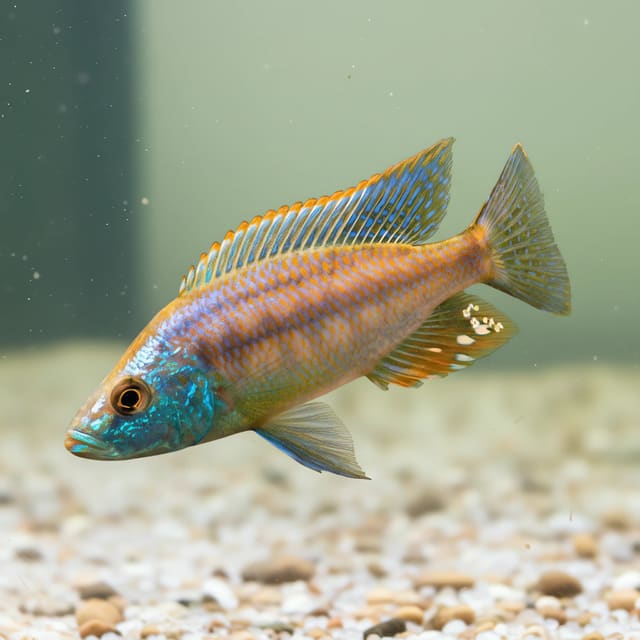
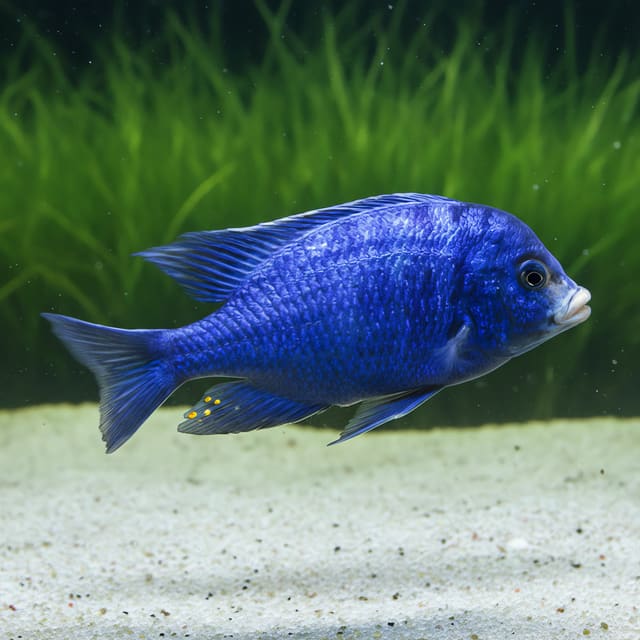
Star Sapphire Hap is the aquarium trade name for the blue Lake Malawi hap whose adult male-form develops pale, star-like marks across the body. On this page we identify that spotted trade fish as Placidochromis sp. "phenochilus Tanzania". That wording matters: specialist sources distinguish the Star Sapphire presentation from true Placidochromis phenochilus, the white-lipped fish commonly sold as Mdoka White Lips. The two names have often been merged in retail catalogues and search results, but they should not be treated as automatically interchangeable.
This listing supplies one unsexed live fish in the size selected: approximately 4-5 cm, approximately 6-7 cm, or XL. The supplier has not given an exact centimetre range for XL. Each quantity is one fish, not a confirmed male, female, pair or breeding group. Young and female-form fish may be grey-blue or comparatively plain, and the white spotting associated with a mature male-form can develop gradually. Sex, mature colour, locality and compatibility with another individual are not guaranteed.
Star Sapphire Haps need more than bright colour and a large litre figure. They are substantial Malawi cichlids that use open swimming space, investigate sand and can create serious social pressure as they mature. A long, mature aquarium, powerful filtration, stable mineralised water and a plan for separating incompatible fish are central to responsible care. This guide preserves the useful detail of the original listing while separating source facts, scientific uncertainty and our conservative retailer planning advice.
Choose the size in the live variant selector, then choose the number of individual fish required. The 4-5 cm and 6-7 cm labels are approximate supplier size bands rather than exact measurements for every animal. XL is a supplier grade with no centimetre range in the current source record, so it is not converted into an invented number here. Natural growth, transport preparation and individual body shape can create small differences within any commercial size band.
The store's quantity-pricing setting may reduce the per-fish price when the qualifying quantity is selected. That is a commercial discount only. Two unsexed fish are not guaranteed to be one male and one female, and a larger order is not guaranteed to contain a particular sex ratio. Because sex and social compatibility can become clearer only with development, order multiple fish only when the aquarium and backup space can support more than one possible male.
| Included | Not promised |
|---|---|
| One live fish per selected quantity | A pair, trio or sexed group |
| The selected 4-5 cm, 6-7 cm or XL grade | An exact length for every fish or for XL |
| Care guidance for the Star Sapphire trade form | A certified collecting locality or generation |
| Live Arrival Guarantee under the published terms | A static dispatch day, stock level or delivery promise in this text |
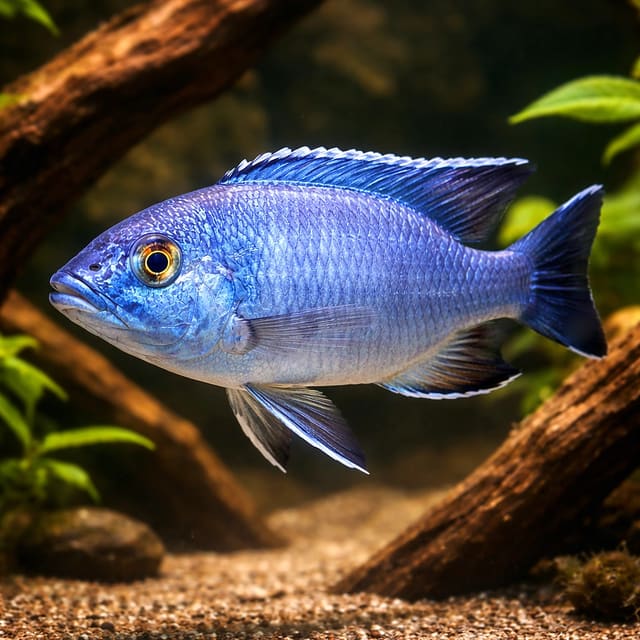
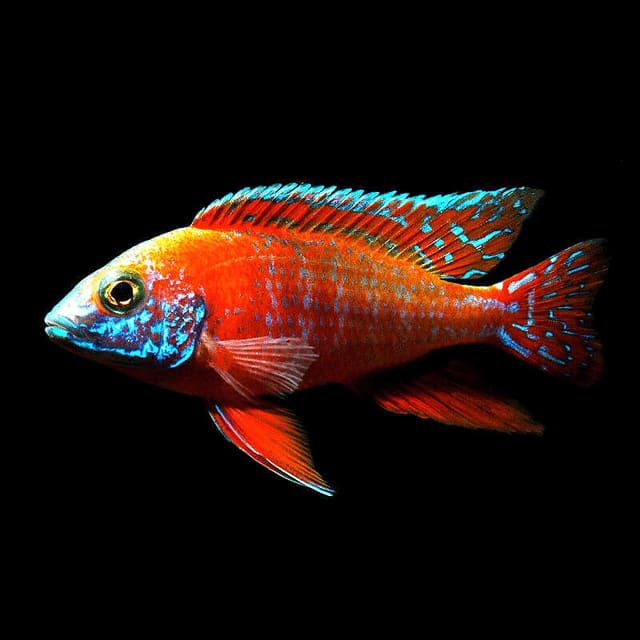
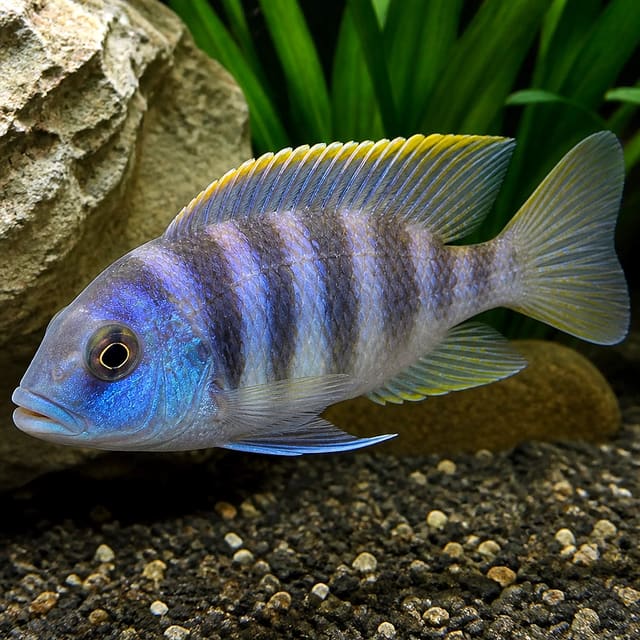
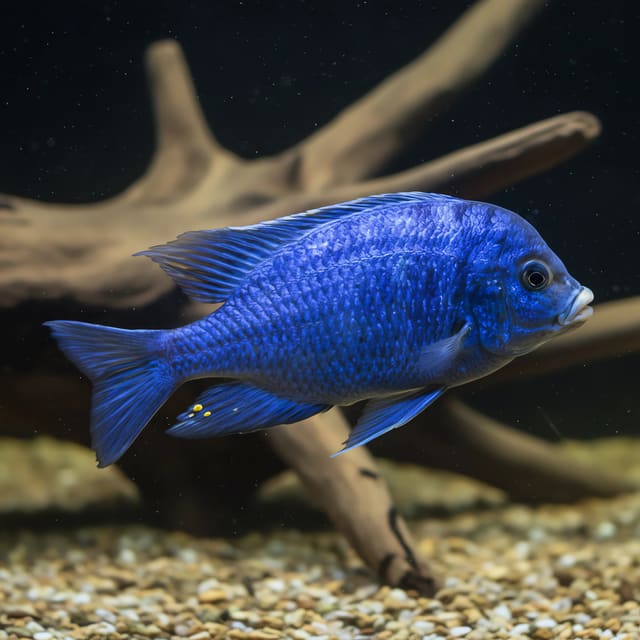
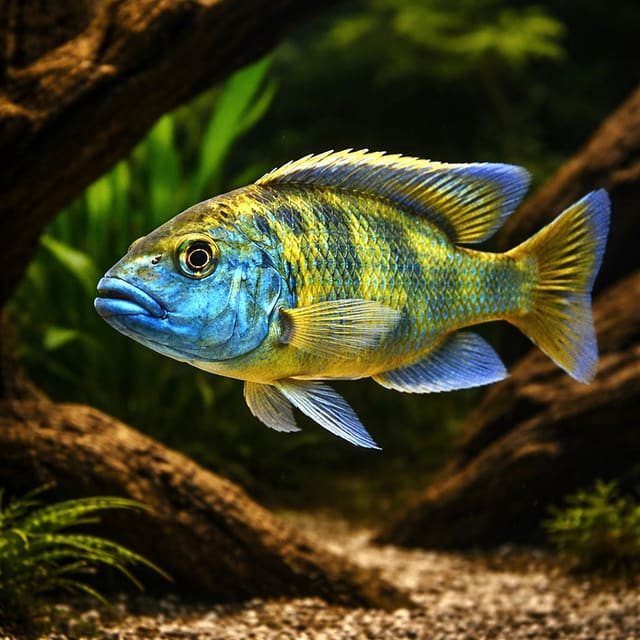
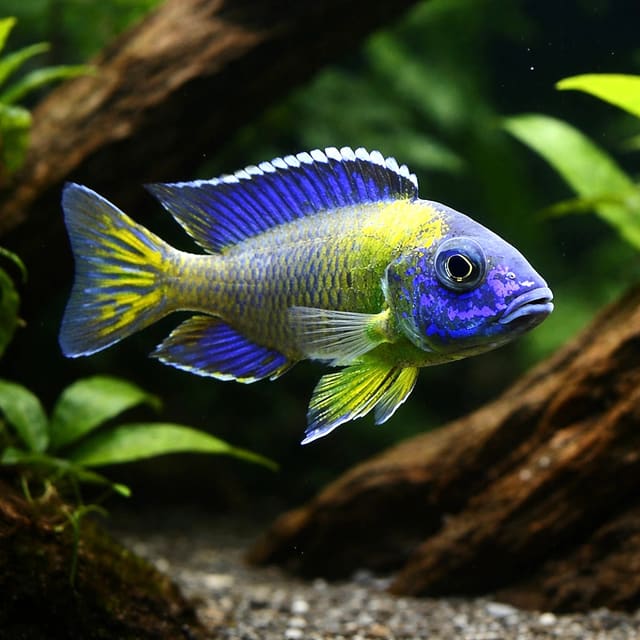
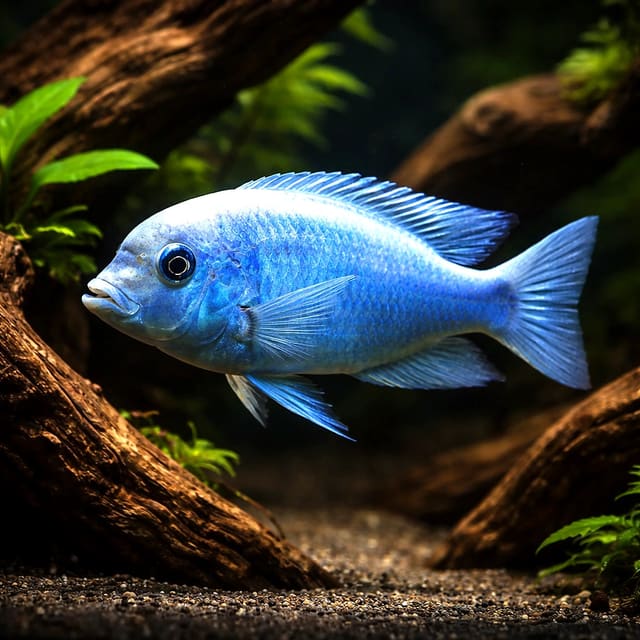
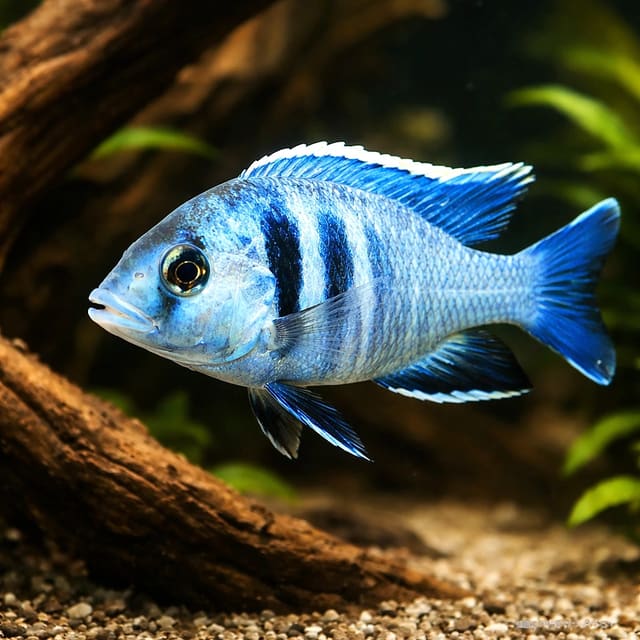
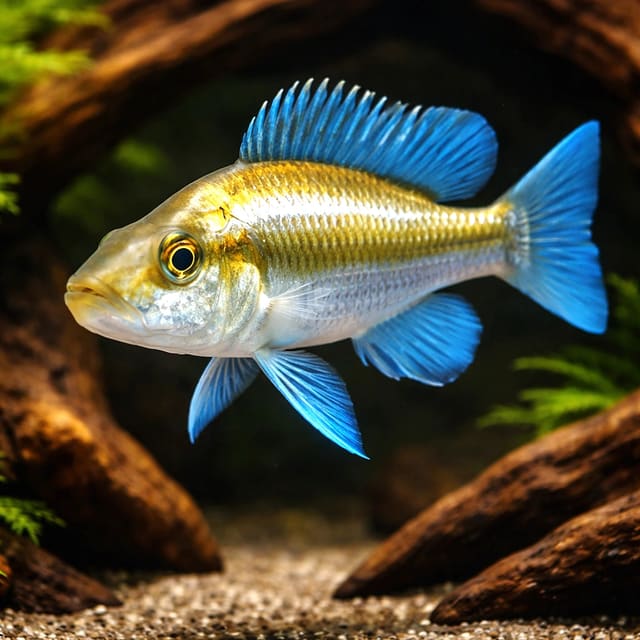
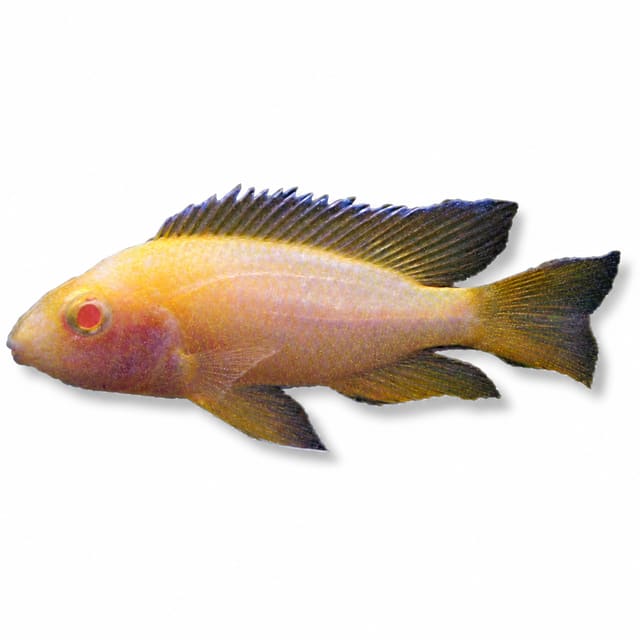
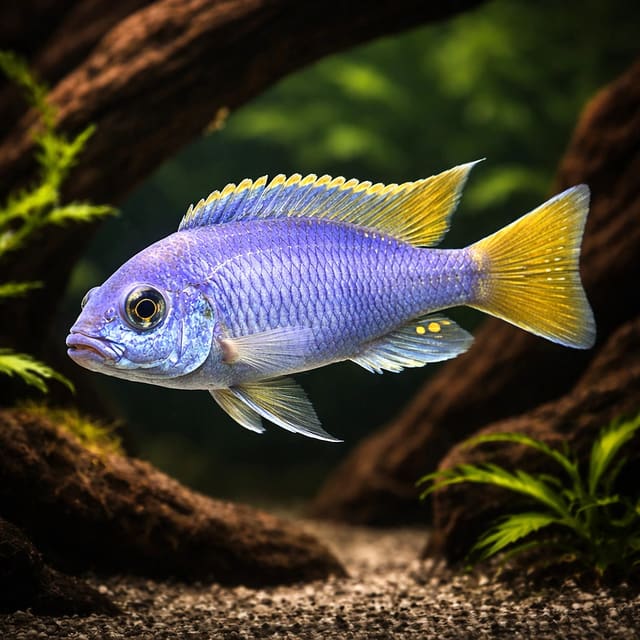
The four gallery images are mature male-form representatives based on the available identity reference. They are not photographs of the exact fish supplied. The scene containing two blue spotted fish shows two male-form representatives; it is not evidence of a male-female pair or a compatible group. Unsexed young stock can look much plainer than the adult presentation shown.
The name Placidochromis phenochilus has been used broadly in the aquarium trade, but the accepted species described by Trewavas in 1935 is associated with conspicuous white lips and the trade name Mdoka White Lips. FishBase's photograph review cautions that a spotted aquarium fish shown under that accepted name may instead be the undescribed form called Placidochromis sp. "Phenochilus Tanzania". A specialist Greater Chicago Cichlid Association profile makes the same practical distinction.
The supplier's small reference photograph and the protected customer gallery show the spotted Star Sapphire presentation, not the characteristic white-lipped presentation of true P. phenochilus. We therefore use the trade-form identity in the title and care data. The abbreviation "sp." signals that the fish is being handled as an uncertain or undescribed form rather than pretending that a settled species identification has been proven for this batch.
"Tanzania" is part of the established aquarium trade label. It is not evidence that these particular fish came from a named Tanzanian collecting site, and it is not a Lupingu, Mdoka or other locality certificate. No source supplied a collecting code, parent-stock history, F-generation, captive-bred statement or wild-caught statement. Those details should be requested separately when population-level provenance matters.
| Identity field | Evidence-led wording for this listing |
|---|---|
| Customer-facing trade name | Star Sapphire Hap or Star Sapphire Cichlid |
| Trade-form scientific label | Placidochromis sp. "phenochilus Tanzania" |
| Accepted P. phenochilus | A distinct white-lipped presentation; not assumed to be this spotted form |
| Certified locality for this batch | Not supplied |
| Sex and generation | Unsexed; generation not supplied |
The distinction is useful for shopping as well as taxonomy. A mature male-form Star Sapphire is sought for the gradual spread of pale spots over a blue body. True P. phenochilus is recognised in the hobby for enlarged pale or white lips. Search engines, marketplace titles and even image captions often combine the two, so colour words alone are not enough to establish identity.
Our separate White Lips Placidochromis phenochilus listing is the more relevant comparison when the enlarged white-lipped appearance is the feature you want. Do not buy both under the assumption that they are merely two sizes of one fish. Check the live images, sale unit and evidence boundary on each page.
| Feature | Star Sapphire trade form | True P. phenochilus trade presentation |
|---|---|---|
| Useful label | Placidochromis sp. "phenochilus Tanzania" | Placidochromis phenochilus |
| Adult display trait | Pale star-like spotting over blue in mature male-form fish | Conspicuous pale or white lips |
| This product | Yes | No |
| Batch locality certificate | Not supplied | Must be checked on that separate listing |
Star Sapphire Haps belong to the Lake Malawi haplochromine aquarium tradition rather than the rock-grazing mbuna model. Specialist observations describe the trade form following larger sand-disturbing fishes and taking exposed edible material. That follower-feeding reputation helps explain its interest in open substrate and food reaching the lower water, but it should not be turned into a claim that one precise wild diet or locality is proven for this retail batch.
In an aquarium, the practical lesson is to provide a clean sandy area, room to cruise and food that every individual can reach. The fish should not be forced into a wall of rock. Secure stone structures still have value as visual barriers and shelter, but they need to leave a broad uninterrupted swimming lane and must be stable before water and fish are added.
Young Star Sapphire Haps can be understated. Unsexed juveniles may arrive grey, silver-blue or lightly marked. Mature male-form fish can develop a deeper blue ground colour and increasing pale flecks that produce the familiar starry effect. Development is not perfectly synchronised: age, sex, social status, nutrition, health, lighting and inherited variation all influence what is visible.
A fish that does not immediately resemble the mature gallery image is not necessarily the wrong animal. Equally, no keeper should be promised that every unsexed fish will become an intensely blue spotted male. Female-form fish are normally less showy, and a subordinate male may suppress display. Stable care and time can support natural development, but they cannot alter sex or guarantee a particular pattern.
| Stage or condition | Likely presentation | What remains uncertain |
|---|---|---|
| 4-5 cm unsexed stock | Often juvenile, comparatively plain or lightly marked | Sex and final pattern |
| 6-7 cm unsexed stock | May show more structure and early colour | Adult intensity and social status |
| XL supplier grade | Larger commercial grade | Exact centimetres, sex and mature display |
| Mature dominant male-form | Blue body with progressive pale spotting | No gallery image guarantees an individual outcome |
FishBase records 15.7 cm total length for accepted P. phenochilus, while our stock records for this Star Sapphire trade fish give a maximum of 18 cm. Because the identity boundary is unresolved, it would be false precision to choose one figure and present it as universal. Plan for an adult in the roughly 16-18 cm class, with the depth and turning room expected for a robust Malawi cichlid.
Growth depends on starting size, sex, age, temperature, food, health and social access. Do not accelerate growth through chronic overfeeding or permanently high temperature. A fish that is excluded from food may remain smaller while losing condition, which is not healthy slow growth. Track body shape and behaviour as well as length.
This fish suits an aquarist who already understands the nitrogen cycle, can provide a long aquarium and is prepared to manage cichlid behaviour rather than simply following a stocking chart. It can become an impressive focal animal in a carefully selected Malawi community. It is not a good choice for a small general community, a newly filled aquarium or a buyer who needs a guaranteed blue male.
Before ordering, read the cichlid care guide and compare the available footprint with the fish's adult needs. Water volume gives dilution, but length and width determine how animals pass one another, leave a chase and use visual barriers. A backup tank, divider or rehoming plan is part of responsible preparation when several unsexed cichlids are ordered.
There is no experimentally established minimum litre number for this commercial form. Our conservative retailer starting point for one adult in a suitable Malawi community is about 400 litres with a footprint around 150 x 50 cm. Larger is preferable, particularly when keeping more than one Star Sapphire, adding other large haps or working with uncertain sex. This is welfare planning guidance, not a scientific threshold at which behaviour suddenly changes.
A taller but short aquarium is not an equal substitute for length. The fish needs a broad route through open water and enough width to turn without continually entering another cichlid's space. Usable volume is also lower than the label once substrate, rock and air space are counted. Stock the adult aquarium, not the temporary juvenile size.
| Plan | Conservative starting point | Essential condition |
|---|---|---|
| One Star Sapphire in a selected Malawi community | About 400 L, around 150 x 50 cm footprint | Mature filtration, open lane and retreats |
| Two or more unsexed Star Sapphires | More usable footprint and backup space | Do not assume a pair or workable sex ratio |
| Several large Malawi haps | Plan from combined adult size and behaviour | Avoid mechanical fish-per-litre formulas |
| Temporary grow-out | Only with a funded, ready adult plan | Do not let a temporary tank become permanent |
The commercial source record for these variants gives 24-26 C, pH 7.5-8.5 and 10-25 dGH. Those are the working ranges used here. Aim for a stable point compatible with the fish's holding water and the rest of the Malawi community. Avoid repeatedly adding chemicals to chase one exact pH value; adequate mineral content, gas exchange and consistent maintenance are more useful than a fluctuating target number.
Ammonia and nitrite must remain at zero. Nitrate should be controlled through sensible stocking, feeding and water changes, with the trend interpreted against source-water nitrate. Temperature, pH and hardness are not the whole picture: dissolved oxygen and carbon dioxide can shift quickly in a heavily stocked warm cichlid aquarium, especially overnight or after equipment failure.
| Parameter | Working range | Operating note |
|---|---|---|
| Temperature | 24-26 C | Stable warm water; avoid prolonged overheating |
| pH | 7.5-8.5 | Alkaline and stable, with good gas exchange |
| General hardness | 10-25 dGH | Mineralised water; acclimate rather than changing abruptly |
| Ammonia | 0 | Any detectable reading needs immediate investigation |
| Nitrite | 0 | Any detectable reading needs immediate investigation |
Use a mature filter sized for the real bioload of large, actively fed cichlids. Published turnover numbers are only a starting point because media volume, flow path, maintenance and stocking change performance. Combine strong biological filtration with mechanical capture that can be cleaned before waste breaks down. Protect intakes and arrange outlets so that debris moves toward collection points without pinning fish in constant current.
Surface movement is important. Warm water holds less oxygen, and large fish consume more than juveniles. Maintain visible but not violent surface agitation and consider independent aeration so one pump failure does not remove every source of gas exchange. Clean filter media in removed aquarium water as needed and stagger disruptive maintenance so the whole biological system is not reset at once.
Use smooth aquarium sand or another substrate that is safe around the mouth and gill covers. An open sandy section supports natural investigating and lets food be seen and removed. Rockwork should be placed securely on a stable base, not balanced on loose sand where digging can undermine it. Avoid sharp edges and narrow traps that a growing cichlid cannot reverse out of.
Build broken sight lines along the sides and rear while preserving a broad central route. A retreat is useful only when a chased fish can enter and leave without being cornered. Taller visual barriers can interrupt a direct chase more effectively than a row of low stones. Inspect the layout from fish level and leave enough open floor to clean waste.
Offer a varied diet built around quality Malawi or hap cichlid pellets sized for the fish. Suitable frozen foods, including mysis and Artemia, can provide variety. Some keepers include spirulina-containing foods, but one ingredient should not replace a balanced ration. Feed the animal in front of you: juvenile mouth size, body condition and acceptance matter more than a rigid menu copied from another species.
The follower-feeding account suggests an opportunistic relationship with edible material exposed from sand, not a licence to feed mammal meat or oversized rich foods. Avoid beef heart and other fatty terrestrial meats. Rinse frozen food where appropriate, use trusted sources and keep portions small enough that the filter is not asked to process a blanket of leftovers.
A useful prepared option is the small tropical cichlid pellet for fish that can take that particle size. Frozen mysis can be part of a rotation. These are examples, not a compulsory bundle or a claim that one product alone is nutritionally complete for every life stage.
| Food type | Useful role | Control point |
|---|---|---|
| Quality cichlid pellet | Measured staple when accepted | Match pellet size and avoid stale food |
| Frozen mysis or Artemia | Variety and feeding enrichment | Use controlled portions and remove leftovers |
| Spirulina-containing prepared food | One part of a varied plan | Do not treat one ingredient as a complete diet |
| Fatty terrestrial meat | Not recommended | Poor match for routine cichlid nutrition |
| Unverified live food | Potential enrichment with risk | Avoid contaminated or disease-bearing sources |
One or two controlled feeds per day may suit many adult systems, while growing fish can need a different schedule. Watch every fish take food. A dominant animal can become overweight while a subordinate fish starves in the same aquarium. Weekly fasting rules are not universal; adjust from condition, temperature and health rather than following a slogan.
Star Sapphire Haps are often described as relatively composed for a large Malawi cichlid, but "peaceful hap" is not a guarantee. Mature size, sex, territory, breeding condition and the behaviour of companions all matter. Expect purposeful swimming and investigation of the substrate. Display, lateral posturing and short chases may occur; chronic pursuit and blocked access to food are welfare problems.
Intervene when one fish is repeatedly pinned behind equipment, loses colour and appetite, shows torn fins, breathes rapidly or cannot cross the aquarium. Rearranging decor may interrupt established territories, but it is not a substitute for adequate space or removal. A transparent divider can continue visual stress, so any temporary separation must be assessed rather than assumed effective.
This listing cannot provide a planned harem because sex is not selectable. Ordering three fish does not produce one male and two females by probability or promise. Several juveniles may mature as males, and even a mixed-sex group can create persistent pressure. The safest order size is the one for which you have adult footprint and independent separation capacity.
There is no mandatory shoal size. A single specimen in a well-chosen Malawi community is not being deprived of a schooling group. If multiple Star Sapphires are kept, identify individuals through natural markings and behaviour, record changes and act before damage becomes severe. Do not wait for a hierarchy to "sort itself out" when one fish is deteriorating.
| Observation | Likely meaning | Response |
|---|---|---|
| Brief display with normal feeding | Social assessment may be occurring | Continue close observation |
| Repeated full-tank pursuit | Targeted pressure | Increase barriers and prepare separation |
| One fish stays behind equipment | Usable territory has collapsed | Separate before condition declines |
| Unequal growth in a group | Check food access and social stress | Observe individual feeding and body condition |
Choose companions by adult size, diet, water requirements, swimming space and individual temperament. Selected haps and some peacock cichlids may work in a properly sized Malawi aquarium, but a species name does not guarantee compatibility. Very aggressive mbuna, small community fish, ornamental shrimp and slow or delicate species are poor starting choices.
Synodontis catfish are sometimes kept with Malawi cichlids, but the particular catfish species, adult size, night-time activity and refuge needs must fit the aquarium. The linked Synodontis listing is a research starting point, not an automatic recommendation. Never add a bottom-dwelling fish simply to consume waste; every fish adds waste and needs its own diet.
Browse the African cichlid collection to compare actual listings. The Blue Otter Hap, Spindle Hap and Rubin Red Peacock illustrate different Malawi trade choices. They are comparison links, not a pre-approved stocking recipe.
| Companion type | Assessment | Reason |
|---|---|---|
| Selected similarly sized Malawi haps | Case by case | Space, sex and individual behaviour still decide the outcome |
| Selected peacock cichlids | Case by case | Check adult size, feeding and social pressure |
| Suitable Synodontis species | Case by case | Needs compatible size, refuge and feeding access |
| Small tetras, guppies or dwarf fish | Avoid | Size and behavioural mismatch |
| Shrimp and tiny fry | At risk | May be eaten or injured |
| Highly aggressive mbuna mix | High caution | Rock-territory pressure can overwhelm a hap |
Prepare the mature aquarium before dispatch. Test temperature, pH, ammonia and nitrite, check filter and heater operation, and inspect the rockwork for instability. Dim the aquarium and room on arrival. Follow the instructions supplied with the parcel; do not extend time in opened transport water while trying to achieve laboratory-perfect matching.
Observe respiration, balance, fin position and external condition before feeding. Allow the fish to settle, then offer a small familiar food and confirm swallowing. A dedicated observation aquarium can reduce disease risk before a fish enters an established community, but it must be cycled, heated, mineralised and large enough for the specimen. An uncycled bucket is not quarantine.
There is no universal water-change percentage. Stocking, feeding, nitrate, source water, filter capacity and real volume determine the schedule. Many cichlid systems benefit from regular substantial changes with closely matched, dechlorinated water, but testing should confirm whether the interval controls waste without causing parameter swings.
Vacuum exposed debris, clean mechanical media before it clogs and inspect hidden areas behind rock. Do not dismantle every biological filter component on the same day. Record nitrate trend, pH trend and maintenance rather than relying on memory. Sudden changes in appetite or breathing often become easier to interpret when the water history is visible.
| Frequency | Check | Why it matters |
|---|---|---|
| Every feeding | Appetite, access and pursuit | Social problems often appear first around food |
| Daily | Temperature, filter flow, aeration and respiration | Equipment failure can become urgent in a warm stocked tank |
| Regularly | Ammonia, nitrite, nitrate and pH trend | Clear water is not proof of safe water |
| At maintenance | Rock stability, waste traps, body and fin condition | Links cleaning with close welfare inspection |
| Before adding fish | Adult footprint and separation capacity | Prevents reactive overcrowding |
The Star Sapphire trade form is described by specialist keepers as a maternal mouthbrooder: after spawning, the female carries developing eggs and early fry in her mouth. That life history does not make this listing a ready breeding group. You need correctly sexed mature fish, adequate space, excellent condition and a plan that protects a holding female from persistent pressure.
Do not rely on a universal one-male-to-several-female formula. The number and layout that work depend on aquarium footprint, the adults involved and alternative housing. A female that is holding may eat less and seek refuge, but refusal to feed can also signal stress or disease. Avoid catching and stripping a fish unless you understand the technique and have a welfare reason to intervene.
An exact 18-28-day promise is removed because development varies with temperature, fish condition and the point at which spawning was noticed. Observe the individual rather than using one countdown as proof that something has failed. If a holding female is to remain in the community, she needs routes away from harassment. If she is moved, the receiving aquarium must already be mature and closely matched.
Prepare fry food and safe rearing space before release. Fry need suitably sized food, gentle filtration and frequent monitoring. Overfeeding a fry tank creates rapid water-quality failure; underfeeding reduces growth and survival. Keep parent identity and dates in a written record if the offspring will ever be exchanged under a population or trade-form name.
A settled fish should balance normally, hold its fins without persistent clamping, breathe without continuing distress and take food. Warning signs include rapid gill movement, flashing, visible spots, damaged skin, cloudy eyes, progressive weight loss, swelling, stringy waste, refusal to feed and ongoing isolation. Start with complete water tests, temperature, oxygen and social observation before reaching for medication.
Use a separate treatment system where appropriate and identify the likely problem. Medication choice depends on the diagnosis and the animals sharing the aquarium. Copper and other treatments can harm invertebrates or biological filtration. Dose for actual water volume, follow the product label and do not combine treatments casually.
| Observation | First checks | Do not assume |
|---|---|---|
| Rapid breathing | Temperature, oxygen, ammonia, nitrite and gill condition | That it is only transport stress |
| Refuses food | Recent arrival, food size, water and social pressure | That a holding female is the only explanation |
| Torn fins | Aggression, sharp decor and infection risk | That all chasing is harmless |
| Weight loss | Actual intake, waste, bullying and disease signs | That more food alone fixes the cause |
| Colour becomes subdued | Status, stress, lighting, water and health | That every unsexed fish must become a blue male |
Lifespan depends on age at purchase, genetics, water quality, diet, social stress and health. A well-kept fish may live for years, yet no responsible listing can promise a death date.
Judge care through body condition, normal behaviour and stable water rather than trying to reach an advertised maximum. Mature colour is not proof of old age, and a large supplier grade is not an age certificate. Persistent decline deserves investigation even when the fish is believed to be mature.
FishBase reports an Endangered global assessment for accepted Placidochromis phenochilus. A 2021 Lake Malawi ornamental-fish assessment also identifies the accepted species as highly vulnerable and explains that undescribed ornamental taxa make evaluation difficult. Because this listing concerns an uncertain spotted trade form, we do not automatically transfer the accepted species' status to the product as though identity and locality were proven.
The conservation lesson is provenance discipline. Never release fish, water, plants or equipment contents into the wild. If a conservation or locality-preservation project is your goal, obtain traceable stock with a collecting code and breeding records before assigning population significance. The word Tanzania in a trade name is not enough.
Choose according to adult appearance, identity confidence, aquarium plan and the actual animal being sold. The White Lips product is the direct taxonomic comparison. Other haps and peacocks can help you compare body shape and display colour, but they are distinct fish with their own pages. No comparison row below is a promise that the animals should be housed together.
| Listing | Why compare it | Key decision |
|---|---|---|
| This Star Sapphire Hap | Spotted trade form, one unsexed fish | Accept sex and mature-colour uncertainty |
| White Lips P. phenochilus | True white-lipped identity comparison | Choose lips versus star-like spotting |
| Blue Otter Hap | Different blue Malawi hap presentation | Research that listing independently |
| Spindle Hap | Different hap shape and identity | Compare adult size and behaviour |
| Rubin Red Peacock | Different Malawi colour and genus | Compare community plan, not colour alone |
Current price, availability and dispatch choices are shown by the live storefront controls rather than fixed inside this evergreen care guide. Review the delivery page for the current service area, packing process, schedule and Live Arrival Guarantee terms. The guarantee applies to live animals when its notification and evidence conditions are followed.
A strong specialist listing should explain uncertainty rather than hide it. We state the trade-form identity, show how it differs from true White Lips, disclose that the gallery is representative, define the one-fish sale unit and leave stock and delivery state to live systems.
The care plan is intentionally practical. Source water data is separated from retailer tank guidance, linked products are comparisons rather than blanket compatibility claims, and no stock code wastes the title. The useful depth of the original page remains, but unsupported lifespan, sex-ratio, locality and exact-incubation promises have been removed.
Accepted-species taxonomy, maximum size and mouthbrooding context were checked against FishBase and the 1935 original description. The identity warning for spotted aquarium fish comes from the FishBase photograph review. Aquarium trade-form context was checked against the GCCA Star Sapphire profile.
Conservation and unresolved-taxon context was checked against the 2021 Lake Malawi ornamental-fish vulnerability assessment. Supplied size labels and the 24-26 C, pH 7.5-8.5, 10-25 dGH and 18 cm supplier values are commercial-source facts for these variants. The 400-litre, 150 x 50 cm footprint, stocking, compatibility and maintenance advice are conservative retailer recommendations rather than scientific minimums. Sources were reviewed in July 2026.
No reviews for this item yet. Bought one? Honest reviews only, good or bad.
What customers say about ordering from us
I have a small group of long finned mountain minnows. So was delighted to be able to order ten of this variety to increase the genetics in my tank . The ones I recieved are healthy but it’s to early to give a verdict on wether they are of a long finned type since they are small currently.
Gordon Walker · 23 Sept 2026
100% success travel and "installation". Pleased with quality of purchase. The Siamese fighter a bit "shy" so have not yet seen him at his best yet but looking good. Happy customer. GG
George E Garratt · 21 Sept 2026
Reviews of our shop, collected by Judge.me, an independent third-party review collector. Newest first.