Moderate
Acei Cichlid (Pseudotropheus sp. “acei”)
24–26°C · pH 7.5–8.5 · 300L
£7.99

The Chilumba Maison Reef Zebra Mbuna Cichlid is a territorial Lake Malawi rock cichlid for a rocky, hard-water Malawi aquarium. One purchase supplies one animal in the selected dispatch size; plan around a 120 × 38 cm base and about 205 litres.
Adult size is the maximum length this species reaches at full maturity (scientific sources). The livestock you receive will be younger and smaller — pick a size above for the actual shipping size. Product-photo provenance and any image-specific limitations are stated on the listing.
Pseudotropheus zebra
Shoaling fish: kept in a group they feel safer, stay calmer and show their best colour.
The Chilumba Maison Reef Zebra Mbuna Cichlid is a territorial Lake Malawi rock cichlid for a rocky, hard-water Malawi aquarium. One purchase supplies one animal in the selected dispatch size; plan around a 120 × 38 cm base and about 205 litres.
Adult size is the maximum length this species reaches at full maturity (scientific sources). The livestock you receive will be younger and smaller — pick a size above for the actual shipping size. Product-photo provenance and any image-specific limitations are stated on the listing.
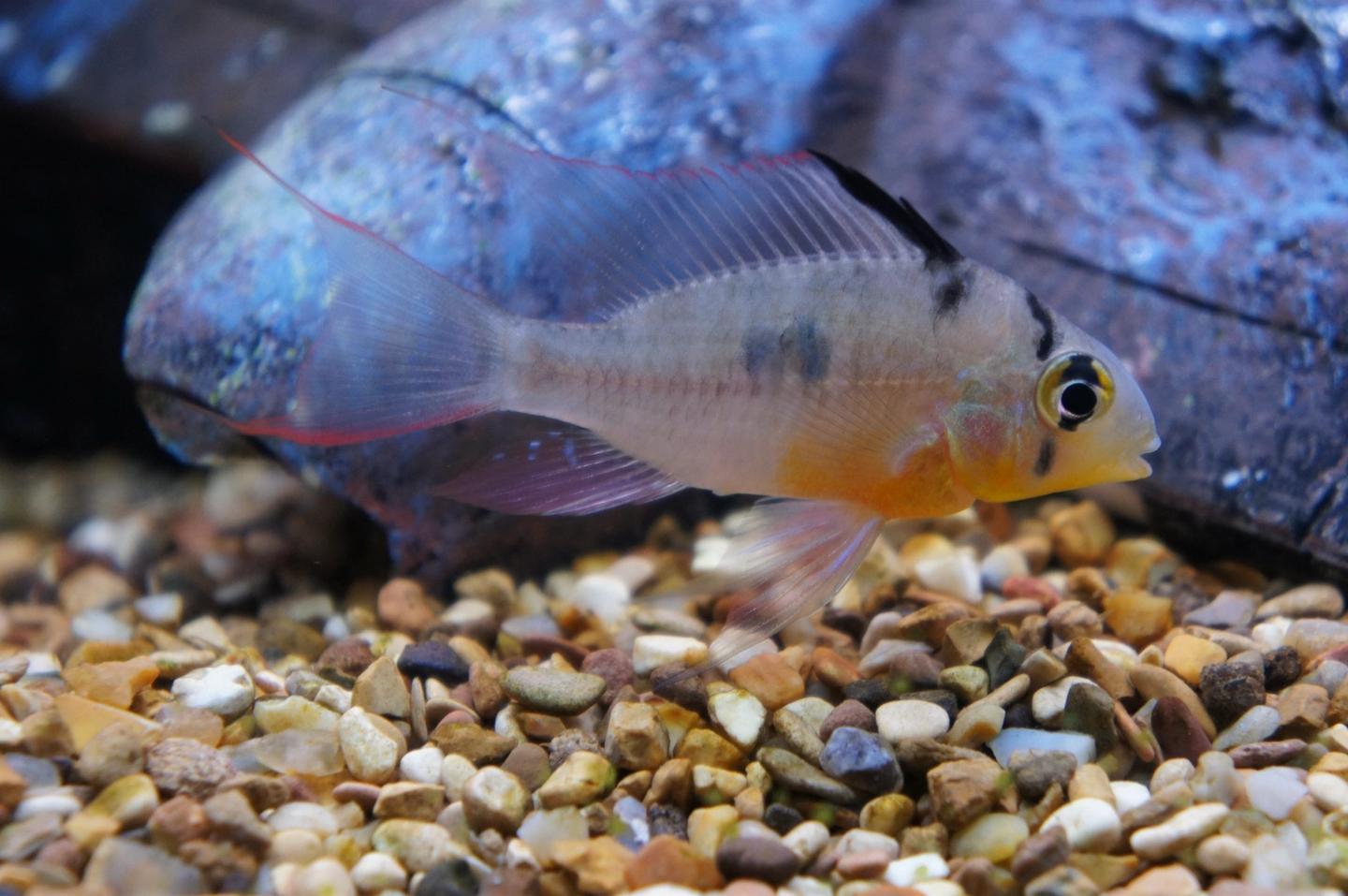
Cichlids are a family of roughly 1,800 accepted species, not one care type. Before buying, identify the exact species and source, then compare adult measurement, usable tank dimensions, social system, territory, tested water, diet and an exit plan. No family-wide minimum tank, water range or tank-mate list is safe.
Maintain these water conditions for optimal health and vibrant colors
The Chilumba Maison Reef Zebra Mbuna Cichlid is a freshwater, rock-dwelling Lake Malawi cichlid sold under the established Pseudotropheus zebra name. FishBase now lists it as Maylandia zebra and places it in the family Cichlidae. That naming update does not change the central buying decision: this is a territorial mbuna for a purpose-planned Malawi aquarium rather than a mixed general tropical community.
In Lake Malawi, adults occupy rocky areas ranging from shallow, sediment-free habitat to deeper rocks with more sediment. They feed at right angles to the substrate, combing loose material from the biological covering on rocks, and they also take plankton in open water. That natural behaviour explains the value of extensive rockwork and an algae-led aquarium diet.
This fish suits a keeper prepared to manage aggression, hard alkaline water, strong biological filtration and a carefully chosen community. Its bold behaviour should be treated as a stocking constraint, not as a reason to reduce hiding places. Caves, crevices and broken lines of sight give fish more ways to establish and leave territories.
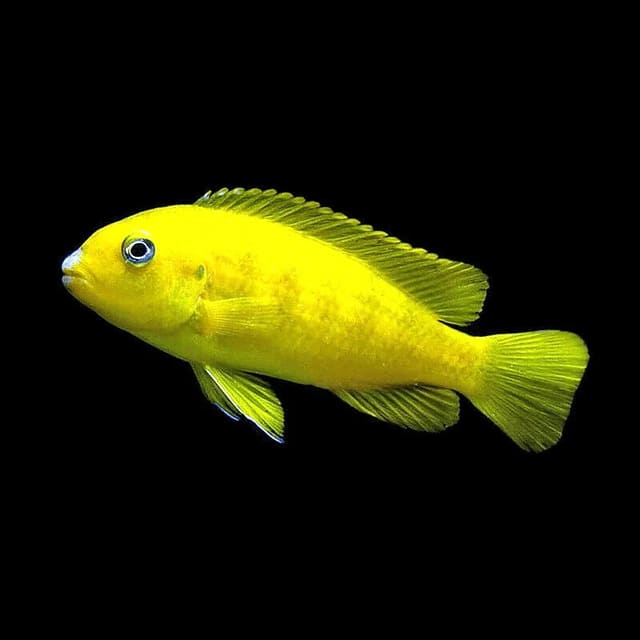
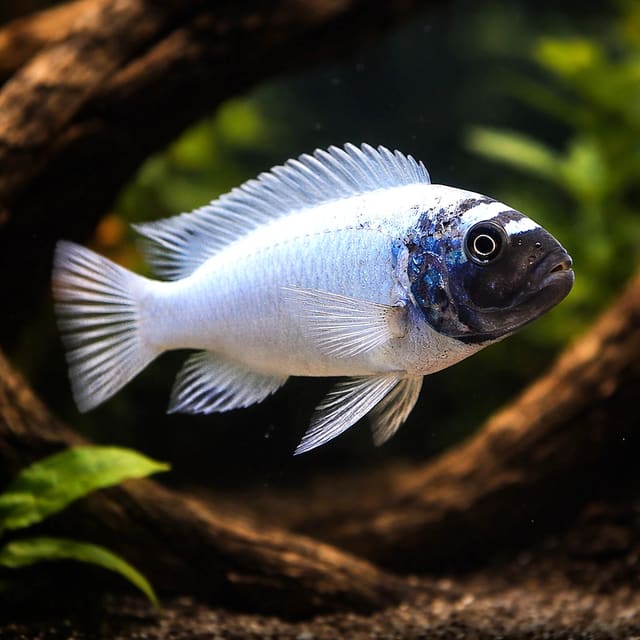
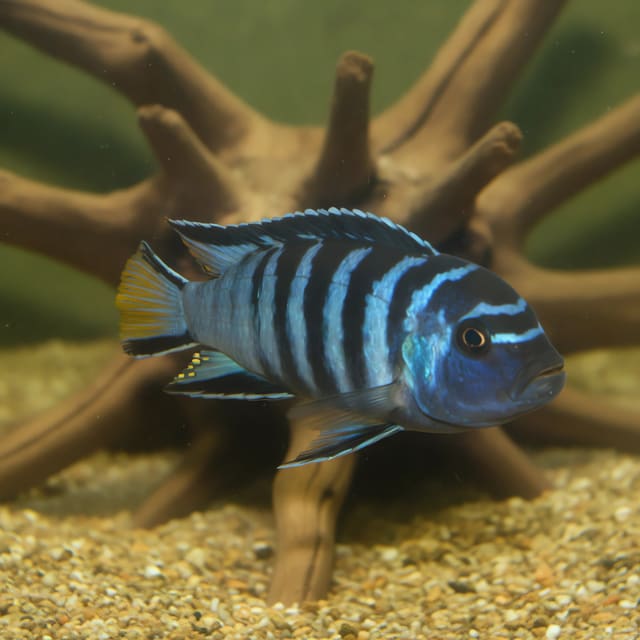
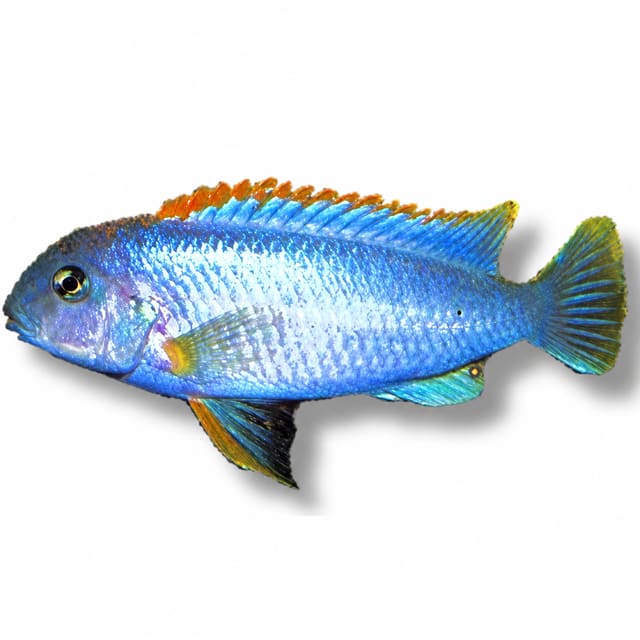
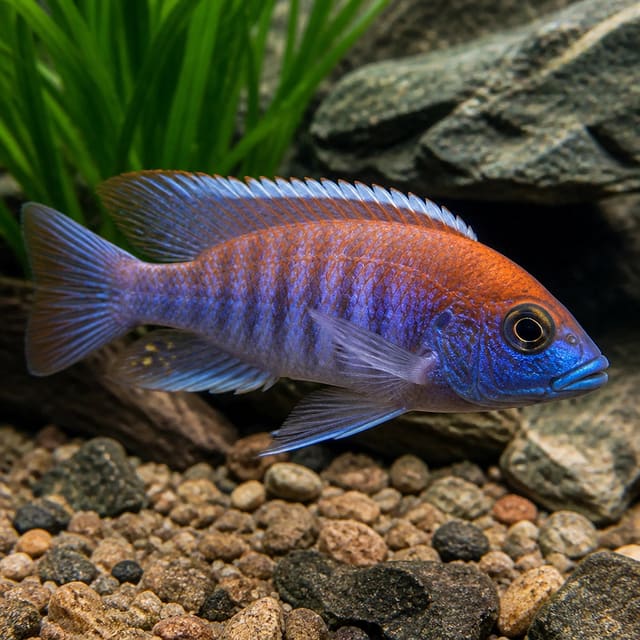
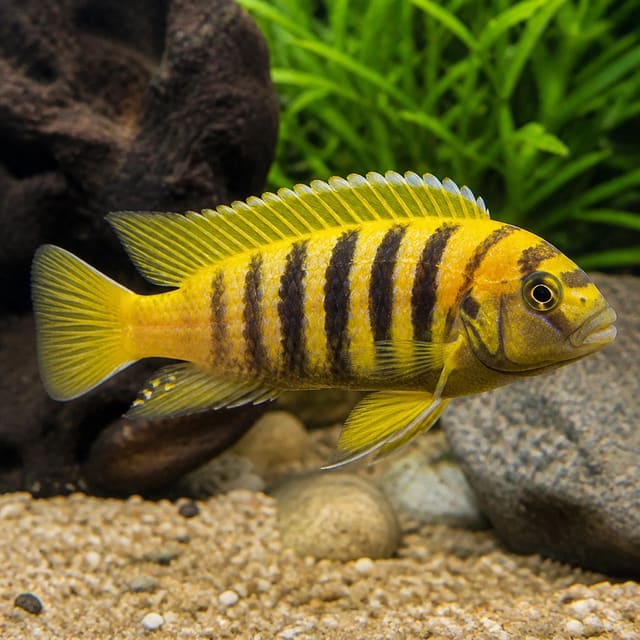
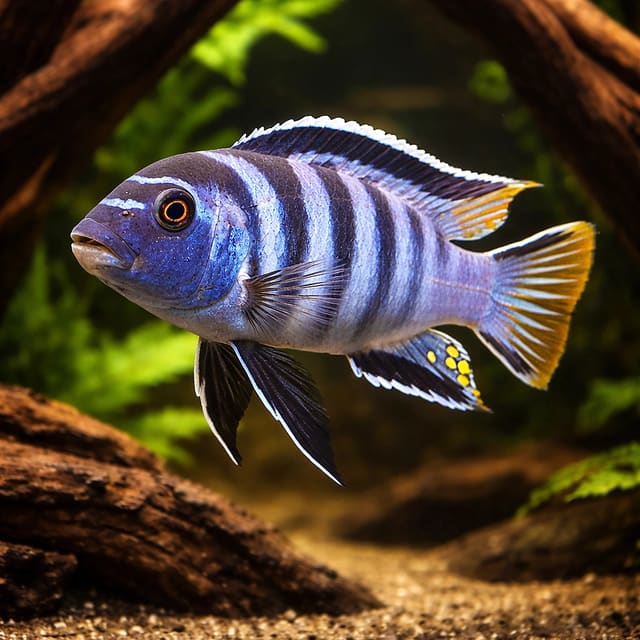
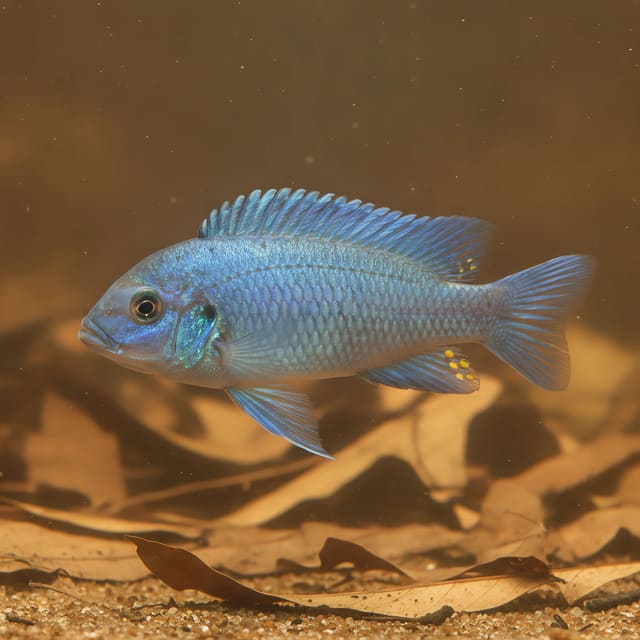
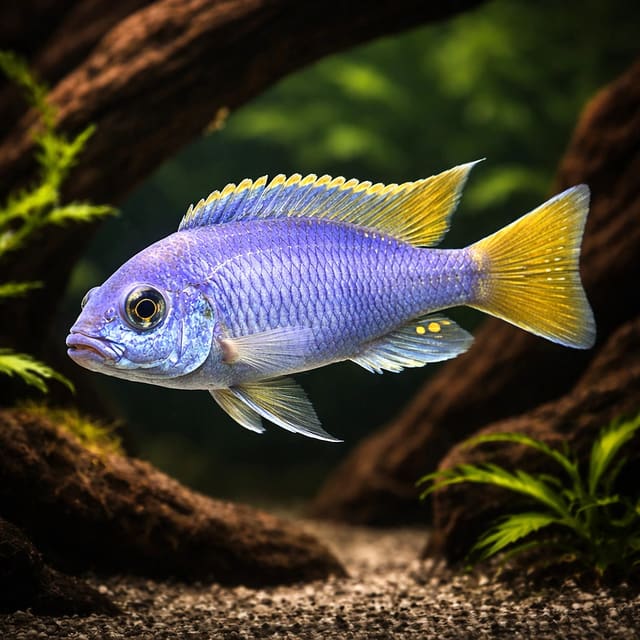
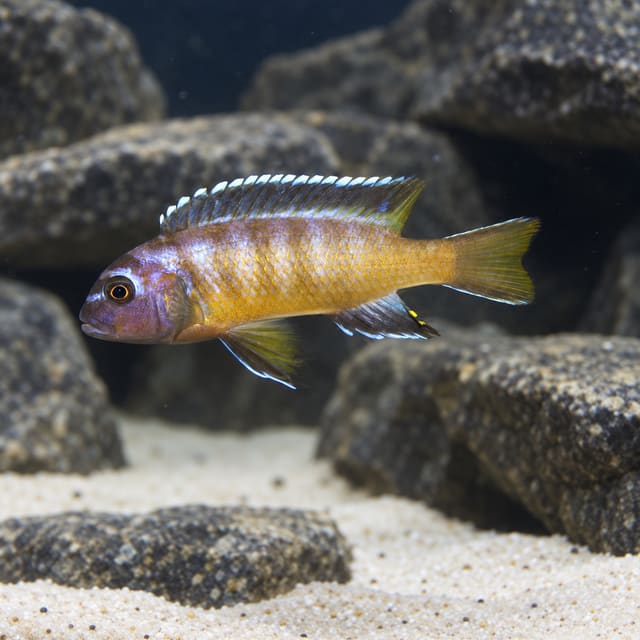
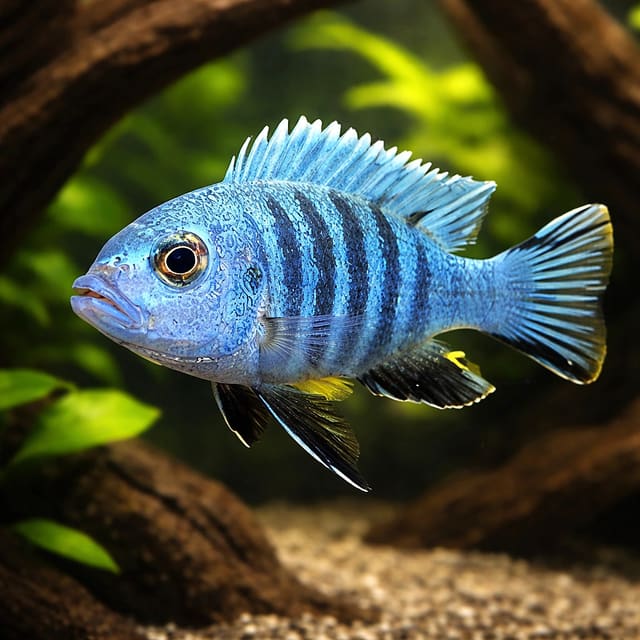
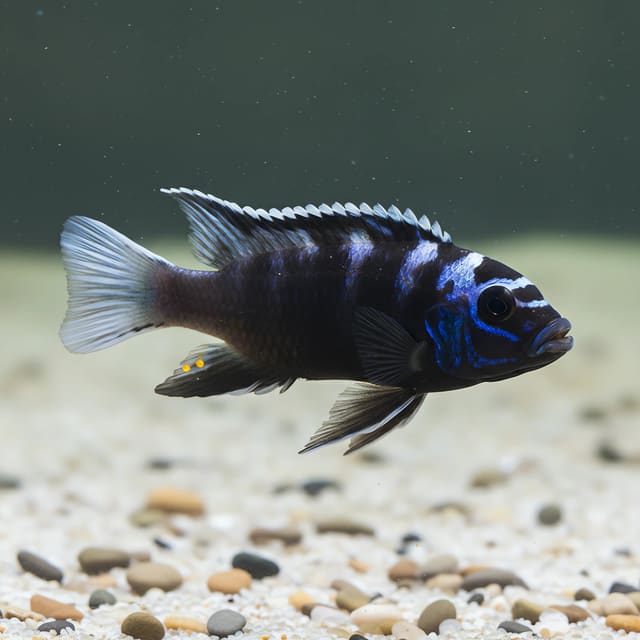
The gallery images are representative of this type of animal rather than photographs of the exact animal supplied, so colours can look slightly different from the live animal.
One purchase quantity supplies one animal of the selected option. Use the live size selector to choose between the labels 3 - 4 cm, 4 - 5 cm, 5-6 cm and 7-9 cm. The selector is the place to check which label can be chosen when ordering; the static description does not replace it.
The size you select is the size supplied, not the adult size. A smaller dispatch fish still needs an aquarium planned around the mature territorial cichlid. Do not use the dispatch measurement to justify a smaller permanent aquarium, weaker filter or gentler community. Growth changes the space occupied by the fish, while mbuna aggression also depends on territories, sex balance and the behaviour of every other resident.
| Selector label | How to use it |
|---|---|
| 3 - 4 cm or 4 - 5 cm | Choose the preferred dispatch size, then assess existing residents before introduction. |
| 5-6 cm or 7-9 cm | Treat the label as dispatch length rather than an adult-size promise. |
Prepare the full aquarium before choosing a size. Measure the tank base, test its water, check filtration and review every resident’s adult size and temperament. A larger dispatch fish is not automatically dominant, and a smaller one is not automatically safe beside established cichlids; the whole stocking pattern decides the risk.
Sex is guaranteed only when the selected option explicitly states male or female. This Chilumba Maison Reef Zebra Mbuna Cichlid listing has no sex-guaranteed option.
FishBase lists a maximum of 11.3 cm standard length for male or unsexed Maylandia zebra. A separate Seriously Fish aquarium profile uses 15.2 cm standard length as its planning reference and recommends a base of 120 × 38 cm with about 205 litres. Use that larger planning reference when choosing the aquarium; it creates a more cautious space allowance without promising the eventual length of an individual fish.
| Planning point | Working figure |
|---|---|
| Aquarium base | 120 × 38 cm |
| Volume reference | About 205 litres |
| Routine temperature | 23–27°C |
| Routine pH | 8.0–8.6 |
| Routine general hardness | 12–18 dGH |
Seriously Fish gives 22–28°C, pH 7.6–8.6 and 10–25 dGH for the species. OATA’s Malawi-cichlid guidance narrows those values to 23–27°C, pH 8.0–8.6 and 12–18 dGH for the group. Use the narrower values as the routine target rather than chasing one exact optimum.
Footprint matters alongside litres because rock piles, caves and territories occupy the base. Start with the 120 × 38 cm benchmark, then consider whether the intended Malawi community, rock structure and filter can all fit without removing the territorial complexity this fish needs.
| Suits | Not suited to |
|---|---|
| Stable aquarium water maintained at 23–27°C and pH 8.0–8.6 | Water outside 23–27°C and pH 8.0–8.6 |
| A carefully planned Malawi community that meets the full screening rule | General tropical communities |
Fill much of the aquarium with rock piles arranged to create numerous caves and crevices. The aim is not one dominant cave surrounded by open water; provide several routes through and around the rocks so a chased fish can leave a territory without immediately entering another dead end. Broken sight lines make it harder for one resident to monitor the whole aquarium continuously.
| Area | Purpose |
|---|---|
| Rock piles | Create caves, crevices and grazing surfaces. |
| Gaps between piles | Break direct lines of sight between territories. |
| Sand areas | Provide the preferred substrate and room for natural digging. |
| Open routes | Let fish move between structures without being trapped. |
Sand is the preferred substrate in the species profile. OATA also notes that Malawi cichlids dig and rearrange the substrate, which will uproot any plants present. Only the hardiest plants that grow attached to décor are practical when plants are included.
Bright lighting can encourage algae and the microorganisms associated with it on the rock surfaces. This supports the fish’s grazing behaviour, although it does not replace deliberate feeding. Keep enough rock structure to provide cover even if the aquarium looks visually busy; a sparse display sacrifices one of the principal aggression-management tools.
Before adding livestock, view the aquarium from the front and both ends. If you can see uninterrupted from one end to the other, turn or extend a rock pile to divide that view. Then check that caves have usable entrances and that the layout leaves room for maintenance. Browse the African cichlid collection only after deciding which adult fish can share the same water, footprint, diet and level of aggression.
Keep the aquarium at 23–27°C, pH 8.0–8.6 and general hardness 12–18 dGH. OATA also gives a carbonate hardness range of 10–15 dKH for Malawi cichlids. Test the water that will actually enter the aquarium rather than assuming that local tap water already matches these values.
Our water chemistry guide explains what each measurement tells you. Record the aquarium and tap-water results on the same day so changes in the source water are not mistaken for changes created inside the tank.
If the measured aquarium values sit outside the routine range, resolve the mismatch before introduction. The water matcher can compare your readings with the target values. Recheck after any adjustment and again before livestock enters; one isolated reading is less useful than a stable pattern.
Use conditioned replacement water during maintenance so chlorine or chloramine does not enter the aquarium. Match routine husbandry to the measured water rather than changing several variables at once. Temperature, mineral content, waste processing and stocking pressure work together, so a correct pH reading cannot compensate for ammonia, nitrite or an immature filter.
A working biological filter is essential. The RSPCA’s aquarium filtration guidance explains that fish waste releases toxic ammonia, beneficial bacteria convert it to nitrite, and further bacterial action converts nitrite to the safer nitrate. The aquarium must therefore be matured before the fish arrives, not filled and stocked on the same day.
Use our first aquarium guide to prepare and mature the system. Confirm zero ammonia and zero nitrite before introduction. When fish numbers or feeding increase, the bacterial population must also support the extra waste; OATA advises increasing livestock slowly because stocking too quickly can trigger new tank syndrome.
For the roughly 205-litre planning example, the species profile recommends filtration turnover of four to five times the aquarium volume each hour. The calculation is straightforward:
Use that 820–1,025 lph example as a starting point for a tank near 205 litres, while allowing for the effect of filter media, pipework and maintenance on the working flow. OATA recommends an oversized filter for crowded Malawi communities and strong aeration to maintain adequate dissolved oxygen.
The same species profile estimates about 200–300 W of heating for a tank of this size when the room is around 20°C. Check that the chosen heater can hold 23–27°C in the actual room rather than selecting wattage from volume alone. Position water movement so heated and filtered water circulates through the aquarium without removing every calmer route around the rocks.
Make vegetable matter the basis of the diet. Suitable choices named for this fish include Spirulina flakes, blanched spinach, nori and other green foods, alongside a quality dried food and an algae-based food. This approach matches its natural habit of combing loose material from the biological covering on rocks, while allowing for the plankton it also takes in open water.
OATA recommends feeding Malawi cichlids twice daily and limiting each meal to what they consume within a few minutes. That instruction controls both body condition and water pollution. Uneaten food releases waste as it decomposes, increasing the burden on the filter and undermining the zero-ammonia, zero-nitrite target.
High-protein food is not recommended as the basis of this species’ diet. Seriously Fish allows a couple of treats each week, such as live or frozen bloodworm or Artemia, but says not to overdo the protein. Never feed beefheart or other animal meat; the profile warns that it interferes with the digestive system of these fish.
Watch body condition as well as appetite because this zebra mbuna is described as particularly prone to obesity. A fish rushing to the surface does not show that the portion is appropriate. If body condition increases, reduce the quantity rather than removing the algae-led balance. If food remains after a few minutes, shorten the next portion and check whether every resident can reach food without being displaced by aggression.
At least once every week, change 25% of the aquarium water. Use a siphon to remove solid waste from the substrate, particularly around rock bases and other places where debris collects. Treat the replacement tap water with conditioner before it enters the aquarium so chlorine or chloramine does not damage fish or filter bacteria.
Do not wash biological filter media under the tap. If cleaning is needed, rinse it lightly in aquarium water removed during the partial water change. This limits exposure to chlorine or chloramine and reduces the loss of the beneficial bacteria responsible for processing waste.
Use the written results to spot direction as well as individual values. A nitrate reading that remains within the limit but rises each week points to increasing waste, feeding or stocking pressure. Falling filter flow calls for a blockage check rather than an immediate increase in food or fish. Repeated pH or hardness movement calls for comparison with the tap-water readings and the materials used in the aquarium.
Maintenance should preserve the territorial layout as well as water quality. Return rocks and caves to a deliberate arrangement after cleaning. If aggression has become concentrated around one structure, rearranging décor can make established fish find new territories, but retain numerous caves and broken sight lines.
Complete the aquarium checks before the parcel arrives. Confirm that someone can receive the fish, the aquarium is fully matured, ammonia and nitrite are both zero, and temperature, pH and hardness sit within the routine range. Leave the established filter running and make any major layout decision before opening the transport bag.
These steps follow the Tropical Fish Co delivery and Live Arrival Guarantee policy. Read the policy before the delivery date for the receiving requirements and the short unboxing-video requirement attached to a Live Arrival Guarantee claim.
If the fish is joining a Malawi community, decide how it will enter the territorial structure before release. OATA recommends adding more peaceful species before more aggressive ones and adding Malawi cichlids in groups to reduce the risk of one newcomer receiving all the aggression. Rearranging the décor can also interrupt established territories. These measures reduce risk, but they do not make every combination suitable.
After release, observe where the newcomer can retreat and whether another fish blocks all routes to food or cover. A brief chase and sustained exclusion are different practical problems: if the newcomer cannot leave a territory, reach cover or move through the aquarium, intervene by reassessing the rock arrangement and the stocking plan rather than waiting for visible damage.
Learn the fish’s normal swimming, breathing, colour, temperament and feeding pattern. Individual fish vary, so a useful health check compares today’s behaviour with the same animal’s usual pattern while also checking objective water readings.
| Checkpoint | What to assess |
|---|---|
| First day | Breathing, swimming, access to cover and whether another fish blocks movement. |
| First week | Food intake, body condition, colour, fins, scales and the pattern of chasing. |
| First month | Stable water tests, maintained filter flow, territory use and weight trend. |
Warning changes named by OATA include hanging at the surface, sitting on the bottom, erratic swimming, unusually fast or slow gill movement, darker or paler colour, increased hiding, altered aggression, reduced appetite, white spots, fluffy growths, lost fins or scales, ulcerations, bumps and a marked change in body condition.
If you see a concerning change, test ammonia, nitrite, nitrate, temperature and the routine mineral values first. Check filter flow, aeration and whether the fish can reach cover and food. Record what changed and when. Contact us for health guidance after taking those readings, particularly when breathing, swimming, appetite or skin condition changes.
Do not respond to every change by feeding more. Reduced appetite can occur alongside poor water quality or aggression, while excess food adds further waste. Likewise, a fish that hides more than usual needs a territory and water-quality check rather than the immediate removal of all cover. Use the observed sign to choose the next check: breathing points first to water and aeration, damage points to aggression and décor, and increasing body condition points to portion control.
Seriously Fish describes the zebra as one of the more aggressive mbuna and unsuitable for a general tropical aquarium. Keep that warning central to the stocking plan. Shared temperature alone does not make two fish compatible; compare adult size, aggression, diet, water chemistry, territorial behaviour and the available aquarium footprint.
| Candidate | Decision |
|---|---|
| General tropical community fish | Avoid; this zebra mbuna is not suitable for that community style. |
| Gentle mbuna | Avoid combinations in which the gentler fish cannot withstand its aggression. |
| Aulonocara or Peacock cichlids | Avoid; the species profile names these as gentle companions that should not be housed with it. |
| Other Malawi cichlids | Consider only after screening size, diet, water needs and aggression. |
| Lake Malawi Synodontis | Consider only after checking the exact catfish species and the complete stocking plan. |
OATA limits Malawi-cichlid companions to other Malawi cichlids or some Synodontis species that also inhabit Lake Malawi. That is a boundary for assessment rather than a promise that every fish within those categories will work. Seriously Fish says the zebra can fit many Malawi communities while specifically excluding gentle mbuna such as Aulonocara.
Assess the aquarium as a whole. A candidate that matches the water may still compete poorly for food, occupy the same caves or be unable to escape persistent chasing. Conversely, adding another aggressive fish does not automatically balance the tank; it may create another territorial conflict. Ask us for one stocking and compatibility assessment with the aquarium dimensions, volume, rock layout and a complete list of residents and proposed additions.
Do not plan this fish as a simple pair. OATA notes that Malawi cichlids are not social fish, can be highly aggressive and often fight when kept in small groups. For a reasonable Malawi community, its guidance uses at least 15 fish with slight overstocking to distribute aggression. That approach requires a sufficiently large aquarium, oversized filtration, strong aeration and a carefully assessed species mix; it is not permission to exceed the system’s waste-processing capacity.
Seriously Fish recommends three females for every male and no more than one male in any aquarium below 200 litres. More females can spread a male’s attention rather than leaving one female to receive persistent harassment. Only use that ratio when each individual has been reliably sexed; do not infer sex from dispatch size, colour or a representative gallery image.
The 200-litre male threshold should not be read backwards. An aquarium just above 200 litres does not automatically make multiple males compatible. The species planning benchmark is about 205 litres with a 120 × 38 cm base, and the result still depends on territory structure, female numbers, the character of individual fish and every other resident.
Aggression management is a complete-system decision. More fish can distribute attention in a correctly planned Malawi community, but more waste also places greater demand on the biological filter. Balance social structure, physical territory and water quality rather than treating any single measure as a universal solution.
It is a territorial, rock-dwelling Lake Malawi cichlid that grazes rocky biocover and also takes plankton in nature. Its aquarium should be planned as a dedicated hard-water Malawi setup rather than a general tropical community.
One purchase quantity supplies one animal of the selected option. Use the live selector to choose a dispatch-size label and check which label can be selected when ordering.
The selector labels are 3 - 4 cm, 4 - 5 cm, 5-6 cm and 7-9 cm. These are dispatch sizes, so plan the permanent aquarium around the adult fish rather than the selected measurement.
Use a rocky Malawi aquarium with a base of 120 × 38 cm and about 205 litres as the planning benchmark. Provide sand, extensive rock piles, many caves, broken sight lines, mature filtration and strong aeration.
Do not rely on a pair. Malawi-community guidance uses at least 15 fish to distribute aggression, while the species profile recommends three females per male when sex is known and no more than one male below 200 litres.
Keep routine aquarium water at 23–27°C, pH 8.0–8.6 and 12–18 dGH, with carbonate hardness of 10–15 dKH. Ammonia and nitrite should remain at zero mg per litre.
Base its diet on vegetable matter such as Spirulina flakes, blanched spinach, nori, other green foods and a quality algae-based dried food. Feed only what it finishes within a few minutes, twice daily, and avoid animal meat.
Start filming while the parcel is still sealed, then open it in one continuous take and show the fish inside the sealed bag. Float the bag for 20–30 minutes before release and do not pour transport-bag water into the aquarium.
No. It is an aggressive mbuna suited to a carefully planned Malawi community, not a general tropical aquarium. Avoid gentle mbuna such as Aulonocara or Peacock cichlids and screen every proposed companion individually.
No reviews for this item yet. Bought one? Honest reviews only, good or bad.
What customers say about ordering from us
I have a small group of long finned mountain minnows. So was delighted to be able to order ten of this variety to increase the genetics in my tank . The ones I recieved are healthy but it’s to early to give a verdict on wether they are of a long finned type since they are small currently.
Gordon Walker · 23 Sept 2026
100% success travel and "installation". Pleased with quality of purchase. The Siamese fighter a bit "shy" so have not yet seen him at his best yet but looking good. Happy customer. GG
George E Garratt · 21 Sept 2026
Reviews of our shop, collected by Judge.me, an independent third-party review collector. Newest first.