Moderate
Acei Cichlid (Pseudotropheus sp. “acei”)
24–26°C · pH 7.5–8.5 · 300L
£7.99

Mpanga Elongatus Mbuna (Pseudotropheus elongatus) is an aggressive, rock-dwelling Lake Malawi cichlid for experienced mbuna keepers. One purchase supplies one fish in the selected 3–4 cm, 4–5 cm, 6–7 cm or XL option; plan around a 120 × 38 cm base, about 137 litres, and 24–27°C.
Adult size is the maximum length this species reaches at full maturity (scientific sources). The livestock you receive will be younger and smaller — pick a size above for the actual shipping size. Product-photo provenance and any image-specific limitations are stated on the listing.
Pseudotropheus elongatus
Save when buying multiple fish. Each quantity is one fish; sex and pair formation are not guaranteed unless the selected variant explicitly states them.
Mpanga Elongatus Mbuna (Pseudotropheus elongatus) is an aggressive, rock-dwelling Lake Malawi cichlid for experienced mbuna keepers. One purchase supplies one fish in the selected 3–4 cm, 4–5 cm, 6–7 cm or XL option; plan around a 120 × 38 cm base, about 137 litres, and 24–27°C.
Adult size is the maximum length this species reaches at full maturity (scientific sources). The livestock you receive will be younger and smaller — pick a size above for the actual shipping size. Product-photo provenance and any image-specific limitations are stated on the listing.
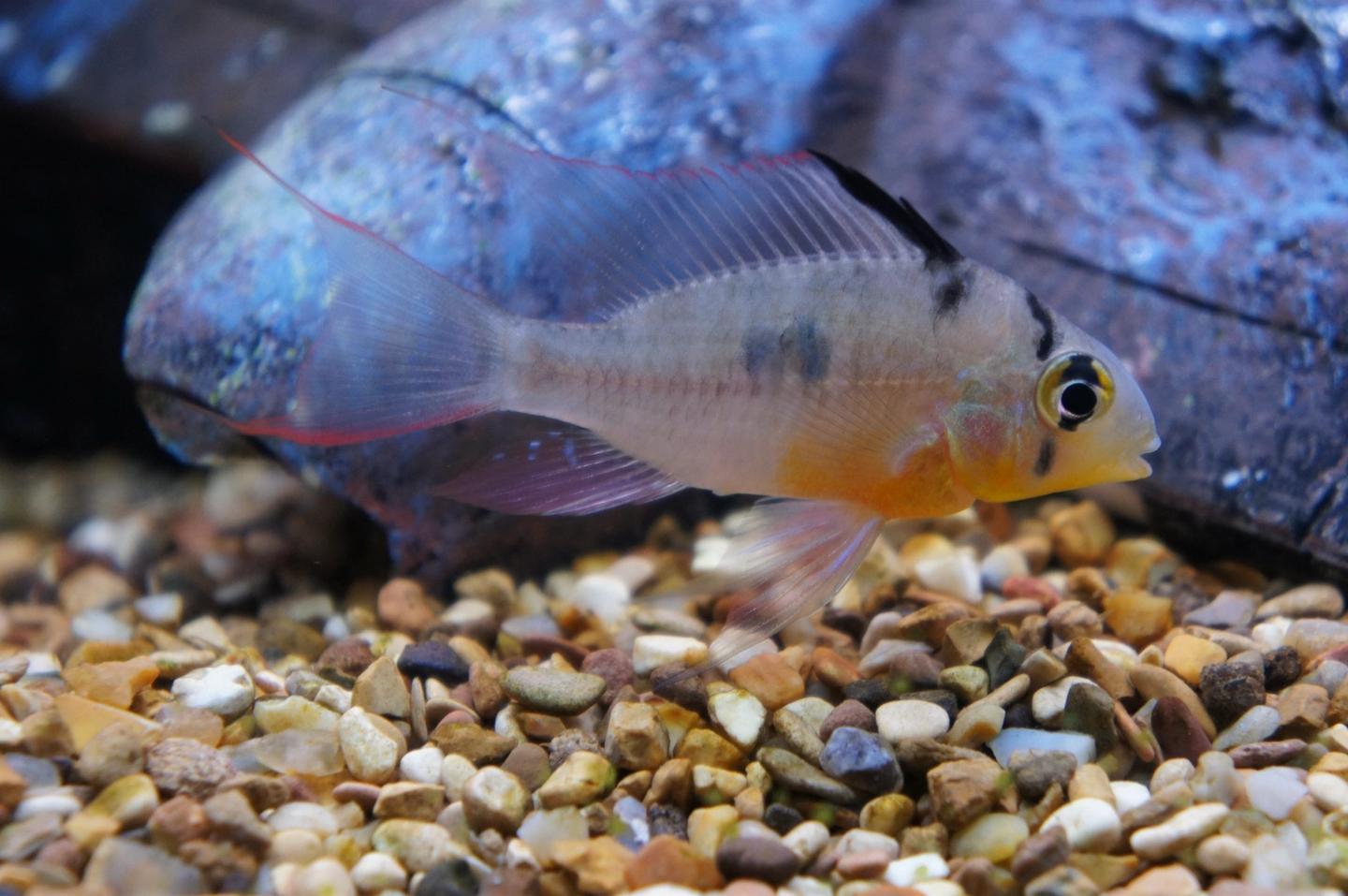
Cichlids are a family of roughly 1,800 accepted species, not one care type. Before buying, identify the exact species and source, then compare adult measurement, usable tank dimensions, social system, territory, tested water, diet and an exit plan. No family-wide minimum tank, water range or tank-mate list is safe.
Maintain these water conditions for optimal health and vibrant colors
Mpanga Elongatus Mbuna is a slender, territorial Lake Malawi cichlid for an experienced keeper who wants to organise an aquarium around rock territories, hard alkaline water and carefully screened companions. The familiar scientific name is Pseudotropheus elongatus. FishBase now lists it as Chindongo elongatus, within the cichlid family Cichlidae.
In the wild, it inhabits shallow, sediment-free rocky areas and is commonly associated with small rocks. It feeds by combing loose algae from the biological covering on those surfaces. That natural history explains the essential aquarium decisions: provide extensive rockwork, allow algal growth on safe surfaces, and make algae-rich vegetable foods the foundation of the feeding routine.
FishBase records a maximum of 9.5 cm standard length for male or unsexed fish. The Seriously Fish aquarium profile uses 13.5 cm standard length as its planning reference. Treat 13.5 cm as the conservative figure when arranging space and territories rather than as a guaranteed final length for every individual.
| Decision | Planning point |
|---|---|
| Keeper experience | Advanced; aggression management is central to care |
| Aquarium footprint | At least 120 × 38 cm in the species profile |
| Approximate volume | About 137 litres for that stated footprint and depth |
| Routine temperature | 24–27°C with stable biological filtration |
| Layout | Rock piles, caves, broken sightlines and open swimming areas |
This is not a general community fish. It is described as one of the most aggressive and territorial mbuna, so peaceful Peacocks and Utaka should be avoided. A successful home is a purpose-planned Malawi aquarium in which every inhabitant is chosen for compatible water requirements, behaviour and patterning. Browse the African cichlid collection to compare identities, but assess each proposed combination rather than treating a collection category as a compatibility guarantee.
One purchase supplies one animal of the option selected on the live size selector. The labels are 3–4 cm, 4–5 cm, 6–7 cm and XL. The size you select is the size supplied, not the adult size. XL is a named grade rather than a stated centimetre measurement, so use the selector label without assigning it a numerical length.
Dispatch size helps you plan immediate observation and introduction, but it does not reduce the adult footprint, filtration or territory requirements. Build the aquarium around the 120 × 38 cm base recommendation and the larger 13.5 cm planning reference before choosing a smaller dispatch grade. A 3–4 cm fish still needs an aquarium organised for adult mbuna behaviour rather than a temporary small-fish layout.
Sex is guaranteed only when the selected option explicitly states male or female. This Mpanga Elongatus Mbuna listing has no sex-guaranteed option.
Do not infer sex from dispatch size, image colour or markings. Adult males are usually described as larger and as having brighter egg spots on the anal fin, but those adult tendencies do not assign a sex to the individual supplied. This distinction matters because same-species group planning calls for a strongly female-biased ratio when sex is known.
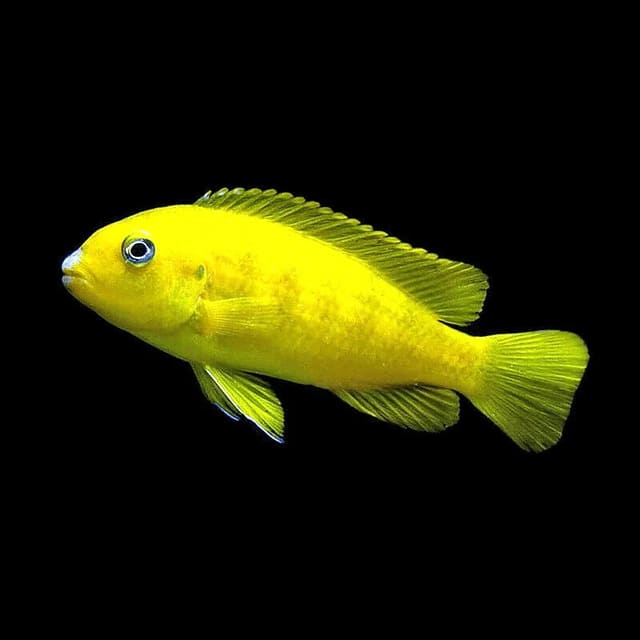
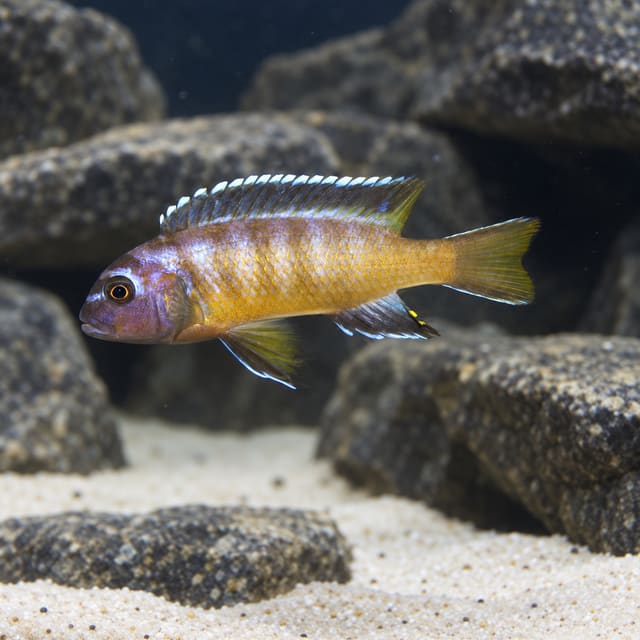
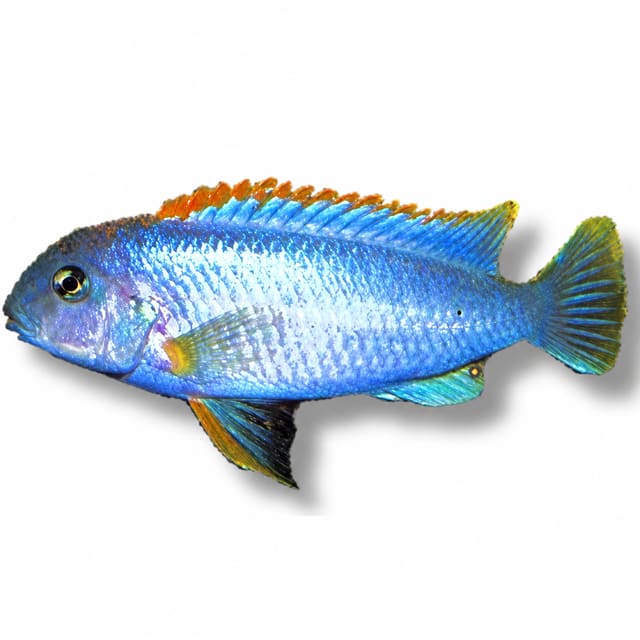
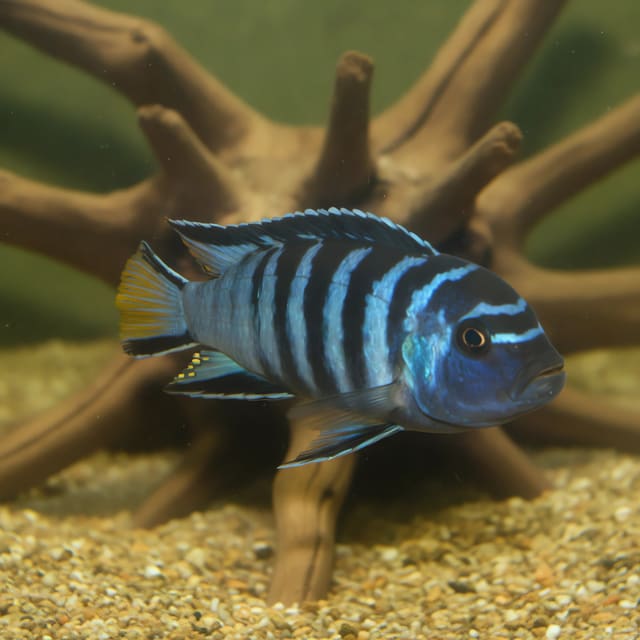
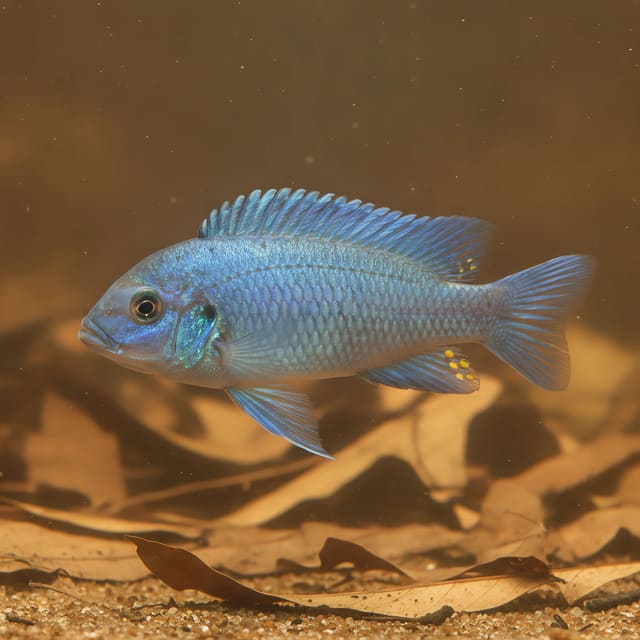
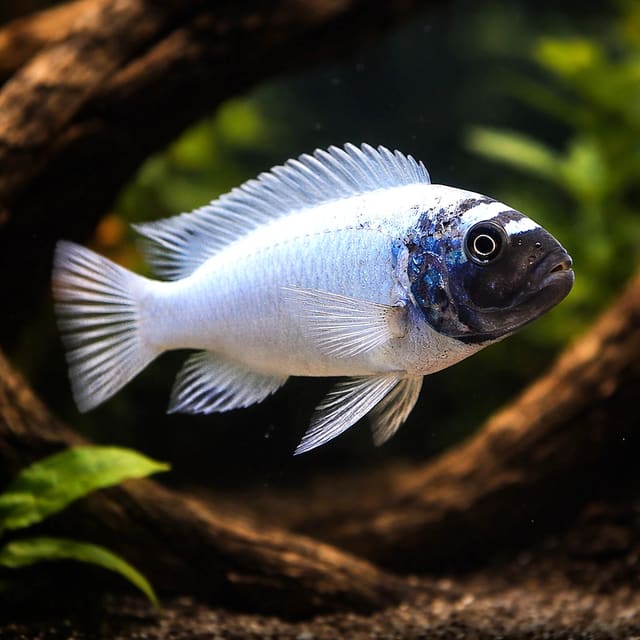
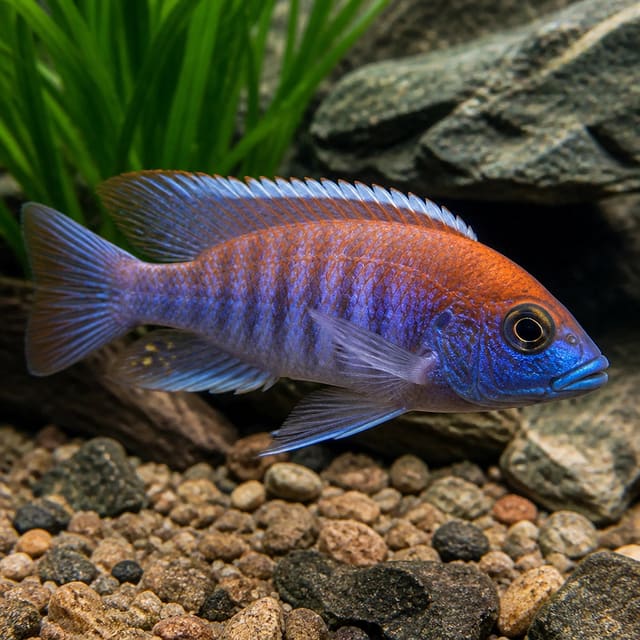
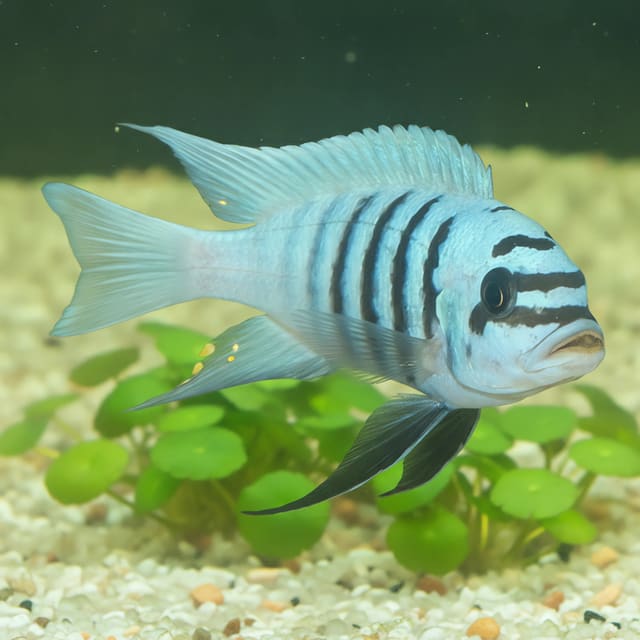
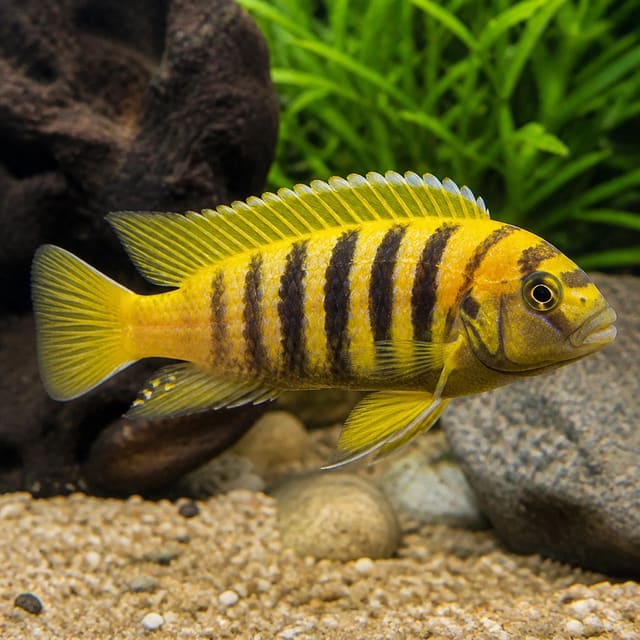
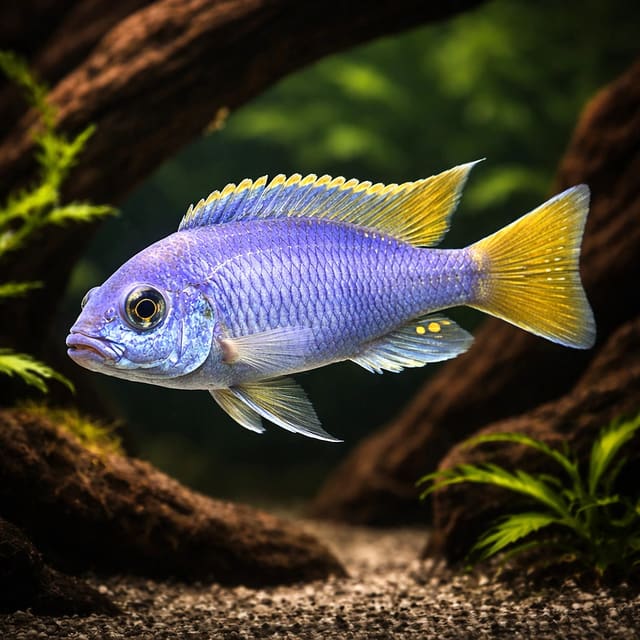
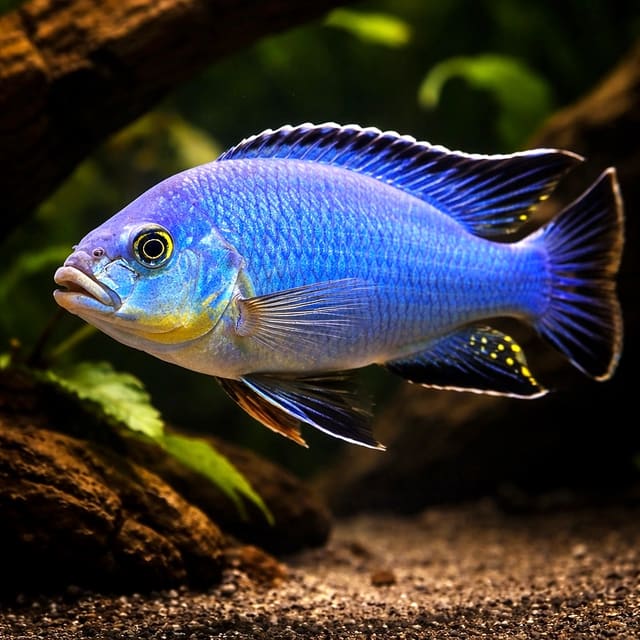
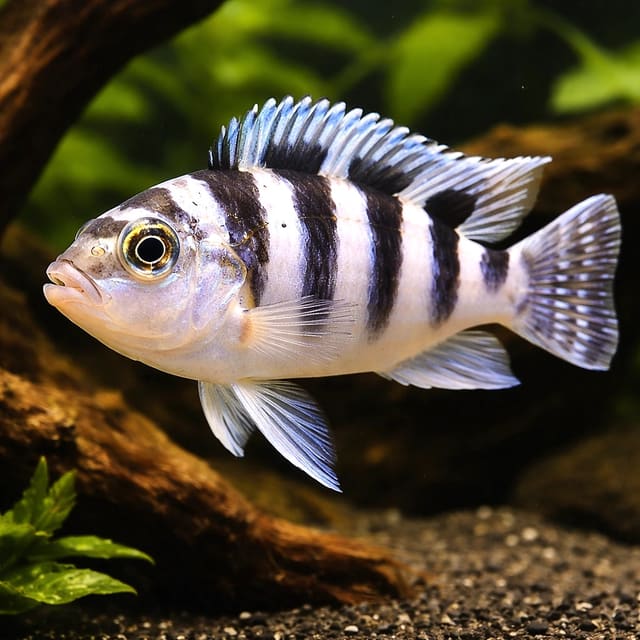
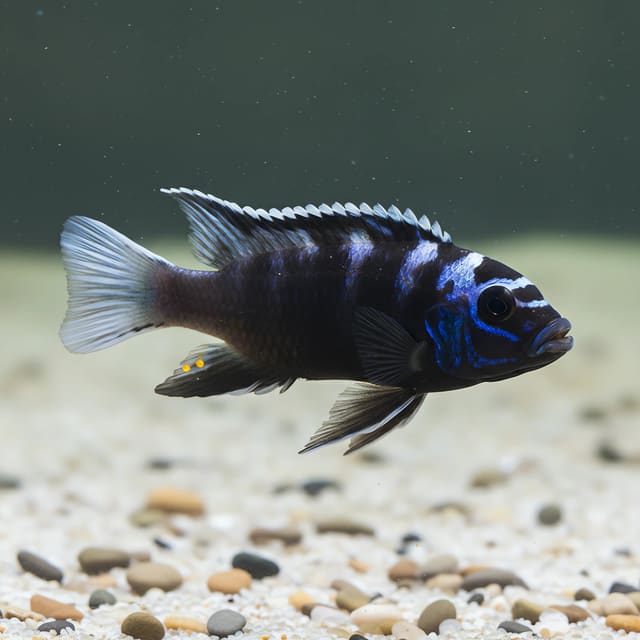
Some gallery images have been digitally enhanced to improve image quality. They show the listed type of animal rather than guaranteeing the exact markings of the individual supplied, so natural colour and pattern can vary.
The images illustrate a blue, vertically barred mbuna form with pale fin edging and yellow fin accents. Use them to understand the represented pattern and body shape, not to predict the exact colour intensity, sex or markings of an individual fish. Aquarium lighting, background and the animal itself can alter how colour appears.
Before selecting a size, confirm that the aquarium is biologically mature, that ammonia and nitrite test at zero, and that the planned companions pass the compatibility screen below. Those checks are more important than matching the dispatch length to fish already in the tank by eye alone.
| Suits | Not suited to |
|---|---|
| Stable aquarium water maintained at 24–27°C and pH 8.0–8.6 | Water outside 24–27°C and pH 8.0–8.6 |
| Unlike-patterned mbuna in a carefully planned Malawi aquarium | Peace-loving species such as Peacock cichlids and Utaka |
The species aquarium profile gives a base of 120 × 38 cm and an approximate volume of 137 litres, based on dimensions of 120 × 38 × 30 cm. Use both measurements when choosing the aquarium. Litres describe water capacity, while the base determines how much room can be divided into rock territories and swimming lanes.
A taller aquarium with a short base does not reproduce the stated footprint. Territorial mbuna interact across the rockwork, so length and front-to-back depth give you more scope to form separate shelters and interrupt direct lines of sight. Set up the permanent aquarium before the fish arrives rather than relying on a smaller temporary tank because a small dispatch grade has been selected.
| Plan | Action |
|---|---|
| One specimen in a Malawi aquarium | Start with the 120 × 38 cm species footprint and screen every companion |
| Same-species group | Allow more territory and use the stated one-male, 4–6-female structure only when sexes are known |
| Reasonable Malawi community | Use OATA’s broader recommendation of at least 200 litres as the community starting point |
| More than one male | Use a very large aquarium and recognise that severe conflict may still occur |
The approximately 137-litre figure is tied to a particular 120 × 38 cm base; it is not a promise that every stocking plan will work at that volume. A mixed Malawi population, a same-species group and a multi-male plan create different territorial demands. The fish count must also remain within the biological capacity of the filter.
OATA recommends at least 200 litres for a reasonable-sized Malawi cichlid community and notes that larger aquaria provide more stable temperature and water quality. It also describes slightly crowded Malawi groups as one method of spreading aggression. Do not interpret that method as permission to add fish faster than the biological filter can adapt.
If you are preparing your first aquarium, follow our guide to maturing a tropical tank before livestock is introduced. A working biological filter must be established before stocking because fish waste produces toxic ammonia, which the filter bacteria process through nitrite towards safer nitrate.
Arrange piles of stable rocks into cave-like structures and hiding places while retaining areas of open water for swimming. This follows the species profile and reflects the shallow rocky habitat recorded in Lake Malawi. The aim is not a single central cave claimed by one dominant fish, but a series of shelters and visual barriers distributed across the aquarium.
A sand substrate is preferred in the species profile. OATA also recommends coral sand or a similar substrate for Malawi aquaria because it can help buffer the water. Test the source water before trying to alter it, then confirm the result in the aquarium rather than assuming a substrate will produce the intended pH and hardness.
Algal growth should not be discouraged on safe grazing surfaces. The wild fish combs loose algae from the biocover on rocks, so a completely scrubbed hardscape removes an opportunity for natural grazing. Keep the viewing panes as clean as needed, but allow managed growth on selected rock faces while maintaining the feeding routine.
Plants are optional and must fit a digging cichlid layout. OATA notes that Malawi cichlids will often dig and rearrange the substrate, which will uproot any plants present, and recommends only hardy forms that can grow attached to décor. Do not depend on planting to create the main territory barriers; rocks provide the cave structures described for this fish.
Inspect the finished layout from both ends of the tank. If you can see an uninterrupted corridor across most of the aquarium, add or turn a structure to interrupt it. If a cave has only one narrow entrance, provide another nearby route so a subordinate fish is less easily cornered.
The practical routine is 24–27°C, pH 8.0–8.6 and 12–18 dGH. OATA’s Malawi-cichlid sheet gives group guidance of 23–27°C, pH 8.0–8.6 and 12–18 dGH; here those values narrow the Seriously Fish aquarium profile of 24–28°C, pH 7.6–8.8 and 10–25 dGH. FishBase records the wild environment at 22–25°C, pH 7.5–8.0 and 9–19 dGH.
| Measurement | Routine target |
|---|---|
| Temperature | 24–27°C |
| pH | 8.0–8.6 |
| General hardness | 12–18 dGH |
| Carbonate hardness | 10–15 dKH |
| Ammonia | 0 mg/l |
| Nitrite | 0 mg/l |
| Nitrate | Up to 20 mg/l above the normal tap-water level |
Stability matters as much as reaching the range. Measure the aquarium rather than setting equipment by its dial alone, and compare readings taken at consistent times. Our water chemistry guide explains what the main tests measure, while the water matcher helps compare measured aquarium values with this routine.
Do not make repeated rapid chemical adjustments to chase a single reading. Test the source water, condition it for chlorine or chloramine, and plan any change so temperature and chemistry remain steady. Hard alkaline water must be established before introduction, not created suddenly around the fish.
A well-established biological filter is essential. The RSPCA explains that aquarium fish release toxic ammonia; filter bacteria convert it first to nitrite, which is also toxic, and then towards safer nitrate. The filter therefore protects the fish only when it is mature, running continuously and maintained without destroying its bacterial population.
For the approximately 137-litre example aquarium, the species profile recommends turnover of four to five times the tank volume each hour. That calculation gives about 550–685 litres per hour. Treat the manufacturer’s stated flow as a starting point because media, pipework and accumulated debris can reduce actual movement.
| 137-litre example | Planning figure |
|---|---|
| Four times volume per hour | About 550 lph |
| Five times volume per hour | About 685 lph |
| Heater in a room near 20°C | Roughly 125–175 W |
| Routine temperature | 24–27°C |
OATA recommends an oversized filter and vigorous aeration for crowded Malawi communities. Aim the return so the surface moves and oxygen exchange remains strong without removing all calm shelter behind the rocks. Check that circulation reaches the ends of the aquarium and that debris is not accumulating unseen behind the main structures.
Do not replace every filter medium at once. Preserving established media helps retain the bacteria needed to process waste. If flow falls, investigate blockage and media condition rather than compensating by adding livestock more slowly while leaving a failing filter unresolved.
After maintenance, confirm that the heater, filter return and aeration are operating normally. A quick equipment check prevents a routine water change from becoming an unnoticed loss of circulation or heat.
Build the diet around vegetable matter and algae-rich food. In Lake Malawi, this fish combs loose algae from the biocover on rocks. In the aquarium, Seriously Fish recommends that spirulina flakes, blanched spinach, nori and other vegetable matter form a large proportion of the diet, with live and frozen varieties used as supplements.
OATA’s feeding guidance for smaller mbuna also favours specialised Malawi cichlid foods with a high algae content and fresh vegetables. Feed twice a day, offering only what the fish can finish within a few minutes. Remove uneaten food before it breaks down and adds waste to the system.
| Feeding decision | Action |
|---|---|
| Main food | Use an algae-rich Malawi food such as spirulina flakes |
| Vegetable variety | Offer suitable portions of blanched spinach or nori |
| Supplement | Use live or frozen varieties as a supplement, not the foundation |
| Portion test | Give only what is eaten within a few minutes |
| Frequency | Feed twice daily |
Never feed beefheart or other red meat. The species profile warns that red meat interferes with the digestive system of these fish. A rich animal-based diet also conflicts with the algae-led feeding pattern described for this mbuna.
Watch how food is distributed in a territorial aquarium. If one fish controls the only feeding point, spread the same measured portion across more than one area so subordinate fish can reach it. Do not increase the total amount simply because feeding is divided between locations.
Use the “few minutes” rule rather than a fixed pinch or item count. Food forms differ in density and size, and the fish’s immediate intake changes as the group and water temperature change. If pieces remain after the feeding window, reduce the next portion and remove the residue.
Algae growing on rocks contributes grazing opportunities but does not replace the planned diet. Likewise, vegetable food does not replace weekly water testing or waste removal. Feeding and filtration work together: measured portions reduce the load that the biological filter must process.
Prepare the aquarium before the delivery window. Test ammonia and nitrite at zero, confirm 24–27°C, and check that the filter, heater and aeration are running normally. Leave the rockwork in its planned arrangement so the new fish enters a stable environment rather than one being rebuilt around it.
Follow the store’s delivery and Live Arrival Guarantee policy: someone must be present to receive live fish. Start filming before the sealed parcel is opened, continue in one take through opening, and show the fish inside the sealed bag before anything is disturbed. Float the bag for 20–30 minutes before release, and never pour transport water into the aquarium.
After release, give the fish access to shelter and observe breathing, swimming and aggression from a distance. Do not add several unplanned fish simply to distract established residents. OATA recommends adding Malawi cichlids in groups as part of an intentional stocking plan, but also warns that stocking too quickly can exceed the filter bacteria’s capacity and cause new tank syndrome. The social plan and biological capacity must be considered together.
When introducing a planned group, rearranging some décor can reduce established territorial ownership as the fish settle. Make that change before release, secure every rock again, and retain the cave and sightline structure described for the species.
During the first day, concentrate on breathing, swimming and immediate harassment rather than expecting the fish to occupy a particular cave. If one resident pins the newcomer into a corner or prevents it from leaving shelter, intervene in the stocking arrangement rather than allowing continuous pursuit to continue.
Keep the continuous unboxing video and order number if a Live Arrival Guarantee claim is needed, then contact us the same day.
Use repeatable observations to distinguish settling behaviour from a developing welfare problem. A healthy Malawi cichlid should have clear bright eyes, intact scales, undamaged fins, appropriate swimming and steady interest in food. Record the normal appearance and behaviour once the fish has settled so later changes are easier to recognise.
Changes in aggression, hiding, breathing, swimming, colour, condition or feeding can signal a problem. Start with a complete water test because ammonia, nitrite, nitrate, pH and temperature affect the entire aquarium. Correct a measured husbandry problem gradually while preserving oxygenation and filtration.
Do not choose medication from one symptom alone. White marks, reduced feeding or hiding can have more than one cause, and adding a treatment without a sound diagnosis can complicate water quality. If concerning changes persist after testing the water and checking aggression, contact us for health guidance.
Keep observation brief and consistent. Repeatedly moving rocks, chasing the fish for inspection or changing food several times can add stress and make behaviour harder to interpret. A stable routine produces a clearer comparison from one day to the next.
Expect the fish to spend time around rockwork, inspecting surfaces and defending access to a chosen area. Its wild feeding method involves combing algae from the biocover, while the aquarium profile describes unusually strong territorial aggression. Both behaviours should influence how the aquarium is read and managed.
Grazing at rock faces is useful natural activity. Leave selected safe surfaces with managed algal growth, maintain the algae-led feeding routine and avoid treating every patch of algae as a failure. Continue cleaning where needed for viewing and water quality; the aim is controlled grazing surface, not uncontrolled nutrient accumulation.
| What you see | What to do |
|---|---|
| Brief display followed by separation | Observe whether both fish resume normal movement and feeding |
| One fish controls the only shelter | Add or reposition secure barriers and create alternative exits |
| Continuous pursuit | Review compatibility and stocking rather than waiting for injury |
| A fish cannot reach food | Distribute the same measured portion across separate feeding areas |
| Sudden aggression change | Test water and reassess territories and group structure |
Slight crowding is described by both OATA and the species profile as a way to spread aggression, but it is a specialist stocking technique rather than a substitute for space. It increases waste and oxygen demand, which is why oversized filtration, vigorous aeration and slow additions are required.
Do not treat the animal as a cleaner fish. Its natural algae-combing behaviour does not remove the keeper’s responsibility for feeding, glass cleaning, substrate siphoning or nitrate control. Any visible grazing is part of the fish’s behaviour, not a complete aquarium maintenance service.
Changes in colour can accompany stress or social interaction, but the dispatch animal’s sex must not be inferred from colour. Adult males are usually larger and may have brighter egg spots, yet the offer remains unsexed. Plan social groups around identified adults rather than assuming a small or brightly patterned fish fills a particular sex role.
Territorial behaviour becomes easier to manage when every decision supports the same plan: sufficient footprint, multiple shelters, interrupted sightlines, compatible Malawi companions and a filter capable of the total population’s waste.
Avoid peace-loving species such as Peacock cichlids and Utaka. The species profile specifically excludes these calmer Malawi fish because Mpanga Elongatus Mbuna is exceptionally aggressive and territorial. A shared Lake Malawi origin or similar water range is not enough to make two fish compatible.
Other mbuna may be considered only when they do not resemble this fish in patterning and can be housed within a carefully managed Malawi plan. Similar markings can intensify territorial responses, so compare body pattern as well as adult size, water requirements and temperament.
| Candidate | Screening decision |
|---|---|
| Peaceful Peacocks | Avoid |
| Peaceful Utaka | Avoid |
| Unlike-patterned mbuna | Consider conditionally in a managed Malawi aquarium |
| Similar-patterned mbuna | High conflict risk; choose a different combination |
| Some Lake Malawi Synodontis | Screen the exact catfish species, adult size and space needs |
| General community fish | Do not use a generic community label as a compatibility basis |
OATA limits Malawi cichlid companions to other Malawi cichlids or some Synodontis catfish species that also naturally inhabit Lake Malawi. “Some” is important: it is not a universal approval for the whole genus. The exact catfish must fit the aquarium footprint, water, adult size and stocking plan.
Choose companions that share the hard alkaline routine, can cope with an assertive rock-dwelling mbuna, do not closely resemble it in pattern and can be given distinct territory without exceeding filtration capacity. Compatibility remains conditional because individual behaviour and the complete aquarium layout affect the result.
Add more peaceful Malawi species before more aggressive species when building a planned community. OATA also recommends introducing Malawi cichlids in groups to reduce one newcomer receiving all the aggression. Balance that social method with gradual biological stocking so ammonia and nitrite stay at zero.
For a stocking assessment, contact us once you have the aquarium dimensions, measured water values, filter capacity and the exact names and numbers of all resident fish. Those details allow a meaningful screen; tank volume alone cannot describe territories or behavioural pressure.
Do not buy an arbitrary pair or trio and expect a stable same-species group. This mbuna is described as extremely aggressive towards its own species. More than one male requires a very large aquarium, and even then subordinate males may be killed.
When adult sexes are known, the species profile calls for at least four to six females per male for the females’ safety. That is a stronger female bias than the old idea of one male with three females. It also creates a substantial stocking and territory commitment that must be considered before assembling the group.
| Group plan | Decision |
|---|---|
| One specimen | May be planned within a carefully screened mbuna community |
| Unsexed pair or trio | Do not rely on chance to produce a safe ratio |
| Known one-male group | Use at least 4–6 identified females and extensive hiding places |
| More than one male | Requires a very large aquarium and still carries severe risk |
| Mixed locality or colour forms | Keep separate because the forms may hybridise |
The offer does not guarantee sex, so the selector cannot be used to build the stated harem ratio. Dispatch size and image appearance are not substitutes for identified adult sex. If your plan depends on a known ratio, obtain appropriately identified adults rather than assigning roles to unsexed fish.
Seriously Fish notes that other species in the aquarium can help dissipate aggression between these fish. That does not turn any other species into a suitable companion. Each additional fish must pass the compatibility screen and increases the filter’s waste and oxygen load.
Different forms of Pseudotropheus elongatus should not be mixed because they may hybridise freely. Keep the Mpanga form separate from other elongatus forms if maintaining form identity matters to the aquarium plan.
OATA’s general Malawi guidance describes groups of at least 15 fish and slight crowding as an aggression-management approach, while recommending at least 200 litres for a reasonable community. These figures apply to a planned Malawi community, not automatically to a same-species colony. The one-male, 4–6-female direction is the relevant species-specific structure when identified sexes are being grouped.
It is an aggressive, rock-dwelling Lake Malawi cichlid in the family Cichlidae, suited to experienced keepers who can manage hard alkaline water, extensive rockwork and carefully screened companions.
One purchase quantity supplies one animal of the option selected on the live size selector.
The selector uses 3–4 cm, 4–5 cm, 6–7 cm and XL labels. The numeric labels are dispatch sizes, while XL has no stated centimetre measurement; every fish still needs an adult aquarium plan.
Use a base of at least 120 × 38 cm, approximately 137 litres at the profiled dimensions, with stable rock piles, cave-like shelters, broken sightlines, sand and open swimming areas.
A single specimen may be planned within a compatible mbuna community. For a same-species group with identified adults, use one male with at least 4–6 females; an unsexed pair or trio cannot ensure that ratio.
Use a stable routine of 24–27°C, pH 8.0–8.6 and 12–18 dGH, with ammonia and nitrite at 0 mg/l and nitrate no more than 20 mg/l above the normal tap-water level.
Feed algae-rich Malawi food, spirulina flakes and vegetable matter such as blanched spinach or nori twice daily, giving only what is eaten within a few minutes. Never feed beefheart or other red meat.
Start filming before opening the sealed parcel, continue in one take through opening and show the fish still inside the sealed bag before anything is disturbed. Float the bag for 20–30 minutes, then release the fish without pouring transport water into the aquarium.
Avoid peaceful Peacocks and Utaka. Unlike-patterned mbuna may be considered conditionally in a carefully managed Malawi aquarium, while some Lake Malawi Synodontis require an exact species-by-species assessment.
No reviews for this item yet. Bought one? Honest reviews only, good or bad.
What customers say about ordering from us
I have a small group of long finned mountain minnows. So was delighted to be able to order ten of this variety to increase the genetics in my tank . The ones I recieved are healthy but it’s to early to give a verdict on wether they are of a long finned type since they are small currently.
Gordon Walker · 23 Sept 2026
100% success travel and "installation". Pleased with quality of purchase. The Siamese fighter a bit "shy" so have not yet seen him at his best yet but looking good. Happy customer. GG
George E Garratt · 21 Sept 2026
Reviews of our shop, collected by Judge.me, an independent third-party review collector. Newest first.