Moderate
Acei Cichlid (Pseudotropheus sp. “acei”)
24–26°C · pH 7.5–8.5 · 300L
£7.99
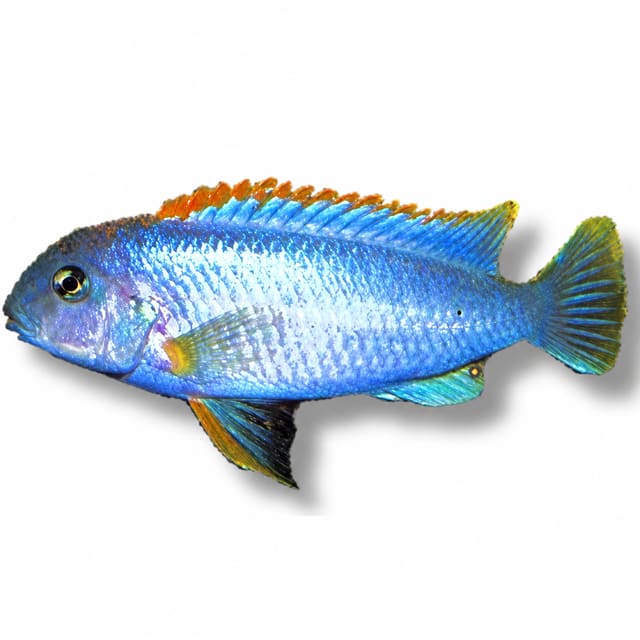
Pseudotropheus Lilancinius (Pseudotropheus lombardoi) is a highly territorial Lake Malawi mbuna for advanced keepers. One purchase supplies one fish in the size chosen, without a sex guarantee; plan for up to 15 cm SL, a 120 × 45 cm tank base and hard, alkaline water.
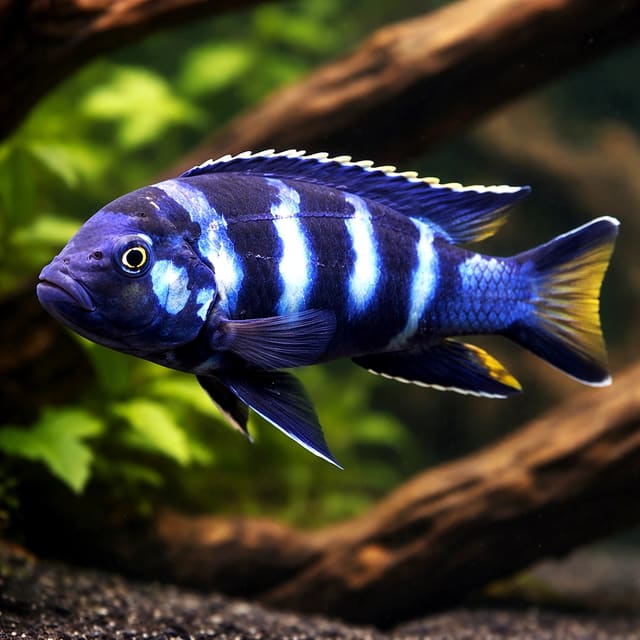
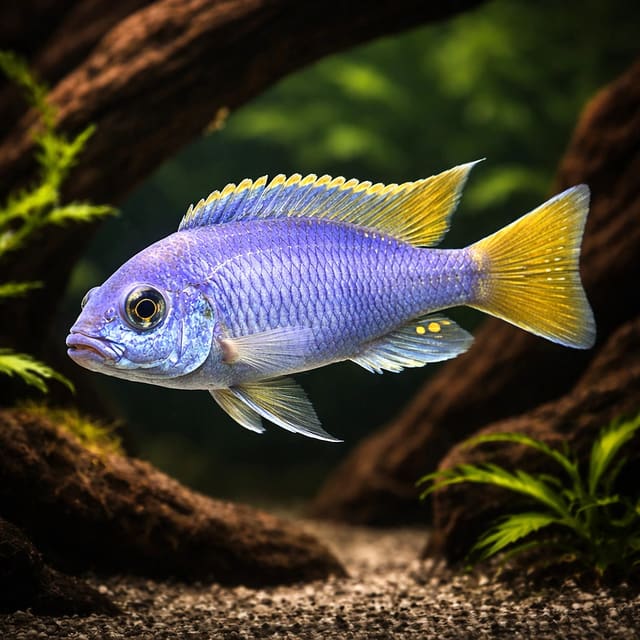
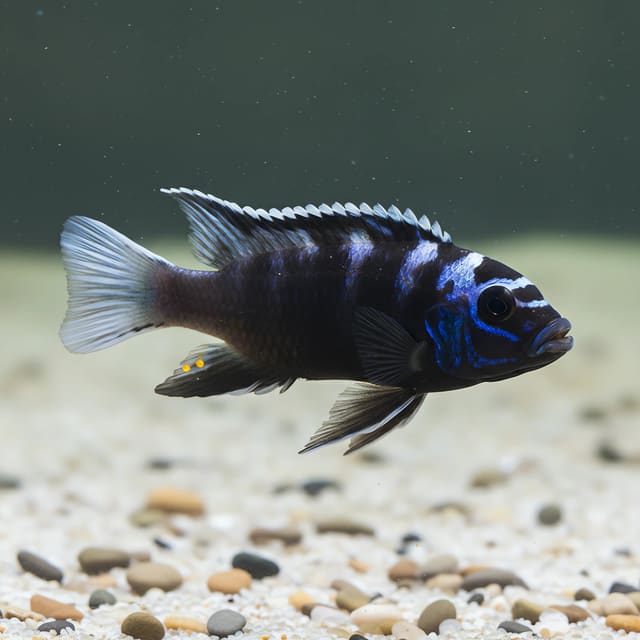
Adult size is the maximum length this species reaches at full maturity (scientific sources). The livestock you receive will be younger and smaller — pick a size above for the actual shipping size. Product-photo provenance and any image-specific limitations are stated on the listing.
Pseudotropheus lombardoi
Shoaling fish: kept in a group they feel safer, stay calmer and show their best colour.
Pseudotropheus Lilancinius (Pseudotropheus lombardoi) is a highly territorial Lake Malawi mbuna for advanced keepers. One purchase supplies one fish in the size chosen, without a sex guarantee; plan for up to 15 cm SL, a 120 × 45 cm tank base and hard, alkaline water.
Adult size is the maximum length this species reaches at full maturity (scientific sources). The livestock you receive will be younger and smaller — pick a size above for the actual shipping size. Product-photo provenance and any image-specific limitations are stated on the listing.

Cichlids are a family of roughly 1,800 accepted species, not one care type. Before buying, identify the exact species and source, then compare adult measurement, usable tank dimensions, social system, territory, tested water, diet and an exit plan. No family-wide minimum tank, water range or tank-mate list is safe.
Maintain these water conditions for optimal health and vibrant colors
Pseudotropheus Lilancinius (Pseudotropheus lombardoi) is a Lake Malawi mbuna for an experienced keeper who wants a forceful, conspicuous rock-dwelling cichlid and is prepared to manage serious territorial aggression. One purchase supplies one live fish in the size chosen. The established size choices are 2–3 cm, 4–5 cm, 6–7 cm and 7–9 cm, and none is sold as a guaranteed male or female. The size you select is the size supplied, not the adult size. Plan the adult aquarium before choosing a juvenile: the more conservative species-care record reaches 15 cm standard length, and this fish needs a large footprint, dense rock structure and carefully selected Malawi companions.
This is not a general community fish and it is not a gentle introduction to African cichlids. Its appeal is the same quality that makes it demanding: it is alert, active around rockwork and strongly territorial. A suitable home is a mature hard-water aquarium designed as a complete mbuna system, not a peaceful mixed tank with one cichlid added for colour. Keepers who enjoy watching territory choice, grazing and assertive social behaviour can find it absorbing; anyone hoping for a relaxed centrepiece among small tetras, long-finned fish or placid cichlids should choose a different animal.
| Suits | Needs |
|---|---|
| Experienced Malawi-cichlid keepers | At least a 120 × 45 cm base and about 205 litres |
| A deliberately planned robust mbuna community | 24–28 °C, pH 7.6–8.8 and 10–25 dGH |
| Keepers able to observe and respond to aggression | Rock piles, caves, sand, open gaps and strong filtration |
| One fish per purchase, with a choice of supplied sizes | No assumption of sex from colour, photograph or size |
Sex is guaranteed only when the selected option explicitly states male or female. This Pseudotropheus Lilancinius listing has no sex-guaranteed option.
The shop title uses Pseudotropheus lombardoi, a documented scientific synonym still familiar in the aquarium trade. Current FishBase treatment accepts Maylandia lombardoi. The different genus names refer to the same species here; they are not two different fish and they should not be used to justify mixing care advice from merely similar cichlids. “Pseudotropheus Lilancinius” is the supplied trade name. This guide keeps that customer-facing identity while making the synonym bridge clear.
Published adult records differ. FishBase gives a maximum of 8.7 cm standard length, whereas the species aquarium profile gives 150 mm standard length. Neither figure should be confused with the smaller dispatch sizes. For aquarium planning, 15 cm SL is the safer figure: it avoids building a stocking plan around the smaller record and leaves sensible room for a powerfully built adult. It is also why a tempting 2–3 cm fish must not be treated as a nano or medium-community choice.
Wild habitat records place the species around Mbenji Island in Lake Malawi, with an introduced population at Namalenje Island. It uses sediment-rich sandy or muddy patches between rocks and occurs especially in deeper water. FishBase describes grazing loose algae from rocks as well as taking plankton in open water. In an aquarium, this translates into a fish that benefits from both rock faces to investigate and clear water lanes rather than a solid wall of decoration.
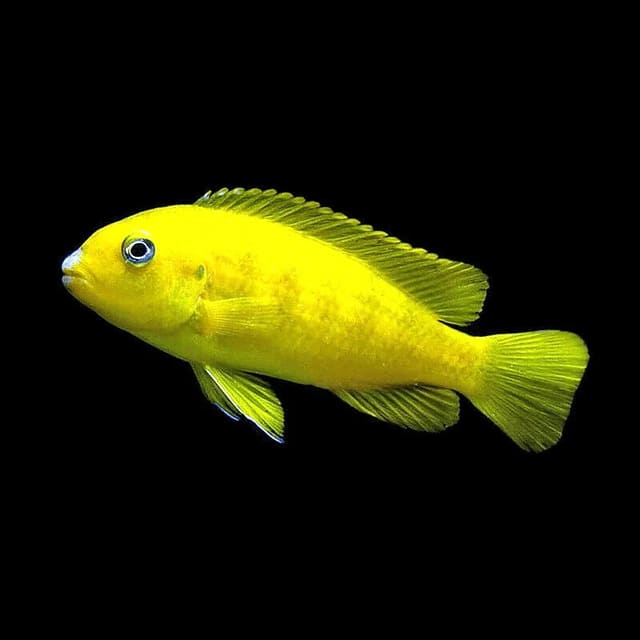
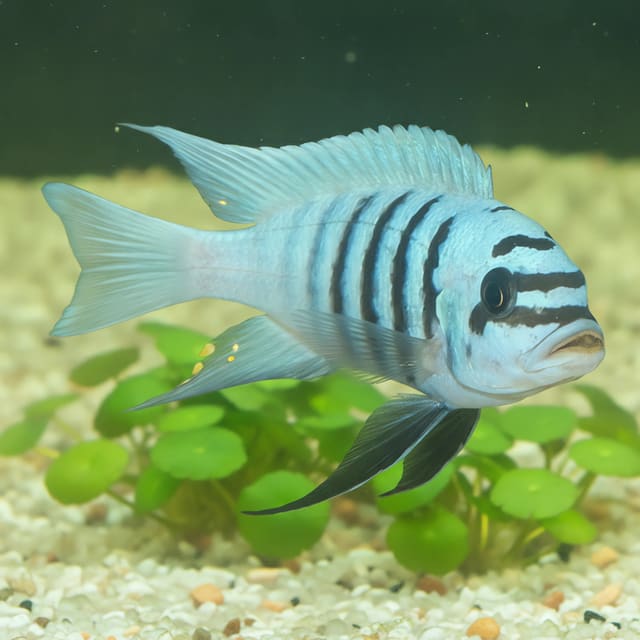
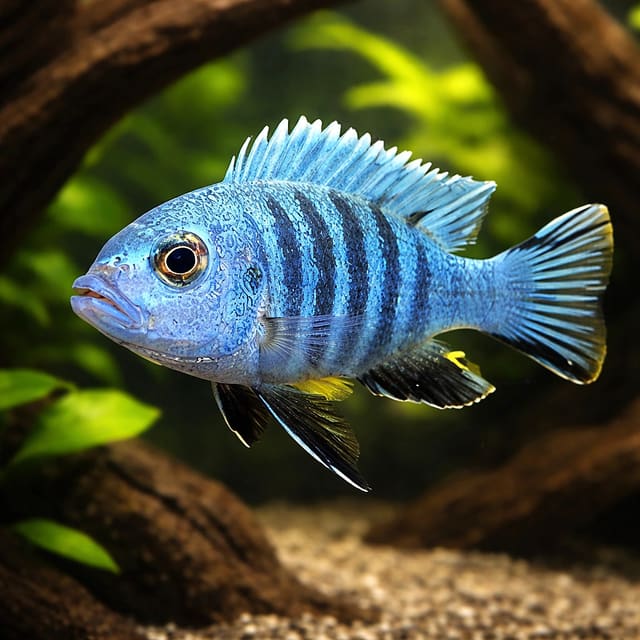
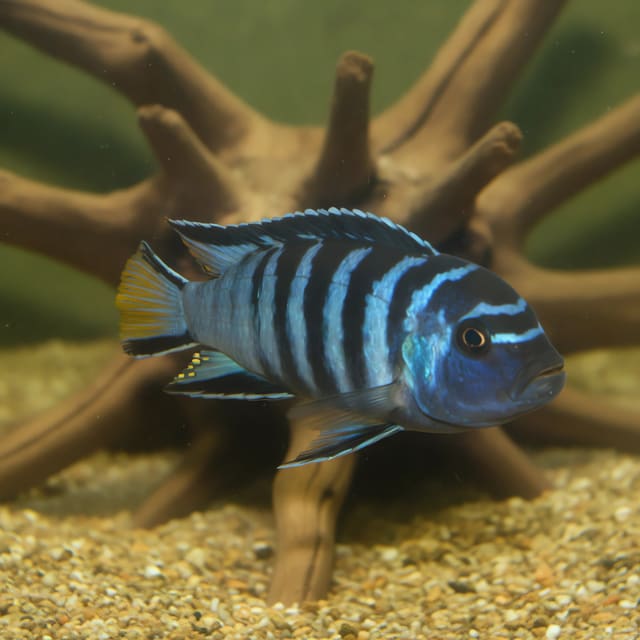
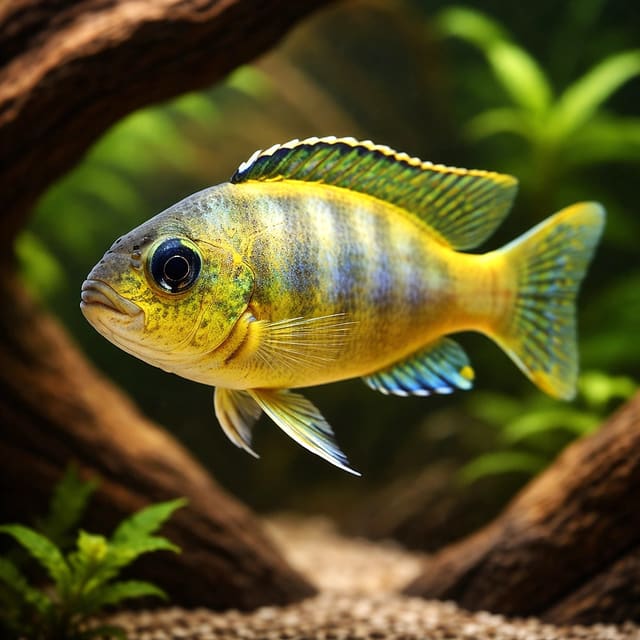
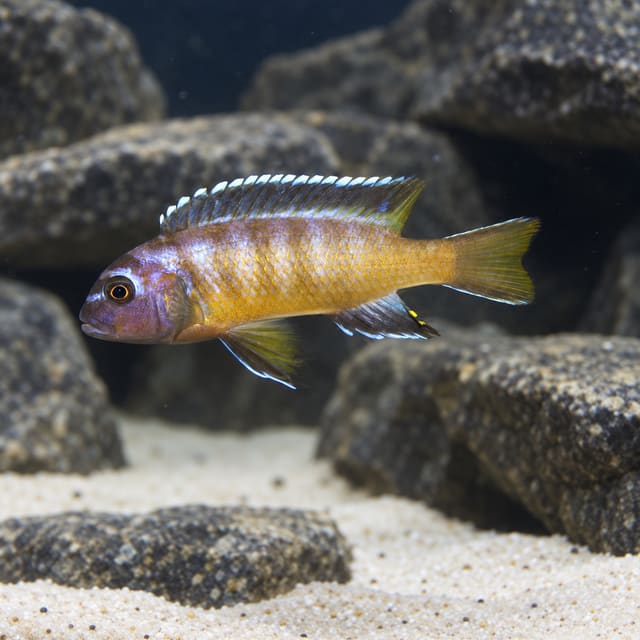
Colour is an unreliable basis for selecting sex from a juvenile or a photograph. The species profile describes dominant mature males as yellow and females as blue, while subordinate males can resemble females and mouthbrooding females can take on yellow. This variability makes a simple colour rule unsafe. The practical conclusion is simple: this listing does not promise sex, and colour alone should not be used to build a male-to-female plan. Buy only if you can manage the fish you actually receive as it matures.
Browse the current African cichlid collection if you are comparing specialist hard-water fish. A product shown nearby is an alternative to consider, not automatic evidence of compatibility with this species. Compatibility must be decided from adult size, water requirements, pattern, temperament, sex balance and the exact aquarium footprint.
Gallery images have been digitally enhanced to improve image quality. Natural colour, pattern, size and maturity can vary between live animals.
The species aquarium profile treats a 120 × 45 cm base, approximately 205 litres, as the absolute minimum because of this mbuna’s aggression. The footprint matters as much as nominal volume: territories are defended across the floor and rockwork, so a tall narrow aquarium with the same litres is a poor substitute. Larger dimensions provide more options for separate rock piles, broken sight lines and escape routes, but extra water alone does not make a careless stocking plan safe.
Arrange stable piles of aquarium-safe rock to make caves and visual barriers, with small open-water gaps between them. Set heavy rocks securely rather than balancing them on loose sand, because Malawi cichlids dig and rearrange substrate. A sandy substrate supports the species’ natural interaction with the bottom, while exposed rock surfaces give it grazing opportunities. The specialist profile advises against discouraging algal growth: a clean-looking tank need not mean scrubbing every rock bare. Leave useful grazing surfaces while keeping the viewing panes and filter intakes serviceable.
Do not depend on delicate rooted planting to organise the layout. Group-level Malawi guidance notes that these fish will often dig and uproot plants. If plants are included, use only robust choices attached to hardscape and accept that the fish, rather than the planting plan, may decide their final position. Caves must also be functional: each should have room for a fish to enter and leave without becoming trapped by a dominant animal at a single narrow opening.
If this is your first aquarium, use the first tropical tank guide to understand maturation before livestock is added. The filter needs a functioning biological colony capable of processing ammonia to nitrite and then nitrate. Clear water is not proof that this cycle is ready, and adding a full Malawi community to an immature filter can overload it quickly.
For routine species care, use the aquarium profile’s range of 24–28 °C, pH 7.6–8.8 and 10–25 dGH. FishBase records a narrower wild temperature range of 24–26 °C, hardness of 10–20 dH and a pH record beginning at 8.0 without a stated upper figure. Those environmental records describe where the fish has been recorded; the aquarium profile provides the practical captive range. The overlap reinforces the need for warm, mineral-rich, alkaline water rather than soft acidic community conditions.
Choose a stable target within this care range instead of chasing a reading from one end to the other. Measure the source water, then decide whether it is naturally suitable or requires a carefully controlled mineral strategy. Sudden correction is usually more disruptive than a slightly different but stable value within the care range. The water chemistry guide explains the role of the main tests, and the water matcher can help compare measured aquarium values with this guidance.
The species profile suggests turnover of four to five times the aquarium volume per hour for a tank around the stated minimum, equivalent to roughly 820–1,025 litres per hour before real-world losses. Treat that as a planning reference rather than a promise printed on a filter box: media, pipework, head height and maintenance all reduce actual flow. Arrange outlets so oxygenation and waste collection are strong without leaving every resting area in a harsh jet.
Check actual circulation rather than relying only on the filter's printed rating. Food and waste should not collect indefinitely in sheltered corners, yet each fish should be able to rest without fighting a direct outlet jet. Surface movement should be obvious, especially overnight and in warm water, because a heavily stocked Malawi aquarium places high demand on both oxygen and biological filtration. If breathing becomes faster across several fish, test ammonia and nitrite and check temperature, filter flow and surface agitation promptly.
At least once every week, carry out a partial water change of 25%, using conditioned replacement water matched sensibly for temperature and mineral conditions. Siphon accumulated waste from open sand and accessible crevices. Test regularly, particularly after adding fish, changing feeding or cleaning equipment. Rinse filter media lightly in removed aquarium water when necessary; do not run established biological media under the tap, as chlorine or chloramine can damage the bacteria that perform the nitrogen cycle.
FishBase records this species brushing loose algae from rocks and also taking plankton in open water. The aquarium profile says it accepts most offered foods but that vegetable matter should form a large proportion of the diet. A suitable routine therefore starts with a good-quality algae-rich or spirulina-based dried food, supported by appropriate vegetable foods such as blanched spinach or nori. Suitable live or frozen foods can be offered as supplements rather than turning the whole routine into a rich meat-heavy diet.
Never feed beefheart or other red meat. The specialist source warns that these foods interfere with the digestive system of the fish. Offer portions the fish can finish promptly and remove uneaten material before it decays. The group care sheet suggests feeding only what the fish can eat within a few minutes, twice daily; portion size must still reflect the number and size of fish present. Watch that subordinate animals receive food without a dominant fish monopolising one corner.
Allowing some natural algal film on selected rocks gives the fish something to browse between meals and supports normal foraging. It does not replace a nutritionally complete staple, and it is not an excuse to leave decomposing food or detritus in the aquarium. Observe body condition over time. Reduced interest in food, weight loss, abnormal swelling or a fish repeatedly excluded at feeding should trigger water testing and a review of aggression, diet and stocking rather than simply adding more food.
Learn the normal behaviour of every individual. Healthy fish should show clear eyes, intact fins and scales, controlled swimming, regular breathing and interest in food. Changes such as hiding more than usual, sitting on the bottom, hanging near the surface, rapid gill movement, colour becoming markedly darker or paler, damaged fins, white spots, fluffy growths or loss of condition deserve prompt attention. Test water first because ammonia, nitrite, temperature or oxygen problems can affect several fish at once.
Aggression is also a daily welfare check. One chase is not the same as relentless targeting. Look for a fish confined behind equipment, held at the surface, unable to feed or showing repeated fresh damage. The response may require separating an aggressor or victim, revisiting the stocking plan or rebuilding territories. Keep a safe divider or spare holding arrangement available before it is needed; an emergency plan made after injury is less useful.
When changing the layout, preserve swimming space and stable shelter. Do not make several major changes to filtration, stock and feeding on the same day, because that makes any subsequent problem difficult to interpret. Record test results and maintenance dates. A brief log reveals gradual trends in nitrate, pH or aggression that are easy to miss when each day is viewed alone.
A useful weekly review combines numbers with behaviour. Compare temperature and test results with the previous entry, confirm that the heater and filter are operating normally, and inspect rock piles for movement. Then watch the fish from a distance before feeding: note which territories are occupied, which animals emerge readily and whether any individual has changed breathing, posture or appetite. This makes the log a welfare tool rather than a collection of water readings.
Prepare the aquarium and quarantine arrangements before delivery, and make sure an adult is present to receive the live-animal parcel. Follow the current delivery and Live Arrival Guarantee policy rather than relying on an old timetable. The fish is hand-bagged in oxygen, packed in an insulated box with a heat pack when weather calls for it, and carried by a licensed live-animal courier.
The unboxing recording is a claims step, not a treatment. The receiving aquarium must already match the required hard alkaline conditions and have mature biological filtration. Do not use arrival day to improvise mineral changes, rebuild the entire rockscape with fish loose in the tank or add several unrelated new animals without a stocking plan.
Pseudotropheus lombardoi is described by the species aquarium profile as one of the most aggressive and territorial mbuna. It should not be kept with peaceful species, peacocks or utaka. Its best prospects are in a carefully designed Malawi aquarium with other robust mbuna that share comparable hard alkaline water requirements and do not closely resemble it in pattern. Even then, “robust mbuna” is a starting category rather than a guarantee that two individual fish will coexist.
Avoid small peaceful fish, long-finned species and slow animals that cannot escape repeated pursuit. Do not use small invertebrates as experimental companions. Different water needs can disqualify a tank mate before temperament is even considered: a fish that needs soft acidic water is not suitable simply because it looks assertive. Likewise, an alternative product in the shop is not necessarily a fish to house with this one.
| Consider | Avoid |
|---|---|
| Robust mbuna with comparable water needs and clearly different pattern | Peacocks, utaka and peaceful community fish |
| A full Malawi stocking plan with substantial filtration | Long-finned, slow or markedly smaller fish |
| Separated rock territories and open escape routes | Lookalike mbuna likely to provoke focused rivalry |
| Close observation and a practical separation plan | Adding one fish casually to an established peaceful aquarium |
Aggression towards its own species can be especially intense. Unless the aquarium is very large, the species profile advises a single male with several females so attention is not concentrated on one female. This is not permission to assume sex from the colour of a juvenile. Dominant and subordinate states can obscure the colour pattern, and this retail offer is not sex guaranteed. If the intended social structure depends on known sexes, source explicitly sexed animals rather than treating colour, size or a photograph as proof.
Starting with young fish does not make the adult problem disappear; it merely delays it. The profile discusses groups of six to eight young fish in a breeding context, but that number should not be copied into every display aquarium without regard to footprint, eventual sex ratio and the rest of the community. Plan where surplus males or incompatible individuals can go before the fish mature.
Malawi group guidance commonly uses a reasonably large, slightly crowded community to spread aggression and warns that small groups often fight. It gives at least 15 fish as a broad community reference and at least 200 litres for a reasonable community. This species’ own profile is more demanding about aggression and gives a 120 × 45 cm base and about 205 litres as its absolute minimum. Use the species minimum and the complete stocking calculation together; do not treat either broad number as a recipe that automatically makes the aquarium safe.
Adding a single newcomer to an established territory can focus aggression on that fish. Broader Malawi guidance favours adding cichlids in groups, introducing more peaceful species before more aggressive ones and rearranging décor to interrupt established boundaries. Apply those principles only after checking that the filter can accept the increased waste and that every planned fish is compatible with the same water conditions. Do not stock rapidly just to reach a target count.
Before an introduction, map the aquarium’s caves, open lanes and dead ends. Rebuild rock territories while the fish are safely contained if a major change is needed, then observe continuously during the first interactions. Watch whether every fish can leave a cave, reach food and use open water without being intercepted. A subordinate animal that remains hidden for long periods or is repeatedly driven into equipment is not simply “settling in”.
This species is a maternal mouthbrooder. Males defend a display and spawning area, and courtship can intensify pressure on females. The species profile recommends a species aquarium for deliberate breeding and stresses the value of several females with one male. Flat rock surfaces and open sand among the rockwork may be used around spawning. These facts help explain behaviour; they do not mean a mixed display will breed safely or that a purchased fish has a guaranteed sex.
A brooding female can withdraw and stop feeding, while her colour may change in a way that makes visual sex assumptions even less reliable. She still needs refuge from harassment and excellent water quality. Avoid repeatedly netting or disturbing a suspected mouthbrooder merely to confirm what she is doing. Anyone intending to raise fry should prepare a separate plan for housing, feeding and eventual numbers rather than allowing breeding to increase an already crowded community without capacity.
Compatibility is an ongoing observation, not a label fixed at purchase. Revisit the layout and stock if one fish has persistent fin damage, loses condition, cannot leave cover, breathes rapidly after chases or is excluded from food. Also reconsider the plan if a previously subordinate male matures and begins defending territory. Removing one fish can change where aggression is directed, so monitor the remaining group after every intervention.
Make the decision from the least flexible requirement. If a proposed companion needs softer water, has flowing fins, remains much smaller as an adult or closely resembles this species, a shared preference for warm freshwater does not make the match sound. When all basic requirements align, look at the available floor area and the number of genuinely separated territories. Only then decide whether the filtration and backup separation space can support the additional fish.
If the aquarium cannot provide the required footprint, filtration or separation options, the responsible choice is not to add this species. An advanced keeper’s advantage is not a willingness to tolerate injury; it is the ability to recognise risk early, design around it and act before normal territorial display becomes sustained harm.
Pseudotropheus Lilancinius is best planned as a fish reaching up to 15 cm standard length. FishBase records 8.7 cm SL, while the species aquarium profile records 15 cm SL, so the larger figure is the prudent one for space and compatibility planning.
Allow at least a 120 × 45 cm base and about 205 litres for Pseudotropheus lombardoi. That is an absolute species minimum from the aquarium profile; a larger footprint gives more scope for separated rock territories and a carefully managed mbuna community.
In all but a very large aquarium, keep no more than one male with several females, and manage it within a deliberately planned robust mbuna group. Do not buy an arbitrary small group: this highly aggressive species needs the whole aquarium and sex ratio considered together.
No. Pseudotropheus Lilancinius is an advanced choice because it is exceptionally territorial and needs hard alkaline water, substantial filtration, deliberate stocking and close observation for targeted aggression.
Use a good algae-rich or spirulina-based staple and make vegetable matter a large part of the diet. Suitable live or frozen foods can supplement it. Feed modest portions and never offer beefheart or other red meat.
The species aquarium profile gives 24–28 °C, pH 7.6–8.8 and 10–25 dGH for routine care. Stability matters: mature biological filtration, zero measurable ammonia and nitrite, strong oxygenation and regular testing are essential.
Pseudotropheus Lilancinius is one of the more aggressive, territorial mbuna. Chasing and sustained harassment are the main concerns, so avoid peaceful or long-finned fish and intervene if one animal is being pinned into a corner or denied food.
Only consider other robust mbuna that need comparable hard alkaline water and do not closely resemble it in pattern. Avoid peacocks, utaka and peaceful community fish; no species name is a universal guarantee, so judge the complete stocking plan and individual behaviour.
Tropical Fish Co hand-bags the fish in oxygen, uses an insulated box and a heat pack when conditions call for it, then sends it with a licensed live-animal courier. Be present to receive it, record one continuous unboxing video from the still-sealed parcel before anything is disturbed, inspect the fish that day, float the sealed bag for 20–30 minutes, and transfer the fish carefully without adding transport water to the aquarium.
These sources support the identity, natural history, species care and welfare guidance used above. Aquarium targets are distinguished from wild environmental records and from broad group advice.
Sources were accessed through the reviewed listing evidence dated 20 September 2026. If central delivery terms change, the current policy page governs the delivery process; the biological care recommendations remain tied to the species and welfare sources above.
No reviews for this item yet. Bought one? Honest reviews only, good or bad.
What customers say about ordering from us
Easy website plenty of info on fish your buying great to pick a time slot
TRACEY DURRANT · 7 Oct 2026
Got some lovely fish thank you
Kevin Mackie · 7 Oct 2026
Reviews of our shop, collected by Judge.me, an independent third-party review collector. Newest first.