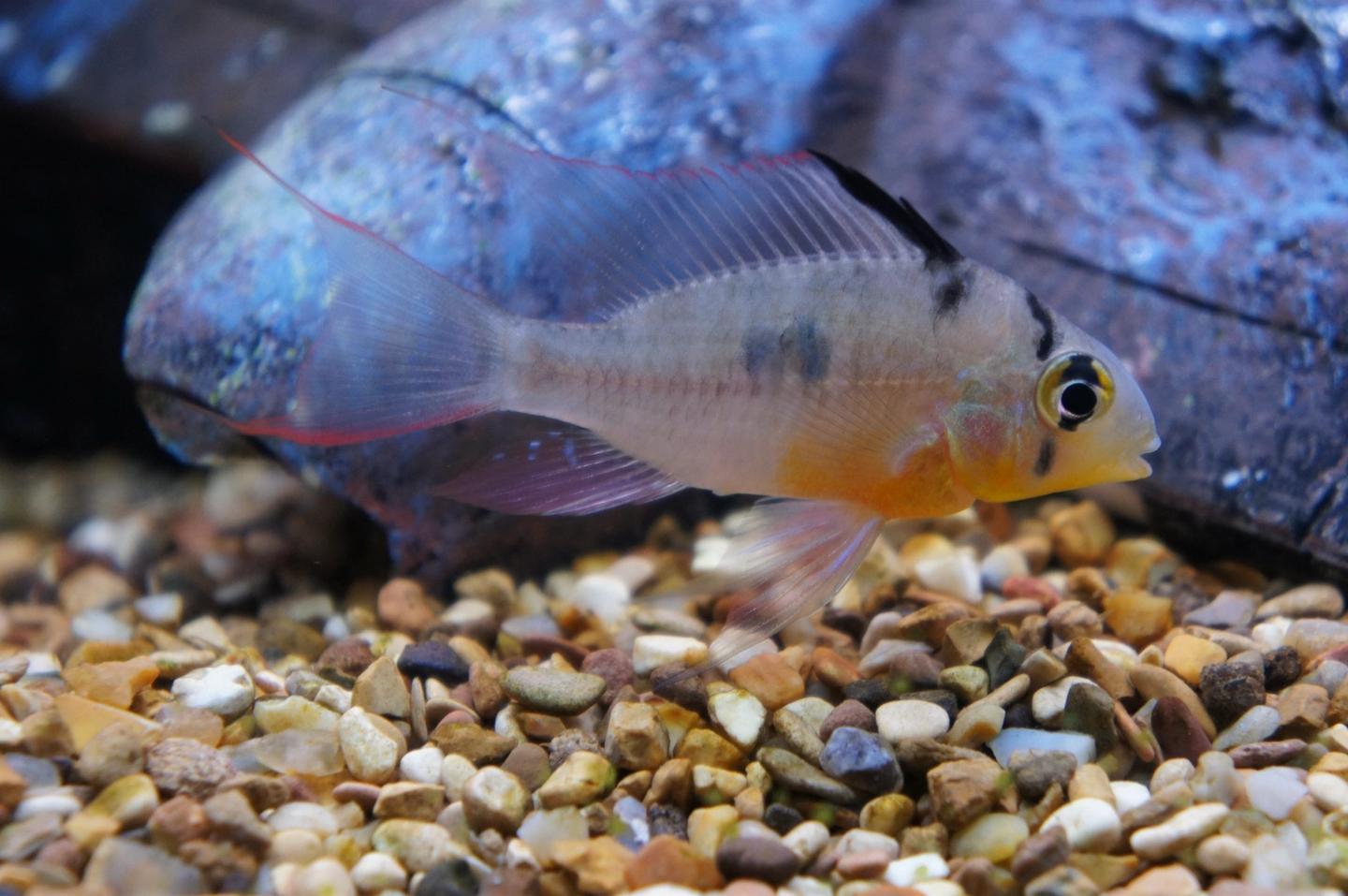
The Gold Mundola Point Zebra Mbuna is a locality-named Lake Malawi rock cichlid supplied in the aquarium trade as Pseudotropheus / zebra gold Mundola Point. Specialist Malawi references identify the form more precisely as Maylandia sp. 'zebra gold' (Mundola Point), while many aquarists and publications use the alternative genus combination Metriaclima sp. 'zebra gold' Mundola Point. It is an undescribed form rather than the formally described species Maylandia zebra. That distinction is important for accurate care, search results and responsible breeding records.
This is a bold, territorial mbuna for an experienced keeper with a large, mature, hard-water aquarium. Adult males can show warm gold, orange-gold or yellow colour with variable darker barring; females are usually more consistently brown. Colour and markings vary naturally, and a juvenile cannot be promised to become the brightest photographed male. Plan the aquarium around adult behaviour rather than the small dispatch size: for a deliberate adult group, we recommend at least 400 litres and a 150 cm footprint, extensive secure rockwork, fine sand, powerful established filtration and a practical way to separate an aggressor or injured fish.
Gold Mundola Point Zebra Mbuna at a Glance
| Best-supported aquarium name | Maylandia sp. 'zebra gold' (Mundola Point) |
|---|---|
| Alternative name | Metriaclima sp. 'zebra gold' Mundola Point |
| Supplier / older trade grouping | Pseudotropheus / zebra gold Mundola Point |
| Taxonomic status | Undescribed locality form; not the described species Maylandia zebra |
| Natural range associated with the form | Western Lake Malawi, reported from Chirombo Point north towards Charo, including Mundola Point |
| Adult size | Plan for about 13 cm total length in males and around 11 cm in females; some aquarium sources report 12-15 cm overall |
| Care level | Advanced |
| Temperament | Aggressive, territorial mbuna; strongest aggression is often directed at its own kind and similar-looking fish |
| Recommended adult aquarium | 400 litres and at least 150 cm long for a planned group; 300 litres is a specialist-published minimum, not our preferred target |
| Temperature | 24-26°C |
| pH | 7.6-8.6, stable and well buffered |
| Hardness | 10-25 dGH |
| Diet | Primarily aufwuchs grazer with some plankton feeding; plant-rich complete mbuna food with controlled animal protein |
| Breeding | Maternal mouthbrooder |
Identity, Locality and Photo Notice
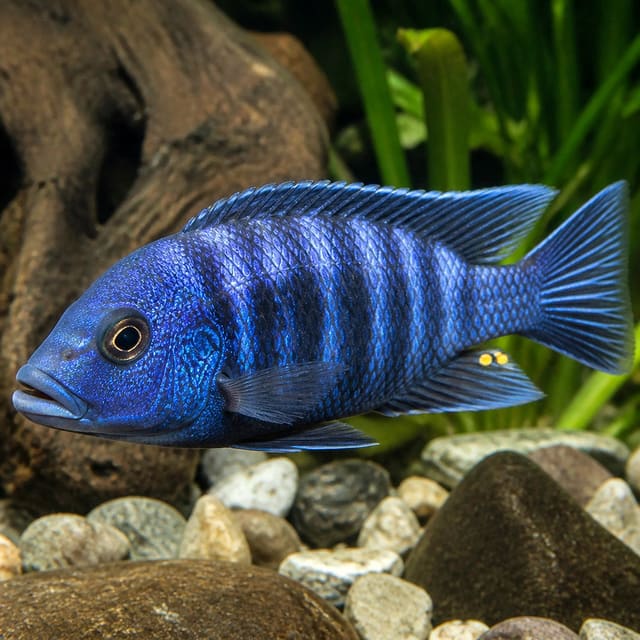
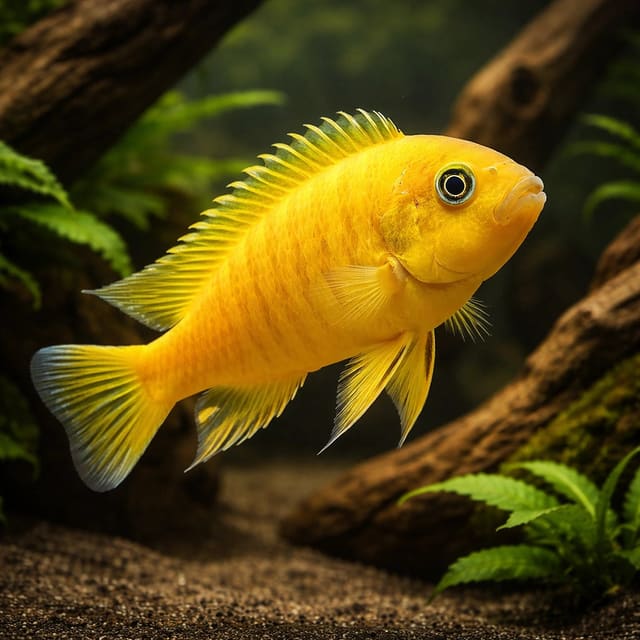
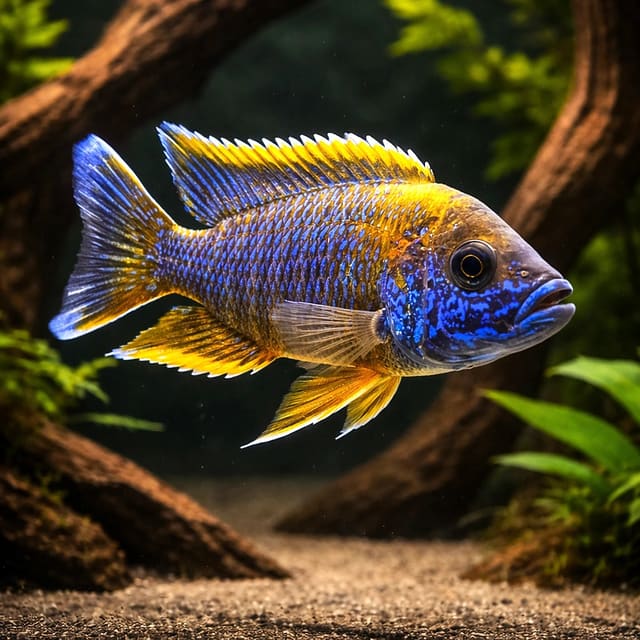
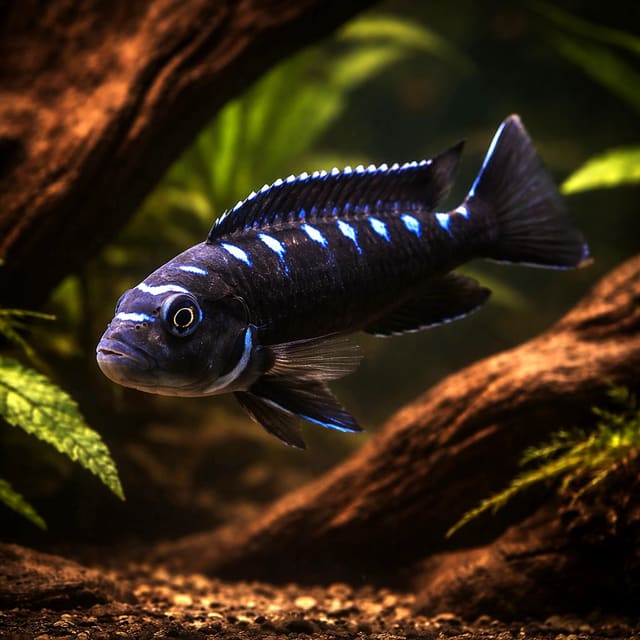
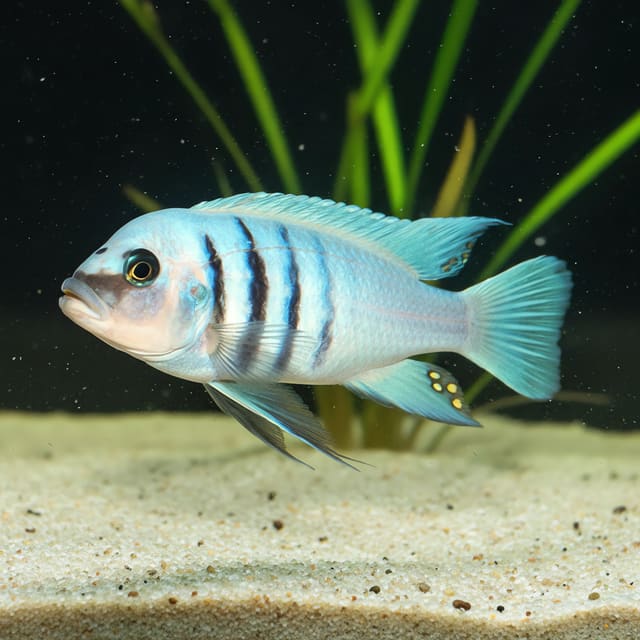
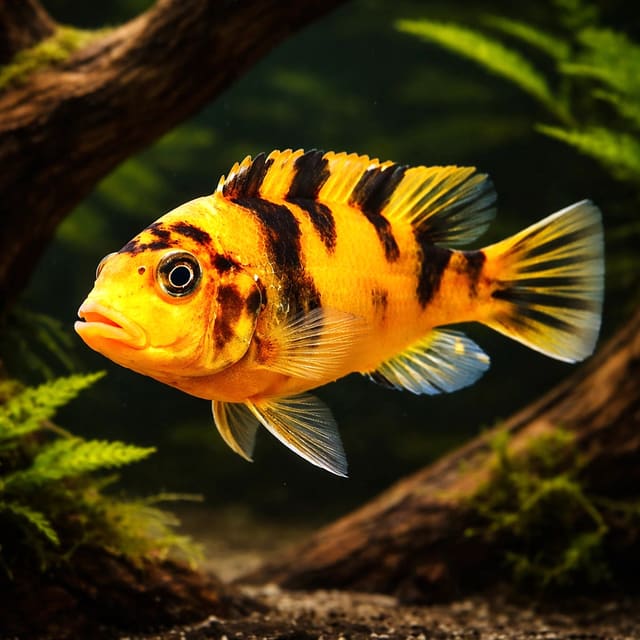
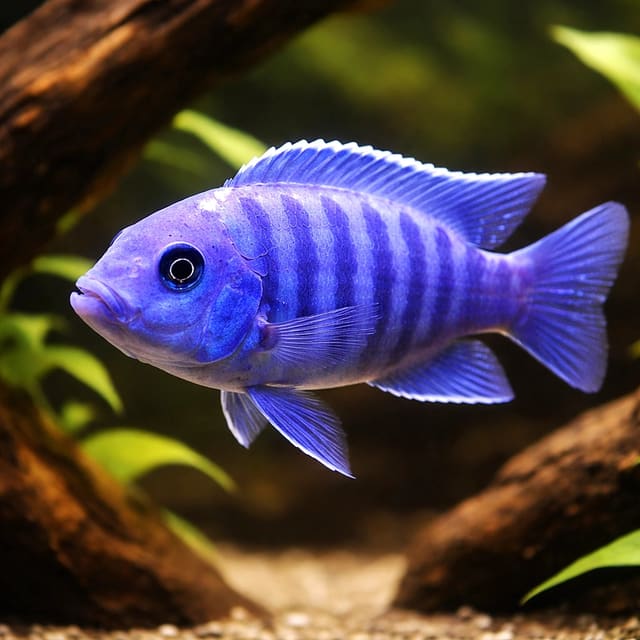
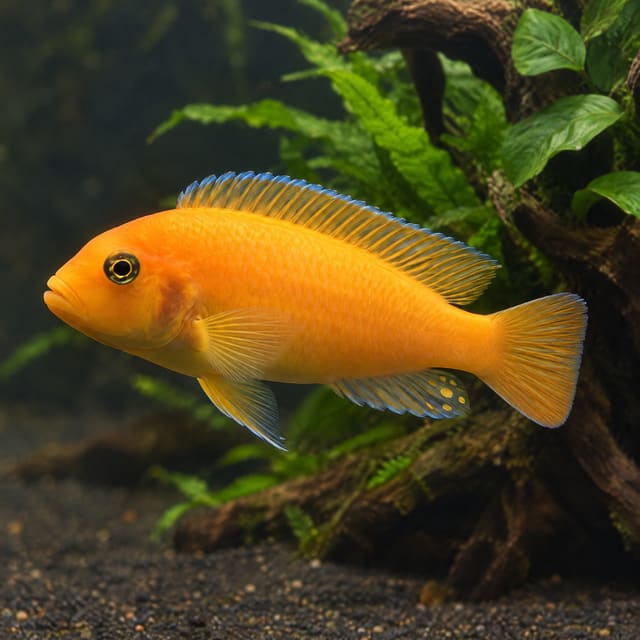
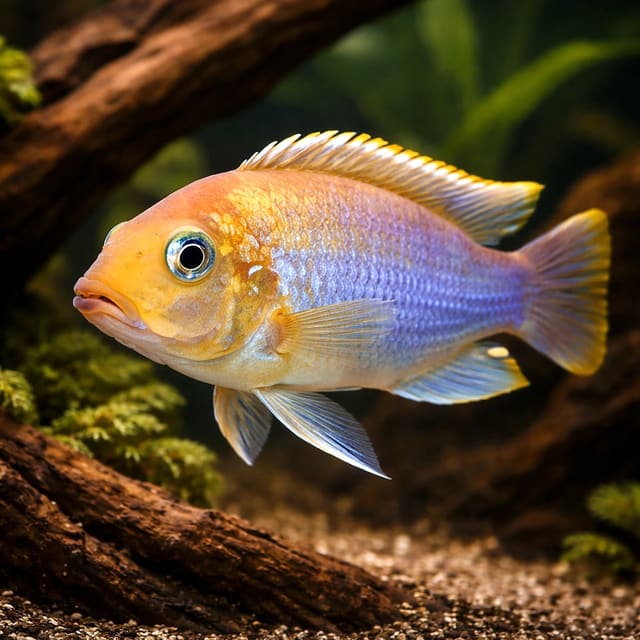
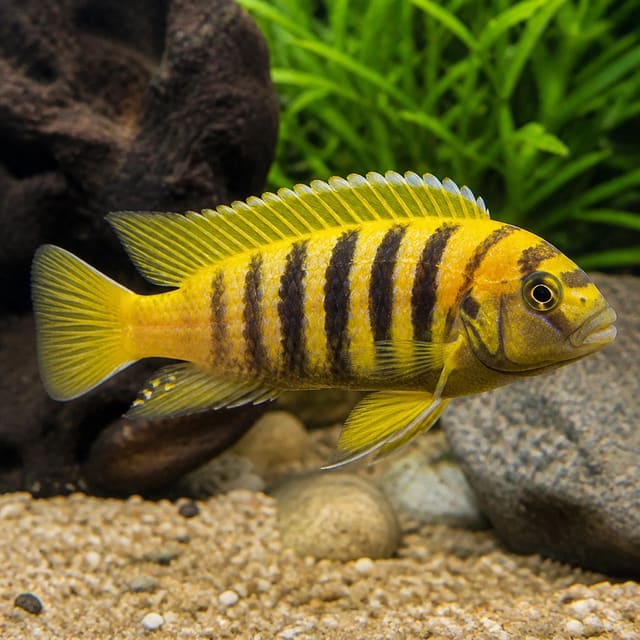
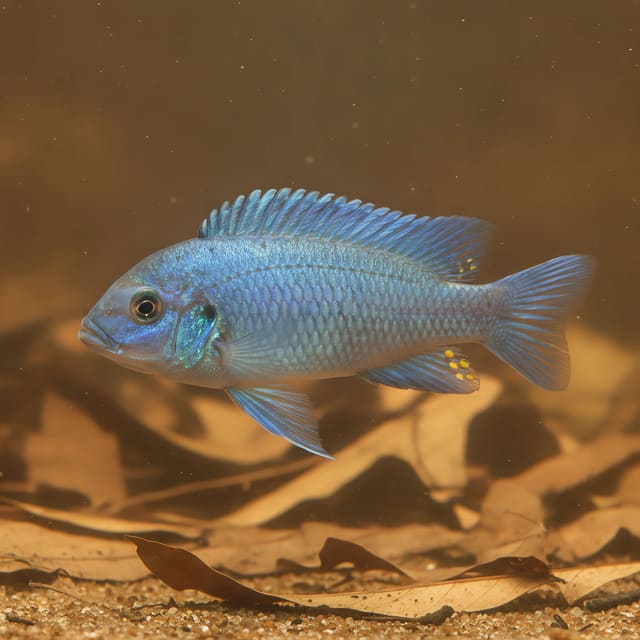
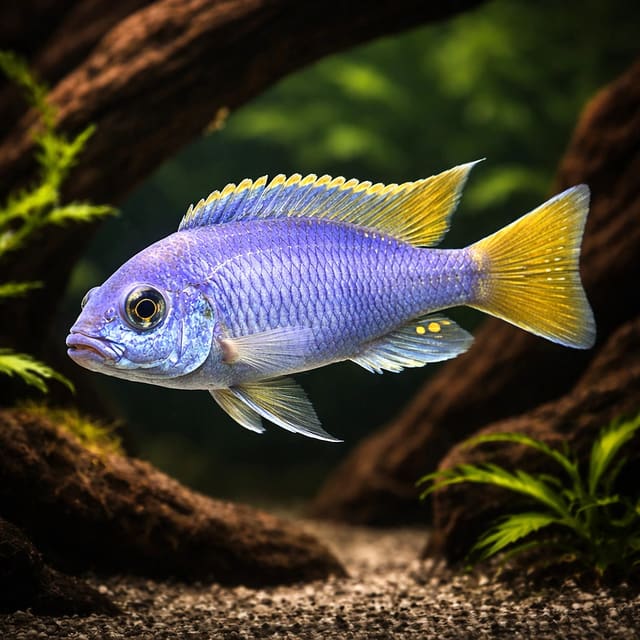
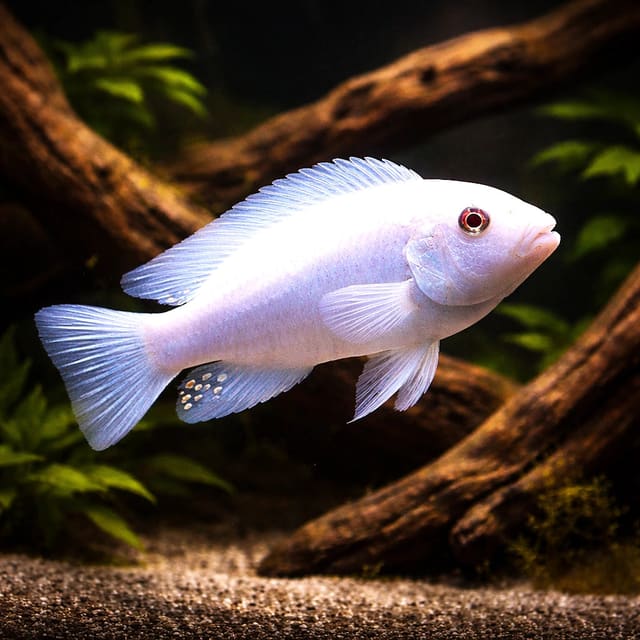
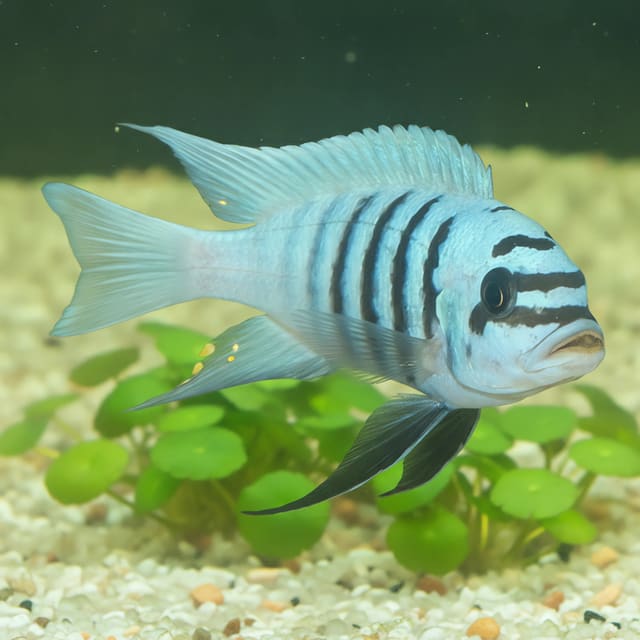
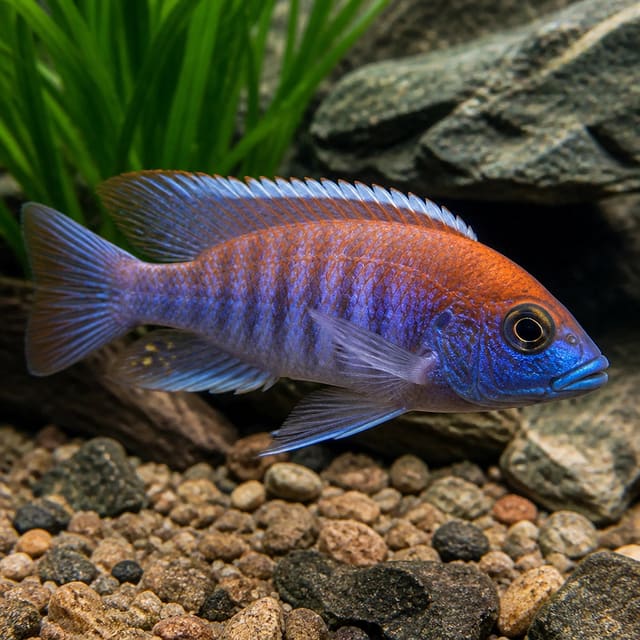
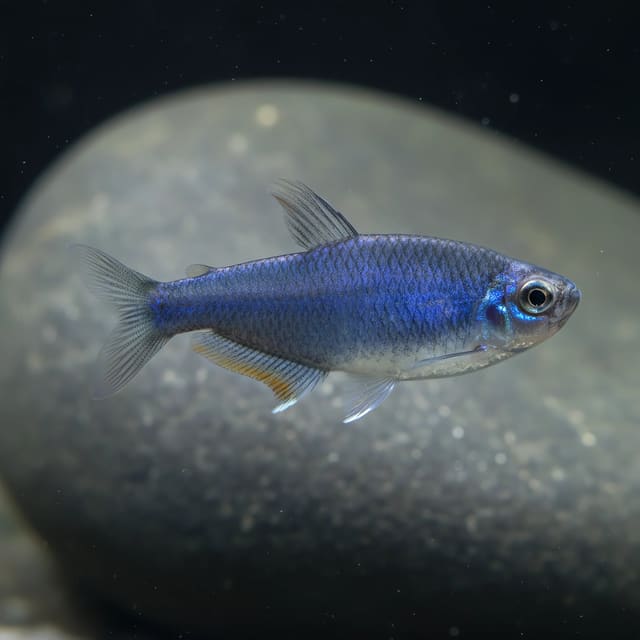
Mundola Point is a geographic form name, but a trade label alone does not prove that the fish offered today is wild collected, first-generation from wild stock or accompanied by a locality certificate. This listing preserves the supplier's Mundola Point identity without making an unsupported collection-history promise. The gallery also contains an illustrative aquarium image and a recovered source photograph. Neither is a photograph of the exact individual dispatched. The source photograph is the closer identity reference; the illustrative scene may exaggerate yellow colour, dark bars or facial contrast. Selected size, sex, maturity, social rank, lighting and transport stress all affect what the delivered fish looks like.
What Is the Correct Scientific Name?
The safest name for this listing is Maylandia sp. 'zebra gold' (Mundola Point). The abbreviation "sp." tells the reader that the fish has not been formally described as a named species. The words in quotation marks are an aquarium or field identifier, and Mundola Point identifies the locality form. Writing Maylandia zebra without "sp. 'zebra gold'" incorrectly turns this fish into a different, formally described zebra mbuna.
The genus name is less settled in aquarium literature. Metriaclima is widely used for zebra-complex mbuna and appears in modern specialist sources, while the current Catalog of Fishes accepts Maylandia and treats Metriaclima as a synonym. A continuing nomenclatural debate explains why both combinations remain searchable. The supplier's Pseudotropheus label reflects an older, broad trade grouping. These names do not mean three different fish are included; they are competing or historical classifications for the same Mundola Point form.
Accurate naming protects specialist keepers. Someone searching for a true Maylandia zebra should not be sent to an undescribed gold form, and a breeder should not distribute offspring under a formal species name that the parents do not possess. We retain the familiar phrases "Gold Mundola Point Zebra" and "zebra mbuna" because customers genuinely use them, but the page explains their meaning once instead of forcing them into every paragraph.
Natural Distribution and Habitat
Specialist locality records place this zebra-gold form along the western coast of Lake Malawi, from around Chirombo Point north towards Charo, with Mundola Point represented in the name. It is associated mainly with rocky habitat. Reports also place fish over sandy patches at depth, commonly below about 15 metres. That combination suggests a rock-dominated aquarium with open sand passages rather than a solid wall of stone from glass to glass.
Lake Malawi is mineral rich, alkaline and exceptionally stable compared with a small aquarium. The fish experiences abundant oxygen, extensive rock surfaces, strong biological processes and room to move between feeding and territorial areas. Recreating the exact lake is impossible, but the useful principles are clear: maintain hard buffered water, excellent gas exchange, zero ammonia and nitrite, controlled nitrate, secure rocks and enough footprint for fish to avoid one another.
"Mundola Point" should not be read as a licence to claim wild provenance. Commercial stocks may be many generations removed from the lake. Keep the locality label with breeding records if it came with the fish, but do not add claims such as wild caught, F1 or pure locality line unless documentary evidence accompanies the stock.
Appearance, Sex and Natural Colour Variation
Mature males are variable and can be polychromatic. A dominant fish may show a yellow-gold or orange-gold ground colour, dark vertical barring, a contrasting face and blue or dark edging in the fins. Other males can appear more mottled, less strongly barred or more muted. Specialist photographs from the locality show that there is no single paint-by-numbers pattern that every male must match. Females are reported to remain consistently brown, although shade and barring still change with condition and mood.
Juveniles of both sexes can be subdued. A young male may resemble a female until size, hormones and social position allow stronger colour. A subordinate adult male may also suppress display colour when housed beneath a dominant rival. Transport often makes fish pale or blotchy for several days. Assess breathing, balance, appetite, fin condition and gradual improvement before treating temporary colour loss as disease.
The recovered source image shows a more mottled gold-orange fish with softer bars than the brighter illustrative aquarium scene. Keeping both images is more honest than deleting one or pretending the stronger render is the only possible adult appearance. Neither image guarantees sex. If a specific adult male pattern is essential, ask whether current stock can be assessed before ordering; routine centimetre variants are sold by approximate size, not by a guaranteed colour grade.
| Feature | Likely mature male | Likely female or juvenile | What cannot be promised |
|---|---|---|---|
| Body colour | Variable gold, yellow or orange-gold, sometimes mottled | Usually brown or muted | An exact shade matching a screen image |
| Barring | May become dark and distinct during display | Usually softer or less dramatic | A fixed number or intensity of bars |
| Adult size | About 13 cm total length | About 11 cm is reported for females | Exact final length for an individual |
| Sex at small sizes | May not be externally clear | May resemble a young male | Sex unless the selected option explicitly says sexed |
Choosing a Dispatch Size
Four size options are associated with this product. The centimetre label is an approximate dispatch grade, not adult size. A larger option usually gives a more substantial fish and may make sex or colour easier to assess, but it can also be more territorial immediately. A small juvenile needs protection from established adults and should never be added where it can be swallowed or pinned continuously in a corner.
| Listed size | Development stage | Introduction consideration |
|---|---|---|
| 3-4 cm | Young juvenile; sex and final colour normally uncertain | Use a grow-on plan or a carefully matched juvenile group |
| 4-5 cm | Juvenile to early subadult | Still vulnerable to large established mbuna |
| 5-6 cm | Growing subadult | Hierarchy and colour may be developing but are not guaranteed |
| 7-9 cm | Larger subadult or young adult | Match adult aggression and body size before introduction |
The Shoal Pricing control is a quantity discount. This species does not school or shoal in the behavioural sense, and the discount must not be interpreted as a recommendation to buy a random pair. Two unsexed fish can mature as two territorial males, and even one male with one female can concentrate courtship pressure dangerously. A planned group commonly uses one male with three or four females, but that ratio must be created from reliably sexed fish and backed by enough space and a removal plan.
Minimum Tank Size: Why We Recommend 400 Litres
A detailed Malawi locality reference gives 300 litres as a minimum, while another specialist source recommends 400 litres and a 150 cm length for this form. We use the more conservative 400-litre, 150-cm recommendation for a planned adult group. The fish can reach a solid 11-13 cm, occupies rock territories and may chase its own kind intensely. Extra length gives subordinate fish escape distance and allows several broken lines of sight.
Litres alone can mislead. A tall 400-litre aquarium with a short footprint can offer less usable territory than a long, broad tank of similar volume. Prioritise length and front-to-back depth, then use volume to support stable chemistry and waste dilution. A 300-litre aquarium may be a workable specialist floor for a carefully composed arrangement, but it is not a universal promise and is not our preferred target for a group purchased without known sex.
Do not plan this fish for a 125-litre or 200-litre community aquarium, a nano tank, a soft-water planted display or an unheated pond. A temporary juvenile grow-on tank does not become suitable merely because the fish currently fits. Buy only when the adult system is ready or when there is a firm, near-term transfer plan.
Adult Aquarium Planning Standard
- Preferred group aquarium: 400 litres or more
- Preferred footprint: at least 150 cm long with useful front-to-back depth
- Published specialist floor: 300 litres for a carefully managed arrangement
- Rockwork: numerous stable structures, caves and visual barriers
- Contingency: divider, spare mature tank or rehoming route available
Water Parameters and Stability
Maintain 24-26°C, pH 7.6-8.6 and approximately 10-25 dGH. These are practical aquarium targets for a hard, alkaline Lake Malawi system. Stability matters more than forcing water to a single decimal. Test source water before adding mineral salts or buffers; many UK areas already have hard tap water, while soft-water areas need a measured, repeatable preparation method.
Ammonia and nitrite must remain at 0 mg/L. Keep nitrate as low as practical with sensible stocking, restrained feeding and regular water changes. A heavily stocked mbuna aquarium can look clear while dissolved waste rises, so visual clarity is not a substitute for testing. Any unexplained gasping, clamped fins, loss of appetite or unusual aggression should prompt immediate checks of temperature, ammonia, nitrite, nitrate, pH, oxygen and filter operation.
Strong surface movement is essential. Warm water holds less oxygen, and active cichlids demand a great deal from the system. Aim near 25°C for normal maintenance rather than running continuously at the warm edge. Match replacement water for temperature and chemistry, dechlorinate it fully and avoid large sudden pH shifts. A separate thermometer is useful because heater dials are not precision instruments.
| Parameter | Working target | Management priority |
|---|---|---|
| Temperature | 24-26°C | Stable, well oxygenated water; avoid chronic overheating |
| pH | 7.6-8.6 | Buffer consistently; do not chase pH with sudden dosing |
| General hardness | 10-25 dGH | Prepare replacement water predictably |
| Ammonia | 0 mg/L | Any reading needs immediate action |
| Nitrite | 0 mg/L | Any reading needs immediate action |
| Nitrate | As low as practical | Control with stocking, food and water changes |
Rockwork, Sand and Territory Design
Build a rock-dominated layout with many caves, overhangs, narrow passages and broken sight lines. Place major rocks directly on a stable base before adding deep sand so digging cannot undermine them. Test every structure for movement. An adult mbuna can shift substrate and exploit surprisingly small gaps, so a decorative pile that feels stable only because it rests on sand can become dangerous.
Use fine, smooth sand across open areas. The natural form is reported from rocky habitat and sandy patches at depth, and the contrast creates useful feeding and patrol zones. Avoid sharp gravel that can injure mouths or trap excessive waste. Leave several routes through and around the rocks; a single cave with one entrance can become a dead end for a chased fish.
Do not give one dominant male an uninterrupted view of the entire aquarium. Tall rock groups and offset structures should divide the footprint into territories. At the same time, preserve open swimming lanes and access for cleaning. Plants are optional and often uprooted or grazed. Tough epiphytes may survive when attached securely, but a delicate planted aquascape is not the welfare priority here.
Filtration, Oxygen and Maintenance Capacity
Use mature filtration sized for an active, messy cichlid population. A generous external canister, sump or well-designed multi-filter system can work, but manufacturer flow figures are not the whole story. Actual flow falls as media loads and head height increases. Biological media capacity, oxygen transfer, mechanical capture, redundancy and maintenance access matter more than a headline turnover number.
Arrange outlets to move waste towards intakes while keeping strong surface agitation. Provide lower-flow refuges behind rockwork so a subordinate fish is not forced to fight current and aggression simultaneously. Protect heater glass from rock impact and fish activity. If one filter fails, the tank should not become oxygen-starved before the problem is noticed.
A weekly change of around 30-50% is a reasonable starting range for many mbuna aquariums, adjusted to measured nitrate, stocking and feeding. Siphon accessible debris, clean mechanical media before it clogs and preserve biological stability by avoiding simultaneous deep cleaning of every filter. Record test results instead of relying on memory. Increased chasing after a maintenance change can indicate that rock territories were disturbed, not only a chemistry issue.
Natural Diet: Aufwuchs Grazer, Not a Strict Plant Eater
Specialist habitat information describes this form as primarily herbivorous and feeding on aufwuchs, while also taking plankton. Aufwuchs is the living film on submerged rock: algae mixed with microbes, detritus and tiny invertebrates. Calling the fish simply "herbivore" is convenient but incomplete. The practical aquarium translation is a plant-rich, fibre-conscious diet with controlled, appropriate animal protein, not lettuce alone and not a rich carnivore menu.
Use a reputable complete mbuna flake, small pellet or granule as the staple. Foods containing spirulina or other algae can contribute useful plant material, but the full formulation matters more than a single marketing ingredient. Offer particles the fish can swallow without repeated spitting or surface gulping. Distribute food along the aquarium so one dominant animal cannot take every portion.
Small amounts of plankton-like foods such as cyclops, daphnia or enriched brine shrimp can provide variety. Avoid routine heavy feeds of bloodworm, mammalian meat, poultry, feeder fish or rich high-fat foods. Digestive problems often blamed on one ingredient can also involve stress, parasites, poor water or chronic overfeeding, so do not treat every swollen abdomen as proof of a single cause.
| Food role | Suitable approach | Use sparingly or avoid |
|---|---|---|
| Daily staple | Complete plant-rich mbuna flake or appropriately sized pellet | Large hard pellets that swell or cannot be swallowed comfortably |
| Algae component | Quality spirulina or algae-containing prepared foods | Assuming one ingredient makes an otherwise unsuitable food safe |
| Plankton variety | Small portions of cyclops, daphnia or enriched brine shrimp | Frequent heavy bloodworm or fatty animal-protein meals |
| Vegetable variety | Small clean portions of softened courgette or leafy greens if accepted | Leaving vegetables to decay in the aquarium |
| Never a maintenance solution | Balanced feeding and water changes | Feeder fish, mammalian meat or starvation to control waste |
For suitable prepared options, compare Spirulina Cichlid Food Small Pellet and Tropical Super Spirulina Forte Granulat. Match particle size to the selected fish and introduce any new food gradually. Product links are feeding options, not a claim that one jar alone replaces dietary judgment.
How Much and How Often to Feed
Feed one or two small meals daily for established adults, with portions consumed promptly and no persistent debris. Growing juveniles may benefit from smaller, more frequent feeds if filtration and water changes support them. A fast day is used by some keepers, but it is not a cure for poor food choice, parasitic disease or chronic aggression.
Watch body condition. The abdomen should be gently rounded after feeding, not tight or ballooned. Long white faeces alone are not a diagnosis, but refusal to eat, swelling, hollowing, rapid breathing, isolation or repeated spitting needs investigation. Test water first, assess bullying and quarantine history, then seek an aquatic veterinarian or experienced fish-health professional when signs persist.
Remove uneaten food before it breaks down. Do not increase portions merely because fish beg at the glass; mbuna learn feeding cues quickly. Strong colour comes from genetics, maturity, social confidence, appropriate nutrition and stable care. Excess food does not force a juvenile to colour sooner.
Temperament and Aggression
This is an aggressive, territorial mbuna, not a peaceful community fish. Specialist observations suggest that males direct much of their aggression towards conspecifics, but similar-looking zebra mbuna can also attract challenge. A dominant male may patrol a cave complex, intercept females and repeatedly pursue a subordinate male. Aggression often intensifies as juveniles mature, even when a group appeared calm for months.
Rockwork can reduce visual contact, but it cannot guarantee peace. Overstocking is sometimes used in experienced Malawi systems to diffuse attention, yet it also raises waste, oxygen demand, disease transmission and feeding competition. It must never be presented as a simple beginner formula. The safer foundation is a large footprint, deliberate species and sex planning, strong maintenance, observation and a contingency tank.
Warning signs include one fish living permanently behind equipment, torn fins that worsen, refusal to feed, rapid breathing, dark stress colour, surface hovering or repeated high-speed pursuit without respite. Rearranging a few rocks may reset territories temporarily, but severe aggression requires separation. Do not wait for visible wounds if one fish has lost all access to food and shelter.
Group Planning and the One-Male Ratio
A commonly recommended breeding arrangement is one male with three or four females. The purpose is to distribute courtship attention and give each female recovery time. It is not a mathematical guarantee. Individual behaviour, footprint, cover and the presence of other fish still determine whether the arrangement works.
Do not assume that buying four juveniles produces one male and three females. The group can mature with multiple males or an unbalanced female count. Grow-on groups require space and a plan to remove surplus males. A single male display can reduce conspecific rivalry, but interactions with similarly shaped mbuna still need monitoring.
When adding fish to an established aquarium, quarantine first and avoid dropping one small newcomer into a settled adult territory. Introducing several appropriately matched fish together, dimming lights and carefully rearranging some boundaries may help, but none of these techniques overrides a major size or aggression mismatch.
Tank Mates: Compare, Do Not Assume Compatibility
Choose robust Lake Malawi mbuna that need the same hard alkaline water, reach a compatible adult size and do not look so similar that they invite constant rivalry. Even then, compatibility is conditional. This fish is not suitable with tetras, guppies, angelfish, dwarf cichlids, shrimp or other soft-water community livestock. It is also usually a poor companion for calmer peacock cichlids, which can be outcompeted or harassed.
Potential comparisons include the Coral Red Saulosi Mbuna, Electric Yellow Labidochromis and Blue OB Masinje Zebra Mbuna. These links are for species-level comparison, not a ready-made stocking list. The Blue OB zebra may be particularly likely to trigger rivalry because of body shape and zebra-complex appearance. Research every proposed combination and retain a separation plan.
| Companion type | General assessment | Main risk |
|---|---|---|
| Differently coloured, robust mbuna of compatible size | Possible in a large, carefully structured system | Individual aggression and excessive total stocking |
| Other zebra-complex mbuna | High caution | Direct rivalry, misidentification and hybridisation |
| Calmer peacock cichlids | Usually poor | Peacocks can be stressed or outcompeted |
| Large predatory haps | Risky | Small variants may be treated as prey |
| Small community fish | Unsuitable | Water, size and temperament mismatch |
| Shrimp and small snails | Unsuitable as display companions | Predation, harassment or incompatible management |
Our Lake Malawi cichlid guide provides broader planning context. No online chart can account for the personality of each adult fish, so observe the actual aquarium and act early when one animal is excluded.
Hybridisation and Locality Records
Closely related mbuna can hybridise, especially when females lack access to males of their own form or when several similar zebra types share a tank. Hybrid fry can be attractive, but they must not be sold or passed on as pure Gold Mundola Point stock. Accurate names and parent records matter because undescribed locality forms can otherwise disappear into generic trade mixtures.
If breeding for known lineage, keep one clearly identified form, label tanks and fry groups, record supplier and acquisition dates, and avoid adding visually similar fish. Do not use colour alone to identify females. The supplier's locality wording is useful provenance, but it is not proof of wild or F1 status; keep that distinction in any future sale or exchange description.
Breeding and Maternal Mouthbrooding
The Gold Mundola Point Zebra Mbuna is a maternal mouthbrooder. A mature male establishes a territory, displays and attempts to draw a receptive female to the spawning site. After eggs are laid and fertilised, the female collects them in her mouth and carries the developing brood. She may eat little or nothing during incubation and can lose condition if repeatedly harassed.
Provide several female refuges and watch a brooding fish closely. Moving her can cause premature release or swallowed eggs, while leaving her with an aggressive group can also fail. There is no universal answer; experienced breeders judge the individual and maintain a separate mature rearing system if intervention becomes necessary.
Once released, fry need very clean, stable water and small, appropriate plant-rich prepared foods. Feed modest portions several times daily only when the rearing filter and maintenance schedule can handle them. Do not distribute juveniles under the locality name if parent identity is uncertain or if similar mbuna could have crossed.
| Breeding stage | What the keeper may observe | Management priority |
|---|---|---|
| Courtship | Intensified male colour, quivering and territorial circling | Ensure females can escape and are not continuously trapped |
| Early brooding | Female holds mouth differently and may stop feeding | Reduce disturbance and monitor condition |
| Incubation | Female remains withdrawn for roughly several weeks | Prevent harassment; decide carefully whether separation is needed |
| Fry release | Free-swimming young seek cover and begin feeding | Use a mature rearing setup, fine food and excellent water |
| Record keeping | Young forms may look similar | Keep parent and locality records attached to the group |
Quarantine and Introducing New Fish
Quarantine new livestock in a separate, fully cycled system whenever possible. A useful quarantine allows observation of appetite, breathing, faeces, skin, gills and fins without exposing the display. Match hard alkaline water and provide inert shelters. Do not medicate automatically; unnecessary treatment can mask symptoms, stress the fish and damage biological filtration.
Before transfer, compare temperature, pH and hardness between systems. Add the fish when you can observe for several hours, not immediately before leaving home or switching off all room lights. In an established mbuna aquarium, review body-size matching and territory structure before release. A divider or isolation box may help assess initial reactions but should not become a place where the newcomer is attacked through plastic for days.
Acclimation cannot correct an uncycled tank or incompatible chemistry. Use the acclimation timer as a prompt, while following the instructions supplied with the delivery. Never pour transport water into the display if it can be avoided.
Delivery-Day Care and Live Arrival Protection
We dispatch live fish in oxygen-charged bags inside insulated packaging through a licensed live-animal courier on the current livestock schedule. Tracking and the live arrival guarantee reduce ordering risk, but the customer still needs a mature aquarium, someone available to receive the box and time to acclimate the fish calmly.
Open the outer box promptly and inspect the sealed bag before beginning acclimation. If there is a genuine arrival problem, follow the current photo-proof process: keep the affected fish in the unopened bag for the required evidence and contact us promptly. Read the full live fish delivery and guarantee guidance before dispatch day because opening or discarding the bag can remove evidence needed to resolve a claim.
Dim the aquarium lights and avoid feeding immediately on arrival. Follow the supplied temperature and water-acclimation instructions, then net the fish without adding shipping water to the tank. A newly transported mbuna may hide, darken or breathe more quickly for a short period; severe imbalance, injury or persistent respiratory distress requires immediate attention.
Health Monitoring and When to Act
Healthy fish should become alert, maintain balance, breathe evenly, respond to food and hold fins normally once settled. Look at every individual rather than only the dominant male. A subordinate fish can deteriorate behind rockwork while the rest of the aquarium appears active.
Common warning signs include clamped fins, repeated scratching, spots, excess mucus, cloudy eyes, rapid gill movement, swollen or hollow abdomen, refusal to eat, stringy waste, torn fins that do not heal and isolation from the group. These signs have multiple causes. Test water, check oxygen and inspect social behaviour before choosing treatment. Move a fish that is being relentlessly attacked rather than trying to medicate an injury while the cause continues.
Do not add salt, antibiotics, parasite treatments or pH chemicals blindly. Identify the likely problem and follow product directions or professional advice. Some treatments reduce oxygen or harm filter bacteria, which is especially risky in a heavily stocked cichlid aquarium.
Daily and Weekly Care Routine
| Frequency | Checks and actions | Reason |
|---|---|---|
| Daily | Count fish, observe breathing, appetite, injuries, hiding and filter flow | Behaviour changes often appear before test results or visible disease |
| Each feed | Spread a small portion and confirm subordinate fish can eat | Dominant fish can monopolise one feeding point |
| Weekly | Test key parameters and change roughly 30-50% as the system requires | Controls dissolved waste and catches chemistry drift |
| Weekly | Siphon accessible debris and inspect rock stability | Prevents waste pockets and collapse after digging |
| As needed | Clean mechanical media without sterilising all biological media | Maintains flow while protecting the nitrogen cycle |
| Monthly | Review adult stocking, body condition and contingency capacity | Juvenile groups change as sex and hierarchy develop |
Common Mistakes to Avoid
- Calling the fish Maylandia zebra and losing the undescribed zebra-gold locality identity.
- Buying for a 200-litre community aquarium because the selected juvenile looks small.
- Assuming Shoal Pricing means the species should be kept as a peaceful shoal.
- Ordering two unsexed fish and expecting a guaranteed male and female.
- Using one bright illustrative image as a promise of sex, colour or wild provenance.
- Feeding a rich carnivore diet because the fish eagerly accepts it.
- Building rock piles on loose sand where digging can cause collapse.
- Mixing similar zebra mbuna without considering rivalry and hybridisation.
- Using overcrowding as a substitute for filtration, oxygen and observation.
- Waiting for severe wounds before separating a persistently excluded fish.
Gold Mundola Point Compared with Similar Listings
| Fish | Identity | Adult planning | Key distinction |
|---|---|---|---|
| Gold Mundola Point Zebra Mbuna | Maylandia sp. 'zebra gold' (Mundola Point) | 400L+, 150 cm preferred for a group | Undescribed gold locality form; variable males, brown females |
| Blue OB Masinje Zebra Mbuna | Zebra-complex OB form | Large specialist mbuna setup | Different pattern identity; not a substitute for Mundola records |
| Coral Red Saulosi Mbuna | Chindongo saulosi trade form | Species-specific Malawi planning | Different species, adult appearance and social dynamics |
| Electric Yellow Labidochromis | Labidochromis caeruleus trade stock | Rocky hard-water aquarium | Usually less forceful, but compatibility is never automatic |
Who Should Buy This Fish?
This listing suits an aquarist who already understands cycled hard-water systems, can provide a 150-cm adult aquarium, enjoys observing complex cichlid behaviour and is willing to intervene when hierarchy changes. It is especially interesting to keepers who value locality-form names and want a variable gold zebra mbuna rather than a mass-market colour promise.
Choose another fish if the aquarium is small, softly planted, filled with peaceful community species or lacks a spare separation option. This is not an ideal first cichlid for someone who wants guaranteed harmony. The challenge is part of the appeal for a prepared Malawi specialist, but it should be stated before purchase rather than discovered after juveniles mature.
Ordering, Pricing and Current Offers
Select the required size in the buy box to see its current price and availability. Prices and stock can differ by size. The quantity-pricing display is a commercial discount only; it does not promise a shoal, breeding pair, sex ratio, matched colour or compatible group. Contact us before ordering if sex, exact size or current appearance is essential, and treat any answer as an assessment of available stock rather than a lifetime colour guarantee.
Eligible first-time customers can use the current WELCOME5 promotion for 5% off their first order under its terms. Live livestock is sent with tracked UK delivery and our live arrival guarantee. Review the delivery page, prepare the aquarium before ordering and make sure someone can receive the parcel.
Frequently Asked Questions
Is Gold Mundola Point the same species as Maylandia zebra?
No. The best-supported aquarium identity is Maylandia sp. 'zebra gold' (Mundola Point), an undescribed form. Maylandia zebra is a separately described species name.
Why do some sources call it Metriaclima?
Metriaclima remains widely used for zebra-complex mbuna, while the current Catalog of Fishes accepts Maylandia. Both combinations occur in modern searches because the nomenclature is debated.
Does Mundola Point mean the fish is wild caught?
No. It identifies the locality form used in the trade. Wild, F1 or locality-certified status requires separate documentation and is not promised by this listing.
How large does this zebra mbuna grow?
Plan for about 13 cm total length in males and around 11 cm in females. Aquarium reports vary, so provide space for a robust adult rather than planning to the smallest figure.
What is the minimum tank size?
We recommend 400 litres and at least 150 cm length for a planned adult group. A specialist source gives 300 litres as a floor, but the larger target provides more useful territory and escape distance.
Can it live in a 200-litre aquarium?
We do not recommend 200 litres for a planned adult group. The fish is territorial, and a small juvenile size does not reduce its eventual space and social needs.
Is it a peaceful community fish?
No. It is an aggressive mbuna for a specialist Lake Malawi aquarium. Small community fish and calm soft-water species are unsuitable.
Should I buy a pair?
A random pair is risky. Two unsexed fish may both be males, while one male and one female can place too much pressure on the female. A deliberately sexed group often uses one male with three or four females.
Does Shoal Pricing mean it needs a shoal?
No. Shoal Pricing is a quantity discount. This cichlid does not behave like a schooling or shoaling tetra, and group composition must be planned around sex and aggression.
What should I feed Gold Mundola Point mbuna?
Use a complete plant-rich mbuna food as the staple, with controlled portions of suitable plankton-like foods. Avoid heavy rich animal-protein feeding and chronic overfeeding.
What temperature and pH does it need?
Maintain 24-26°C and pH 7.6-8.6 in hard, buffered water around 10-25 dGH. Keep ammonia and nitrite at zero and provide strong oxygenation.
Will a juvenile become bright gold?
Not necessarily. Sex, genetics, maturity, social rank and environment affect colour. Females are usually brown, and subordinate males may remain muted.
Are the images the exact fish I will receive?
No. The preserved gallery includes an illustrative aquarium scene and a recovered source photograph. They show the listing concept, not the exact dispatched individual or guaranteed adult colour.
Can it live with other zebra mbuna?
Sometimes, but similar body shape and pattern can increase rivalry and hybridisation risk. Any combination needs a large aquarium, many sight breaks and a separation plan.
How does it breed?
It is a maternal mouthbrooder. The female carries developing eggs and fry in her mouth, often eating little during incubation.
What should I do if the new fish is pale?
Dim the lights, complete acclimation carefully and assess breathing, balance and injury. Transport stress often suppresses colour; report genuine arrival problems promptly under the live arrival process.
Evidence and Care-Standard Note
The identity, locality, sex-colour distinction, depth, adult size, 300-litre specialist floor, group structure, aufwuchs and plankton diet, and maternal mouthbrooding context were checked against a dedicated Mundola Point locality profile. The more conservative 400-litre and 150-cm planning target was cross-checked with a second specialist zebra-gold husbandry profile. Genus usage and the separation from Maylandia zebra were checked against the current Catalog of Fishes record. These sources guide the listing but cannot predict the behaviour, sex, colour or final size of an individual animal.