Steveni Blue Neon Peacock Cichlid (Aulonocara stuartgranti)
23–26°C · pH 8–8.6 · 243L
£18.99

Neon Spot Mbuna is a territorial, algae-grazing Lake Malawi cichlid for a mature hard-water aquarium. The cautious identity is Chindongo sp. 'elongatus spot'; plan at least 250 litres and a 100 cm tank length, with secure rockwork and specialist stocking.
Adult size is the maximum length this species reaches at full maturity (scientific sources). The livestock you receive will be younger and smaller — pick a size above for the actual shipping size. Product-photo provenance and any image-specific limitations are stated on the listing.
Chindongo sp. 'elongatus spot'
Save when buying multiple fish. Each quantity is one fish; sex and pair formation are not guaranteed unless the selected variant explicitly states them.
Neon Spot Mbuna is a territorial, algae-grazing Lake Malawi cichlid for a mature hard-water aquarium. The cautious identity is Chindongo sp. 'elongatus spot'; plan at least 250 litres and a 100 cm tank length, with secure rockwork and specialist stocking.
Adult size is the maximum length this species reaches at full maturity (scientific sources). The livestock you receive will be younger and smaller — pick a size above for the actual shipping size. Product-photo provenance and any image-specific limitations are stated on the listing.
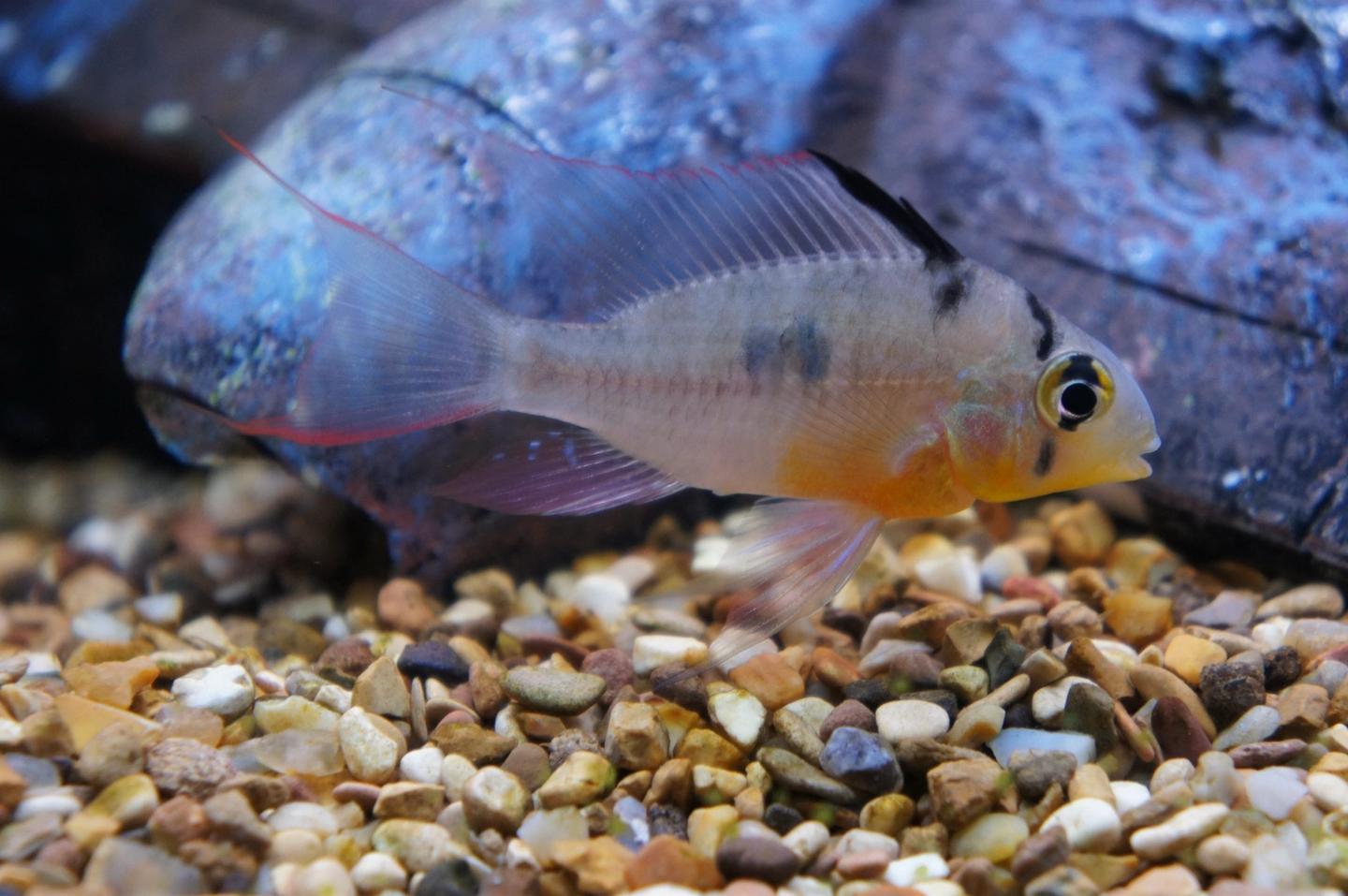
Cichlids are a family of roughly 1,800 accepted species, not one care type. Before buying, identify the exact species and source, then compare adult measurement, usable tank dimensions, social system, territory, tested water, diet and an exit plan. No family-wide minimum tank, water range or tank-mate list is safe.
Maintain these water conditions for optimal health and vibrant colors
Neon Spot Mbuna is a compact-looking but assertive rock-dwelling Lake Malawi cichlid sold in the aquarium trade under names including Pseudotropheus sp. neon spot, Elongatus Neon Spot and Jewel Spot. The most careful working name for this listing is Chindongo sp. 'elongatus spot'. That wording matters: similar forms have circulated under the same trade name, and the supplier catalogue does not establish a collection locality or prove that these fish are the formally described species Chindongo elongatus.
This is a specialist mbuna for a mature, hard-water Malawi aquarium, not a peaceful community fish. Plan around territorial behaviour from the beginning: a long footprint, secure rock structures, strong biological filtration, high oxygen, stable alkaline water and a stocking plan made for the whole aquarium. Each quantity is one unsexed fish of the selected grade, not a pair or the supplier’s wholesale pack. Current options are 3–4 cm, 4–5 cm, 6–7 cm and XL; XL has no exact centimetre band stated. The fish are offered in selectable size variants on this page. Choose by the size shown in the live selector, then judge compatibility by the fish already in your tank rather than by colour alone.
| Planning point | Evidence-led guidance | Why it matters |
|---|---|---|
| Trade name | Neon Spot Mbuna / Elongatus Neon Spot | Useful for finding the fish in the hobby, but not a locality-level identification. |
| Working scientific name | Chindongo sp. 'elongatus spot' | A cautious name that does not claim the fish is proven C. elongatus. |
| Origin group | Rock-dwelling Lake Malawi mbuna | Explains the need for alkaline water, rock structure, oxygen and territorial planning. |
| Planning size | Allow for up to 12 cm because the supplier lists that maximum | A specialist profile reports smaller typical adults, so the larger figure is the safer aquarium-planning boundary. |
| Aquarium | 250 litres and 100 cm length as a conservative starting point | Footprint and broken sight lines matter more than height for a territorial rock fish. |
| Experience | Best for an experienced Malawi keeper | Aggression and chemistry are less forgiving than in a general tropical community. |
The profile above is a planning guide, not a promise that every individual will reach the same size, colour or aggression level. Juveniles can appear calm in a retailer's holding system and become much more territorial as they mature. Likewise, a fish that is less dominant in one group can become the principal territory holder after a move. Build the aquarium for adult behaviour before the fish arrives.
The aquarium trade often retains names long after scientific classifications change. Pseudotropheus was historically used as a broad home for many elongate mbuna. A 2016 taxonomic revision established Chindongo for a group of small, rock-dwelling Lake Malawi cichlids and showed why the old elongatus grouping could not be treated as one simple species. The accepted species Chindongo elongatus still exists, but that does not make every fish sold as Elongatus or Neon Spot that species.
Specialist Malawi references use Chindongo sp. 'elongatus spot' for the Neon Spot/Jewel Spot trade form and warn that closely resembling populations can be confused. Collection locality is especially important in Lake Malawi cichlids because fish that look similar may represent separate geographical forms. The supplier catalogue gives the trade name and grades but no locality. We therefore keep the useful historic wording in the explanation while avoiding false certainty in the product title.
| Name seen online | How this listing uses it | Confidence |
|---|---|---|
| Neon Spot Mbuna | Primary common name | High as a trade identity |
| Elongatus Neon Spot / Jewel Spot | Recognised alternative trade wording | Useful, but may cover similar forms |
| Pseudotropheus sp. neon spot | Supplier and legacy hobby name | Historical placement, not current proof of genus |
| Chindongo sp. 'elongatus spot' | Cautious working scientific name | Best fit for an unlocalised trade form |
| Chindongo elongatus | Not asserted for the sale fish | Valid species, but this shipment lacks evidence needed for that identification |
Treat the working name as a qualified trade-form label, not a formal species or locality guarantee. If maintaining a locality-focused breeding line, ask for dependable breeder or collection records rather than inferring identity from a shopping name.
Choose Neon Spot Mbuna if you already understand the basics of cycling, water testing and cichlid behaviour and are prepared to manage a purpose-built Malawi aquarium. It can suit a keeper who enjoys observing territories, grazing and social hierarchy, and who is willing to change the layout or separate fish if aggression becomes unsafe. It is not a sensible impulse purchase for an empty cave in a mixed tropical tank.
Before ordering, identify every existing fish by adult size, water requirements, diet, body shape and likely aggression. Check the aquarium's actual length and volume, not the number in its model name. Test source water as well as tank water. Use our tank volume calculator and water matcher to expose common planning gaps, then read the broader Lake Malawi cichlid guide.
Neon Spot Mbuna is not a community clean-up fish, a guaranteed algae controller, a snail solution or a way to make a small aquarium look busier. Natural grazing is part of mbuna behaviour, but it does not replace maintenance, and territorial pressure can make an already crowded aquarium less stable.
A specialist form profile recommends 250 litres and a minimum tank length of 100 cm. We use that as the conservative starting point for this listing. Volume alone is not enough: a tall 250-litre aquarium with a short base can provide less usable territory than a longer tank of similar capacity. Adult stocking, sex distribution, filtration capacity and the shape of the rockwork can all justify going larger.
The supplier lists a maximum size of 12 cm, while a specialist Neon Spot profile reports males around 8 cm and females around 7 cm. Those figures are not necessarily contradictory; trade-form identity, sex, age and husbandry can affect reported sizes. For planning, allow for the supplier's larger upper figure. Never calculate capacity from the juvenile size selected at checkout.
| Question | Safer decision | Unsafe shortcut |
|---|---|---|
| Is 250 litres automatically enough? | Only after checking length, rock footprint, existing adults and filtration. | Assuming the printed volume guarantees compatibility. |
| Can a juvenile live in a small tank temporarily? | Prepare the adult aquarium before purchase. | Buying now and planning an upgrade after aggression starts. |
| Does more rock always help? | Create several stable territories and broken sight lines while preserving water flow. | Filling the tank with unstable piles or dead-flow pockets. |
| Can crowding reduce aggression? | Discuss any deliberate density strategy with an experienced Malawi keeper and match filtration and maintenance. | Adding fish at random to distract an aggressor. |
Lake Malawi cichlids need stable, mineral-rich alkaline water. OATA's general guidance for African Malawi cichlids is 23-27°C, pH 8.0-8.6, GH 12-18 and KH 10-15. The supplier catalogue for this trade form gives 24-26°C, pH 7.5-8.5 and 10-30 dGH. A practical plan is to keep the aquarium stable within the overlapping hard, alkaline range and to avoid chasing a number with unmeasured additives.
| Parameter | Planning range | Management note |
|---|---|---|
| Temperature | 23-27°C; supplier range 24-26°C | Use a reliable heater and independent thermometer; stability is more valuable than daily adjustment. |
| pH | 8.0-8.6 general Malawi guidance | Know tap-water pH and KH before buffering. Sudden pH change is dangerous. |
| GH | 12-18 general Malawi guidance | Measure hardness rather than assuming local hard water is suitable. |
| KH | 10-15 general Malawi guidance | Adequate carbonate hardness helps resist an unexpected pH fall. |
| Ammonia | 0 mg/L | Any detectable result needs immediate investigation and controlled corrective action. |
| Nitrite | 0 mg/L | Also toxic; do not treat heavy breathing as aggression until water has been tested. |
| Nitrate | No more than 20 mg/L above tap-water level | Track the difference between source and aquarium rather than quoting tank nitrate without context. |
Test before a water change and again after any unexplained change in behaviour. Keep a simple log of temperature, pH, ammonia, nitrite and nitrate so a trend is visible. If your source water is much softer or less alkaline, research a repeatable remineralisation method before buying fish. Do not alternate between untreated tap water and heavily buffered replacement water.
Use a mature biological filter sized for the actual stock and feeding load, with enough circulation to prevent low-oxygen pockets behind rockwork. OATA recommends oversized filtration and strong aeration for Malawi cichlids. There is no single hourly turnover number that proves a system is adequate because filter design, media, head height, stocking and maintenance differ. Judge the system by zero ammonia and nitrite, controlled nitrate, clear flow through the whole layout and normal fish respiration.
Complete the nitrogen cycle before adding the fish. A tank is not mature because it has run for a fixed number of weeks or because the water looks clear. It is ready when the biological filter can process the expected waste and repeated testing supports that conclusion. Protect the filter colony during maintenance: rinse biological media in removed aquarium water where appropriate, avoid replacing all media together and never let mature media dry out.
Add surface agitation or an air-driven component if oxygenation is weak, especially in warm water or heavily stocked systems. Rapid gill movement, gathering near an outlet or gasping at the surface can indicate oxygen or water-quality trouble and requires testing, not guesswork.
Build the hardscape before the fish arrives. Place stable base rocks securely so digging cannot undermine them, then create several routes, caves and visual barriers. The aim is not to provide one perfect cave that a dominant fish can control from end to end. A better layout interrupts direct pursuit and gives subordinate fish more than one escape path.
Fine sand or smooth, easy-to-clean substrate suits a Malawi display, but substrate choice is secondary to stability and hygiene. Keep intake guards and heater placement clear. Check that water can move around and behind the structure and that trapped food can be siphoned. Tough attached plants may survive in some mbuna aquariums, but planting is optional and should not replace rock cover. Expect digging and grazing.
Treat this form as an algae-grazing, herbivore-leaning mbuna. Use a reputable spirulina- or algae-rich Malawi food as the staple, offered in measured portions that the group consumes promptly. A relevant option is Tropical Malawi Mbuna Flakes, but no food is automatically correct in unlimited amounts. Read its label, consider the other species in the tank and remove uneaten material.
Natural aufwuchs is more complex than algae alone: it includes microorganisms and organic material on rock surfaces. That does not justify a rich, meat-heavy captive diet. Avoid mammalian meat and do not make bloodworm or other rich foods the routine staple. Sudden diet changes, overfeeding and poor water quality are common, preventable stressors. Feed the aquarium you have, not an internet schedule copied without regard to fish number, food density or filtration.
| Food choice | Role | Use with care |
|---|---|---|
| Algae-rich Malawi flake or small herbivore pellet | Regular staple | Use portions the group finishes without food settling behind rocks. |
| Appropriate vegetable matter | Occasional variety | Prepare safely and remove leftovers before they decay. |
| Natural algae and biofilm on rocks | Grazing enrichment | Helpful behaviourally, but not a complete measured diet on its own. |
| Rich animal-protein foods | Not a routine staple | Do not copy diets designed for predatory or insectivorous cichlids. |
| Mammalian meat | Avoid | It is not an appropriate mbuna food. |
Watch body condition and faeces rather than trying to intensify colour through overfeeding. A fish that stops eating, swells, isolates itself or produces abnormal waste needs prompt investigation. Test water first and seek experienced aquatic or veterinary advice rather than applying medication blindly.
Neon Spot Mbuna is territorial and can be highly aggressive. There is no universally safe tank-mate list. Success depends on aquarium length, rock layout, the number and sex of each fish, maturity, relative size, visual similarity, feeding competition and the temperament of individuals. A combination that works in a large, established aquarium may fail in a smaller tank.
Avoid peaceful soft-water fish, long-finned fish, very small species and invertebrates you expect to remain undisturbed. Do not assume all Lake Malawi cichlids can live together. Closely resembling mbuna may provoke intense rivalry, while peacocks and other non-mbuna can differ in diet, habitat use and ability to withstand harassment. Mixing fish simply because they share a lake label is not a stocking plan.
| Compatibility check | Proceed only when | Stop or redesign when |
|---|---|---|
| Water chemistry | Every species thrives in the same hard, alkaline range. | A proposed companion needs soft or acidic water. |
| Diet | All fish can receive an appropriate diet without one group being overfed. | A carnivore-rich feeding plan conflicts with mbuna digestion. |
| Adult size and confidence | Fish are robust enough for the same system and have escape space. | One species is delicate, slow, long-finned or small enough to be relentlessly targeted. |
| Visual similarity | You have specialist evidence and enough space to manage rivalry. | Two males resemble each other and the tank offers one obvious territory. |
| Contingency | A divider, spare cycled tank or rehoming route is ready. | There is nowhere safe to put a fish if chasing escalates. |
For comparison rather than automatic cohabitation, you can review the separately listed Yellow Elongatus form, Demasoni Mbuna and Powder Blue Cichlid. Their pages help compare identity and care, but none is endorsed here as a guaranteed companion. Browse the wider African cichlid range only after defining the aquarium's stocking limits.
The supplier does not guarantee sex, and juvenile sexing can be unreliable. Some hobby guidance recommends one male with several females for aggressive mbuna, but a fixed ratio should not be treated as a promise for an unlocalised trade form. A group can contain more males than expected, and a male may direct pressure at one female despite the nominal ratio. Aquarium footprint and individual behaviour remain decisive.
If you intend to build a breeding or species group, ask what sizes are currently available and plan for uncertain sex. Introduce fish with care, observe continuously during the first hours and days, and be ready to alter the hardscape or separate an aggressor. Do not add a single smaller individual to an established adult territory without a specialist plan.
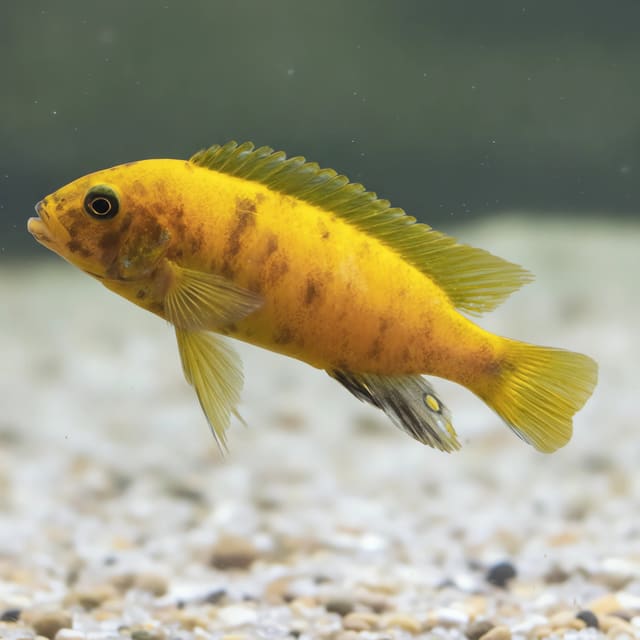
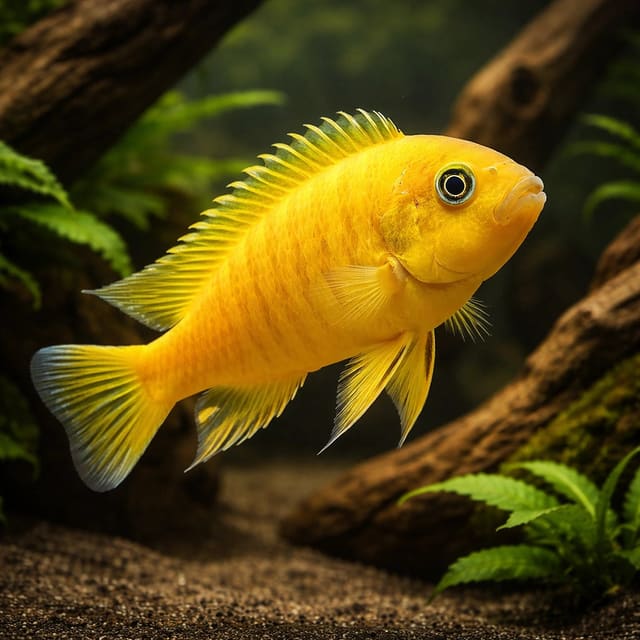
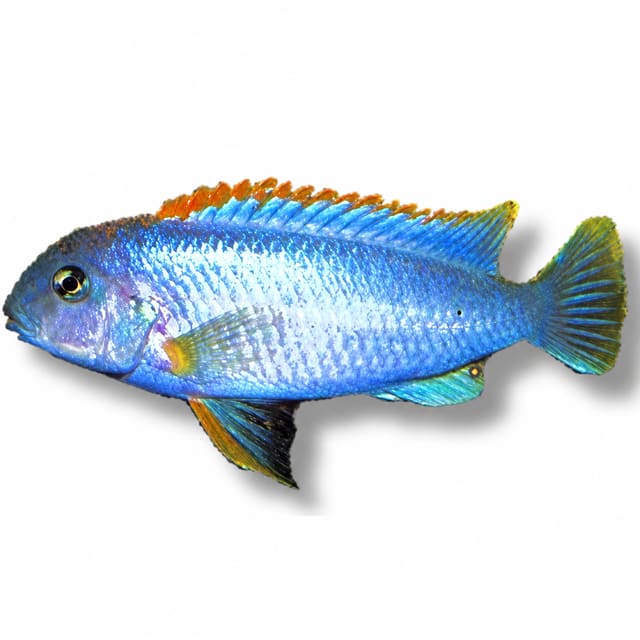
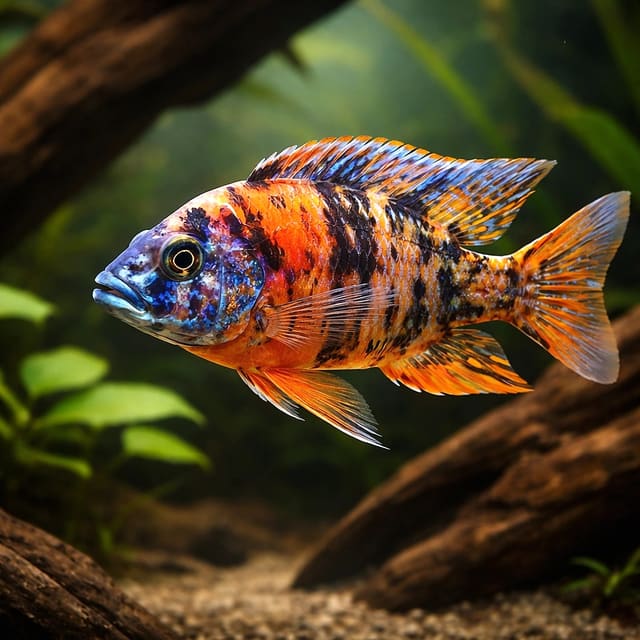
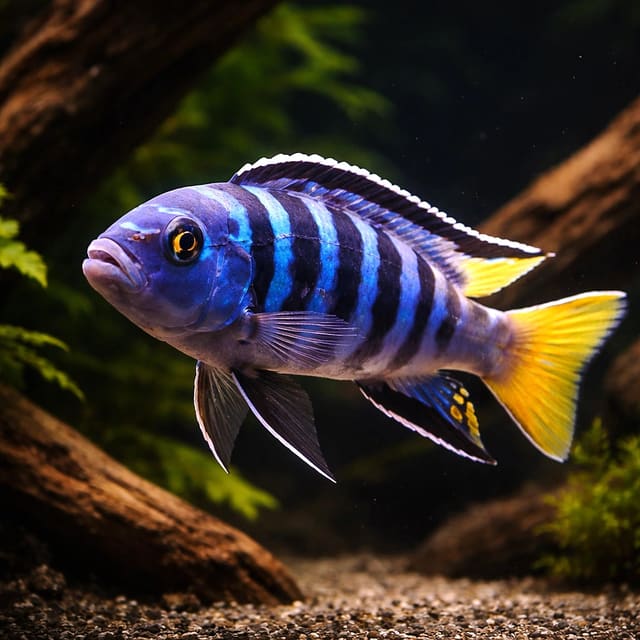
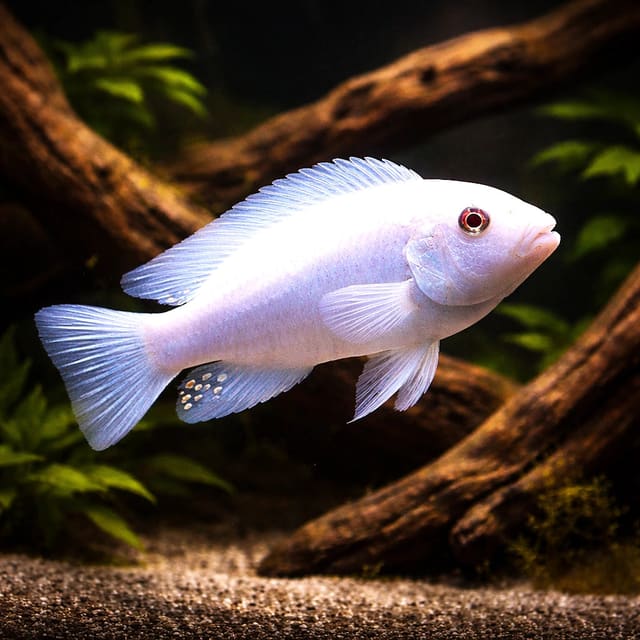
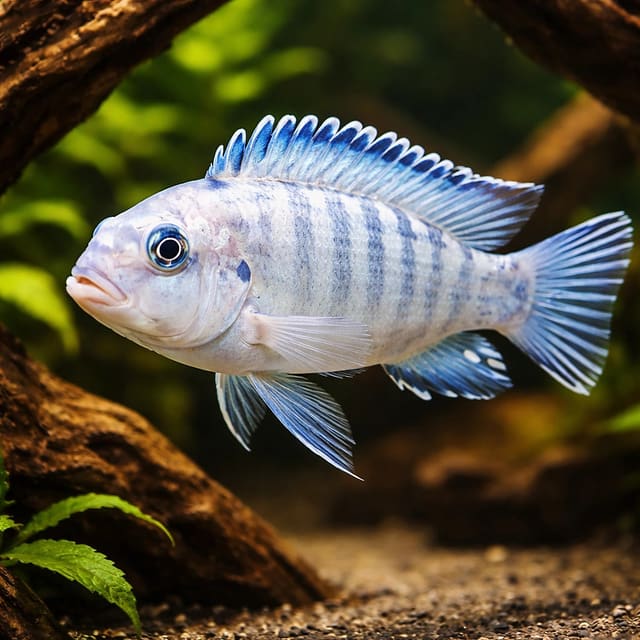
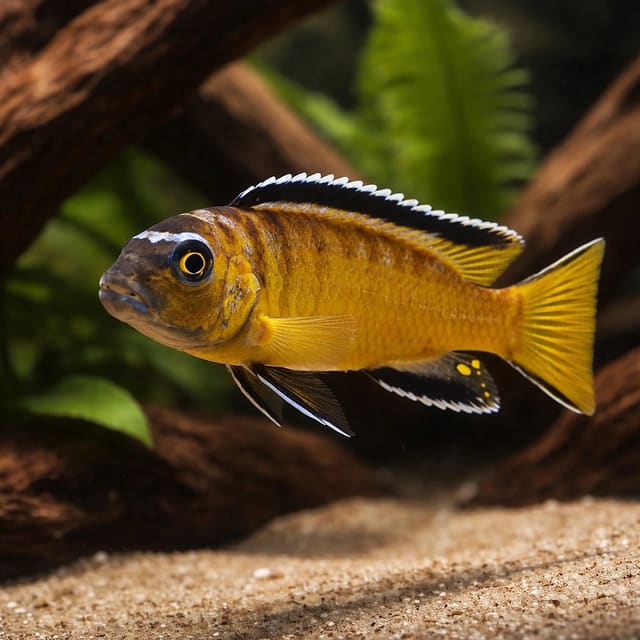
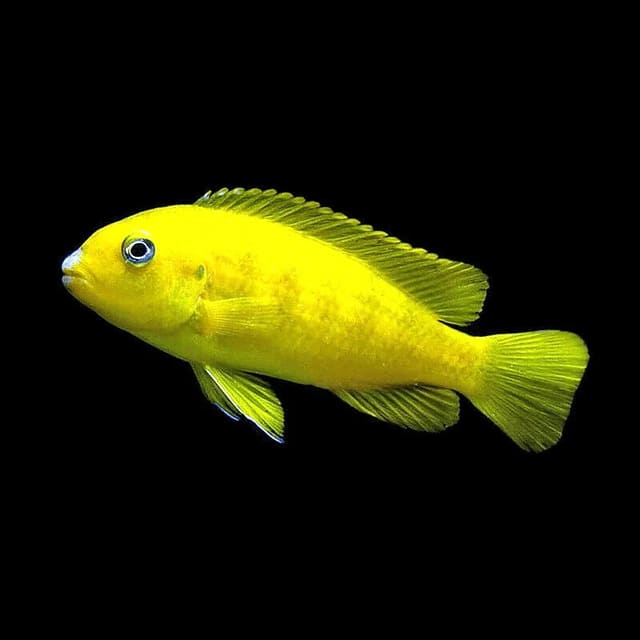
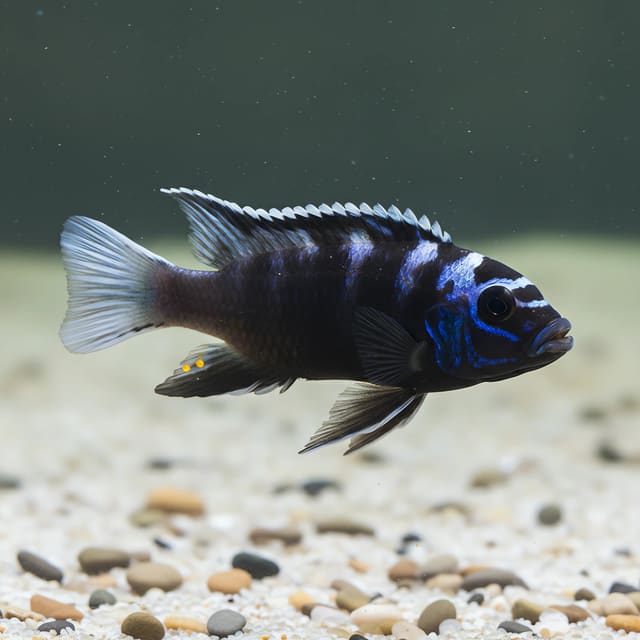
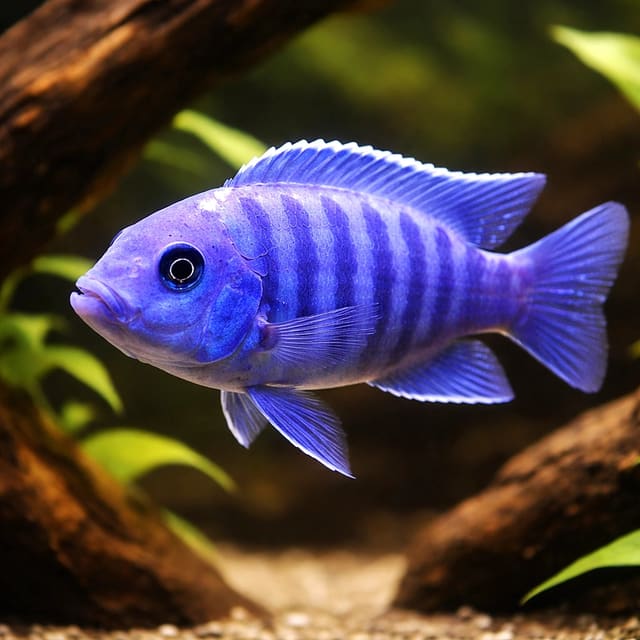
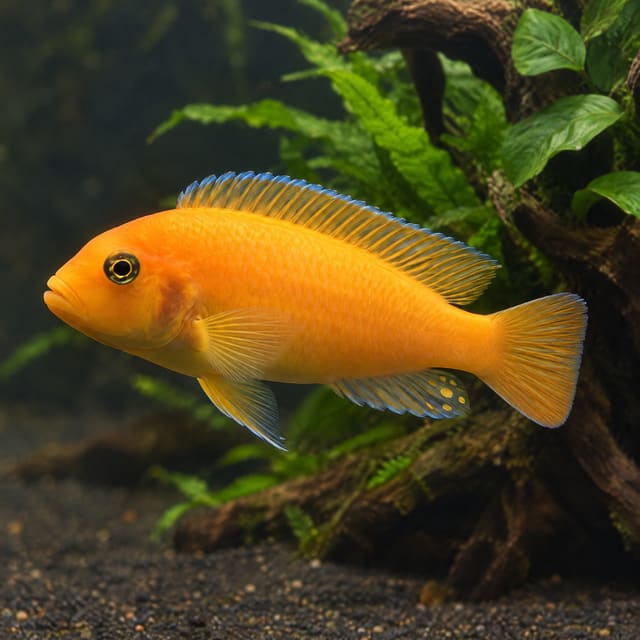
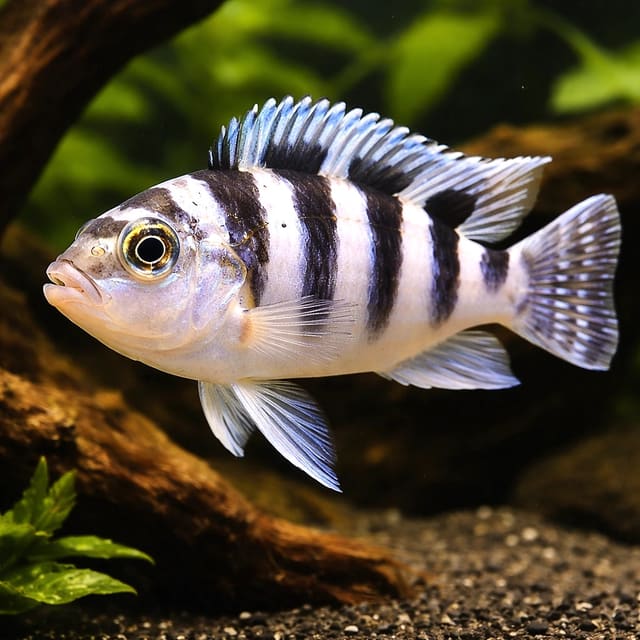
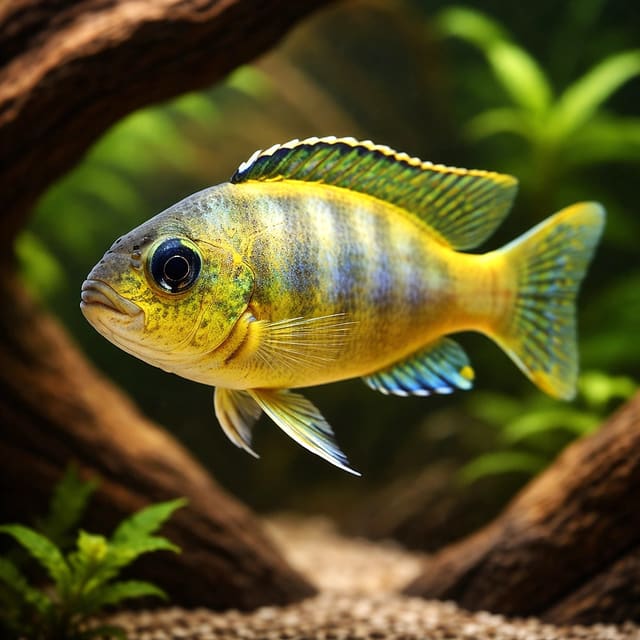
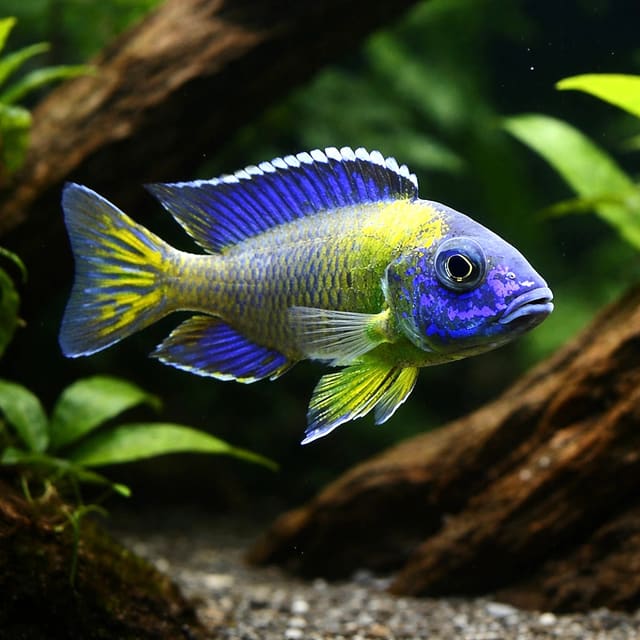
Fish sold under Neon Spot names are usually sought for dark blue to blackish body colour with brighter blue spotting or short markings, but trade forms and individuals vary. Dominance, sex, age, stress, lighting and background can all change the apparent colour. Juveniles may not resemble a dominant adult, and an exact pattern cannot be selected from a representative gallery.
The gallery is representative, not a guarantee of the individual fish supplied. Markings, sex, locality and adult colour are not established by these views. The live size selector identifies the ordered grade, and a two-fish scene does not create a pair offer. Exact capture or creation provenance is not certified.
Use the gallery for appearance context, not to override the qualified trade identity or the aquarium’s care and stocking requirements.
Prepare a separate, fully cycled quarantine aquarium before delivery. Match its temperature and hard-water chemistry closely enough to avoid an abrupt transition, while still following the acclimation information provided with the order. Quarantine gives you time to observe appetite, breathing, fins, waste and behaviour without exposing an established display or forcing a new fish immediately into an adult hierarchy.
| Stage | What to do | What to avoid |
|---|---|---|
| Before dispatch | Confirm tank cycle, water results, spare equipment and delivery availability. | Ordering before the adult setup or quarantine tank is ready. |
| On arrival | Follow the supplied acclimation steps and check the fish promptly. | Leaving a live-fish parcel unattended or exposing bags to temperature extremes. |
| Quarantine | Observe feeding, breathing, fins, body condition and waste in stable water. | Preventive medication without a diagnosis or water-quality check. |
| Display introduction | Review layout, reduce immediate territorial advantage and monitor closely. | Releasing a smaller newcomer into one dominant fish's only cave. |
| After introduction | Check all fish repeatedly and keep a separation plan ready. | Assuming chasing is harmless because there are no visible wounds yet. |
Read the current live-fish delivery information before choosing a delivery week, especially for postcode restrictions, and review the Live Arrival Guarantee terms. The guarantee covers qualifying arrival issues under the published claim process; it is not a substitute for a cycled aquarium, suitable water or post-arrival husbandry.
Use testing and observation to set the maintenance rhythm. Perform regular partial water changes with replacement water matched for temperature and chemistry. Siphon accessible waste, clean flow paths and inspect equipment, but avoid dismantling the entire territory map or sterilising all filter media at once. Large, abrupt changes can destabilise both water chemistry and social boundaries.
Each week, compare current results with the aquarium log, inspect rock stability and look for a fish that is eating less, hiding in one corner or being excluded from food. Aggression often appears first as restricted access rather than dramatic fighting. A subordinate fish that cannot rest or feed needs intervention even if its fins are still intact.
Any detectable ammonia or nitrite requires immediate attention. Check for a dead fish, overfeeding, filter interruption, damaged media or a sudden increase in bioload. Use controlled water changes and expert advice appropriate to the measured problem. Do not conceal an environmental failure with random medication.
Specialist references describe the elongatus-spot form as a maternal mouthbrooder, consistent with mbuna reproduction. A female carries developing eggs and fry in her mouth after spawning. That broad behaviour is useful to recognise, but this listing does not promise that sexed fish, a breeding pair or a particular male-to-female ratio will be supplied.
We also do not assign a simple breeding rating or promise a fixed holding period. Temperature, maturity, stress and the identity of the form can affect observations. A brooding female may eat little and can be vulnerable to harassment. If breeding is the goal, research a species-group plan, prepare a quiet recovery or rearing space and avoid stripping eggs unless you already have the skills and a clear welfare reason.
A healthy mbuna should be alert, maintain normal balance and respiration, respond appropriately to food and move confidently through the aquarium. Warning signs include rapid breathing, surface gasping, clamped fins, abnormal swelling, repeated spitting of food, white or unusual waste, loss of balance, isolation, persistent darkening, wounds or being trapped away from food.
Start with evidence: test ammonia, nitrite, nitrate, pH and temperature; confirm flow and oxygen; review recent additions, diet and aggression. Similar symptoms can have very different causes. Seek a fish-experienced aquatic professional or veterinary surgeon when the cause is unclear or the fish deteriorates. Medication selected from one symptom can delay the correct response and can damage biological filtration.
Repeated chasing, blocked access to food, confinement above the filter or behind equipment, torn fins and rapid weight loss are not a normal price of keeping mbuna. Change the layout, separate fish or revise stocking before chronic stress becomes injury or disease.
Use the live variant selector for the size currently available and check the whole aquarium plan before ordering. Each quantity buys one unsexed fish of the selected grade; prices and stock can change independently of this guide.
Read the current delivery and live-arrival terms for eligibility, receiving steps and guarantee conditions. Check any current offers at checkout rather than relying on an old discount code; no universal next-day delivery is promised.
Ordering should be the final step, not the first. Confirm water chemistry, cycle evidence, adult space, quarantine capacity and a separation route. If the aquarium is not ready for an aggressive Malawi mbuna, save the product and return after the setup is stable.
Comparison is most useful for understanding care, not assembling a tank-mate list. Yellow Elongatus, Demasoni and Powder Blue cichlids can all be territorial rock-dwelling Malawi fish, but identity, adult size, diet, aggression and visual similarity differ. Closely related appearance can increase conflict rather than guarantee a natural group.
| Listing to compare | Useful comparison | Do not assume |
|---|---|---|
| Neon Spot Mbuna | Dark, blue-marked elongatus-spot trade form with uncertain locality. | Every fish has the gallery colour or is accepted C. elongatus. |
| Yellow Elongatus form | Shows why similar elongatus trade names can represent visually distinct forms. | Two elongatus-labelled males will tolerate each other. |
| Demasoni Mbuna | Another small-looking Chindongo that still requires serious aggression planning. | Small adult dimensions mean a small or peaceful aquarium. |
| Powder Blue Cichlid | Another hard-water rock-dwelling Chindongo for care comparison. | Shared genus makes it a safe companion. |
The cautious working name is Chindongo sp. 'elongatus spot'. Pseudotropheus sp. neon spot is retained as legacy supplier and hobby wording. The shipment lacks locality evidence needed to claim that it is the accepted species Chindongo elongatus.
The names are often used for similar elongatus-spot forms, but specialist references warn that more than one lookalike may circulate under these trade names. Treat the names as useful shopping terms, not proof of one exact geographical population.
A specialist form profile reports males around 8 cm and females around 7 cm, while the supplier lists a maximum of 12 cm. Because the trade identity is not locality-confirmed, plan the aquarium for the larger supplier figure and never use the juvenile sale size as the adult limit.
Use 250 litres and at least 100 cm of tank length as a conservative starting point. Existing stock, sex distribution and mixed-species plans can require considerably more space. Footprint, stable territories and escape routes matter more than volume alone.
We do not recommend 200 litres as the default for this listing because the specialist form reference recommends 250 litres. A nominal volume also says nothing about tank length, rock displacement, adult stocking or filtration.
General OATA Malawi guidance is 23-27°C, while the supplier gives 24-26°C. A stable temperature in the overlapping range is sensible. Verify it with an independent thermometer and acclimate carefully if the current holding water differs.
Plan for hard, alkaline Malawi water. OATA gives pH 8.0-8.6, GH 12-18 and KH 10-15 as general guidance. Test tap and aquarium water before using buffers; consistency and measured adjustment are essential.
Yes. It is territorial and can be highly aggressive, particularly as fish mature or territories change. Dense but stable rockwork, broken sight lines, adequate footprint and a separation plan are essential, but no layout guarantees harmony.
No. Peaceful soft-water species, long-finned fish and very small community fish are poor choices because both water chemistry and behaviour conflict with a specialist mbuna setup.
There is no universal list. Compatibility depends on sex, adult size, resemblance, aquarium length, territory design, diet and individual behaviour. Related product links on this page are for care comparison, not guaranteed cohabitation.
That pattern is common in mbuna guidance, but the supplier does not guarantee sex and this form is not locality-confirmed. Do not buy a fixed number assuming the ratio will be correct or safe. Plan for uncertain sex and monitor individuals.
Use an algae-rich, herbivore-leaning Malawi flake or small pellet as the staple, in controlled portions. Avoid mammalian meat and do not make rich animal-protein foods the routine diet. Remove leftovers and watch body condition.
It naturally grazes rock surfaces, but it is not a clean-up fish and cannot replace glass cleaning, waste removal, water changes or nutrient control. Buy it for a suitable Malawi display, not as maintenance equipment.
It is best for a keeper already comfortable with cycling, hard-water chemistry and aggressive cichlid management. A careful newcomer can learn those skills first, but this is not a forgiving first fish for a small mixed aquarium.
Not from this listing unless a live variant explicitly says so. Sex may be uncertain at juvenile sizes, and colour varies with individual, maturity, dominance, stress and lighting. Gallery images are representative rather than exact-fish photographs.
An individual fish is not guaranteed to match a gallery image. Exact markings, sex, locality or adult colour are not certified, and the two-fish view does not establish a breeding pair. Capture or creation provenance is not certified here.
Specialist sources describe the elongatus-spot form as a maternal mouthbrooder. This listing does not guarantee sexed fish, a breeding group, a particular difficulty level or a fixed holding period.
Prepare a cycled quarantine aquarium, tested hard alkaline water, appropriate food, secure cover, a reliable heater and a separation plan. Read the live delivery and guarantee terms and make sure someone can receive the order in the confirmed window.
The principal references are the Catalog of Fishes record for Chindongo elongatus, the 2016 revision of the Pseudotropheus elongatus group, OATA’s African Malawi cichlid care sheet, and the previously cited specialist elongatus-spot profile (its old page address is unavailable). A genus revision or described-species record does not identify this unlocalised stock. General Malawi guidance and the existing retailer planning recommendations are not current holding-water measurements or a batch-tolerance guarantee.
No reviews for this item yet. Bought one? Honest reviews only, good or bad.
What customers say about ordering from us
I have a small group of long finned mountain minnows. So was delighted to be able to order ten of this variety to increase the genetics in my tank . The ones I recieved are healthy but it’s to early to give a verdict on wether they are of a long finned type since they are small currently.
Gordon Walker · 23 Sept 2026
100% success travel and "installation". Pleased with quality of purchase. The Siamese fighter a bit "shy" so have not yet seen him at his best yet but looking good. Happy customer. GG
George E Garratt · 21 Sept 2026
Reviews of our shop, collected by Judge.me, an independent third-party review collector. Newest first.