Advanced
Neon Spot Mbuna (Chindongo sp. 'elongatus spot')
23–27°C · pH 8–8.6 · 250L
£13.99

One unsexed William's Mbuna (Maylandia greshakei) in the selected size. A territorial Lake Malawi cichlid for an established hard-water mbuna aquarium with extensive rockwork and a separation plan.
Adult size is the maximum length this species reaches at full maturity (scientific sources). The livestock you receive will be younger and smaller — pick a size above for the actual shipping size. Product-photo provenance and any image-specific limitations are stated on the listing.
Maylandia greshakei
Shoaling fish: kept in a group they feel safer, stay calmer and show their best colour.
Confirm your email, then we’ll send an availability message for this exact item if it returns within 180 days.
This request is only for this product—no newsletter or other promotions. A mail-provider retry may very rarely duplicate the same availability message. Unconfirmed addresses are removed after 48 hours. See our privacy policy.
One unsexed William's Mbuna (Maylandia greshakei) in the selected size. A territorial Lake Malawi cichlid for an established hard-water mbuna aquarium with extensive rockwork and a separation plan.
Adult size is the maximum length this species reaches at full maturity (scientific sources). The livestock you receive will be younger and smaller — pick a size above for the actual shipping size. Product-photo provenance and any image-specific limitations are stated on the listing.
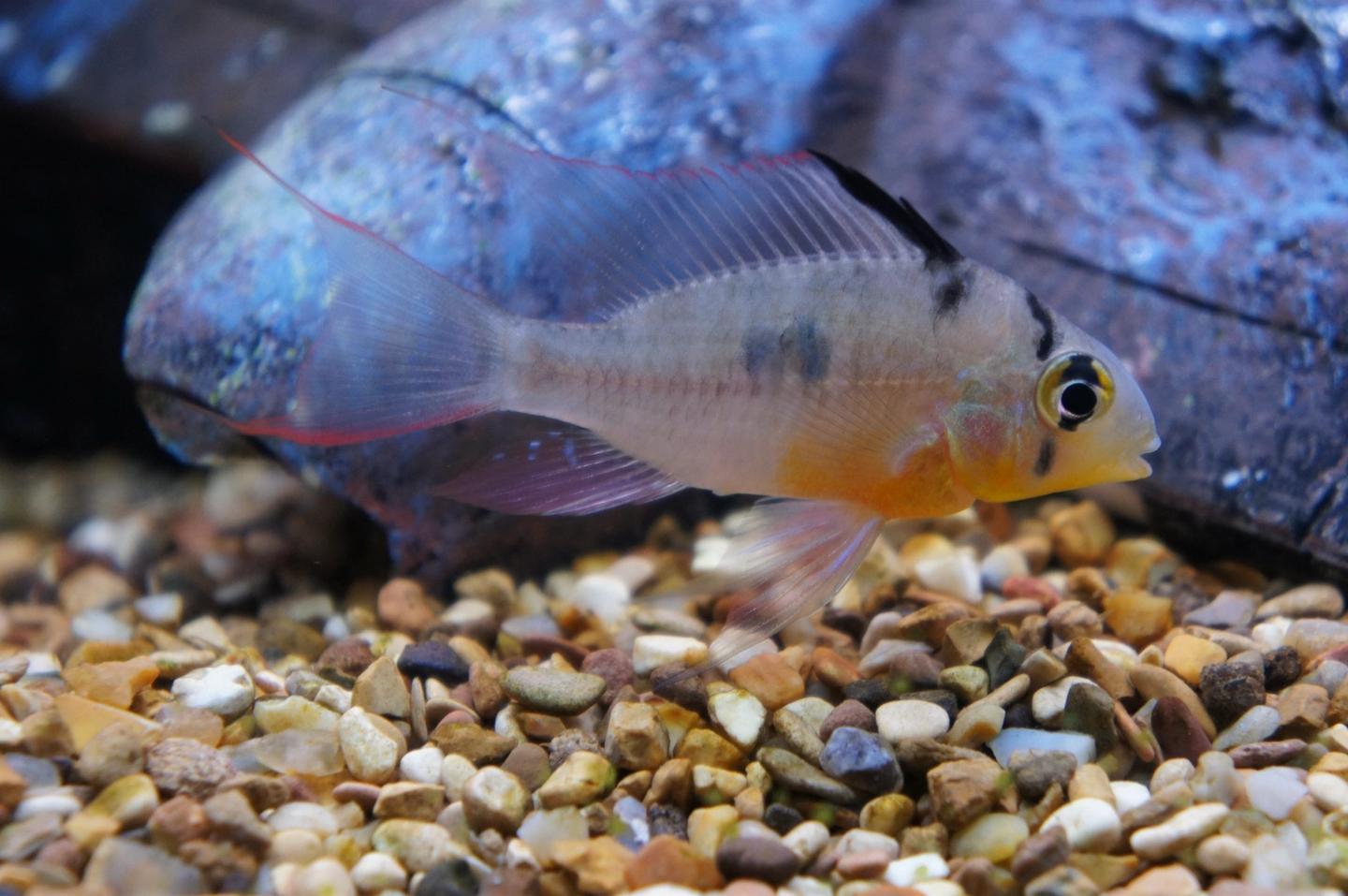
Cichlids are a family of roughly 1,800 accepted species, not one care type. Before buying, identify the exact species and source, then compare adult measurement, usable tank dimensions, social system, territory, tested water, diet and an exit plan. No family-wide minimum tank, water range or tank-mate list is safe.
Maintain these water conditions for optimal health and vibrant colors
William's Mbuna (Maylandia greshakei), also sold in the aquarium trade as Redtop Ice Blue or Ice Blue Zebra, is a territorial rock-dwelling cichlid from Lake Malawi. It is a compelling fish for an established mbuna aquarium, but its colour should not hide the commitment: an adult can reach a published 13.4 cm total length, needs hard alkaline water, uses space assertively and should be chosen as part of a complete stocking plan rather than added to a general community tank.
Each quantity is one unsexed fish in the size selected on this page. The current options are approximately 4-5 cm, 6-7 cm and XL. The supplier does not give an exact measurement for XL or state whether its centimetre bands are total length or standard length, so contact us before ordering if an exact present size is essential. No option certifies sex, a compatible pair, colour, collection locality, lineage, wild or captive origin, or the exact fish shown in the gallery.
Choose this species for a mature Lake Malawi mbuna setup with a long footprint, stable mineral-rich water, extensive rock structure, powerful filtration, several broken sightlines and a spare separation enclosure. It is not appropriate for a peaceful mixed community, a new uncycled aquarium or a keeper hoping that one cave will contain aggression.
| Planning point | Reviewed guidance | Important boundary |
|---|---|---|
| Accepted identity | Maylandia greshakei (Meyer & Förster, 1984) | Metriaclima greshakei and Pseudotropheus greshakei are historical combinations, not additional species. |
| Common names | William's Mbuna, Redtop Ice Blue, Ice Blue Zebra | Trade names describe a marketed form; they do not guarantee an individual fish's colour. |
| Adult size | Plan around the published 13.4 cm maximum total length | The supplier lists 12 cm; using the larger published figure gives safer adult planning. |
| Adult aquarium | Begin around 250 litres with at least a 120 x 50 cm footprint; larger for a group or mixed mbuna community | This is our conservative welfare recommendation, not a published biological minimum. |
| Water | 24-26°C working target; pH 7.5-8.5; supplier hardness 10-30 dGH | The supplier temperature range is 23-27°C. Stability matters more than sitting at an endpoint. |
| Temperament | Territorial and potentially highly aggressive | No universal stocking ratio or density makes incompatible fish safe. |
| Diet | Quality algae- and plant-led mbuna staple with suitable variety | A natural diet is more complex than the single label "herbivore"; portions and water quality still matter. |
| Sale unit | One unsexed fish in the selected size per quantity | Two fish in an illustrative image do not mean that a pair is included. |
The accepted name used in current taxonomic references is Maylandia greshakei. Aquarists will also encounter Metriaclima greshakei and the older combination Pseudotropheus greshakei in books, stock lists and search results. Those correctly spelled names refer to the same species in this context. A 2025 review in Zootaxa supports Maylandia as the valid genus and treats Metriaclima as its junior synonym; GBIF also places the species under Maylandia greshakei.
The incoming supplier label contained the spelling "greishakei" and older genus Pseudotropheus. That wording is retained privately as source provenance, but it should not be presented as the accepted identity or pushed into customer copy as a keyword. This page uses the accepted name while still explaining genuine synonyms so keepers can reconcile older care material.
Use: Maylandia greshakei. Recognise in older material: Metriaclima greshakei and Pseudotropheus greshakei. Do not confuse with: similarly named or similarly coloured mbuna, or with the unrelated erroneous name previously stored in this listing.
Correct identity is not cosmetic. It helps the keeper find species-relevant size, habitat, feeding and reproductive evidence, and prevents a generic African cichlid profile from being mistaken for individual-stock certification. Scientific names can change as research improves, so the sources and date at the end of this guide are part of the care information rather than decorative citations.
One unit adds one unsexed William's Mbuna in the selected size option to the basket. Selecting a larger quantity gives that number of individual unsexed fish; it does not create a bonded pair, a proven breeding group or a requested male-to-female ratio. Juvenile colour and shape are not dependable sex guarantees, and even mature visual differences cannot turn an unspecified supplier shipment into a certified-sex sale.
| Visible option | What it means | What it does not promise |
|---|---|---|
| 4-5 cm | One fish in the supplier's approximate smaller size band | Sex, final colour, exact age or a specific pictured fish |
| 6-7 cm | One fish in the supplier's approximate larger measured band | Maturity, sex, dominance or compatibility with an existing group |
| XL | One fish in the XL grade | An exact centimetre range; ask before ordering when present length is critical |
Size bands describe present sale grades, not adult aquarium requirements. A 4-5 cm fish still needs a system planned for an adult around the published maximum. Do not buy the smallest option as a way to make a small aquarium suitable temporarily: rapid growth, hierarchy changes and the difficulty of relocating an aggressive cichlid can turn that delay into a welfare problem.
The supplier does not certify sex, locality, lineage, wild or captive origin, life expectancy or exact dispatched colour. Ask a stock-specific question before ordering if any unlisted trait would decide whether the fish can enter your aquarium.
Maylandia greshakei is endemic to Lake Malawi. FishBase associates it with Makokola in the lake's south-eastern arm and records a demersal freshwater life around rocky reefs at approximately 15-35 metres. The published setting is more specific than the repeated hobby shorthand "shallow rocky shore". It points to a fish shaped by open lake water, mineral stability, oxygen, rock faces, crevices and sediment-covered surfaces rather than a soft, acidic, densely planted community habitat.
Rock is both structure and resource. Territorial males use defined areas, while the surfaces around them support natural feeding opportunities. FishBase describes feeding on phytoplankton in open water and also records use of material associated with rock biocover. The practical lesson is not to imitate the lake with an arbitrary blue background; it is to build a stable hard-water system with enough usable rock structure, open swimming lanes and visual boundaries for fish to choose distance from one another.
Lake Malawi is enormous and chemically stable compared with a household aquarium. A home tank cannot reproduce the lake's dilution, depth or spatial escape. That makes routine testing, filtration and conservative stocking more important, not less. The purpose of habitat evidence is to guide function: clean oxygenated water, hard alkaline chemistry, a long horizontal footprint and securely assembled rocks.
Provide several routes through and around the rockwork, not one central pile with a single dominant cave. A subordinate fish should be able to leave another fish's view without becoming trapped against glass or equipment.
FishBase records a maximum of 13.4 cm total length. The supplier gives 12 cm. Because total length includes the tail and because individuals do not all stop at an average, this guide uses the larger published number for planning. Adult body depth, speed, territory and waste output are more important than length alone; a 13 cm mbuna does not occupy an aquarium like a peaceful 13 cm schooling fish.
For an adult-led setup, begin around 250 litres with at least a 120 x 50 cm footprint. A larger system is preferable for multiple mbuna species, several adults or fish with closely matched colour and territory use. This is a conservative Tropical Fish Co welfare recommendation, not a claim that research established a universal litre minimum. Dimensions, rock displacement, filtration, stocking composition and available retreat space can make two tanks with the same nominal volume behave very differently.
Length and front-to-back depth deserve priority over ornamental height. A 120 cm run allows more territory boundaries than a short tall tank, while 50 cm or more of depth gives routes around structures rather than forcing every encounter along one corridor. After rock and substrate displace water, the actual volume will be lower than the box label. Use our tank volume calculator for the real internal dimensions and then plan filtration for livestock and displaced volume, not marketing capacity.
| Planning factor | Safer approach | Risky shortcut |
|---|---|---|
| Footprint | At least about 120 x 50 cm for adult planning, with more space for a mixed group | Choosing a short tall aquarium because its litre label looks similar |
| Rock displacement | Calculate the remaining water and retain open movement lanes | Filling most of the tank with one solid wall of rock |
| Separation | Keep a cycled spare enclosure or robust divider ready | Assuming a shop will always accept an aggressive fish immediately |
| Growth | Buy for the adult system already available or firmly commissioned | Treating a juvenile grade as permission to use a small temporary tank |
Use a stable 24-26°C as the everyday working target. FishBase reports 24-26°C, while the supplier gives a broader 23-27°C range. The broader range is useful for source comparison, but its endpoints should not become a reason to allow daily swings. Warmer water holds less dissolved oxygen and can raise activity and waste demand; abrupt cooling during a water change is also stressful.
The supplier lists pH 7.5-8.5 and hardness of 10-30 dGH. This is hard alkaline water, but stability matters more than repeatedly dosing the aquarium toward an exact number. Test the source water first. Where tap water already sits within a workable mineral range, consistent partial changes may be safer than frequent chemical adjustment. If remineralisation is necessary, use a measured repeatable method and verify both the prepared water and the aquarium.
Ammonia and nitrite should remain at zero, while nitrate should be kept controlled through stocking discipline, measured feeding, mature filtration and water changes. A high pH makes un-ionised ammonia more hazardous, so a cycling or filter failure can become serious quickly. Our aquarium water chemistry guide explains the nitrogen cycle and testing, while the tropical fish temperature guide covers heater choice and measurement.
A rapid pH or temperature correction can be more harmful than a stable value near the appropriate range. Prepare replacement water consistently, match temperature closely and make chemistry changes gradually.
Build rockwork on a stable base before adding loose substrate around it. Mbuna dig and investigate gaps, so a heavy stack resting only on movable sand can shift. Use aquarium-safe rock with secure contact points; do not lean unstable piles against the glass or create narrow traps. Adhesive or purpose-built supports may be appropriate where a structure cannot be made mechanically stable.
Create several distinct zones rather than a single showpiece cave. Low passes, high blocks, partial screens and open lanes let fish move without maintaining constant eye contact. Caves should have usable entrances and exits where possible. A structure that looks complex from the front may still form one uninterrupted line of sight from end to end, so inspect it from each side before livestock is introduced.
Sand or fine smooth gravel is practical, provided waste can be reached during maintenance. Pale substrate can reflect light and alter how colour looks, while dark rock can increase contrast; neither guarantees a particular fish will become ice blue or develop a red top. Hardy plants may survive if fixed to decor, but this species does not need a planted layout and may dig or damage vulnerable growth. Plant choice should never reduce the space and rock structure required for aggression management.
Rearranging some rockwork before introducing a new fish can disrupt established territories, but it is not a cure for an incompatible stocking plan. Make changes with the fish's safety in mind, ensure all rocks remain secure and keep a way to remove an aggressor. Decor should support management, not serve as a substitute for monitoring.
A mbuna aquarium needs mature biological filtration and enough mechanical capture to handle active fish, frequent feeding and waste around rockwork. Choose equipment for the stocked system, not merely the empty tank volume printed on a box. Maintain surface movement and oxygenation without creating a layout where a weaker fish must remain in exhausting flow to avoid aggression.
Use pre-filters or accessible mechanical media where practical, and clean them often enough to stop trapped organic matter becoming a hidden nutrient source. Biological media should be rinsed in removed aquarium water or otherwise maintained according to the manufacturer's instructions without sterilising the entire filter at once. Keep spare parts and a response plan for pump or heater failure.
Rock-heavy tanks accumulate debris behind and beneath structures. Direct flow to reduce dead areas, but still siphon accessible waste during water changes. Check that intake guards are secure, heaters cannot be pinned by moving stones and cables do not create gaps in the cover. A water change schedule should respond to test results and stocking load; it should not be copied as an identical percentage for every aquarium.
| Check | Routine | Action signal |
|---|---|---|
| Temperature | Read a separate thermometer daily | Unexpected drift, heater cycling continuously or fish clustering near flow |
| Ammonia and nitrite | Test after setup, additions, filter work or any health concern | Any detectable result requires immediate investigation and protective water management |
| Nitrate and pH | Track consistently before water changes | A rising trend or pH instability means the maintenance and stocking plan needs review |
| Filter flow | Observe return flow and inspect mechanical media | Reduced flow, unusual noise, trapped waste or loss of surface movement |
| Social behaviour | Watch all fish at feeding and from a distance | One fish excluded from food, pinned in a corner or unable to rest out of view |
William's Mbuna is territorial. Aggression is not limited to dramatic biting; persistent following, blocking food, controlling a cave, pinning another fish above the rocks and denying a resting route can cause chronic stress before visible injury appears. Behaviour may change as juveniles mature, after a water change, when rockwork is moved or when a dominant fish is removed.
No single formula guarantees harmony. Advice to keep one male with several females assumes accurate sexing, adequate room, an appropriate group and the ability to remove fish. Those conditions are not certified by this unsexed retail listing. Advice to "overstock mbuna" also needs context: higher density can sometimes spread attention in a deliberately designed expert system, but it increases waste, oxygen demand, disease exposure and the number of possible conflicts. It does not make a small tank suitable or erase individual aggression.
Plan the whole community before purchasing. Compare adult size, diet, water chemistry, body shape, colour similarity and expected territory use. Close-looking forms can trigger conflict and may hybridise if males and females of related or similar species are mixed. If preserving identity matters, avoid combinations where females or juveniles cannot be distinguished reliably.
Have a cycled spare aquarium, safe divider or equivalent full-support enclosure ready before adding territorial cichlids. A breeder box is not long-term accommodation for a fish being attacked or doing the attacking.
This fish belongs in a planned Lake Malawi mbuna aquarium, not a general tropical community. Small tetras, guppies, shrimp, timid fish, slow long-finned species and soft-water animals are unsuitable. A generic claim that "other mbuna" are good tank mates is also too broad: another mbuna may be much more aggressive, visually too similar, differently sized or poorly matched in diet.
Potential companions should tolerate the same hard alkaline water and active social environment without being likely prey or permanently intimidated. Even then, compatibility remains individual and layout-dependent. Introduce only when quarantine is complete, the main aquarium has spare capacity and a separation plan is already operational. Do not rely on adding fish after lights-out as the only protection.
| Candidate | Default assessment | Reason |
|---|---|---|
| Planned, differently patterned mbuna of comparable adult robustness | Possible with advanced planning | Water needs may align, but aggression, diet, sex ratio and visual similarity still need assessment. |
| Another William's Mbuna | High caution | Two unsexed fish are not a pair; same-species territorial pressure can be severe. |
| Peacock cichlids and timid haps | Generally avoid in a routine setup | Many are less able to withstand persistent mbuna pressure and may need a different feeding approach. |
| Small community fish, shrimp or snails | Avoid | Predation, harassment, injury and incompatible water requirements are likely concerns. |
| Closely related or similarly coloured zebra-type forms | Avoid when identity matters | Increased aggression and hybridisation or misidentification risk. |
For broader planning, read the cichlid care guide and browse the Lake Malawi cichlid guide. The Metriaclima-labelled collection helps reconcile older catalogue naming, but category membership is not a compatibility recommendation.
Natural feeding evidence is more nuanced than the copied label "herbivore". FishBase reports phytoplankton feeding in open water and feeding associated with rock biocover. In the aquarium, use a high-quality algae- and plant-led food formulated for mbuna as the staple, with suitable variety that does not turn every meal into rich animal protein. The objective is steady condition, normal digestion and controlled waste rather than rapid forced growth.
Offer small measured portions and watch that every fish can eat. One or two modest feeds may suit many established systems, but frequency should respond to fish size, food density, temperature and body condition. Remove uneaten food rather than leaving it behind rockwork. A fish that rushes the glass is not proof that it needs a larger portion.
Appropriate foods can include quality spirulina-rich flakes or small pellets, carefully selected algae-based wafers and other complete mbuna formulations. Vegetable ingredients are not automatically complete nutrition on their own, so occasional kitchen greens should not replace a balanced staple. Avoid beef heart and other mammalian meats, habitual heavy servings of rich foods and live feeder fish. Feeder fish are unnecessary and can introduce pathogens while providing poorly controlled nutrition.
| Food role | Suitable approach | Avoid |
|---|---|---|
| Daily staple | Complete algae- and plant-led mbuna flake or correctly sized pellet | A generic rich carnivore pellet as the only food |
| Variety | Small appropriate additions chosen for species and group needs | Large protein-heavy treats copied from predatory cichlid routines |
| Portion | Measured amount all fish finish promptly | Feeding until fish lose interest or food enters inaccessible gaps |
| Observation | Confirm subordinate fish eat and maintain shape | Judging the whole group only by the dominant fish's appetite |
Browse the fish food range by formulation and particle size, then check the current label rather than relying on a product name alone. Sudden appetite loss, spitting, swelling, abnormal faeces or isolation should trigger a water and social review before more food is added.
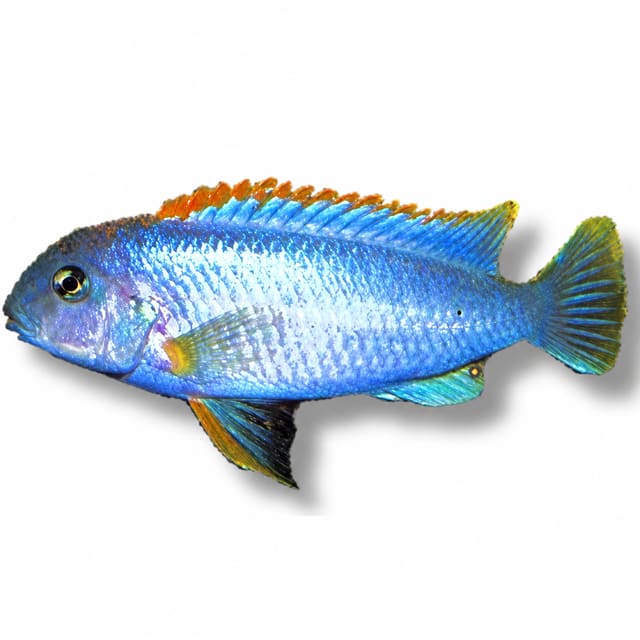
The Redtop Ice Blue trade name refers to the contrast associated with this mbuna in the hobby, but retail colour is variable. Sex, maturity, dominance, stress, lighting, background, diet, source line and photography all affect appearance. Juveniles and subordinate fish may look different from a mature dominant male, and an orange-heavy illustration cannot promise the colour of a living animal.
The supplier does not offer certified males or females on this product. Do not use one photograph, a bright dorsal fin, egg spots, body depth or behaviour as a guaranteed sex test for an unverified juvenile. Venting mature fish is a specialist procedure and still needs competent handling; it is not appropriate to make a sale promise from an image.
Good care should aim for normal condition and behaviour, not manufacture a catalogue colour. Stable water, suitable social space, complete food and low chronic stress support natural presentation. Colour enhancers cannot correct an incompatible group, poor oxygenation or water quality. If a precise sex or visual trait is essential to an existing breeding project, this unsexed size-option listing is not a reliable route unless current stock has been assessed separately and confirmed in writing.
Maylandia greshakei is oviparous, and FishBase records fertilisation in the mouth. Specialist species accounts describe maternal mouthbrooding. This biology is useful care context, but it does not mean that two fish ordered here are a compatible pair or that a mixed unsexed group will breed safely.
Courtship and spawning can intensify territorial behaviour. A brooding female may eat less and seek distance from other fish; disturbance or relentless pursuit can compromise her condition. A breeding plan therefore requires more than caves: it needs known mature stock, adequate group structure, close observation, suitable rearing space and a decision about how offspring will be identified and housed.
Do not strip eggs or handle a mouthbrooding fish without experience and a defined welfare reason. Do not distribute juveniles under a pure species name if the parentage is uncertain or if similar related forms shared the aquarium. Hybrid offspring may be healthy fish, but selling or passing them on under an unsupported identity damages traceability.
The listing certifies species and selected size only. It does not certify sex, fertility, pairing, brood timing, parentage or a breeding result.
Healthy mbuna should be alert, balanced in the water and able to feed without being permanently excluded. Colour alone is a poor health test. Watch breathing rate, posture, fin condition, body shape, faeces, appetite and access to territory. Observe from a distance as well as at the glass because a dominant fish may change behaviour when a person approaches.
Fast breathing can reflect low oxygen, ammonia or nitrite, excessive heat, gill irritation, disease or recent exertion. A fish remaining at the surface or directly in filter flow needs immediate water testing, temperature confirmation and a check of circulation. Do not assume every breathing problem is an infection and add medication before correcting environmental danger.
A fish hidden constantly may be newly unsettled, but it may also be trapped socially. Check whether it emerges when the dominant fish moves away, whether fins are clamped or damaged and whether it receives food. Rearranging rock can occasionally help, but a fish that cannot occupy the aquarium safely should be separated rather than left to "work it out".
Abdominal swelling, loss of appetite and abnormal faeces are sometimes grouped under the informal term Malawi bloat, but they can have multiple causes. Review water, feeding, social stress and recent introductions, then obtain qualified diagnosis where possible. Blindly combining medicines can harm filtration, complicate diagnosis and expose every fish unnecessarily.
| Observation | Check first | Immediate priority |
|---|---|---|
| Rapid breathing | Temperature, ammonia, nitrite, surface movement and gill appearance | Restore safe water and oxygen conditions while seeking diagnosis |
| One fish stays above rocks | Aggression, escape routes, injuries and feeding access | Separate if it cannot leave pressure or rest safely |
| Food refusal | Water, social stress, recent transport, swelling and mouthbrooding possibility | Do not keep adding rich foods; identify the cause |
| White spots or rubbing | New arrivals, temperature, skin and gill signs | Quarantine and diagnose before whole-tank treatment where practical |
| Torn fins | Who is pursuing whom and whether sight breaks function | Stop repeated injury rather than relying on healing additives alone |
Quarantine new fish in a fully cycled, heated and filtered aquarium where feeding, faeces, respiration and external signs can be observed. The quarantine tank must suit the fish's present size and water requirements; a bare unfiltered container is not quarantine. Use separate nets and equipment or disinfect them appropriately between systems.
A fixed number of quarantine days cannot eliminate every risk. The period should be long enough to observe normal feeding and health, and should reset in practical terms if signs appear or treatment is required. Avoid prophylactic mixtures without a reasoned protocol. A fish can look normal while transport stress is resolving, so quiet conditions and stable water are valuable.
Before introduction, compare temperature and chemistry, prepare the main tank, confirm spare capacity and decide exactly how a failed social introduction will be handled. Modifying territory boundaries before release may help, but keep all rock secure. Add the fish when you can observe for an extended period, not immediately before leaving home or turning the room dark for the night.
Watch the new fish and every established fish. A newcomer may become the aggressor, and removing the visibly chased fish is not always the complete solution. Use a safe divider or spare tank quickly if pursuit is sustained, feeding is blocked or injury begins.
Prepare the aquarium, quarantine system, heater, cover and test results before dispatch. Do not order first and plan the tank while the fish is travelling. Check the current livestock delivery information for available dates and destination limits, and make sure someone can receive and inspect the parcel promptly.
On arrival, follow the current new-fish acclimation guide. Keep the bag closed while equalising temperature as directed, avoid exposing the fish to prolonged transport water once opened and do not add bag water to the aquarium unnecessarily. Acclimation should account for the difference between source and destination chemistry rather than become an excessively long ritual.
Keep lighting subdued and provide secure cover after introduction. A short initial hiding period can be normal, but verify breathing, balance and response. Do not feed heavily on arrival. Document any delivery concern immediately and follow the evidence and timing requirements in the current Live Arrival Guarantee; the guarantee cannot be reconstructed from memory after packaging or timestamps have been discarded.
Eligible first orders can use WELCOME10 for 10% off under the current promotion terms. Eligible livestock orders have Live Arrival Guarantee protection when the current delivery, inspection and evidence conditions are followed. Checkout is the source for current price, stock, delivery choices and discount eligibility.
Daily care begins with observation. Confirm normal temperature, filter flow, surface movement, appetite and social access. Look at every fish rather than counting only the animals that rush to feed. Remove uneaten food, inspect the floor around territories and ensure no fish has been confined to an unsafe corner.
Test water on a consistent schedule and whenever behaviour changes. Use the results to set water-change frequency. Match replacement water for temperature and prepared mineral content, add it without destabilising rockwork and never expose a heater while it is powered. Siphon reachable debris but do not dismantle the entire social landscape at every maintenance session.
Clean mechanical filter media as needed to preserve flow. Stagger deeper maintenance so biological capacity is not stripped from every component at once. Inspect seals, hoses, impellers, heater guards, supports and cover gaps. A spare air pump and a plan for power interruption are sensible for a heavily stocked warm-water cichlid aquarium.
Reassess stocking as fish grow. A group that worked at 5 cm can change substantially at maturity. Increased chasing, fewer usable retreats, rising nitrate or one fish monopolising food are reasons to change the plan, not proof that another purchase will spread attention. Record dates, test results and major social changes; simple notes reveal trends that memory misses.
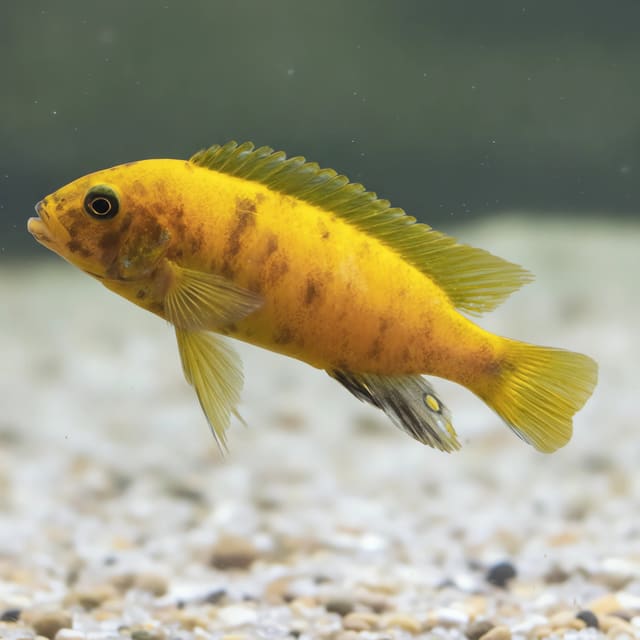
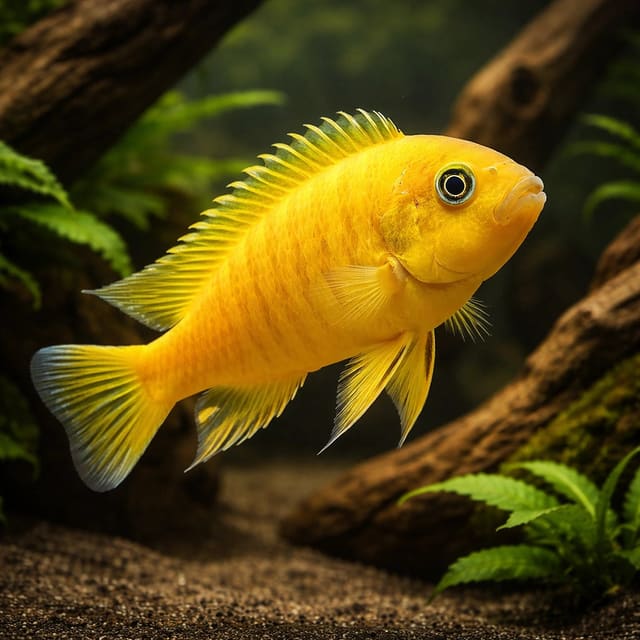
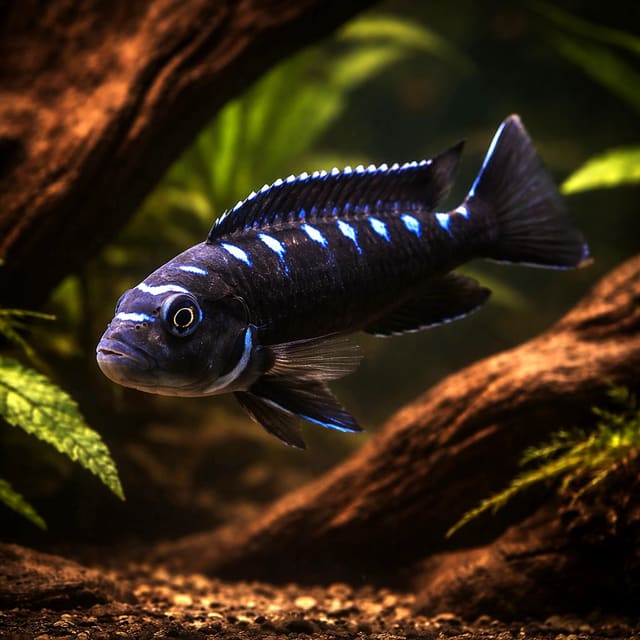
All four protected gallery images are existing illustrative renders. They show orange mbuna-style fish in aquarium scenes, but they are not photographs of the exact animal that will be dispatched and are not reliable diagnostic images of Maylandia greshakei. They do not certify body colour, red-top intensity, sex, maturity, locality or present size.
The scene containing two fish is an illustration only. Each selected quantity remains one unsexed fish. Plants, rocks and other objects in the scenes are not scale references or included products. The reference photo is a very small watermarked photograph retained privately for provenance; it is not being promoted as a customer-facing hero, altered to remove its watermark or used to replace the current gallery.
Choose this fish because the species and care requirements suit your aquarium, not because an illustrative render promises an exact orange or ice-blue individual.
| Question | You should be able to answer |
|---|---|
| Is the aquarium mature? | Yes: ammonia and nitrite are zero, temperature and chemistry are stable, and filtration is proven under load. |
| Is the adult footprint available? | Yes: about 120 x 50 cm or larger, around 250 litres or more, with greater space for a group or mixed mbuna plan. |
| Does the water suit Lake Malawi mbuna? | Yes: a stable 24-26°C working temperature and hard alkaline water around the supplier's pH and hardness ranges. |
| Does the rockwork create genuine escape routes? | Yes: several secure structures, broken sightlines and movement routes without traps. |
| Is every existing fish compatible on paper? | Yes: adult size, water, diet, aggression, colour similarity and hybrid risk have been reviewed. |
| Can you separate fish immediately? | Yes: a cycled spare system or safe full-support divider is ready before introduction. |
| Are you comfortable receiving an unsexed fish? | Yes: sex, pair formation, exact colour and breeding outcome are not promised. |
If any answer is no, complete the system before ordering. The freshwater fish selection guide can help compare aquarium needs, and the help and FAQ page provides a route for stock or care questions that need clarification.
This guide separates supplier facts, published biology, current taxonomy and retailer welfare recommendations. The supplier supports the trade identity, size options and broad water ranges. Scientific sources support accepted naming and species biology. Neither source type certifies the sex, colour, locality, lineage or exact appearance of an individual dispatched fish.
Sources can change as taxonomy and evidence improve, and stock can vary between shipments. The visible product selector and checkout remain the source for current size availability, price, delivery options and promotion eligibility.
No reviews for this item yet. Bought one? Honest reviews only, good or bad.
What customers say about ordering from us
I have a small group of long finned mountain minnows. So was delighted to be able to order ten of this variety to increase the genetics in my tank . The ones I recieved are healthy but it’s to early to give a verdict on wether they are of a long finned type since they are small currently.
Gordon Walker · 23 Sept 2026
100% success travel and "installation". Pleased with quality of purchase. The Siamese fighter a bit "shy" so have not yet seen him at his best yet but looking good. Happy customer. GG
George E Garratt · 21 Sept 2026
Reviews of our shop, collected by Judge.me, an independent third-party review collector. Newest first.