Moderate
Acei Cichlid (Pseudotropheus sp. “acei”)
24–26°C · pH 7.5–8.5 · 300L
£7.99

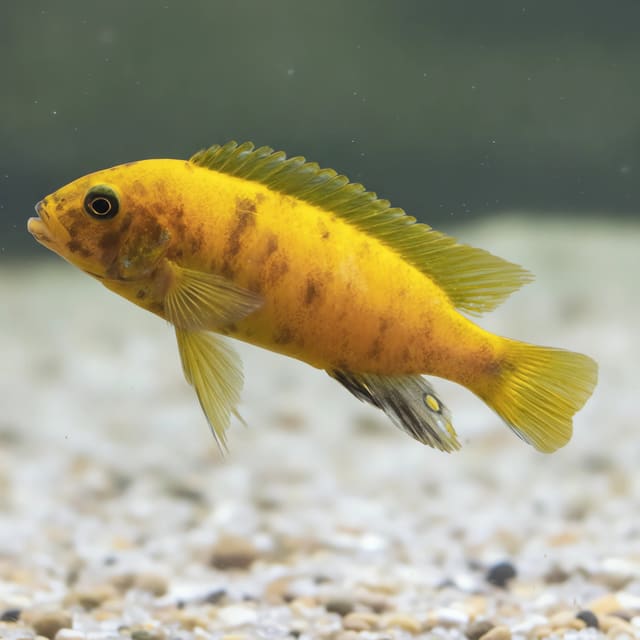
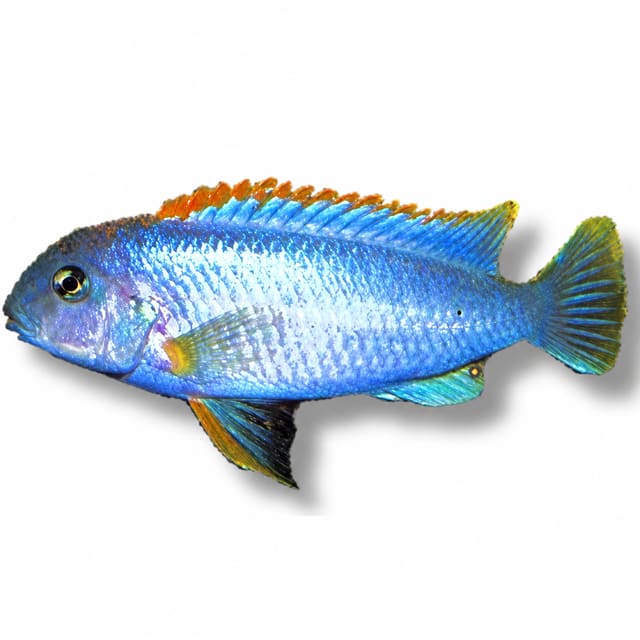
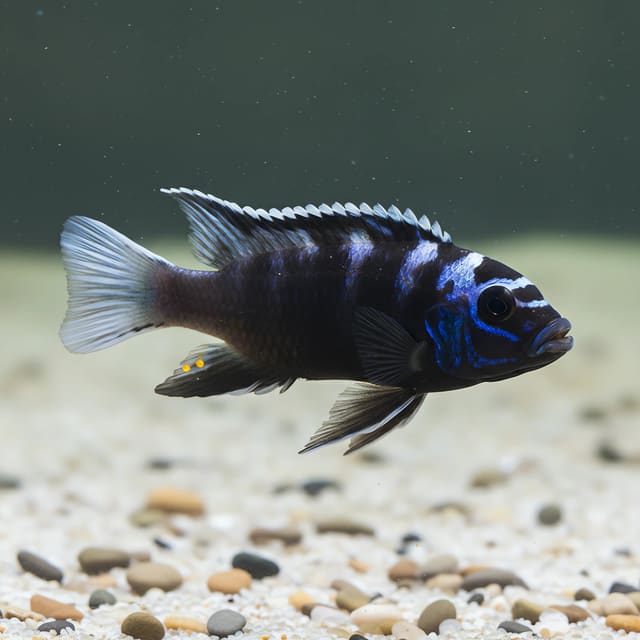
The Daktari Mbuna (Maylandia sp. 'daktari') is a rock-dwelling haplochromine cichlid from Lake Malawi in East Africa. It suits an intermediate keeper; OATA’s Malawi cichlid guidance gives groups of at least 15, 23–27°C, pH 8.0–8.6 and 12–18°dH. Sold individually in sizes from 3–4 cm to 7–9 cm.
Maylandia sp. 'daktari'
The Daktari Mbuna (Maylandia sp. 'daktari') is a rock-dwelling haplochromine cichlid from Lake Malawi in East Africa. It suits an intermediate keeper; OATA’s Malawi cichlid guidance gives groups of at least 15, 23–27°C, pH 8.0–8.6 and 12–18°dH. Sold individually in sizes from 3–4 cm to 7–9 cm.
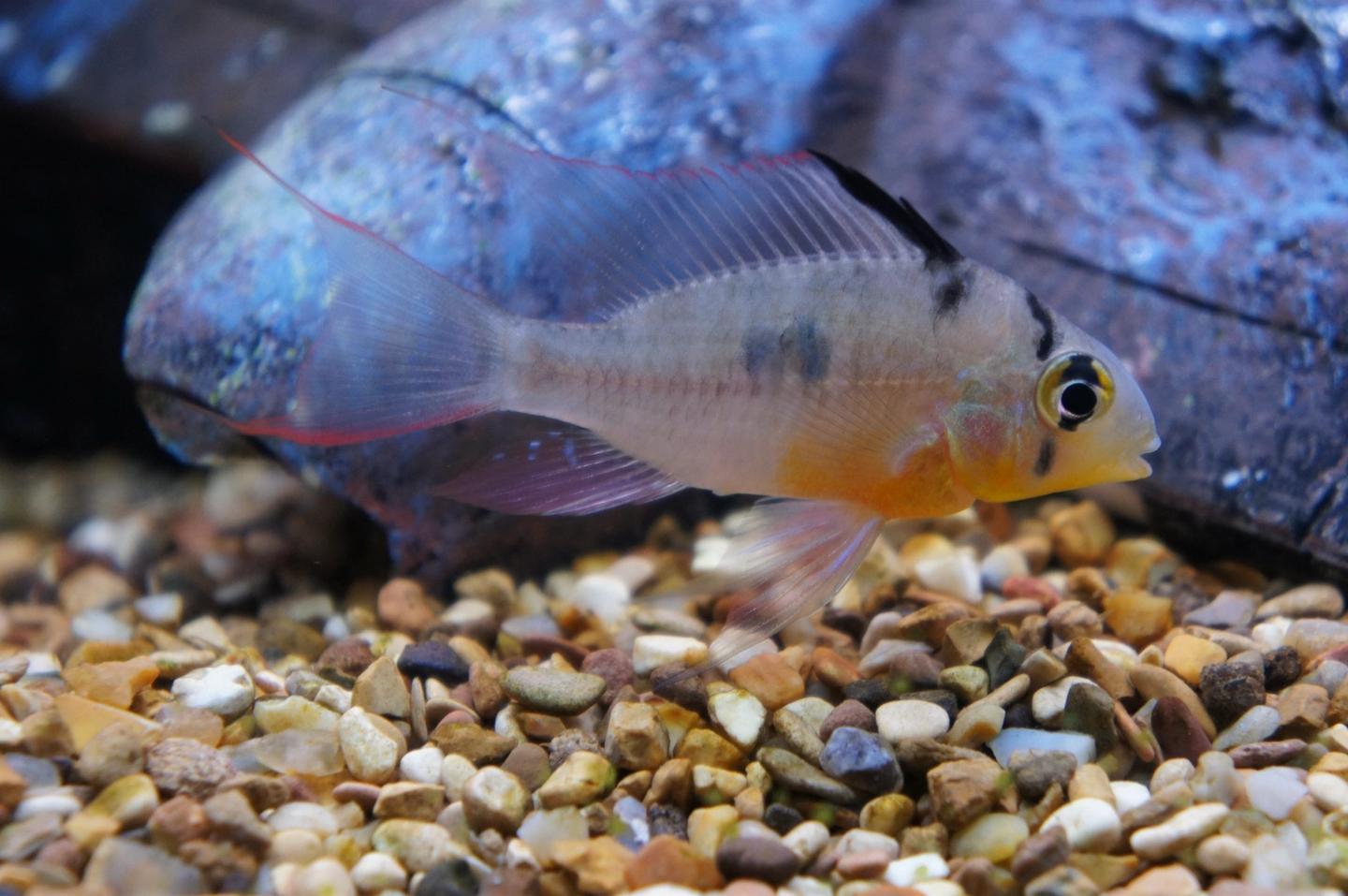
Cichlids are a family of roughly 1,800 accepted species, not one care type. Before buying, identify the exact species and source, then compare adult measurement, usable tank dimensions, social system, territory, tested water, diet and an exit plan. No family-wide minimum tank, water range or tank-mate list is safe.
Maintain these water conditions for optimal health and vibrant colors
The Daktari Mbuna (Maylandia sp. 'daktari') is a haplochromine cichlid from Lake Malawi in East Africa. It belongs to the mbuna, the rock-dwelling Malawi cichlids, and suits an intermediate keeper prepared to manage hard alkaline water, substantial filtration and an aggressive cichlid community. This is not a conventional mixed-community fish.
WoRMS recognises Maylandia as an accepted genus in the family Cichlidae. Wikipedia describes Maylandia, also called Metriaclima, as a genus endemic to Lake Malawi and places it among the rock-dwelling haplochromines. That natural history makes a Malawi-focused aquarium the right starting point.
Plan a reasonable Malawi community around an aquarium of at least 200 litres, a group of at least 15 fish and a carefully screened stock list. OATA’s African Malawi cichlid guidance gives 23–27°C, pH 8.0–8.6, general hardness of 12–18°dH and carbonate hardness of 10–15°dKH for the group; these are group guidance, not a species-specific optimum.
The combination of aggression and deliberate group management drives the intermediate care assessment. Routine feeding and weekly maintenance are straightforward, but a small group, weak filter or poorly matched companion can create a welfare problem quickly. The permanent aquarium should therefore be mature, tested and planned as a complete Malawi system before the fish arrives.
The scientific label is Maylandia sp. 'daktari'. The abbreviation sp. identifies an animal within the genus without assigning a formally named species. Keep that abbreviation whenever you record the fish in stocking notes or compare care requirements.
Metriaclima is another name used for the genus in natural-history writing. Both names lead back to the same broad group of Lake Malawi rock-dwelling cichlids, but the aquarium identity here remains Maylandia sp. 'daktari'. Daktari Mbuna is the useful trade name for discussing the fish without turning 'daktari' into a formal species name.
The exact species has not been identified, so the care advice here follows the genus Maylandia and its care group. That affects adult-size planning in particular: use the permanent Malawi community requirement, behaviour and filtration load rather than assigning this fish one adult length from a different member of the genus.
One purchase supplies one Daktari Mbuna from the size band selected on the live size selector. The labels are 3-4 cm, 7-9 cm, 4 - 5 cm and 5 - 7 cm. Use the label to plan receiving space and the introduction, while basing the permanent aquarium on the needs of the complete Malawi community.
The size you select is the size supplied, not the adult size. Use every band as a receiving measurement only; each fish still needs the same long-term community plan. Never use a dispatch measurement by itself to infer sex, maturity or eventual colour.
Sex is guaranteed only when the selected option explicitly states male or female. This Daktari Mbuna listing has no sex-guaranteed option.
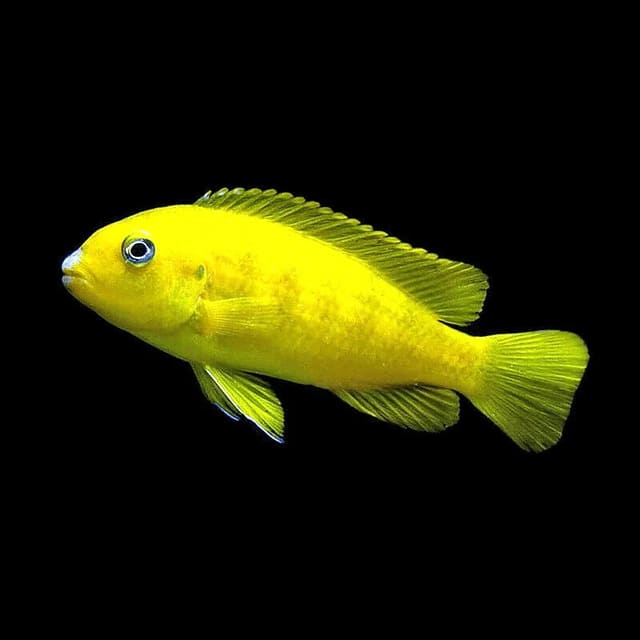
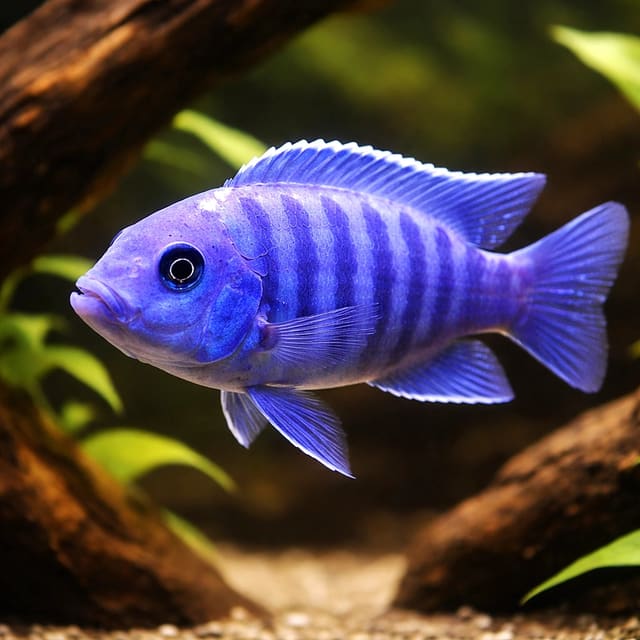
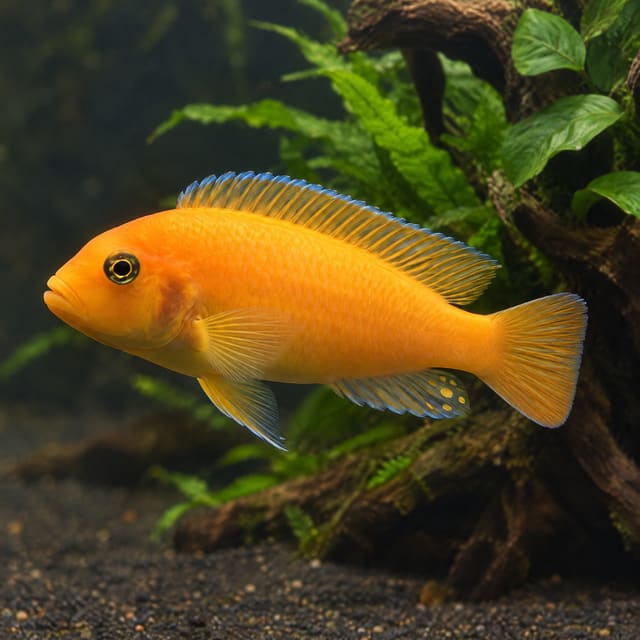
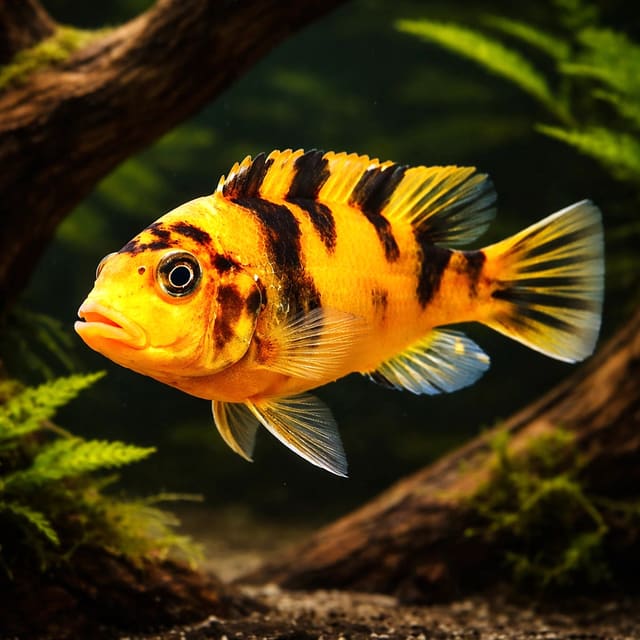
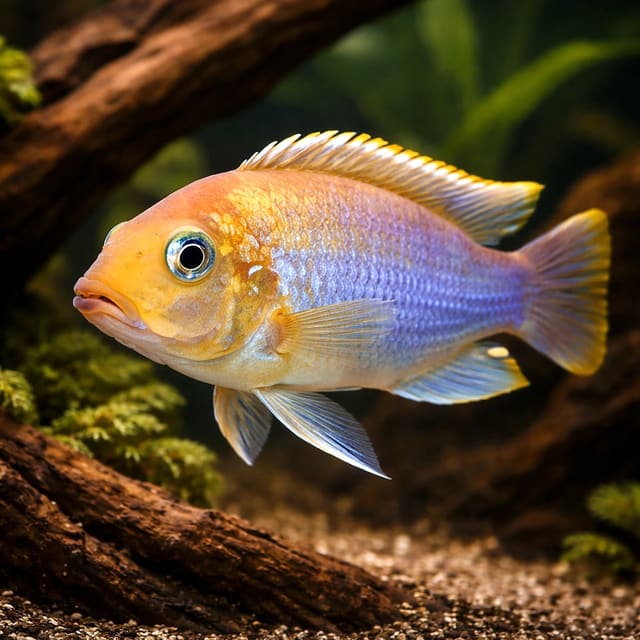
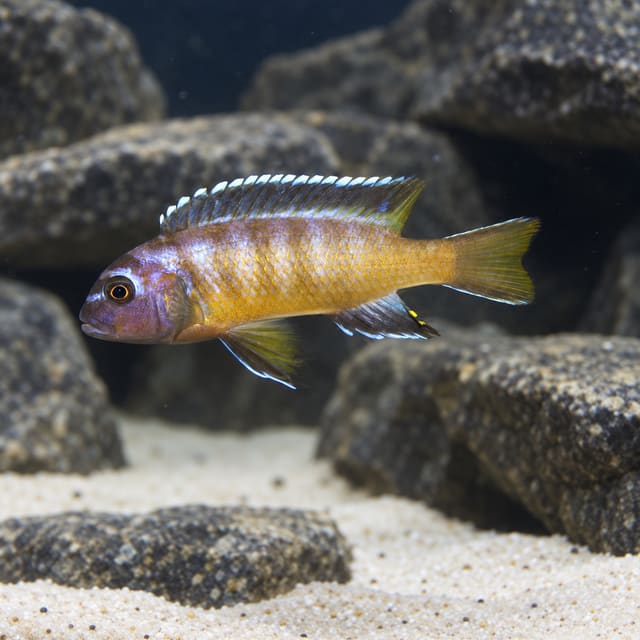
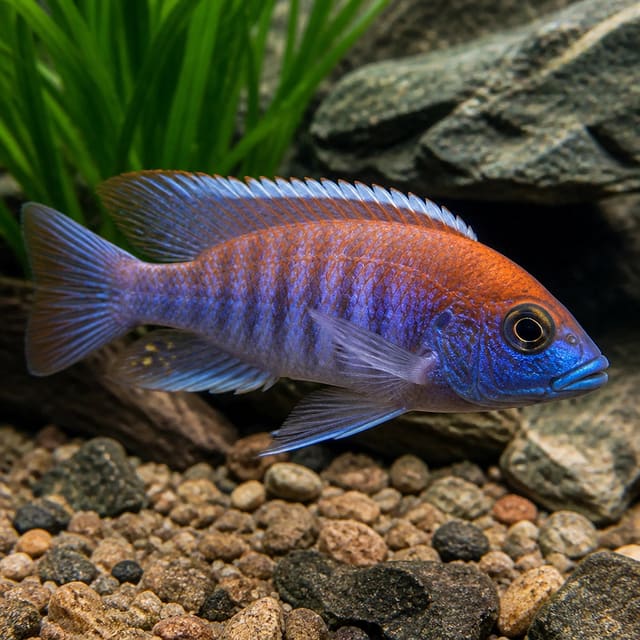
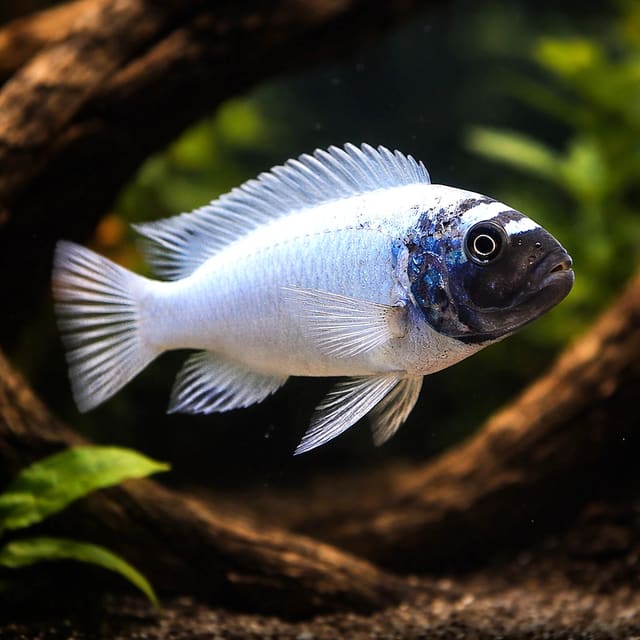
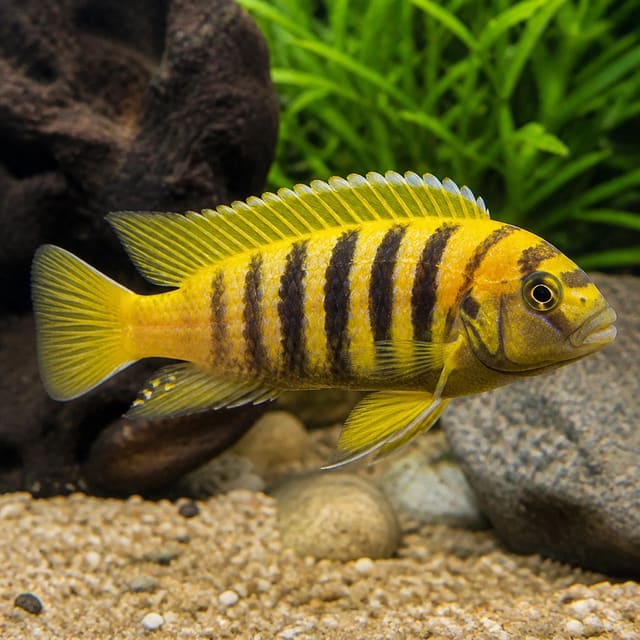
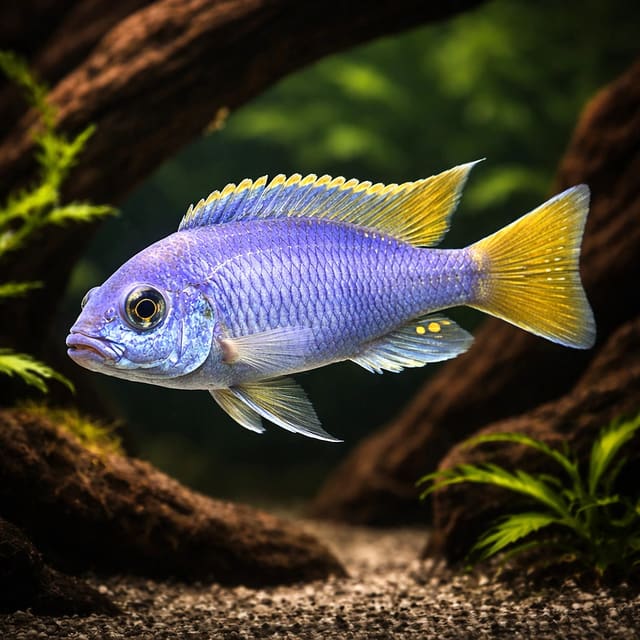
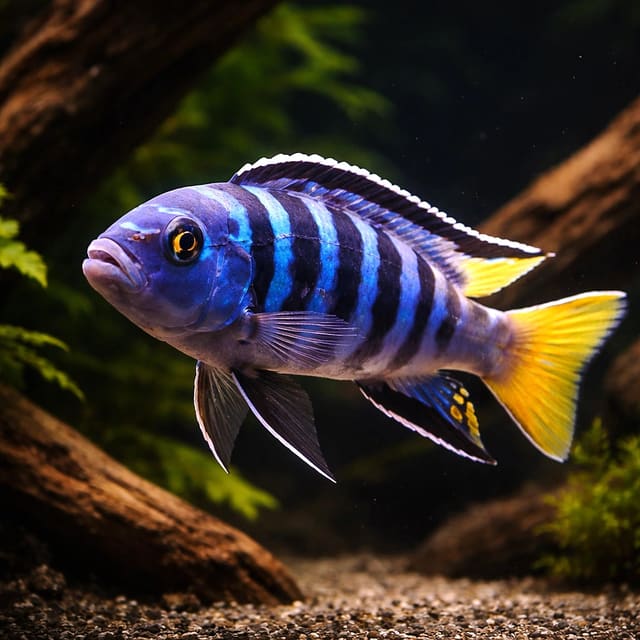
Some gallery images have been digitally enhanced to improve image quality. They show the listed type of animal rather than guaranteeing the exact markings of the individual supplied, so natural colour and pattern can vary.
| Suits | Not suited to |
|---|---|
| A mature, filtered Malawi aquarium of at least 200 litres | A new aquarium with detectable ammonia or nitrite |
| A planned Malawi group of at least 15 fish | A small Malawi group in which fighting is concentrated |
| Hard alkaline water at 23–27°C and pH 8.0–8.6 | Water outside the Malawi ranges used for the community |
| An intermediate keeper ready to monitor aggression | A general community assembled without aggression screening |
Use at least 200 litres for a reasonable Malawi cichlid community and plan a group of at least 15. OATA explains that Malawi cichlids are not social fish in the peaceful shoaling sense, but keeping a suitably managed larger group can distribute aggression more evenly; small groups often fight.
The 200-litre figure belongs to the community plan rather than to one unidentified Maylandia species. Aquarium shape, filtration capacity, décor and the behaviour of every proposed fish still matter. A larger aquarium also gives more stable temperature and water quality, which helps when feeding and waste production rise with the population.
| Planning question | Decision |
|---|---|
| Is the aquarium below 200 litres? | Choose a different project rather than building a reasonable Malawi community around too little volume. |
| Would the Malawi group remain below 15? | Rework the complete plan because OATA warns that small groups often fight. |
| Can the filter handle each staged increase? | Add fish only as the biological filter adjusts to greater feeding and waste. |
| Can a pressured fish be separated? | Prepare a safe intervention plan before territorial behaviour develops. |
Slight overstocking is sometimes used to spread Malawi cichlid aggression, but it must remain within the capacity of the aquarium, filter and maintenance routine. It is not permission to add fish rapidly or ignore rising waste. Contact us with the aquarium dimensions, measured water and complete stock list if you want a stocking and compatibility assessment.
During the first month, judge the community by both water results and access to resources. A stable ammonia result does not make a social plan successful if one fish is repeatedly excluded from food, while calm-looking fish do not make rising nitrite acceptable. Record who occupies each main area, whether every fish reaches both daily meals and whether chasing ends quickly or continues until the target hides.
Review the plan after each addition rather than waiting until the intended total has been reached. If ammonia or nitrite appears, stop adding fish and restore safe water quality. If one individual receives sustained attention, use the prepared separation option and reassess the group before another introduction. When all fish feed, move through the aquarium and retain intact fins while weekly readings remain within target, the plan is functioning well enough to continue cautiously.
You can compare identities across our African cichlid collection, but each candidate still needs to pass the water, aggression and introduction checks described here.
Use a Malawi layout with rockwork, a buffering substrate where needed and enough structure for territories to change. Mbuna are rock-dwelling fish, while OATA notes that Malawi cichlids often dig, rearrange substrate and uproot plants. Arrange every aquarium decoration so routine movement by the fish cannot make the layout unsafe.
OATA recommends coral sand or a similar substrate to help buffer the water. Test the aquarium first: the purpose is to support the required hard alkaline conditions, not to make chemistry changes without measurement. Keep enough open substrate accessible for siphoning because uneaten food and solid waste must be removed during maintenance.
Spread the décor through the aquarium instead of making one feature the only defensible place. OATA advises that rearranging décor can reduce aggression because every fish must find territories again. That can be useful when territorial pressure develops, but it does not replace adequate volume, group planning or separation when one fish is being persistently attacked.
Digging will uproot plants, so build the aquarium to work without relying on rooted planting. Hardy plants may be tried if they suit the chemistry and remain secure, but the practical priorities are buffering, access for cleaning and a layout that supports a Malawi cichlid community.
Keep the aquarium at 23–27°C, pH 8.0–8.6, general hardness 12–18°dH and carbonate hardness 10–15°dKH. Ammonia and nitrite must remain at 0 mg/l, while nitrate should not exceed 20 mg/l above the normal tap-water level.
Test before changing chemistry. Our water chemistry guide explains what the principal readings mean, and the water matcher helps compare measured aquarium values with the ranges used here. Record actual numbers rather than relying on descriptions such as hard or alkaline.
| Reading | Action |
|---|---|
| Temperature: 23–27°C | Keep the chosen value stable and check that every companion uses the same range. |
| pH: 8.0–8.6 | Measure regularly and investigate a change rather than repeatedly chasing the reading. |
| General hardness: 12–18°dH | Confirm that replacement water keeps the aquarium within the hard-water range. |
| Carbonate hardness: 10–15°dKH | Monitor the buffering capacity that supports alkaline conditions. |
| Ammonia and nitrite: 0 mg/l | Do not add fish when either is detectable; check filtration, stocking and waste immediately. |
| Nitrate: no more than 20 mg/l above tap water | Compare aquarium and conditioned tap-water readings, then adjust maintenance and feeding. |
A single acceptable test is only a starting point. Measure at least weekly and compare results over time. Rising nitrate, detectable ammonia or detectable nitrite shows that the balance between fish, feeding, filtration and maintenance needs attention.
For example, if conditioned tap water tests at 10 mg/l nitrate, keep the aquarium from exceeding 30 mg/l because OATA’s limit is 20 mg/l above the normal tap-water level. If the tap-water reading is 20 mg/l, the corresponding ceiling is 40 mg/l. Repeat the source-water test periodically because the baseline used for that comparison can change.
If the aquarium approaches its calculated ceiling before the next weekly change, review the amount fed, the amount of waste trapped in the substrate and the number of fish supported by the filter. Increase the effectiveness of maintenance rather than waiting for visible distress. Any ammonia or nitrite result requires action even when nitrate remains below its ceiling, because each reading describes a different part of water quality.
Treat replacement tap water with a suitable conditioner before it enters the aquarium so chlorine or chloramine does not harm the fish or biological filter. Keep preparation consistent from one water change to the next.
Use a well-established filter in every aquarium. The RSPCA explains that biological filtration supports bacteria that convert toxic ammonia first to toxic nitrite and then to safer nitrate. A filter must therefore be running, established and maintained before it carries a Malawi cichlid community.
OATA recommends an oversized filter for the crowded conditions often used in Malawi aquariums, together with strong aeration to maintain dissolved oxygen. Choose capacity for the complete community rather than for one dispatch-size fish. If this is your first setup, follow our guide to preparing and maturing a tropical aquarium before arranging livestock.
Rinse filter media in water removed from the aquarium, never under the tap. When cleaning is needed, rinse the media lightly in aquarium water removed during the partial water change. Avoid cleaning every component so aggressively that the biological population is stripped away.
More fish and more food create more waste, while the beneficial bacterial population needs time to respond. Increase the population slowly, continue testing and reduce feeding pressure if uneaten food accumulates. Slight crowding for aggression management never cancels the need for oxygen, filtration and measured maintenance.
Feed a specialised Malawi cichlid food with a high algae content, supported by fresh vegetables. OATA explains that smaller mbuna tend to be more herbivorous, while dietary requirements vary among Malawi cichlids. For this genus-level identity, that smaller-mbuna guidance is the practical basis for routine feeding.
Offer only what the fish can finish within a few minutes, twice a day. The time limit matters because uneaten food breaks down and releases waste into the aquarium. A fish continuing to approach the feeding area is not a reason to keep adding food after the measured portion has been eaten.
| What you observe | What to do next |
|---|---|
| Food remains after a few minutes | Remove accessible leftovers and reduce the next portion. |
| One fish controls the feeding area | Distribute the same measured meal so other fish can reach it, then review aggression. |
| The group finishes instantly | Observe body condition and water tests before increasing the measured portion. |
| Interest in food falls | Check behaviour, breathing, appearance and water quality before offering more. |
Use variety within this feeding routine rather than repeatedly feeding one product or one vegetable. The staple should remain an appropriate complete Malawi cichlid food, with fresh vegetables adding variety. Keep every item small enough for the fish to eat promptly so fragments do not settle among décor and substrate.
Track feeding alongside nitrate and weekly maintenance. If nitrate rises or waste collects faster, check portions before assuming the aquarium simply needs more cleaning. If one fish loses condition while others gain it, investigate access and aggression as well as the food itself.
Be present to receive the parcel because live fish cannot be left unattended. Tropical Fish Co hand-bags livestock in pure oxygen, uses an insulated poly box and adds a heat pack when the weather calls for it. Read the current delivery and Live Arrival Guarantee policy before the parcel is due.
Keep this sequence simple. The permanent aquarium should already be mature, within the stated water ranges and ready for the planned introduction before the box is opened.
OATA advises checking that ammonia and nitrite are both zero before adding fish. Malawi cichlids are best introduced in groups so one newcomer does not receive all the aggression, but the total aquarium population must still increase slowly enough for beneficial filter bacteria to adjust to extra waste and feeding.
Adding too many fish too quickly can produce new tank syndrome, with ammonia or nitrite rising because the filter bacteria cannot process the increased waste. Test after the introduction and keep feeding within the small twice-daily portions. Watch whether every fish can swim normally, use the aquarium and reach food without being continually displaced.
A newcomer that hides briefly but later feeds and moves through the aquarium needs continued observation. A fish that remains pinned in one area, cannot reach food or develops damaged fins needs the separation plan. Keep social observations beside the water results so a behavioural problem is not mistaken for a filtration problem, or vice versa.
When planning several additions, OATA recommends introducing more peaceful Malawi species before more aggressive ones. That advice must be combined with the actual behaviour already present: a settled territorial community can still challenge later arrivals, so have a practical way to separate a fish if aggression becomes relentless.
Check the fish closely during normal feeding and movement. A useful health assessment combines behaviour, colour, breathing, appearance, body condition and appetite rather than relying on one sign.
| Change to watch | Immediate check |
|---|---|
| Hanging at the surface, sitting on the bottom or erratic swimming | Test water quality and confirm filtration and aeration are operating. |
| Colour becoming darker or paler | Compare aggression, hiding and feeding with the fish’s normal pattern. |
| More aggression or more hiding | Identify who is chasing whom and whether a fish needs separation. |
| Gill covers moving faster or slower | Check oxygenation, ammonia, nitrite and the behaviour of the whole group. |
| White spots, fluffy growths, ulcers or missing fins and scales | Record the appearance and isolate the welfare issue from ordinary territorial display. |
| Weight change or reduced feeding | Confirm food access, portion size, waste levels and social pressure. |
Test the water first whenever health changes occur, even if only one fish appears affected. Zero ammonia and nitrite remain essential, and a filter blockage or missed maintenance can affect the whole group. If the readings are normal, continue through the behaviour, feeding and physical checks instead of assuming that hiding is harmless.
Contact us for health guidance when a change persists or the fish is deteriorating. Share the aquarium volume, complete stock list, temperature, pH, hardness, ammonia, nitrite, nitrate and a clear description of the signs. Do not let repeated aggression continue while waiting for a diagnosis; use the prepared separation plan to protect the targeted fish.
Keep Daktari Mbuna only with carefully screened Malawi cichlids or some species of Synodontis catfish that also naturally inhabit Lake Malawi. OATA limits its recommended companion types to those two groups, and it warns that all Malawi cichlids can be aggressive.
Those categories are a shortlist, not a promise that any two named fish will live together. The exact Synodontis species must suit the aquarium, and every Malawi cichlid must be assessed for adult demands, water requirements, feeding access and likely aggression. Avoid fish outside those companion types.
| Compatibility check | Pass condition |
|---|---|
| Water | Every animal must suit 23–27°C, pH 8.0–8.6 and hard water. |
| Community type | The aquarium must be a deliberate Malawi setup rather than a general mixed community. |
| Aggression | The layout, group and intervention plan must cope with territorial behaviour. |
| Feeding | Every fish must reach an appropriate portion without one individual controlling the meal. |
| Filter load | Ammonia and nitrite must remain at zero as fish and feeding are added. |
| Introduction order | More peaceful Malawi species should enter before more aggressive species where the plan allows. |
Compatibility can change as fish mature or territories shift. Passing the initial screen means the combination is reasonable to assess, not that behaviour will remain stable. Continue checking fins, feeding access, hiding and body condition, and separate a fish if aggression becomes persistent.
Treat aggression as a community-level issue. Malawi cichlids may be highly aggressive, and OATA recommends groups of at least 15 with slight crowding to spread attention. That approach works only alongside adequate volume, oversized filtration, strong aeration and frequent observation.
Where sexes can be identified, OATA advises keeping more females than males of each species so one female is less likely to receive all the attention from a male. Many Malawi cichlids show clearer differences only as adults, so do not build the initial plan around assumed juvenile sexes or dispatch sizes.
Introduce Malawi cichlids in groups rather than placing one newcomer into concentrated attention. Add more peaceful species before more aggressive species where possible, and increase the total population gradually enough for the biological filter to respond. These two decisions solve different risks: grouped introductions address social pressure, while staged stocking protects water quality.
Rearranging aquarium décor may reduce aggression by forcing fish to establish territories again. Use that option when the pressure is connected to fixed territorial control, then observe the result closely. If one fish remains pinned away from food, hides more than normal, loses condition or develops damaged fins or scales, move to the prepared separation plan.
| Observed pattern | Response |
|---|---|
| Brief chasing that ends with both fish feeding | Continue close observation and record whether the pattern becomes more frequent. |
| One territory causes repeated confrontations | Rearrange décor to redistribute territories, then watch the whole group again. |
| One fish cannot reach food | Separate the pressured fish and reassess group structure and feeding access. |
| Damaged fins, missing scales or declining condition | Intervene immediately rather than waiting for the conflict to settle itself. |
| Several fish breathe abnormally or remain at the surface | Test water quality and check filtration and aeration as a whole-system problem. |
Use repeated observations rather than one isolated chase to understand the pattern, but do not wait for severe injury before acting. The decisive question is whether every fish can move, feed and maintain condition. Décor changes may interrupt territorial control; separation protects an individual when that reset does not work.
Daktari Mbuna is identified as Maylandia sp. 'daktari', so plan its permanent home from the mature Malawi community requirement rather than assigning it an adult length from another species: use at least 200 litres for a reasonable community.
Use an aquarium of at least 200 litres for a reasonable Malawi cichlid community. OATA gives this as Malawi cichlid guidance and explains that a larger aquarium provides more stable temperature and water quality.
OATA’s Malawi cichlid guidance recommends a planned group of at least 15 fish because small groups often fight; this is a whole-community figure, not a requirement to keep 15 of the same trade form.
Daktari Mbuna has an intermediate store care assessment: feeding and maintenance are straightforward, but hard alkaline water, a mature oversized filter and aggressive group management require confident planning.
Feed specialised Malawi cichlid food with a high algae content and add fresh vegetables. OATA advises two small meals a day, each limited to what the fish finish within a few minutes.
OATA’s Malawi cichlid guidance gives 23–27°C, pH 8.0–8.6, general hardness of 12–18°dH and carbonate hardness of 10–15°dKH, with ammonia and nitrite at 0 mg/l.
Yes. OATA describes Malawi cichlids as aggressive, so plan at least 15 fish, monitor chasing and feeding access, and separate any individual that is persistently attacked or losing condition.
OATA recommends only carefully screened Malawi cichlids or some Synodontis catfish that naturally inhabit Lake Malawi. Compatibility still depends on water, aggression, feeding access and the complete aquarium plan.
Tropical Fish Co hand-bags the fish in pure oxygen, packs it in an insulated poly box with a heat pack when the weather calls for it and uses a licensed live-animal courier. Someone must be present to receive the parcel.
| Reference | Coverage |
|---|---|
| WoRMS | Accepted Maylandia genus and Cichlidae family identity. |
| Wikipedia | Lake Malawi range, haplochromine identity and rock-dwelling mbuna context for the genus. |
| OATA | African Malawi cichlid water, aquarium, feeding, group, maintenance and compatibility guidance. |
| RSPCA | General aquarium biological filtration and nitrogen-cycle welfare. |
| Tropical Fish Co delivery policy | Packing, receipt, acclimatisation and Live Arrival Guarantee procedure. |
No reviews for this item yet. Bought one? Honest reviews only, good or bad.
What customers say about ordering from us
I have a small group of long finned mountain minnows. So was delighted to be able to order ten of this variety to increase the genetics in my tank . The ones I recieved are healthy but it’s to early to give a verdict on wether they are of a long finned type since they are small currently.
Gordon Walker · 23 Sept 2026
100% success travel and "installation". Pleased with quality of purchase. The Siamese fighter a bit "shy" so have not yet seen him at his best yet but looking good. Happy customer. GG
George E Garratt · 21 Sept 2026
Reviews of our shop, collected by Judge.me, an independent third-party review collector. Newest first.