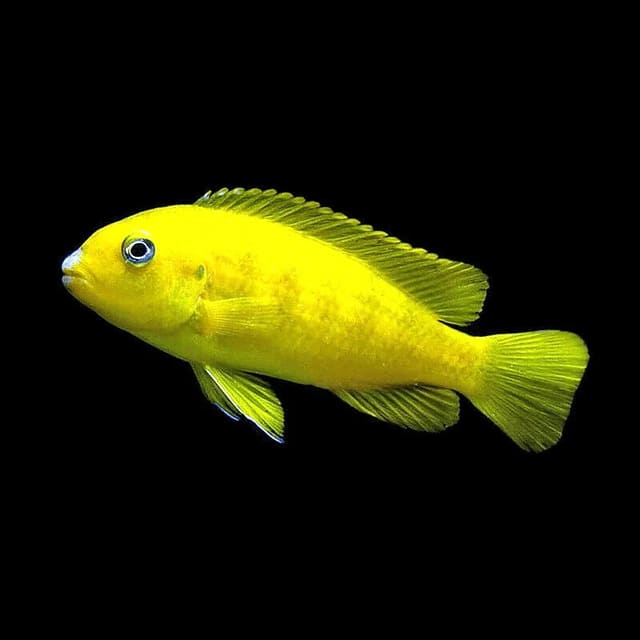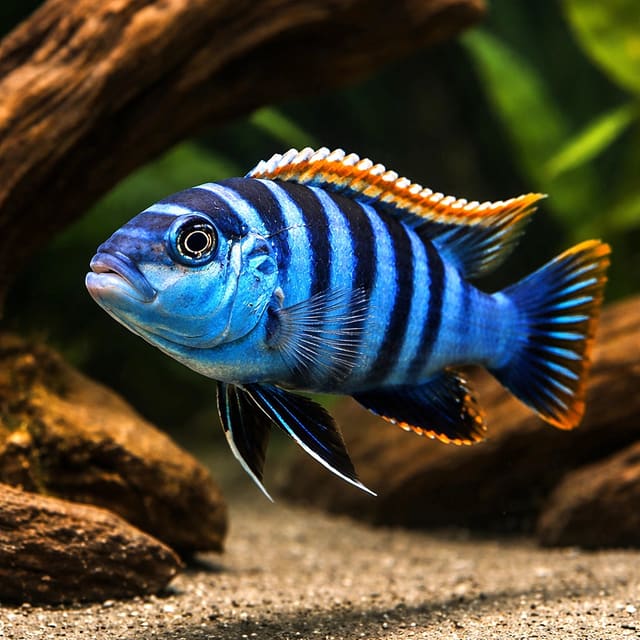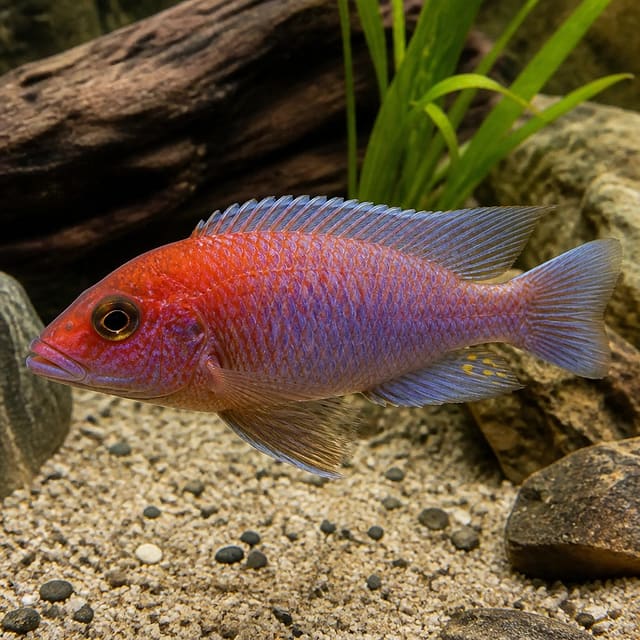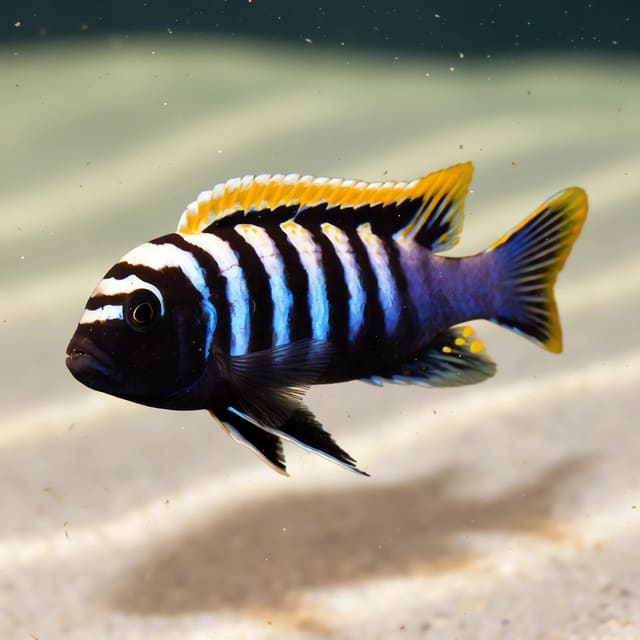
Moderate
Acei Cichlid (Pseudotropheus sp. “acei”)
24–26°C · pH 7.5–8.5 · 300L
£7.99

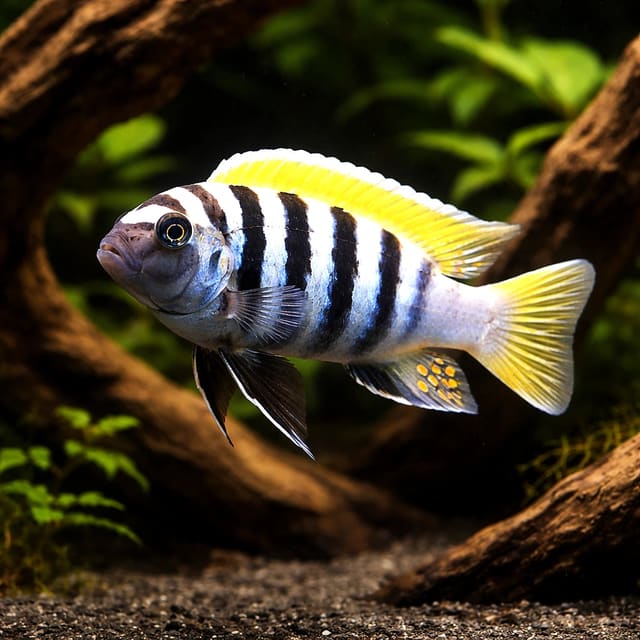
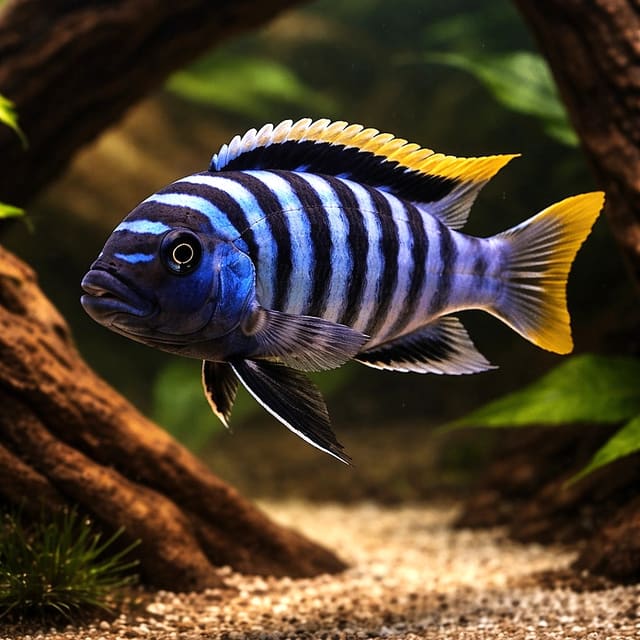
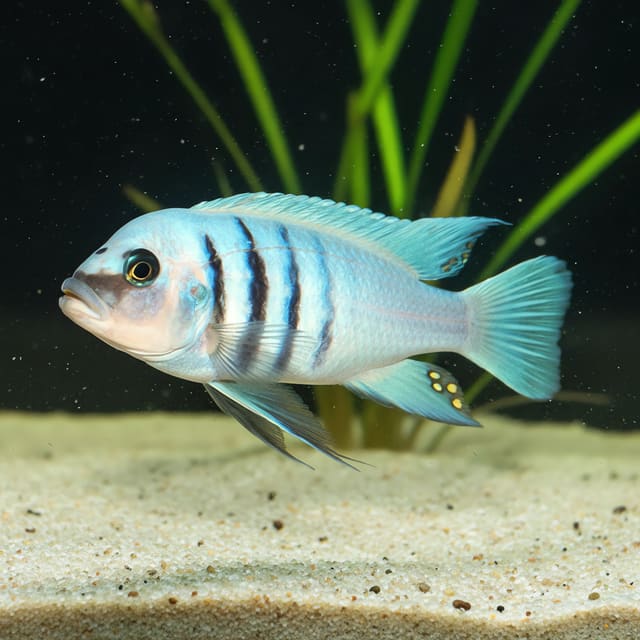
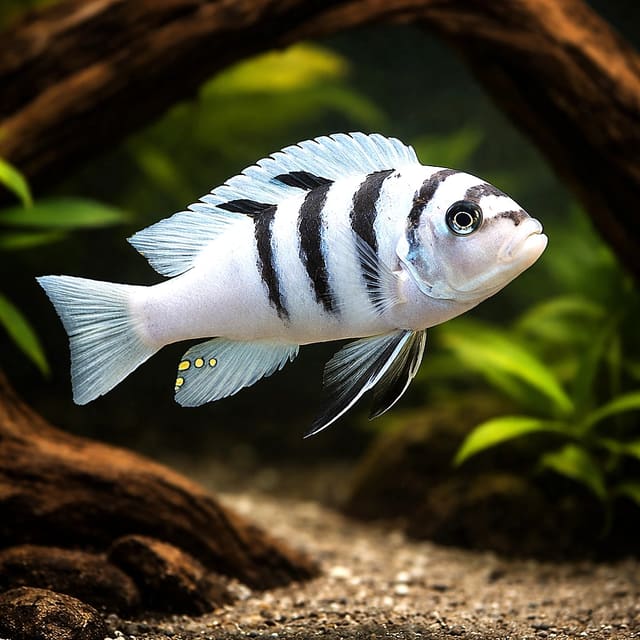
Pulpican Mbuna (Maylandia pulpican) is a compact territorial Lake Malawi cichlid for mature hard-water aquariums with strong filtration, extensive rockwork and carefully chosen Malawi companions. One purchase supplies one fish in the selected size.
Adult size is the maximum length this species reaches at full maturity (scientific sources). The livestock you receive will be younger and smaller — pick a size above for the actual shipping size. Product-photo provenance and any image-specific limitations are stated on the listing.
Maylandia pulpican
Save when buying multiple fish. Each quantity is one fish; sex and pair formation are not guaranteed unless the selected variant explicitly states them.
Pulpican Mbuna (Maylandia pulpican) is a compact territorial Lake Malawi cichlid for mature hard-water aquariums with strong filtration, extensive rockwork and carefully chosen Malawi companions. One purchase supplies one fish in the selected size.
Adult size is the maximum length this species reaches at full maturity (scientific sources). The livestock you receive will be younger and smaller — pick a size above for the actual shipping size. Product-photo provenance and any image-specific limitations are stated on the listing.
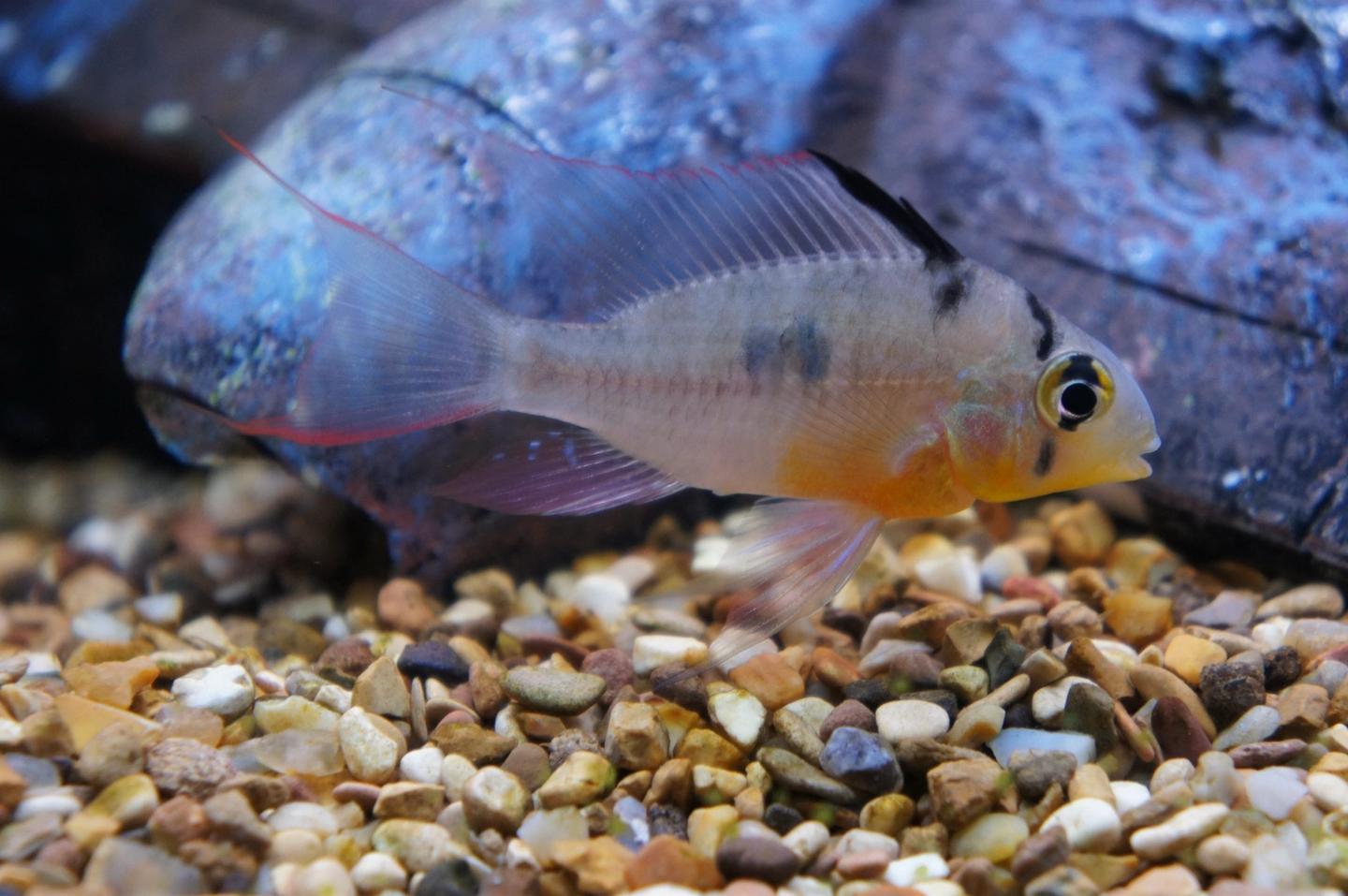
Cichlids are a family of roughly 1,800 accepted species, not one care type. Before buying, identify the exact species and source, then compare adult measurement, usable tank dimensions, social system, territory, tested water, diet and an exit plan. No family-wide minimum tank, water range or tank-mate list is safe.
Maintain these water conditions for optimal health and vibrant colors
Pulpican Mbuna (Maylandia pulpican) is a compact rock-associated cichlid from Lake Malawi for aquarists who deliberately want an assertive African cichlid display. FishBase places it in the family Cichlidae and records the species from Malawi and Mozambique, where it occupies the intermediate zone between rocks and sand. Males defend territories, while females may be solitary or form small groups. Those natural behaviours make this an engaging fish, but they also mean that the aquarium has to be planned around space, shelter and interaction rather than added casually to a peaceful mixed community.
One purchase supplies one live fish. Three dispatch sizes are part of the established offer, ranging from 3–4 cm to 6–7 cm. The size you select is the size supplied, not the adult size. FishBase records a maximum length of 7.1 cm SL; use that species record when judging the mature animal and use the chosen size only to understand what will arrive. A smaller arrival still needs the completed adult layout from its first day, because territorial decisions begin long before a fish reaches its maximum recorded length.
| Suits | Prepared Malawi keepers with mature filtration, hard alkaline water, extensive rockwork and a carefully designed cichlid stocking plan. |
|---|---|
| Not suited to | Soft-water community tanks, small lightly filtered aquariums or homes seeking an undemanding peaceful shoaling fish. |
| Sold unit | One live fish per purchase, in the size selected. |
| Sex | No male or female guarantee is attached to this product. |
Choose this fish only when the completed aquarium can supply several secure rock zones, open sand between structures and a stable Malawi water routine. The practical commitment begins before delivery: mature the filter, secure the hardscape, measure the water and decide how an animal will be separated if interaction becomes harmful.
Browse the African cichlid collection to compare other hard-water fish, but treat a neighbouring product as an alternative to research rather than proof that it belongs in the same aquarium.
The accepted name used on this page is Maylandia pulpican. Older aquarium labels may use Cynotilapia pulpican or Metriaclima pulpican; those are naming history, not different colour forms or separate stock promises. The FishBase species account anchors the identity, maximum length, distribution and natural-history details used here. The broader Maylandia genus summary explains why these cichlids are classed among Lake Malawi's rock-dwelling mbuna.
Expect a fish whose interest comes from behaviour and habitat use. In the wild it feeds on aufwuchs and plankton in the water column, moves through an intermediate rock-and-sand zone and uses holes beneath rocks as spawning sites. In the aquarium, those observations translate into practical priorities: build usable caves, leave open routes between rock piles, provide an algae-rich Malawi diet and watch how each animal occupies space. They do not justify promising a particular colour, sex, breeding result or personality.
Sex is guaranteed only when the selected option explicitly states male or female. This Pulpican Mbuna listing has no sex-guaranteed option. Do not infer sex from an image, a juvenile pattern, the dispatch size or a momentary display. If a stocking plan depends on a precise male-to-female ratio, it needs fish whose sex has actually been established rather than assumptions made at checkout.
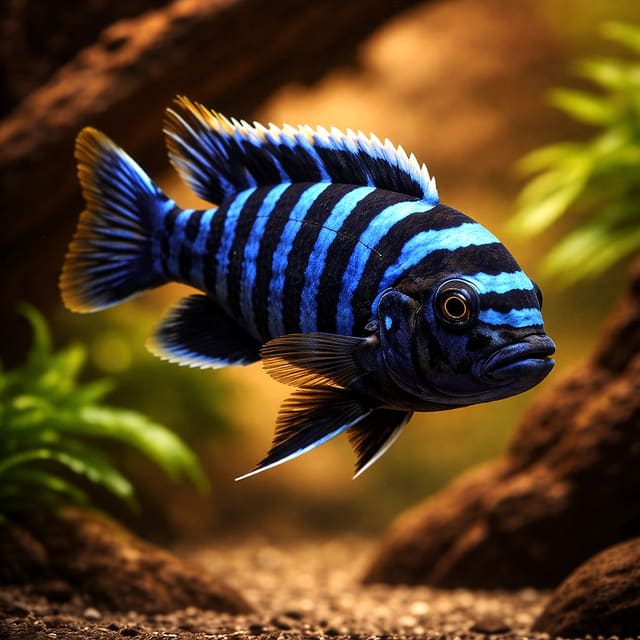
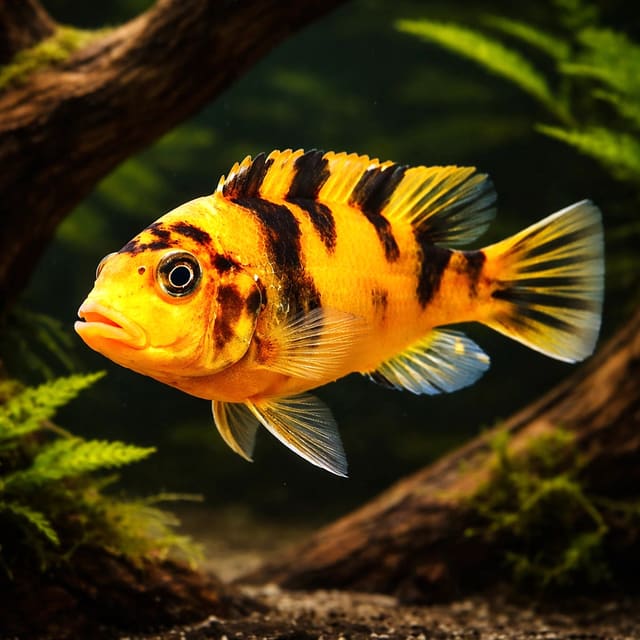
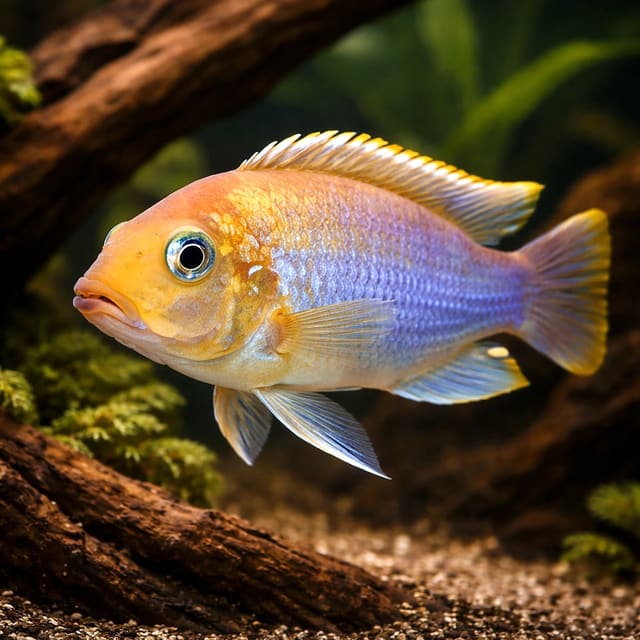
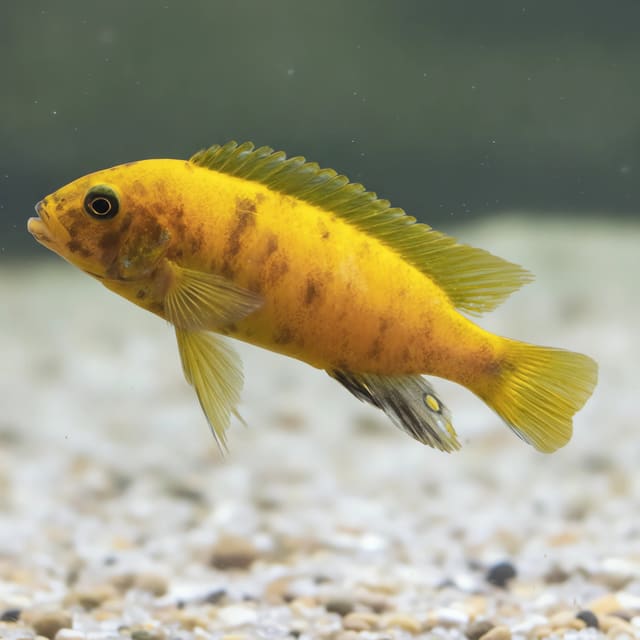
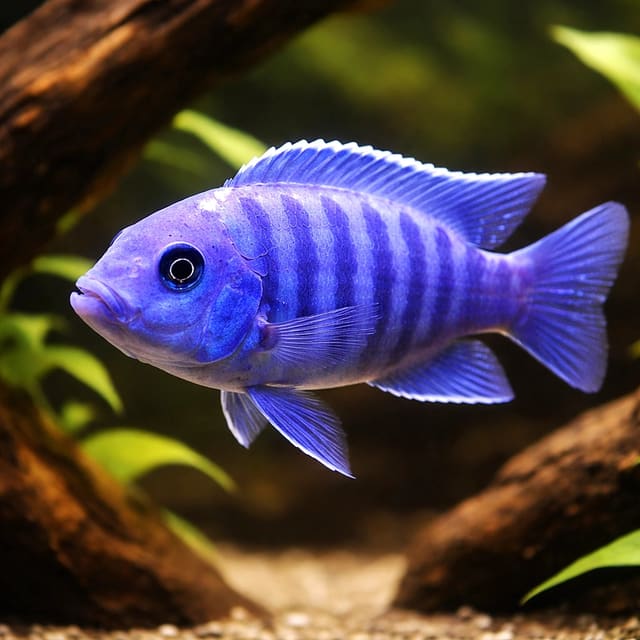
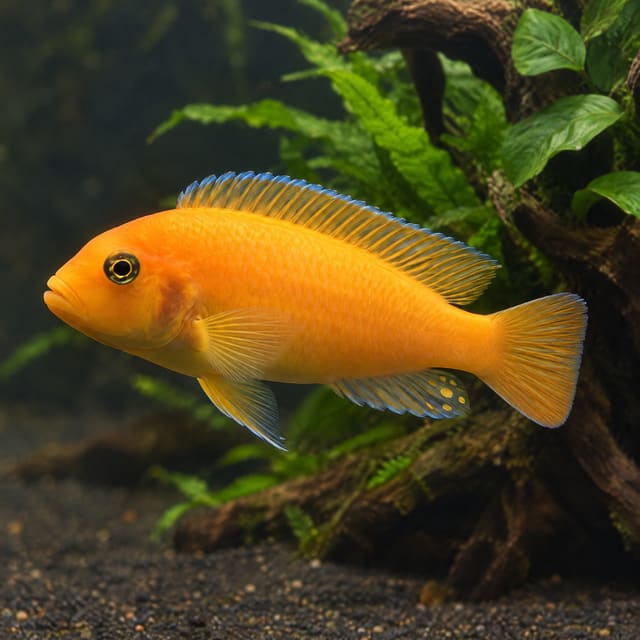
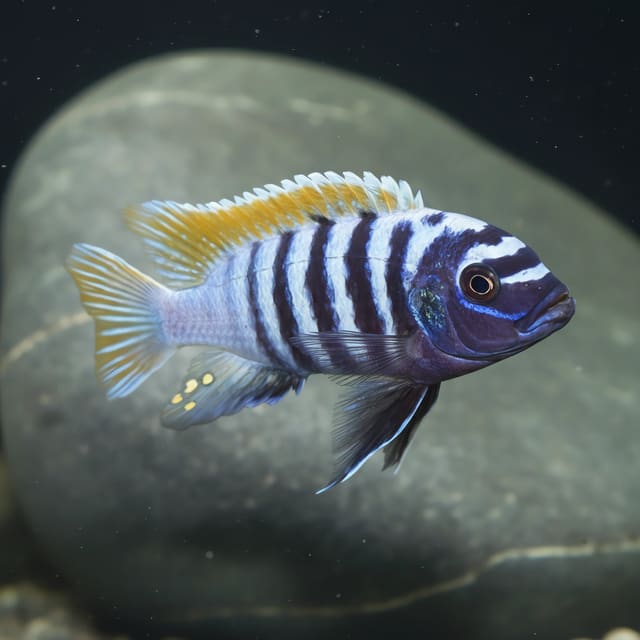
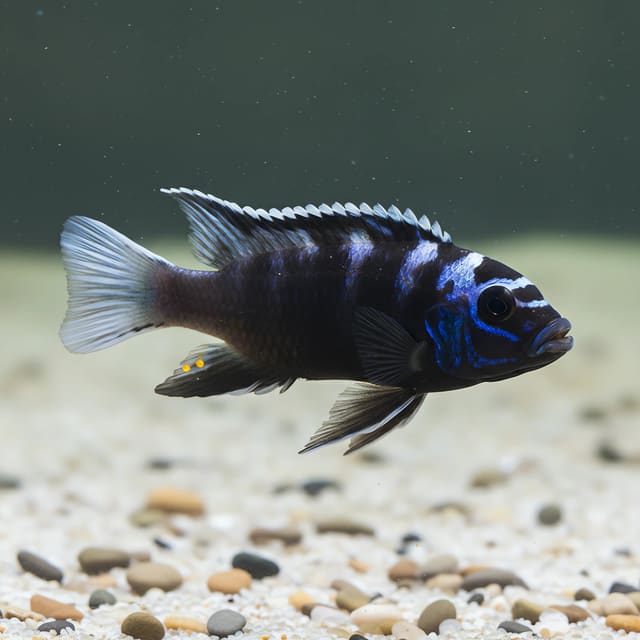
Gallery images have been digitally enhanced to improve image quality. Natural colour, pattern, size and maturity can vary between live animals. Choose this fish for its species and care commitment, not for an exact colour match to one image.
A Pulpican aquarium works best when the hardscape creates choices. FishBase describes the species from the intermediate zone, where rocks and sandy areas meet, and notes that males are territorial. Recreate that structure with several separate rocky areas rather than one solid wall. Each pile should offer more than one entrance and an escape route, while open sand between piles makes boundaries easier for the keeper to see. Secure every heavy stone before livestock enters the tank; mbuna investigate gaps and can move loose substrate around a base.
OATA's broad Malawi care sheet recommends at least 200 litres for a reasonable community. Volume matters, but the usable footprint matters as well. A tall narrow container with one cave can concentrate conflict, while a longer aquarium can carry several territories, open swimming space and equipment without blocking movement. Plan the adult community, not merely today's juvenile bodies. Count every cichlid, consider how large each species becomes and leave enough access to maintain the substrate without dismantling the entire structure.
A mature aquarium is essential. If this is your first livestock system, follow the first tropical tank guide before ordering. The biological filter must already be processing waste, and ammonia and nitrite should both test at zero. Adding several fish quickly increases the load placed on the bacteria; introduce stock in a planned sequence and keep testing as feeding and waste rise.
Plants are optional rather than the centre of this layout. OATA notes that Malawi cichlids dig and rearrange substrate, which will uproot plants. Rock-attached hardy plants may be practical, but do not let planting reduce cave choice or create unstable stonework. The strongest design is one that remains safe when fish excavate, that the keeper can clean and that offers several routes away from a territorial animal.
Before filling the aquarium, view the structure from both ends and from the normal feeding position. No single cave should control the only route between water flow, food and shelter. Leave a clear maintenance path so waste can be removed without shifting the foundations. If a stone needs support, place it securely before substrate surrounds it; loose gravel is not a dependable base for a heavy pile. Mark the intended water line and make sure circulation can pass around the rock faces rather than travelling only across the surface.
After the aquarium is running, observe how flow behaves around the hardscape. Fine debris collecting in one hollow points to a weak area that will need regular attention. A useful layout allows the keeper to reach that area with a siphon while leaving the principal caves intact. The objective is not to reproduce every stone in Lake Malawi, but to provide the functions seen in the species' habitat: solid cover, rock surfaces, nearby open sand and more than one route away from a territorial male.
Use OATA's Malawi cichlid guidance as the routine aquarium target: 23–27°C, pH 8.0–8.6, general hardness 12–18°dH and carbonate hardness 10–15°dKH. These are broad values for Malawi cichlids as a group rather than a species-specific optimum for Maylandia pulpican. They nevertheless give a practical operating window that matches the kind of mineral-rich system this fish requires. Measure the source water before changing chemistry, then choose a repeatable method that avoids sudden movement in pH, temperature or hardness.
| Temperature | 23–27°C under OATA's group guidance |
|---|---|
| pH | 8.0–8.6 under the same broad guidance |
| General hardness | 12–18°dH |
| Carbonate hardness | 10–15°dKH |
| Ammonia and nitrite | Zero mg/l |
| Nitrate | No more than 20 mg/l above the normal tap-water level |
Use the water-chemistry guide to understand what each test means, then compare actual readings with the target using the water matcher. A reading is useful only when it leads to a calm decision. If pH or hardness is outside the plan, identify whether the cause is the source water, depleted buffering, unsuitable décor or an inconsistent maintenance routine before adding products.
OATA recommends oversized filtration and strong aeration for Malawi communities, while the RSPCA aquarium guidance explains why a working biological filter is vital: fish release ammonia, bacteria convert it first to nitrite and then to the safer nitrate. Select equipment for the completed stocking level, provide surface movement and check that rockwork does not leave stagnant pockets. Mechanical media should be easy to reach, because trapped solid waste can undermine water quality even when the water looks clear.
Test at least weekly and whenever behaviour changes. OATA recommends a partial water change of 25% at least once every week. Treat replacement tap water for chlorine or chloramine and match its temperature closely. If filter media needs cleaning, rinse it lightly in water removed from the aquarium rather than running it under the tap. Check intakes, impellers and air flow for blockages, and restore normal circulation before leaving the tank unattended.
Write down the tap-water baseline as well as the aquarium result. OATA's nitrate ceiling is relative to the normal tap-water level, so comparing the two readings is more informative than treating the tank number in isolation. Use the same test method each time and look for movement across several results. A steadily rising figure calls for attention to stocking, feeding, filtration and maintenance; one surprising result should be confirmed before a drastic change is made.
FishBase records Maylandia pulpican feeding on aufwuchs and plankton in the water column. OATA's broad guidance says smaller mbuna tend towards herbivory and appreciate specialist Malawi foods with a high algae content plus fresh vegetables. That combination supports an algae-rich, plant-forward routine rather than repeated heavy meals of rich animal protein. Choose a complete Malawi cichlid food as the staple and use suitable vegetable matter as variety, keeping every item small enough for the fish to take cleanly.
OATA advises feeding Malawi cichlids only what they can finish within a few minutes, twice a day. Watch the fish rather than tipping in a fixed handful. Food should be distributed so that more than the boldest animal can reach it, yet should disappear before it drifts behind rocks. Remove uneaten material where practical. Excess food decomposes, adds toxic waste and makes both filtration and aggression management harder.
Natural feeding behaviour is useful context, but it is not a reason to scrape unknown material from wild rocks or to improvise an unbalanced diet. Aufwuchs is a complex surface community, not a single ingredient. In a home aquarium, a formulated food makes the basic nutrient supply consistent, while controlled vegetable additions add texture and foraging interest. Avoid describing this fish as an obligate carnivore, and do not rely on occasional frozen foods as the foundation of the menu.
Feeding time is also a daily health check. Look for every fish emerging, taking food and swimming normally. A sudden loss of appetite, rapid breathing, unusual hiding or a change in colour can be an early warning. Test water before reaching for medication, because ammonia, nitrite, temperature or oxygen problems can affect several fish at once. If concern remains after water and equipment have been checked, seek focused advice with clear observations rather than treating blindly.
Have the aquarium mature, heated and tested before dispatch. Leave the rockwork finished, filtration running and lighting routine settled; arrival day is not the time to rebuild the tank. The current delivery and Live Arrival Guarantee policy explains the packing, receiving and claim conditions. Tropical Fish Co hand-bags fish in pure oxygen, uses an insulated poly box and adds a heat pack when the weather calls for one. Tracking and the confirmed Thursday or Friday delivery date are sent by email, and a licensed live-animal courier carries the parcel.
The video protects a genuine claim only when it starts before the parcel is opened. Someone must be present at the delivery address, the parcel must be opened and inspected on the day it arrives, and any problem should be reported the same day with the order number and video. Those conditions are part of the store policy rather than a general fish-care rule.
During the first week, keep the normal water targets steady and feed sparingly while observing. A newly introduced cichlid has to learn the cave map and the location of other fish, so close attention matters more than attempts to force activity. Check that the newcomer can leave shelter, reach food and rest without relentless pursuit. If one established fish controls every path, adjust the layout calmly to create additional broken views rather than chasing animals around the tank.
Continue the weekly maintenance routine after the fish settles: test ammonia and nitrite, check nitrate against the source-water level, change 25% at least once each week, condition replacement water and inspect filtration. Good care is a sequence of small repeatable actions. Stable chemistry, clean mechanical media, reliable oxygenation and measured feeding together protect the fish more effectively than occasional large interventions.
Pulpican Mbuna belongs in a deliberately planned Malawi aquarium. FishBase records territorial males, and OATA describes Malawi cichlids as aggressive fish that should be mixed with caution. A companion therefore needs to tolerate the same hard alkaline water, cope with the activity of mbuna and have enough room to avoid a cave holder. Colour alone says nothing about compatibility, and another African fish is not automatically appropriate merely because it comes from the same continent.
| Potentially suitable | Carefully selected Malawi cichlids of compatible adult size and activity, or some Synodontis catfish, in an aquarium planned for the whole group. |
|---|---|
| Avoid | Peaceful soft-water community fish, delicate long-finned fish and animals unable to compete in an assertive hard-water setup. |
| Watch closely | Any new addition that is pinned in one corner, prevented from feeding, breathing rapidly or repeatedly chased away from all shelter. |
OATA's broad community method uses groups of at least 15 Malawi cichlids and some deliberate crowding to spread aggression. That is not permission to exceed filtration capacity. The method assumes a sufficiently large aquarium, oversized filter, strong aeration, extensive rockwork and a keeper able to monitor every fish. A small group can focus aggression, yet an overfilled immature aquarium creates ammonia and oxygen risks. Balance both sides of the problem before increasing numbers.
Where possible, OATA also recommends more females than males of each species. This product does not guarantee sex, and juveniles may not display dependable adult differences. Never count an assumed female as part of a ratio. If sex balance matters, wait for properly identified animals or choose a plan that remains safe when the sex of an individual is unknown.
Add more peaceful species before more aggressive ones, and add Malawi cichlids in groups rather than exposing a lone newcomer to every established territory. Rearranging décor can reduce aggression by forcing fish to establish boundaries again. Make the change before release, keep the rocks stable and retain several usable shelters. Then observe continuously through the first feeding periods.
Compatibility is an ongoing condition, not a promise made once. As fish mature, a previously quiet cave can become important. Review the community when a fish changes its usual location, loses condition or stops reaching food. Acting early is kinder than waiting for torn fins or exhaustion. Keep a safe contingency space available so a fish can be separated if the social arrangement breaks down.
Normal behaviour varies among individuals, so establish what each fish does when healthy. A settled Pulpican may move between rock and sand, graze surfaces, enter open water for plankton-like food and return to a chosen shelter. The important question is whether every fish can perform ordinary activities without being excluded by another animal.
When several animals show distress together, water and equipment should be checked immediately. Measure ammonia, nitrite and temperature, confirm the filter and aeration are working and inspect for an obstruction. When one fish is affected, still test the water before assuming an individual disease. OATA advises contacting the retailer when health is concerning after water quality has been checked.
Keep a simple record of test results, water changes and notable behaviour. The aim is not paperwork for its own sake; it lets you recognise a trend that memory may miss. A gradual nitrate rise can indicate that feeding, stocking or maintenance has changed. Repeated chasing after each layout adjustment can show that the footprint lacks enough distinct territories. Consistent observations make the next practical decision clearer.
With a stable hard-water system and a thoughtfully built rockscape, Pulpican Mbuna rewards close observation. Its natural history is visible in the way it uses the boundary between rocks and sand, responds to surface food and treats shelter as valuable space. Keeping that behaviour healthy is the central measure of success.
FishBase records Maylandia pulpican at a maximum length of 7.1 cm SL. That is an adult biological record, whereas the size chosen for an order is the size supplied on dispatch.
OATA's broad guidance for a reasonable Malawi cichlid community starts at 200 litres. Treat that as a group-planning baseline, then allow extra footprint, rockwork and filtration for the number and mix you intend to keep.
OATA advises groups of at least 15 for Malawi cichlids as a broad aggression-management approach, with more females than males where possible. This product is not sex guaranteed, so never build a ratio by guessing sex from colour or size.
It is best treated as an advanced choice. A keeper needs a mature hard-water aquarium, strong filtration, substantial rockwork and a plan for territorial behaviour rather than a general peaceful community tank.
FishBase records aufwuchs and plankton in its natural diet. OATA's group guidance for smaller mbuna favours Malawi foods with a high algae content and fresh vegetables, fed only in amounts eaten within a few minutes.
OATA's group-level Malawi guidance is 23–27°C, pH 8.0–8.6 and 12–18°dH, with ammonia and nitrite at zero. Keep those values steady and test the aquarium rather than chasing a number with sudden chemical changes.
FishBase records territorial males, and OATA describes Malawi cichlids as aggressive fish that must be mixed cautiously. Caves, broken lines of sight and enough space help prevent one fish controlling the whole aquarium.
OATA limits broad Malawi companionship to other carefully chosen Malawi cichlids or some Synodontis catfish. Match adult size, activity and water needs, and keep peaceful soft-water community fish out of this setup.
Tropical Fish Co hand-packs live fish in oxygenated bags inside an insulated box, using a heat pack when weather calls for one, and uses a licensed live-animal courier. Keep a continuous unboxing video from the sealed parcel, inspect the fish the same day and float the sealed bag for 20–30 minutes before release; the current delivery policy gives the full Live Arrival Guarantee conditions.
Wild observations describe the animal's ecology; OATA values describe Malawi cichlids as a group. The store offer defines the sold unit and dispatch sizes.
No reviews for this item yet. Bought one? Honest reviews only, good or bad.
What customers say about ordering from us
I have a small group of long finned mountain minnows. So was delighted to be able to order ten of this variety to increase the genetics in my tank . The ones I recieved are healthy but it’s to early to give a verdict on wether they are of a long finned type since they are small currently.
Gordon Walker · 23 Sept 2026
100% success travel and "installation". Pleased with quality of purchase. The Siamese fighter a bit "shy" so have not yet seen him at his best yet but looking good. Happy customer. GG
George E Garratt · 21 Sept 2026
Reviews of our shop, collected by Judge.me, an independent third-party review collector. Newest first.