Moderate
Acei Cichlid (Pseudotropheus sp. “acei”)
24–26°C · pH 7.5–8.5 · 300L
£7.99

The Gallireya Reef Dogtooth Cichlid (Cynotilapia sp.) is a rock-dwelling Lake Malawi mbuna identified to genus level. OATA’s Malawi cichlid guidance gives 23–27°C, pH 8.0–8.6 and 12–18°dH for the group; plan a 200-litre or larger Malawi community. Sold by Tropical Fish Co as one live fish per purchase in dispatch sizes spanning 3–7 cm.
Cynotilapia sp.
Save when buying multiple fish. Each quantity is one fish; sex and pair formation are not guaranteed unless the selected variant explicitly states them.
The Gallireya Reef Dogtooth Cichlid (Cynotilapia sp.) is a rock-dwelling Lake Malawi mbuna identified to genus level. OATA’s Malawi cichlid guidance gives 23–27°C, pH 8.0–8.6 and 12–18°dH for the group; plan a 200-litre or larger Malawi community. Sold by Tropical Fish Co as one live fish per purchase in dispatch sizes spanning 3–7 cm.
Cichlids are a family of roughly 1,800 accepted species, not one care type. Before buying, identify the exact species and source, then compare adult measurement, usable tank dimensions, social system, territory, tested water, diet and an exit plan. No family-wide minimum tank, water range or tank-mate list is safe.
Maintain these water conditions for optimal health and vibrant colors
The Gallireya Reef Dogtooth Cichlid is a trade form of Cynotilapia, an accepted cichlid genus. The exact species has not been identified, so the care advice here follows the genus Cynotilapia and its care group. That distinction matters because a genus name is a sound identity boundary, while attaching an unconfirmed species name could give false confidence about adult size or fine-detail husbandry.
WoRMS places Cynotilapia in the family Cichlidae. The genus belongs to the mbuna flock: rock-dwelling cichlids from Lake Malawi in East Africa. Their home among rocks explains the most important aquarium decisions. This is an active fish that needs a mineral-rich Malawi environment, secure stonework, clear routes through the aquarium and enough room for fish to move away from one another.
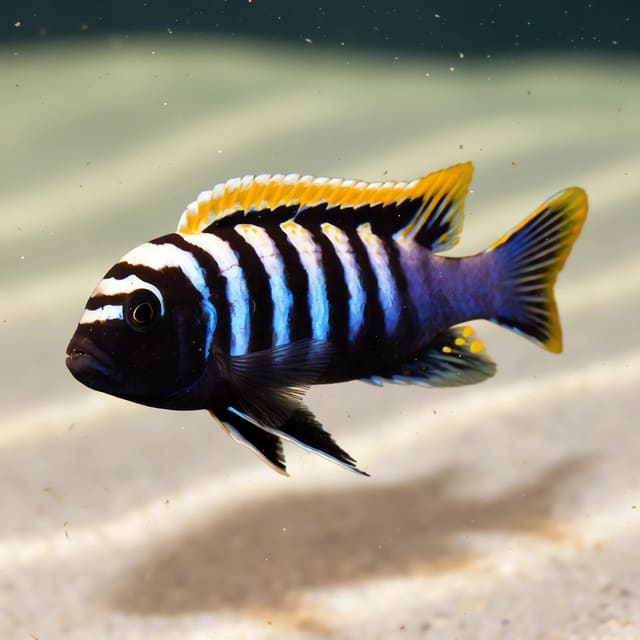
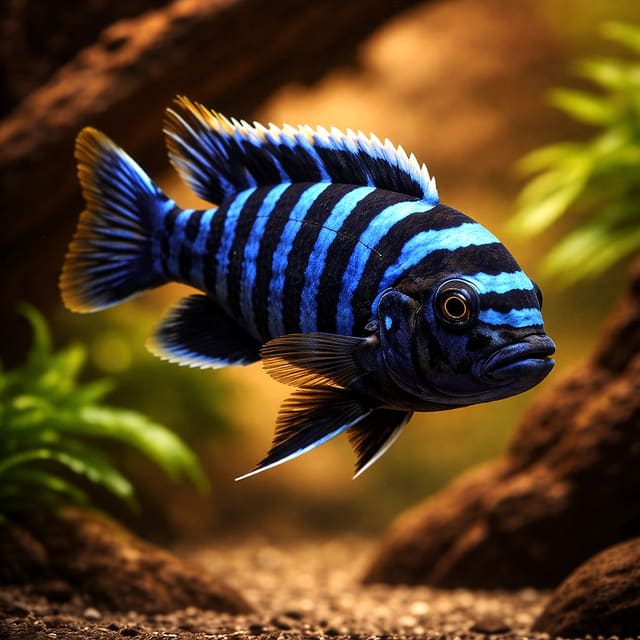
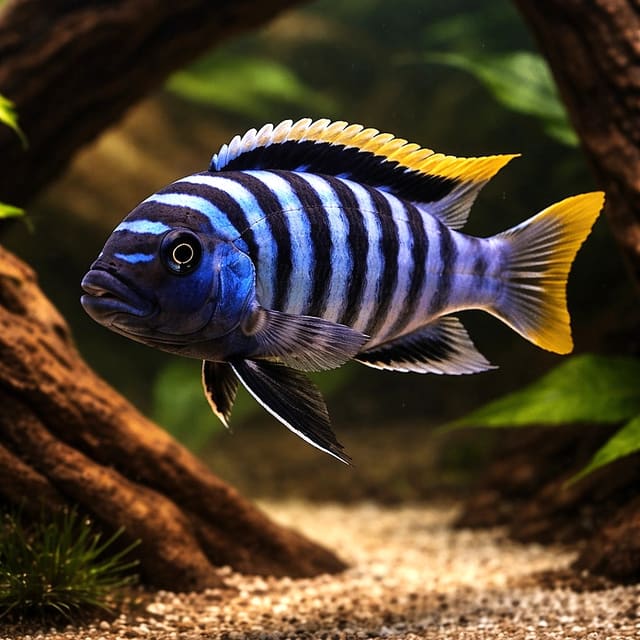
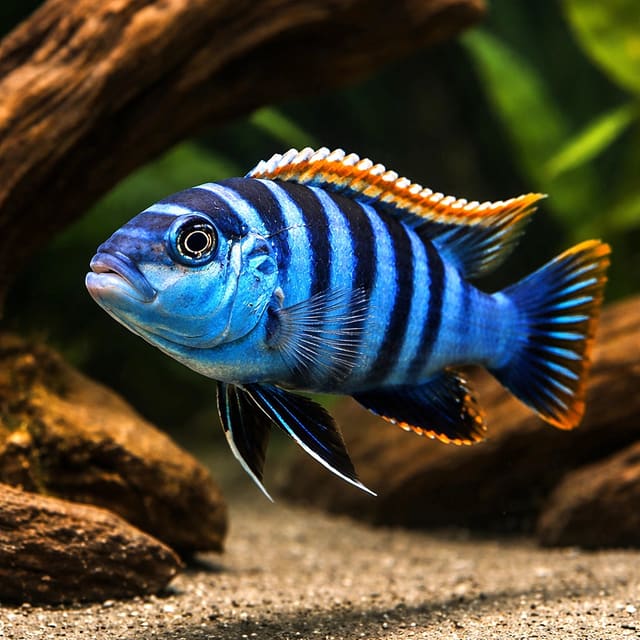
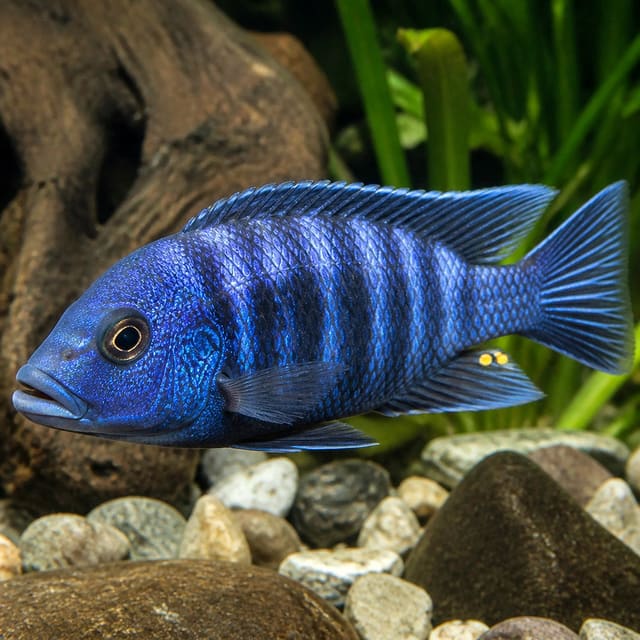
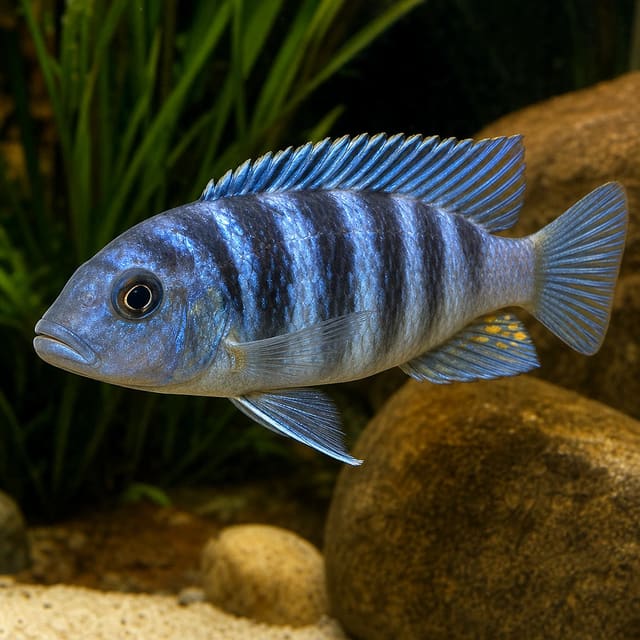
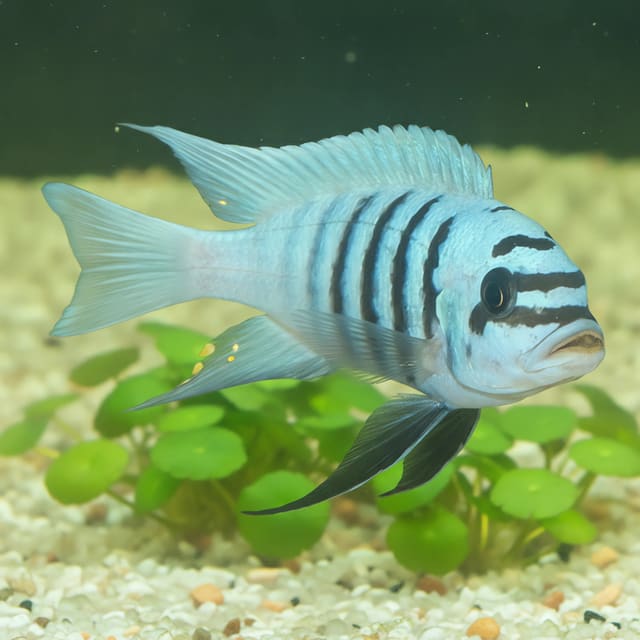
The Gallireya or Hara Reef name identifies the offered form without changing the genus-level scientific identity. Keep that trade name useful, but do not read sex, adult size or individual colour into it. The gallery shows a pale blue cichlid with strong dark vertical bars, a deep body and extended fins against plants and sand; colour, pattern and maturity can differ from one live fish to another.
The genus summary for Cynotilapia describes these fish as Lake Malawi mbuna and maternal mouthbrooders. That natural history supports a rocky setup and explains why territorial behaviour and breeding behaviour can become intertwined. It does not turn the aquarium into a breeding project: the first responsibility is stable water, suitable space and a community in which every fish can feed and retreat.
This fish is a strong match for an established Malawi aquarium whose keeper is comfortable planning aggression rather than reacting after trouble begins. It is a poor choice for a peaceful general community, soft or acidic water, a newly cycled aquarium or a small display built around a few timid fish. OATA describes Malawi cichlids as colourful and usually undemanding in routine care, but also specialised and aggressive; both sides of that description belong in the decision.
| Suits | Not suited to |
|---|---|
| A 200-litre or larger Malawi community with hard alkaline water | A small, soft-water community aquarium |
| Secure rockwork, strong filtration and vigorous aeration | Loose stone piles, delicate planting or weak biological filtration |
| A keeper willing to plan the complete cichlid group | Adding one territorial fish without checking the existing community |
| Regular testing, weekly maintenance and close observation | An immature filter or irregular water care |
Use 200 litres as the starting point for a reasonable Malawi cichlid community, not as a promise that every collection of fish will work in that volume. Length, width and rock placement decide how many usable territories the aquarium offers. A larger footprint usually gives more practical separation than extra height, while greater total volume makes temperature and water chemistry less prone to rapid change.
The care level is best treated as advanced at the stocking stage. The daily tasks are familiar—feed, observe, test and maintain—but errors in group choice or territory design can affect several fish quickly. If the aquarium already contains Malawi cichlids, assess their adult size, temperament and present territories before adding another form.
One purchase supplies one Gallireya Reef Dogtooth Cichlid. The live selector carries dispatch sizes across 3–7 cm, including 3–4 cm, 4–5 cm, 5–6 cm and 6–7 cm labels. The size you select is the size supplied, not the adult size. Treat the centimetres as an arrival-size choice and plan the permanent aquarium around the needs of an adult Malawi cichlid community.
Sex is guaranteed only when the selected option explicitly states male or female. This Gallireya Reef Dogtooth Cichlid listing has no sex-guaranteed option. Juvenile colour, egg spots or a single gallery view should not be used to promise a male or female. Build a stocking plan that remains workable whichever sex the supplied fish proves to be.
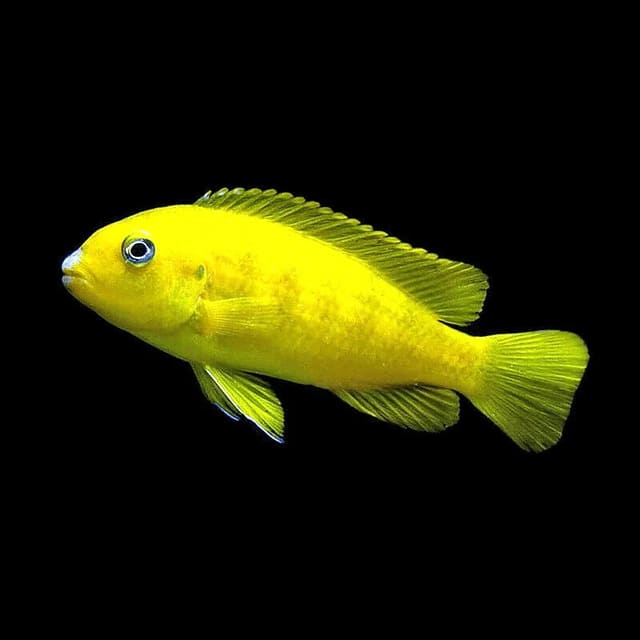
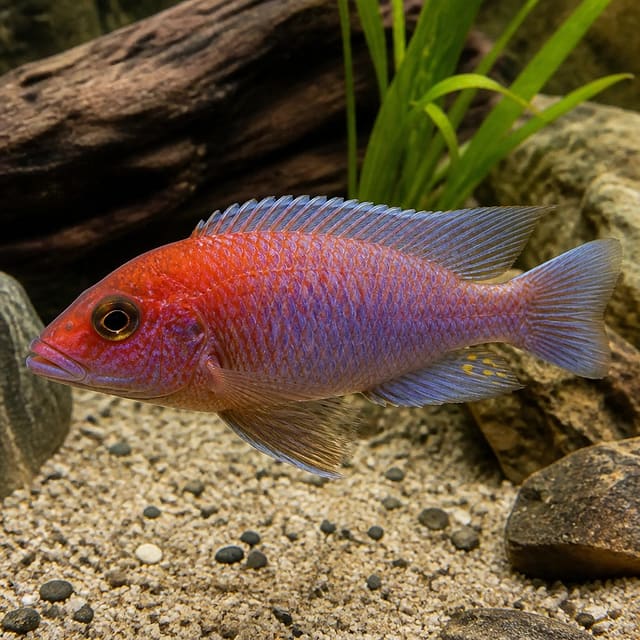
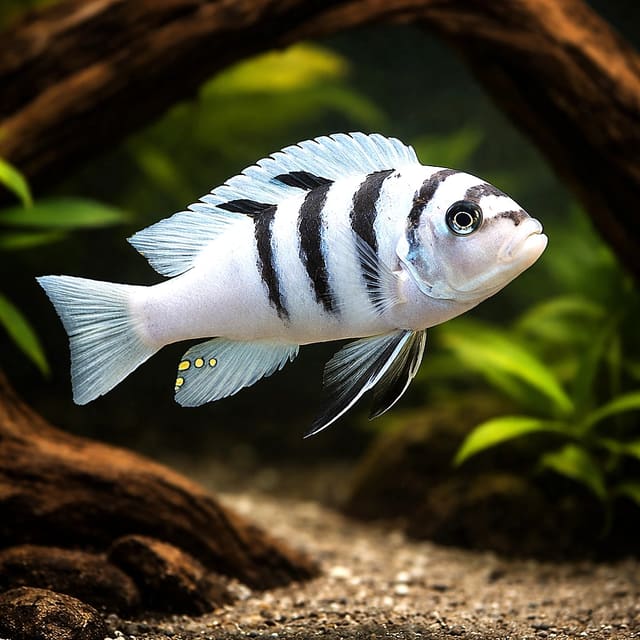
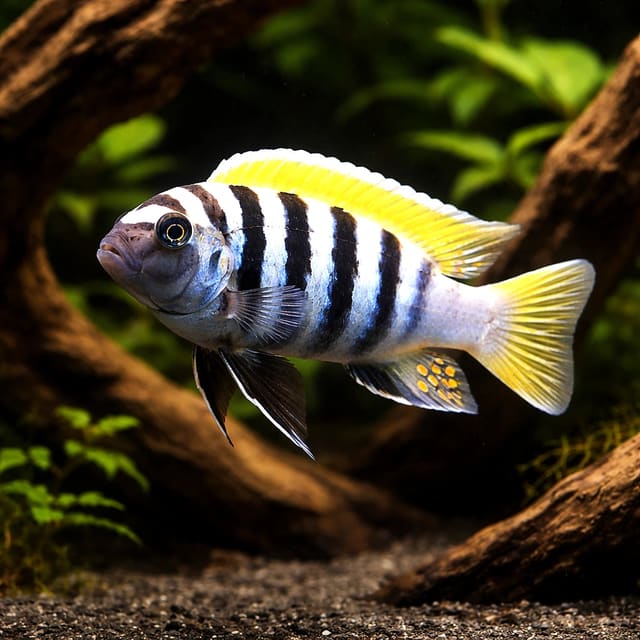
Gallery images have been digitally enhanced to improve image quality. Natural colour, pattern, size and maturity can vary between live animals. The image helps with recognition of the listed form, but the animal arriving is a living individual. Judge its condition by clear eyes, intact fins and scales, appropriate swimming and feeding behaviour, then let it settle without expecting an exact copy of the photographed colour.
For a wider view of fish intended for this type of setup, browse the African cichlid collection. Use the collection for comparison, not as an automatic compatibility list: every addition still needs the same water, space and temperament screen.
Start with a properly matured aquarium and a dependable biological filter. If this is a new system, work through the first tropical tank guide before livestock is introduced. Malawi cichlids produce a substantial biological load when kept as a group, so the filter must be able to process ammonia to nitrite and then nitrate before the aquarium is stocked.
Place rockwork securely on a stable base and arrange it so digging cannot undermine a dangerous pile. OATA notes that Malawi cichlids often rearrange substrate. Create caves, narrow passages and several routes around the display, while keeping open water for movement. The aim is not to trap each fish in one cave; it is to give a chased fish more than one direction of escape and to prevent a single dominant animal seeing the entire aquarium from one position.
Use coral sand or a similar substrate where it suits the system because the material can help buffer Malawi water. Expect digging and choose planting accordingly. Delicate rooted plants are likely to be disturbed, while only the hardiest plants have a realistic chance in a busy mbuna display. Leave enough access to siphon debris rather than packing every centimetre with stone.
Filtration and oxygenation need to match the community, not just the volume printed on the aquarium. OATA recommends an oversized filter and aggressive aeration for crowded Malawi communities. Aim the return so water circulates around rock faces without leaving stagnant pockets, and check that surface movement remains strong when filter media begins to collect waste.
Keep the aquarium at 23–27°C, pH 8.0–8.6 and 12–18°dH. OATA gives these as broad guidance for Malawi cichlids as a group, not a species-specific optimum for the Hara form. Carbonate hardness guidance for the group is 10–15°dKH. Choose a stable point that works with the source water and the rest of the Malawi community instead of moving values up and down in pursuit of one exact number.
Ammonia and nitrite must remain at zero. Nitrate should not rise more than 20 mg per litre above the normal tap-water level. Those figures require regular testing because clear water can still contain harmful dissolved waste. The water chemistry guide explains what each reading means, and the water matcher can help compare measured aquarium values with the intended range.
Test the tap water as well as the aquarium. A pH reading makes more sense when considered with general and carbonate hardness, since buffering capacity affects how readily pH can shift. Record results at the same point in the maintenance cycle—before a water change is useful—so a trend is easier to see. If pH or hardness starts drifting, check the replacement water, substrate, rocks and maintenance routine before adding chemicals.
Temperature stability matters more than selecting the warmest end of the range. Position the heater where circulation distributes warmth, use a separate thermometer and check it during seasonal room-temperature changes. Vigorous aeration is especially valuable in a busy cichlid aquarium because warm water carries less dissolved oxygen and every fish depends on steady gas exchange.
At least once every week, make a partial water change of 25%. Use a siphon to lift solid waste from accessible substrate, especially around the front and sides of rock piles where debris settles. Treat replacement tap water with a conditioner that removes chlorine or chloramine and bring it close to the aquarium temperature before it enters the system.
Check the filter for reduced flow and blockages. If mechanical media needs cleaning, do not rinse it under the tap. Swish or squeeze it lightly in water removed from the aquarium so chlorine does not damage the beneficial bacteria. Clean only what needs attention and put the filter back into service promptly; a biological filter protects the fish only while oxygenated water continues to pass through its media.
RSPCA aquarium guidance explains why filtration is essential: fish release toxic ammonia, bacteria convert it to nitrite and then to the safer end product nitrate. In a Malawi community, the visible fish and rockwork can look excellent while a blocked filter or sudden increase in feeding pushes the nitrogen cycle beyond its capacity.
Use a short weekly record: temperature, pH, ammonia, nitrite, nitrate, general hardness and carbonate hardness. Add observations about filter flow, appetite and aggression. The value of the record is the pattern. A single odd reading should be retested, while a repeated movement calls for a practical cause to be found.
| Every day | Check breathing, swimming, feeding and whether every fish can leave its refuge. |
|---|---|
| Every week | Test water, make the 25% partial change and inspect filter flow. |
| When flow falls | Check for blockage and rinse dirty media lightly in removed aquarium water. |
| After adding fish | Test more closely while bacterial capacity adjusts to the extra waste. |
OATA advises that smaller mbuna are more herbivorous than the larger open-water Malawi cichlids. Use a quality specialised Malawi cichlid food with a high algae content as the regular base, and include suitable fresh vegetables. This is a sound group-level feeding pattern for Cynotilapia without pretending that a genus-level identity supplies a unique species menu.
Feed only what the fish consume within a few minutes, twice a day. Spread the food so several fish can feed at once instead of dropping one large portion into the territory of the boldest animal. Watch the quieter fish: a meal is not successful simply because the food disappears. It must reach the full group without leaving a large residue to break down.
Remove uneaten food and adjust the next portion. Repeated excess raises the biological load and eventually appears as nitrate, poorer oxygen conditions or blocked mechanical media. Rich meaty foods should not become the centre of the diet for this smaller mbuna pattern. Variety should stay within the algae-rich approach rather than turning into frequent heavy animal-protein meals.
Use feeding time as a health check. Look for a fish that approaches but cannot take food, hangs back because of aggression, spits repeatedly or has a sudden loss of interest. Compare that behaviour with breathing, body condition, colour and water-test results. A single missed mouthful is different from a repeated pattern across two feeds.
Check ammonia and nitrite are zero and confirm the aquarium is suitable for the planned number of Malawi cichlids before adding fish. Increase the population gradually. Every addition raises feeding and waste production, and the beneficial bacteria in the filter need time to increase. Adding too many fish too quickly can cause new tank syndrome, with harmful ammonia or nitrite rising before the filter catches up.
Malawi cichlids are best introduced in groups so one newcomer does not receive all the attention. Add more peaceful species before the more aggressive ones. Re-arranging some décor just before introduction can reduce the value of existing territories and make the fish establish their positions again, but every rock moved must remain stable.
During the first week, test more often than the normal weekly routine and compare each fish at feeding time. Check that all animals leave cover, take food and breathe normally. A fish remaining hidden all day may be settling, but persistent exclusion, fin damage or missed feeds points to a compatibility or layout problem that needs action.
Keep the aquarium calm while still observing it closely. Avoid repeated chasing with a net merely to inspect a fish. Instead, watch from a short distance and use the same feeding positions each day so a change is obvious. If aggression concentrates on one individual, review the group composition, swimming space and rock arrangement together.
The full delivery and Live Arrival Guarantee policy explains the evidence needed for a claim and the confirmed delivery-day arrangements. The parcel is hand-packed with oxygen in an insulated box, with a heat pack when conditions call for it, and carried by a licensed live-animal courier.
Healthy fish should have clear bright eyes, intact scales and fins, appropriate swimming and a normal interest in food. Pay attention to hanging at the surface, sitting on the bottom, erratic swimming, faster or slower gill movement, darkening or paling, hiding more than usual, white spots, fluffy growths, damage, weight change or reduced feeding.
Start with a water test whenever health or behaviour changes. Temperature, ammonia, nitrite and nitrate can turn an apparent fish problem into a whole-aquarium diagnosis. If the readings are sound but the concern continues, contact Tropical Fish Co for guidance and describe the fish, the timing, the aquarium and the recent test results.
Build a baseline once the fish has settled. Note which rocks it uses, where it feeds, how readily it leaves cover and whether it can move through the aquarium without being intercepted. Malawi cichlids are active and territorial, so the useful question is not whether chasing ever occurs but whether every animal can still feed, rest and leave a disputed area.
Watch at more than one point in the day. Feeding time reveals competition, while quieter periods show whether a fish is permanently confined to one corner or refuge. Look for clear eyes, intact fins and scales, steady swimming and a normal interest in food. Record fresh damage, a marked colour change, altered breathing or a repeated loss of appetite.
Test water whenever the group's behaviour changes. A fish hanging near the surface may point to oxygen or water-quality trouble, while several fish acting unusually suggests an aquarium-wide cause. Confirm temperature, ammonia, nitrite, nitrate and pH, then check filter flow and aeration. Clear water by itself does not confirm safe chemistry.
If one individual alone is affected and the readings are steady, examine social pressure. Identify the fish doing the chasing, the route being defended and whether food is available outside that territory. A secure rearrangement of rocks during a planned introduction can reset familiar boundaries, but unstable piles or a cramped footprint create a different risk.
Restore filter flow safely when circulation falls, review portions when waste rises, and reassess the community when one fish repeatedly misses meals. Separate an animal when there is immediate danger, then correct the underlying stocking or layout problem before considering a return. Simply putting it back into unchanged conditions usually recreates the same pressure.
Keep a short dated record of readings, feeding, aggression and maintenance. The record makes patterns easier to see: repeated damage near one cave points to territory, while several fish breathing faster after a maintenance change points back to the system. Prompt, measured changes are safer than making several large adjustments at once.
Keep Malawi cichlids with other Malawi cichlids or with some species of Synodontis catfish that also naturally inhabit Lake Malawi. This OATA rule is much more useful than a long generic tank-mate list. It keeps the aquarium centred on hard alkaline water and on animals whose activity can fit a robust cichlid community.
That permission is not an automatic match. Compare adult size, feeding access, activity, aggression and the amount of usable territory. Two fish can need the same pH yet still be a poor combination if one monopolises caves or feeding points. Product alternatives elsewhere on the page are shopping comparisons, not declarations that those fish belong together.
Plan a group of at least 15 Malawi cichlids only when the aquarium volume, footprint and filtration can carry them. Small groups often fight because aggression is concentrated. Where sex is known in the wider community, more females than males can reduce repeated male attention to one female, but this product itself carries no sex guarantee and its image must not be used to assign one.
Add Malawi cichlids in groups rather than one exposed newcomer, place peaceful species first and more aggressive species later, and consider rearranging secure décor during a planned introduction. These steps spread attention and reset familiar territories. They do not make an unsuitable combination safe, so decide the community before the fish are in the same aquarium.
| Consider | Other Malawi cichlids chosen for the same hard-water community; some suitable Lake Malawi Synodontis. |
|---|---|
| Avoid | Peaceful soft-water community fish and animals that cannot compete safely in a territorial mbuna setup. |
| Check closely | Similar-looking cichlids, existing territorial males, feeding competition and total filter load. |
Aggression management begins with the aquarium footprint. Rock piles should break views across the tank and create more than one path between feeding areas and refuges. An animal that is chased from one cave needs somewhere else to go without crossing the same dominant territory. Check the layout from fish height, not only from above.
Distribute food to prevent one cichlid turning a single feeding point into another territory. Watch who eats rather than only how quickly food vanishes. A subordinate fish that repeatedly misses meals, stays pressed into an upper corner or shows fresh fin damage needs attention before loss of condition develops.
Rearranging décor can help when adding a planned group because existing fish must reassess boundaries. Move only stable pieces and keep the filter running while work is carried out. Adding more fish solely to distract an aggressor is risky unless the aquarium and biological filter were already sized for the resulting community.
Separate a fish when there is immediate danger, but use the event to reassess the underlying plan: species mix, numbers, sex pattern where known, swimming space, cave ownership and feeding access. Returning the same fish to an unchanged layout usually returns it to the same problem. Record when chasing occurs—at feeding, near one cave or throughout the tank—because the timing points to the most useful correction.
A maternal mouthbrooding female may isolate herself and eat less while carrying young. The genus summary describes mouthbrooding for roughly 20–30 days. Observe without assuming every withdrawn fish is breeding: check breathing, physical condition, water readings and aggression at the same time.
Gallireya Reef Dogtooth Cichlid is identified to Cynotilapia genus level rather than to one named species, so use the 200-litre Malawi-community starting point instead of relying on a single claimed adult length. Leave room for rockwork, open water and territorial spacing, and review the whole group as the fish develop.
Use at least 200 litres for a reasonable Malawi cichlid community. That is OATA guidance for the group, and a larger aquarium gives more room for separate territories while making temperature and water quality steadier. The footprint, rock layout, filtration and number of fish matter alongside the litre figure.
Malawi cichlids can be kept in groups of at least 15 because small groups often fight, according to OATA group guidance. Plan the complete community before buying, allow for the biological load, and add fish gradually so the filter bacteria can adjust. This product does not include a guaranteed male or female.
The daily feeding and maintenance are straightforward, but this is a specialised, territorial Malawi cichlid rather than an easy mixed-community choice. It suits a keeper prepared to run hard alkaline water, strong filtration, secure rockwork and a deliberately planned group. Treat it as an advanced stocking decision even if routine care feels manageable.
Use specialised Malawi cichlid foods with a high algae content and include fresh vegetables, following OATA advice for smaller mbuna. Feed only what the fish finish within a few minutes, twice a day. Remove uneaten food and avoid making rich meaty foods the centre of the diet.
Keep the aquarium at 23–27°C, pH 8.0–8.6 and 12–18°dH. These are OATA group-guidance values for Malawi cichlids, not a species-specific optimum. Stability matters: test regularly, keep ammonia and nitrite at zero, and investigate a changing pH or hardness before it becomes a repeated swing.
Malawi cichlids can be highly aggressive, and this fish should be planned as a territorial rock-dweller. Use secure rock piles, several refuge routes and enough space for fish to separate. Watch for one animal being cornered, hiding continuously, missing feeds or showing damaged fins, then reassess the group promptly.
Build a Malawi-focused community. OATA advises keeping Malawi cichlids with other Malawi cichlids or with some Synodontis catfish that naturally inhabit the lake. Match water needs, adult size and temperament, and plan introductions carefully; peaceful general-community fish are a poor fit for this hard-water territorial setup.
Be present to receive the parcel and start a continuous unboxing video while it is still sealed, before opening it. Inspect the fish in the sealed bag, then float the bag for 20–30 minutes and release the fish without pouring bag water into the aquarium. Contact Tropical Fish Co the same day with the order number and video if anything is wrong.
No reviews for this item yet. Bought one? Honest reviews only, good or bad.
What customers say about ordering from us
I have a small group of long finned mountain minnows. So was delighted to be able to order ten of this variety to increase the genetics in my tank . The ones I recieved are healthy but it’s to early to give a verdict on wether they are of a long finned type since they are small currently.
Gordon Walker · 23 Sept 2026
100% success travel and "installation". Pleased with quality of purchase. The Siamese fighter a bit "shy" so have not yet seen him at his best yet but looking good. Happy customer. GG
George E Garratt · 21 Sept 2026
Reviews of our shop, collected by Judge.me, an independent third-party review collector. Newest first.