Moderate
Jalo Reef Afra (Cynotilapia zebroides)
24–28°C · pH 7.5–8.5
£14.89
One unsexed Cobue Afra Cichlid in the selected 3-4 cm, 4-5 cm, 6-7 cm or 7-9 cm size. A territorial Lake Malawi mbuna for mature hard-water rock aquariums; current name Cynotilapia zebroides "Cobue", older trade name C. afra "Cobue".
Cynotilapia zebroides 'Cobue'
Save when buying multiple fish. Each quantity is one fish; sex and pair formation are not guaranteed unless the selected variant explicitly states them.
One unsexed Cobue Afra Cichlid in the selected 3-4 cm, 4-5 cm, 6-7 cm or 7-9 cm size. A territorial Lake Malawi mbuna for mature hard-water rock aquariums; current name Cynotilapia zebroides "Cobue", older trade name C. afra "Cobue".
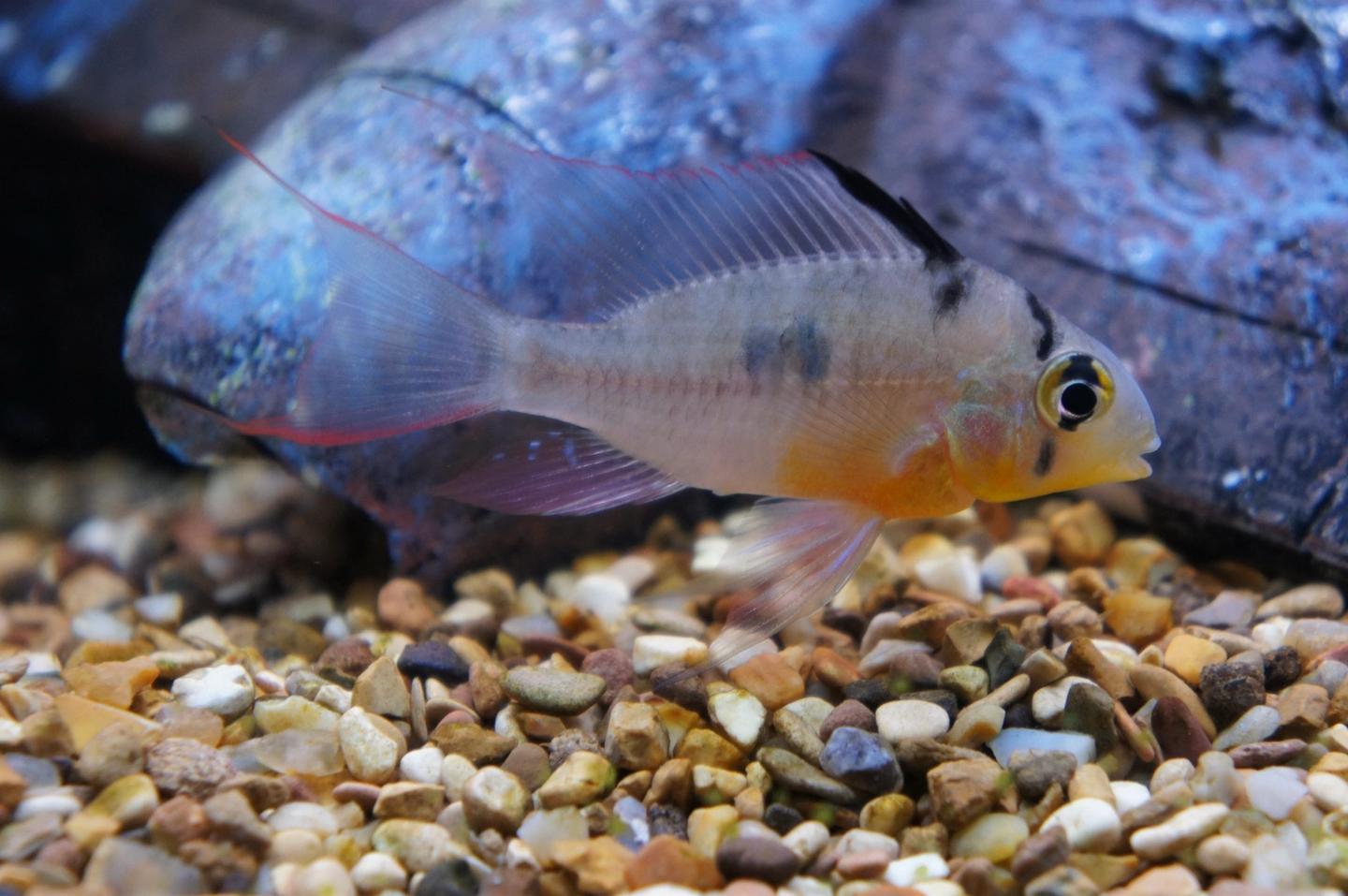
Cichlids are a family of roughly 1,800 accepted species, not one care type. Before buying, identify the exact species and source, then compare adult measurement, usable tank dimensions, social system, territory, tested water, diet and an exit plan. No family-wide minimum tank, water range or tank-mate list is safe.
Maintain these water conditions for optimal health and vibrant colors
Cobue Afra Cichlid is a compact, territorial mbuna from the rocky Mozambique side of Lake Malawi. The fish is still widely traded as Cynotilapia afra "Cobue", but current references place the familiar aquarium form under Cynotilapia zebroides "Cobue". Both names refer to the Cobue form discussed here.
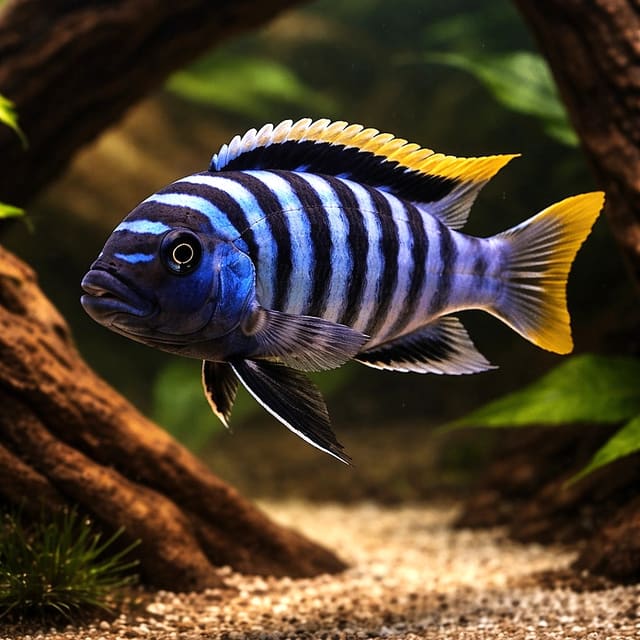
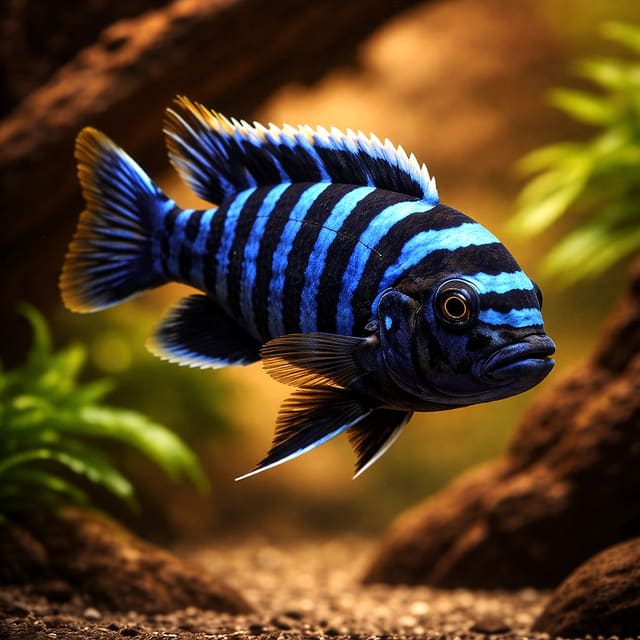
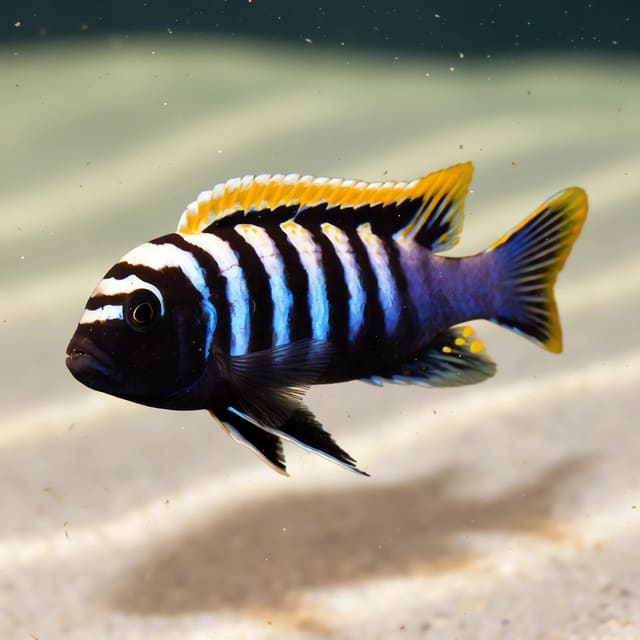
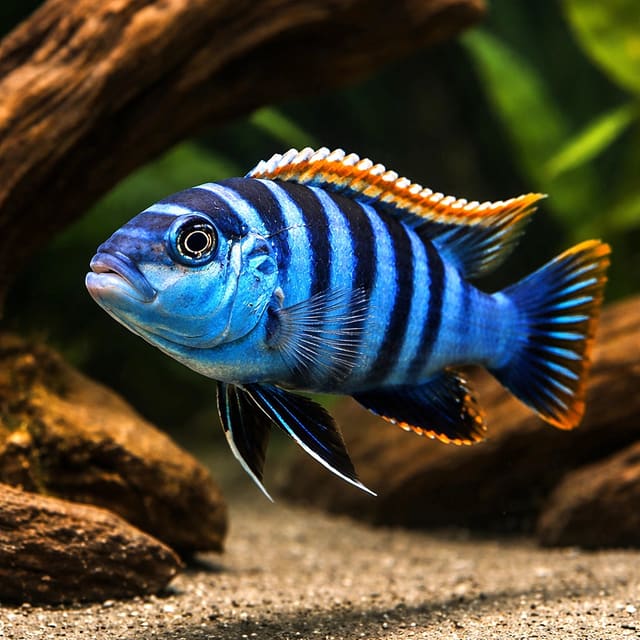
Its appeal is easy to understand: a settled dominant male can show a blue body crossed by dark vertical bars, a yellow-gold forehead and upper back, and sharply edged fins. That colour comes with true mbuna behaviour. Cobue Afra are active, territorial and socially demanding, so they need hard alkaline water, secure rockwork, broken sight lines and a stocking plan made for Lake Malawi cichlids. They are not a peaceful mixed-community substitute for tetras, gouramis or small livebearers.
This product has four size options. One selected option is one unsexed fish, not a pair, trio or breeding group. Colour and sex cannot be promised from size alone, and transport or a subordinate social position may leave a fish much paler than a displaying adult male. For related stock and broader planning, browse our Lake Malawi and Victoria cichlids.
Choose one of four listed size options. Each quantity added to the basket represents one fish in that selected grade. The measurement is an approximate commercial dispatch size, not a promise that every fish will measure to the millimetre on arrival. Live fish vary naturally, and posture, fin position and the point from which a supplier measures can all change the apparent length.
| Size option | What it means | Important limit |
|---|---|---|
| 3-4 cm | One small unsexed juvenile | Adult colour and sex are not guaranteed |
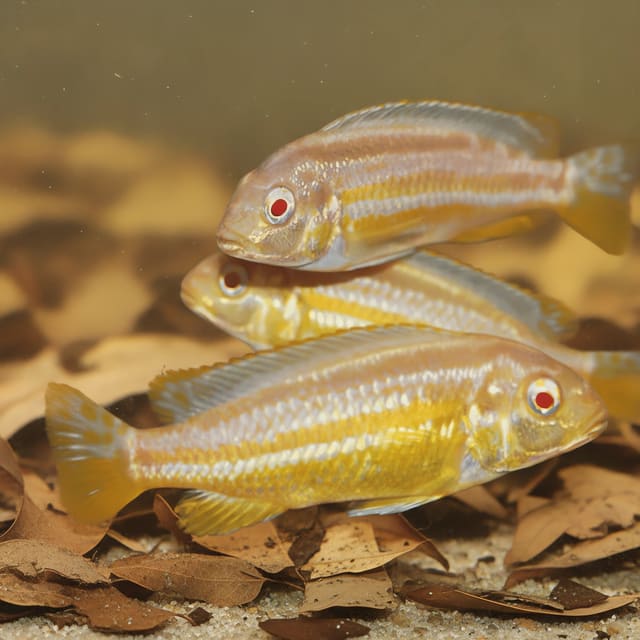
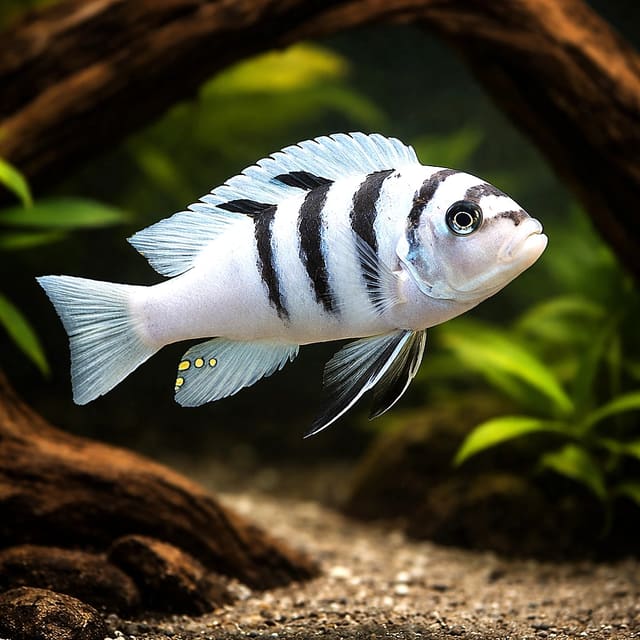
| 4-5 cm | One unsexed growing fish | This is not a pair despite any gallery image showing two fish |
| 6-7 cm | One larger unsexed fish | Social rank can still suppress colour |
| 7-9 cm | One large fish when available | No breeding, locality-line or sex guarantee is implied |
This product is not sold with documented F1, wild-caught or conservation-line status. "Cobue" is the trade locality attached to the form; it should not be taken as proof that an individual commercial fish carries a traceable collection history. If lineage matters for a breeding project, ask for documented provenance before mixing stock and keep records from the first day.
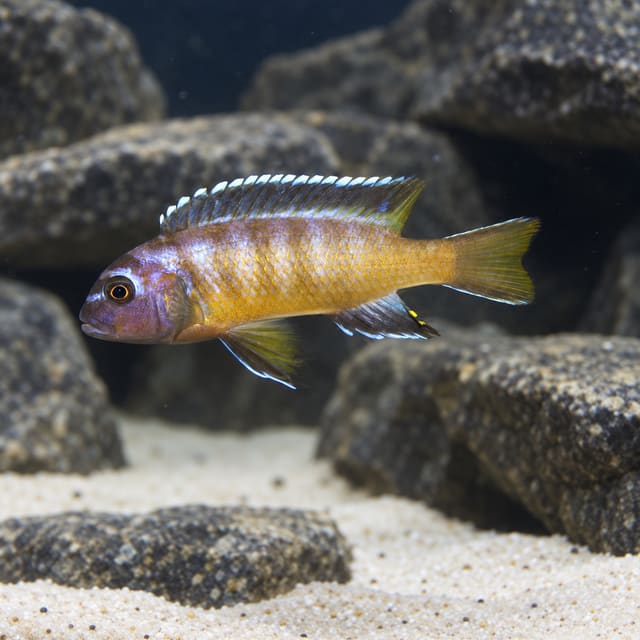
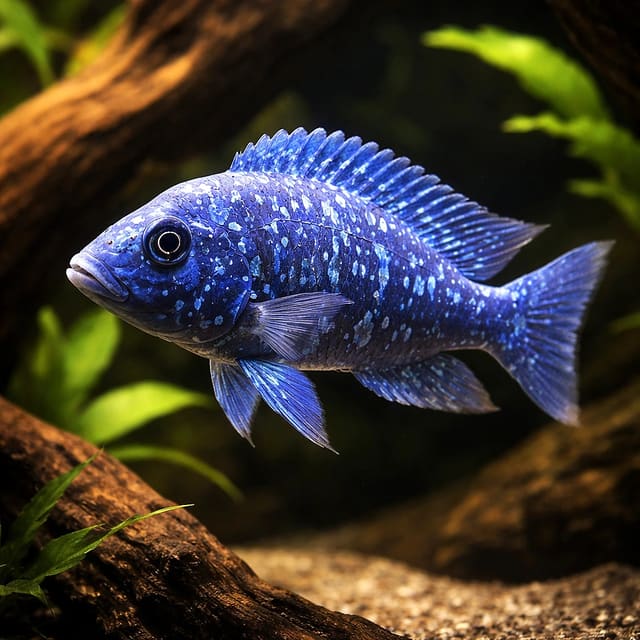
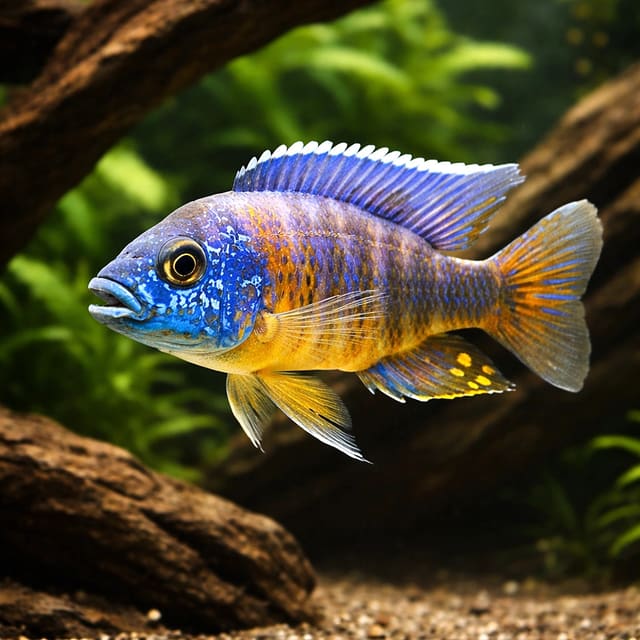
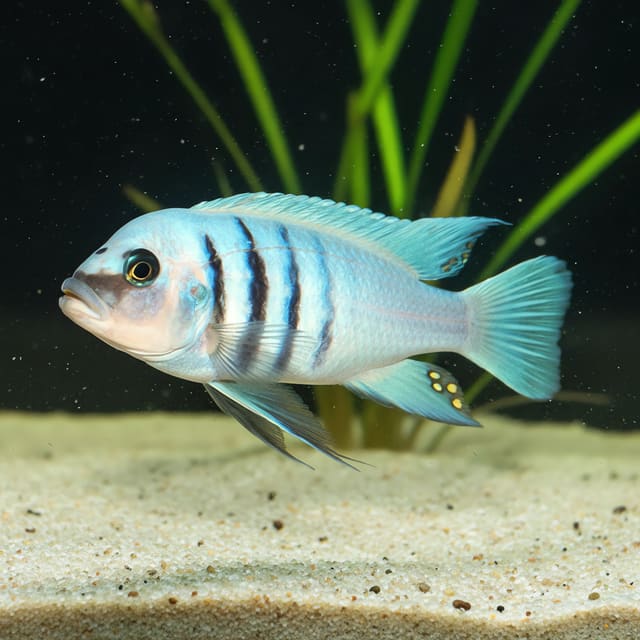
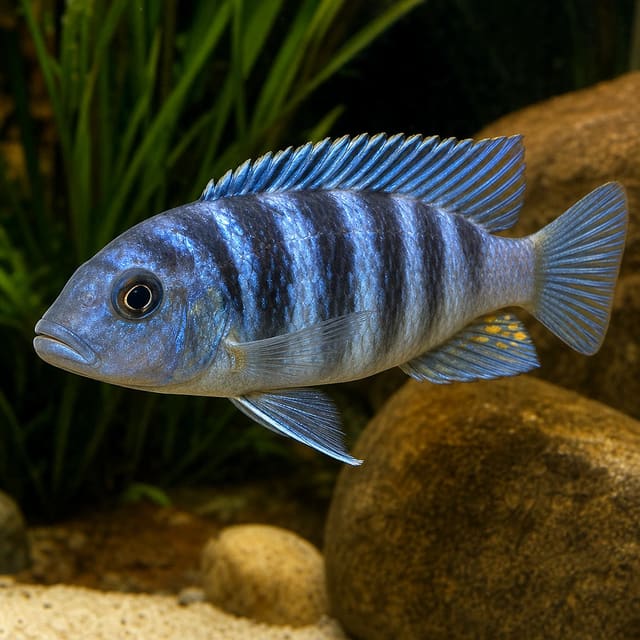
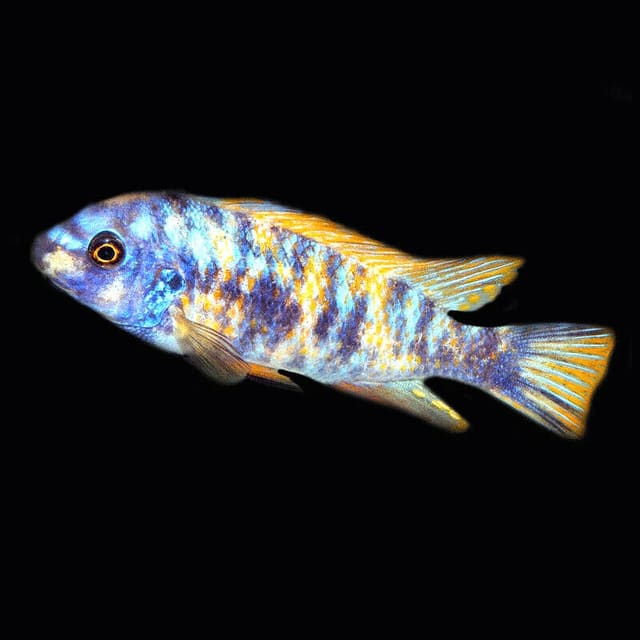
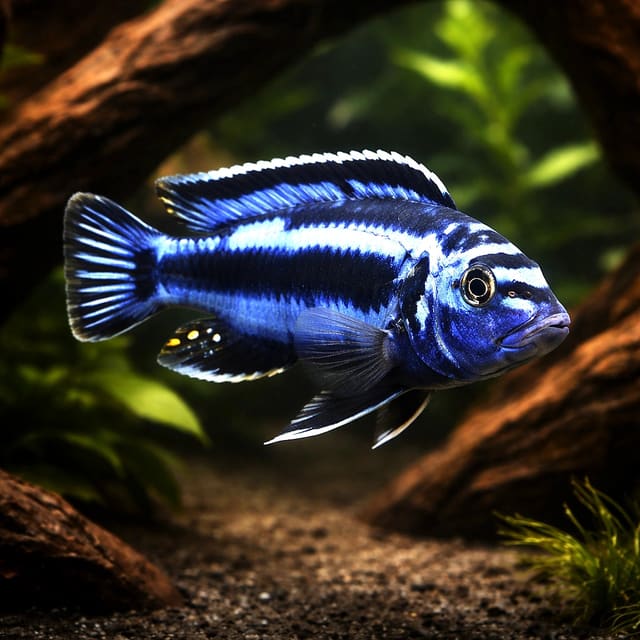
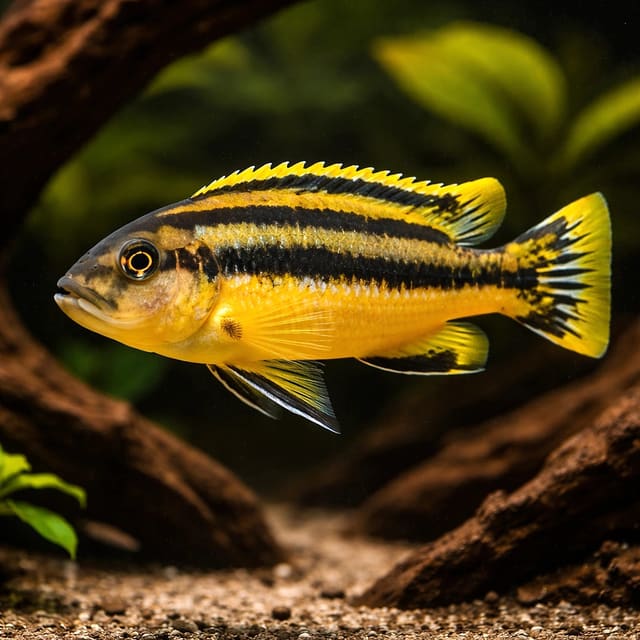
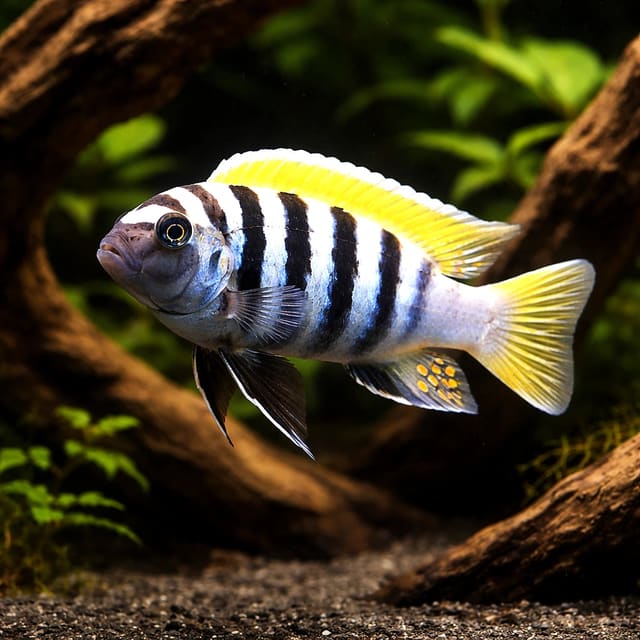
Gallery images illustrate the form and aquarium scenes; the selected live fish may differ in colour and markings. A young fish, female or subordinate male may be grey-blue and lightly marked. A dominant mature male can show much stronger blue, black and yellow-gold contrast. Lighting, stress, diet and social position all affect the display.
One unit is one fish. We do not promise a male, female, pair, trio, breeding group, exact adult colour or collection-line status. Build a group only after checking the sex and behaviour of the fish you already own.
The smallest option is useful when a keeper wants to observe a group developing together, but it also carries the greatest uncertainty. A 3-4 cm juvenile may not show the colour, body depth or sex characteristics seen in a mature fish shown in the gallery. It also needs food small enough to swallow and companions that will not exclude it from every feeding. Buying a juvenile is a commitment to manage the adult fish it becomes, not a way to fit an mbuna permanently into a smaller aquarium.
The middle size grades can be easier to observe for body condition and emerging hierarchy, yet they are still unsexed. A 4-5 cm or 6-7 cm fish may colour strongly in one social setting and become subdued in another. A keeper adding one to an established aquarium should compare body size with the resident fish, because a much smaller newcomer may struggle to feed while a large newcomer may challenge an existing territory immediately.
The 7-9 cm option is close to adult scale and needs adult space from day one. It should not be chosen simply because it looks more colourful at dispatch. A larger fish can exert more social pressure, and an established dominant male may regard it as a direct rival. Before ordering, identify where the fish can retreat, how it will be quarantined, and which aquarium or divider can be used if the introduction fails.
| Decision | Question to answer first | Good evidence |
|---|---|---|
| Choosing a juvenile | Can every small fish reach suitably sized food? | You can observe several feeding points and adjust portions |
| Adding to adults | Is the size difference likely to create immediate exclusion? | A quarantine period and a planned introduction method are ready |
| Building a group | What happens if the eventual sex ratio is unsuitable? | There is a real separation or rehoming plan |
| Selecting for colour | Would the fish still suit the aquarium if it remained subdued? | The choice is based on care and behaviour, not a guaranteed display |
Order the size that fits the existing stock plan rather than the brightest gallery image. If several fish are being introduced, quarantine and observe them before assuming they form a stable group. Similar length does not guarantee equal confidence, and a quiet fish should not be dismissed as poor quality merely because a dominant fish is displaying more strongly.
The name history is not a spelling exercise. The familiar aquarium fish long sold as Cynotilapia afra "Cobue" has been reassessed as part of a wider taxonomic problem in the Lake Malawi dogtooth cichlids. Patrick Tawil's 2011 re-examination of type material showed that the traditional aquarium use of C. afra did not map neatly onto the original type. FishBase currently lists Cynotilapia zebroides and describes the blue, vertically barred rocky-habitat fish associated with this complex.
Aquarium shops, breeder records and older care articles still use Cynotilapia afra "Cobue". Cobue Afra Cichlid remains a familiar trade name, while C. zebroides "Cobue" is the current placement and C. afra appears in older aquarium records.
| Name | How it is used | How to record it |
|---|---|---|
| Cynotilapia zebroides "Cobue" | Current species/locality presentation used on this page | Use for current catalogue and care records |
| Cynotilapia afra "Cobue" | Older and still widespread aquarium-trade name | Older aquarium name for this form |
| Cobue Afra Cichlid | Recognisable trade name | Common aquarium trade name |
| Cobwe / Cobue | Alternative spellings of the Mozambique locality name | Both spellings appear in aquarium and locality references |
Do not cross this fish casually with another Cynotilapia locality form. Similar-looking mbuna can hybridise in captivity, and uncertain offspring quickly lose the information that makes a locality fish meaningful. Our Cynotilapia collection is useful for comparison, but similar colour is a reason for caution rather than an automatic compatibility recommendation.
Cobue Afra have the compact, streamlined body expected of a rock-associated mbuna. The outer teeth are short and conical, a feature behind the "dogtooth" name and an adaptation linked with taking plankton from the water column. FishBase describes C. zebroides as blue with dark vertical bars that become stronger in dominant fish and can extend into the dorsal fin.
In the Cobue aquarium form, a mature dominant male is usually the showpiece. Blue flanks and dark bars can be accompanied by a yellow to orange-gold forehead or upper back, dark pelvic and anal fins, and a bright edge along the dorsal. The intensity is not fixed. A male can lighten when moved, challenged or subordinate, then darken again once settled. The brightest gallery image should not be treated as a guaranteed everyday colour.
Females and juveniles are generally less intense and may look grey, brown-grey or pale blue with softer bars. Size alone is not a reliable sex guarantee, especially in a shop or transport setting. Venting by an experienced keeper is more dependable than guessing from colour, but even that should be done gently and only when necessary.
The supplier guide gives an adult size up to about 8 cm. FishBase reports a maximum of 9.3 cm standard length for C. zebroides; standard length excludes the tail fin, so a total-length aquarium measurement can appear larger. Plan the aquarium around adult territory and activity, not around the smallest number printed in a sales table.
Cobue lies on the Mozambique shore of Lake Malawi. The locality form is associated with rocky habitat, where crevices, ledges and open water immediately above stone create both feeding space and defensible territories. Lake Malawi water is alkaline and mineral-rich, with high visibility and strong oxygenation compared with many soft, tannin-stained tropical habitats.
The fish is not tied to driftwood or dense planting, even when a gallery illustration shows those elements. The natural lesson is rock structure: secure piles, narrow retreats, shaded gaps and open lanes. Juveniles and subordinate fish need routes through the layout that do not force them to pass a dominant male's single cave entrance every time they move.
Cynotilapia are often observed feeding away from the rock face on plankton, while territorial males may also browse the biological growth on rock. That mixed feeding context matters. The Cobue Afra is neither a dedicated algae-cleaning fish nor a strict carnivore. It needs a controlled, varied mbuna diet rather than a page built around the word "herbivore".
In the aquarium, do not try to reproduce the lake by adding large amounts of salt. Stable hardness, alkalinity and oxygen are the useful targets. Test the tap water first. If it already sits within the working range, consistent dechlorinated water changes are safer than repeatedly chasing numbers with buffers. If it is very soft, use a measured Malawi mineral strategy and verify the result before fish are added.
A 150-litre aquarium is a lower planning boundary for a carefully managed species setup, not a universal promise that any group will work in that volume. Footprint is more important than height. For a long-term group or mixed mbuna display, around 200 litres or more and a tank length near 120 cm gives substantially more room for territories, escape routes and visual barriers.
Place base rocks securely before adding loose sand so digging cannot undermine the structure. Use aquarium-safe stone and avoid unstable towers. Create more retreats than dominant fish can control at once, but leave open water for feeding and observation. Rock should break the tank into several visual zones rather than forming one impressive cave that becomes the only territory worth defending.
Choose a mature filter rated comfortably above the actual aquarium volume and maintain strong surface movement. Mbuna are active, eat eagerly and can create a high waste load. Mechanical media should catch suspended debris; biological media must remain oxygenated and established. Clean blocked mechanical media in removed aquarium water as needed, but never strip all biological media at once.
Ammonia and nitrite must remain at zero. Nitrate should be kept low and stable through sensible stocking, controlled feeding and regular water changes. The right water-change percentage depends on the measured waste load, but many mbuna tanks need meaningful weekly maintenance rather than occasional large corrections. Match replacement-water temperature and chemistry closely enough to avoid sudden swings.
| Tank feature | Recommended approach | Why it matters |
|---|---|---|
| Footprint | Long tank, ideally near 120 cm for a group | Creates multiple territories and escape distance |
| Rockwork | Secure layered stone with many broken sight lines | Lets subordinate fish leave a dominant fish's view |
| Substrate | Sand or fine rounded gravel | Supports natural sifting and avoids sharp digging surfaces |
| Flow | Strong filtration with surface agitation | Supports oxygen and manages the waste load |
| Plants | Optional hardy plants protected from digging | Plants are not a substitute for rock territory |
Photograph the empty rock structure and check it from the sides before filling. If one rock moves under hand pressure, it can move when a fish digs. Stability is part of animal care, not only aquascaping.
Start with the tank footprint on paper. Mark the filter intake and outlet, heater, feeding area and the places that can be seen from the front. Then divide the rockwork into several separate zones. A fish inside one zone should be able to leave without crossing the centre of every other territory. This usually means using staggered piles or ridges rather than one continuous wall of stone.
Each zone needs more than a decorative front opening. Include narrow side exits, shaded gaps and routes behind or between rocks. A retreat with only one entrance can become a trap if a dominant fish controls the doorway. Check the layout from both ends of the aquarium: if you can see straight through every cave from one side, the fish probably can as well. Turning one stone or adding an offset can break a long pursuit route without filling all the swimming space.
Leave a clear observation lane along the front so that appetite, breathing and fin condition remain visible. Keep the filter intake accessible and prevent sand from being piled directly against it. Strong circulation is useful, but the aquarium should still contain calmer pockets where a resting or holding female is not forced to swim against the highest flow continuously. Surface movement should exchange gas across a broad area rather than producing one violent jet.
| Planning layer | What to provide | Failure sign |
|---|---|---|
| Base | Stable load-bearing rock placed before loose substrate | A pile shifts when sand is moved |
| Territory | Several visually separate ledges and cave systems | One male controls the whole front of the tank |
| Escape | Multiple exits and broken pursuit routes | A subordinate fish is repeatedly cornered |
| Observation | Open areas where every fish can be counted and fed | Injury or appetite loss is noticed late |
| Service access | Reachable intake, heater and debris collection points | Maintenance requires dismantling the main territory |
Run the completed aquarium before stocking and confirm that heat and flow are distributed through every zone. Test water at the same time of day for several days rather than relying on one reading. After fish are introduced, photograph the layout again. If aggression later concentrates around one route, the comparison helps you change a boundary deliberately instead of rebuilding at random.
Cobue Afra are territorial, with the strongest aggression usually directed towards similar fish. A dominant male may defend a cave, ledge or open patch and repeatedly chase subordinates. The goal is not to eliminate every display; short chases and boundary signalling are normal. The goal is to prevent one fish from being trapped, denied food or forced to hide continuously.
A managed group is commonly arranged around one male and several females, but that is not a formula we can guarantee from unsexed stock. Do not buy a fixed number of juveniles and assume they will mature into the desired ratio. Watch the developing group, be prepared to separate surplus males, and have a realistic rehoming plan before conflict becomes injury.
Blind overstocking is not a cure. Some Malawi keepers use a deliberately full stocking plan to diffuse attention, but it only works with exceptional filtration, oxygenation, maintenance and enough space. Adding fish to a small or unstable aquarium can turn focused aggression into chronic stress and poor water quality. Stocking density should be a planned system, not an emergency response.
Avoid mixing multiple Cobue sources or very similar Cynotilapia forms if you intend to breed. The fish may fight because they recognise a close competitor, and surviving fry may be hybrids with no reliable locality identity. Compare the Gallireya Reef Dogtooth Cichlid and Jalo Reef Dogtooth Mbuna as separate locality choices, not as automatic companions for the same breeding tank.
Mbuna do not need to appear motionless or avoid one another to be healthy. A male may darken, flare his fins, quiver, circle a boundary or perform a short chase when another fish approaches. The other fish should be able to leave, return to normal swimming and feed later. Brief display with a clear end is different from pressure that continues through every part of the aquarium.
Intervene when one fish is unable to use open water, loses access to food, breathes rapidly after repeated pursuits, remains pressed into an upper corner, or develops torn fins and weight loss. A subordinate fish that hides for part of the day may be using cover normally; a fish that never leaves one crevice and misses meals is not. Record which individual starts the chase and where it happens, because the remedy may be a territory change, separation of a surplus male or removal of an incompatible species rather than simply adding more rock.
| Observation | Likely meaning | Response |
|---|---|---|
| Fin display followed by separation | Boundary communication | Continue observing; confirm both fish feed |
| Short chase with several escape routes | Typical territorial correction | Check that it does not become constant |
| One fish trapped at the surface or filter | Unsafe social pressure | Separate promptly and review the stock plan |
| Repeated mouth or flank injury | Conflict has exceeded display | Use a divider or alternative aquarium; assess wounds |
| Colour loss without other symptoms | Possible rank, stress or lighting effect | Check behaviour and water before assuming disease |
A divider is useful only if it creates a genuinely protected area with suitable flow and enough room to feed. Transparent dividers can allow continuous visual display, so an opaque section may be needed. Do not return a recovered fish to the same unchanged conflict and expect a different outcome. Rearrange boundaries, alter the group plan or use a separate aquarium before attempting reintroduction.
The safest companions are robust Lake Malawi fish that share alkaline, hard-water requirements and are different enough in colour and body pattern not to invite constant direct rivalry. Even then, compatibility depends on aquarium length, rock layout, sex balance, individual temperament and the order in which fish are introduced.
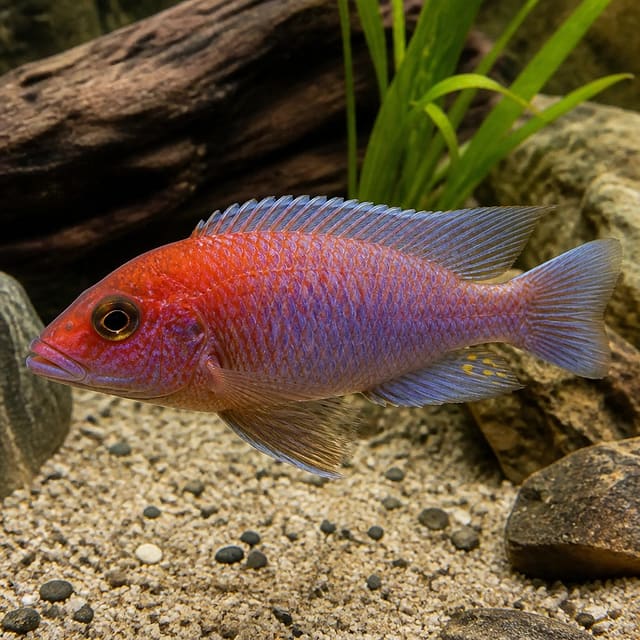
Other mbuna can work in a large, carefully planned display. A Coral Red Saulosi Mbuna, Yellow Lab Cichlid or Lavender Mbuna may provide a clearer visual contrast than another blue-barred dogtooth form, but none is a guaranteed match. Research the adult behaviour and sex ratio of every species before combining them.
Peacock cichlids and many haps are often less combative than mbuna. They can be bullied, outcompeted or kept in a state of constant alertness by a dominant Cobue male. Mixing them is not recommended in a small aquarium and should not be presented as a beginner community. Small tetras, guppies, gouramis, shrimp and slow long-finned fish are inappropriate.
Some larger hard-water catfish are used in Malawi displays, but bottom space, caves and night-time feeding still need attention. A catfish should not be added as a clean-up tool. No fish removes the need to vacuum accessible debris, control portions and maintain the filter.
| Potential companion | Decision | Reason |
|---|---|---|
| Distinct, robust mbuna | Possible with planning | Shared water needs, but territory and hybrid risk still require management |
| Similar blue-barred Cynotilapia | Usually avoid | Direct rivalry and accidental hybridisation are more likely |
| Peacocks and peaceful haps | High caution | They may be bullied or lose access to food |
| Small community fish and shrimp | Avoid | Wrong social pressure, size relationship and water-style expectations |
Cynotilapia have conical teeth associated with taking plankton, while territorial fish can also browse algae, microorganisms and other material from rock surfaces. A practical aquarium diet should reflect both behaviours: small, digestible foods with plant material and controlled aquatic protein.
Use a reputable mbuna or small African cichlid pellet/flaked food as the staple. A quality spirulina-containing food can form part of the rotation, but the label should still provide a complete nutrient profile. Small portions of daphnia, cyclops, mysis or brine shrimp can add variety. Avoid making rich bloodworm, tubifex, beef heart or other fatty high-protein foods the routine diet.
Feed only what the group can take promptly, usually in one or two small meals each day. Juveniles may benefit from smaller, more frequent feeds, but every extra feeding increases the filtration load. Spread food across the water surface so subordinate fish have a chance to eat instead of dropping one large portion into a dominant male's territory.
Our Malawi Mbuna flakes offer a convenient staple format for an appropriate rotation. Check pellet or flake size against the fish you select, especially for 3-4 cm juveniles. A food that is too large encourages spitting and waste; crushing it lightly is safer than overfeeding to compensate.
Swelling, stringy waste, appetite loss and hiding can have several causes. Test water, review social stress and diet, isolate when appropriate, and seek fish-health advice before choosing medication. "Malawi bloat" is a descriptive syndrome, not a diagnosis that proves one single cause.
Feeding time is the easiest daily health check. Before adding food, count the fish and watch how they approach the surface or water column. A healthy individual should notice the routine, orient towards food and make coordinated feeding movements. Appetite can vary after transport or during mouthbrooding, but a sudden change in one established fish deserves attention.
Offer the first small portion across a wide area and watch which fish are excluded. Add a second portion only after the first has been taken. This gives quieter fish another opportunity without turning the meal into excess waste. For juveniles, crush food to a particle size that can be swallowed cleanly. Repeated spitting may mean the food is too large, too hard or unfamiliar; it does not automatically mean the fish needs a larger quantity.
| What you see | What to check | Useful adjustment |
|---|---|---|
| Food reaches only one territory | Dominant fish controls the feeding point | Distribute small portions across the tank |
| Whole flakes or pellets collect on the floor | Particle size or portion is excessive | Reduce and resize the next feed |
| One fish hangs back repeatedly | Social exclusion, illness or mouthbrooding | Observe separately and confirm body condition |
| Abdomen stays swollen after meals | Portion, digestion and water quality | Stop guessing; test water and seek informed advice |
| Fish remain lean despite feeding | Competition, food quality or health issue | Verify individual intake and investigate the cause |
Keep a simple note of foods, frequency and any appetite change. That record is more useful than changing several foods and treatments at once. It also helps distinguish a group-wide response, which may point to water or food, from a problem affecting one fish. Remove persistent leftovers and review filtration rather than relying on a catfish or snail to consume them.
Prepare the aquarium before delivery. Temperature, pH, hardness, ammonia and nitrite should already be known, and the rockwork should be stable. Keep the lights low on arrival. Follow the acclimation instructions supplied with the order rather than extending the process indefinitely; once a transport bag is opened, changing gas balance can alter the toxicity of accumulated waste.
A separate quarantine aquarium is strongly recommended. It should have mature filtration, matching water and simple removable shelters. Observe breathing, balance, appetite, fins, skin and waste for two to four weeks. Quarantine also gives a new fish time to regain condition without immediately facing an established mbuna hierarchy.
When introduction day comes, rearranging some rock boundaries can reduce the established fish's advantage. Add the newcomer with lights low and watch closely. Do not leave a fish that is pinned in a corner, breathing rapidly or unable to feed. A divider or spare aquarium is far more useful than hoping serious aggression will disappear overnight.
Start a short record on arrival day with the selected size, date, supplier name, trade name, current scientific placement and any lineage information actually provided. Add a photograph under neutral lighting after the fish has settled. This establishes body condition and markings without pretending that transport colour is permanent. If the fish later changes rank or breeding condition, the record helps explain why its appearance has changed.
During quarantine, note temperature, pH, ammonia, nitrite, nitrate, appetite, waste, breathing and any skin or fin changes. Use consistent language rather than writing only "fine" or "bad". For example, record whether the fish ate immediately, approached but spat food, or ignored the meal. If a concern develops, this timeline is far more useful to a fish-health professional than a single photograph.
| Checkpoint | Record | Reason |
|---|---|---|
| Arrival | Size option, body condition, breathing and visible damage | Separates transport effects from later changes |
| First feeds | Food offered, appetite and waste | Shows whether the fish is settling and digesting normally |
| Quarantine week | Water results, activity and any treatment with dose | Prevents repeated or conflicting interventions |
| Introduction | Tank layout, resident stock and chase locations | Makes social problems easier to diagnose |
| One month | Body condition, colour context and hierarchy | Provides a realistic settled baseline |
Do not use stronger colour as the only measure of success. A subordinate female or juvenile may remain less vivid while eating, growing and behaving normally. A highly coloured male can still be overaggressive or in poor water. Judge the fish through appetite, breathing, body condition, injury, activity and its ability to use the aquarium safely.
Cobue Afra are maternal mouthbrooders. A courting male intensifies colour, displays within his territory and attempts to draw a receptive female to a spawning site. The female collects fertilised eggs in her mouth and carries the developing brood. The holding period varies with temperature, the fish and disturbance.
A holding female may eat little or stop feeding and often seeks quieter cover. Repeated harassment can make her swallow or release a brood early. Dense retreats and a sensible social structure matter more than forcing a single "pair" into a small breeding box. If a female must be moved, do it with minimal chasing and match the receiving water carefully.
Released fry can take appropriately small powdered or finely crushed foods. Maintain excellent water quality with gentle, frequent maintenance and avoid sudden changes. Sort growing juveniles before size differences or early male aggression becomes severe.
Keep a record of the parents, supplier, date and name under which the stock was received. Do not mix fry from C. zebroides "Cobue" with other dogtooth locality forms and later sell them under a locality name. If the original fish has no documented wild lineage, label offspring honestly as aquarium stock rather than F1 or conservation-line fish.
A healthy Cobue Afra is alert, balanced, interested in food and able to move through the aquarium without being continuously displaced. Clear eyes, full but not swollen body condition, intact fin edges and steady breathing are useful signs. Colour alone is unreliable because sex, rank, mood and lighting all change it.
Warning signs include clamped fins, gasping, rapid gill movement, repeated flashing, white spots, sores, severe fin damage, persistent stringy waste, refusal of food or a fish that hides all day after previously being active. Test ammonia, nitrite, nitrate, pH and temperature first. A treatment cannot compensate for toxic water or relentless aggression.
Inspect fish during every feed and count them. Rock-heavy tanks make it easy to miss a sick or trapped individual. Check equipment flow and temperature daily, remove obvious waste, and perform regular partial water changes based on test results. Keep replacement water and maintenance routines consistent enough that the fish are not subjected to repeated chemistry swings.
Do not use salt, buffers or medication by habit. Each has a specific purpose and dose. If a treatment is required, check whether it affects biological filtration and use a hospital tank when practical. Never combine medicines without confirming that the active ingredients are compatible.
| Your setup | Fit | Why |
|---|---|---|
| Mature 200 L+ rocky Malawi aquarium with a separation plan | Strong candidate | Space, chemistry and territory management match the fish |
| 150 L species-focused setup run by an experienced mbuna keeper | Possible lower boundary | Requires careful sex management and close observation |
| Soft-water planted community | Poor fit | Water requirements and aggression do not match |
| First aquarium chosen only for colour | Not recommended | Mbuna social management is a core part of the care |
| Locality breeding project with documented stock | Potentially suitable | Only if provenance and cross-breeding controls are maintained |
This fish suits keepers who enjoy observing territory, display, hierarchy and maternal mouthbrooding, and who are willing to intervene when a group balance changes. It does not suit someone looking for a single blue centrepiece in a peaceful mixed tank. Choosing against a poor fit is part of responsible fishkeeping.
Select the required size before adding the fish to the basket and check that the aquarium can house the adult, not only the dispatch grade. The live option price and availability shown beside the selector are the current values; they can differ between sizes.
Review the published livestock-delivery and Live Arrival Guarantee terms before ordering. Check the current checkout and livestock-delivery terms for the selected option and address.
On arrival, use the fish's body condition and behaviour as the main assessment. A newly transported Cobue Afra may be pale and should not be judged against a brightly coloured gallery image during the first minutes. Have quarantine water ready and contact us promptly through the guarantee process if there is a genuine arrival concern.
The familiar aquarium Cobue form is still widely traded as Cynotilapia afra "Cobue", while current references place it under Cynotilapia zebroides "Cobue". We show both and explain the history instead of pretending the older trade name never existed.
No. One quantity is one fish in the selected size option. A gallery image showing two fish does not change the one-fish sale unit.
No sex guarantee is attached to these variants. Juveniles and subordinate males can be difficult to distinguish by colour, so order only if an unsexed fish is suitable for your plan.
The supplier guide states up to about 8 cm. FishBase records 9.3 cm standard length for C. zebroides, and total length including the tail can appear larger. Use adult territory and activity, not a single small measurement, when choosing the tank.
About 150 litres is a lower boundary for a carefully managed species setup. A tank around 200 litres or more and close to 120 cm long is a safer starting point for a group or mixed mbuna plan.
The listing-specific supplier guide is 23-27°C, pH 7.5-8.5 and 12-30 dGH. Stable, clean and well-oxygenated water matters more than repeatedly adjusting to one exact number.
No. Cynotilapia take plankton and also browse rocky surfaces. Use a controlled mbuna diet with plant material and modest aquatic protein rather than either a meat-heavy cichlid diet or an incomplete algae-only diet.
No. It is territorial and can be aggressive, especially towards similar blue-barred fish and other males. Rock barriers, floor space, group management and a backup separation plan are essential.
Peacocks are often less combative and can be bullied by mbuna. Mixing them is high risk in smaller tanks and is not presented here as a beginner combination.
Hardy plants can be used, but they are optional and may be dug up or damaged. Secure rock territory and open swimming routes are more important than dense planting.
No. The gallery illustrates possible appearance; sex, age, rank, stress, lighting and acclimation can all affect colour. The live fish supplied may look different.
This product is not sold with documented wild-caught, F1 or conservation-line status. If traceable lineage matters, ask before ordering.
Identity, size and rocky-habitat context were checked against FishBase's Cynotilapia zebroides record. The name problem was checked against Tawil's peer-reviewed 2011 re-examination of Cynotilapia afra and Microchromis zebroides. The listed size options are approximate; check the live selector for current availability.
Compare Cobue Afra with the Gallireya Reef Dogtooth Cichlid and Jalo Reef Dogtooth Mbuna if you are choosing one Cynotilapia locality direction. For visually distinct mbuna, review the Coral Red Saulosi Mbuna, Yellow Lab Cichlid and Lavender Mbuna. These are planning comparisons, not a promise that every combination will be compatible.
No reviews for this item yet. Bought one? Honest reviews only, good or bad.
What customers say about ordering from us
Easy website plenty of info on fish your buying great to pick a time slot
TRACEY DURRANT · 7 Oct 2026
Got some lovely fish thank you
Kevin Mackie · 7 Oct 2026
Reviews of our shop, collected by Judge.me, an independent third-party review collector. Newest first.