−14%
Advanced
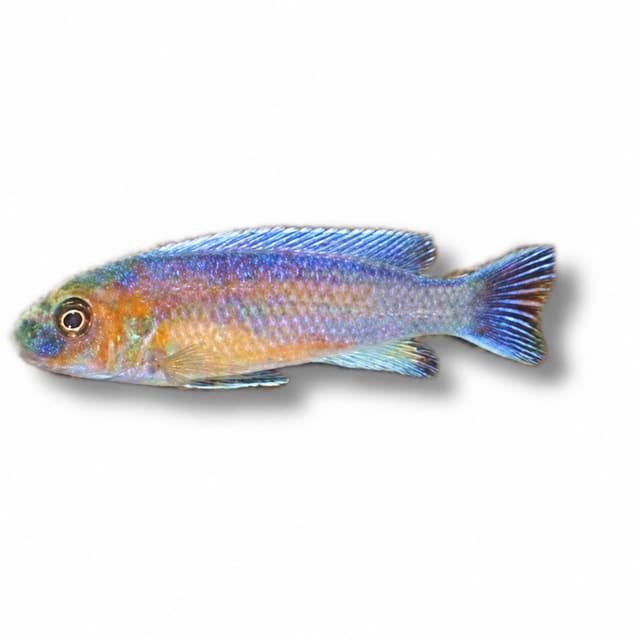
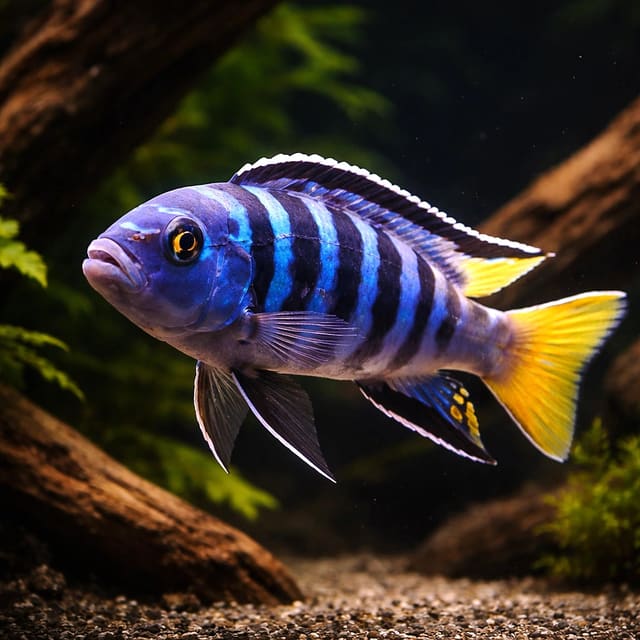
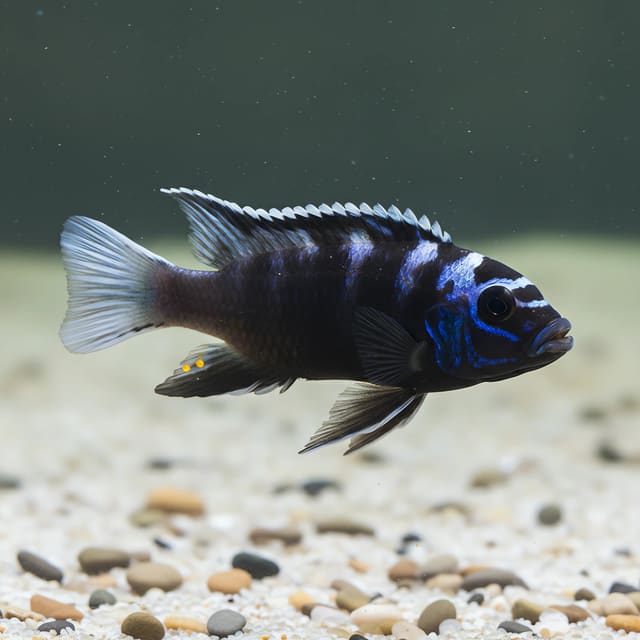
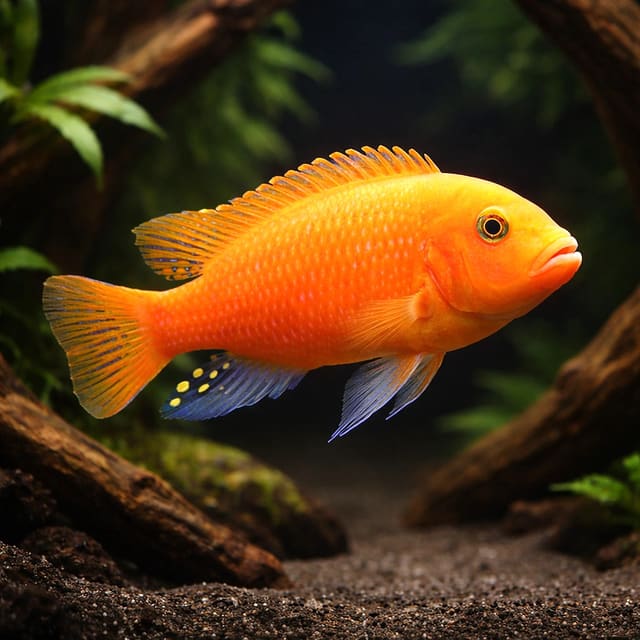
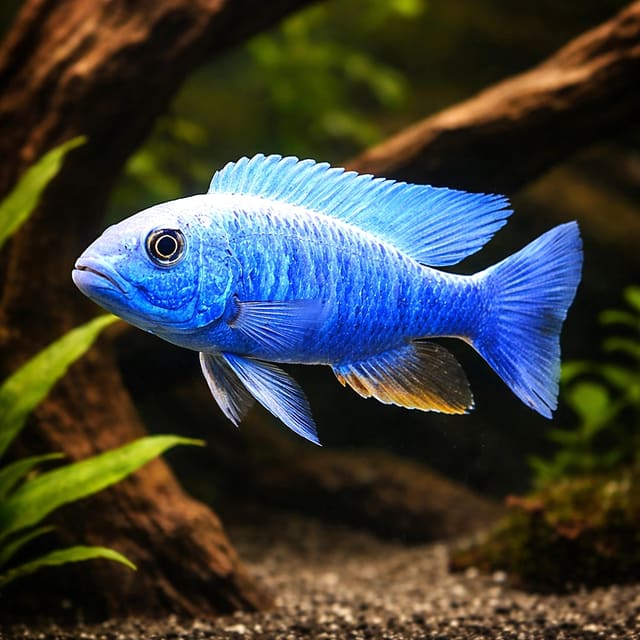
Iceberg Electric Blue Hap (Haplochromis fryeri)
23–27°C · pH 8–8.6
£13.75£15.99

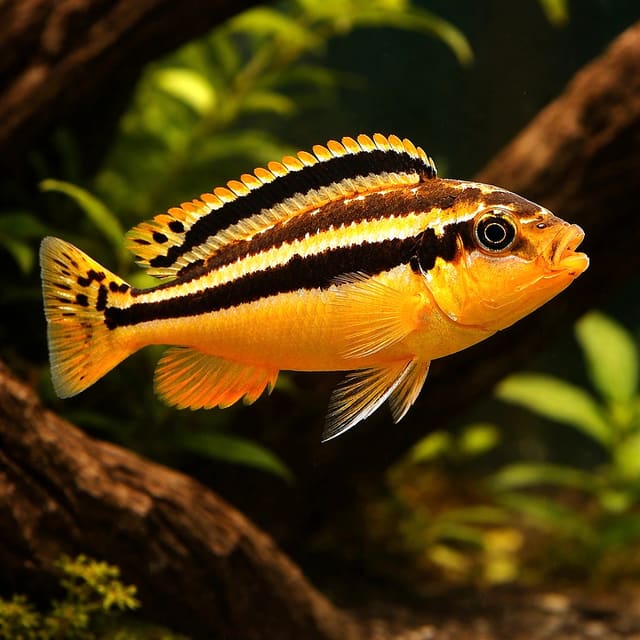
Scrapermouth Mbuna 'Marmalade' is a territorial Lake Malawi rock grazer. One purchase supplies one fish, offered at 3–4, 4–5, 5–6 or 6–7 cm. Plan a mature, well-filtered, hard alkaline aquarium with secure rockwork and carefully chosen mbuna companions.
Adult size is the maximum length this species reaches at full maturity (scientific sources). The livestock you receive will be younger and smaller — pick a size above for the actual shipping size. Product-photo provenance and any image-specific limitations are stated on the listing.
Labeotropheus trewavasae
Shoaling fish: kept in a group they feel safer, stay calmer and show their best colour.
Scrapermouth Mbuna 'Marmalade' is a territorial Lake Malawi rock grazer. One purchase supplies one fish, offered at 3–4, 4–5, 5–6 or 6–7 cm. Plan a mature, well-filtered, hard alkaline aquarium with secure rockwork and carefully chosen mbuna companions.
Adult size is the maximum length this species reaches at full maturity (scientific sources). The livestock you receive will be younger and smaller — pick a size above for the actual shipping size. Product-photo provenance and any image-specific limitations are stated on the listing.
Cichlids are a family of roughly 1,800 accepted species, not one care type. Before buying, identify the exact species and source, then compare adult measurement, usable tank dimensions, social system, territory, tested water, diet and an exit plan. No family-wide minimum tank, water range or tank-mate list is safe.
Maintain these water conditions for optimal health and vibrant colors
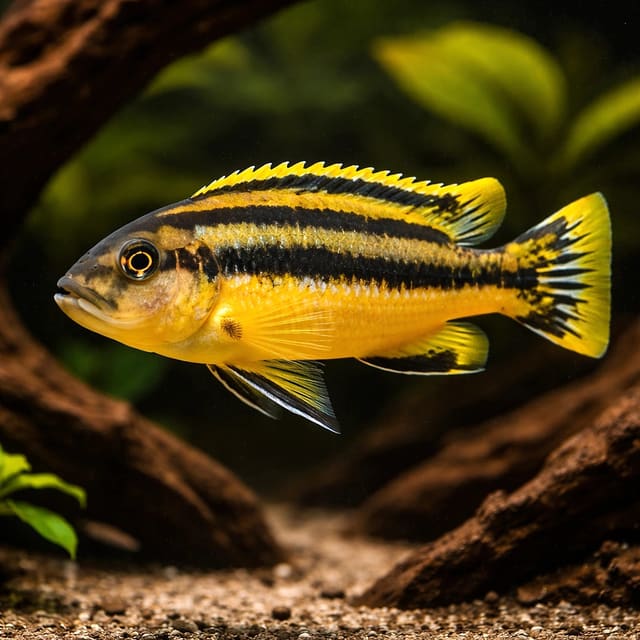
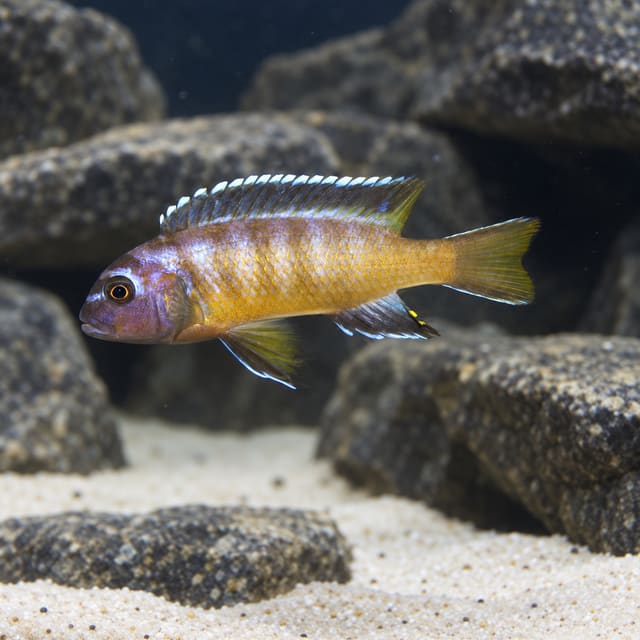
Scrapermouth Mbuna 'Marmalade' (Labeotropheus trewavasae) is a territorial, rock-dwelling cichlid from Lake Malawi. One purchase supplies one live fish of the chosen size. The four sizes are 3–4 cm, 4–5 cm, 5–6 cm and 6–7 cm. The size you select is the size supplied, not the adult size. Sex is guaranteed only when the selected option explicitly states male or female. This Scrapermouth Mbuna 'Marmalade' listing has no sex-guaranteed option. Plan for a fish whose adult behaviour, not its dispatch size, determines the aquarium it needs.
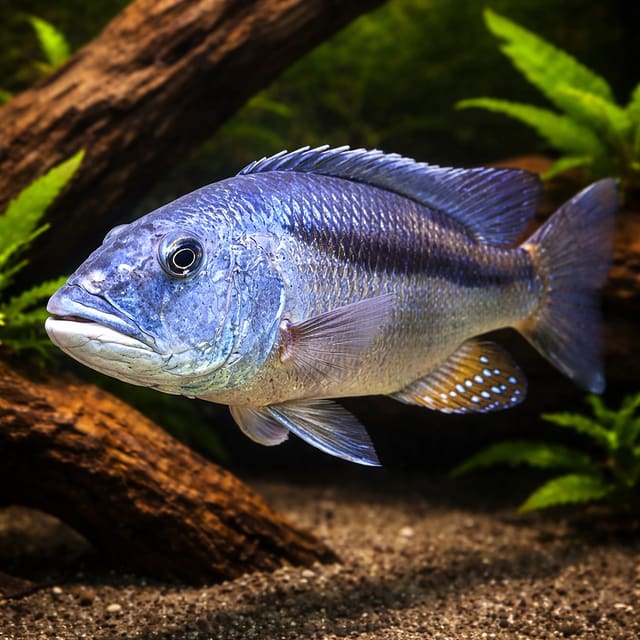
This is a rewarding choice for someone who enjoys a busy Malawi rock tank and can manage territorial fish. It is a poor addition to a quiet, soft-water community. The downturned mouth and chisel-like teeth suit grazing on rock surfaces. Watch one work along a rock face and the name makes sense: it stays close to the surface as it scrapes, then moves between nearby refuges and feeding areas. A layout with broad rock faces, caves, broken sight lines and open passages lets that behaviour happen while giving other fish room to withdraw.
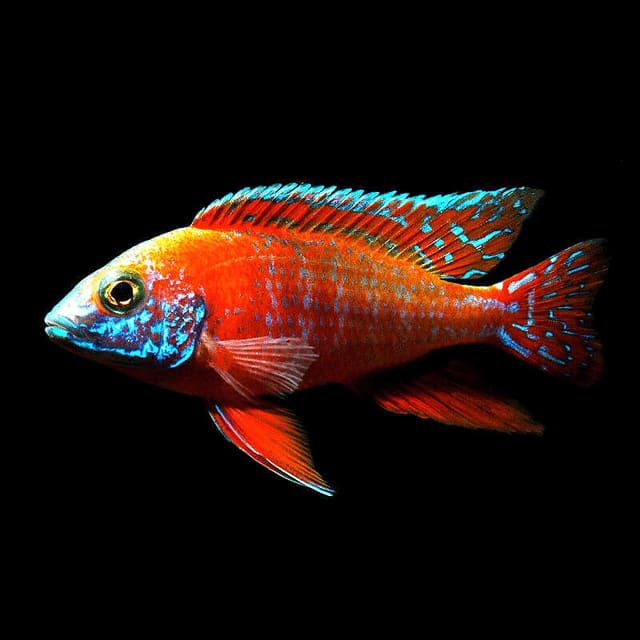
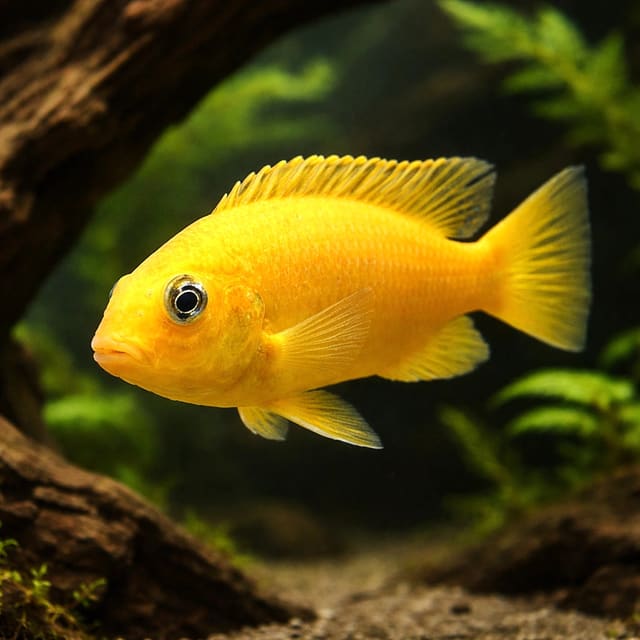
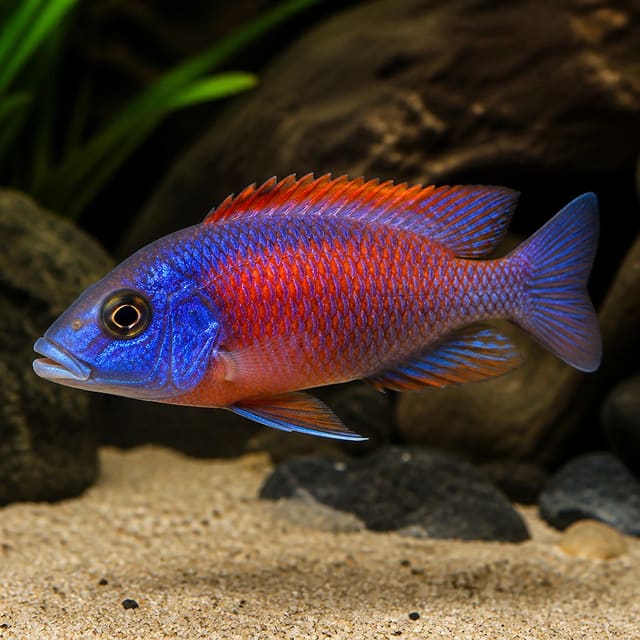
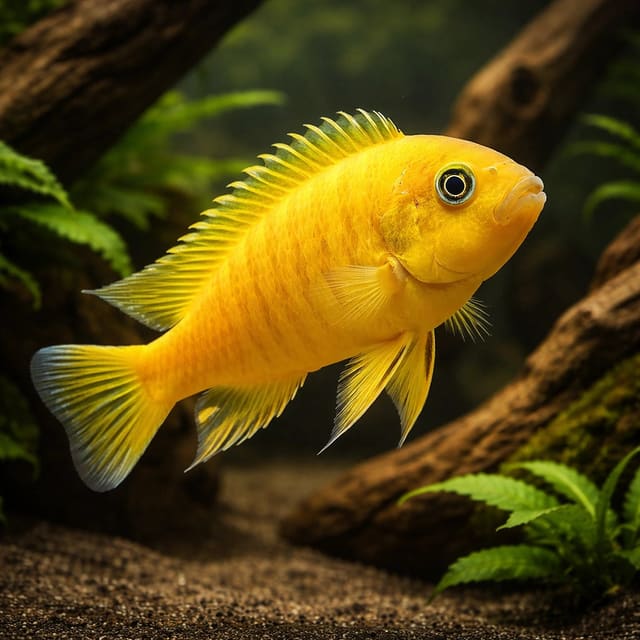
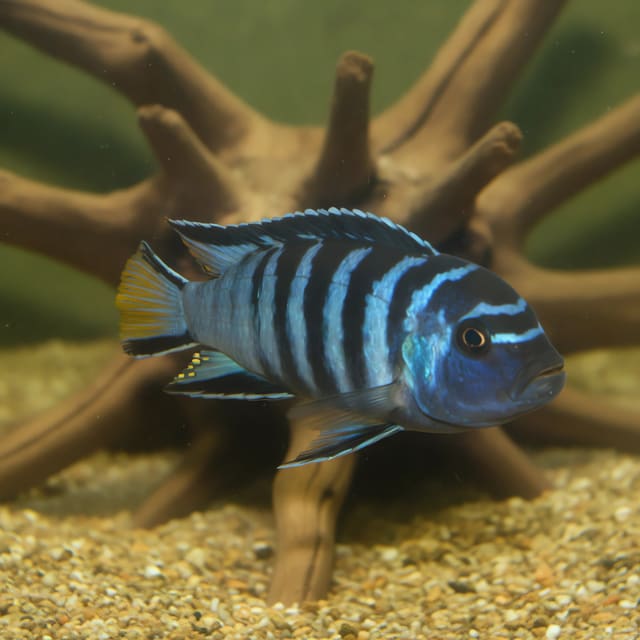
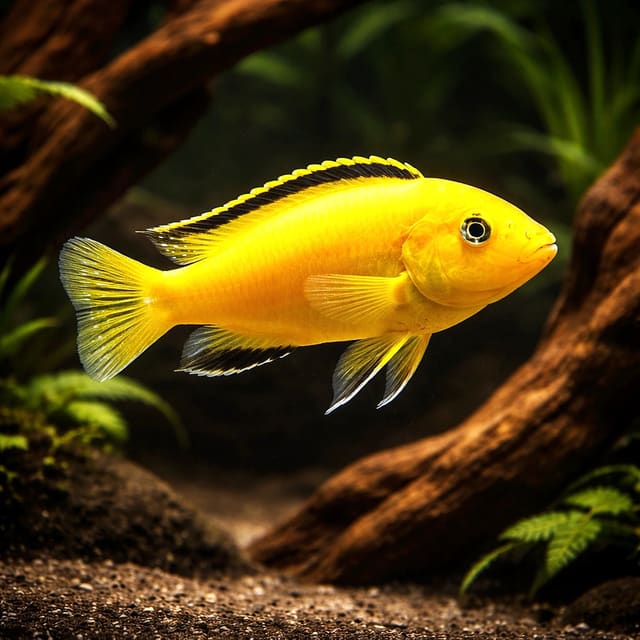
The 'Marmalade' wording describes the trade form; individual colour and pattern can vary. The supplier's record uses a legacy spelling, while the accepted species name used here is Labeotropheus trewavasae. Colour alone cannot tell you the sex of the fish being supplied, and a photograph cannot promise the markings of an individual animal. Choose this fish for its species, its movement and its care requirements as much as for the colour you hope to see. Juveniles can change in appearance as they mature, and their position in a group can affect how readily they display.
Lake Malawi mbuna make an aquarium feel active, but their activity needs structure. A fish may defend a favoured cave, chase a neighbour away from a grazing patch or interrupt feeding. Those displays are part of the species' natural social life; relentless pursuit, torn fins or a fish unable to eat are signs that the arrangement is failing. Build the aquarium around room to escape, a stable hierarchy and water that remains clean under a lively fish load. It is easier to do this before adding fish than to rescue a cramped group later.
The basic match is hard, alkaline water, a mature biological filter, strong aeration, a sandy substrate and secure rockwork. Specialist species guidance gives a base footprint of at least 90 × 45 cm, roughly 154 litres at the example height, for L. trewavasae. That is a minimum planning reference for the species, not a promise that a mixed Malawi community will fit. OATA's broader Malawi guidance recommends at least 200 litres for a reasonable community. As the number of territories and fish rises, a longer and larger tank gives more options for a balanced layout. Check the full adult stocking plan before choosing any of the smaller fish offered here.
Feeding should also reflect the mouth and habitat. Algae-based foods and vegetable matter form a substantial part of the diet, with other foods used as measured supplements. The species scrapes algae in the wild and also takes small invertebrates; neither fact makes a constant rich meaty diet sensible in an aquarium. Stable conditions, varied grazing opportunities and sensible portions matter more than a promise of dramatic colour from a particular food.
If this is your first Malawi aquarium, allow time to mature the filter and measure the water before choosing fish. The first aquarium guide explains the preparation that should happen before livestock arrives. For an established Malawi tank, consider its existing territories, the size of its residents and whether a new mbuna can reach food without being cornered. Assess the adult group, rockwork, water and feeding space together before introducing a territorial mbuna.
Start with footprint. Seriously Fish gives a minimum base of 90 × 45 cm for this species and illustrates it with a roughly 154-litre aquarium. Floor area and the shape of the rockscape are as important as the volume printed on the tank. A tall, narrow aquarium may hold a similar number of litres yet offer fewer separate territories and less room to avoid a dominant fish. OATA's at-least-200-litre advice concerns a reasonable Malawi community as a group, rather than a species-specific minimum for a single Labeotropheus. If you intend a mixed mbuna display, work out the adult group and leave space for visual barriers before settling on a tank.
Arrange stable piles of rock to create several caves, ledges and routes through the aquarium. Leave gaps so fish can move away without ending in a blind corner. Place heavy structures securely before building sand around them: digging fish can shift loose substrate, and a precarious rock pile is a risk to animals and glass. Smooth, exposed surfaces provide grazing area; crevices offer cover. A wall of stone pressed tightly against every pane may look dramatic but can be difficult to inspect and clean. Leave room for maintenance and for flow to reach the spaces behind the décor.
A sandy substrate matches specialist guidance and suits a fish that works close to the bottom and rocks. A bare glass floor removes opportunities for natural movement; sharp coarse material can make repeated contact uncomfortable. You do not need an elaborate planted display. The specialist profile notes that plants are likely to be eaten, while the wider Malawi guide explains that cichlids will dig and uproot them. If you do include plants, treat them as optional and keep the core design centred on rock, sand, water movement and retreat spaces.
Keep the biological filter running continuously and size it for the final fish load. In an active Malawi system, filtration must process waste while water movement keeps oxygen available. OATA recommends generous filtration and strong aeration for crowded Malawi communities; the RSPCA explains why a mature biological filter is essential for converting toxic ammonia through nitrite to nitrate. A powerful filter is not permission to crowd fish without thought. More animals add waste and more social interactions. Watch the fish as well as the test kit when deciding whether the group is sustainable.
Think about access to food while setting up the rocks. If every fish must emerge at one narrow opening to feed, a dominant animal can control it. Several open routes and feeding points help subordinate fish take part. Rockwork can break sight lines during introductions, but it should still allow you to observe every fish and recover one if it is injured. Resist the urge to make a tiny maze simply to hide aggression. If one fish is permanently confined to a cave, the stocking plan needs attention.
Use a lid and maintain equipment safely. Malawi cichlids can make rapid movements during disputes or maintenance. Keep cables, heaters and filter intakes positioned so the fish can move without being trapped behind them. Check that circulation reaches the surface and that the filter outlet does not create a single exhausting current through every refuge. The aim is clean, oxygenated water and a range of sheltered positions, rather than a tank in which the only calm spot is occupied by the strongest fish.
Before buying, imagine the fully grown group in the tank, not just the fish at the size supplied today. The selected 3–4 cm fish will not remain that size. The most useful preparation is a layout that can be adjusted as hierarchies change. Keep spare rocks or alternative placements in mind, and make changes carefully so structures remain secure. A larger aquarium cannot remove every behavioural problem, but it gives you more ways to separate territories and intervene when a pairing fails.
For aquarium planning, the species profile at Seriously Fish recommends 24–28 °C, pH 7.6–8.8 and hardness 10–25 °dGH for Labeotropheus trewavasae. These are husbandry ranges, not a reason to swing the aquarium from one end to the other. Choose a sensible stable point within the species aquarium range and learn what your source water can maintain. OATA's Malawi group sheet gives broader guidance of 23–27 °C, pH 8.0–8.6 and hard general and carbonate hardness. The two sources have different scopes. FishBase reports 21–24 °C, pH 8.0 and 5–12 °dH as environmental entries; wild records are not interchangeable with an aquarium care target.
Test your tap water before buying equipment or fish. If it is naturally hard and alkaline, consistency may be easier than repeated adjustments. If it is soft, plan a safe, measured way to provide suitable minerals. Test treated water before it reaches the aquarium, and make changes gradually. A sudden attempt to correct pH can stress fish even when the final number looks attractive on a chart. The water chemistry guide explains the values to measure, and the water matcher can help compare a measured aquarium with stated guidance. Use the reading and the fish's condition together.
Do not add fish to an immature aquarium. Ammonia and nitrite should measure zero before introduction and remain zero as the filter adapts to the stocked aquarium. A biological filter works through living bacteria; replacing all media can damage that population. Do not run filter media under the tap, because chlorine or chloramine can kill the beneficial bacteria. The RSPCA's general advice explains the nitrogen cycle, and OATA recommends regular water testing for Malawi systems. More feeding and more fish mean more waste. If a test shows ammonia or nitrite, treat the result as an urgent water-quality problem and investigate the cause, rather than assuming an active cichlid can tolerate it.
OATA recommends a partial water change of about 25% at least weekly for Malawi cichlids and monitoring nitrate against the local tap-water baseline. That is a group-care routine, so adjust the practical schedule to the actual fish load and measured results. Condition replacement tap water to remove chlorine or chloramine and match its temperature closely enough to avoid a sudden shock. Siphon waste from accessible sand and behind rocks without dismantling every territory at once. If filter media needs cleaning, rinse it gently in water removed from the aquarium during a change.
Watch equipment as well as test numbers. A blocked intake, slowing filter or disturbed heater can change conditions before a weekly test catches the problem. Surface movement should support gas exchange; fish spending time gasping at the surface may signal a serious issue requiring immediate checks. Strong aeration is especially useful in busy Malawi aquariums. Keep a record of temperature, pH, hardness and nitrogen tests so you can see a drift rather than responding only after a fish looks unwell.
Water stability includes the way you stock. A mature filter has capacity for its existing load, not an unlimited number of additions. OATA cautions against adding fish too quickly because the beneficial bacteria must adjust to extra waste. Plan introductions in manageable stages and retest after each change. If you temporarily rearrange rocks to ease aggression, avoid stirring up large amounts of trapped debris or leaving unstable structures. Social management and water maintenance are linked: fish under constant pursuit eat poorly, and an overstocked aquarium is harder to keep clean.
Do not chase FishBase's wild environmental values as though they were a prescription for a heater or a bottle of buffer. The practical species-level aquarium range and the broad UK Malawi sheet are the useful planning references. What matters at home is a consistent, tested hard-water system in which this fish can graze, breathe and hold a territory without deteriorating water quality. If your home aquarium cannot maintain those conditions reliably, choose a different fish rather than forcing a Malawi cichlid into soft community water.
The shape of this fish's mouth is a clue to its feeding. FishBase describes scraping algae from rocks and taking small crustaceans and worms. The species profile recommends a substantial vegetable component, such as spirulina flakes or blanched spinach, with live or frozen foods as supplements. Build the routine around a good algae-based Malawi food and offer appropriate vegetable matter in modest portions. A varied diet does not require a heavy stream of rich animal foods. Keep treats supplementary and watch the condition of the whole group rather than feeding only to bring out colour.
OATA's broader Malawi care sheet suggests small amounts that are eaten within a few minutes, twice a day, and cautions that uneaten food degrades water quality. That is group guidance, not a guarantee that every individual must receive an identical portion at a fixed time. Observe who reaches food. In a territorial tank, a dominant fish can intercept the first flakes while a smaller one stays behind a rock. Spread food sensibly and watch that less assertive fish feed. If a fish is repeatedly excluded, the answer may be more cover or a changed group, not simply more food.
Grazing does not mean the fish can live on whatever algae appears on the glass. Aquarium algae may be limited, seasonal or unevenly available, and not all visible films provide a complete diet. Offer prepared food matched to mbuna and maintain clean rock surfaces where natural investigation can continue. Remove uneaten vegetables before they spoil. A fish that is always pecking at a rock can be behaving normally; judge its welfare by body condition, activity, breathing and its ability to eat at scheduled feeds.
Use the first days after arrival to establish a calm routine. The store's delivery guidance asks keepers to receive the parcel, check the fish while still in the sealed bag and acclimatise slowly; it advises floating the bag for 20–30 minutes before release. Prepare the aquarium first and reduce bright disturbance while the fish settles. Do not pour transport water into the display aquarium. Once the fish is swimming normally, offer a small suitable meal rather than a large welcome feed. Monitor the reaction of resident cichlids as closely as the newcomer.
A quiet fish on the first day is not automatically ill, but continued hiding, rapid breathing, damage or missed meals call for checks. Start with water tests and observation of social pressure. OATA lists changes in swimming, colour, breathing, appetite and fins as signs worth investigating. Look for a pattern: does the fish emerge when the dominant animal moves away, or does it remain unable to feed at all? A healthy hierarchy gives lower-ranking fish places to retreat. It should not leave one fish exhausted or starved.
Maintenance is part of feeding. Extra food becomes waste whether the fish eat it or not, and a crowded display can accumulate debris behind rocks. Check the filter and remove settled waste during regular water changes. If growth or appetite changes, review the diet, test the water and look for bullying before reaching for a disease label. An aquarium problem may have more than one cause. Careful observation gives you a sounder basis for help from a knowledgeable aquatic retailer or veterinary professional.
Colour is appealing but variable. A fish's markings may differ from an image, and juveniles can look different from adults. Avoid trying to produce a particular look through overfeeding or unstable water adjustments. The most dependable way to enjoy this form is to keep the fish in conditions that support natural behaviour: access to rock faces, appropriately spaced companions, food suited to a grazer and a clean, mature aquarium. When those basics are in place, the daily movements between grazing and display are much more interesting than a static colour promise.
Labeotropheus trewavasae is aggressive and territorial, particularly toward its own kind. Seriously Fish advises against keeping it with peaceful peacock cichlids or open-water utaka and describes planned combinations with other mbuna. OATA's broader Malawi guidance says to mix aggressive cichlids cautiously and restrict companions to suitable Malawi cichlids or some appropriate Synodontis catfish. Neither statement makes any named fish a guaranteed tank mate. The adult sizes, available floor area, water values and individual behaviour all matter.
Begin with the fish already in your aquarium. Are they robust Malawi species that use comparable hard, alkaline water? Do they have space to move around a dominant mbuna without being trapped? Does the aquarium have more than one useful cave and feeding route? A new fish may be safe in a carefully planned group yet be badly harassed in a small established tank. A Malawi community needs deliberate stocking, observation and sometimes intervention; sharing a tank does not mean these territorial fish will simply get along.
Several females per male can reduce the concentration of courtship pressure in a deliberately sexed breeding group, according to the species profile. The group ratio does not establish the sex of the fish supplied here. These size choices carry no sex guarantee, and appearance in a photo cannot provide one. Avoid designing a precise sex ratio around an unsexed purchase. If sex composition is essential to your plan, establish it through an explicitly sexed offer before ordering.
Some keepers slightly crowd a Malawi group to spread aggression. Both Seriously Fish and OATA discuss this approach in context, but it is not a shortcut to adding extra fish to an immature or undersized aquarium. More fish produce more waste and need oxygen, filtration and a footprint that allows escape. OATA recommends at least 200 litres for a reasonable Malawi community; treat that as broad planning advice, then consider the demands of the particular species and group. A large tank with poor structure can still fail, while a nominal litre figure cannot make incompatible animals safe.
Before adding a newcomer, assess whether established fish have monopolised all useful territory. Rearranging secure rocks can interrupt familiar boundaries, but keep escape routes and avoid destabilising the aquarium. Observe interactions for more than a few minutes. Short chases may occur; repeated attacks, torn fins, a fish pinned in a corner or blocked from food call for action. Be ready to separate an aggressor or a vulnerable fish safely if a combination does not work. Changing the rockwork may help, but it will not alter the basic temperament of the species.
Avoid peaceful soft-water fish, delicate long-finned species and small animals that share neither the water conditions nor the social resilience of a Malawi mbuna. The specialist profile explicitly warns about peacocks and utaka; do not assume that all African cichlids are interchangeable. If you are comparing other rock-dwelling Malawi fish, browse the African cichlid collection for choices, then research each proposed combination in its own right. A product shown as an alternative is a buying comparison, not an instruction to house the two together.
Finally, remember the offered sizes are young-fish sizes. A smaller purchase can be easier to introduce alongside similarly sized fish, but it will grow and its place in the hierarchy may change. A larger animal may have a stronger immediate presence and could intimidate smaller residents. Neither outcome is certain for every fish. Choose based on the existing group's sizes and a long-term adult plan, and keep a close eye on feeding access and physical condition after introduction.
FishBase records a maximum of 11.7 cm total length for Labeotropheus trewavasae; Seriously Fish lists 11.3 cm standard length, measured without the tail fin. Those are different measurements of adult fish, not the 3–7 cm sizes supplied here.
Seriously Fish gives a 90 × 45 cm base, about 154 litres at its example height, for the species. OATA recommends at least 200 litres for a reasonable Malawi community. Choose a larger footprint when planning several territories or a mixed group.
There is no simple number for an unsexed purchase. The species is aggressive toward its own kind. A planned breeding group may use several females per male, but these fish are not sold with a sex guarantee. Build a compatible adult Malawi group around available space and monitor aggression.
It is best for someone ready to manage a hard-water Malawi aquarium and territorial behaviour. A new keeper can learn those skills, but this is not a peaceful first fish for a general community tank.
Use an algae-based mbuna food and make vegetable matter a substantial part of the diet. Small live or frozen supplements can add variety; avoid making rich animal foods the staple.
Species-level aquarium guidance is 24–28 °C, pH 7.6–8.8 and 10–25 °dGH. Keep conditions stable within that range, with a mature filter and hard, alkaline water.
It is territorial and can chase or injure weaker fish. Provide secure rockwork, several escape routes and suitable Malawi companions; intervene if one fish is repeatedly trapped or damaged.
Other carefully chosen mbuna may work in a properly planned Malawi tank. Peaceful peacocks and utaka are poor companions according to the species profile. No combination is guaranteed; compare adult size, water requirements, space and individual behaviour.
Tropical Fish Co packs live fish for a licensed live-animal courier. Someone must be at the delivery address to receive the parcel. Follow the current delivery and acclimatisation guidance, and inspect the fish on arrival while it remains in the sealed bag.
For the species name, wild records and recorded total length, see FishBase: Labeotropheus trewavasae. For species-level aquarium dimensions, water guidance, diet and behaviour, see the Seriously Fish profile. The OATA Malawi cichlid care sheet provides broader UK group-care advice. The RSPCA fish-environment guidance explains filtration and biological maturity. Group guidance and wild records have different uses from the species-level aquarium recommendations above.
No reviews for this item yet. Bought one? Honest reviews only, good or bad.
What customers say about ordering from us
I have a small group of long finned mountain minnows. So was delighted to be able to order ten of this variety to increase the genetics in my tank . The ones I recieved are healthy but it’s to early to give a verdict on wether they are of a long finned type since they are small currently.
Gordon Walker · 23 Sept 2026
100% success travel and "installation". Pleased with quality of purchase. The Siamese fighter a bit "shy" so have not yet seen him at his best yet but looking good. Happy customer. GG
George E Garratt · 21 Sept 2026
Reviews of our shop, collected by Judge.me, an independent third-party review collector. Newest first.