−14%
Advanced
Demasoni Cichlid (Chindongo demasoni) – 2–5cm & XL Malawi Mbuna
24–26°C · pH 7.5–8.5
£16.33£18.99

The Saulosi Mbuna (Chindongo saulosi) is a dwarf mbuna cichlid endemic to Taiwan Reef in Lake Malawi and reaches 8.6 cm. It suits keepers prepared for aggressive Malawi-cichlid group management; OATA says Malawi cichlids can be kept in groups of at least 15, while the FishBase–OATA overlap is 23–27°C and pH 8.0–8.4. Sold individually in 2–3 cm, 4–5 cm, 5–6 cm and XL dispatch sizes.
Adult size is the maximum length this species reaches at full maturity (scientific sources). The livestock you receive will be younger and smaller — pick a size above for the actual shipping size. Product-photo provenance and any image-specific limitations are stated on the listing.
Chindongo saulosi
Shoaling fish: kept in a group they feel safer, stay calmer and show their best colour.
The Saulosi Mbuna (Chindongo saulosi) is a dwarf mbuna cichlid endemic to Taiwan Reef in Lake Malawi and reaches 8.6 cm. It suits keepers prepared for aggressive Malawi-cichlid group management; OATA says Malawi cichlids can be kept in groups of at least 15, while the FishBase–OATA overlap is 23–27°C and pH 8.0–8.4. Sold individually in 2–3 cm, 4–5 cm, 5–6 cm and XL dispatch sizes.
Adult size is the maximum length this species reaches at full maturity (scientific sources). The livestock you receive will be younger and smaller — pick a size above for the actual shipping size. Product-photo provenance and any image-specific limitations are stated on the listing.
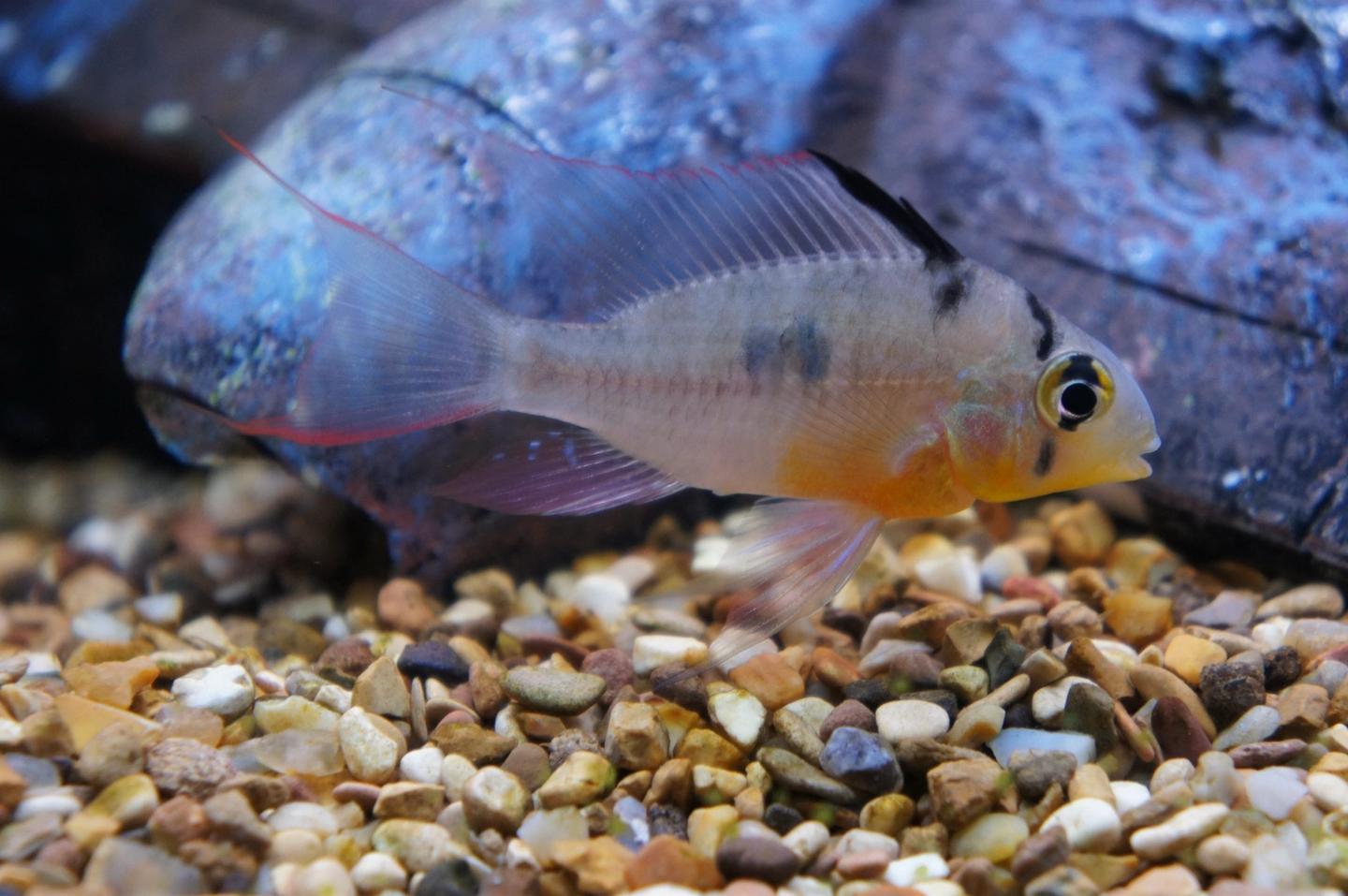
Cichlids are a family of roughly 1,800 accepted species, not one care type. Before buying, identify the exact species and source, then compare adult measurement, usable tank dimensions, social system, territory, tested water, diet and an exit plan. No family-wide minimum tank, water range or tank-mate list is safe.
Maintain these water conditions for optimal health and vibrant colors
The Saulosi Mbuna (Chindongo saulosi) is a freshwater cichlid from the family Cichlidae. This dwarf mbuna is endemic to Taiwan Reef in Lake Malawi, East Africa, and FishBase records a maximum length of 8.6 cm total length. It suits a keeper prepared to manage an aggressive Malawi-cichlid group in hard, alkaline water with substantial filtration. Its compact length does not turn it into a peaceful fish for a small mixed community.
Keep the aquarium at 23–27°C, pH 8.0–8.4 and 12–18°dH. These routine values are the overlap between FishBase’s environment range for the species and OATA’s group-level Malawi-cichlid guidance. Maintain ammonia and nitrite at zero, and keep nitrate from exceeding 20 mg per litre above the normal level in your tap water.
OATA says Malawi cichlids can be kept in groups of at least 15 and that small groups will often fight. It recommends an aquarium of at least 200 litres for a reasonable-sized Malawi community, with an oversized filter and aggressive aeration. Those figures describe the planned community rather than a special smaller allowance for this compact species.
| Suits | Not suited to |
|---|---|
| Keepers prepared to manage an aggressive Malawi group | Small groups that leave aggression concentrated |
| Hard, alkaline aquariums at 23–27°C | Soft-water general communities |
| Reasonable-sized Malawi communities planned around at least 200 litres | Unfiltered or biologically immature aquariums |
| Systems with oversized filtration and strong aeration | Buyers who require a guaranteed sex |
Wikipedia describes this dwarf-mbuna as restricted to Taiwan Reef, where it lives around rocky substrates. FishBase places large groups in sediment-free rocky habitat on the upper reef, where the current is strong. The fish picks and nibbles loose material from the biocover covering the substrate. These details support a rock-focused Malawi layout, brisk oxygenation and a feeding plan based on its grazing behaviour.
FishBase reports the wild species as Critically Endangered. Keep its identity accurate when recording or transferring fish, and plan long-term care before adding it to the aquarium.
One purchase supplies one Saulosi Mbuna in the size selected on the live size selector. The labels are 2–3 cm, 4–5 cm, 5–6 cm and XL. Basket quantity controls the number of fish: a quantity of three means three individual fish, not three packs or a promised social arrangement.
The size you select is the size supplied, not the adult size. The centimetre labels describe dispatch length, while XL is a non-numeric grade. Whichever label you choose, plan the aquarium around the recorded adult maximum of 8.6 cm and the needs of the complete Malawi group. Do not use the size label to infer sex, origin, social position or life stage.
| Size label | How to use it |
|---|---|
| 2–3 cm | Match the stated dispatch band to the existing fish and introduction plan |
| 4–5 cm | Assess the whole community before adding another individual |
| 5–6 cm | Keep adult space and biological load in the plan |
| XL | Treat XL as the stated grade, not a precise centimetre length |
Sex is guaranteed only when the selected option explicitly states male or female. This Saulosi Mbuna listing has no sex-guaranteed option.
Order quantity therefore cannot create a promised male-to-female ratio. OATA advises keeping more females than males where possible to reduce concentrated harassment, but this offer does not let you select that composition. Assess developing group dynamics and retain a practical way to revise the social plan if aggression becomes focused.
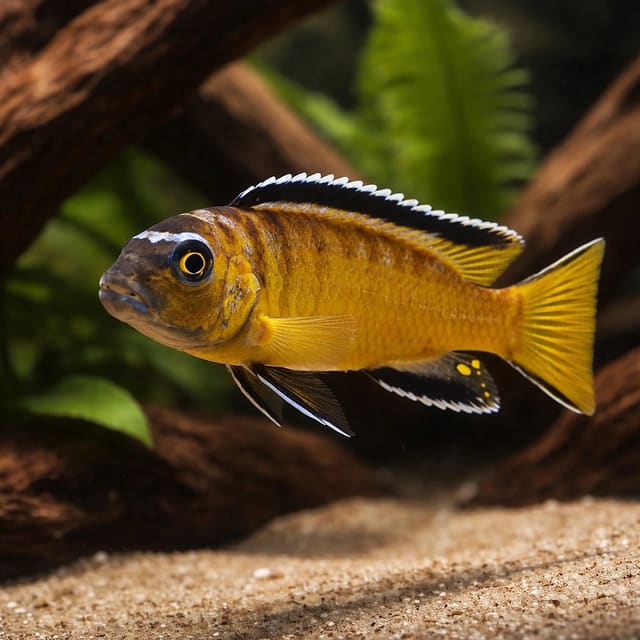
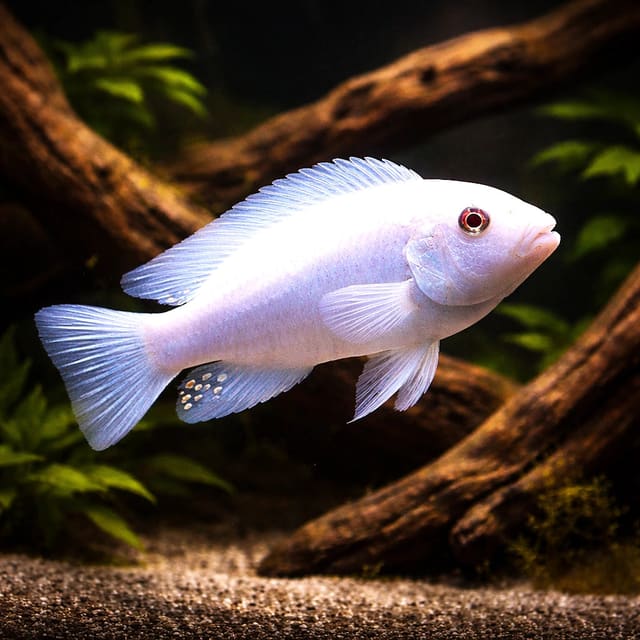
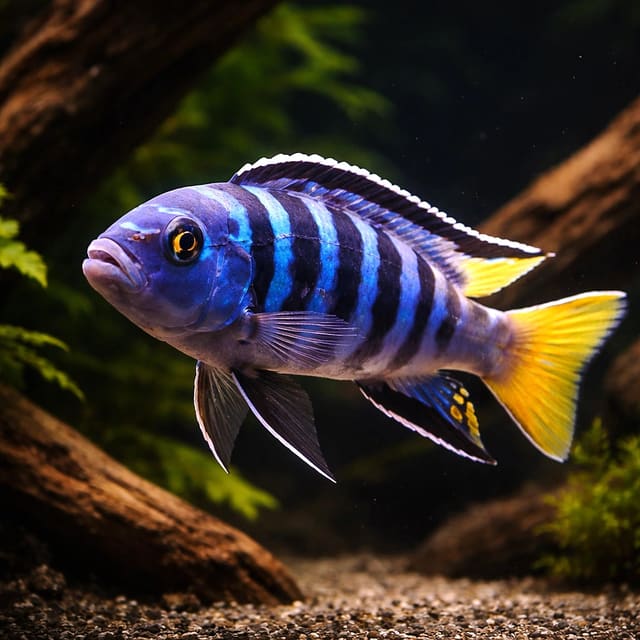
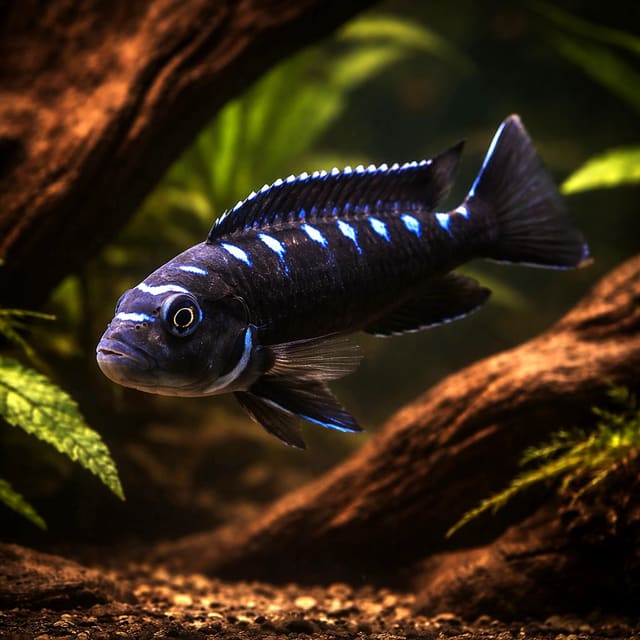
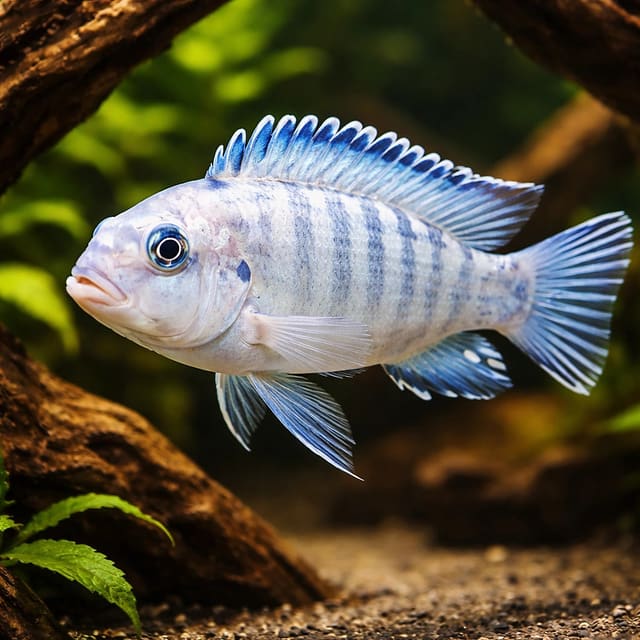
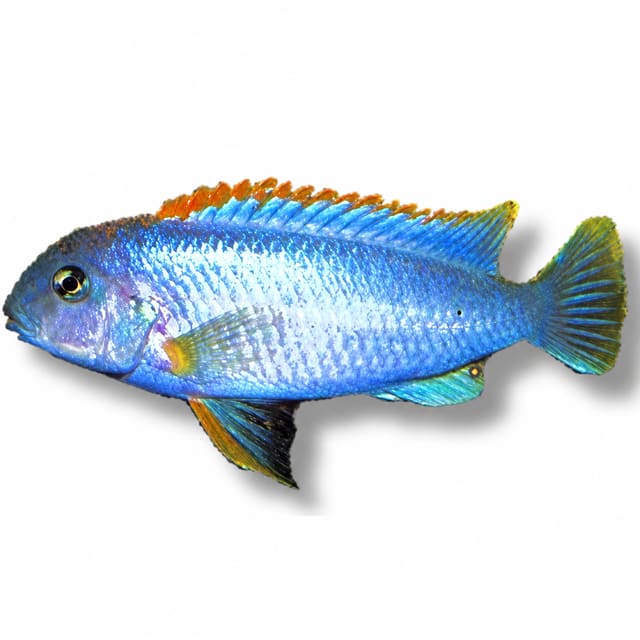
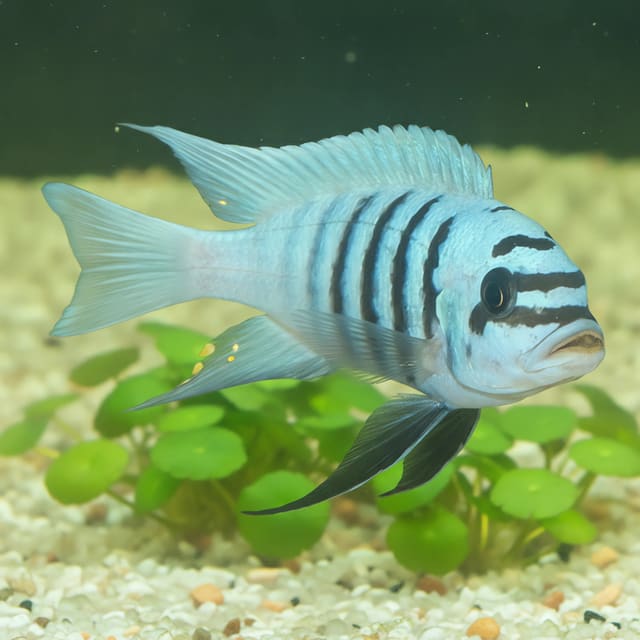
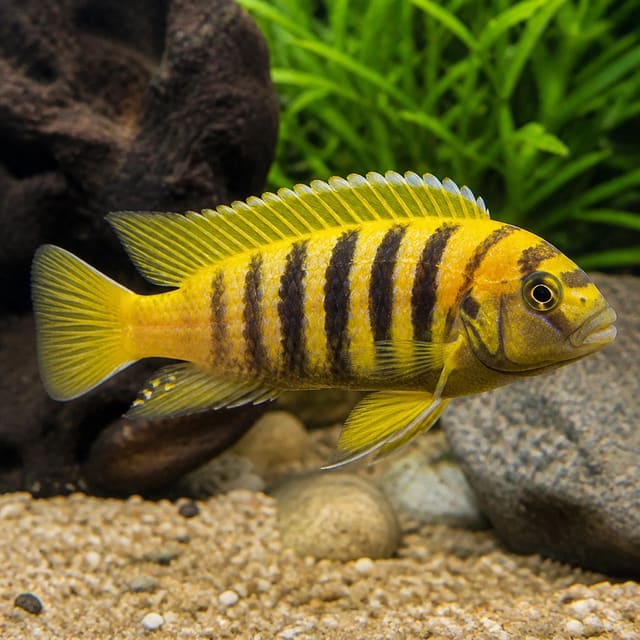
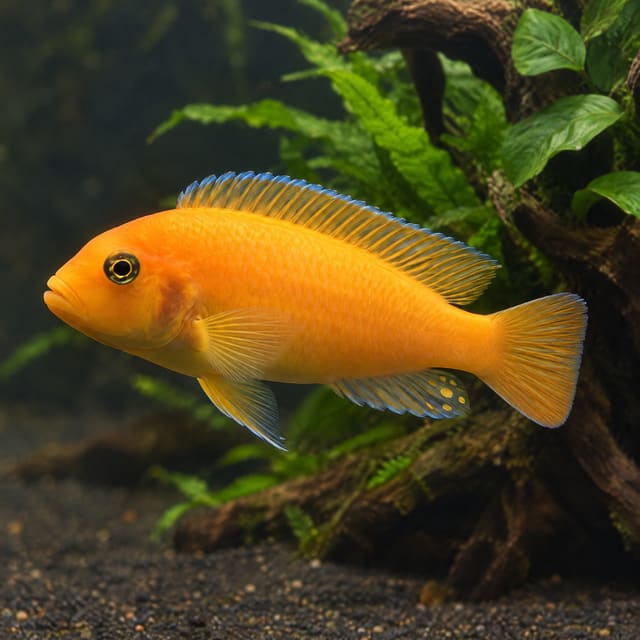
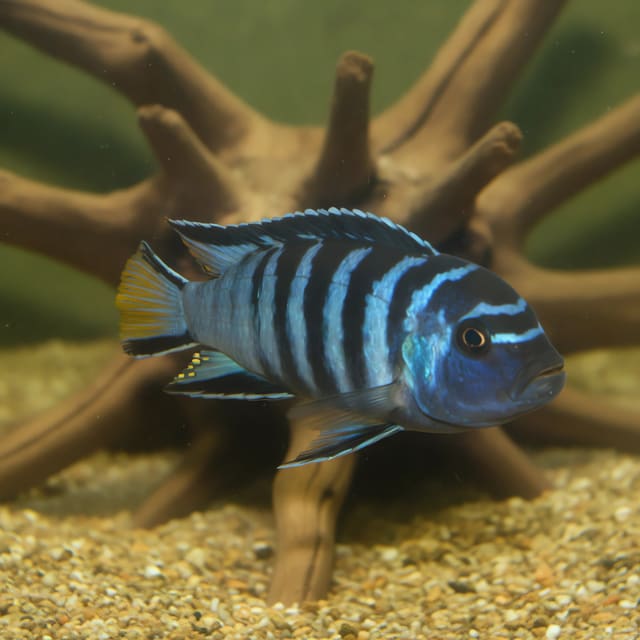
Some gallery images have been digitally enhanced to improve image quality. They show the listed type of animal rather than guaranteeing the exact markings of the individual supplied, so natural colour and pattern can vary.
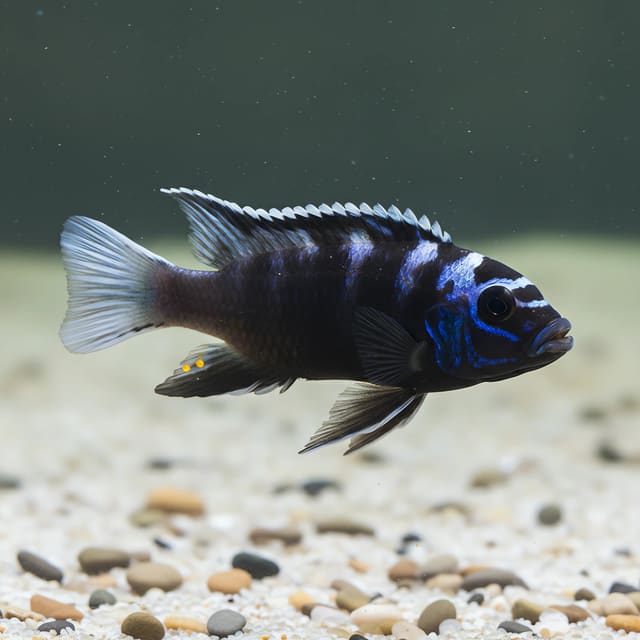
The gallery scenes show one or two yellow fish in side profile, with plain or aquarium backgrounds. A scene containing two fish describes only what is visible in that image; it does not change the retail unit or imply that two fish form a pair. We rate this an intermediate-care choice because success depends on planned group management, suitable hard water, strong filtration and prompt responses to aggression.
Keep Saulosi Mbuna at 23–27°C, pH 8.0–8.4 and 12–18°dH. This range sits within both FishBase’s species environment values and OATA’s Malawi-cichlid aquarium guidance. Use it as the routine target for the aquarium and prepare replacement water consistently enough to avoid abrupt changes.
| Value | Routine instruction |
|---|---|
| Temperature | Keep between 23°C and 27°C |
| pH | Keep between 8.0 and 8.4 |
| General hardness | Keep between 12°dH and 18°dH |
| Carbonate hardness | OATA’s Malawi guidance gives 10–15°dKH |
| Ammonia | Maintain zero mg per litre |
| Nitrite | Maintain zero mg per litre |
| Nitrate | Do not exceed 20 mg per litre above the normal tap-water level |
Test the source water and aquarium before deciding how to prepare a water change. The aquarium water chemistry guide explains why temperature, pH, hardness and nitrogen compounds need separate measurements. Record the figures rather than judging water by appearance; clear water can still contain ammonia or nitrite.
Use the water matcher to compare measured aquarium values with the 23–27°C, pH 8.0–8.4 and 12–18°dH target. A reading outside the range calls for a repeat test and a review of source water, replacement-water preparation and recent maintenance. Avoid making several unmeasured changes at the same time, because that makes the cause of any movement harder to identify.
Do not pair one source’s upper pH limit with another source’s hardness or temperature in a way that leaves the shared range. For example, 27°C, pH 8.4 and 18°dH remain within the overlap. A pH of 8.6 falls within OATA’s broad Malawi range but outside FishBase’s range for this species, so it is not the routine target used here.
Use an aquarium of at least 200 litres when planning a reasonable-sized Malawi-cichlid community. OATA gives that minimum for the community and advises choosing as large an aquarium as is practical. Account for the fish already present, the intended group, the filter’s capacity and the space displaced by the finished décor before adding another animal.
Base the setting around the rocky environment recorded for Saulosi Mbuna. FishBase places it in sediment-free upper-reef habitat with strong current, while Wikipedia identifies rocky substrates at Taiwan Reef. Arrange the aquarium so fish can use the rock-focused setting without every route ending at one occupied point. Check the layout during maintenance because Malawi cichlids will often dig and rearrange the substrate, which will uproot any plants present.
OATA recommends coral sand or a similar substrate to help buffer the water. Test pH and hardness after the aquarium has settled rather than assuming a substrate will produce a particular result. Keep the target at pH 8.0–8.4 and 12–18°dH, and use regular measurements to detect drift.
| Planning decision | Reason |
|---|---|
| At least 200 litres for a reasonable Malawi community | Larger aquariums provide more stable temperature and water quality |
| Rock-focused décor | The species occurs in rocky upper-reef habitat |
| Coral sand or similar substrate | OATA recommends it for buffering Malawi water |
| Check décor after digging | Malawi cichlids will often dig and rearrange the substrate |
| Plan around the adult community | Dispatch length does not define long-term space or filtration needs |
Judge usable space after the substrate, rocks and equipment are installed. A 200-litre label is the starting community figure, not permission to ignore displaced water or social pressure. Map where fish can move around the structure, watch how the existing group uses it and revise the stocking plan if one area becomes the focus of repeated aggression.
Run a well-established biological filter before adding Saulosi Mbuna. The RSPCA explains that fish release toxic ammonia; beneficial bacteria in a working biological filter convert it to nitrite and then to the safer nitrate. Both ammonia and nitrite must read zero before introduction and throughout routine care.
Prepare the aquarium and filter through the steps in the first tropical aquarium guide. Add livestock slowly because the bacterial population must respond each time fish numbers and feeding increase. OATA warns that stocking too quickly can produce new tank syndrome, with unhealthy ammonia and nitrite that may cause illness or death.
Use an oversized filter for a Malawi community. OATA links this recommendation to the crowded conditions used to distribute aggression, and it also recommends aggressive aeration so enough dissolved oxygen remains accessible. Keep strong surface movement and check that the filter continues moving water after media begins collecting waste.
| Check | Required result or action |
|---|---|
| Ammonia | Zero mg per litre |
| Nitrite | Zero mg per litre |
| Filter flow | Check for blockages |
| Aeration | Provide vigorous gas exchange |
| Stocking pace | Increase fish numbers slowly |
Do not rinse filter media under the tap. OATA warns that chlorine or chloramine may kill the established bacterial population. When cleaning is needed, rinse the media lightly in aquarium water removed during a partial water change. Clean only what is necessary to restore function and return the filter to operation promptly.
Treat a reduced flow rate as a maintenance signal rather than proof that the filter has spare capacity. Check for blockages, inspect aeration and test ammonia and nitrite. If either nitrogen reading rises above zero, pause further stocking and address the water-quality problem before relying on additional fish to settle into the group.
Feed a specialised Malawi-cichlid food with a high algae content and include fresh vegetables as variety. FishBase records Saulosi Mbuna picking and nibbling loose material from the biocover on rocky substrate, while OATA says smaller mbuna are more herbivorous and appreciate these foods. Natural grazing behaviour supports the food choice, but the aquarium still needs measured meals.
Feed only what the fish can eat within a few minutes, twice a day. Keep that frequency attached to the portion rule: two oversized meals still create excess waste. Watch the whole group during each meal and stop adding food when the few-minute allowance has been reached.
| Feeding decision | Instruction |
|---|---|
| Main prepared food | Use specialised Malawi-cichlid feed with a high algae content |
| Variety | Include fresh vegetables |
| Frequency | Feed twice a day |
| Portion | Give only what can be eaten within a few minutes |
| Leftovers | Prevent uneaten food from accumulating |
Choose food particles the selected fish can take without leaving a cloud of uneaten fragments. The 2–3 cm, 4–5 cm and 5–6 cm labels describe different dispatch bands, so the practical particle size may differ even though the dietary basis remains the same. XL is not a measured centimetre band; observe whether each piece is taken cleanly and adjust the presentation rather than inferring an exact length.
Overfeeding allows uneaten food to break down and release toxic waste. If ammonia or nitrite rises, food remains after the meal or nitrate control becomes harder, reduce the portion while checking filtration and maintenance. Do not extend the few-minute feeding period simply because the most assertive fish continues to approach; the objective is to feed the group without loading the aquarium with excess food.
Combine feeding observation with body-condition and behaviour checks. Reduced intake or loss of interest in food is a health warning under OATA guidance, particularly when it appears alongside altered swimming, breathing, colour or aggression.
Carry out a 25% partial water change at least once every week. OATA recommends this schedule and suggests using a siphon to remove solid waste from the gravel. Treat replacement tap water with conditioner to remove chlorine or chloramine before adding it to the aquarium.
Test the water at least weekly for ammonia and nitrite. Keep both at zero, and monitor nitrate so it does not exceed 20 mg per litre above the normal level in the tap water. Record temperature, pH and hardness alongside those nitrogen readings so a gradual movement can be seen before it becomes a large change.
This sequence separates measurements from corrections. If a test result is unexpected, repeat the test before changing several parts of the routine. A log showing food changes, new fish and maintenance makes it easier to connect a water-quality movement with a recent decision.
Any ammonia or nitrite result above zero needs action. Stop adding fish, check the filter’s operation and review whether stocking or feeding increased faster than the biological filter could respond. Continue testing while correcting the cause. New tank syndrome can make fish ill or kill them, so do not wait for visible distress before taking the reading seriously.
| Pattern | Decision |
|---|---|
| Filter flow has fallen | Check for blockages |
| Food remains after a few minutes | Reduce the portion |
| Ammonia or nitrite is detected | Pause stocking and investigate filtration |
| pH or hardness drifts | Compare source, replacement and aquarium water |
| Waste collects in substrate | Use the siphon during the weekly partial change |
Prepare a filtered aquarium at 23–27°C, pH 8.0–8.4 and 12–18°dH before the parcel is due. OATA advises confirming that ammonia and nitrite are zero before adding fish and increasing the population slowly as the biological filter adjusts. These water checks belong to aquarium preparation rather than the parcel-opening sequence.
Read the Tropical Fish Co delivery and Live Arrival Guarantee policy before the delivery date. Fish are hand-bagged in pure oxygen and placed in an insulated poly box, with a heat pack when the weather calls for it. A licensed live-animal courier carries the parcel, and someone must be at the delivery address to receive it.
Keep the continuous video with the order number because it is required for a Live Arrival Guarantee claim. Contact us on the same day if a claim is needed, following the policy page’s reporting route.
OATA recommends adding Malawi cichlids in groups so one newcomer does not receive all the aggression while settling. It also advises adding more peaceful species before more aggressive species and says rearranging aquarium décor can help reduce aggression as fish establish territories. Apply these points to the existing aquarium rather than treating arrival as an isolated bag-acclimatisation task.
Check the planned fish number, filtration and social order before completing the purchase. If the addition would create a small Malawi group, exceed the reasonable load for the aquarium or leave one fish exposed to concentrated aggression, revise the plan before dispatch. The 20–30 minute float period prepares the bag for release; it does not resolve an unsuitable community.
Watch for changes in swimming, colour, aggression, hiding, breathing, appearance, body condition and feeding. OATA identifies hanging at the surface, sitting on the bottom, erratic swimming, unusually fast or slow gill movement, white spots, fluffy growths, fin or scale loss, weight change and reduced food intake as warning signs.
| What you see | What to do first |
|---|---|
| Hanging at the surface | Test water and check aeration |
| Sitting on the bottom or erratic swimming | Compare water values with the routine range |
| Faster or slower gill movement | Check oxygenation, ammonia and nitrite |
| More hiding or altered aggression | Observe which fish is directing the pressure |
| White spots, fluffy growths or lost scales | Record the change and seek guidance |
| Reduced feeding or body-condition change | Review water, social pressure and recent feeding |
Begin with temperature, pH, hardness, ammonia, nitrite and nitrate. A behaviour change that appears social can coincide with a water problem, while poor water can intensify stress across the whole community. Confirm that filtration is running, aeration is vigorous and ammonia and nitrite remain at zero.
Compare the affected fish with its own recent pattern and with the rest of the group. One fish hiding while others feed normally points to a different decision from several fish gasping together. Record when the change began, whether a fish or décor was recently added and whether food or maintenance changed.
If the warning sign continues after immediate water and equipment checks, contact us for further guidance. Provide the test results and a concise description of swimming, breathing, appearance and feeding. Those details make the next decision more useful than a colour description alone.
Do not leave a fish under repeated social pressure while waiting for routine weekly maintenance. Focused chasing, escalating aggression or physical damage means the stocking and territory plan needs prompt review. Keep the aquarium’s group structure, rock-focused layout and filtration capacity in that assessment.
Plan Saulosi Mbuna as part of an aggressive Malawi-cichlid group, not as a peaceful pair. OATA says these fish are not social in the ordinary community-fish sense, but they can be kept in groups of at least 15 and slightly overcrowded to limit aggression. It also warns that Malawi cichlids kept in small groups will often fight.
The permission to keep at least 15 does not turn that number into a promise of harmony. Aquarium size, filtration, aeration and the behaviour of every species still matter. OATA connects crowded Malawi communities with oversized filtration and aggressive aeration, so the social and biological plans must be built together.
| Group decision | How to apply it |
|---|---|
| Group size | OATA says Malawi cichlids can be kept in groups of at least 15 |
| Small groups | Avoid relying on them because they will often fight |
| Sex balance | Keep more females than males where possible |
| Initial purchase | Do not assume a sex ratio from dispatch size or quantity |
| Filtration | Use oversized filtration for the planned Malawi community |
Each quantity is one fish, but several purchased fish do not form a guaranteed pair, colony structure or sex ratio. This offer carries no sex-guaranteed option. Build the initial plan around an unknown composition, then assess how the group behaves rather than assigning social roles from a size label or gallery colour.
OATA recommends adding Malawi cichlids in groups, adding more peaceful species before more aggressive species and rearranging décor to reduce aggression as territories are found. Use those steps only after confirming that the aquarium can carry the added biological load. A social introduction plan cannot compensate for detectable ammonia, nitrite or insufficient filtration.
Before combining a new fish with an established group, review the aquarium volume, the number and identity of existing Malawi cichlids, the filter and the intended group total. Contact us for a stocking and compatibility assessment if those factors leave the outcome uncertain.
Keep Saulosi Mbuna only with other Malawi cichlids or some species of Synodontis catfish that naturally inhabit Lake Malawi. OATA gives this companion rule for Malawi cichlids and also says every mix requires caution because the group is aggressive. A shared lake label is therefore a screening starting point, not automatic compatibility.
Avoid fish outside the two categories named above. Do not treat an unrelated soft-water fish, a peaceful general-community species or a catfish from another environment as suitable after screening; OATA’s rule limits the mix to other Malawi cichlids and some qualifying Synodontis.
| Candidate | Decision |
|---|---|
| Another Malawi cichlid | Consider only after water, size, diet, aggression and capacity checks |
| Lake Malawi Synodontis species | Consider the individual species after the same checks |
| Other fish | Avoid under OATA’s Malawi companion rule |
| Unknown identity | Identify it before making a compatibility decision |
The African cichlid collection can be used to compare identities and care requirements. Collection membership does not make every fish a companion for Saulosi Mbuna. Apply the Malawi-only rule first, then carry out the complete water, adult-size, feeding, aggression and aquarium-capacity assessment.
Compatibility remains conditional because individual fish and established groups can behave differently. Watch interactions after introduction and act when aggression becomes concentrated, fins or scales are damaged, a fish hides more than normal or feeding access changes.
It reaches 8.6 cm total length; FishBase records this maximum for the species. Plan the aquarium for an aggressive Malawi cichlid rather than judging space by body length alone.
Use at least 200 litres for a reasonable-sized Malawi-cichlid community. OATA gives this as group guidance, so stocking, rock displacement and filtration still shape the final plan.
OATA says Malawi cichlids can be kept in groups of at least 15 and warns that small groups will often fight. The aquarium must also support the resulting waste load and aggression.
We rate it intermediate because it needs hard alkaline water, an aggressive group plan, at least a 200-litre aquarium for a reasonable Malawi community, oversized filtration and active behaviour monitoring.
This fish picks and nibbles loose material from biocover in nature. Feed specialised Malawi-cichlid food with a high algae content and fresh vegetables, twice a day in portions eaten within a few minutes.
Keep this fish at 23–27°C and pH 8.0–8.4, with hardness at 12–18°dH. These routine values are the overlap of FishBase’s species environment range and OATA’s Malawi-cichlid guidance.
It is an aggressive Malawi cichlid, and OATA says small groups will often fight. Treat altered aggression, concentrated chasing, damaged fins or increased hiding as reasons to reassess the group promptly.
Keep it only with other Malawi cichlids or some Synodontis catfish species that naturally inhabit Lake Malawi, after checking water needs, adult size, diet, aggression and aquarium capacity.
Tropical Fish Co packs it in pure oxygen in an insulated poly box, adding a heat pack when the weather calls for it, and uses a licensed live-animal courier. Someone must receive the parcel; film the sealed parcel continuously through opening and show the fish inside the sealed bag.
No reviews for this item yet. Bought one? Honest reviews only, good or bad.
What customers say about ordering from us
I have a small group of long finned mountain minnows. So was delighted to be able to order ten of this variety to increase the genetics in my tank . The ones I recieved are healthy but it’s to early to give a verdict on wether they are of a long finned type since they are small currently.
Gordon Walker · 23 Sept 2026
100% success travel and "installation". Pleased with quality of purchase. The Siamese fighter a bit "shy" so have not yet seen him at his best yet but looking good. Happy customer. GG
George E Garratt · 21 Sept 2026
Reviews of our shop, collected by Judge.me, an independent third-party review collector. Newest first.