Advanced
Pseudotropheus elongatus "Usisya Mara Rock" Mbuna
24–28°C · pH 7.6–8.8 · 135L
£17.99

Blue-and-dark barred Lake Malawi mbuna with a compact adult size and forceful territorial behaviour. Chindongo demasoni needs a mature, long, rock-filled hard-water aquarium and a carefully planned stocking strategy; it is not a peaceful community fish or a beginner nano species.
Adult size is the maximum length this species reaches at full maturity (scientific sources). The livestock you receive will be younger and smaller — pick a size above for the actual shipping size. Product-photo provenance and any image-specific limitations are stated on the listing.
Chindongo demasoni
Save when buying multiple fish. Each quantity is one fish; sex and pair formation are not guaranteed unless the selected variant explicitly states them.
Blue-and-dark barred Lake Malawi mbuna with a compact adult size and forceful territorial behaviour. Chindongo demasoni needs a mature, long, rock-filled hard-water aquarium and a carefully planned stocking strategy; it is not a peaceful community fish or a beginner nano species.
Adult size is the maximum length this species reaches at full maturity (scientific sources). The livestock you receive will be younger and smaller — pick a size above for the actual shipping size. Product-photo provenance and any image-specific limitations are stated on the listing.
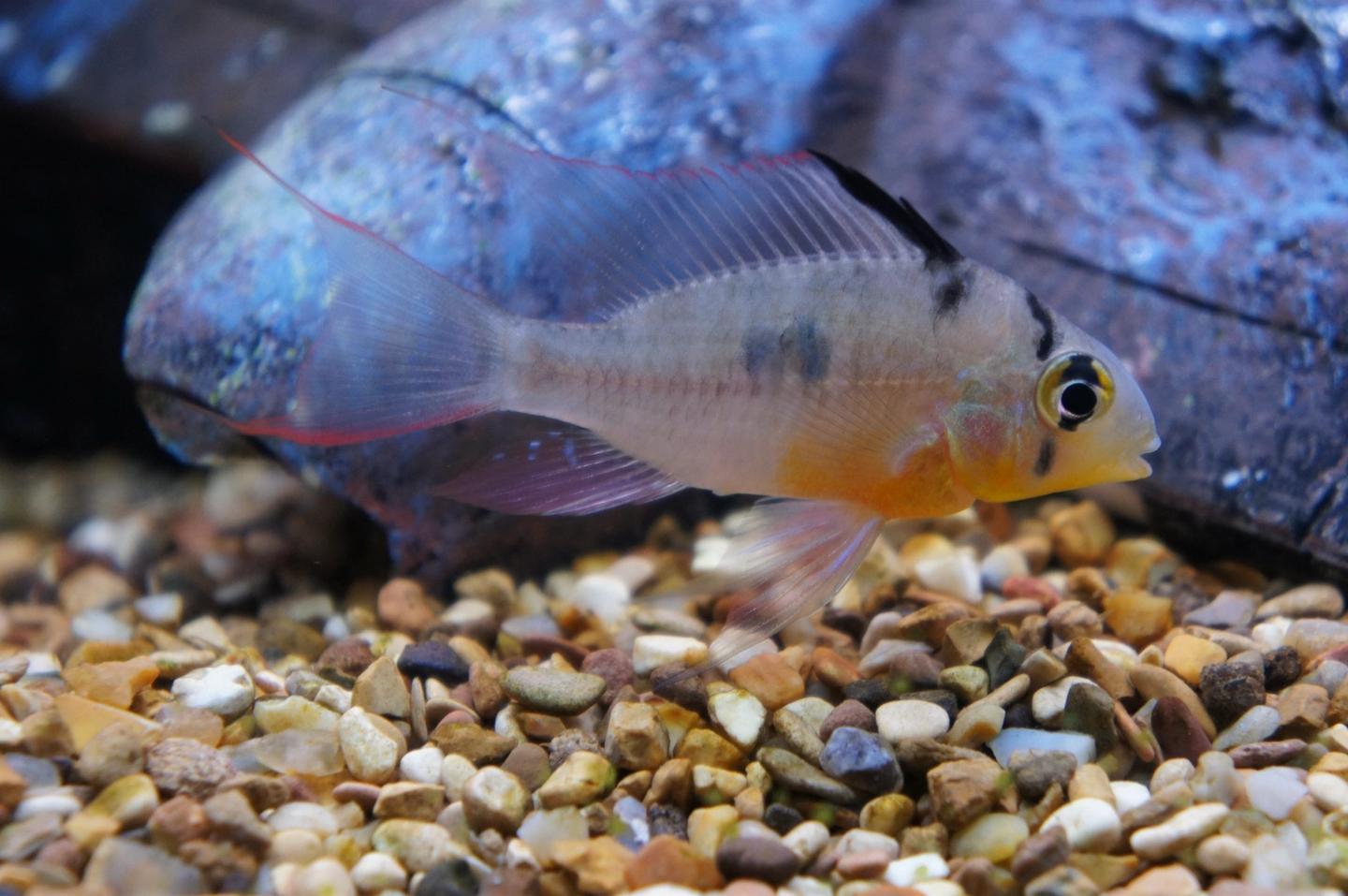
Cichlids are a family of roughly 1,800 accepted species, not one care type. Before buying, identify the exact species and source, then compare adult measurement, usable tank dimensions, social system, territory, tested water, diet and an exit plan. No family-wide minimum tank, water range or tank-mate list is safe.
Maintain these water conditions for optimal health and vibrant colors
Demasoni Cichlid (Chindongo demasoni) is a compact, intensely territorial mbuna from the rocky Tanzanian shore of Lake Malawi. Both sexes carry a striking pattern of blue and dark vertical bars, but the small adult size can be deceptive: this is an assertive African cichlid for a deliberately planned Malawi aquarium, not a peaceful fish for a general tropical community.
The species was originally described as Pseudotropheus demasoni, and that historical name remains common in aquarium shops and searches. The accepted scientific combination is now Chindongo demasoni. This page uses both names naturally so existing keepers can identify the fish without pretending that the older genus is still current.
Four sale-size options are shown in the selector: 2–3 cm, 3–4 cm, 4–5 cm and XL. Those are purchase options, not four different species, and they do not guarantee sex, final size or social compatibility. Current stock, price and any quantity saving are displayed beside the basket controls rather than fixed inside this description.
Demasoni reward experienced keepers with constant rock-grazing, territorial displays and remarkable colour. Casual stocking can lead to serious welfare problems. Read the aquarium footprint, group-planning, diet and compatibility sections before ordering, particularly if the tank already contains peaceful fish or another blue-barred mbuna.
The current valid name is Chindongo demasoni. Eschmeyer's Catalog of Fishes records the species as originally described by Ad Konings in 1994 under Pseudotropheus demasoni, with Pombo Rocks in Lake Malawi, Tanzania, as the type locality. A 2016 taxonomic revision by Li, Konings and Stauffer established the genus Chindongo for a group of small rock-dwelling mbuna and explicitly transferred this species.
The older combination is therefore useful as a synonym, not as a second species. A listing labelled Demasoni, Chindongo demasoni or former Pseudotropheus demasoni may refer to the same fish.
| Name seen online | What it means | How this page uses it |
|---|---|---|
| Demasoni cichlid | The widely used common trade name | Primary customer-facing name |
| Chindongo demasoni | The current valid scientific name | Primary scientific identity |
| Pseudotropheus demasoni | The original and still-common historical combination | Synonym for identification, not repeated as a sales keyword |
| Dwarf mbuna | A size-based hobby description | Used cautiously because small body size does not mean mild behaviour |
The genus name Chindongo refers to small rock-dwelling fish, and the revision distinguishes the group in part by its vertical-bar pattern and feeding anatomy. That classification aligns with the fish's appearance and rock-associated behaviour, but scientific placement does not supply a complete aquarium stocking formula. Husbandry still has to account for the individual tank and group.
Select the size required before adding the fish to the basket. The measured options are 2–3 cm, 3–4 cm and 4–5 cm; XL is the larger grade. If an exact measurement within the XL grade is essential to an established group, ask before dispatch rather than inferring a number that is not stated in the option.
One order quantity means one fish unless the live buy box explicitly shows a separate quantity or shoal offer. A quantity of two is not a guaranteed male/female pair, a bonded pair or a safe social unit. Demasoni are difficult to sex reliably from colour alone, especially while young, and this listing does not offer sex-selected stock.
| Selector option | What is specified | What is not promised |
|---|---|---|
| 2–3 cm | A small sale-size grade within that measured band | Sex, exact age or adult social rank |
| 3–4 cm | A measured intermediate sale-size grade | A female, male or compatible partner |
| 4–5 cm | A larger measured grade | Adult size or settled territorial behaviour |
| XL | The currently offered larger supplier grade | A fixed centimetre measurement unless confirmed before dispatch |
Size can influence introduction risk because a much smaller newcomer may be unable to withstand an established territorial fish, while a larger newcomer can also disrupt the hierarchy. It is only one variable. Layout, colour pattern, available retreats, sex ratio, resident behaviour and the ability to separate fish matter just as much.
Prices and availability can differ by option and change with stock. Use the current selector and checkout as the authority. The page deliberately avoids an outdated “from” price in the description and avoids claiming that every size is available simply because four options exist.
This fish is best suited to someone who already understands biological filtration, hard-water cichlid husbandry and active aggression management. The keeper needs enough space for a long rock-based aquarium, a plan for every existing fish, and a separate safe place available if one individual is relentlessly targeted.
Demasoni are a poor choice for a first uncycled aquarium, a peaceful mixed community, a small tank chosen only because the fish stays compact, or an impulsive addition to an established mbuna display. They should not be bought as an “algae cleaner”. Natural grazing behaviour does not mean the fish can maintain an aquarium or live on incidental algae alone.
Do not use the word dwarf as a shortcut for easy, peaceful or nano-suitable. Demasoni can direct sustained aggression at their own kind and at fish that resemble them. A sale-size juvenile still needs an adult stocking plan from the start.
A well-prepared keeper can explain where the fish will live, how water chemistry is maintained, which residents share that chemistry, where visual barriers will be built, and what happens if the introduction fails. The Lake Malawi cichlid guide provides broader context, while the care planner can help organise practical preparation. Neither tool can make an incompatible group safe.
Chindongo demasoni has a very restricted natural identity. Eschmeyer's Catalog gives Pombo Rocks in Lake Malawi, Tanzania, as the type locality, and FishBase records the species from the Tanzanian part of the lake. It is a rock-dwelling mbuna rather than a river fish, a Tanganyikan cichlid or a general “African cichlid” with interchangeable care.
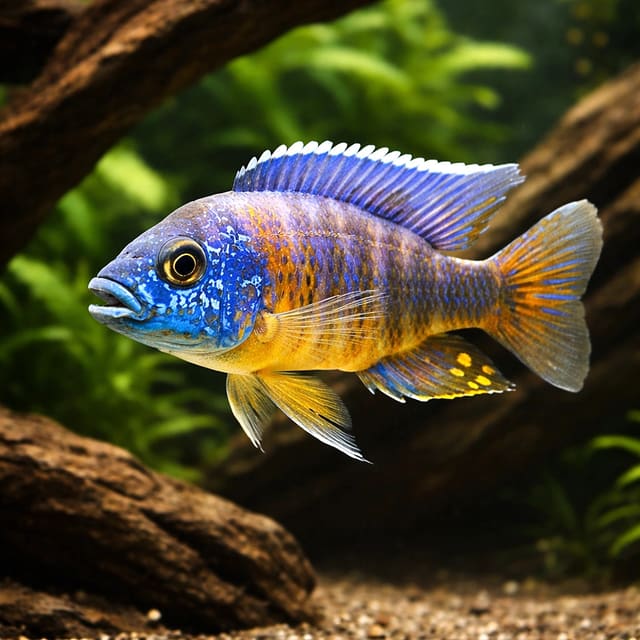
The rocky origin helps explain the aquarium priorities: hard alkaline water, extensive rock surfaces, narrow routes, crevices and broken lines of sight. It also explains why a decorative planted-community layout shown in an image should not be treated as the care plan. The existing gallery illustrates the fish's barred appearance; it does not recreate Pombo Rocks or show the exact individual that will be dispatched.
FishBase lists the species as Vulnerable (VU D1+2), based on an assessment dated 22 May 2018. That status belongs in the page because it gives important ecological context. It does not prove whether a particular shop specimen is wild-collected or captive-produced, and this listing does not invent provenance. Contact the team before ordering if origin documentation is important to your purchase.
Lake Malawi and Lake Tanganyika have different fish communities. Demasoni is a Lake Malawi mbuna. Search phrases that call for a Tanganyika setup are geographically wrong and have been removed from the listing.
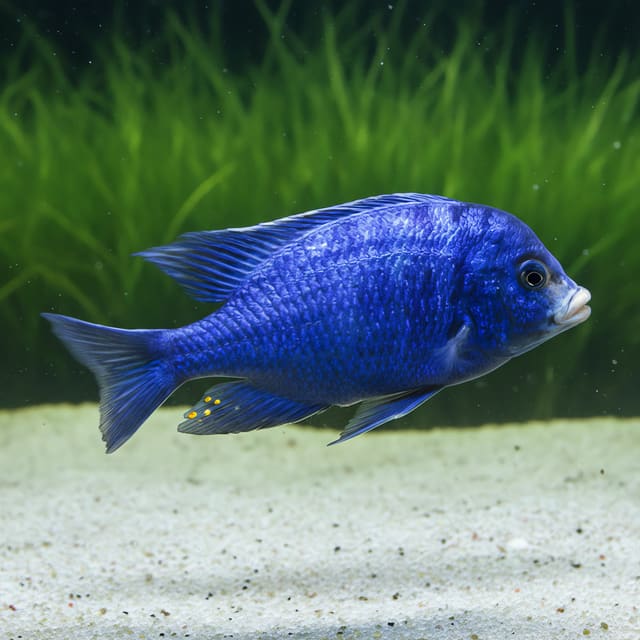
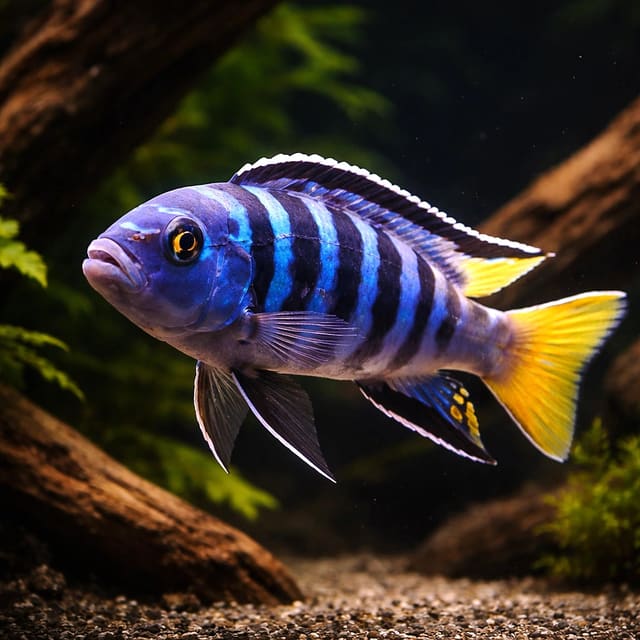
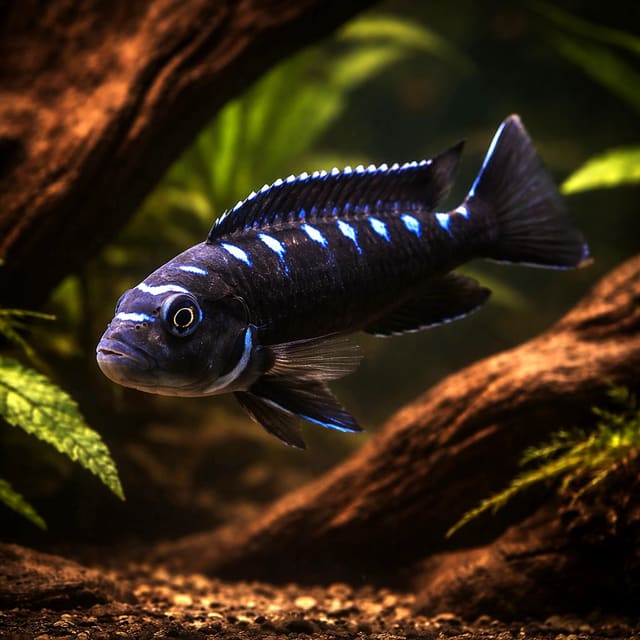
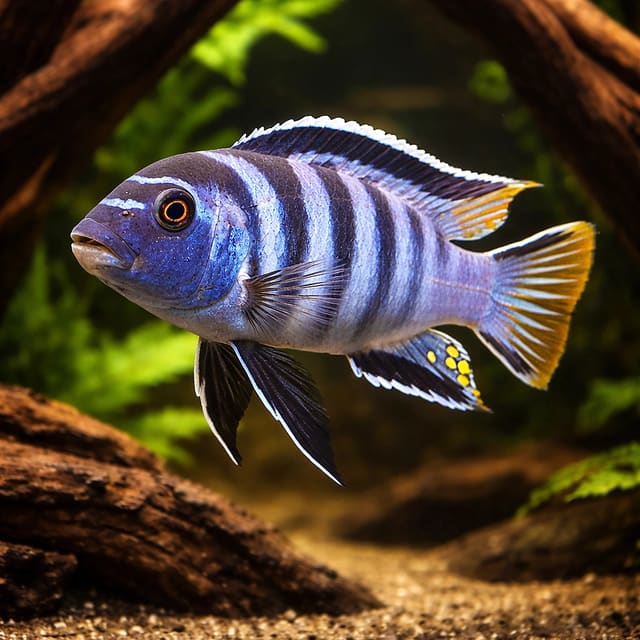
The characteristic pattern is a blue body crossed by dark vertical bars, with barring continuing across the head and fins. The contrast can vary with age, lighting, background, social state and the individual fish. Darkening does not automatically identify a male, and a paler fish is not automatically female or unhealthy.
The 2016 revision describes Chindongo as having a vertical-bar melanin pattern without horizontal elements, and it distinguishes C. demasoni by four flank bars in the diagnostic comparison used there. Aquarium images may make the number or width of visible light and dark bands appear different because the head, caudal peduncle and reflected highlights are counted inconsistently. Identification should use the whole fish and reliable provenance, not a casual stripe count from one photograph.
Males and females are similarly coloured, which is one reason a “breeding pair” should not be inferred from two blue fish. Mature males may become more territorial and can differ subtly in size or fin shape, but those clues are not a reliable retail sex guarantee. Venting by an experienced keeper is more informative than colour alone and still should not be promised from a standard unsexed sale option.
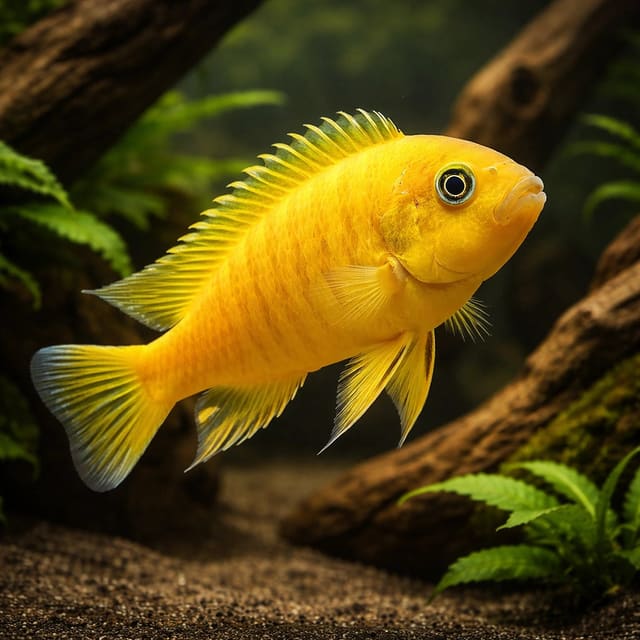
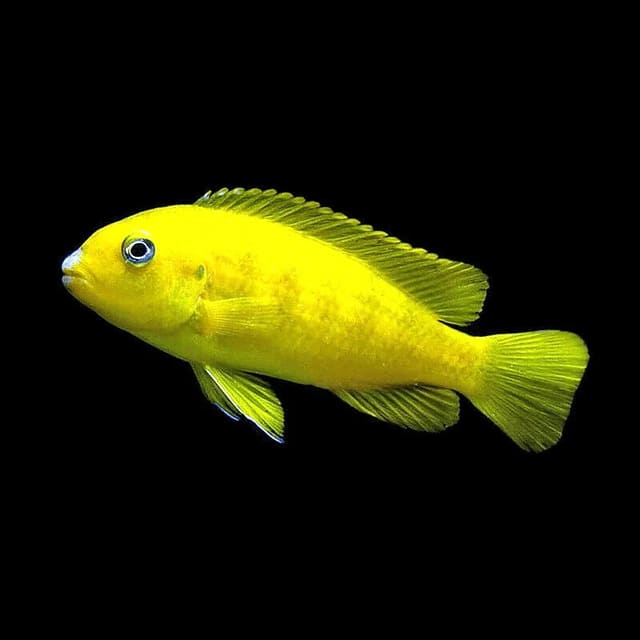
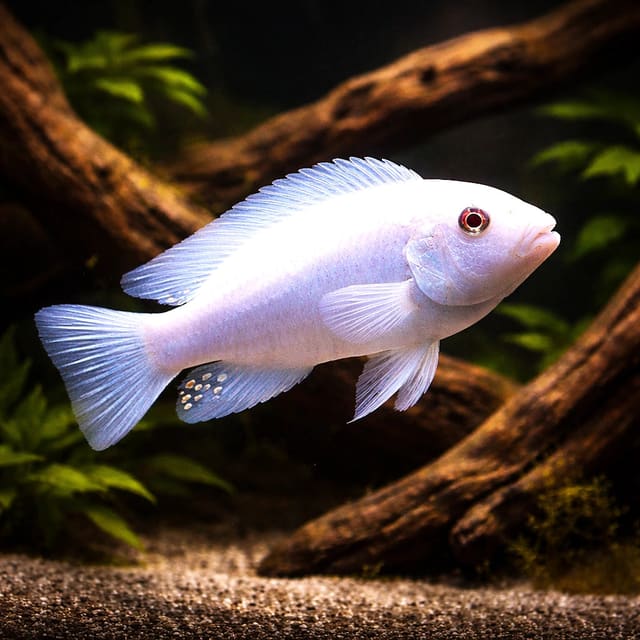
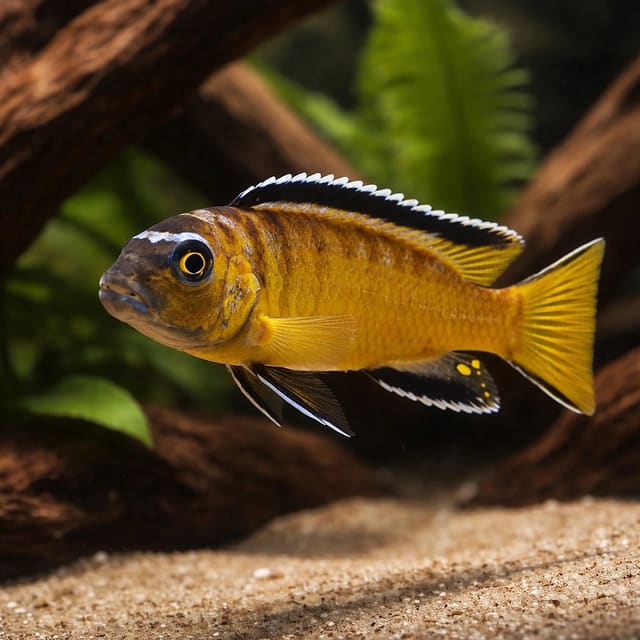
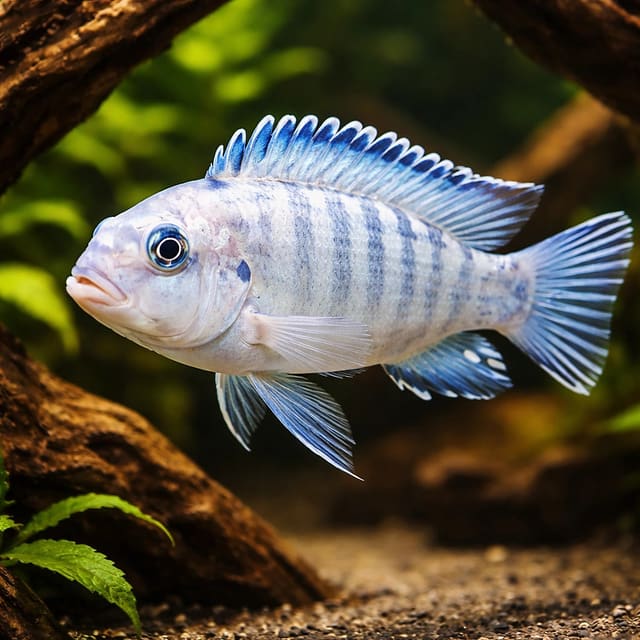
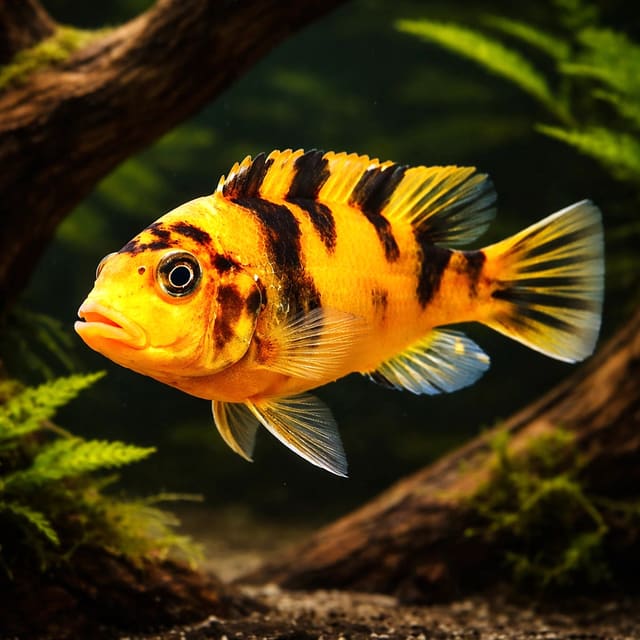
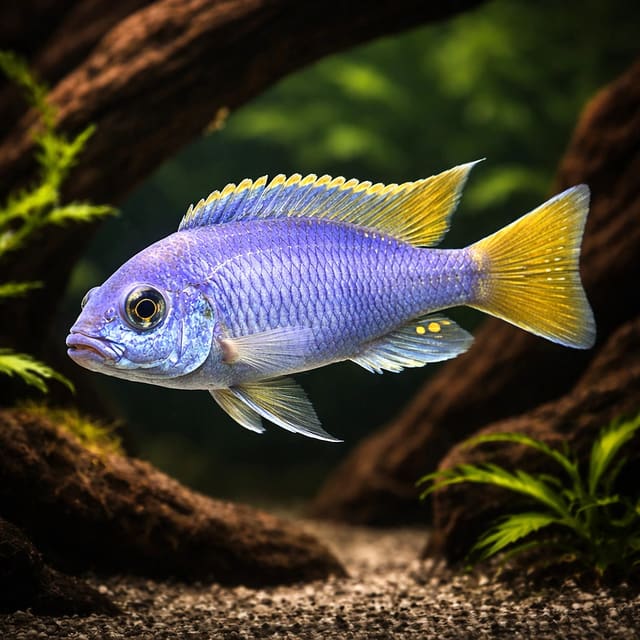
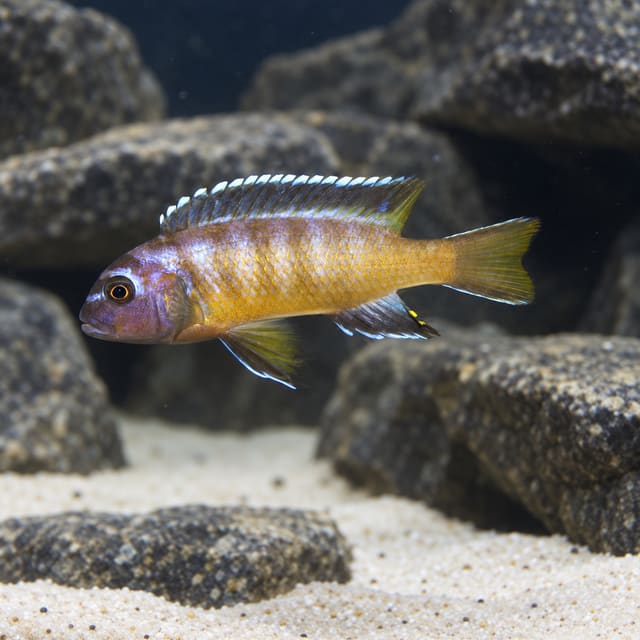
Reference images are not the individual fish received. A scene showing two fish does not change the single-fish sale unit; colour varies with maturity and conditions.
FishBase records a maximum of 6.3 cm standard length. Standard length is measured from the snout to the base of the tail fin, so it is not the same as the total nose-to-tail measurement a keeper sees in the aquarium. Specialist aquarium guidance commonly gives approximately 8 cm total length. Presenting both figures with their measurement context resolves the apparent contradiction more honestly than choosing whichever number looks better in a snippet.
The sale sizes are smaller than the expected adult total length. A 2–3 cm fish is not a permanent small-tank version, and an XL option should not be assumed to have stopped growing. Growth depends on age, nutrition, health and husbandry; the page does not promise a growth rate or an exact adult length for every fish.
| Size statement | Meaning | Use it for |
|---|---|---|
| 6.3 cm standard length | FishBase maximum excluding the tail fin | Scientific size context |
| About 8 cm total length | Specialist aquarium guidance including the visible tail-to-snout impression | Practical adult planning |
| 2–3, 3–4 or 4–5 cm | Measured sale-size options | Choosing a current grade |
| XL | A larger commercial grade without a stated exact band | Choosing the larger live option, subject to confirmation |
Adult body length is not the main driver of aquarium space. Territory, social pressure, rock structure, swimming routes and bioload make a long aquarium necessary despite the compact fish. Use the tank volume tool to calculate the actual capacity of a proposed aquarium, but make the final decision from footprint and stocking rather than litres alone.
A long aquarium around 120 cm / 4 ft is a practical starting point from specialist Demasoni guidance. This page does not turn that into a universal litre minimum because tanks with the same volume can have very different footprints. A tall narrow aquarium offers less horizontal territory and fewer useful escape routes than a longer tank holding a similar number of litres.
Build the hardscape around stable rock structures with multiple crevices, routes and visual barriers. Place heavy rocks securely so digging cannot undermine them; do not balance a tall pile on loose substrate. Leave some open swimming space, but avoid a bare sightline from one end of the aquarium to the other. A pursued fish needs to disappear from the aggressor's view, not merely sit behind one ornament while remaining visible.
Rock choice should be aquarium-safe and structurally sound. Calcareous material can contribute to hardness and alkalinity, but the effect varies with source water and maintenance. Do not use decor as a substitute for measuring pH and hardness. Likewise, a sand or fine-gravel substrate may suit the layout, but no substrate corrects an unstable stocking plan.
Plants are optional and may be uprooted or grazed. The species' natural context is rocky, and the priority is secure structure rather than a densely planted aquascape. If plants are used, protect roots and choose them for the maintained hard-water conditions. A planted gallery background is not a husbandry plan or a guarantee that delicate plants will remain untouched.
| Layout feature | Why it matters | Common mistake |
|---|---|---|
| Long footprint | Creates separate zones and travel routes | Choosing a tall tank from litres alone |
| Secure rockwork | Provides grazing surfaces, crevices and territorial boundaries | Stacking rocks loosely on deep substrate |
| Broken sightlines | Allows a chased fish to leave view | Using one central cave in an otherwise open tank |
| Open areas | Supports movement and feeding observation | Filling every route with unstable decor |
| Accessible maintenance | Lets the keeper remove waste and inspect fish | Building a structure that cannot be safely cleaned |
Specialist aquarium guidance for Demasoni gives 24–26°C, pH 7.5–8.5 and hard alkaline water. These are maintained-care figures, not a licence to change a fish rapidly from one chemistry to another. Stability, acclimation and the conditions the fish arrives in all matter.
Test source water and established aquarium water before ordering. If the supply is naturally soft or acidic, decide how mineral content and buffering will be managed consistently through future water changes. A one-off dose that produces the target number on delivery day is not a stable system. The water matcher can help compare ranges, but actual liquid-test results and a repeatable maintenance method remain essential.
Ammonia and nitrite should not be detectable in a stocked, biologically mature aquarium. Nitrate and other accumulated waste should be controlled through an appropriate maintenance schedule. This page does not invent a universal water-change percentage because stocking density, feeding, filtration, source water and measured results differ. Test, record and adjust gradually.
Avoid chasing pH with frequent abrupt chemical corrections. Hard alkaline water does not mean adding random salt or medication, and ordinary sodium chloride is not a complete Rift Lake mineral system. If source water needs substantial adjustment, establish and prove the method before livestock arrives rather than experimenting with the fish in the tank.
A display can test perfectly before a water change and still become unstable if each refill has very different temperature, hardness or pH. The sustainable target is a repeatable process, not one perfect reading.
Demasoni stocking strategies can create a substantial bioload, so filtration must be sized for the complete group and feeding plan. There is no evidence-based reason to promise a universal turnover multiplier for every filter. Choose equipment that provides dependable biological capacity, mechanical waste capture, oxygenation and service access without creating a hazardous current or leaving dead zones behind rockwork.
Rocky aquariums trap debris. During maintenance, inspect gaps, accessible substrate and filter intakes rather than cleaning only the open front area. Service media in a way that preserves biological function, and never replace all established biological media simply because it looks discoloured. Measure water before and after significant changes so decisions are based on the aquarium rather than a generic calendar.
Observe the fish at every feed. A missing individual, torn fin, fish held at the surface or corner, repeated hiding, rapid breathing or sudden refusal to eat may indicate water-quality trouble, social pressure or illness. Those signs overlap, so test water and review interactions before reaching for a treatment.
The aquarium should be fully cycled and stable before the order is placed. Adding bacterial products at the same time as a territorial cichlid does not prove that the tank can process its waste. Use the site's cycle tracker for records if helpful, but confirm readiness with measured results.
Demasoni are highly territorial and particularly capable of strong aggression towards their own species. The 2016 revision describes Chindongo species as defending aufwuchs feeding grounds, and practical aquarium guidance treats Demasoni as one of the more demanding mbuna to organise socially.
Aggression is not solved by one magic number. Some keepers use larger groups to distribute attention, while others design species-focused or mixed-mbuna systems around sex ratio, footprint and rockwork. A fixed instruction such as “always keep 12+” ignores aquarium dimensions, filtration, the sexes actually received and the keeper's ability to intervene. Buying more fish without more usable territory and capacity can increase risk.
Equally, one fish is not guaranteed to be peaceful simply because there is no second Demasoni. It may redirect territorial behaviour towards a similar-looking resident. A pair is not automatically safe, and a quantity discount is not a behavioural recommendation. The relevant question is whether every individual has compatible water, sufficient structure and a realistic escape from sustained targeting.
Plan the group before purchase, rearrange rockwork before introductions where appropriate, and keep a cycled separation option available. Remove a fish from immediate danger if it cannot feed, leave a corner or avoid continuous attack.
| Claim | Accurate interpretation |
|---|---|
| “Keep one” | Does not guarantee peaceful behaviour towards other blue or similarly shaped fish. |
| “Keep a pair” | Does not create a bonded or safe male/female unit; sale fish are not sex guaranteed. |
| “Keep 12 or more” | A hobby strategy sometimes used to distribute aggression, not a universal minimum or guarantee. |
| “Overstock mbuna” | Requires deliberate filtration, oxygenation, maintenance and welfare monitoring; crowding alone is not husbandry. |
| “Add more hiding places” | Useful only when structures create stable territories and genuine breaks in sightline. |
There is no universally safe tank-mate list. Any candidate must share stable hard alkaline Malawi conditions, be robust enough for an assertive mbuna environment, and avoid a colour pattern or body shape likely to attract focused aggression. Temperament labels on two product pages are not enough; the existing group and aquarium design decide much of the risk.
Avoid peaceful community fish, small delicate species, long-finned fish, shrimp and other animals that cannot escape persistent attention. Similar blue-and-dark barred mbuna deserve particular caution because Demasoni may treat them as direct rivals. Peacocks and many non-mbuna Malawi cichlids also have different feeding and social needs; sharing a lake name does not make a combination sensible.
The useful way to compare another fish is to ask five questions: does it need the same water; does it use the same territory; will its colour trigger rivalry; can both species eat appropriately in the same tank; and can the aquarium absorb the combined adult bioload? If any answer is uncertain, research the exact species and do not use a retailer's “often bought together” block as compatibility evidence.
| Candidate | Assessment | Reason |
|---|---|---|
| Peaceful tetras, rasboras and livebearers | Avoid | Behaviour, water chemistry and social pressure do not align. |
| Small shrimp | Avoid | They are not suitable companions for an assertive rock-dwelling cichlid. |
| Similar blue-barred mbuna | High caution | Close visual resemblance can intensify territorial focus. |
| Different-looking robust Lake Malawi mbuna | Case by case | Water may align, but diet, adult size, group structure and individual aggression still need assessment. |
| Synodontis catfish | Case by case | Species, adult size, water range, hiding space and feeding access vary; “Synodontis” alone is not enough. |
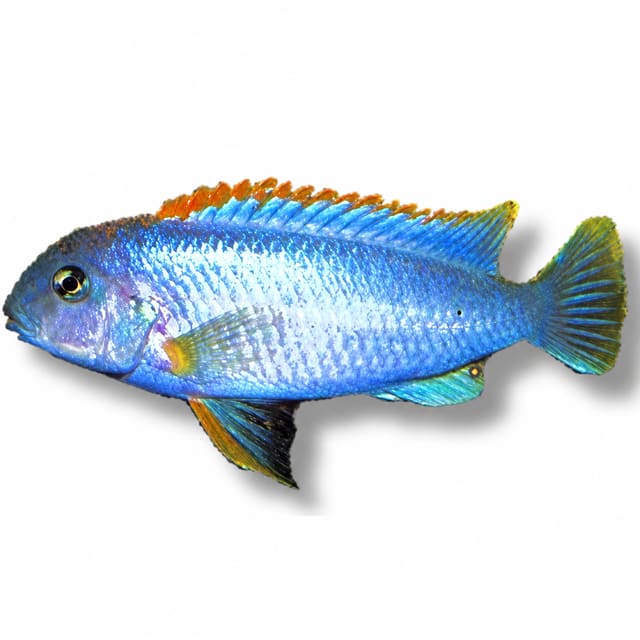
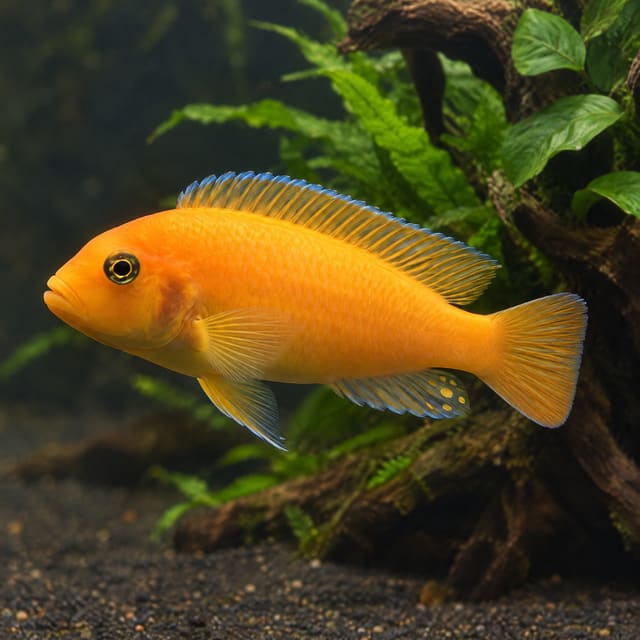
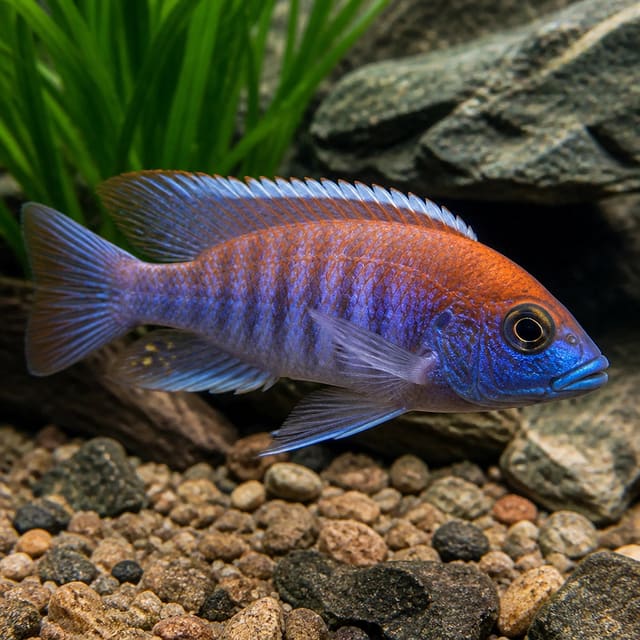
For research, compare the Coral Red Saulosi mbuna, Red Fin Cichlid, Blue OB Masinje Zebra mbuna and Pulpican mbuna. These are comparison links, not automatic Demasoni tank-mate endorsements. Their pages, colour patterns and adult requirements must be assessed independently.
The natural feeding evidence is more precise than calling the species simply herbivorous. The 2016 revision says members of Chindongo feed mainly on aufwuchs, biting loose material such as diatoms and cyanobacteria from the algal matrix growing on rocks. Aufwuchs is a complex living surface, not just a sheet of vegetable matter, so “strict herbivore” is an oversimplification.
In the aquarium, use a reputable, appropriately sized, plant-led complete mbuna flake or pellet as the staple. Spirulina or other algae ingredients can be part of that formula. Offer small portions that are consumed promptly and make sure subordinate fish can reach food. Grazing behaviour continues between meals, but visible algae is not a complete diet and an algae wafer designed for another animal is not automatically balanced for Demasoni.
Rich animal-heavy foods should not dominate the routine. At the same time, this page does not claim that one protein percentage directly causes Malawi bloat or that a particular packet prevents disease. Digestive problems are multifactorial and can involve diet, stress, water quality, infection and social exclusion. Persistent swelling, abnormal waste or appetite loss needs investigation rather than a keyword diagnosis.
| Food decision | Good practice | Avoid |
|---|---|---|
| Staple | Complete plant-led prepared food labelled for mbuna and appropriate to the fish's mouth size | Using one occasional food as the entire diet |
| Portion | Small observed feeds distributed so less dominant fish can eat | Adding a large amount and assuming all fish received an equal share |
| Natural grazing | Provide mature safe rock surfaces as behavioural enrichment | Expecting the fish to live on nuisance algae or clean the aquarium |
| Animal material | Keep supplementary choices restrained and consistent with a balanced mbuna plan | Routine rich mammalian meat or an animal-heavy staple |
| Health claims | Use food as nutrition and monitor condition | Presenting food as a cure or guaranteed prevention for bloat |
Remove repeated leftovers and review the amount before adding more. Overfeeding raises waste and can obscure whether every fish is feeding. Underfeeding a bullied fish is also possible even when the aquarium receives plenty of food, so observe individuals rather than judging only by the amount that disappears.
Prepare the mature receiving aquarium before dispatch. Confirm temperature and chemistry, inspect rock stability, decide where the new fish can retreat, and have a separate cycled holding option ready. Introducing the fish and redesigning the whole tank after aggression begins is slower and more stressful than planning first.
On arrival, follow the current instructions supplied with the livestock and use the acclimation timer as an aid to timing, not as a replacement for those instructions. Keep transport water out of the display where directed, minimise chasing and do not prolong the process merely to hit a generic internet duration. The correct method depends on the shipment guidance and the difference between transport and tank conditions.
Dim lighting and an appropriate rockwork rearrangement can reduce immediate territorial certainty in some established mbuna systems, but neither guarantees acceptance. Watch continuously through the initial introduction and return at frequent intervals. Normal display and brief chasing are different from one fish being pinned, bitten repeatedly or denied all access to food and shelter.
A quarantine or observation system can be valuable when it is mature, correctly matched and large enough for the fish. An uncycled small container may create more immediate danger than it prevents. This listing does not prescribe a universal number of quarantine days or recommend preventive medication without a diagnosis.
Demasoni are maternal mouthbrooders. During spawning, the female takes fertilised eggs into her mouth and carries the developing brood. A holding female may eat less and use quieter areas, but appetite loss can have other causes; behaviour should be assessed in the context of the whole group and water results.
Breeding is not labelled easy on this page. Spawning behaviour may occur readily in mature fish, but sexing, male pressure, protection of holding females, fry survival and management of early aggression make the complete process demanding. Buying two fish does not create a breeding pair, and buying a fixed group does not guarantee a safe ratio.
Before attempting a breeding project, plan where a pressured female can be protected, where fry will be raised, how their water will remain stable and how growing juveniles will be separated if aggression develops. Do not strip a holding female or move her repeatedly without experience; disturbance can cause brood loss or injury.
Male and female colour is similar, so breeding plans should not rely on the brightest fish automatically being male. If sex-specific stock is essential, contact the team to ask what can actually be confirmed. Standard size options on this page remain unsexed unless the live offer explicitly states otherwise.
A settled fish should move purposefully around rockwork, show coordinated swimming, respond to food and maintain an even body profile. Fins should not remain tightly clamped, and breathing should not stay unusually rapid at rest. Colour alone is a weak health test because social status, lighting, background and stress all affect how dark or bright the bars appear.
Warning signs include persistent isolation, inability to leave one corner, repeated bite damage, failure to feed, swelling, a hollow abdomen, abnormal buoyancy, flashing or laboured breathing. These signs are not one diagnosis. First check temperature, ammonia, nitrite, recent changes and visible aggression; then seek species-appropriate veterinary or experienced specialist help where the cause remains unclear.
Do not add a general medication, salt or diet change simply because a search result associates Demasoni with one disease. Treatment depends on the cause, and some products affect filtration or other residents. Separate a fish from immediate physical attack when necessary, but keep the emergency system heated, oxygenated and biologically safe.
A fish can look vividly coloured while dominating the aquarium, and a subordinate healthy fish can look pale under pressure. Judge breathing, feeding, posture, damage, location and water results together.
Demasoni is often chosen for its compact body and exceptional blue-and-dark barring. Compared with many larger mbuna, it uses less body length but not necessarily less behavioural space. It is also unusually risky to combine casually with close visual lookalikes. The right alternative depends on whether the keeper values colour, a species-focused group, a mixed display or a less confrontational social plan.
| Decision point | Demasoni | What to compare in another mbuna |
|---|---|---|
| Adult scale | Compact; about 8 cm total aquarium length is commonly cited | Do not equate a larger fish with automatically greater aggression. |
| Pattern | Blue with dark vertical bars in both sexes | Similar barring may provoke rivalry rather than create a coordinated display. |
| Social challenge | Strong intraspecific territorial aggression | Compare actual species behaviour, not only a generic “semi-aggressive” label. |
| Diet | Aufwuchs-focused, plant-led mbuna feeding plan | Mixed tanks must allow every species to receive an appropriate staple. |
| Best use | Purpose-designed experienced Malawi setup | Choose according to footprint, current residents and intervention capacity. |
The Coral Red Saulosi page offers a same-genus comparison, while Red Fin, Blue OB Masinje Zebra and Pulpican show other mbuna forms. Do not infer that close taxonomy means easy coexistence. A related or similarly sized species may compete for the same rock zone, and a different colour may reduce one trigger without removing territorial behaviour.
If the aquarium is still at the broad planning stage, browse the freshwater fish guide and buying live tropical fish online guide before choosing from product tiles. A good purchase is one that fits a documented system, not simply the fish with the strongest photograph.
| Check | Ready means |
|---|---|
| Tank maturity | The aquarium is cycled, stable and processing the existing bioload with measured results. |
| Footprint | A long aquarium around 120 cm / 4 ft is the practical starting point, with adult stocking considered. |
| Water | Hard alkaline conditions around 24–26°C and pH 7.5–8.5 can be maintained consistently. |
| Rockwork | Structures are secure, sightlines are broken and routes remain accessible for inspection. |
| Residents | Every fish has been checked for water, diet, colour-pattern and territorial compatibility. |
| Group plan | The number ordered is part of a considered social plan, not a universal formula copied from a forum. |
| Food | An appropriately sized plant-led complete mbuna staple is available. |
| Contingency | A heated, filtered and cycled separation option is available if an introduction fails. |
Choose the sale size only after those checks. A larger fish is not automatically safer, and a smaller juvenile does not postpone the need for adult space. If the current tank contains peaceful community fish, similar blue-barred mbuna or uncertain water conditions, resolve that conflict before placing the order.
If a detail about the live XL grade, sex, current provenance or compatibility with a named resident affects the purchase, use the contact page before checkout. A specific unanswered question is a reason to pause, not a reason to treat an SEO paragraph as a guarantee.
Current price, stock and available delivery choices are shown by the live product page and checkout. Review the live-fish delivery information before ordering, including service areas, dispatch timing, weather-related changes and what someone must do at the address. Do not choose a livestock delivery day when the parcel may be left unattended.
Eligible livestock orders are covered by the Live Arrival Guarantee under the current terms. Follow the arrival and evidence steps on the delivery policy if a problem occurs; keeping the packaging and taking prompt clear photographs can be important. The guarantee is not a promise that a fish will suit an incompatible aquarium after delivery.
For a wrong item, damaged non-living goods or another order issue, review the returns and problem-reporting information. Live animals have time-sensitive welfare and evidence requirements, so do not delay a report while waiting for a general return window.
Yes. They are highly territorial mbuna and can show severe aggression towards their own kind or similar-looking fish. Rockwork, sight breaks and a planned social structure reduce some pressure but do not guarantee harmony.
FishBase records 6.3 cm standard length, which excludes the tail fin. Specialist aquarium guidance commonly describes about 8 cm total length. Plan the aquarium for adult behaviour rather than body length alone.
A long aquarium around 120 cm / 4 ft is a practical starting point. A universal litre number is less useful because footprint, rockwork, stocking and filtration change the usable space and bioload.
No. Tetras, rasboras, livebearers, shrimp and other peaceful or delicate residents are not appropriate companions. A Demasoni community means a carefully designed Lake Malawi cichlid system, not a typical mixed tropical aquarium.
Potential companions must share hard alkaline Malawi water, withstand an assertive mbuna environment and avoid close blue-barred resemblance. Even robust differently coloured mbuna need case-by-case assessment; there is no guaranteed list.
There is no universal safe number. Larger groups are sometimes used to distribute aggression, but group size must be designed around footprint, sex ratio, rockwork, filtration, existing residents and the ability to separate a targeted fish. “12+” is not a guarantee.
The standard size options are not sex guaranteed. Males and females have similar colour, especially when young, and ordering two fish does not create a bonded or behaviourally safe pair.
Yes. Pseudotropheus demasoni is the original historical combination; the current accepted name is Chindongo demasoni. Both names remain useful for identifying older care material and trade listings.
It is compact compared with many cichlids and is often called a dwarf mbuna. The label describes body size, not temperament or tank suitability. It is not a nano fish.
Specialist aquarium guidance gives 24–26°C. Match the established aquarium and acclimation instructions rather than making a rapid temperature change just to reach a number.
Use stable hard alkaline water, with pH 7.5–8.5 as practical maintained guidance. Test source water and create a repeatable method rather than repeatedly correcting pH with abrupt doses.
Use a complete, appropriately sized, plant-led mbuna food as the staple. The genus naturally grazes aufwuchs, a complex algal surface containing diatoms and cyanobacteria, so “strict herbivore” is less accurate than aufwuchs-focused.
A rich animal-heavy diet should not be the routine staple. However, one protein percentage does not by itself diagnose or cause every digestive problem. Use a balanced mbuna diet and investigate water, stress and illness if symptoms appear.
They are maternal mouthbrooders and may spawn in aquariums, but complete breeding management is not necessarily easy. Aggression, sexing, protection of holding females, fry space and juvenile social behaviour all require planning.
Social pressure, recent transport, water conditions, illness and lighting can all affect behaviour or colour. Test the aquarium, inspect interactions and assess breathing, feeding and damage together rather than diagnosing from colour alone.
They graze rock-associated aufwuchs, but they are not an aquarium-cleaning service and visible algae is not a complete diet. Maintenance and a balanced prepared food remain necessary.
No. Reference images are not the individual fish received. The size selector defines the offered grade; colour intensity and pattern vary between individuals and with conditions.
Eligible livestock orders are covered under the current Live Arrival Guarantee terms. Read the delivery page before ordering and follow its arrival, timing and evidence steps if there is a problem.
This listing separates taxonomic evidence, species-database facts and practical aquarium guidance. The accepted name, original combination and type locality come from Eschmeyer's Catalog of Fishes. The genus transfer, vertical-bar diagnosis and aufwuchs feeding context come from the peer-reviewed 2016 revision. FishBase supplies the standard-length and conservation records. The four-foot aquarium, maintained water range and practical aggression guidance are attributed to a specialist aquarium profile rather than presented as universal scientific constants.
Reviewed 21 July 2026. The page does not invent a lifespan, fixed minimum group, guaranteed sex ratio, disease cure, exact XL measurement or captive-bred status. Current stock, price, discounts, dispatch choices and guarantee eligibility remain dynamic. The physical livestock received, the live option selected and the current checkout terms remain the transaction authority.
For help with the order process or a species-specific question not answered here, use the help and FAQ page or contact the team before purchase. Advice can clarify the listing, but the keeper remains responsible for providing a suitable mature aquarium and monitoring the fish after introduction.
No reviews for this item yet. Bought one? Honest reviews only, good or bad.
What customers say about ordering from us
I have a small group of long finned mountain minnows. So was delighted to be able to order ten of this variety to increase the genetics in my tank . The ones I recieved are healthy but it’s to early to give a verdict on wether they are of a long finned type since they are small currently.
Gordon Walker · 23 Sept 2026
100% success travel and "installation". Pleased with quality of purchase. The Siamese fighter a bit "shy" so have not yet seen him at his best yet but looking good. Happy customer. GG
George E Garratt · 21 Sept 2026
Reviews of our shop, collected by Judge.me, an independent third-party review collector. Newest first.