Advanced
Mpanga Elongatus Mbuna (Pseudotropheus elongatus)
24–27°C · pH 8–8.6 · 137L
From £12.03Some sizes on sale

The elongate mbuna, Chindongo elongatus, is a slim, blue-and-black barred rock cichlid from Lake Malawi. It needs hard, alkaline water at 24-28°C, a rock-built tank of 200 litres or more and a vegetable-rich diet. Each unit is one fish; sex and size are not specified.
Adult size is the maximum length this species reaches at full maturity (scientific sources). The livestock you receive will be younger and smaller. Product-photo provenance and any image-specific limitations are stated on the listing.
Chindongo elongatus
Save when buying multiple fish. Each quantity is one fish; sex and pair formation are not guaranteed unless the selected variant explicitly states them.
The elongate mbuna, Chindongo elongatus, is a slim, blue-and-black barred rock cichlid from Lake Malawi. It needs hard, alkaline water at 24-28°C, a rock-built tank of 200 litres or more and a vegetable-rich diet. Each unit is one fish; sex and size are not specified.
Adult size is the maximum length this species reaches at full maturity (scientific sources). The livestock you receive will be younger and smaller. Product-photo provenance and any image-specific limitations are stated on the listing.
Cichlids are a family of roughly 1,800 accepted species, not one care type. Before buying, identify the exact species and source, then compare adult measurement, usable tank dimensions, social system, territory, tested water, diet and an exit plan. No family-wide minimum tank, water range or tank-mate list is safe.
Maintain these water conditions for optimal health and vibrant colors
The elongate mbuna, Chindongo elongatus, is a small, slim rock-dweller from Lake Malawi and one of the more forceful characters you can put in a Malawi tank. Fryer described it in 1956 as Pseudotropheus elongatus, and most older books and forum threads still use that name. In 2016 Li, Konings and Stauffer revised the slender “elongatus” mbuna and moved this species into a new genus, Chindongo, a name they took from the local Malawian word for small, rock-dwelling fish. You will also see it called the slender mbuna in shops.
FishBase gives a maximum size of 9.5 cm standard length. Standard length runs from the snout to the base of the tail, so a full-grown fish looks a little longer than that figure once you add the tail fin. Seriously Fish quotes a larger maximum of 13.5 cm, and we set out how to read that difference in the tank section below. Either way, this is a small cichlid by Malawi standards, but small does not mean mild.
Each unit on this listing is one fish. The listing has a single option and does not state a sex or a size, so we promise neither. If you order several, you are buying several individual fish, not a sexed pair and not a ready-made harem. That matters more with this species than with most. Seriously Fish advises keeping one male with at least four to six females, and the differences it describes between the sexes are adult ones: males are usually larger and have brighter egg spots on the anal fin. Young fish are not easy to sort by eye, so plan for the ratio to settle out as your group matures. The stocking section explains how.
It suits someone who already enjoys mbuna, or someone building a Malawi rock tank from scratch who wants a fish with real presence. It does not suit a peaceful mixed community, a soft-water planted tank or a small aquarium. Seriously Fish describes it as one of the most aggressive and territorial mbuna, and the way to enjoy it is to build the whole tank around that fact rather than hope it mellows with age.
The rest of this guide follows the order we would talk you through it across the counter: how to recognise the fish, where it lives in the wild, the tank, the water, the food, temperament and tank mates, breeding, health, and what to do on the day it arrives. Every figure comes from the sources listed at the end, so you can check them yourself.
The clue is in the name. Next to the deeper-bodied mbuna most people meet first, the elongate mbuna is long and narrow, shaped for slipping between stones. The 2016 revision makes an important point here: a slender body evolved more than once among Malawi mbuna, and the authors suggest that small size and dark colouring are adaptations for life in small crevices between rocks. So a slim outline on its own does not prove a fish is this species; plenty of unrelated mbuna share it.
What marks out the genus Chindongo, according to the scientists who named it, is a combination of features:
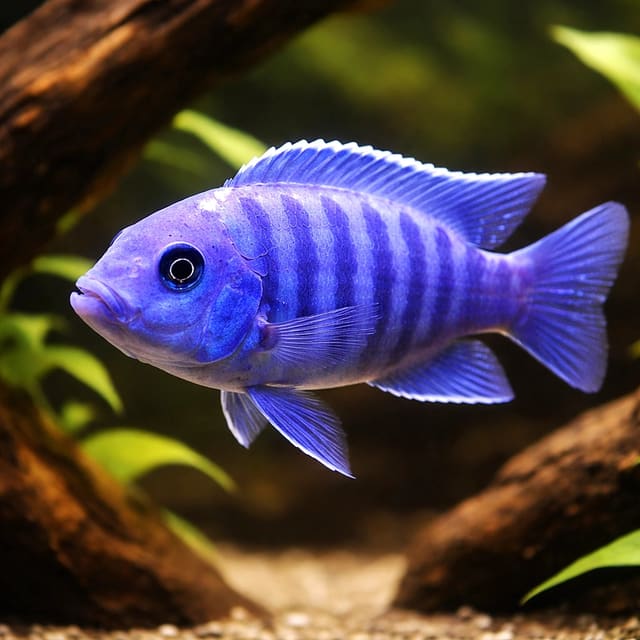
For C. elongatus itself, the revision notes that both males and females carry bars along the full length of the flank and onto the caudal peduncle, the narrow section just in front of the tail. That complete barring is one of the features used to tell it apart from its close relative Chindongo bellicosus, whose bars are missing from the rear half of the body.
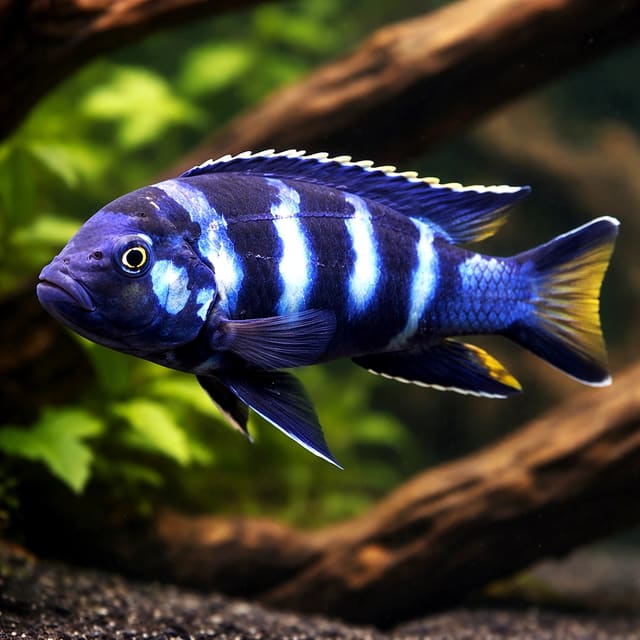
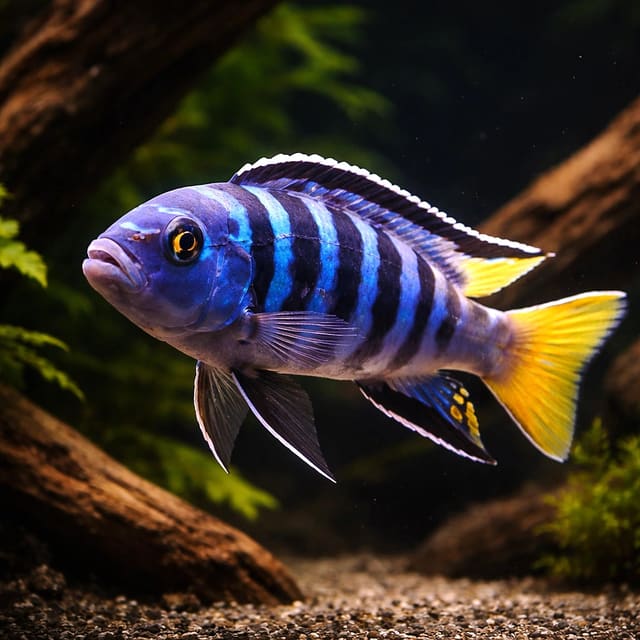
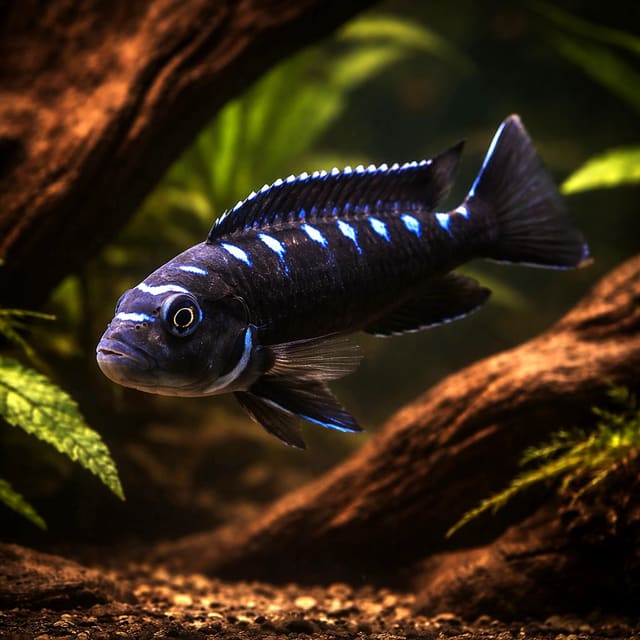
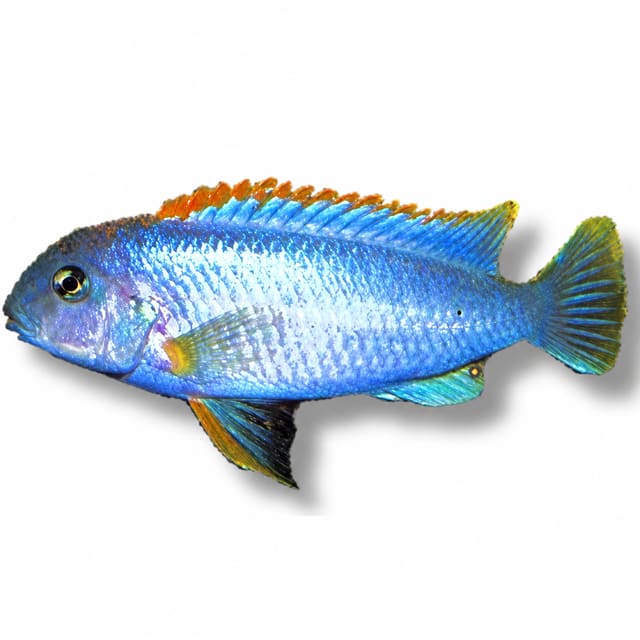
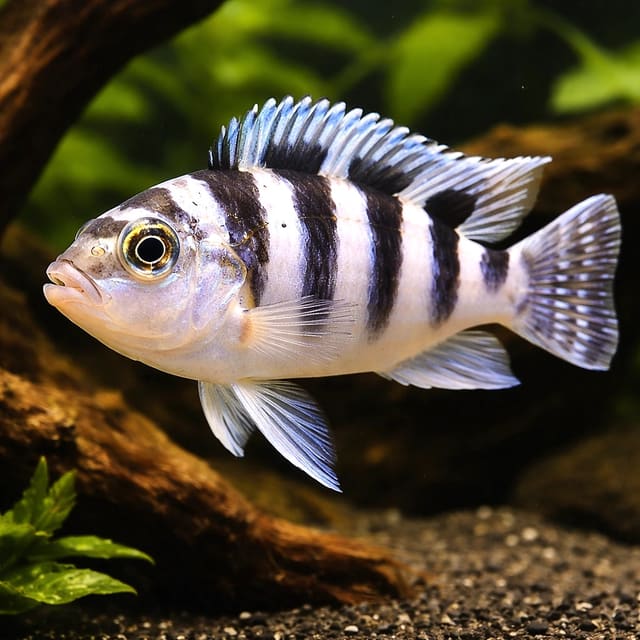
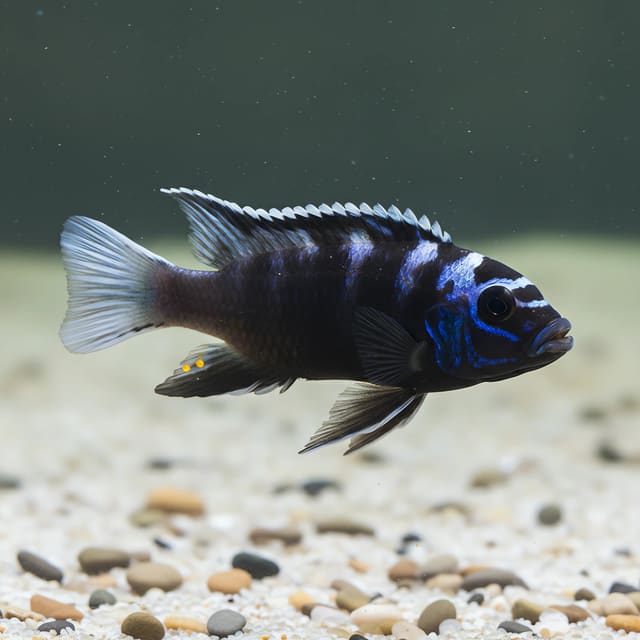
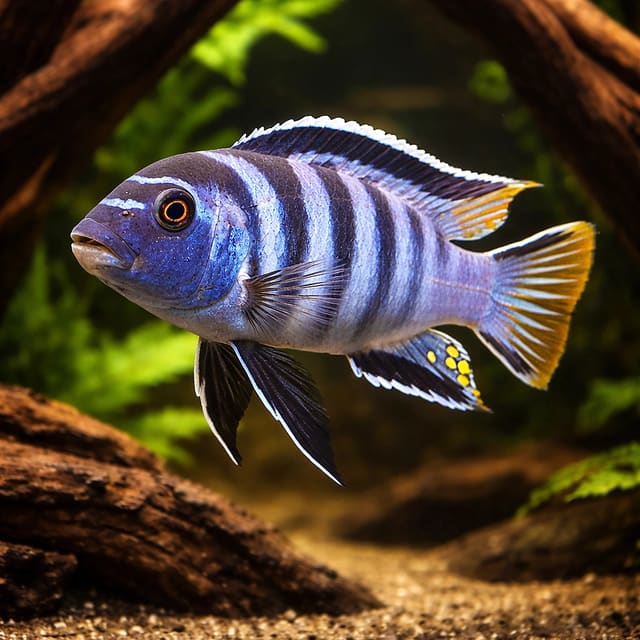
The fish in our photo has the look most buyers are after: a bright blue body crossed by broad black bars from behind the head to the tail, a blue-and-black dorsal fin, yellow egg spots on the anal fin and yellowish edging on the tail. A photo shows one fish on one day, though. Seriously Fish describes a breeding male showing intense colour as he displays at his chosen site, so expect colour to change with what a fish is doing and how settled it is. Fish that have not finished growing will not yet look like a confident adult.
This is the part that catches people out. For decades “elongatus” was applied to a whole crowd of slim mbuna from around the lake. Seriously Fish records over 30 different forms and warns that they should not be mixed in the aquarium because they hybridise freely. The 2016 revision showed that the old elongatus group was not a single natural group at all: several forms went into Metriaclima, Tropheops and Cynotilapia, and new species were described from them.
We list other fish under the elongatus name, such as the Mpanga elongatus mbuna and the Chewere elongatus mbuna. They are good fish in their own right, but each form belongs in its own tank. Put two of them together and you risk fry nobody can name.
Within the genus, this fish's relatives include the saulosi mbuna (Chindongo saulosi) and the powder blue cichlid (Chindongo socolofi), both moved out of Pseudotropheus in the same paper. Being related does not make them easy company. The revision says most Chindongo species defend their feeding patches aggressively, and Seriously Fish advises against keeping this species with mbuna that resemble it in pattern, and barred relatives are the obvious look-alikes.
Lake Malawi is also known as Lake Nyasa, the name given in the scientific record of the specimen that anchors this species' name. The rock-dwelling cichlids that live along its stony shores are called mbuna, and the elongate mbuna is found nowhere else. The specimens used to describe it came from Mbamba Bay on the Tanzanian shore. Seriously Fish also records it from Nkata Bay, and FishBase places its range between 11 and 12 degrees south.
The descriptions of its habitat agree closely. FishBase and Seriously Fish both describe shallow, rocky areas with little or no sediment, where the fish is commonly found in association with small rocks. Picture clean stones in shallow water, each one coated in a film of algae and the tiny organisms living in it. Fishkeepers call that coating aufwuchs, and it is the elongate mbuna's larder.
FishBase describes the feeding method in one line: the fish combs loose algae from the biocover. The 2016 revision adds detail for the genus as a whole. Chindongo species bite into the algal mat and pull out the loose material, mainly diatoms and cyanobacteria, feeding at an angle to the rock rather than straight on. They favour patches of lush growth, where every bite is worth the effort, and most species defend those patches aggressively as so-called algal gardens. The temperament that surprises new keepers is the same behaviour that keeps a wild fish fed: a rich patch of algae is worth fighting for, and a rival that looks like you is the biggest threat to it.
The species has conservation status worth knowing about. FishBase and Wikipedia both record an IUCN Red List assessment of Near Threatened, made in 2018. That is one more reason to keep each elongatus form separate in the aquarium rather than producing crosses, and a reminder that this fish comes from a particular stretch of one lake, not from a widespread, adaptable population.
Seriously Fish gives a minimum tank base of 120 × 38 cm, which works out at roughly 137 litres. Our own care figure is higher, at 200 litres, and that is the size we would plan around. The reason is the stocking advice: one male with at least four to six females, ideally alongside other mbuna to spread his attention. Six or seven territorial fish need floor space, and a tank of 120 cm or longer holding 200 litres or more gives you far more room to arrange rock and break sight lines than a short, tall tank of the same volume. Length and footprint matter more than height for a fish that lives among stones.
The sources disagree on maximum size. FishBase and Wikipedia give 9.5 cm standard length; Seriously Fish lists 13.5 cm standard length. The 2016 revision notes that most members of the old elongatus group are small fish under 10 cm standard length, and the specimen chosen to fix the name, a male, measured 65.9 mm standard length. We use the FishBase figure as the adult size on this listing, but we would plan the tank for the larger end, because a fish that turns out bigger than expected is easy to live with in a roomy tank and a problem in a cramped one.
Seriously Fish's advice is short and exact: use piles of rocks to form cave-like structures and hiding places, and leave areas of open water for swimming. Two or three separate rock piles usually work better than one solid wall along the back glass, because a dominant male cannot watch the whole tank from a single spot and a chased female always has somewhere else to go. Give caves more than one way out. Mix plenty of fist-sized stones in with the larger pieces; the wild fish is commonly found around small rocks, and lots of small stones create lots of small territories.
Stand the rock directly on the glass base and pour the sand in around it afterwards, so that nothing heavy rests on a layer that can shift. Check that every stack is stable before you fill the tank. Smooth-edged rock is kinder than sharp, jagged pieces in a tank where fish chase each other at speed.
Seriously Fish says a sand substrate is preferable. A few centimetres of fine sand is plenty and easy to keep clean around the base of the rocks. Plants are optional and not part of this fish's natural setting. If you want some greenery, use tough plants fixed to rock or kept in pots, and accept that stone and algae are the real decoration in a mbuna tank.
Lighting that keeps a film of algae growing on the upper faces of the rocks is useful, since the fish will graze it between meals. You do not need strong planted-tank lighting. A steady daily light period on a timer helps keep algae growth predictable.
A busy rock tank with a vegetable-fed group of active fish produces a lot of waste, and the overcrowding approach described in the stocking section only works with generous filtration. Choose a filter rated well above your tank volume, with plenty of room for biological media, and make sure you can reach the intake and the sand between rock piles for cleaning. A heater with a thermostat and a separate thermometer you can read at a glance complete the basic kit.
Lake Malawi fish need hard, alkaline water, and this one is no exception. The table shows the figures we use on this listing alongside what each source gives, so you can see where they agree and where they differ.
| Parameter | Our care figure | FishBase | Seriously Fish |
|---|---|---|---|
| Temperature | 24-28°C | 22-25°C | 24-28°C |
| pH | 7.5-8.5 | 7.5-8.0 | 7.6-8.8 |
| General hardness | 10-20 dGH | 9-19 dH | 10-25 dGH |
FishBase's temperature range is cooler than the aquarium range Seriously Fish gives. We use the Seriously Fish range of 24-28°C, which is the normal aquarium range for this species, and we suggest keeping your heater somewhere in the middle of it rather than at either edge. For breeding, Seriously Fish suggests 25-26.5°C and a pH of around 8.2-8.5, which sits comfortably inside the general ranges and makes a sensible everyday target too.
UK tap water varies a great deal from one region to the next, so test what comes out of your own tap before you decide whether you need to do anything to it. Check pH and general hardness, and carbonate hardness if your kit measures it. If your water already sits in the ranges above, keep things simple and use it with a dechlorinator. If it is soft, products made to raise hardness and pH for Rift Lake aquariums are available; follow the maker's dosing and prepare every batch of change water the same way, so that each water change matches the tank rather than jolting it.
Steady water is better than water that is nudged up and down every few days. Pick a target inside the ranges, reach it, and hold it. The real enemies are the invisible ones: ammonia and nitrite from an immature filter or an overloaded tank.
OATA, the UK ornamental fish trade association, recommends testing at least once a week for ammonia, nitrite, nitrate and pH, with ammonia and nitrite at zero. It suggests partial water changes of up to 25% every week using water treated with dechlorinator and brought to the right temperature, and regular temperature checks. In a crowded mbuna tank that weekly routine is not optional; it is what makes the overcrowding approach safe.
OATA also explains how to tell when a new tank is ready: the maturing period is complete once ammonia and nitrite have dropped to zero and stay at zero. Do not shortcut that stage. Territorial fish placed in an immature tank face poor water and each other at the same time, which is a hard start for any fish.
Get the diet right and most of the elongate mbuna's care falls into place. In the wild it is a grazer: FishBase says it combs loose algae from the biocover on rocks, and the 2016 revision describes Chindongo species extracting diatoms and cyanobacteria from the algal mat by biting. That is a diet built on algae and the microscopic life within it, not on meaty food.
Seriously Fish says the species will accept most foods offered, but that vegetable matter, such as spirulina flake, blanched spinach and nori, should form a large proportion of the diet. In practice that means a good spirulina-based flake or small sinking pellet as the everyday food, with blanched spinach or a strip of nori clipped to a rock as a grazing treat. Remove any uneaten greens before they start to break down.
Seriously Fish says the vegetable diet can be supplemented with live and frozen foods, and for breeding it recommends conditioning the fish with plenty of live and frozen food. Use these as a supplement, not the main menu.
Seriously Fish is blunt about this: never feed beefheart or any other red meat, as it interferes with the digestive system of these fish. Keep red meat and other rich, fatty foods off the menu altogether.
Feed small amounts that the group clears quickly, rather than one large meal. Scatter food across the surface so it drifts down over several territories at once; if you drop it in one spot, the dominant male will own that spot and the subordinate fish will go short. Watch who is eating. A fish that hangs back at feeding time is either low in the pecking order, unwell or, if it is a female with a swollen throat, holding eggs. Seriously Fish notes that a holding female will not eat during brooding, so do not worry if a brooding female ignores food for a while.
Leave the algae on the rockwork. It gives the fish something to graze between meals, as they would in the lake, and it means a missed feed now and again is no hardship.
| Food | Role | Notes |
|---|---|---|
| Spirulina flake or small vegetable pellet | Daily staple | Small portions, cleared quickly |
| Blanched spinach, nori | Grazing extra | Clip to a rock; remove leftovers |
| Live and frozen foods | Supplement and breeding conditioning | Occasional, never the main diet |
| Algae on the rockwork | Natural grazing | Do not scrub every surface clean |
| Beefheart and other red meat | Leave out | Interferes with digestion, per Seriously Fish |
Let us be plain about this fish's temper, because it decides everything else. Seriously Fish calls it one of the most aggressive and territorial mbuna. It describes the species as incredibly aggressive towards others of its own kind, and warns that a very large tank is needed to keep more than one male, and that even then the subdominant males are likely to be killed. Its stocking advice is at least four to six females per male, for the females' own safety.
The logic is simple. With one female, she takes all of a territorial male's attention. With five or six, his drive is shared out and no single fish is chased all day. Seriously Fish also notes that the presence of other species helps to dissipate aggression, which is why a mixed mbuna tank can be easier to run than a single-species one, outside a breeding set-up.
Because this listing does not specify sex, think about the ratio before you order rather than after. Two approaches work:
Seriously Fish says the tank should be overcrowded to reduce aggression and territory formation. The idea is that with many fish in the tank, aggression is spread across many targets and fewer fixed territories form. It only works with the filtration and weekly water changes described above. Overcrowding without that maintenance simply produces poor water and stressed fish.
Seriously Fish says this species can be combined with other mbuna, provided they do not resemble it in patterning. In practice, look for robust Lake Malawi rock-dwellers that need the same hard, alkaline water and that look clearly different: different ground colour, different markings. Avoid fish that share its blue body and black vertical bars. The 2016 revision describes Chindongo demasoni as blue with black bars, for example, which makes it exactly the sort of look-alike to leave out.
Some chasing is normal in a mbuna tank. What you are watching for is one fish being singled out: torn fins, a fish hiding at the surface or in a corner all day, or a fish that never reaches food. If that happens, add more rock and sight breaks, rehome the aggressor or the victim, or change the stocking balance. With a fish this aggressive, waiting for it to sort itself out is a gamble.
Seriously Fish describes breeding as possible but not easy. The species is a maternal mouthbrooder, which means the female carries the eggs and young fry in her mouth, and FishBase records up to 37 eggs per spawning. Seriously Fish recommends spawning it in a species tank, with one male and at least four to six females, in a tank of 48 inches (about 120 cm) or larger, furnished with rock as described above plus some flat stones and patches of open sand as potential spawning sites. It stresses plenty of hiding places, because the male may kill females that are not ready to spawn.
For spawning, Seriously Fish suggests a pH of around 8.2-8.5 and a temperature of 25-26.5°C, and conditioning the fish with plenty of live and frozen foods. Keep the vegetable staple going alongside; conditioning is a boost, not a change of diet.
The male cleans a spawning site and displays around it in intense colour, trying to draw females in. Seriously Fish describes him as very aggressive in this pursuit, which is the whole reason for the harem. When a female is ready, she approaches the site, lays her eggs there and picks them up in her mouth. The male has egg-shaped spots on his anal fin; the female is attracted to them, and when she tries to add them to the brood in her mouth she takes in milt from the male, which fertilises the eggs.
Seriously Fish says the female carries the eggs for around three to four weeks before releasing free-swimming fry. She will not eat during this period, and she is easy to spot by her distended mouth. Stress is the main risk: an overly stressed female may spit out the brood early or eat it. Seriously Fish recommends removing holding females, because the male will usually not leave them alone, but warns that any move must be done carefully. Some breeders strip the fry from the mother's mouth at around two weeks and raise them separately, which usually results in more fry.
The fry are large enough to take brine shrimp nauplii straight away, according to Seriously Fish. If they are left with the mother, she will actively protect them for a few days, after which they are allowed to stay in her territory. A separate rearing tank with the same water chemistry as the main tank is a practical way to raise a good number.
Because the elongatus forms hybridise freely, a breeding tank should hold one form only. If you plan to pass young fish on to other keepers, they will want to know exactly what the parents were.
Most health problems in elongate mbuna come from three places: water quality, diet and other fish. Get those right and you will rarely need medication.
OATA lists the signs of a healthy fish as clear, bright eyes, undamaged fins, intact scales, no ulcers or bumps, appropriate swimming behaviour and steady breathing. For an elongate mbuna, add a good appetite. A fish that hides all day, hangs at the surface or stops eating needs a closer look.
This is the most likely problem with this species. Seriously Fish warns that subdominant males are likely to be killed in all but very large tanks, and that the male may kill females that are not ready to spawn. Torn fins, missing scales and a fish that is always hiding are early warnings. Act on them quickly by changing the stocking or the layout, as described in the tank mates section.
Seriously Fish warns that beefheart and other red meat interfere with the digestive system of these fish. Keep the diet vegetable-based, feed small amounts and remove uneaten food. A fish that stops eating and is not a holding female should prompt you to test the water and think about what it has been fed.
When anything looks wrong, test first. OATA's guidance is that ammonia and nitrite should be zero. If either reading is above zero, or nitrate has crept up, a partial water change with matched, dechlorinated water is the first step, before any treatment.
Do not mistake a brooding female for a sick fish. Seriously Fish notes that she will not eat while carrying eggs and is easy to recognise by her distended mouth. Give her peace; stressing her can make her spit or eat the brood.
If you already have an established mbuna tank, a separate quarantine tank for new arrivals is worth having. It lets you watch the newcomer feed and settle for a few weeks before it faces territorial residents, and it keeps any problem away from your main display. It doubles as a refuge for a bullied fish or a holding female.
Please read our delivery and live-arrival information before you order. Your fish travels in an oxygen-filled bag inside insulated packaging, with heat packs when conditions call for them, via a tracked courier licensed to carry live animals. We email you the confirmed delivery date and tracking details.
Start a continuous video while the parcel is still sealed, open it in the same take and show the fish in its still-sealed bag. If a fish arrives dead, dying or clearly compromised, email hello@tropicalfishco.co.uk on the day of delivery with your order number and that video. Photos alone do not meet the policy. The resolution is a replacement with your next order or a refund for the affected fish, subject to the guarantee terms.
Keep the lights low for the rest of the first day and watch breathing, appetite and behaviour over the first week. Offer a small amount of the vegetable staple the next day and see who eats. Do not judge colour on the first day or two; give the newcomer time among the rocks first. Watch how the residents treat it, especially any male already established in the tank, and be ready with a refuge or quarantine tank if one fish is singled out. Keep up the weekly testing and water changes from the start.
These are the sources behind the figures in this guide:
No reviews for this item yet. Bought one? Honest reviews only, good or bad.
What customers say about ordering from us
I have a small group of long finned mountain minnows. So was delighted to be able to order ten of this variety to increase the genetics in my tank . The ones I recieved are healthy but it’s to early to give a verdict on wether they are of a long finned type since they are small currently.
Gordon Walker · 23 Sept 2026
100% success travel and "installation". Pleased with quality of purchase. The Siamese fighter a bit "shy" so have not yet seen him at his best yet but looking good. Happy customer. GG
George E Garratt · 21 Sept 2026
Reviews of our shop, collected by Judge.me, an independent third-party review collector. Newest first.