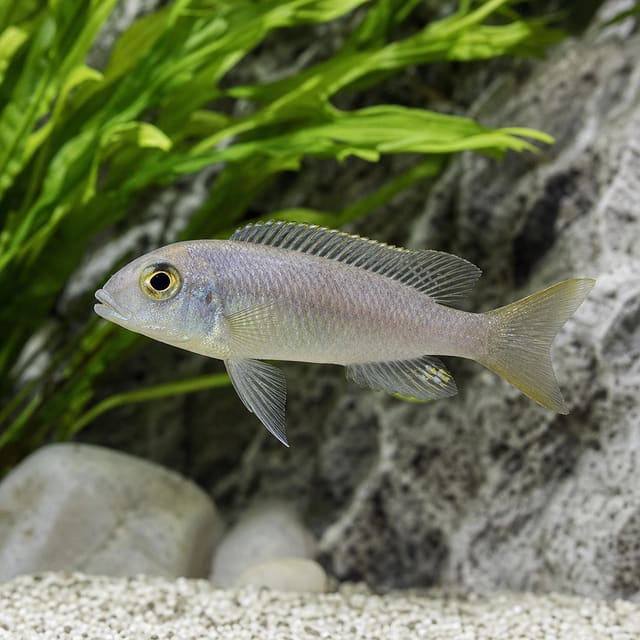
Taeniolethrinops furcicauda
23–27°C · pH 8–8.6
£45.99

The Powder Blue Cichlid (Chindongo socolofi) is a Lake Malawi mbuna that reaches a recorded 6.7 cm standard length. It suits a planned rocky aquarium; the FishBase, Seriously Fish and OATA overlap is 24–26°C, while Seriously Fish and OATA overlap at pH 8.0–8.6 and 12–18 dGH. Sold individually in 4–5 cm, 6–7 cm, 7–9 cm and 9–10 cm sizes.
Adult size is the maximum length this species reaches at full maturity (scientific sources). The livestock you receive will be younger and smaller — pick a size variant above for the actual shipping size. Product-photo provenance and any image-specific limitations are stated on the listing.
Chindongo socolofi
Powder Blue Cichlid are a shoaling species — they need 6+ to feel safe and show their full colour.
The Powder Blue Cichlid (Chindongo socolofi) is a Lake Malawi mbuna that reaches a recorded 6.7 cm standard length. It suits a planned rocky aquarium; the FishBase, Seriously Fish and OATA overlap is 24–26°C, while Seriously Fish and OATA overlap at pH 8.0–8.6 and 12–18 dGH. Sold individually in 4–5 cm, 6–7 cm, 7–9 cm and 9–10 cm sizes.
Adult size is the maximum length this species reaches at full maturity (scientific sources). The livestock you receive will be younger and smaller — pick a size variant above for the actual shipping size. Product-photo provenance and any image-specific limitations are stated on the listing.
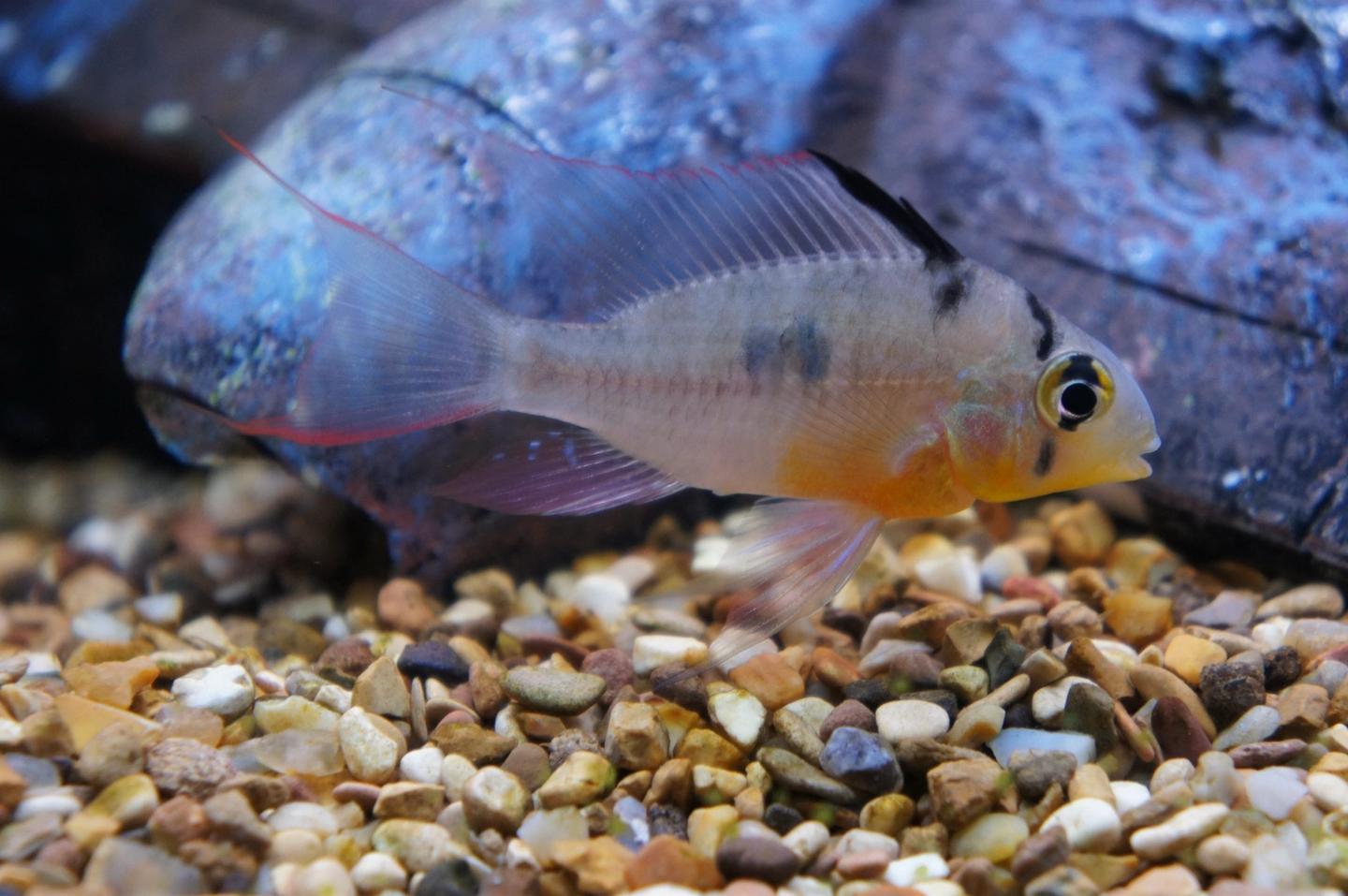
Cichlids are a family of roughly 1,800 accepted species, not one care type. Before buying, identify the exact species and source, then compare adult measurement, usable tank dimensions, social system, territory, tested water, diet and an exit plan. No family-wide minimum tank, water range or tank-mate list is safe.
Maintain these water conditions for optimal health and vibrant colors
The Powder Blue Cichlid (Chindongo socolofi) is a Lake Malawi mbuna that reaches a recorded maximum of 6.7 cm standard length. Also known in the aquarium trade as Pindani, this territorial cichlid suits a keeper prepared to provide a rocky, hard-water Malawi aquarium with mature filtration and carefully screened companions. The older scientific name Pseudotropheus socolofi still appears in books and aquarium discussions, but both names refer to this powder-blue cichlid. It belongs in a planned Malawi aquarium rather than a peaceful general community.
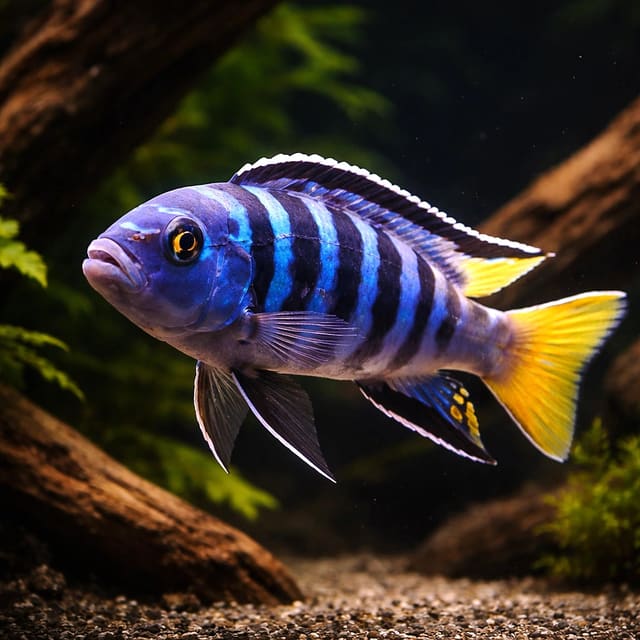
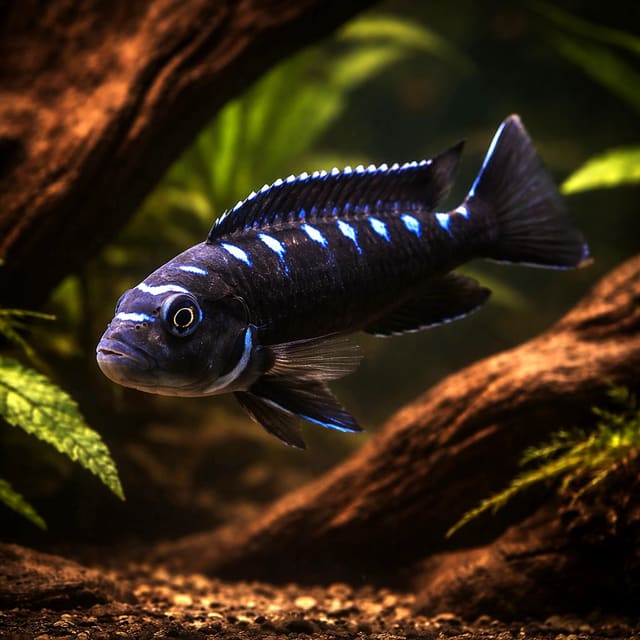
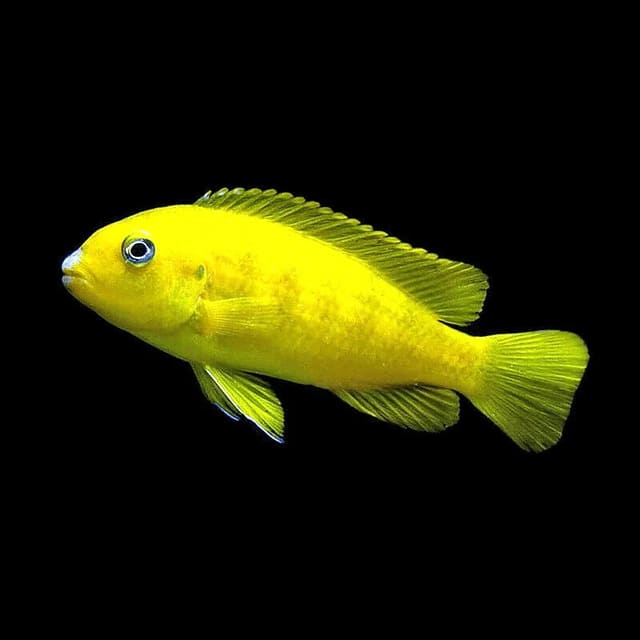
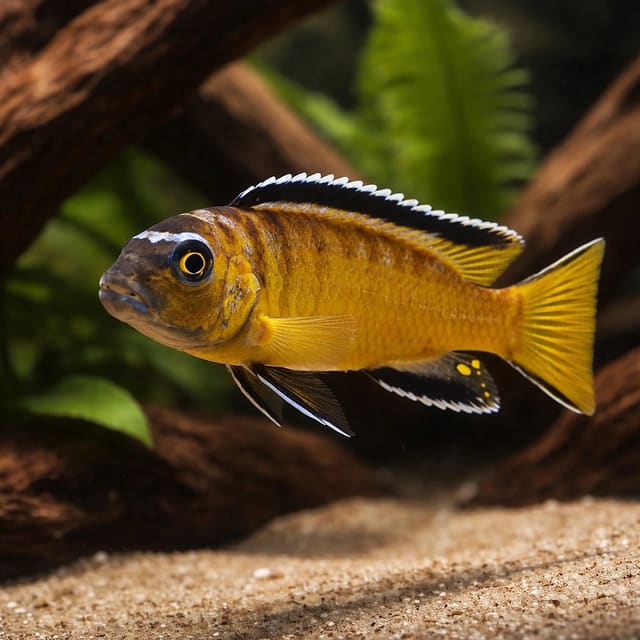
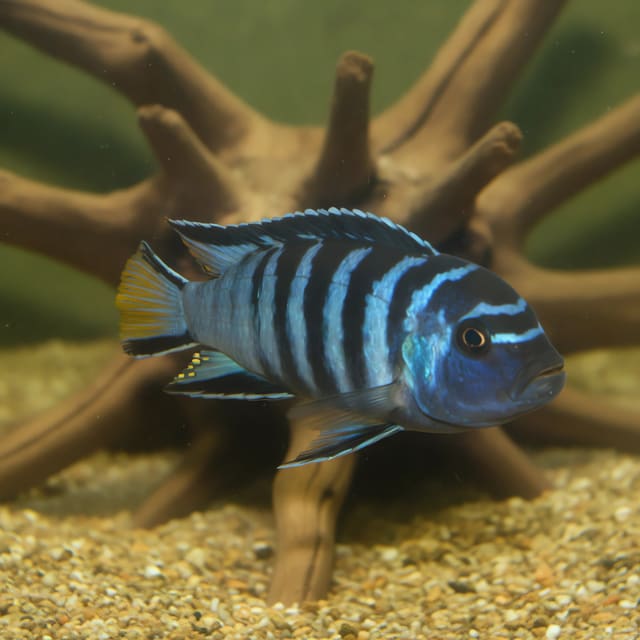
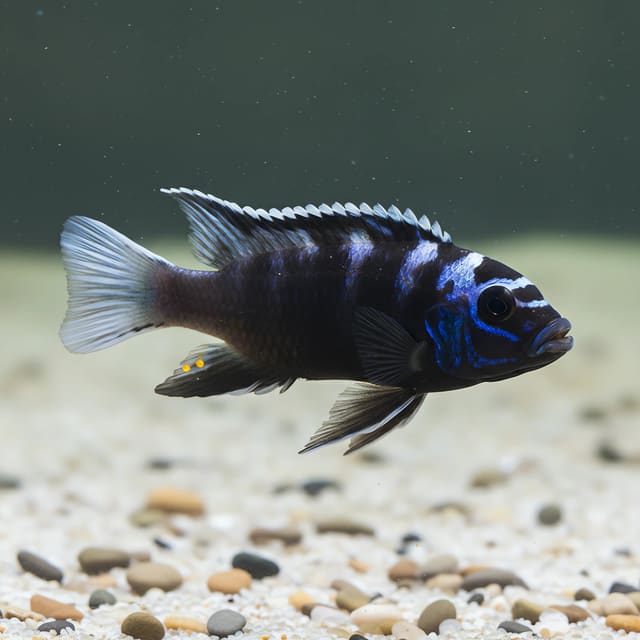
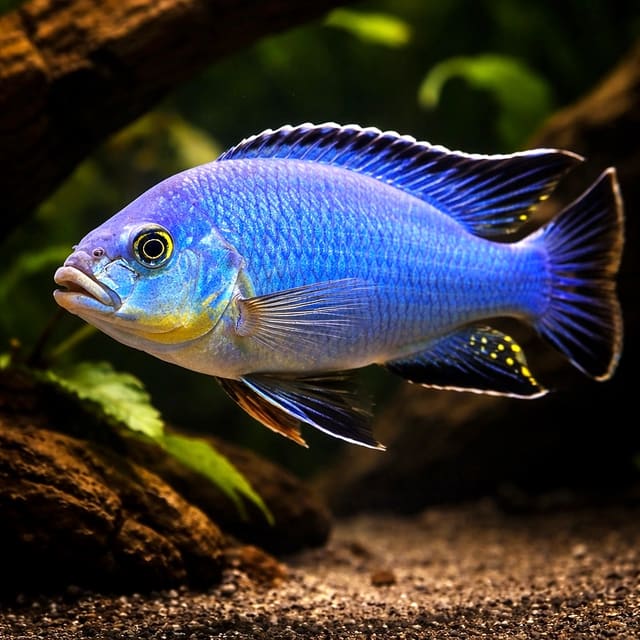
Its colour is shared by males and females: Seriously Fish describes both sexes as displaying the bright powder-blue colour associated with the species. Colour alone must therefore never be used to decide sex. The darker fin edges, faint vertical markings and active cichlid profile shown in the gallery make it a distinctive fish, but the practical attraction is its constant movement between rockwork and nearby open areas.
FishBase describes its wild habitat as shallow freshwater at depths of 4–10 metres in Lake Malawi, mostly over sand, while territorial males remain close to rocks. It feeds from the biocover growing on rock and sand. Those behaviours explain the central aquarium decisions: provide sand, divide the aquarium with caves and rock piles, and make vegetable matter and algae-based food the foundation of feeding.
This mbuna suits a keeper prepared to manage territory as carefully as water quality. Rockwork must provide hiding places and interrupted sight lines, while open areas still allow swimming. The biological filter needs to be mature, water must remain hard and alkaline, and companions must be chosen for compatible water, diet, adult size and temperament.
One purchase supplies one animal in the size chosen from the live selector. The size labels are 4–5 cm, 6–7 cm, 7–9 cm and 9–10 cm. Use the selector for the live choices rather than relying on a static description. The size you select is the size supplied, not the adult size.
Sex is guaranteed only when the selected option explicitly states male or female. This Powder Blue Cichlid listing has no sex-guaranteed option. Plan group composition without assuming a particular sex ratio.
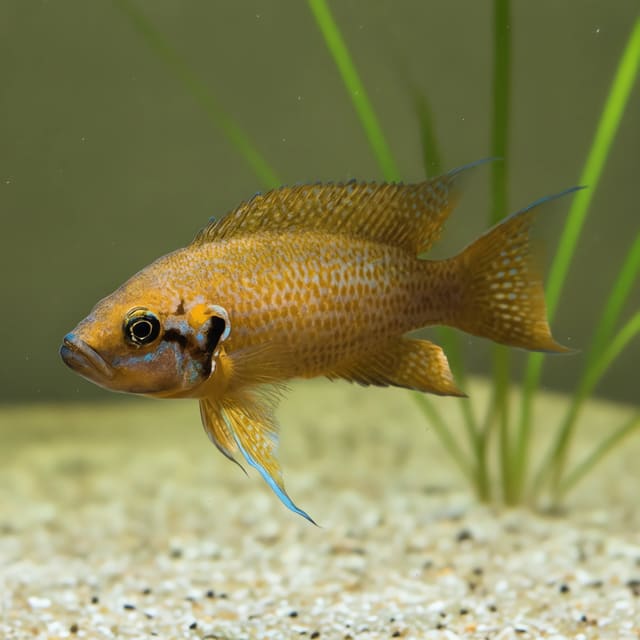
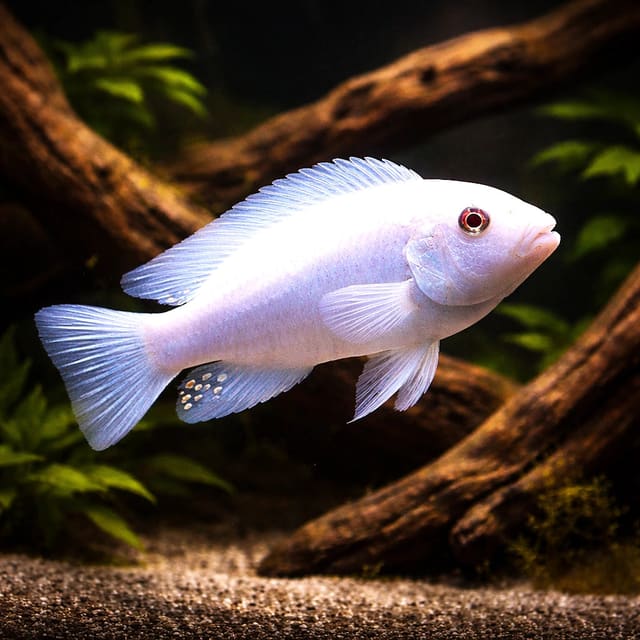
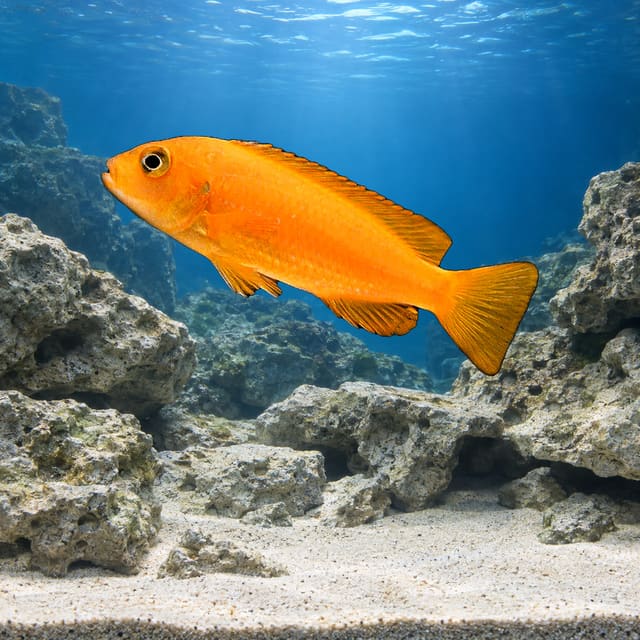
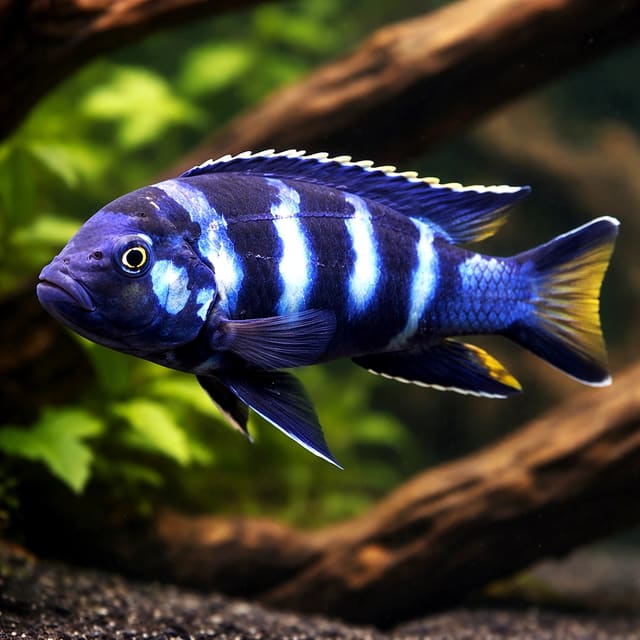
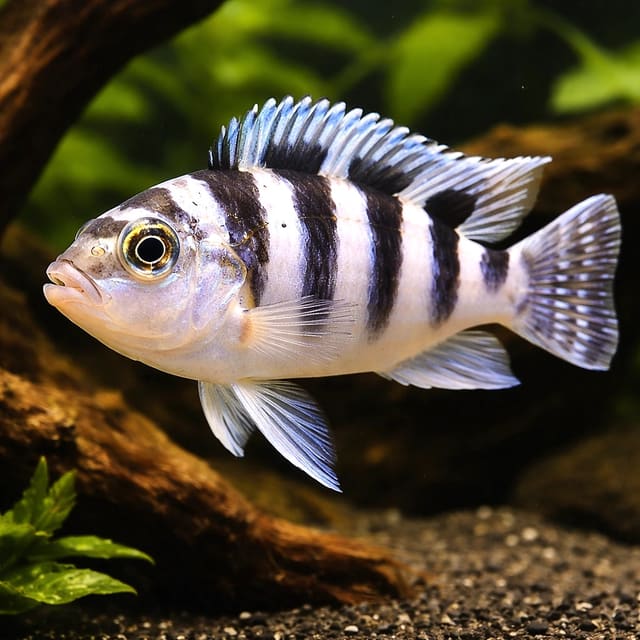
Some gallery images are representative, based on reference photographs of this species, and none shows the exact animal supplied, so colours can look slightly different from the live animal.
FishBase gives a maximum recorded length of 6.7 cm standard length for a male or unsexed fish, while the Seriously Fish aquarium profile uses 11.5 cm standard length as its planning reference. Allow for the larger planning figure when deciding whether the aquarium has enough floor area and territory; it is a planning reference rather than a promise that every individual will reach that measurement.
Seriously Fish specifies an aquarium base of 90 × 45 cm and a volume of about 154 litres. Treat both dimensions as part of the decision. A tall aquarium with a smaller base may hold a similar volume but offers less room for separate territories, caves and open swimming areas.
For routine aquarium care, use 24–26°C, pH 8.0–8.6 and general hardness of 12–18 dGH. FishBase places the fish at 24–26°C in nature, while Seriously Fish gives 24–28°C, pH 7.6–8.8 and 10–25 dGH for aquarium care. OATA’s Malawi-cichlid sheet gives group guidance: 23–27°C, pH 8.0–8.6 and 12–18 dGH. The routine targets below are the overlap of those applicable ranges.
| Suits | Not suited to |
|---|---|
| A rocky aquarium with a 90 × 45 cm base | A peaceful general community aquarium |
| Hard, alkaline water at 24–26°C | Water outside the stated pH and hardness ranges |
| Keepers prepared to manage territorial behaviour | Layouts without caves, hiding places or open swimming room |
| Carefully screened Malawi companions | Large or aggressive mbuna |
| Planning decision | Figure to use |
|---|---|
| Aquarium footprint | 90 × 45 cm |
| Species aquarium volume | About 154 litres |
| Routine temperature | 24–26°C |
| Routine pH | 8.0–8.6 |
| Routine hardness | 12–18 dGH |
Start with the aquarium footprint rather than the appearance of an individual dispatch-sized fish. A base of 90 × 45 cm and a volume around 154 litres provide the species planning point. If the aquarium is intended to hold a broader Malawi community, the community calculation is different: OATA recommends at least 200 litres for a reasonable-sized community.
| Area | Purpose |
|---|---|
| Rock piles | Create caves, hiding places and separate territories. |
| Broken sight lines | Stop one territorial fish seeing every other fish continuously. |
| Open areas | Leave unobstructed swimming room beside the rocks. |
| Sandy substrate | Reflect the species’ association with sand and allow normal digging. |
Arrange several piles rather than one exposed shelter. Seriously Fish recommends lots of caves and hiding places while preserving open swimming areas. This gives a chased fish more than one route out of view and reduces the value of any single cave. Watch the completed layout from each end of the aquarium: if every space is visible in one uninterrupted line, add another visual break.
A sandy substrate is preferable. OATA notes that Malawi cichlids will often dig and rearrange substrate, so delicate planting should not be the foundation of the design. Hardy plants attached to décor are less exposed to uprooting, but the essential structure remains sand, rocks, caves and swimming room.
Coral sand or a similar substrate may help buffer the water where that approach suits the measured tap water. Test before relying on décor to produce the required chemistry. The target is stable pH and hardness within the stated range, not a particular visual style.
Set the aquarium to 24–26°C, pH 8.0–8.6 and 12–18 dGH. These routine values are the overlap of the applicable FishBase, Seriously Fish and OATA ranges. Measure the aquarium rather than assuming that hard-looking décor has produced hard, alkaline water.
Use the water chemistry guide to understand pH, general hardness, carbonate hardness, ammonia, nitrite and nitrate. Once you have actual test results, the water matcher can compare them with the care targets.
| Test | Routine target |
|---|---|
| Temperature | 24–26°C |
| pH | 8.0–8.6 |
| General hardness | 12–18 dGH |
| Carbonate hardness | 10–15 dKH |
| Ammonia | 0 mg/l |
| Nitrite | 0 mg/l |
Check the source water as well as the aquarium. For example, a tank reading pH 7.8 sits below the routine target even if the water looks clear. A hardness reading of 8 dGH is also below the stated range. Resolve those differences before introducing the fish, then test regularly so a gradual change is found before behaviour or feeding is affected.
Temperature deserves the same discipline. A heater setting is not a water measurement, so confirm the result with a thermometer. Seriously Fish estimates roughly 175–250 W of heating for an aquarium around 154 litres when the room is around 20°C. The required heater arrangement therefore depends on the aquarium volume and room temperature, while the water itself must remain within 24–26°C.
Avoid chasing a single midpoint from day to day. A stable reading anywhere inside the routine range is more useful than repeated intervention that moves the aquarium back and forth. Record the result at the same point in the weekly routine so changes are easy to notice.
Use a properly established biological filter before the Powder Blue Cichlid enters the aquarium. The RSPCA explains why biological filtration is essential: fish waste releases toxic ammonia, beneficial bacteria convert it to nitrite, and another stage converts nitrite to the safer nitrate. Ammonia and nitrite must both read 0 mg/l before livestock is added.
If this is a new aquarium, follow the first tropical tank guide to prepare and mature it before arranging delivery. Clear water alone does not show that the biological filter can process fish waste; the zero readings are the decision point.
Seriously Fish recommends turnover of four to five times the aquarium volume each hour. For a tank around 154 litres, its filter example is rated at approximately 615–770 litres per hour. The calculation is straightforward:
Use that range when comparing the filter rating for an aquarium of this volume. If the aquarium is larger, apply the same four-to-five-times calculation to its actual litres rather than carrying over the 154-litre figure.
OATA recommends an oversized filter and strong aeration for crowded Malawi communities. Surface movement is therefore part of the design, not an optional visual effect. Check that the outlet and aeration create active movement without removing all calmer routes between the rocks.
Additions increase waste and feeding, so the filter’s beneficial bacterial population must grow with the load. OATA warns that adding too many fish too quickly may cause new tank syndrome, with ammonia or nitrite rising because the bacteria cannot process the increased waste. Test after any stocking change and do not make another addition while either toxic reading is above zero.
Build the diet around vegetable matter and algae-based food. In Lake Malawi, this fish feeds from biocover on rocks and sand. In the aquarium, Seriously Fish recommends that vegetable matter form a large proportion of the diet, with spirulina flakes, blanched spinach and nori among the stated choices.
OATA advises feeding Malawi cichlids twice a day and giving only what they can eat within a few minutes. Start with a modest portion, watch the fish eat, and stop before food is left to break down. “A few minutes” is a limit, not a reason to keep adding food until the time has passed.
Use the same portion test at both feeds. If food remains after the fish lose interest, reduce the next portion. Uneaten food releases waste as it breaks down, increasing the demand on the filter and working against the ammonia, nitrite and nitrate targets.
Natural grazing behaviour does not replace planned feeding. Biocover on aquarium rock may encourage the fish to pick at surfaces, but the routine still needs a nutritionally suitable Malawi food with a high algae content. Equally, eagerness to take richer food does not make it the correct staple; vegetable matter should continue to form the large proportion.
Keep feeding decisions separate from aggression. A fish that repeatedly misses food because it is being driven away needs a territory and stocking review, not simply a larger amount scattered into the tank. More food increases waste without removing the cause of the exclusion.
Carry out a 25% partial water change at least once every week. Use a siphon to remove solid waste from the substrate, and treat replacement tap water with conditioner before it enters the aquarium so chlorine or chloramine does not damage fish or filter bacteria.
OATA’s nitrate limit is no more than 20 mg/l above the normal tap-water level. This is a difference rather than a single universal reading. If the tap water contains 10 mg/l nitrate, the aquarium should not exceed 30 mg/l under that rule. If the tap-water result changes, recalculate the aquarium limit from the new baseline.
Do not wash biological filter media under the tap. Chlorine or chloramine may kill the beneficial bacteria established in it. When cleaning is needed, rinse the media lightly in water removed during the partial change. This preserves more of the bacterial population while clearing debris.
Keep the maintenance sequence consistent so omissions are obvious. Testing before the water change shows the conditions the fish experienced during the week; checking equipment during the same session catches a blocked filter or reduced aeration before another seven days pass.
Respond to any ammonia or nitrite reading immediately by stopping further livestock additions, checking filtration and carrying out the necessary water-quality response. Do not treat a zero reading from a previous week as permission to skip the next test, particularly after stocking or feeding has increased.
Prepare the aquarium before the journey. Confirm 0 mg/l ammonia and nitrite, check that temperature and mineral readings are within range, and make sure someone can receive the parcel so live fish are not left unattended. Read the current delivery, acclimatisation and Live Arrival Guarantee terms before the delivery window.
The aquarium must already be ready before the parcel arrives. Floating the bag covers the immediate acclimatisation step; it cannot mature a filter, correct unsuitable water or create missing territories.
For an established Malawi aquarium, rearranging some décor before introduction can reduce aggression as resident fish find new territories. OATA also recommends adding Malawi cichlids in groups rather than leaving one new individual to receive all settling aggression, and introducing more peaceful species before more aggressive ones. Apply those principles only within a stocking plan that the aquarium volume and filter can support.
| What you see | What to do |
|---|---|
| The fish reaches cover and moves between areas | Continue observation and the normal care routine. |
| One resident guards every cave | Rearrange décor to create new territories and more sight breaks. |
| The newcomer is pinned in one place | Intervene in the stocking or territory arrangement rather than waiting for damage. |
| Breathing or swimming changes | Test water quality immediately. |
Do not use extra feeding to distract from a poor introduction. Feed according to the twice-daily, few-minutes rule when the fish is participating, and remove the cause if it cannot reach food because of sustained aggression.
Learn the fish’s usual swimming, feeding and use of shelter. A change from that normal pattern is more useful than judging one isolated movement. OATA highlights changes in swimming, colour, temperament, breathing, appearance, body condition and feeding as signs that require attention.
| Change to watch | First response |
|---|---|
| Hanging at the surface, sitting on the bottom or erratic swimming | Test ammonia, nitrite, temperature and aeration. |
| Faster or slower gill movement | Check water quality and surface movement promptly. |
| Darker or paler colour with unusual hiding | Review aggression, shelter and water readings. |
| Reduced feeding | Check whether the fish can reach food and test the water. |
| White spots, fluffy growths, damaged fins or missing scales | Record the change and seek health guidance. |
A torn fin combined with repeated chasing points to a territory or compatibility problem that water treatment alone will not solve. Rearrange décor to interrupt established territories and assess whether the stocking plan gives the targeted fish a safe route to shelter.
If several fish change behaviour together, test the aquarium before assuming an individual health problem. Ammonia and nitrite must remain at zero, while temperature, pH and hardness should remain in their routine ranges. Check the filter for blockage and confirm that surface movement remains strong.
Do not begin an undiagnosed treatment from appearance alone. Test the water, note the exact changes and contact us for guidance when livestock health changes. Clear details about breathing, swimming, appetite, visible marks and recent water results make the next decision more useful.
The Powder Blue Cichlid is not a social shoaling fish. Group keeping is used to manage a territorial Malawi community, not to meet a need to swim in a tight group. OATA warns that small Malawi groups often fight and says they can be kept in groups of at least 15, with slight overcrowding used to spread aggression. That approach requires filtration, aeration, aquarium volume and maintenance capable of handling the resulting load.
Do not apply the 154-litre species planning figure to a 15-fish community without recalculating the whole aquarium. OATA recommends an aquarium of at least 200 litres for a reasonable-sized Malawi community, while advising an aquarium as large as practical. Adult dimensions, territory, waste production and the temperament of every proposed fish still need to fit.
| Decision | Rule to apply |
|---|---|
| One species in a dedicated setup | Start from the 90 × 45 cm base and about 154 litres, then plan territories. |
| A broader Malawi community | Use at least 200 litres and assess the complete group. |
| More than one male | Use a large aquarium because males are territorial. |
| Male-to-female planning | Where possible, keep more females than males; each male should have several females. |
Because the offer does not guarantee sex, do not build a plan that depends on receiving a particular ratio. Watch the group as individuals settle and be prepared to revise territories or stocking if one fish receives continuous pressure.
A large fish count is not a substitute for compatibility. Slight overcrowding is a specific Malawi aggression-management approach and must remain within reason. It only works alongside oversized filtration, strong aeration, weekly maintenance and a layout that provides multiple hiding places. If those conditions cannot be met, do not increase numbers simply to reach a group figure.
Avoid a general community aquarium and avoid large or aggressive mbuna. Seriously Fish describes this species as not especially aggressive for a mbuna, but still unsuitable for a general community tank. A more aggressive cichlid can dominate it, while a peaceful community plan does not match its territorial behaviour or Malawi water requirements.
Potential companions named by Seriously Fish include Aulonocara, Copadichromis and quieter mbuna such as Labidochromis caeruleus. OATA also allows some Lake Malawi Synodontis species in Malawi-cichlid aquariums. These are screening candidates, not automatic matches.
Small Malawi groups require particular caution because aggression may concentrate on one individual. More than one male also needs a larger aquarium, with each male given several females where the sexes are known. Watch for one fish being kept away from food or shelter, not just for brief chasing.
Browse the African cichlid collection to compare identities and care needs, then assess the complete combination rather than choosing by colour. A named candidate may still be unsuitable when aquarium dimensions, existing territories or diet differ. Ask us with the aquarium dimensions, water readings and full livestock list for a stocking and compatibility assessment.
This fish reaches a recorded maximum of 6.7 cm standard length according to FishBase. Plan its territory around a 90 × 45 cm aquarium base rather than judging space by its dispatch size.
Use an aquarium with a 90 × 45 cm base and about 154 litres for the species planning point. OATA recommends at least 200 litres for a reasonable-sized Malawi community.
This fish is not a shoaling species. OATA says Malawi cichlids can be kept in groups of at least 15 because small groups often fight, but that community approach needs at least 200 litres, oversized filtration, strong aeration and a complete stocking assessment.
Seriously Fish recommends it as a beginner’s mbuna, but it still needs a mature rocky aquarium, hard alkaline water, managed territories and screened Malawi companions rather than a peaceful general community.
Feed twice daily and offer only what it can finish within a few minutes. Vegetable matter should form a large proportion of the diet, using algae-rich Malawi food, spirulina flakes, blanched spinach or nori, with live or frozen food as a supplement; never feed beefheart or other red meat.
Keep it at 24–26°C, pH 8.0–8.6 and 12–18 dGH. The temperature is the FishBase, Seriously Fish and OATA overlap, while the pH and hardness are the overlap of Seriously Fish and OATA; ammonia and nitrite must remain at 0 mg/l.
It is territorial and not especially aggressive for a mbuna, but it is unsuitable for a general community aquarium. Judge compatibility through territorial pressure, chasing, access to shelter and fin condition.
Avoid a general community aquarium and large or aggressive mbuna. Carefully screened candidates include Aulonocara, Copadichromis, quieter mbuna such as Labidochromis caeruleus, and some Lake Malawi Synodontis, provided water, diet, adult size, temperament and space all align.
Someone must be present to receive it. Film every delivery continuously from the sealed parcel as it is opened, showing the fish still inside the sealed bag; float the bag for 20–30 minutes, then transfer the fish and never pour the bag water into the aquarium.
Max adult size is the length this species reaches at full maturity (from scientific sources). The livestock you receive will be younger and smaller — pick a size variant on the buy box for the actual shipping size. Product-photo provenance and any image-specific limitations are stated on the listing.
Always research specific species before adding them to your tank. Consider:
No reviews for this item yet. Bought one? Honest reviews only, good or bad.
What customers say about ordering from us
I have a small group of long finned mountain minnows. So was delighted to be able to order ten of this variety to increase the genetics in my tank . The ones I recieved are healthy but it’s to early to give a verdict on wether they are of a long finned type since they are small currently.
Gordon Walker · 23 Sept 2026
100% success travel and "installation". Pleased with quality of purchase. The Siamese fighter a bit "shy" so have not yet seen him at his best yet but looking good. Happy customer. GG
George E Garratt · 21 Sept 2026
Reviews of our shop, collected by Judge.me, an independent third-party review collector. Newest first.