−16%
Moderate
Chindongo saulosi ‘Coral Red’ – Coral Red Dwarf Mbuna Cichlid | Lake Malawi
23–27°C · pH 7.4–8.4 · 150L
£9.68£11.49

Tropheops macrophthalmus "Lumbira" is a colourful Lake Malawi mbuna for hard alkaline rockwork aquariums with compatible cichlid tank mates.
Adult size is the maximum length this species reaches at full maturity (scientific sources). The livestock you receive will be younger and smaller — pick a size above for the actual shipping size. Product-photo provenance and any image-specific limitations are stated on the listing.
Tropheops macrophthalmus "Lumbira"
Save when buying multiple fish. Each quantity is one fish; sex and pair formation are not guaranteed unless the selected variant explicitly states them.
Confirm your email, then we’ll send an availability message for this exact item if it returns within 180 days.
This request is only for this product—no newsletter or other promotions. A mail-provider retry may very rarely duplicate the same availability message. Unconfirmed addresses are removed after 48 hours. See our privacy policy.
Tropheops macrophthalmus "Lumbira" is a colourful Lake Malawi mbuna for hard alkaline rockwork aquariums with compatible cichlid tank mates.
Adult size is the maximum length this species reaches at full maturity (scientific sources). The livestock you receive will be younger and smaller — pick a size above for the actual shipping size. Product-photo provenance and any image-specific limitations are stated on the listing.
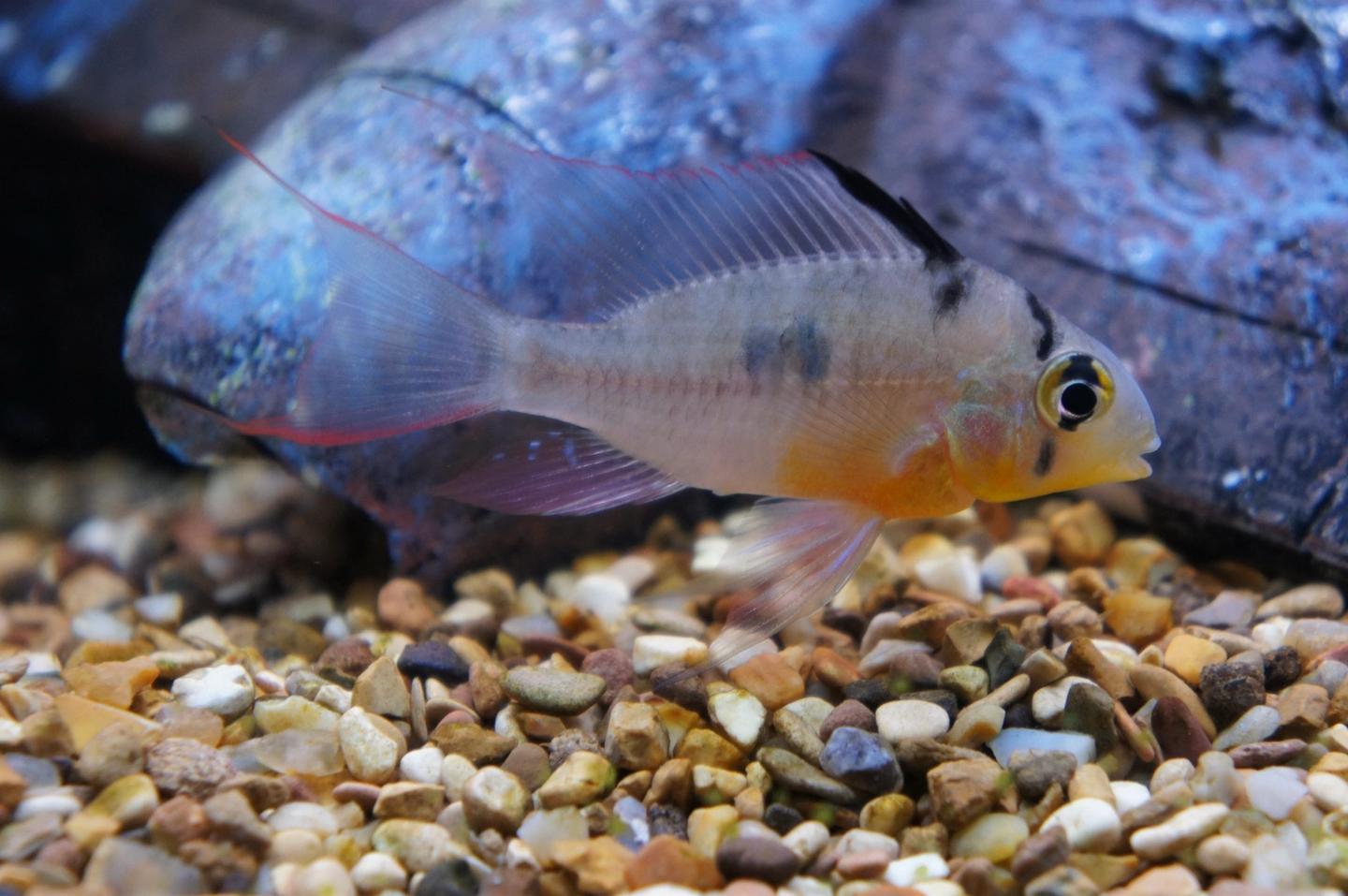
Cichlids are a family of roughly 1,800 accepted species, not one care type. Before buying, identify the exact species and source, then compare adult measurement, usable tank dimensions, social system, territory, tested water, diet and an exit plan. No family-wide minimum tank, water range or tank-mate list is safe.
Maintain these water conditions for optimal health and vibrant colors
Tropheops macrophthalmus "Lumbira" is a bright yellow Lake Malawi mbuna for aquarists who understand rock-dwelling African cichlids. It is sold in the trade under older or supplier-style names such as Pseudotropheus tropheops macrophthalmus Lumbira, but the cleaner customer-facing name is the Lumbira locality form of Tropheops macrophthalmus.
This is not a soft community fish. It is a territorial mbuna that belongs in a planned Malawi cichlid aquarium with hard alkaline water, rockwork, broken sight lines and robust tank mates. Kept in the right setup, it gives strong colour, constant grazing behaviour and the confident movement that makes mbuna tanks so lively.
| Common name | Lumbira Cichlid, Lumbira mbuna |
|---|---|
| Scientific / trade name | Tropheops macrophthalmus "Lumbira"; supplier bridge: Pseudotropheus tropheops macrophthalmus Lumbira |
| Origin | Lake Malawi, Lumbira locality |
| Adult size | About 10-12 cm depending on sex, diet and conditions |
| Care level | Moderate: hardy water needs, but territorial behaviour must be managed |
| Minimum aquarium | 250 litres for a carefully planned mbuna group; larger is easier |
| Temperature | 24-28 C |
| pH | 7.6-8.6, stable and alkaline |
| Temperament | Territorial/aggressive, best with compatible mbuna |
| Diet | Vegetable-rich mbuna foods, spirulina, algae-based pellets and controlled protein treats |
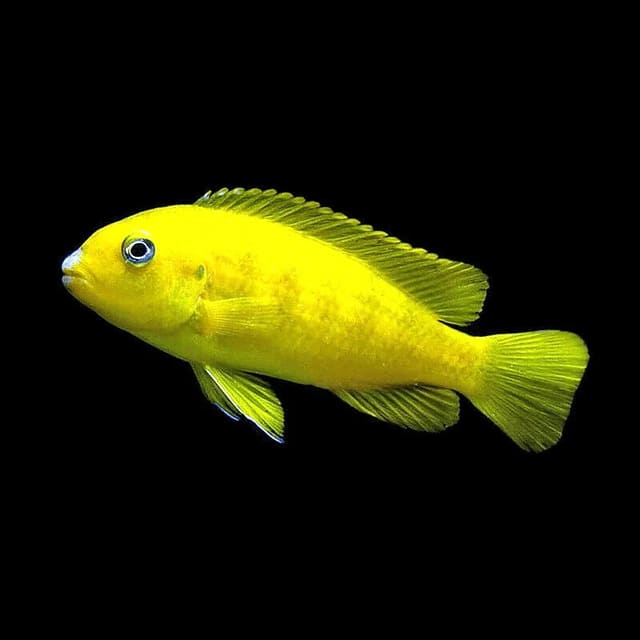
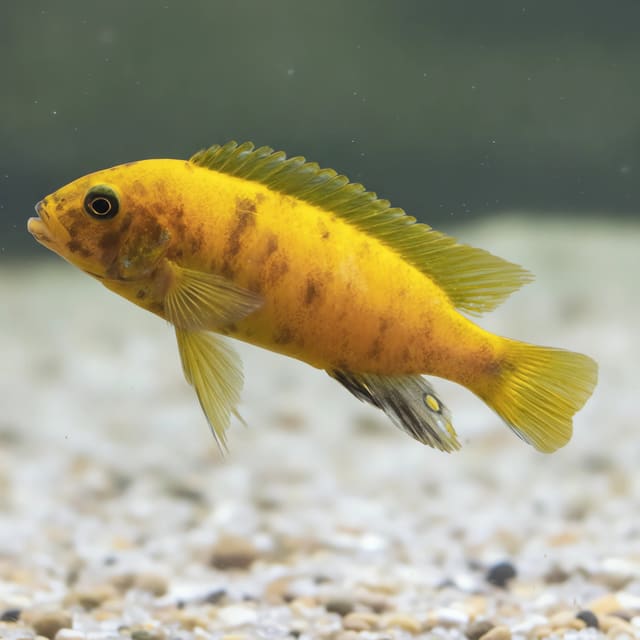
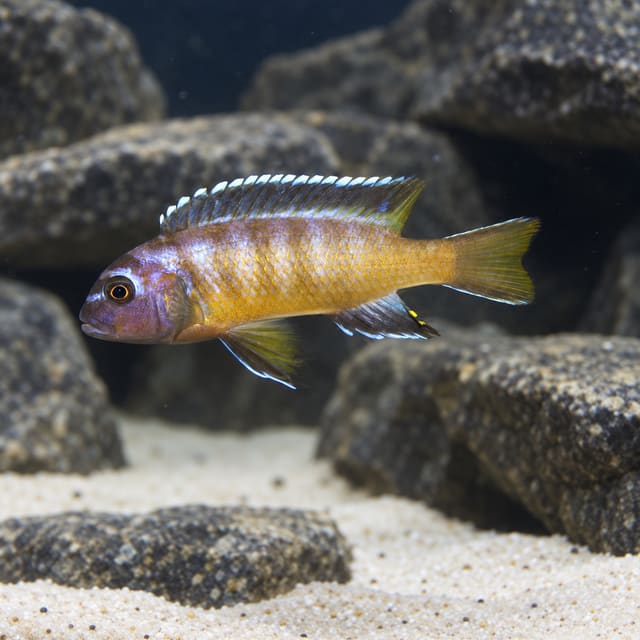
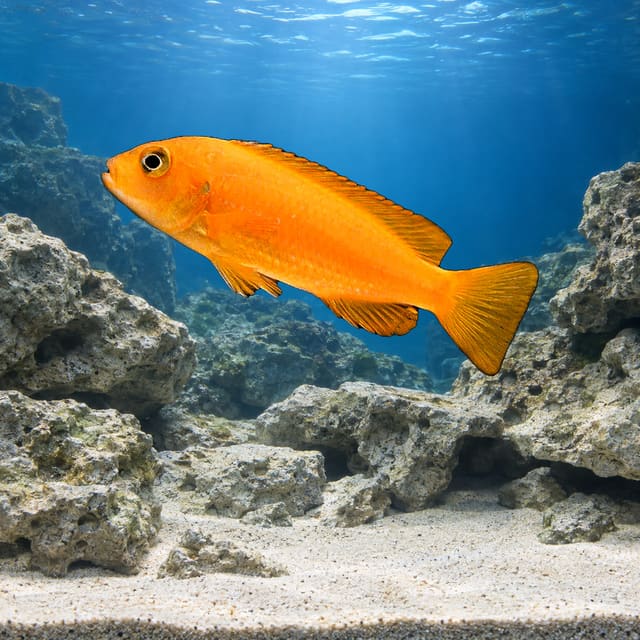
The Lumbira form is part of the yellow "Midas mbuna" look, where several Malawi cichlids converge on strong yellow colour. Good males show a high-bodied profile, blue edging through the dorsal fin and a bold yellow body. Females and younger fish can vary in intensity, and dominance, diet and lighting all affect the colour you see in the aquarium.
The recovered source photo has been restored to this listing because it shows the actual yellow Lumbira-type appearance better than relying only on media. The source-backed fish image carries the product identity, with the aquarium view as extra context.
Use a long aquarium with extensive rockwork, caves, gaps and broken sight lines. Mbuna claim territories around rocks, so a bare open tank makes aggression worse. Build stable rock piles on the base of the tank before adding sand, or use supports that prevent digging fish from undermining the structure. Leave open swimming lanes at the front and top.
Hard, alkaline water is important. Aim for stable Malawi-style conditions rather than soft planted-tank water. Strong filtration, high oxygen and regular water changes matter because active cichlids eat heavily and produce plenty of waste. Avoid delicate plants, shrimp and tiny fish; this is a rockwork cichlid display, not a peaceful mixed community.
Feed mainly vegetable-rich mbuna foods: spirulina flakes, algae wafers, quality herbivore pellets and small amounts of blanched greens. These fish graze algae and biofilm in nature, so a rich meaty diet can cause digestive trouble. Occasional small protein treats are fine, but avoid heavy bloodworm-style feeding as a routine.
Small frequent feeds are better than one large messy meal. Watch body shape; a healthy mbuna should be well conditioned but not bloated. Remove leftovers quickly and keep the substrate clean around the rocks.
Choose other robust Lake Malawi mbuna with similar water needs and temperament. Avoid slow, long-finned or peaceful fish, and avoid mixing with small community species. A carefully stocked mbuna group can spread aggression, while a pair or trio in too small a tank can focus aggression on one weaker fish.
Sex ratios matter. Males can be hard on females, especially when breeding, so experienced keepers often plan groups with more females than males where stock availability allows. Do not mix visually similar yellow mbuna casually if you want to avoid confusion or hybridisation risk.
This is an active diurnal cichlid that patrols rock faces, grazes surfaces and defends chosen areas. Colour and confidence often improve once the fish settles into a structured territory. Like many Malawi mbuna, it is a maternal mouthbrooder: females hold eggs and fry in the mouth, so a calm layout and reduced harassment improve outcomes.
Most problems come from stress, unsuitable tank mates, poor water quality or the wrong diet. Watch for torn fins, hiding, clamped fins, rapid breathing, bloating, repeated chasing injuries or a fish being pinned in one corner. Check ammonia, nitrite, nitrate, temperature and pH before assuming disease. Malawi cichlids are hardy, but they are not immune to poor maintenance.
This product can include more than one size option. Smaller 4-5 cm fish are best for keepers growing a group together and building the hierarchy gradually. Larger 5-7 cm fish show more immediate colour and presence, but they also need enough territory from day one. Match the size to the rest of the aquarium; do not add a small fish to a tank of large dominant mbuna and expect it to compete safely.
Prepare the rockwork before the fish arrives. Rearranging caves on introduction day can help reduce established territories if you are adding to an existing mbuna tank. Float to equalise temperature, acclimate steadily, then release with the lights low. Feed lightly for the first day or two and watch the social response. A little chasing is normal in mbuna tanks; a fish pinned at the surface or trapped in a corner is not normal and needs intervention.
Colour in Lake Malawi cichlids is not fixed like paint. Dominant males often show the strongest yellow and blue fin edging, while subdominant fish, females or juveniles may be duller. Stress bars, faded colour or hiding can indicate social pressure, poor water or a layout that does not provide enough escape routes. Good food and clean alkaline water help, but social stability is just as important.
Mbuna tanks work best with routine. Test nitrate, keep filters clean, change water regularly and vacuum open sand areas without stripping every rock surface bare. Algae and biofilm on rocks are part of the grazing environment. Strong oxygenation and stable minerals are more useful than chasing a sterile-looking display.
Lumbira cichlids are packed for UK live-animal courier delivery with insulation and seasonal protection where needed. The Live Arrival Guarantee applies when the delivery and acclimation instructions are followed. Dim the lights, acclimate steadily and introduce the fish to an already structured rockwork aquarium.
New customers can use WELCOME10 for 10% off their first order where the promotion is active. Useful add-ons include mbuna foods, water conditioner, Malawi buffer/mineral support where appropriate, test kits and extra rockwork.
No reviews for this item yet. Bought one? Honest reviews only, good or bad.
What customers say about ordering from us
I have a small group of long finned mountain minnows. So was delighted to be able to order ten of this variety to increase the genetics in my tank . The ones I recieved are healthy but it’s to early to give a verdict on wether they are of a long finned type since they are small currently.
Gordon Walker · 23 Sept 2026
100% success travel and "installation". Pleased with quality of purchase. The Siamese fighter a bit "shy" so have not yet seen him at his best yet but looking good. Happy customer. GG
George E Garratt · 21 Sept 2026
Reviews of our shop, collected by Judge.me, an independent third-party review collector. Newest first.