Moderate
Acei Cichlid (Pseudotropheus sp. “acei”)
24–26°C · pH 7.5–8.5 · 300L
£7.99
The Ngara Acei Mbuna (Pseudotropheus acei) is a cichlid associated with Lake Malawi in Eastern Africa that reaches 15 cm. It suits keepers planning a Malawi community of at least 15 fish around OATA’s 23–27°C, pH 8.0–8.6 and 12–18°dH group guidance. Sold individually in 4–5 cm, 6–7 cm and XL sizes.
Adult size is the maximum length this species reaches at full maturity (scientific sources). The livestock you receive will be younger and smaller — pick a size above for the actual shipping size. Product-photo provenance and any image-specific limitations are stated on the listing.
Pseudotropheus acei
Save when buying multiple fish. Each quantity is one fish; sex and pair formation are not guaranteed unless the selected variant explicitly states them.
The Ngara Acei Mbuna (Pseudotropheus acei) is a cichlid associated with Lake Malawi in Eastern Africa that reaches 15 cm. It suits keepers planning a Malawi community of at least 15 fish around OATA’s 23–27°C, pH 8.0–8.6 and 12–18°dH group guidance. Sold individually in 4–5 cm, 6–7 cm and XL sizes.
Adult size is the maximum length this species reaches at full maturity (scientific sources). The livestock you receive will be younger and smaller — pick a size above for the actual shipping size. Product-photo provenance and any image-specific limitations are stated on the listing.

Cichlids are a family of roughly 1,800 accepted species, not one care type. Before buying, identify the exact species and source, then compare adult measurement, usable tank dimensions, social system, territory, tested water, diet and an exit plan. No family-wide minimum tank, water range or tank-mate list is safe.
Maintain these water conditions for optimal health and vibrant colors
The Ngara Acei Mbuna (Pseudotropheus acei) is a member of the cichlid family associated with Lake Malawi in Eastern Africa. A summary of the Pseudotropheus genus identifies these fish as mbuna cichlids endemic to Lake Malawi. Plan for this fish to reach 15 cm as an adult.
This is an intermediate store-care choice for a keeper prepared to manage specialised hard, alkaline water, a substantial filtered aquarium and the aggression expected in a Malawi cichlid community. It is not a conventional peaceful-community fish. OATA describes Malawi cichlids as aggressive and advises mixing them cautiously, although they are usually undemanding aquarium inhabitants.
Keep the aquarium at 23–27°C, pH 8.0–8.6 and 12–18°dH. OATA’s African Malawi cichlid guidance gives these group values, together with carbonate hardness of 10–15°dKH; they are not a species-specific optimum. It also recommends an aquarium of at least 200 litres for a reasonable Malawi community and says Malawi cichlids can be kept in groups of at least 15.
| Suits | Not suited to |
|---|---|
| A planned Malawi cichlid community | A conventional peaceful community |
| Hard, alkaline water at pH 8.0–8.6 | Soft or acidic aquarium conditions |
| A group plan involving at least 15 Malawi cichlids | A small Malawi group in which fighting can concentrate |
| At least 200 litres for a reasonable community | An unfiltered or newly prepared aquarium |
| A keeper ready to monitor aggression and water quality | A setup where companions cannot be screened carefully |
Choose this fish only when the aquarium can satisfy all three decisive needs together: Malawi-compatible companions, the stated hard-water conditions and enough biological filtration for the intended group. A suitable pH without the necessary group and filtration plan is not a complete setup, and a large aquarium still needs zero ammonia and zero nitrite before fish are introduced.
One purchase supplies one Ngara Acei Mbuna. Use the live size selector to choose 4–5 cm, 6–7 cm or XL. The size you select is the size supplied, not the adult size. XL is a named dispatch grade, so plan from the 15 cm adult figure rather than assigning XL a numerical length.
All three sizes need an aquarium planned around the same adult length. A smaller dispatch fish does not justify a smaller permanent setup, and the larger grade does not change the water, filtration or compatibility requirements. Prepare the final Malawi aquarium before choosing a dispatch size so that the fish does not depend on an undersized temporary arrangement.
Sex is guaranteed only when the selected option explicitly states male or female. This Ngara Acei Mbuna listing has no sex-guaranteed option. Build the initial stocking plan without assuming that colour, body size or a gallery image reveals the sex supplied. If the sexes later become reliably known, OATA advises keeping more females than males where possible so that one female is less likely to receive persistent attention from a male.
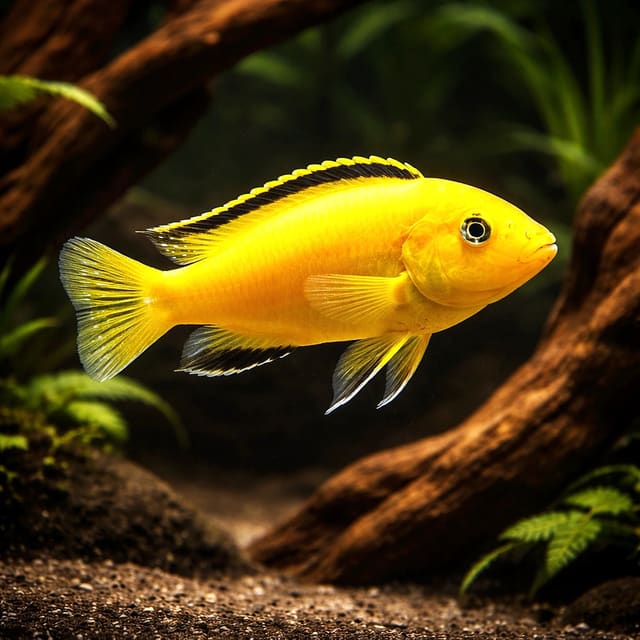
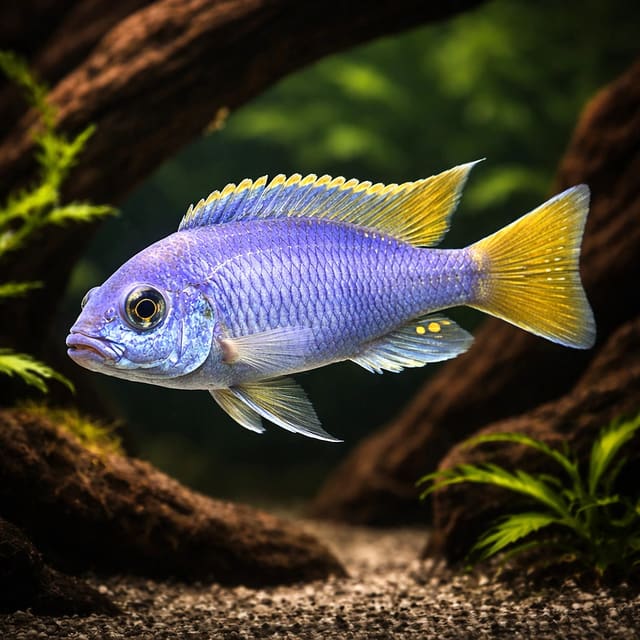
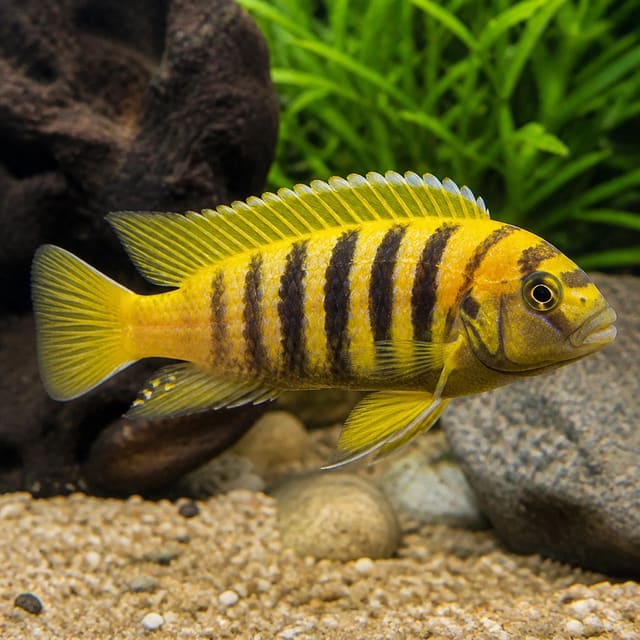
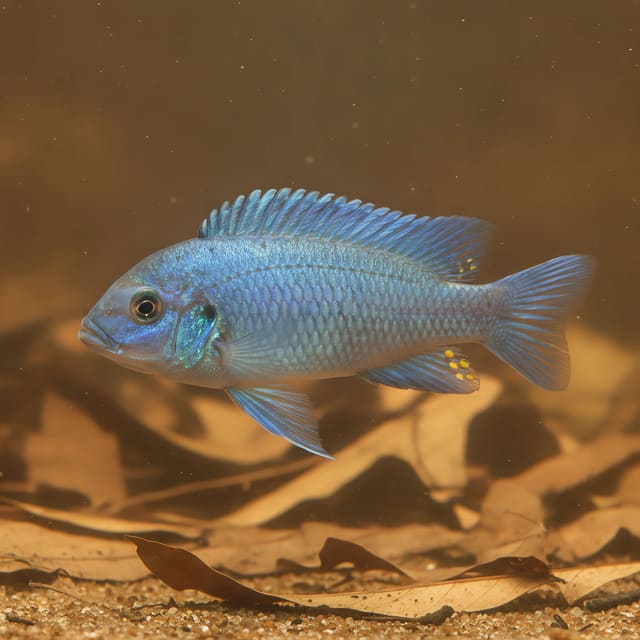
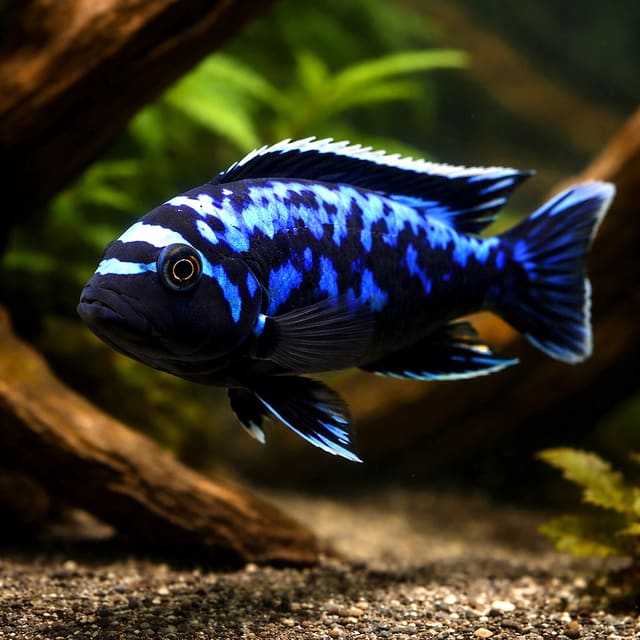
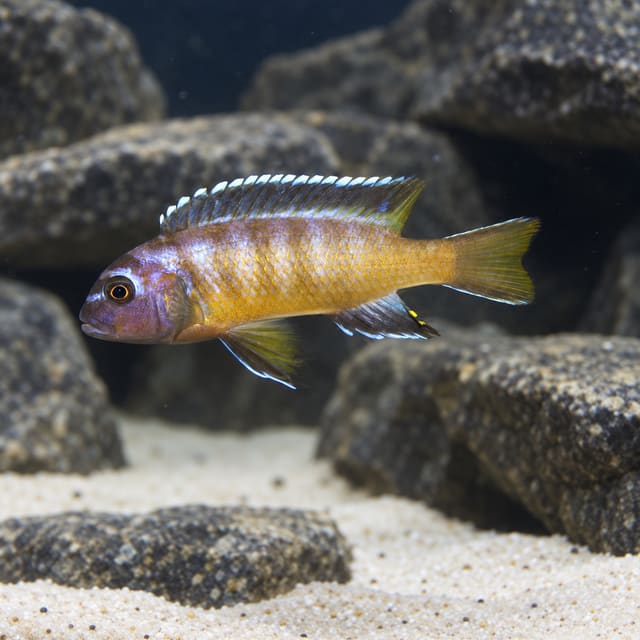
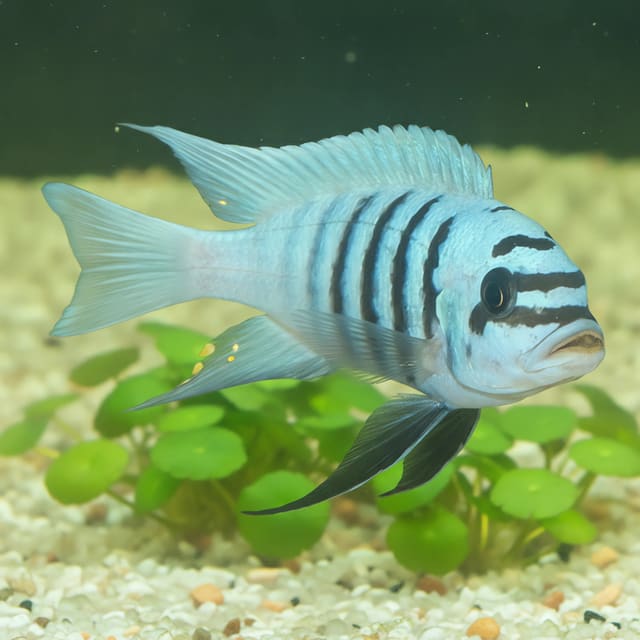
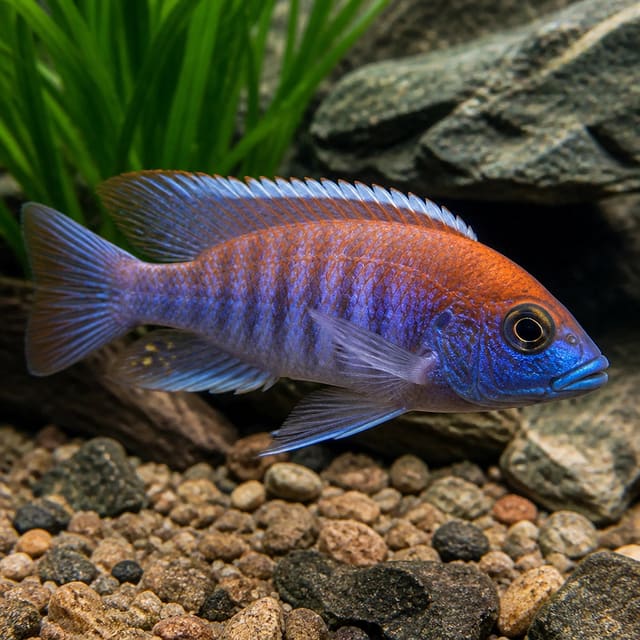
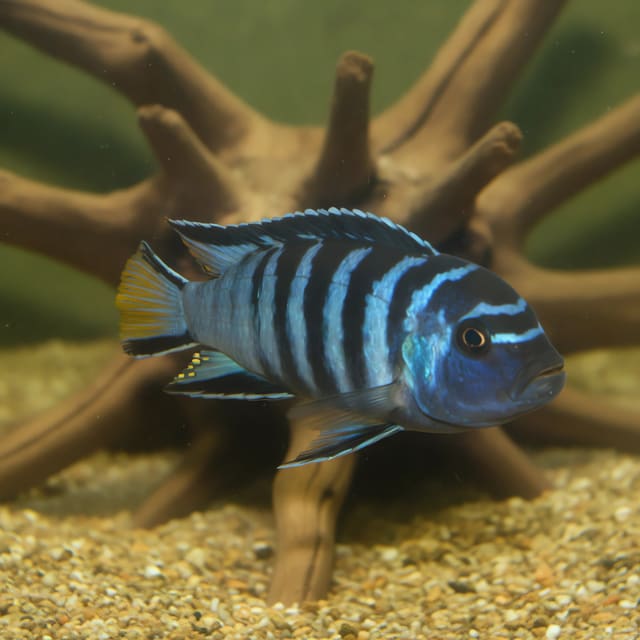
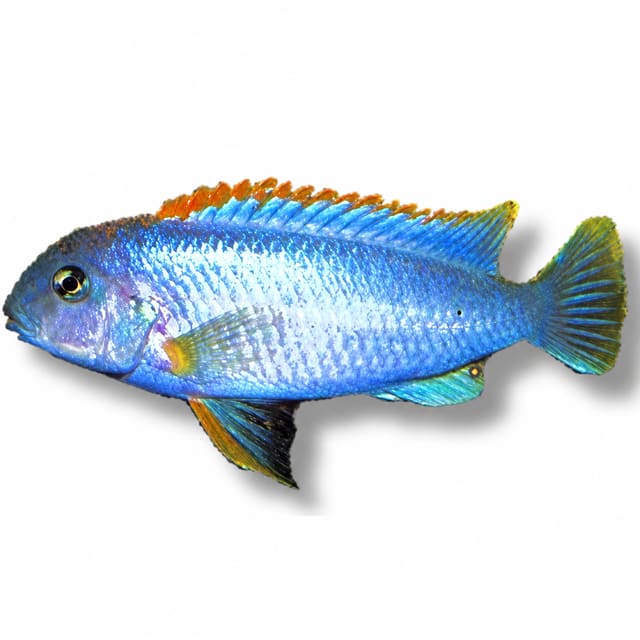
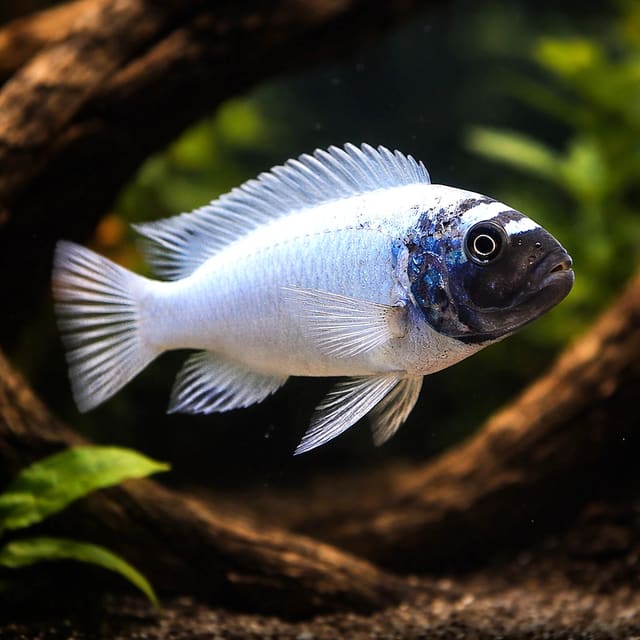
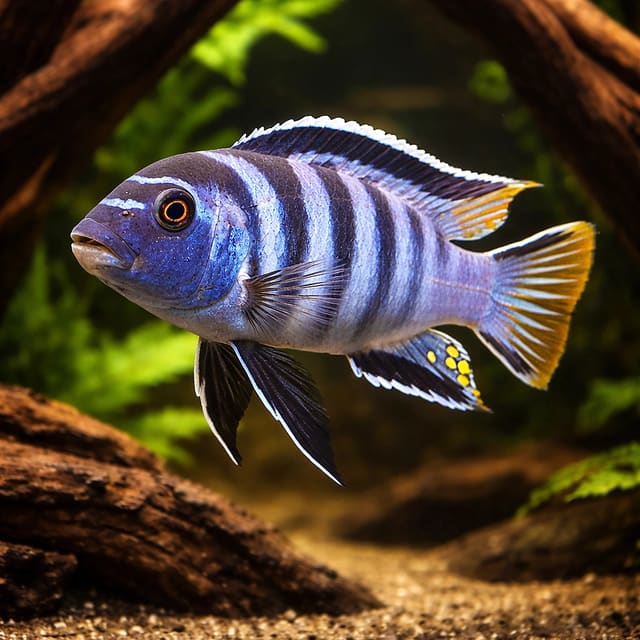
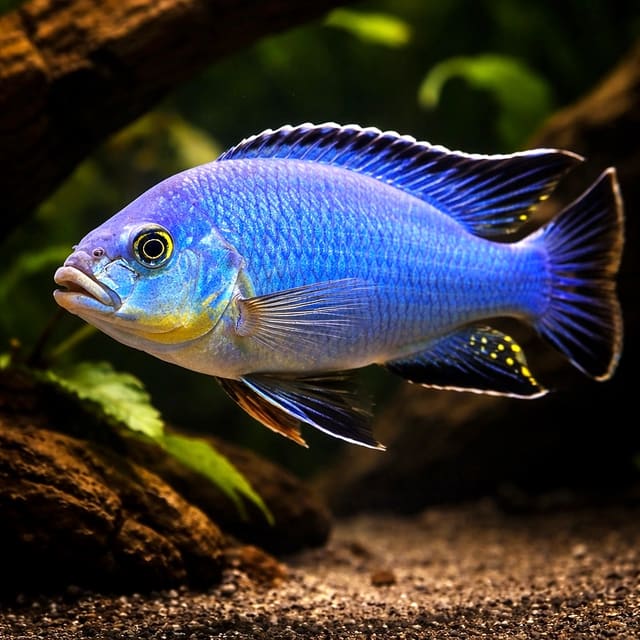
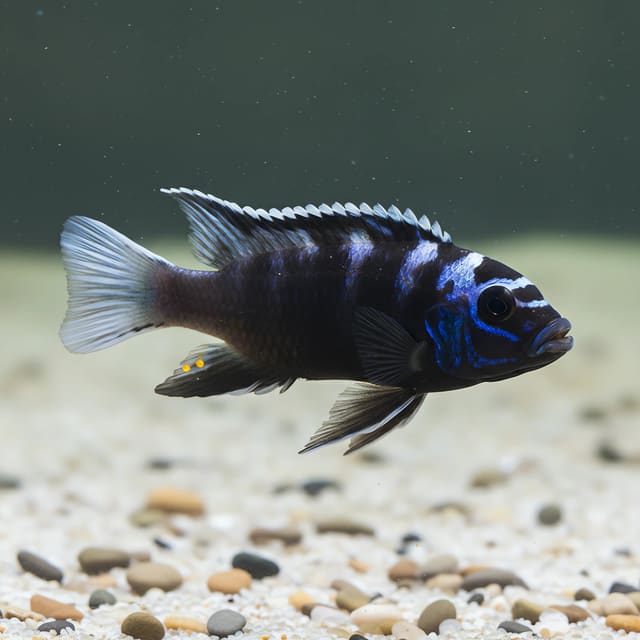
The gallery images are representative, based on reference photographs of this species, so colours can look slightly different from the live animal. Use the gallery to understand the illustrated overall appearance and aquarium scene, not to predict the exact colour, markings, sex or size of the individual supplied.
The selector controls the supplied size only. It does not create a different care plan, guarantee a life stage or identify the fish as male or female.
Plan for an adult length of 15 cm and provide an aquarium of at least 200 litres for a reasonable Malawi cichlid community. The aquarium recommendation applies to the planned community rather than one fish in isolation.
OATA advises choosing as large an aquarium as is reasonable because larger aquariums offer more stable temperature and water-quality conditions. Space must be considered alongside the intended number of fish, the filter’s capacity and the aggressive nature of Malawi cichlids. Do not calculate stocking from litres alone.
A worked planning example separates the different figures. If a 4–5 cm fish is selected, 4–5 cm describes the fish at dispatch and 15 cm is the adult planning length. At least 200 litres applies to a reasonable Malawi community under OATA’s group guidance. The dispatch measurement is not an adult length, and the community-volume recommendation is not a fish count.
Group planning matters because Malawi cichlids kept in small groups will often fight. OATA says they can be kept in groups of at least 15 and notes that slight overcrowding can distribute aggression. Apply that method with oversized filtration, strong aeration and regular water testing because more fish also produce more waste. The aim is a deliberately managed Malawi community, not uncontrolled stocking.
Before increasing the population, check that ammonia and nitrite are both zero. Additions increase feeding and waste, so the beneficial bacteria in the filter must expand with the load. Increase fish numbers gradually and pause further additions if the filter is not maintaining safe test results.
Keep the water at 23–27°C, pH 8.0–8.6 and a general hardness of 12–18°dH. Maintain carbonate hardness at 10–15°dKH, ammonia at 0 mg/l and nitrite at 0 mg/l. Nitrate should not exceed 20 mg/l above the normal level in the tap water used for the aquarium.
Measure the aquarium rather than relying on how clear the water looks. Ammonia and nitrite are invisible hazards, while pH and hardness determine whether the setup remains within the specialised conditions expected by Malawi cichlids. Our aquarium water chemistry guide explains what the main tests measure, and the water matcher can help compare measured values with the targets used here.
| Measurement | Decision |
|---|---|
| Temperature | Keep between 23°C and 27°C |
| pH | Keep between 8.0 and 8.6 |
| General hardness | Keep between 12°dH and 18°dH |
| Carbonate hardness | Keep between 10°dKH and 15°dKH |
| Ammonia and nitrite | Keep each at 0 mg/l |
| Nitrate | Keep within 20 mg/l above the tap-water baseline |
For example, if the tap water contains 10 mg/l nitrate, the OATA limit makes 30 mg/l the upper aquarium reading: 10 mg/l baseline plus 20 mg/l. If the tap-water reading is 20 mg/l, the corresponding upper aquarium reading is 40 mg/l. Test both samples rather than assuming the baseline.
A reading of 22°C is below the stated temperature range, while 28°C is above it. A pH of 7.8 is below the Malawi target even though it is close numerically. Correct the conditions before adding fish whenever a decisive value sits outside its range.
OATA says the aquarium should have coral sand or a similar substrate to buffer the water. Test at least weekly and record the results so that a change can be recognised before it becomes persistent. Larger aquariums can be more stable, but volume never replaces testing, filtration or maintenance.
Use a mature, well-maintained biological filter in every Ngara Acei Mbuna aquarium. The RSPCA’s aquarium guidance explains that fish release toxic ammonia and that beneficial bacteria in a working filter convert it first to nitrite and then to the safer nitrate. Both ammonia and nitrite still need to remain at 0 mg/l.
OATA recommends an oversized filter for the crowded conditions used in Malawi communities. It also recommends aggressive aeration so that enough dissolved oxygen remains accessible to the fish. Match the equipment to the complete community and its feeding load rather than to one fish’s dispatch size.
Prepare and mature the aquarium before livestock is introduced. The first tropical aquarium guide sets out the preparation sequence. A newly running filter is not equivalent to a mature biological filter because its bacterial population must be capable of processing the waste produced by the fish.
Rearranging aquarium décor can help when aggression becomes concentrated because established territories are disrupted and must be formed again. Use that action as part of a wider review of group size, stocking order and water quality rather than as a substitute for an appropriate community.
Check the filter for blockages during routine maintenance. If the media needs cleaning, rinse it lightly in aquarium water removed during a water change. Do not run it under the tap because chlorine or chloramine may kill beneficial bacteria and reduce the filter’s ability to process ammonia and nitrite.
Increase the population slowly. Every added fish increases waste and feeding, while the bacterial population needs time to grow with that load. Stocking too quickly can cause new tank syndrome, with unhealthy ammonia or nitrite that may make fish ill or die.
Use a specialised Malawi cichlid food with a high algae content as the main prepared food, supported by fresh vegetables. OATA notes that smaller mbuna species are more herbivorous and appreciate this type of diet. Choose preparations clearly intended for the algae-rich feeding needs of smaller mbuna.
Feed only what the fish can eat within a few minutes, twice a day. OATA applies that portion and frequency rule to Malawi cichlids. Judge the amount by consumption rather than by a fixed scoop because uneaten food breaks down and releases waste into the aquarium. Stop adding food when the fish are no longer clearing it within the stated period.
| Situation | Action |
|---|---|
| Food is eaten within a few minutes | Keep the portion at that controlled level |
| Food remains after a few minutes | Reduce the next portion |
| Waste tests begin to rise | Test the water and review feeding and filtration |
| Interest in food falls | Check water quality and observe breathing, colour and behaviour |
A simple daily routine is one controlled feed earlier in the day and another later, with each portion limited by the same few-minute rule. Variety can come from alternating suitable high-algae Malawi foods with fresh vegetables; it should not come from adding more food than the fish can consume.
Watch the whole group during feeding. Reduced intake or a complete loss of interest can be an early health warning, while one fish consistently missing food may indicate concentrated aggression. Check the water and the group’s behaviour before assuming the food itself is the only issue.
Overfeeding affects more than body condition. Extra organic waste increases the demand placed on the biological filter and can undermine the zero-ammonia and zero-nitrite requirements. Controlled feeding therefore supports both nutrition and the stability of a crowded Malawi community.
Change 25% of the water at least once every week. Treat replacement tap water with a suitable conditioner before adding it so chlorine or chloramine cannot harm the fish or the filter bacteria. Use a siphon during the change to remove solid waste from the substrate.
Test the aquarium at least weekly for ammonia and nitrite, and include temperature, pH, hardness and nitrate in the routine checks needed to hold the stated Malawi conditions. The essential outcomes are ammonia at 0 mg/l, nitrite at 0 mg/l and nitrate no more than 20 mg/l above the normal tap-water level.
Do not run filter media under the tap. A light rinse in removed aquarium water reduces the loss of beneficial bacteria. Protecting that bacterial population matters because it performs the conversion of toxic ammonia and nitrite.
Use the first month to establish a reliable baseline. Compare each week’s test results with the previous set, note how quickly food is eaten and check whether one fish is repeatedly hiding or receiving aggression. The tests reveal chemical changes, while behaviour and appearance may show which fish is being affected.
If ammonia or nitrite rises above 0 mg/l, pause further stocking and review the biological load, feeding and filter function. If nitrate rises more than 20 mg/l above the tap-water baseline, check the maintenance routine and waste accumulation. Do not wait for cloudy water or visible distress before acting on a test result.
Regular maintenance is especially important when the community is slightly overcrowded to distribute aggression. The stocking method increases the need for oversized filtration, aeration and disciplined testing; it never cancels those requirements.
Start filming before the parcel is opened. The continuous unboxing video must show the parcel still sealed with the outer box visible, the parcel being opened and the fish still inside the sealed bag before anything is disturbed. Have your order number ready and inspect the parcel on the day it arrives.
Someone must be present to receive live fish; the parcel cannot be left unattended. The Tropical Fish Co delivery and Live Arrival Guarantee policy explains the packing, receipt and claim conditions in full.
Confirm separately that the prepared aquarium is within 23–27°C and pH 8.0–8.6, with ammonia and nitrite at 0 mg/l. These checks apply before release because acclimatisation cannot compensate for an immature filter or unsuitable Malawi water.
OATA advises adding Malawi cichlids in groups so that one newcomer is less likely to receive concentrated aggression. The retail unit here is one fish, so coordinate individual purchases within the complete stocking plan rather than introducing an isolated fish without assessing the established group.
Do not add more fish merely because the first individual appears settled. Increase the population only while the mature filter continues to hold safe results and the stocking plan still follows the Malawi compatibility rules.
Check water quality first when feeding, breathing, colour, swimming or temperament changes. OATA identifies these changes as useful early warnings, and ammonia or nitrite must remain at 0 mg/l for Malawi cichlids.
| Change | First action |
|---|---|
| Hanging at the surface | Test water quality and check aeration and filter flow |
| Sitting on the bottom or erratic swimming | Test ammonia, nitrite and the stated water values |
| Faster or slower gill movement | Check water quality and aeration promptly |
| Darker or paler colour | Review water results, aggression and hiding |
| More aggression or hiding | Review group size, stocking order and territories |
| Reduced feeding | Test the water and observe whether the fish is being excluded |
| White spots, fluffy growths or damaged tissue | Test the water and seek help with the observed signs |
A healthy fish should have clear, bright eyes, intact scales, undamaged fins and swimming behaviour appropriate to the setting. Compare the fish with its own normal behaviour rather than waiting for several symptoms to appear together.
Do not choose a disease treatment from one symptom alone. Water-quality problems and concentrated aggression can both produce visible changes, so testing and observation establish the immediate priorities. Record the test results, feeding response and visible signs before seeking further help.
If you remain concerned, contact us with the measured temperature, pH, ammonia, nitrite and nitrate, together with a concise description of the change. Those details make it easier to distinguish a water, filtration, stocking or health problem without delaying the first essential checks.
Keep Ngara Acei Mbuna only with other Malawi cichlids or with a carefully screened species of Synodontis catfish. OATA limits its Malawi compatibility guidance to those groups and notes that only some Synodontis species are suitable. Avoid fish outside those categories rather than experimenting in a general community.
Compatibility is conditional even within the permitted groups. Malawi cichlids are aggressive, individual behaviour can vary and small groups often fight. Assess the aquarium size, total fish count, stocking order, filtration and temperament of every intended companion before combining them.
Browse the African cichlid collection to compare identities, but do not treat collection placement as proof that two fish belong together. Each proposed combination still needs the full screening process.
Where sexes are reliably known, OATA advises keeping more females than males of each species where possible, reducing the chance that a male persistently harasses one female. Do not infer sex from dispatch size or an illustrated colour pattern when applying that advice.
Ask us for one complete stocking and compatibility assessment before combining species. Include the aquarium volume, present fish, intended additions, water values and filter details so the whole community can be considered rather than approving one companion name in isolation.
Treat aggression management as a combination of group size, introduction order, territory and water quality. No single step makes every Malawi cichlid combination suitable. OATA says Malawi cichlids can be kept in groups of at least 15 and advises slight overcrowding to spread aggression, group introductions and careful ordering from more peaceful to more aggressive species.
| Warning | Response |
|---|---|
| A small group fights repeatedly | Reassess the complete Malawi group against the at-least-15 guidance |
| One newcomer receives concentrated aggression | Review whether additions were introduced as a group |
| Territorial conflict persists | Rearrange aquarium décor so territories must be formed again |
| A peaceful addition is being targeted | Review the stocking order and the aggressiveness of all species |
| Ammonia or nitrite rises | Pause additions and correct the filtration or biological-load problem |
| One fish hides or stops eating | Check water results and observe whether aggression is excluding it |
Slight overcrowding is a deliberate Malawi-community method, not a reason to ignore capacity. More fish increase oxygen demand, feeding and waste production. Pair the method with an oversized filter, aggressive aeration, weekly testing and a 25% water change at least once every week.
Additions should be gradual enough for the beneficial bacterial population to grow with the increased waste load. This water-quality instruction sits alongside OATA’s advice to introduce Malawi cichlids in groups: plan each group addition carefully, test after the increased load and wait for safe results before another increase.
Do not move an unsuitable fish into the community merely to reach a numerical target. Companion type comes first: other Malawi cichlids or some carefully screened Synodontis catfish. The group figure then helps plan aggression within that restricted companion pool.
Continue observing after the introduction period. A change in aggression, hiding, feeding, body condition, fins or scales is a reason to reassess the arrangement. Early action is preferable to waiting until one fish shows multiple injuries or stops feeding completely.
It reaches 15 cm as an adult. Plan the permanent aquarium around that adult length, regardless of whether the fish is supplied at 4–5 cm, 6–7 cm or as XL.
Use an aquarium of at least 200 litres for a reasonable Malawi cichlid community. OATA gives this as group guidance, so size the aquarium for the whole community, its filtration and the planned fish count.
OATA says Malawi cichlids can be kept in groups of at least 15 fish and warns that small groups will often fight. Plan the complete Malawi community with oversized filtration and aggressive aeration.
It has an intermediate store-care rating because it needs specialised hard, alkaline water and deliberate aggression management. OATA’s Malawi group guidance is 23–27°C and pH 8.0–8.6, with ammonia and nitrite at 0 mg/l.
Feed a specialised Malawi cichlid food with a high algae content and offer fresh vegetables. OATA’s Malawi cichlid guidance says to feed only what it can eat within a few minutes, twice a day.
Keep it at 23–27°C and pH 8.0–8.6, with general hardness of 12–18°dH. These are OATA’s African Malawi cichlid group values.
Treat it as an aggressive Malawi cichlid and screen companions accordingly. Watch for changes in aggression, hiding, feeding, damaged fins or lost scales, then test the water and reassess the group promptly.
Keep this fish only with other Malawi cichlids or a carefully screened species of Synodontis catfish. OATA advises caution with every mix and warns that small Malawi groups often fight.
Start filming every delivery with the parcel still sealed before opening or floating the bag. It is hand-bagged in pure oxygen and packed in an insulated box, with a heat pack when conditions call for one; someone must receive the parcel, then float the bag for 20–30 minutes before releasing the fish.
No reviews for this item yet. Bought one? Honest reviews only, good or bad.
What customers say about ordering from us
Easy website plenty of info on fish your buying great to pick a time slot
TRACEY DURRANT · 7 Oct 2026
Got some lovely fish thank you
Kevin Mackie · 7 Oct 2026
Reviews of our shop, collected by Judge.me, an independent third-party review collector. Newest first.