Taeniolethrinops furcicauda
23–27°C · pH 8–8.6
£45.99

Pseudotropheus sp. msobo (Pseudotropheus sp. msobo) is a mbuna cichlid of the family Cichlidae from Lake Malawi in Eastern Africa. It suits a carefully planned Malawi aquarium; OATA’s group guidance allows groups of at least 15 at 23–27°C, pH 8.0–8.6 and 12–18°dH. Sold individually in 4–5 cm, 6–7 cm and XL sizes.
Pseudotropheus sp. msobo
Shoaling fish: kept in a group they feel safer, stay calmer and show their best colour.
Pseudotropheus sp. msobo (Pseudotropheus sp. msobo) is a mbuna cichlid of the family Cichlidae from Lake Malawi in Eastern Africa. It suits a carefully planned Malawi aquarium; OATA’s group guidance allows groups of at least 15 at 23–27°C, pH 8.0–8.6 and 12–18°dH. Sold individually in 4–5 cm, 6–7 cm and XL sizes.

Cichlids are a family of roughly 1,800 accepted species, not one care type. Before buying, identify the exact species and source, then compare adult measurement, usable tank dimensions, social system, territory, tested water, diet and an exit plan. No family-wide minimum tank, water range or tank-mate list is safe.
Maintain these water conditions for optimal health and vibrant colors
Pseudotropheus sp. msobo is a freshwater mbuna cichlid in the family Cichlidae, from Lake Malawi in Eastern Africa. It suits a keeper planning a deliberately managed Malawi community and prepared for aggressive behaviour, hard alkaline water and substantial filtration. It is not a choice for a general peaceful community.
WoRMS recognises Pseudotropheus as an accepted genus within Cichlidae. The “sp.” in the name means the label stops at genus rather than identifying a formally named species. That distinction matters when planning growth, because a species-level adult length should not be assigned to every fish carrying this trade label.
Wikipedia describes Pseudotropheus as a genus of mbuna cichlids endemic to Lake Malawi. Mbuna are the rock-dwelling side of the Malawi cichlid group, in contrast with utaka that swim in open water. This natural-history context supports a Malawi-focused aquarium rather than a soft-water or mixed-origin community.
OATA’s African Malawi cichlid guidance says most fish in the group grow to around 10 cm, while some may grow up to 25 cm. Use that broad range only as a conservative space-planning reference, not as an adult-size prediction for this fish. Allow for the needs of the complete community and favour the largest practical aquarium rather than matching the aquarium to the fish’s dispatch length.
One purchase supplies one fish in the size selected from the live selector. The labels are 4–5 cm, 6–7 cm and XL. The two centimetre labels give bounded dispatch lengths, while XL is a non-numeric grade. The size you select is the size supplied, not the adult size.
The exact species has not been identified, so the care advice here follows the genus Pseudotropheus and its care group. Use the selected size to plan immediate handling and introduction, then use the full Malawi community plan for long-term space, filtration and stocking. A smaller dispatch fish does not make a smaller aquarium suitable while it grows.
Sex is guaranteed only when the selected option explicitly states male or female. This Pseudotropheus sp. msobo listing has no sex-guaranteed option. Do not use colour, egg spots, body size or a gallery image as a promise of the fish’s sex.
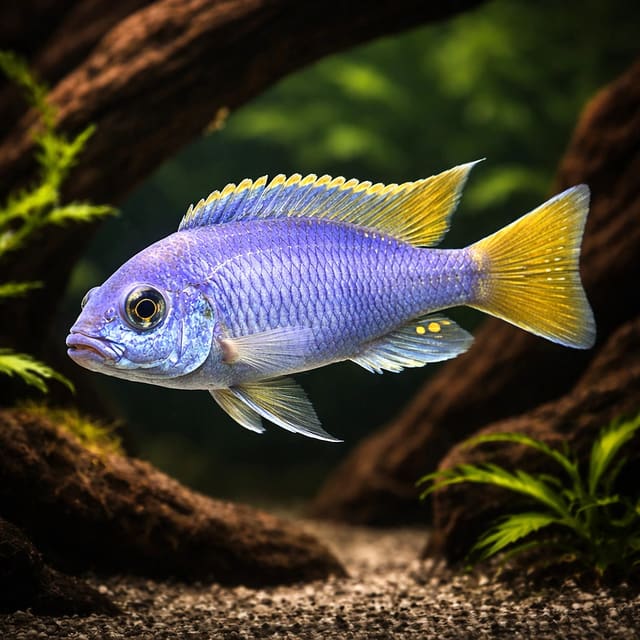
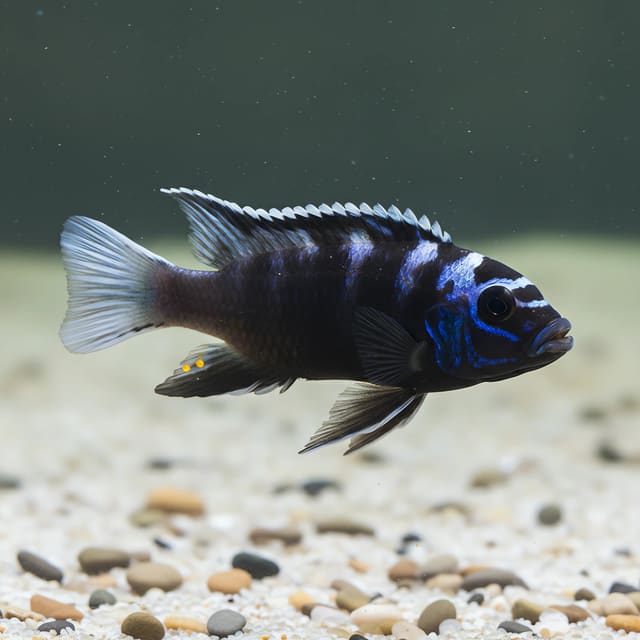
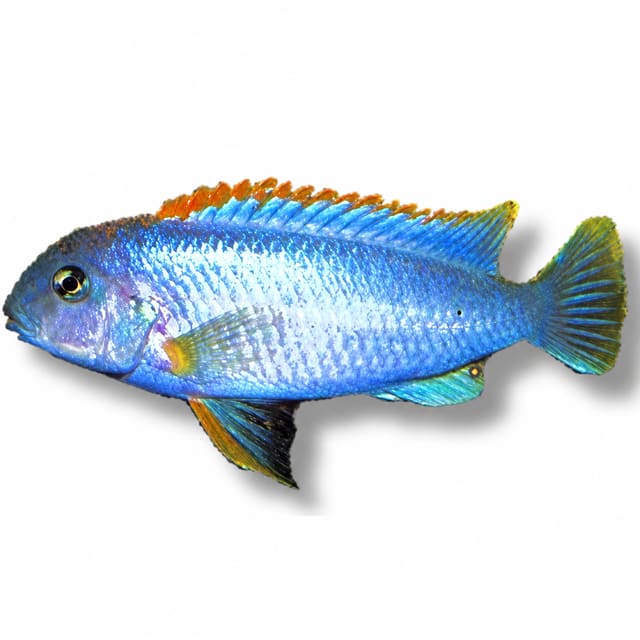
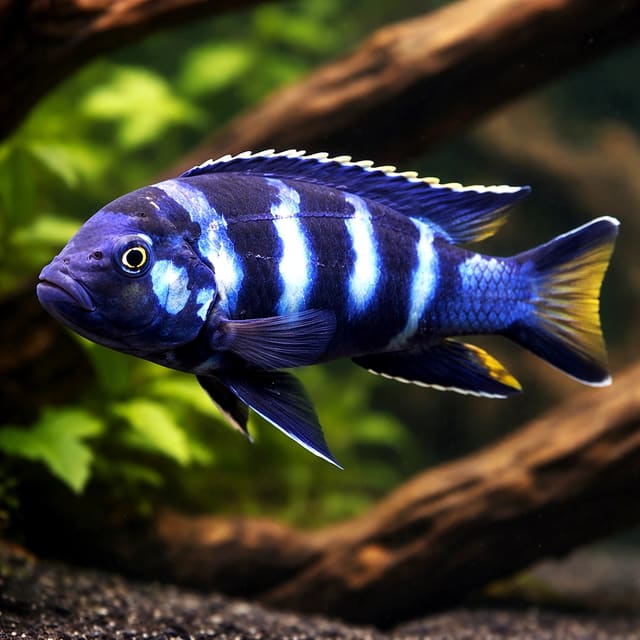
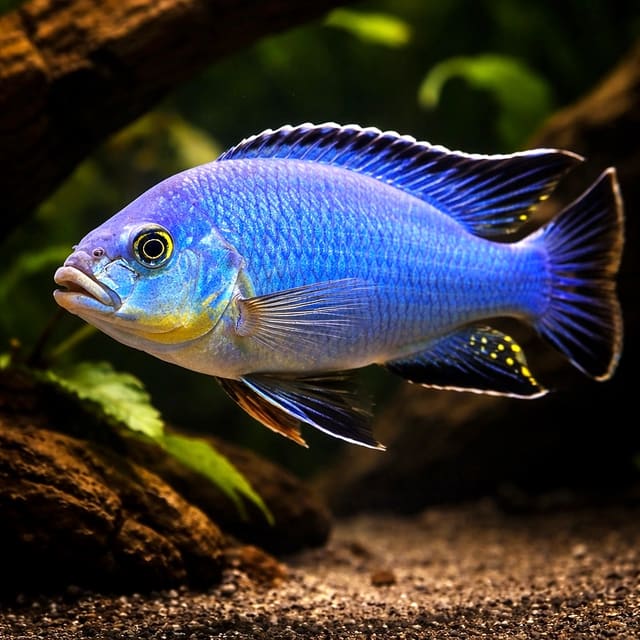
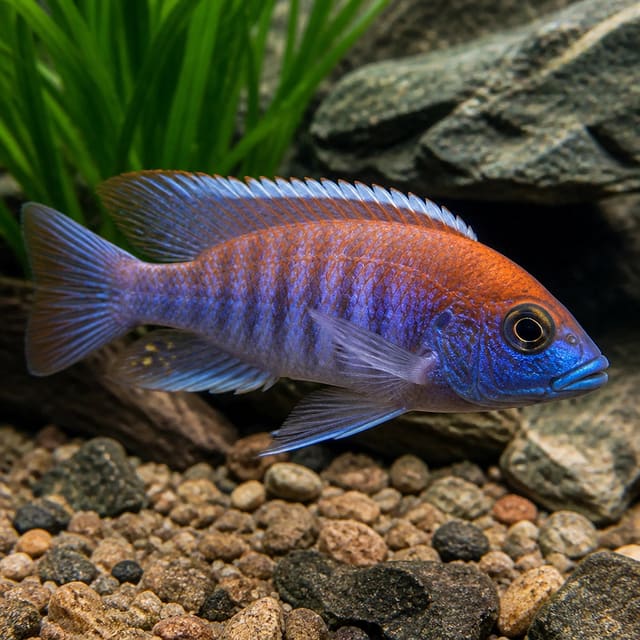
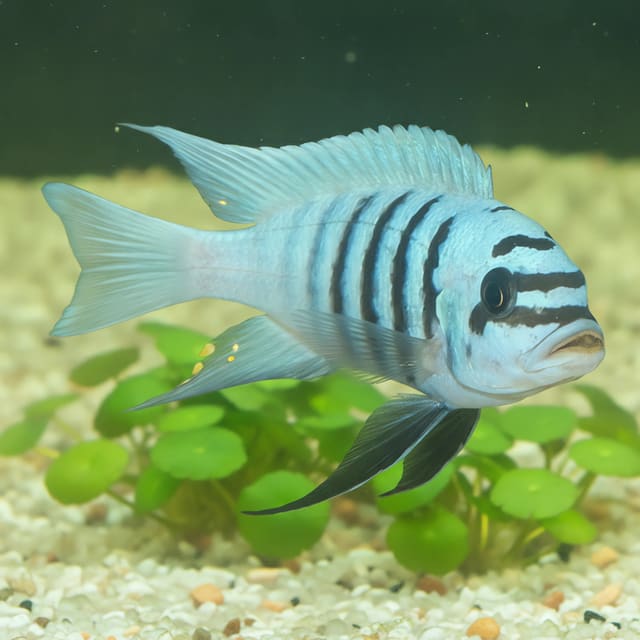
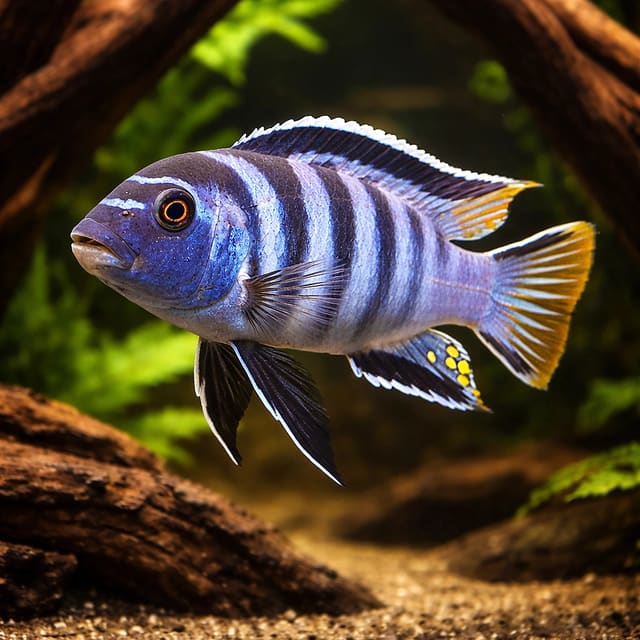
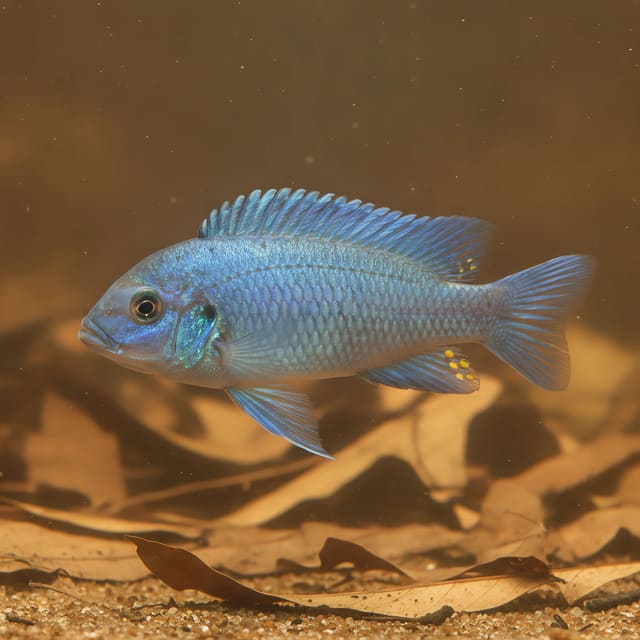
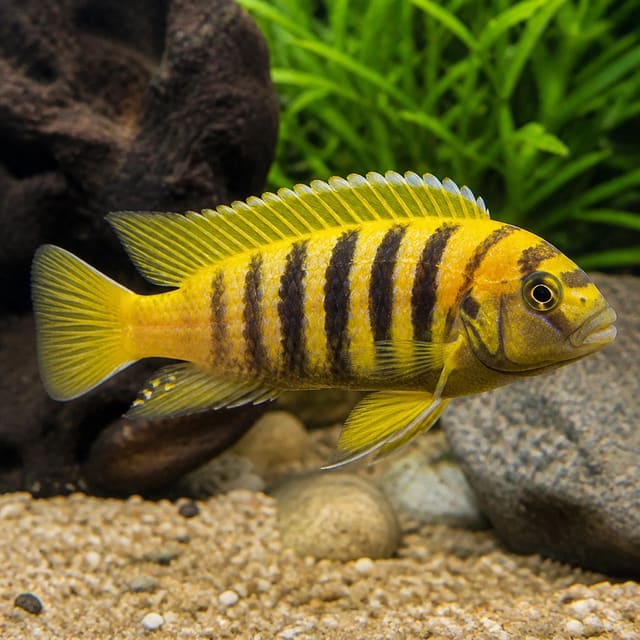
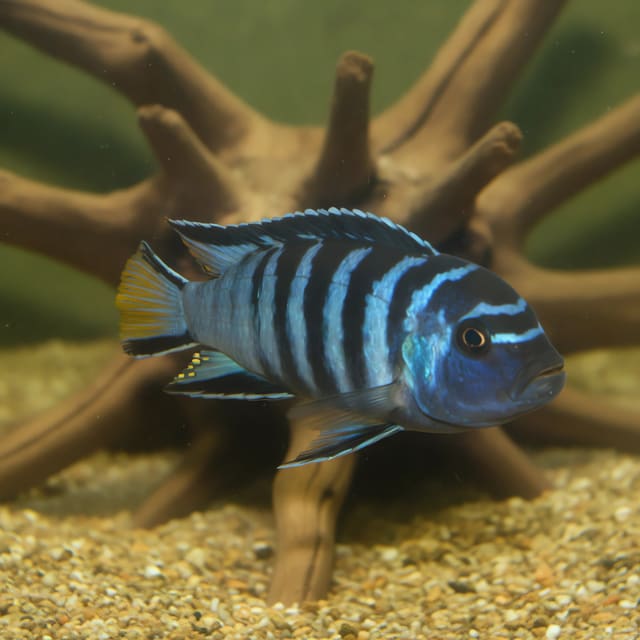
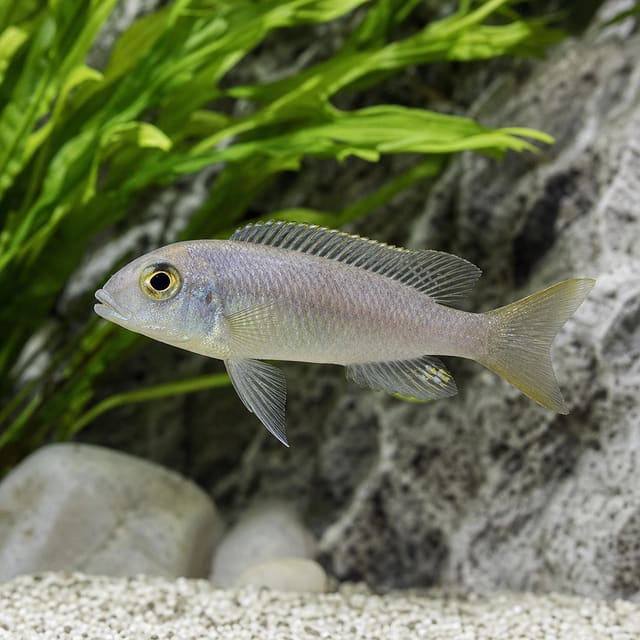
Some gallery images have been digitally enhanced to improve image quality. They show the listed type of animal rather than guaranteeing the exact markings of the individual supplied, so natural colour and pattern can vary. The images show representative blue-and-dark mottled cichlids in different scenes; they do not change the identity, quantity or sex terms of the offer.
Keep this fish only in a prepared Malawi-focused aquarium. OATA’s group values are 23–27°C, pH 8.0–8.6, general hardness of 12–18°dH and carbonate hardness of 10–15°dKH. Ammonia and nitrite must remain at zero mg/l, while nitrate must not exceed 20 mg/l above the normal tap-water level.
For a reasonable-sized Malawi cichlid community, OATA recommends an aquarium of at least 200 litres. It also says Malawi cichlids can be kept in groups of at least 15, with slight overcrowding used to spread aggression; Malawi cichlids kept in small groups will often fight. These are group-planning values rather than an individual minimum for Pseudotropheus sp. msobo.
| Suits | Not suited to |
|---|---|
| A deliberately planned Malawi cichlid community | A general peaceful mixed community |
| Hard, alkaline water at 23–27°C and pH 8.0–8.6 | Soft or acidic aquarium conditions |
| An aquarium of at least 200 litres for a reasonable community | A small aquarium chosen from the dispatch size |
| A group plan of at least 15 when using OATA’s group method | A small Malawi group; Malawi cichlids kept in small groups will often fight |
| Oversized filtration and aggressive aeration | An aquarium without a mature biological filter |
| Décor and substrate that can tolerate digging | Planting expected to remain undisturbed |
Browse the African cichlid collection only after setting the water, space and compatibility rules for the whole aquarium. Similar retail categories or shared water preferences do not make two fish automatic companions.
Use an aquarium of at least 200 litres for a reasonable-sized Malawi cichlid community, and choose a larger aquarium where practical. The 200-litre figure is OATA’s recommendation for the community, not a species minimum or a calculation based on one fish. Greater water volume also makes temperature and water quality more stable.
Fit a filter before adding fish. OATA recommends an oversized filter for the crowded conditions used in successful Malawi communities, together with aggressive aeration so enough dissolved oxygen remains accessible. Size the equipment for the intended final population and its waste, not for the first dispatch fish entering the aquarium.
The genus is associated with rock-dwelling mbuna, so use that biology to guide the overall Malawi character of the aquarium. Keep décor practical to rearrange because OATA recommends changing the layout when territorial aggression needs to be disrupted. Any heavy aquarium décor should remain stable while fish dig and shift substrate around it.
Do not use dispatch length as a shortcut to a temporary smaller aquarium. The 4–5 cm and 6–7 cm labels describe the fish at dispatch, while XL is an unmeasured grade. Every size enters the same long-term community plan.
Keep the aquarium at 23–27°C, pH 8.0–8.6, general hardness 12–18°dH and carbonate hardness 10–15°dKH. OATA sets these as guidance for the Malawi cichlid group, not a species-specific optimum for Pseudotropheus sp. msobo.
Maintain ammonia at zero mg/l and nitrite at zero mg/l. Nitrate must not exceed 20 mg/l above the normal level in the tap water used for the aquarium. This nitrate instruction requires a comparison with the source water rather than treating 20 mg/l as an absolute aquarium ceiling.
| Reading | Decision |
|---|---|
| 23°C, pH 8.2, 14°dH | These readings sit within the stated temperature, pH and general-hardness ranges. |
| 28°C | This is above the 23–27°C group range; correct the aquarium before adding fish. |
| Ammonia or nitrite above zero | The aquarium has missed the required target; postpone livestock additions and check the biological filter. |
| Tap nitrate 10 mg/l | The aquarium nitrate must not exceed 30 mg/l, which is 20 mg/l above that source-water level. |
| Tap nitrate 25 mg/l | The corresponding aquarium ceiling is 45 mg/l; keep comparing like-for-like readings. |
Use the water chemistry guide to understand the roles of ammonia, nitrite, nitrate, pH and hardness. Then enter actual test results into the water matcher to compare the measured aquarium with this Malawi range.
Test the aquarium before introduction and at least weekly thereafter. Treat replacement water with tap-water conditioner to remove chlorine or chloramine before it enters the aquarium. Keep the temperature, pH and hardness within the stated ranges through routine maintenance rather than waiting for fish behaviour to reveal a water problem.
Run a well-set-up, maintained biological filter in every aquarium. The RSPCA explains that fish release toxic ammonia, which filter bacteria convert first to toxic nitrite and then to the safer nitrate. A filter therefore needs an established bacterial population as well as water movement.
Mature the aquarium before fish arrive and confirm that ammonia and nitrite are both zero mg/l. Our first tropical aquarium guide helps organise preparation and maturation before livestock is introduced. A running filter alone is not enough if its bacterial population has not developed to process the waste produced by the planned fish.
Adding too many fish too quickly can produce new tank syndrome because the biological filter cannot yet process the increased waste. The resulting ammonia and nitrite can make fish ill or cause death. Group introduction is useful for managing aggression, but it still has to fit the filter’s biological capacity.
Resolve that tension during planning: establish an appropriately large aquarium and oversized filter, mature it fully, and map a gradual stocking sequence that still avoids leaving a small, conflict-prone Malawi group. The final decision should account for aquarium volume, filtration, water readings, intended group size and the aggression of every planned fish.
Feed only what the fish can eat within a few minutes, twice a day. This is OATA’s schedule for Malawi cichlids and provides a clear portion limit: food should be consumed promptly rather than collecting in the substrate or filter.
Start with a specialised Malawi cichlid food with a high algae content and include fresh vegetables as variety. OATA places this feeding approach with smaller mbuna species. Because Pseudotropheus sp. msobo is a genus-level mbuna label, use body condition, feeding response and water quality to keep the portion controlled rather than assigning a more detailed species diet.
| What you see | What to do |
|---|---|
| All food eaten within a few minutes | Keep the measured portion while condition and water readings remain steady. |
| Food remains after a few minutes | Reduce the next portion; uneaten food breaks down and releases toxic waste. |
| Reduced interest in food | Test water quality and look for changes in breathing, swimming, colour and behaviour. |
| Increasing or decreasing body condition | Reassess the measured portion and confirm that the fish is able to feed within the group. |
Do not turn “twice a day” into two large meals. The amount eaten within a few minutes is the controlling instruction at each feed. A crowded Malawi community can generate substantial waste, so excess food works directly against the zero-ammonia, zero-nitrite targets and the nitrate limit.
Variety should remain within the Malawi feeding plan. Fresh vegetables supplement the specialised food; they do not remove the need to measure each meal. Observe every fish at feeding time where possible, because a change in intake is one of OATA’s listed early signs that health or aquarium conditions may need attention.
At least once every week, change 25% of the aquarium water. Use a siphon to remove solid waste from the gravel, and treat all replacement tap water with conditioner to remove chlorine or chloramine before adding it to the aquarium.
Test ammonia, nitrite and nitrate at least once per week. Ammonia and nitrite must remain at zero mg/l, while nitrate must not exceed 20 mg/l above the normal tap-water level. Include temperature, pH and hardness in the routine so the aquarium remains within 23–27°C, pH 8.0–8.6 and 12–18°dH.
Use feeding and maintenance as observation points. Healthy fish should show clear bright eyes, undamaged fins, intact scales, appropriate swimming and an interest in food. Watch for hanging at the surface, sitting on the bottom, erratic swimming, unusual hiding, a change in aggression, faster or slower gill movement, darker or paler colour, white spots, fluffy growths, ulcers, bumps, lost scales or changing body condition.
| Change | First action |
|---|---|
| Ammonia or nitrite above zero | Check the filter and water quality before adding any more fish. |
| Nitrate above the tap-water allowance | Carry out the partial water-change routine and retest. |
| Filter blockage | Clean the affected media lightly in removed aquarium water. |
| Abnormal swimming, breathing, colour or feeding | Test the water immediately and compare the result with every target. |
If a concerning health change continues after the water has been tested, contact us for guidance. Do not substitute a guessed disease treatment for checking the aquarium’s measurable conditions.
Before adding fish, confirm that the aquarium is large enough for the intended Malawi community and that ammonia and nitrite are both zero mg/l. Check temperature, pH and hardness against the group ranges as well. A suitable introduction begins with the completed aquarium, not with adapting an unfinished system after the fish has arrived.
Increase the population slowly so the biological filter can adjust as fish numbers and feeding rise. OATA warns that stocking too quickly can cause new tank syndrome, allowing ammonia and nitrite to reach unhealthy levels. Retest after each increase and do not make the next addition while either reading is above zero.
Treat Pseudotropheus sp. msobo as an aggressive Malawi cichlid for the stocking decision. Do not assume a similar size, colour or retail category makes another fish compatible. Screen every proposed combination for Malawi origin, water needs, adult community space and likely aggression.
Where the sex of established fish is known, OATA recommends keeping more females than males of each species where possible, reducing the chance of one female being harassed. Build such a ratio only from fish whose sex is explicitly known; never infer it from a dispatch size, juvenile colour or gallery image.
Prepare the mature, tested aquarium before the parcel reaches you. The filter should already be running, and ammonia and nitrite should read zero mg/l. Be present to receive the parcel because live fish cannot be left unattended.
Keep the continuous video and order number. For a Live Arrival Guarantee claim, send them the same day, with the sealed parcel, continuous opening and fish inside the sealed bag clearly shown. Read the current delivery and Live Arrival Guarantee policy before the delivery date so the receiving and claim steps are understood in advance.
The policy describes fish as hand-bagged in pure oxygen and placed in an insulated poly box, with a heat pack used when the weather calls for one. These packing measures do not replace aquarium preparation: the Malawi system still needs mature filtration, suitable water and a completed stocking plan before release.
After release, use the established observation rules. Check swimming, breathing, colour, aggression and feeding response, and test water if any of those change. Keep later additions gradual so the filter can adapt to each rise in fish numbers and feeding.
Keep Pseudotropheus sp. msobo only with other Malawi cichlids or some species of Synodontis catfish that naturally inhabit Lake Malawi. OATA gives this as the compatibility boundary for Malawi cichlids. Fish outside those two categories should be avoided.
Neither permitted category is an automatic match. Malawi cichlids vary in aggression, size and behaviour, while only some Synodontis species meet the Lake Malawi condition. Screen the exact fish being considered rather than treating “African cichlid”, “catfish” or hard-water preference as sufficient.
| Question | Required decision |
|---|---|
| Is it a Malawi cichlid? | Continue the assessment, but still compare aggression, water and community space. |
| Is it a Synodontis catfish? | Continue only if that species naturally inhabits Lake Malawi. |
| Is it another kind of fish? | Avoid the combination. |
| Can it live at 23–27°C, pH 8.0–8.6 and 12–18°dH? | All permitted companions must fit the same Malawi water plan. |
| Can the full community fit the aquarium and filter? | Use at least 200 litres for a reasonable community and size filtration for the final population. |
| Will the plan leave only a small Malawi group? | Rework it, because OATA says small groups often fight. |
Similar dispatch size is not a compatibility guarantee, and the XL label does not describe a companion’s mature size. Plan with the adult requirements of every identified companion. For this genus-level fish, use the broad Malawi growth range conservatively rather than assigning a fixed adult length.
Ask us for a stocking and compatibility assessment with the aquarium volume, current fish list, intended additions and measured water values. The assessment must cover the whole community rather than approving one pair of names in isolation.
Assume aggressive behaviour when planning this aquarium. OATA describes Malawi cichlids as aggressive and says they should be mixed with caution. The group is not naturally social in the sense of forming a peaceful shoal, even though a deliberately structured group can be used to distribute aggression.
OATA says Malawi cichlids can be kept in groups of at least 15 and slightly overcrowded to spread aggression. It also warns that small groups often fight. This is permission to use a particular community method, not a requirement that every aquarium hold exactly 15 fish or that crowding will remove aggression.
Do not solve one problem by creating another. Adding fish to spread aggression without adequate filter capacity risks ammonia and nitrite; adding fish slowly without a final community plan risks leaving a small group that will often fight. Decide the aquarium volume, final group, filter capacity and introduction stages together.
Where sex is already known, OATA recommends more females than males of each species where possible to reduce harassment of one female. That recommendation does not permit visual sex assumptions. Use it only when the sex of the fish involved is explicit.
If aggression changes, test the water, inspect the group for damage or hiding, review whether the population has become too small, and consider rearranging décor. Continue to apply the Malawi-only boundary when making any change; an unsuitable outside fish does not become a solution to aggression within the group.
Use a conservative community plan rather than one fixed adult length. The name is genus-level; OATA says most Malawi cichlids grow to around 10 cm, while some grow up to 25 cm, so the selected dispatch size is not a mature-size promise.
OATA recommends an aquarium of at least 200 litres for a reasonable-sized Malawi cichlid community; this is group guidance, not a species minimum. Choose as large an aquarium as practical and plan it for the entire community.
OATA says Malawi cichlids can be kept in groups of at least 15 and that small groups often fight. This is a permitted group method, not a requirement for this exact genus label.
It can suit a beginner prepared to manage aggression, specialised hard alkaline water and a substantial filtered community. OATA calls Malawi cichlids usually undemanding but also aggressive, so preparation matters more than a simple care label.
Feed only what it can eat within a few minutes, twice daily. OATA’s Malawi guidance recommends specialised high-algae Malawi cichlid foods and fresh vegetables for smaller mbuna; monitor intake, condition and water quality for this genus-level fish.
OATA’s Malawi cichlid guidance gives 23–27°C, pH 8.0–8.6, general hardness of 12–18°dH and carbonate hardness of 10–15°dKH. Keep ammonia and nitrite at zero mg/l.
Plan for aggression and watch for damaged fins rather than relying on a separate fin-nipping label. OATA describes Malawi cichlids as aggressive; monitor changes in aggression, hiding, swimming, breathing and feeding.
OATA says Malawi cichlids should only live with other Malawi cichlids or some Synodontis catfish that naturally inhabit Lake Malawi. Screen every permitted companion for aggression, water needs, community space and group structure.
Start filming the sealed parcel before opening it or floating the bag. Keep the outer box visible, open it the same day in one continuous take, show the fish inside the sealed bag, then float the bag for 20–30 minutes before releasing the fish without pouring bag water into the aquarium.
No reviews for this item yet. Bought one? Honest reviews only, good or bad.
What customers say about ordering from us
I have a small group of long finned mountain minnows. So was delighted to be able to order ten of this variety to increase the genetics in my tank . The ones I recieved are healthy but it’s to early to give a verdict on wether they are of a long finned type since they are small currently.
Gordon Walker · 23 Sept 2026
100% success travel and "installation". Pleased with quality of purchase. The Siamese fighter a bit "shy" so have not yet seen him at his best yet but looking good. Happy customer. GG
George E Garratt · 21 Sept 2026
Reviews of our shop, collected by Judge.me, an independent third-party review collector. Newest first.