Moderate
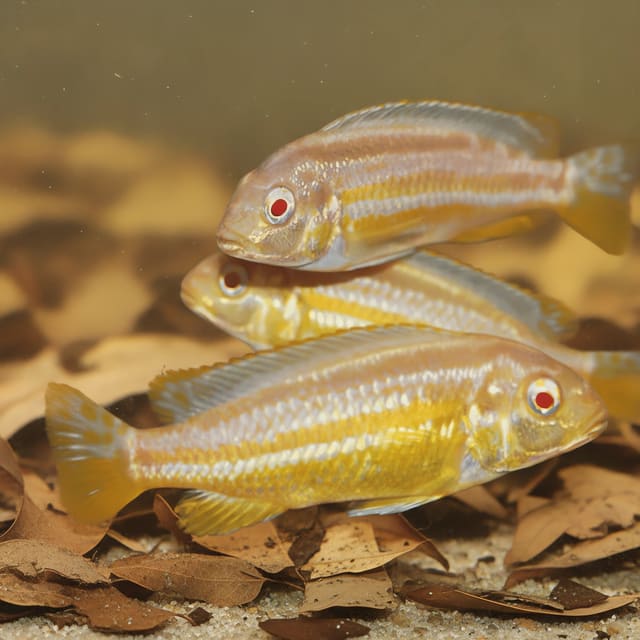
Acei Cichlid (Pseudotropheus sp. “acei”)
24–26°C · pH 7.5–8.5 · 300L
£7.99
Maingano Mbuna (Melanochromis cyaneorhabdos) is a vivid, territorial Lake Malawi cichlid for experienced keepers with a mature, hard-water mbuna aquarium. One purchase supplies one fish; sex is not selectable.
Adult size is the maximum length this species reaches at full maturity (scientific sources). The livestock you receive will be younger and smaller. Product-photo provenance and any image-specific limitations are stated on the listing.
Melanochromis cyaneorhabdos
Shoaling fish: kept in a group they feel safer, stay calmer and show their best colour.
Maingano Mbuna (Melanochromis cyaneorhabdos) is a vivid, territorial Lake Malawi cichlid for experienced keepers with a mature, hard-water mbuna aquarium. One purchase supplies one fish; sex is not selectable.
Adult size is the maximum length this species reaches at full maturity (scientific sources). The livestock you receive will be younger and smaller. Product-photo provenance and any image-specific limitations are stated on the listing.
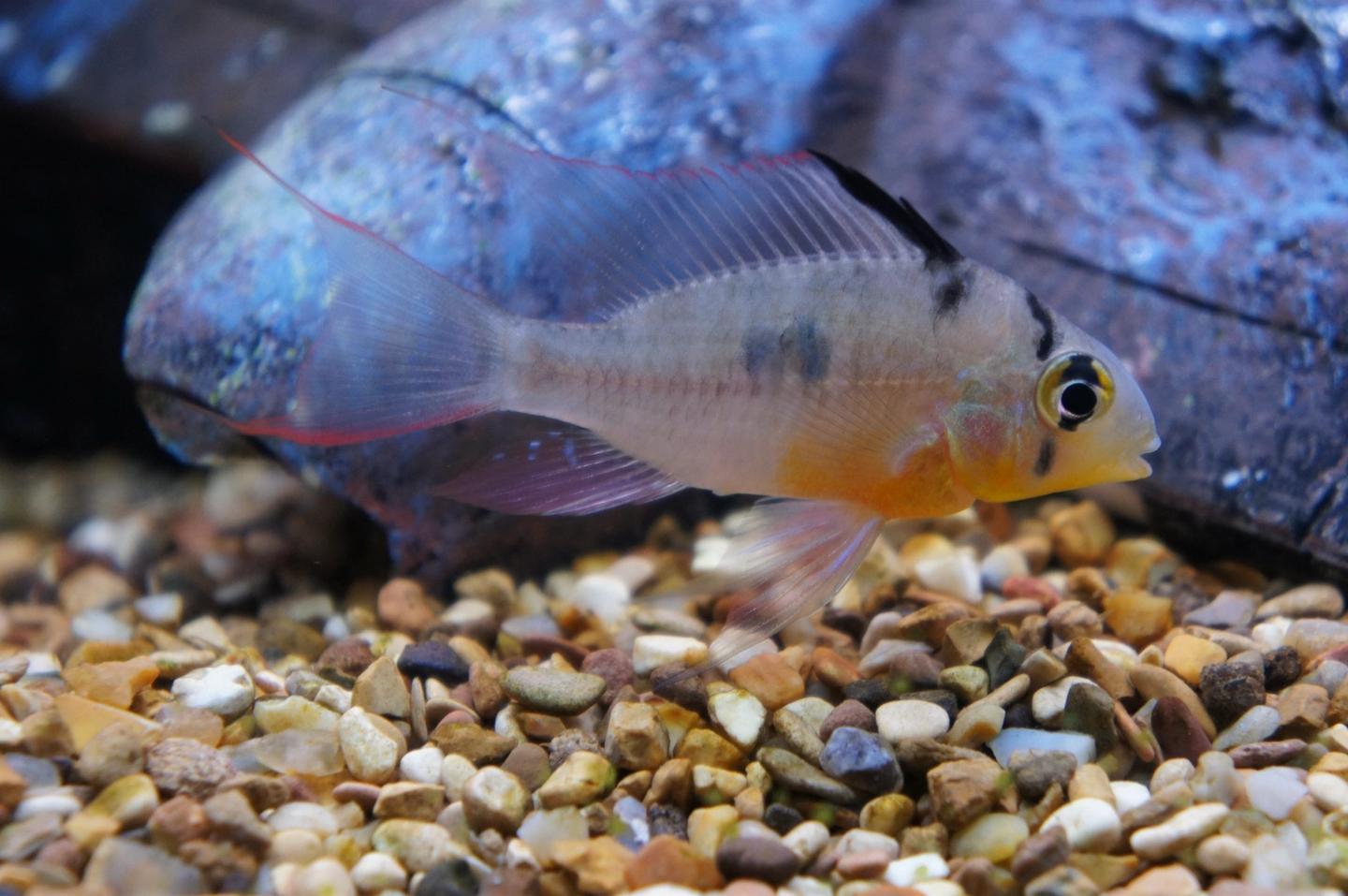
Cichlids are a family of roughly 1,800 accepted species, not one care type. Before buying, identify the exact species and source, then compare adult measurement, usable tank dimensions, social system, territory, tested water, diet and an exit plan. No family-wide minimum tank, water range or tank-mate list is safe.
Maintain these water conditions for optimal health and vibrant colors
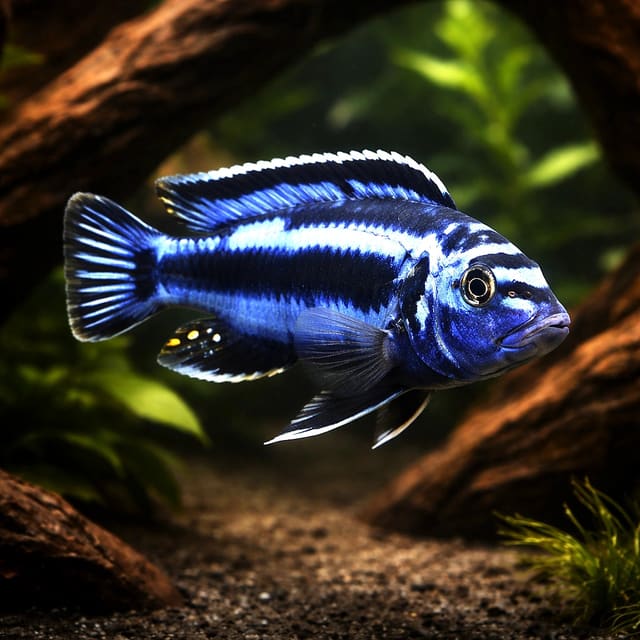
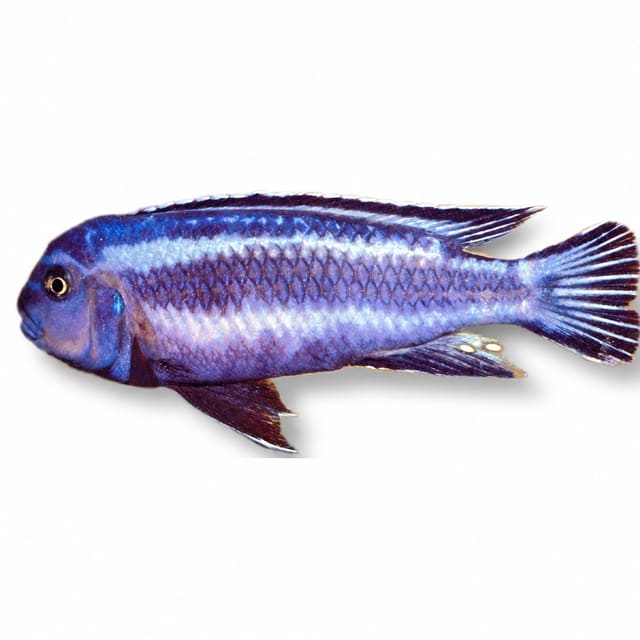
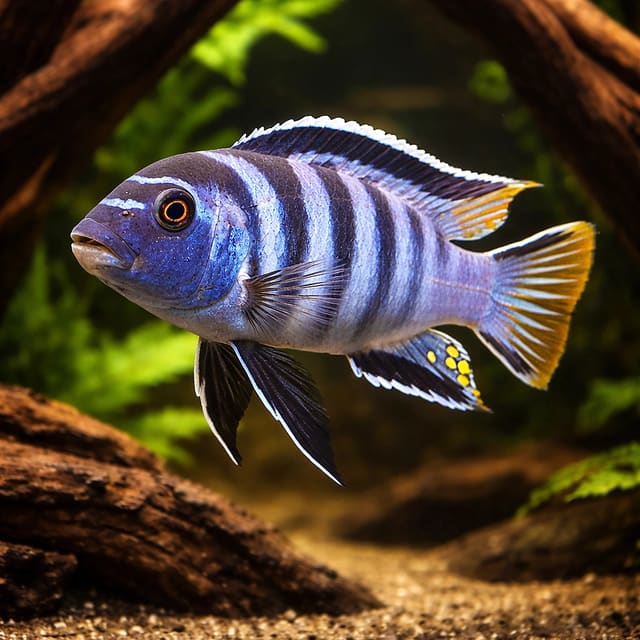
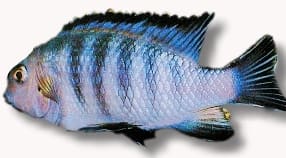
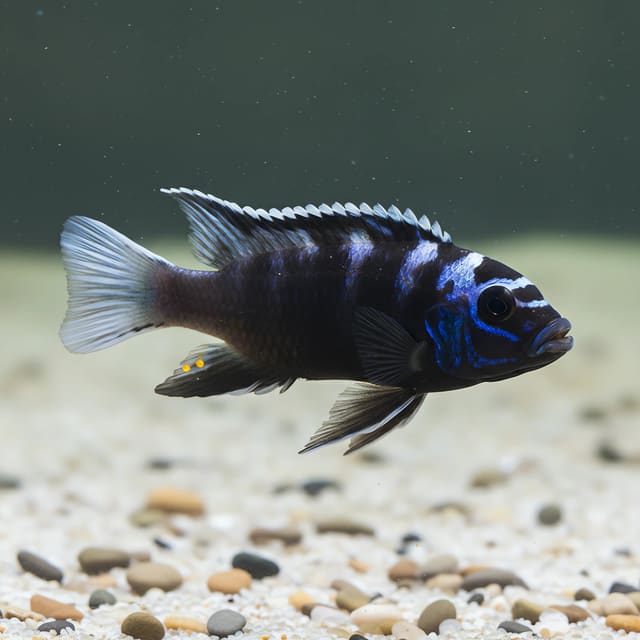
Maingano Mbuna (Melanochromis cyaneorhabdos) is a compact but forceful rock-dwelling cichlid from Lake Malawi. Its deep blue body and horizontal blue-black pattern make it immediately recognisable, yet its real buying question is not colour: it is whether the aquarium and keeper can manage a territorial mbuna properly. This is a specialist community fish for an established hard-water cichlid aquarium, not a blue centrepiece to add casually to a peaceful tropical community.
One purchase supplies one live fish. The supplier dispatch record for this line gives a size of 3–4 cm; that is the size sent, not the adult size. Sex is guaranteed only when the selected option explicitly states male or female. This Maingano Mbuna listing has no sex-guaranteed option. The two sexes can be difficult to distinguish because both may show similar blue patterning. Do not build a promised male-to-female ratio from unsexed juveniles. If a precise breeding group is the goal, the practical plan needs enough space, time and contingency to manage fish whose sex becomes clearer only as they mature.
| Suits | Experienced African cichlid keepers planning a dedicated or carefully matched Lake Malawi mbuna aquarium |
|---|---|
| One purchase | One live, unsexed fish; supplier dispatch grade 3–4 cm |
| Adult planning size | Use the more conservative published figure of 10 cm standard length |
| Water | 24–28 °C, pH 7.6–8.8, 10–25 dGH from the species aquarium profile |
| Space | At least a 90 × 45 cm base; the cited example volume is about 154 litres |
| Main challenge | Territorial aggression, conspecific intolerance and maintaining stable, oxygen-rich water under a substantial bioload |
The shop name follows the supplied and catalogue identity Melanochromis cyaneorhabdos. FishBase now lists Pseudotropheus cyaneorhabdos as the accepted name and treats Melanochromis cyaneorhabdos as a synonym. That is a taxonomic name change, not a different animal. “Maingano” is also an older trade and locality-linked name, while “electric blue johanni” is a misleading label because the species should not be confused with Melanochromis johannii. Keeping the synonym bridge explicit helps a buyer match older books, shop labels and newer records without assuming that several blue fish names describe the same species.
Published adult-size evidence differs. FishBase records 7.5 cm standard length, whereas the specialist aquarium profile records 100 mm standard length. Standard length excludes the tail fin, so neither figure should be compared directly with a casual nose-to-tail estimate. For stocking and cave size, use the larger 10 cm standard-length record. A smaller dispatch fish still needs an aquarium designed for its mature territorial behaviour from the start.
Wild records place the species among rocky habitat in Lake Malawi, where it feeds on zooplankton and small invertebrates associated with the rock surface. In the aquarium, that background translates into constant investigation of rock faces, crevices and territory edges. A bare tank removes both shelter and the visual boundaries that help fish avoid one another. A good layout therefore offers caves, shaded gaps and separate routes around the hardscape, while retaining open water for movement.
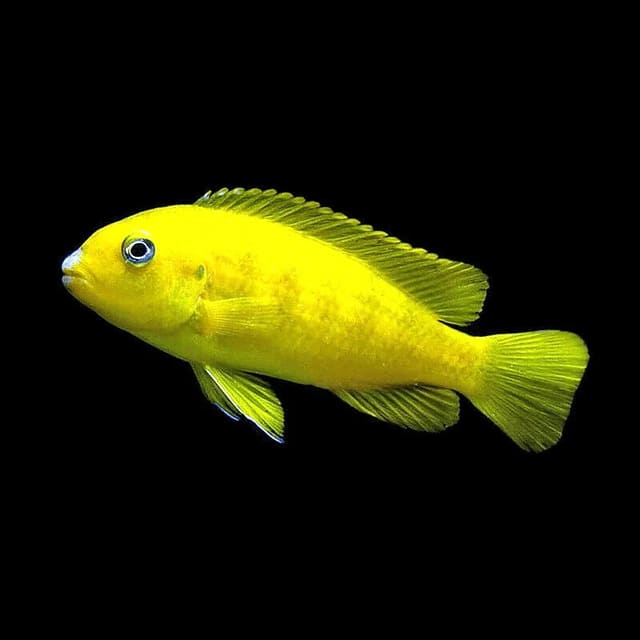
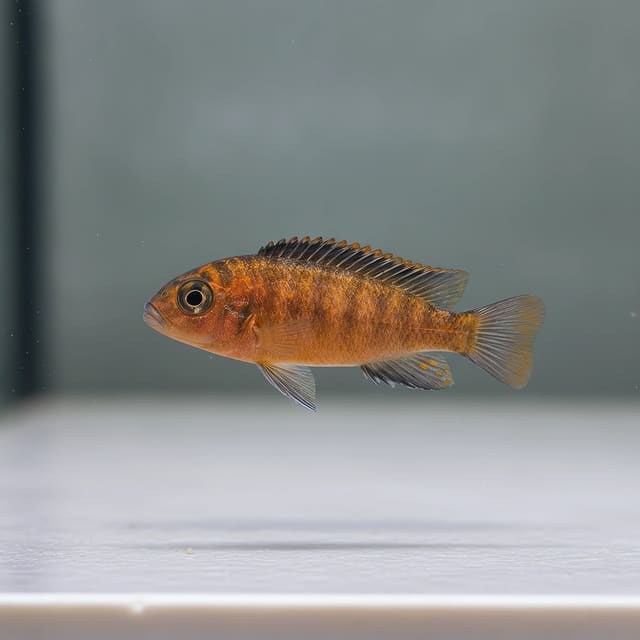
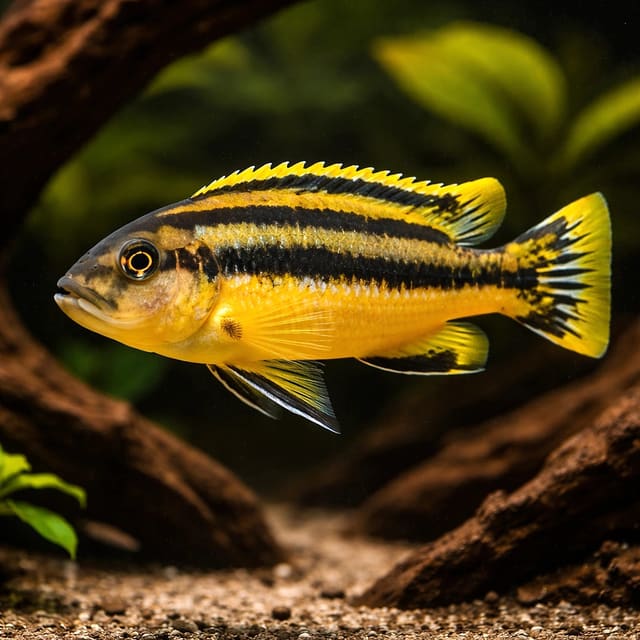
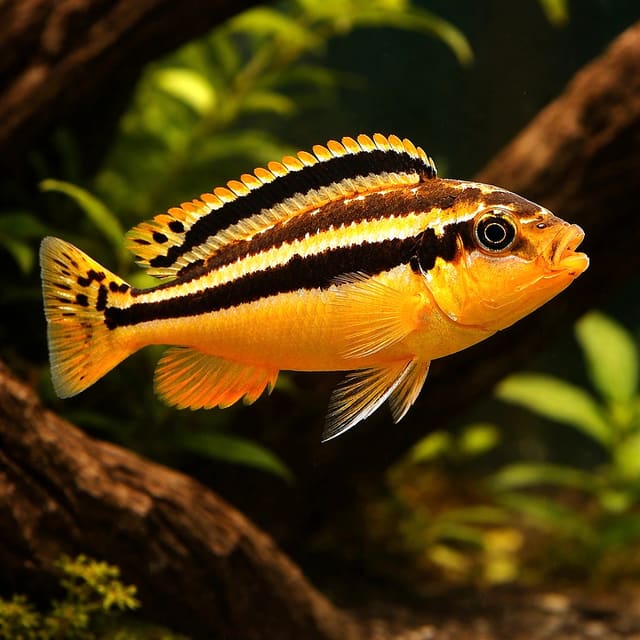
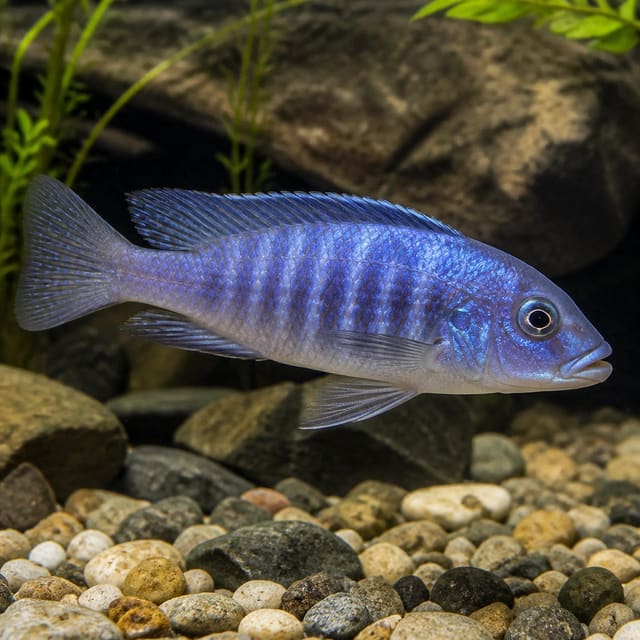
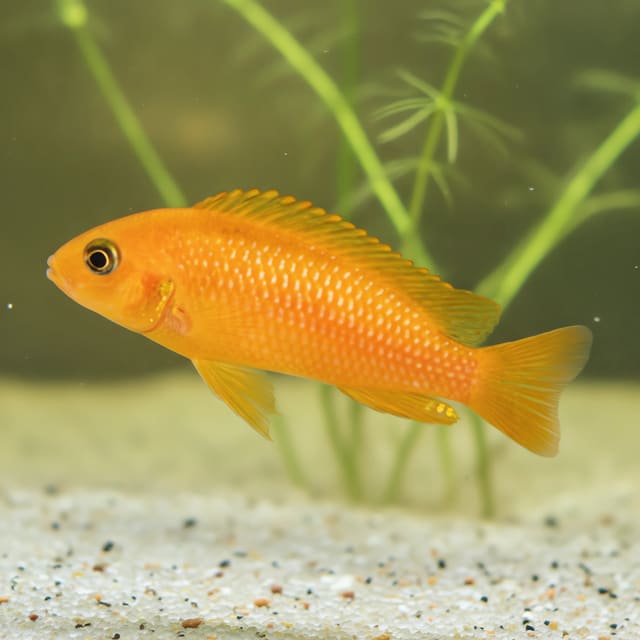
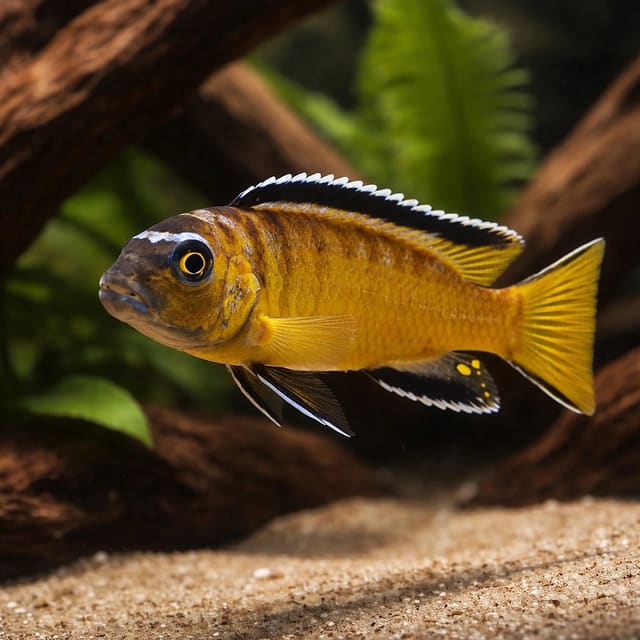
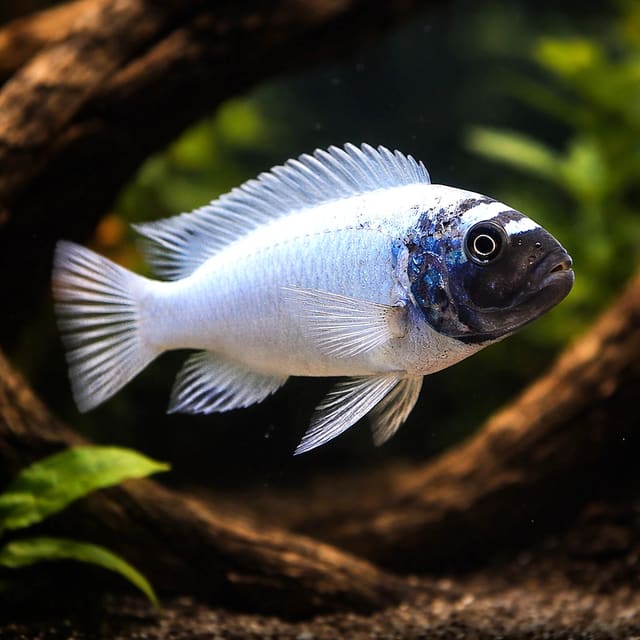
Colour can intensify or soften with maturity, social context, lighting and condition. It is not a reliable promise of sex, rank or the exact shade a newly arrived juvenile will show. The gallery is there to show the characteristic blue-striped type rather than to promise an identical individual. Gallery images have been digitally enhanced to improve image quality. Natural colour, pattern, size and maturity can vary between live animals.
You can compare other animals carried in the African cichlid collection, but shared collection placement does not prove that two species can live together. Compatibility always depends on the exact aquarium, its footprint, rockwork, group structure and the individual fish already present.
Successful care starts with stability and structure. Maingano Mbuna is not delicate in the sense of requiring soft, chemically unusual water, but it is unforgiving of an immature filter, inappropriate companions or an aquarium that gives one dominant fish an uninterrupted view of every other fish. Build the environment first, prove that it is biologically stable, and only then decide whether the stocking plan can absorb another territorial cichlid.
The species profile recommends an aquarium base of 90 × 45 cm and gives an example volume of about 154 litres for a 90 × 45 × 38 cm tank. Treat the footprint as a central requirement. Tall water above a short base does not create the same number of territories or escape routes. Larger aquariums can provide more useful separation, but only if the hardscape actually breaks sight lines rather than forming one open arena around a central ornament.
Build much of the aquarium from stable piles of rock with caves and small open-water spaces between them. Set heavy rocks securely so digging cannot undermine them. A sandy substrate suits the species profile and lets fish sift and rearrange the surface without sharp gravel. Create more potential shelters than there are fish likely to claim them, and vary entrance size and direction. A chased fish should be able to leave a territory without crossing straight through another fish’s defended patch.
Plants are optional rather than a substitute for rock structure. Malawi cichlids will often dig and uproot plants, and a planted scene can still be poor habitat if it lacks solid retreats. If plants are used, choose tough specimens that tolerate alkaline water and protect their roots. Leave access for siphoning detritus from sheltered zones because waste can settle where circulation is weak.
| Temperature | 24–28 °C |
|---|---|
| pH | 7.6–8.8 |
| General hardness | 10–25 dGH |
| Ammonia | 0 mg/l |
| Nitrite | 0 mg/l |
The first three values come from the species aquarium profile. The zero ammonia and nitrite targets are core aquarium welfare requirements also reflected in the broader OATA guidance. Aim for a stable point inside the species range that suits the whole Lake Malawi community. Avoid chasing a nominal “perfect” number with abrupt additions of buffer. Measure the source water, understand its carbonate hardness and make changes gradually through a consistent water-change routine.
Test the aquarium rather than assuming hard-looking décor has produced hard water. The water chemistry guide explains the role of the main readings, and the water matcher helps compare measured values with the stated range. Record temperature, pH and hardness over time. A steady value within range is generally safer than repeated swings caused by trying to hit an exact midpoint.
A working biological filter is essential because fish release ammonia, which beneficial bacteria process first into nitrite and then nitrate. Both ammonia and nitrite must remain at zero. The species profile calls for well-oxygenated water and, in its example 154-litre aquarium, discusses turnover of four to five times the aquarium volume per hour. That example is useful for scale, but actual filter selection must allow for head height, media, maintenance and the stocking load rather than relying on the number printed on a box.
Use circulation to prevent stagnant pockets without turning every cave into a high-speed jet. Watch fish behaviour: rapid breathing, gathering near the surface or unusual inactivity calls for an immediate check of temperature, oxygenation and water quality. Clean blocked intakes promptly. When filter media needs rinsing, use removed aquarium water and do not run it under the tap, because chlorine or chloramine can destroy the bacterial population the filter depends on.
If this is a new aquarium, complete a full fishless maturation process and confirm that the filter can handle waste before livestock is introduced. The first tropical aquarium guide covers the preparation sequence. Adding several fish quickly can outpace the filter’s bacteria even when a tank has been running for some time, so increase bioload deliberately and keep testing after each change.
OATA’s broader Malawi cichlid sheet recommends a partial water change of 25% at least once every week, alongside regular testing. Use that as a practical group-care baseline and adjust only from actual readings and stocking load. Match replacement water for temperature and chemistry, and always treat tap water for chlorine or chloramine before it reaches the aquarium. Siphon loose waste from the sand and behind rocks while leaving established biological media intact.
The specialist profile says this species accepts many foods but should receive a large proportion of vegetable matter, including spirulina foods and suitable blanched greens, with live and frozen foods as supplements. That differs from treating it as either a strict algae eater or a carnivore that should receive rich animal food at every meal. Use a reputable prepared Malawi or mbuna food as the reliable base and add modest variety.
Offer portions that are cleared promptly. In a territorial community, scatter food across more than one area so a dominant fish cannot monopolise a single feeding point. Observe the quieter fish rather than judging the meal by the fastest feeder. Remove leftovers, because uneaten food adds waste and can push a heavily stocked system towards poor water quality. Appetite changes can be an early warning of bullying or illness, so note who eats rather than simply whether food disappears.
Avoid sudden wholesale diet changes. Introduce a new food in small amounts and watch acceptance and condition. The evidence supplied here does not support a treatment regime or a precise therapeutic diet, so a fish that stops eating, swells or produces abnormal waste needs water testing and qualified advice rather than improvised medication.
Prepare the aquarium, testing equipment and receiving area before the parcel arrives. Someone must be at the address to receive live fish. The current delivery and Live Arrival Guarantee guidance explains the courier, packaging, evidence and contact process.
Do not combine arrival with a major rescape, filter clean and large chemistry correction unless a safety issue demands it. The new fish already faces transport stress. Stable water, prepared refuge and close observation give it a clearer start.
Learn the normal posture, breathing and feeding response of each fish. Warning signs include surface hanging, bottom sitting, erratic swimming, unusually dark or pale colour, damaged fins, scale loss, rapid gill movement, hiding that prevents feeding and loss of body condition. These signs do not diagnose a disease, but they do justify immediate water tests and a review of aggression.
Separate causes before choosing a remedy. A fish pinned behind a heater may be bullied; several fish breathing rapidly may point to oxygen or water-quality trouble. Check ammonia, nitrite, temperature and equipment first. If concern remains, seek informed aquatic-veterinary or specialist advice. Avoid adding medication to a whole community on guesswork, especially when the actual problem may be unstable water or a social mismatch.
Use the first week to confirm both physical recovery from transport and social access to the aquarium. On the first day, concentrate on breathing, balance and whether the fish can reach cover without being trapped there. A newly introduced fish may spend time sheltered, but it should not be driven back into the same corner every time it emerges. Check again after the room has been quiet, because aggression that pauses while a person stands at the glass can resume when the fish are undisturbed.
At the next feeds, place small amounts in separated areas and watch the new fish take food. Do not keep adding food simply because it missed the first pass; excess will degrade water while a dominant fish continues to eat. Instead, change the delivery point, use the rockwork to interrupt the dominant fish's view and decide whether separation is needed. A fish that cannot feed for repeated meals needs action, not a longer waiting period.
Test ammonia and nitrite more often than usual after adding livestock, especially in a heavily stocked mbuna aquarium. The filter may be mature, but a new fish still increases waste. Compare readings with the routine log rather than waiting for visible distress. Also check the heater, air flow and filter outlet after any arrival-day work around the tank; equipment can be knocked or a valve partly closed without being obvious.
By the end of the first week, review the social pattern rather than looking only for torn fins. Useful questions are whether the fish uses more than one part of the aquarium, whether it can eat without prolonged pursuit and whether its breathing settles after normal activity. If the answer remains no, revise the stocking or use the prepared separation aquarium. Continuing exposure does not teach a weak fish to tolerate relentless aggression.
Compatibility is the most demanding part of this species. The specialist profile describes Maingano Mbuna as aggressive, territorial and intolerant of others of its own species. It specifically advises against peaceful fish such as peacocks or utaka, while allowing carefully selected other mbuna. That is a conditional starting point, not a universal tank-mate list.
Assess companions by adult size, activity, feeding speed, water needs and aggression style. Fish that merely tolerate the same pH can still be a poor match. A peaceful fish may be chased continually; a similar blue striped fish may be treated as a rival; and another highly aggressive mbuna can turn the aquarium into overlapping defended territories. Add the footprint, rock layout and escape routes to the decision before naming any species as suitable.
The broader Malawi guidance discusses slightly heavier stocking as one way experienced keepers distribute aggression, but crowding is not a substitute for adequate space, filtration or observation. More fish increase waste and oxygen demand. A plan that uses density to manage behaviour therefore needs intentionally oversized biological filtration, vigorous aeration and a realistic maintenance routine. Never use that principle to squeeze a community into a small aquarium.
Seriously Fish describes one male with at least three females for a breeding group because several females can spread male attention. This particular offer is unsexed. Both sexes can show similar colour, especially when young, and males may only grow slightly larger. Buying four juveniles does not guarantee one male and three females. The result may be several males, an unsuitable ratio or a fish that remains difficult to sex.
If keeping more than one, provide excess refuges and expect the social arrangement to change as the fish mature. Watch whether every fish reaches food and can spend time in open water. A fish that hides continuously, loses colour, clamps its fins or is chased whenever it emerges is not “settling in” indefinitely. Intervene before it loses condition. The ability to separate fish is part of the stocking plan, not an emergency afterthought.
Robust Lake Malawi mbuna with comparable water needs may work in a spacious, well-structured setup. Choose fish that differ enough in appearance and territorial niche to reduce direct rivalry, while avoiding an extreme mismatch in size or aggression. Add less aggressive fish before the more assertive species where practical, and rearrange part of the rockwork when adding fish so no resident retains every established boundary.
Avoid other Melanochromis species because the specialist profile warns about possible hybridisation. Hybridisation matters even when fry are not deliberately sold: it makes identity uncertain and can produce offspring that should not circulate as a named species. It is also sensible to avoid very similar blue-striped fish that invite mistaken identity or direct rivalry.
No compatibility table can predict every fish. Territorial behaviour varies with maturity, sex, spawning condition and the aquarium’s layout. Check the community at feeding time and again when fish are not distracted by food. Look for access to shelters, repeated pursuit, torn fins and fish hovering in corners. A temporary lull after lights change is not proof that the conflict is resolved.
When adding a fish, have a clear threshold for action: repeated targeted chasing, inability to feed or visible injury means the plan needs intervention. Sometimes a careful rescape can reset territories; sometimes the only responsible answer is permanent separation. Do not keep experimenting at the expense of the weaker fish.
Suppose an aquarium already contains active, robust Malawi mbuna and has the right water range. That clears only the first hurdle. Next, compare adult size and visual similarity: a fish of comparable build but a very similar blue-striped pattern may attract more direct rivalry than a differently patterned species. Then trace the hardscape from one end of the tank to the other. If a dominant fish can see every cave entrance from one central position, add visual breaks before adding livestock.
Now consider resources. Each fish needs a realistic route to food, shelter and open water. One large cave is not the same as several defensible spaces, and a feeding routine at one fixed point can let the most forceful fish control every meal. Finally, compare filtration and maintenance capacity with the complete proposed bioload. A socially plausible addition can still be irresponsible if it pushes the aquarium beyond reliable oxygenation and waste processing.
This review can also produce a clear no. A peaceful peacock aquarium with open swimming space and limited rockwork may share Lake Malawi chemistry, but the species profile specifically rules out that temperament match. The correct decision is not to add more caves and hope; it is to choose a fish suited to the community already being kept. Water compatibility is necessary, never sufficient.
This species is a maternal mouthbrooder. The specialist account describes a male displaying around a spawning site and a female collecting eggs in her mouth. Courtship can intensify male aggression, which is why rock structure and female refuge matter even in a non-commercial home breeding group. Breeding information should not be treated as a recommendation to produce fry unless the keeper can house and identify them responsibly.
Because the listing does not guarantee sex, do not buy one animal expecting a female or male. Nor should a customer infer sex from the gallery: colour overlap between the sexes makes that unreliable. Choose the fish for a suitable mbuna aquarium first; treat any later breeding as a separate responsibility.
If any answer is no, revise the community before ordering. A beautiful fish is only a good purchase when the aquarium can support its natural territorial behaviour without sacrificing the welfare of its companions.
Maingano Mbuna has two published standard-length records in the supplied references: 7.5 cm and 10 cm. Plan around the more conservative 10 cm standard-length figure; the fish supplied for this line is a smaller dispatch-grade animal, not a fully grown adult.
Use an aquarium with at least a 90 × 45 cm base; the species profile equates its example 90 × 45 × 38 cm aquarium to about 154 litres. The footprint, rock layout, filtration and stocking plan all matter because this is an active, territorial mbuna.
The species profile describes a breeding group of one male with at least three females, but this listing is not sex-selectable. Do not buy an arbitrary small group and assume that ratio: plan the whole mbuna community and have a safe way to separate a relentlessly bullied fish.
It is better for an experienced cichlid keeper. The water itself is not unusually difficult to maintain, but territorial aggression, stocking balance, rockwork, diet and the need for strong filtration make mistakes more consequential than they are in a peaceful community aquarium.
Use a quality prepared food with an algae or vegetable emphasis, such as spirulina-based flakes or pellets, and supplement with suitable live or frozen foods in moderation. Feed amounts the fish clear promptly and remove leftovers so they do not add avoidable waste.
The species aquarium profile gives 24–28 °C, pH 7.6–8.8 and 10–25 dGH. Keep values stable within that range, with ammonia and nitrite at zero, rather than chasing a precise midpoint with sudden chemical adjustments.
Yes. It is described as aggressive and territorial, and persistent chasing can injure weaker fish even when fin nipping is not the only problem. Use substantial rockwork and broken sight lines, monitor individuals closely and act early if one fish is pinned into hiding.
A carefully planned community of robust Lake Malawi mbuna is the relevant starting point. Avoid peaceful species, peacocks and utaka, and avoid other Melanochromis species because of hybridisation risk; never treat a product shown as an alternative purchase as proof of compatibility.
Tropical Fish Co hand-bags the fish in oxygen, uses an insulated box and adds a heat pack when conditions call for it, then sends it with a licensed live-animal courier. Be present to receive it, record the sealed parcel being opened for any Live Arrival Guarantee claim, inspect it the same day and follow the current delivery guidance before release.
The care ranges and behaviour above are drawn from sources with different scopes. Species records establish identity and recorded size; the specialist aquarium profile provides species-level husbandry; OATA and the RSPCA provide broader UK aquarium-welfare context; Tropical Fish Co’s delivery page governs packing, arrival and claim steps.
Taxonomy changes over time. The product title retains the supplied name Melanochromis cyaneorhabdos, while the structured accepted name follows FishBase’s Pseudotropheus cyaneorhabdos. This synonym bridge keeps the offer recognisable without presenting the older combination as the currently accepted taxon.
No reviews for this item yet. Bought one? Honest reviews only, good or bad.
What customers say about ordering from us
Easy website plenty of info on fish your buying great to pick a time slot
TRACEY DURRANT · 7 Oct 2026
Got some lovely fish thank you
Kevin Mackie · 7 Oct 2026
Reviews of our shop, collected by Judge.me, an independent third-party review collector. Newest first.