Moderate
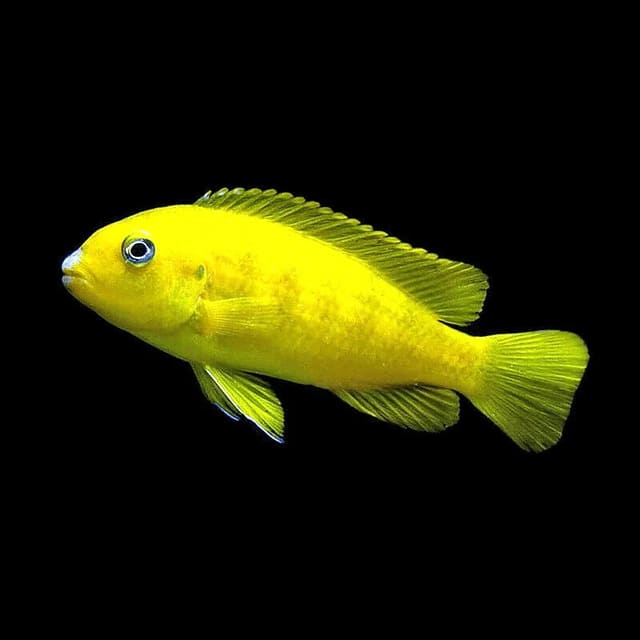
Acei Cichlid (Pseudotropheus sp. “acei”)
24–26°C · pH 7.5–8.5 · 300L
£7.99

Red Johanni Cichlid (Pseudotropheus johannii) is the red-orange trade form of a rock-dwelling Lake Malawi cichlid, suited to a hard, alkaline aquarium full of rockwork. It is sold as one live fish per purchase in three sizes from 3–4 cm to 6–7 cm and belongs in a group with other Malawi cichlids.
Pseudotropheus johannii
Save when buying multiple fish. Each quantity is one fish; sex and pair formation are not guaranteed unless the selected variant explicitly states them.
Red Johanni Cichlid (Pseudotropheus johannii) is the red-orange trade form of a rock-dwelling Lake Malawi cichlid, suited to a hard, alkaline aquarium full of rockwork. It is sold as one live fish per purchase in three sizes from 3–4 cm to 6–7 cm and belongs in a group with other Malawi cichlids.

Cichlids are a family of roughly 1,800 accepted species, not one care type. Before buying, identify the exact species and source, then compare adult measurement, usable tank dimensions, social system, territory, tested water, diet and an exit plan. No family-wide minimum tank, water range or tank-mate list is safe.
Maintain these water conditions for optimal health and vibrant colors
The Red Johanni Cichlid is a rock-dwelling cichlid from Lake Malawi, supplied here in its red-orange trade form. It is a busy, territorial fish that belongs in a hard-water Malawi aquarium built from rock, sand and plenty of company of the right kind. One purchase is one live fish of the size you select, from 3–4 cm to 6–7 cm, and every size grows on into an assertive adult that needs room, rockwork and a well-planned group.
FishBase lists this species as Pseudotropheus johannii, and treats Melanochromis johanni, the name still used by many retailers and by Seriously Fish, as a synonym. Both names refer to the same animal, so care information published under either name applies. FishBase records it as endemic to Lake Malawi, where it occurs at Masinje Rocks and Cape Ngombo, living in rocky habitats along the shoreline. It is assessed as Least Concern on the IUCN Red List.
In the aquarium trade it sits among the mbuna, the rock-dwelling group that OATA, the UK ornamental fish trade body, separates from the open-water utaka. OATA also notes that the majority of Malawi cichlids in the trade are captive bred.
| Suits | A dedicated Lake Malawi aquarium with rockwork, sand and a busy group of similar-sized Malawi cichlids |
|---|---|
| Supplied as | One live fish of the size you select |
| Sizes | 3–4 cm, 4–5 cm or 6–7 cm |
| Adult length | 10 cm total length (FishBase); 12 cm standard length (Seriously Fish) |
| Water | 23–27 °C, pH 8.0–8.6, GH 12–18 °dH |
| Tank | Base of at least 90 × 45 cm for the species; 200 litres or more for a Malawi community |
| Diet | Omnivore; vegetable matter should form a large part of the diet |
| Temperament | Quite aggressive; males territorial towards their own kind |
| Our care rating | Intermediate |
The size you select is the size supplied, not the adult size. All three sizes are young fish with growing still to do, and FishBase's 10 cm total length and Seriously Fish's 12 cm standard length both describe grown adults.
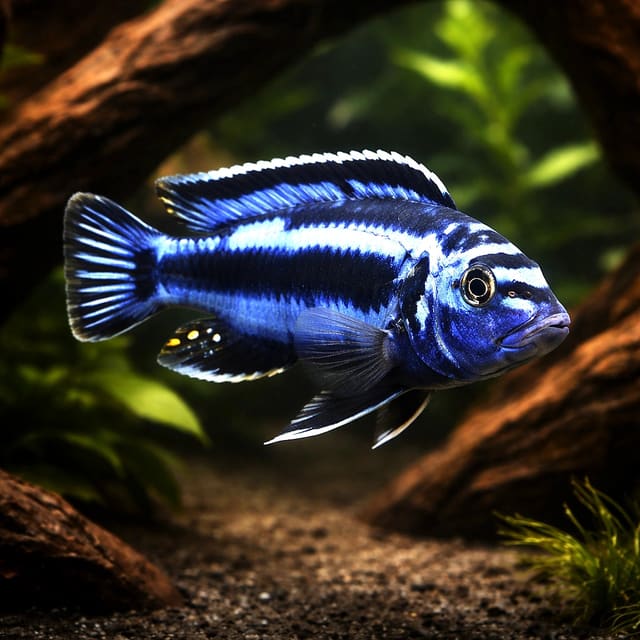
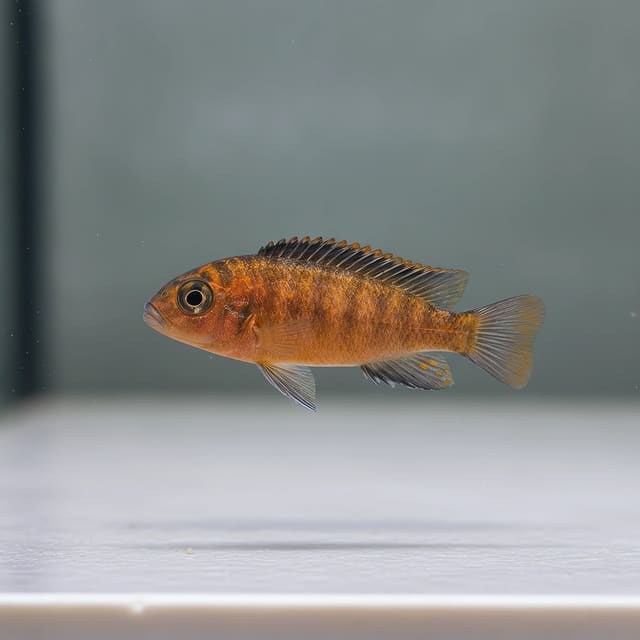
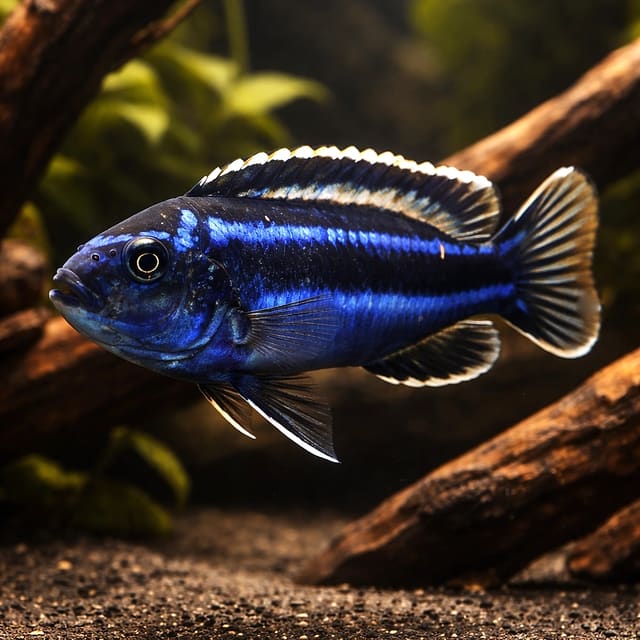
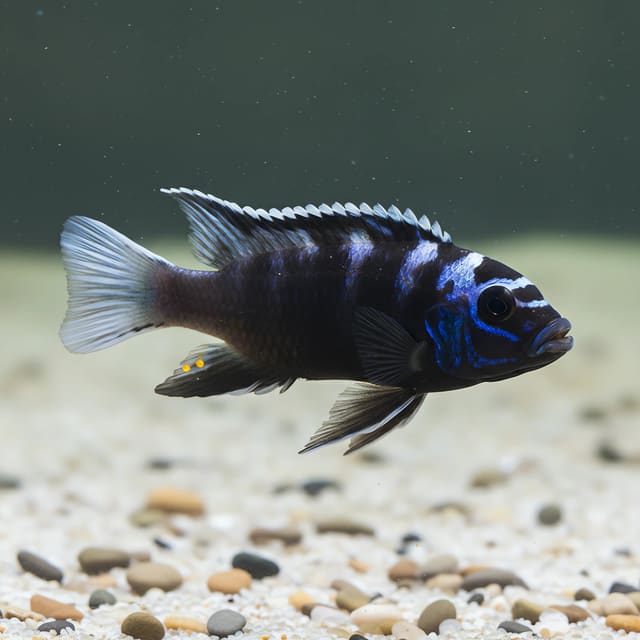
Sex is guaranteed only when the selected option explicitly states male or female. This Melanochromis johanni red listing has no sex-guaranteed option. According to Seriously Fish, adult males of the species are blue-black with bright blue striping, females are orange and males tend to be slightly larger. OATA adds that many Malawi cichlids only show their sex differences once they become adults, not as juveniles. Red Johanni is a trade name for colour, so an orange young fish should not be read as a female.
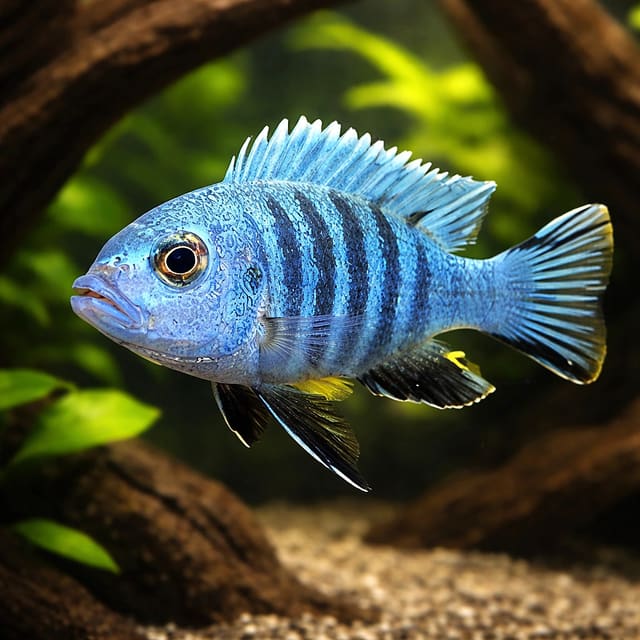
The gallery image shows a red-orange fish with pale speckling along its scale rows and yellow-orange fins, swimming above pale sand in front of slender green plant stems. Gallery images have been digitally enhanced to improve image quality. Natural colour, pattern, size and maturity can vary between live animals. The plants are part of the photographic setting rather than a planting suggestion, as the care notes explain.
A Red Johanni does best when the whole aquarium is planned around Lake Malawi fish. Before buying, check that you can say yes to each of these:
Set up that way, the Red Johanni rewards you with constant activity among the rocks and a warm red-orange colour that stands out against grey stone and pale sand. To compare other rock-dwelling species for a Malawi community, browse our African cichlid collection.
Seriously Fish describes the ideal home plainly: much of the aquarium should contain piles of rocks arranged to form caves, with small areas of open water between them. A sandy substrate is best and the water should be well oxygenated. That rock-and-sand layout is what lets each fish claim a patch of territory and gives weaker fish a way out of sight when a dominant one comes by.
| Seriously Fish, this species | Tank base of 90 × 45 cm; about 154 litres at 38 cm deep |
|---|---|
| OATA, Malawi community | At least 200 litres for a reasonable sized community |
| More than one male | Seriously Fish says a large tank is required |
Because sex cannot be chosen when you buy young fish, it is wise to plan for the possibility of more than one male. OATA's general advice also applies: buy as large an aquarium as you reasonably can, because the larger it is, the more stable temperature and water quality will be.
Malawi communities are kept slightly crowded, so OATA recommends an oversized filter and vigorous aeration to keep enough dissolved oxygen in the water. The RSPCA's advice on the aquarium environment explains why filtration matters: fish release ammonia, which is toxic, and a working biological filter lets beneficial bacteria convert it to nitrite, also toxic, and then to nitrate, which is safer.
For its 154-litre example tank, Seriously Fish suggests a filter rated at 615–770 litres per hour, a turnover of four to five times the volume each hour, and a heater of roughly 150–200 W to hold 23–27 °C in a room of around 20 °C. Scale those figures up for a larger aquarium.
Set up the rockwork, fill the tank, and run the filter until it has matured and ammonia and nitrite both read zero. Our guide to setting up a tropical tank covers the equipment, filling and filter maturation in order, and the same steps apply to a Malawi aquarium before any fish are added.
Lake Malawi fish need hard, alkaline water, and that is what sets a Malawi tank apart from a typical soft-water community aquarium. OATA's care sheet for Malawi cichlids describes them as a specialised group that require particular water parameters, and advises checking species-specific needs as well as the group guide. Here the species profile from Seriously Fish and OATA's group sheet agree well:
| Temperature | 23–27 °C (Seriously Fish and OATA) |
|---|---|
| pH | 7.6–8.8 (Seriously Fish); 8.0–8.6 (OATA) |
| General hardness | 10–25 dGH (Seriously Fish); 12–18 °dH (OATA) |
| Carbonate hardness | 10–15 °dKH (OATA) |
| Ammonia and nitrite | Zero |
| Nitrate | No more than 20 mg per litre above normal tap water levels (OATA) |
The practical target is the ground both sources share: 23–27 °C, pH 8.0–8.6 and general hardness of 12–18 °dH. Staying in that overlap keeps you inside the species profile and the group guidance at the same time. Stability matters as much as the exact figure, so settle on values within the range and hold them there.
FishBase lists a tropical range of 22–25 °C, a pH of 8.0 and hardness of 9–19 dH for the species. Those figures describe its natural habitat in the lake rather than an aquarium target, but they confirm the same picture of warm, hard, alkaline water.
OATA's nitrate limit is not an absolute figure: it is no more than 20 mg per litre above normal tap water levels. Test your tap water for nitrate once, so you know the baseline, and then compare the aquarium reading with it. If the gap keeps widening between changes, the tank needs larger or more frequent water changes, or fewer fish.
Tap water varies widely from one area to another, so test your own supply for pH, general hardness and carbonate hardness before you plan the tank. Our guide to aquarium water parameters explains what each reading means, and the water parameter matcher lets you set your results against target values. Coral sand or a similar buffering substrate, as OATA suggests, helps keep pH and hardness up between water changes.
OATA also points out that good husbandry is essential because Malawi cichlids can be stressed by even the smallest amounts of ammonia. In a crowded rock tank, that makes regular testing part of the routine rather than something saved for when problems appear.
FishBase describes the species as omnivorous, feeding on both plant and animal matter in the wild. Seriously Fish says it will accept most foods offered, but that vegetable matter should form a large proportion of the diet, supplemented with live and frozen varieties. OATA's Malawi sheet points the same way for the smaller mbuna, describing them as more herbivorous fish that appreciate specialised Malawi cichlid feeds with a high algae content, along with fresh vegetables.
Take care not to overfeed. OATA warns that uneaten food breaks down and releases toxic waste into the water, and a crowded Malawi tank has little room for that. Watch the whole feed, clear leftovers from among the rocks with a siphon, and cut back if food is still drifting after a few minutes.
In a group of territorial fish, a dominant individual can crowd others away from food. Spreading food across the surface rather than dropping it in one spot helps every fish get a share, and feeding time is a good daily moment to check that each fish is eating. OATA lists reduced intake or lack of interest in food among the early signs of a problem, so a fish that stops coming forward deserves a closer look.
A slightly overcrowded, well-fed Malawi aquarium produces plenty of waste, so the weekly routine carries more weight here than in a lightly stocked tank. OATA strongly recommends a partial water change of 25% at least once every week, with a siphon to lift solid waste from the substrate.
If the filter needs cleaning, rinse the media lightly in tank water removed during the water change. Do not run it under the tap: any chlorine or chloramine present may kill the beneficial bacteria established in the media. Rinsing in tank water reduces the number of bacteria lost, which matters in a tank that relies on an oversized filter to cope with its stocking.
OATA notes that rearranging the aquarium décor can help reduce aggression as fish find new territories. If one fish is being singled out, moving a few rocks during a water change resets the boundaries. Make sure every rock sits firmly on the base afterwards, since these fish will often dig beneath loose stones.
Before you order, check with us that your aquarium is an appropriate size for the number of Malawi cichlids you want to keep, and confirm that ammonia and nitrite both read zero. OATA advises building numbers slowly: the bacteria in a matured filter must increase every time fish are added and feeding goes up. Overstocking or stocking too quickly can lead to new tank syndrome, when there are not enough nitrifying bacteria to cope with the extra waste, ammonia and nitrite reach unhealthy levels, and this may cause fish to become ill or die.
Our team hand-packs every order. Fish are bagged in pure oxygen inside an insulated poly box, with a heat pack when the weather calls for it, and a licensed live-animal courier carries the tracked parcel. We email the tracking number and your confirmed delivery date so you know when to be in; live fish cannot be left unattended. The full terms are on our delivery and Live Arrival Guarantee page.
OATA's advice on stocking is specific to these cichlids. Add Malawi cichlids in groups, so that no single fish receives all the attention as it settles in. Add the more peaceful species first and the more aggressive ones later. If you are adding Red Johanni to an established tank, rearranging some of the rockwork at the same time gives everyone new territories to sort out rather than letting residents defend old ones.
OATA describes healthy fish as having clear, bright eyes, undamaged fins, intact scales, no ulcerations or bumps, and appropriate swimming behaviour. Check new arrivals against that description, and keep using it as a quick daily scan.
All fish vary a little in behaviour and appearance, but OATA lists the changes below as ones that help identify a problem before it becomes a real health issue:
In a territorial species, torn fins, missing scales or a fish that hides constantly can be signs of a fish being picked on, not only of disease. Look at the group before anything else: whether one fish is under constant pressure, whether there is enough rockwork, and whether the balance of males and females has shifted as the fish mature. Then test the water, as OATA advises for any health concern, and contact us with your results if you would like help.
OATA says Malawi cichlids can live several years in a well-matured set-up with good water quality. Steady hard, alkaline water, a plant-rich diet, secure rockwork and a group large enough to spread aggression are the foundations.
Red Johanni are offered at 3–4 cm, 4–5 cm and 6–7 cm. All three are young fish, well short of FishBase's 10 cm total length or Seriously Fish's 12 cm standard length for adults, so every size needs the same finished Malawi set-up from the day it arrives.
Seriously Fish's companion advice is built on similarly sized fish, and OATA recommends adding Malawi cichlids in groups so that no single fish takes all the attention as it settles. Choosing one size for your Red Johanni, close to the size of any Malawi cichlids already in the tank, puts both pieces of advice into practice. A lone small newcomer among bigger residents is the situation to avoid.
Because young fish cannot be sexed reliably and one purchase is one fish, buy the number you need for a proper group rather than a pair or trio. That gives the best chance of ending up with more females than males as the fish mature, which is the balance both OATA and Seriously Fish recommend.
Seriously Fish describes breeding as relatively easy. The species is a maternal mouthbrooder: the female carries the eggs in her mouth. Whether or not you plan to breed, it helps to recognise the behaviour, because a spawning male's pursuit of females can explain a sudden rise in chasing.
The male cleans and then displays around a chosen spawning site, showing intense colour, and tries to entice females to spawn with him. He can be quite aggressive in his pursuit. When a female is willing, she approaches the site and lays her eggs there, then immediately picks them up in her mouth.
Because the sex of young fish cannot be chosen, anyone hoping to breed Red Johanni is best starting with a group and letting the fish mature before deciding how to arrange them.
Seriously Fish calls this species quite aggressive, while noting that the aggression is not as pronounced as in most other Melanochromis species. OATA goes further for Malawi cichlids as a whole: they are all aggressive, should be mixed with caution and are not social fish. Good planning turns that temperament into lively, manageable behaviour.
OATA says Malawi cichlids can be kept in groups of at least 15 and slightly overcrowded to limit aggression, because Malawi cichlids kept in small groups will often fight. Seriously Fish gives the same advice for this species in a mbuna community: the tank should be overcrowded to reduce aggression and territory formation. Crowding spreads attention, so no single fish carries the full weight of a dominant male's displays.
Chasing and display are normal in a mbuna tank. The warning signs are one fish hiding all the time, a fish with damaged fins, or a fish that no longer comes to feed. When that happens, add rockwork, rearrange territories or reconsider the balance of fish rather than waiting for it to settle on its own.
OATA is clear about companions: Malawi cichlids should only be kept with other Malawi cichlids or some species of Synodontis catfish that also live naturally in Lake Malawi. Within that rule, Seriously Fish says this species can be housed with similarly sized mbuna and even with similarly sized peaceful species such as Aulonocara.
OATA recommends adding the more peaceful species first and the more aggressive species later, and always adding Malawi cichlids in groups. Planning the whole stocking list in advance, rather than adding single fish as they catch your eye, keeps aggression spread evenly across the community.
FishBase records a maximum of 10 cm in total length, while Seriously Fish gives 12 cm in standard length, measured from the snout to the base of the tail. Plan the aquarium around the larger figure; males also tend to be slightly larger than females.
Seriously Fish gives a minimum tank base of 90 × 45 cm, about 154 litres, for the species. OATA recommends an aquarium of at least 200 litres for a reasonable sized Malawi cichlid community, and a large tank is needed if more than one male is kept, so most keepers are better served by the bigger option.
Keep them as part of a lively group, never singly or as a pair. OATA's guidance for Malawi cichlids is a group of at least 15, slightly overcrowded, because small groups will often fight, and Seriously Fish advises several females for every male.
It suits a keeper who has planned a proper Lake Malawi set-up. OATA describes Malawi cichlids as usually undemanding and easy to keep in the right water, but also as aggressive fish to be mixed with caution, which is why we rate the Red Johanni Cichlid as intermediate.
FishBase describes it as omnivorous, feeding on both plant and animal matter. Seriously Fish says vegetable matter such as spirulina flakes and blanched spinach should form a large proportion of the diet, with live and frozen foods as a supplement. Feed only what the fish eat within a few minutes, twice a day.
Seriously Fish gives 23–27 °C, pH 7.6–8.8 and 10–25 dGH for the species, and OATA's broad Malawi cichlid guidance is 23–27 °C, pH 8.0–8.6 and 12–18 °dH general hardness. Aim for the ground both share: warm, hard, alkaline water held steady.
Yes. Seriously Fish calls the species quite aggressive, though less so than most other Melanochromis, and notes that males are aggressive and territorial towards their own kind. Plenty of rockwork, a slightly overcrowded group and more females than males keep that aggression spread out.
OATA advises keeping Malawi cichlids only with other Malawi cichlids or some species of Synodontis catfish that also live in the lake. Seriously Fish adds similarly sized mbuna and similarly sized peaceful species such as Aulonocara. Do not keep it with other Melanochromis species, as they may hybridise.
Our team hand-packs each order, bagging the fish in pure oxygen inside an insulated poly box, with a heat pack when the weather calls for it, and a licensed live-animal courier brings it on your confirmed date. Be there to receive it, open it the same day while recording one continuous unboxing video, and float the sealed bag for 20–30 minutes before releasing the fish. That video is needed for any Live Arrival Guarantee claim.
No reviews for this item yet. Bought one? Honest reviews only, good or bad.
What customers say about ordering from us
I have a small group of long finned mountain minnows. So was delighted to be able to order ten of this variety to increase the genetics in my tank . The ones I recieved are healthy but it’s to early to give a verdict on wether they are of a long finned type since they are small currently.
Gordon Walker · 23 Sept 2026
100% success travel and "installation". Pleased with quality of purchase. The Siamese fighter a bit "shy" so have not yet seen him at his best yet but looking good. Happy customer. GG
George E Garratt · 21 Sept 2026
Reviews of our shop, collected by Judge.me, an independent third-party review collector. Newest first.