Moderate
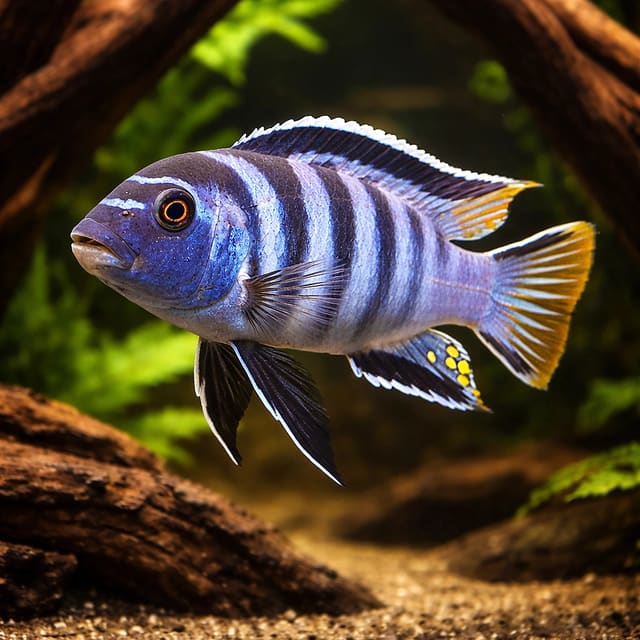
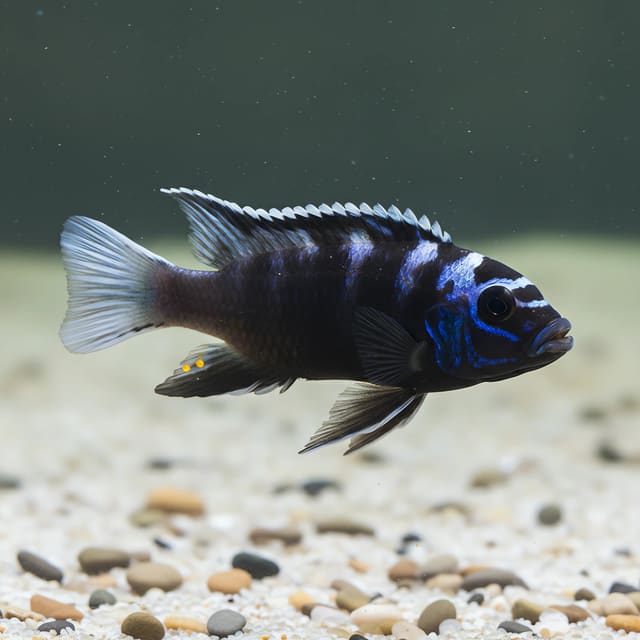
Acei Cichlid (Pseudotropheus sp. “acei”)
24–26°C · pH 7.5–8.5 · 300L
£7.99

Golden Mbuna Cichlid (Melanochromis auratus) is an assertive rock-dwelling Lake Malawi cichlid for experienced mbuna keepers. One purchase supplies one fish in the chosen 2–3cm, 4–5cm, 6–7cm or 7–9cm dispatch grade; FishBase separately records an adult maximum of 11cm total length. Plan a large, mature hard-water aquarium with extensive rockwork, broken sight lines, strong filtration and a vegetable-rich diet.
Adult size is the maximum length this species reaches at full maturity (scientific sources). The livestock you receive will be younger and smaller — pick a size above for the actual shipping size. Product-photo provenance and any image-specific limitations are stated on the listing.
Melanochromis auratus
Shoaling fish: kept in a group they feel safer, stay calmer and show their best colour.
Golden Mbuna Cichlid (Melanochromis auratus) is an assertive rock-dwelling Lake Malawi cichlid for experienced mbuna keepers. One purchase supplies one fish in the chosen 2–3cm, 4–5cm, 6–7cm or 7–9cm dispatch grade; FishBase separately records an adult maximum of 11cm total length. Plan a large, mature hard-water aquarium with extensive rockwork, broken sight lines, strong filtration and a vegetable-rich diet.
Adult size is the maximum length this species reaches at full maturity (scientific sources). The livestock you receive will be younger and smaller — pick a size above for the actual shipping size. Product-photo provenance and any image-specific limitations are stated on the listing.

Cichlids are a family of roughly 1,800 accepted species, not one care type. Before buying, identify the exact species and source, then compare adult measurement, usable tank dimensions, social system, territory, tested water, diet and an exit plan. No family-wide minimum tank, water range or tank-mate list is safe.
Maintain these water conditions for optimal health and vibrant colors
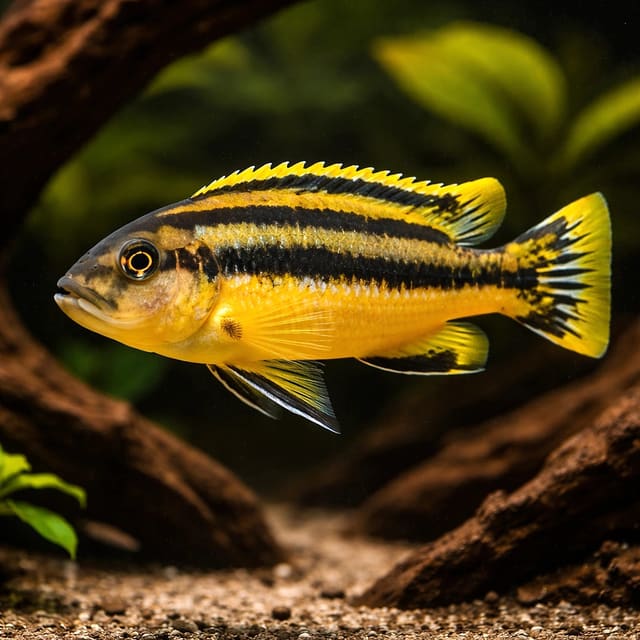
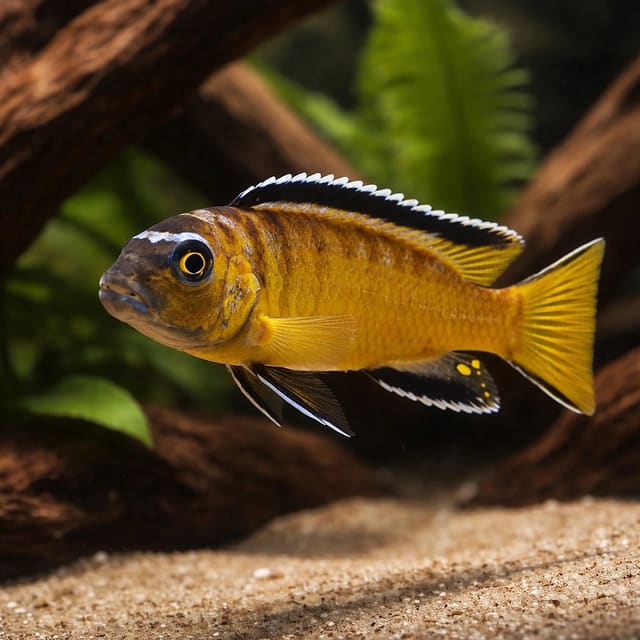
The Golden Mbuna Cichlid (Melanochromis auratus) is a bold Lake Malawi rock cichlid whose vivid yellow, cream and dark horizontal pattern is matched by an unusually forceful temperament. It is a wonderful fish in the right specialist aquarium, but it is not a gentle yellow centrepiece for a mixed tropical community. This is a territorial mbuna for a keeper who enjoys planning rockwork, watching social behaviour closely and managing a busy hard-water cichlid aquarium.
One purchase supplies one live fish. The available dispatch grades are 2–3cm, 4–5cm, 6–7cm and 7–9cm. The size you select is the size supplied, not the adult size. These are four genuine recurring size choices, so select the grade that fits the stocking plan and the size of the fish already present. Smaller juveniles can be vulnerable beside much larger, established cichlids, while adding a larger newcomer to a settled territorial aquarium can also provoke conflict. Size is therefore part of the introduction plan, not merely a visual preference.
FishBase records a maximum of 11cm total length for this species. Seriously Fish separately reports 110mm standard length. Those are different measurement conventions: total length includes the tail, while standard length stops at the base of the tail. The two records should be retained with their own labels rather than converted or treated as the same measurement. In practical terms, this is a solid, active cichlid that needs a substantial footprint and a layout built around territories.
| Suits | Experienced keepers with a mature Lake Malawi mbuna aquarium, hard alkaline water and space for extensive rockwork |
|---|---|
| One purchase | One fish in the selected dispatch grade |
| Adult records | 11cm total length in FishBase; 110mm standard length in Seriously Fish |
| Species aquarium guidance | 24–28°C, pH 7.6–8.8 and 10–25 dGH |
| Temperament | Highly territorial and aggressive, including towards its own species |
| Core habitat | Rock piles, caves, open lanes, sand and well-oxygenated water |
If you are building a specialist setup, browse the African cichlid collection to understand the wider range, but choose companions by adult temperament, body pattern, diet and Lake Malawi requirements rather than colour alone. Similar-looking fish can attract particularly intense aggression from M. auratus.
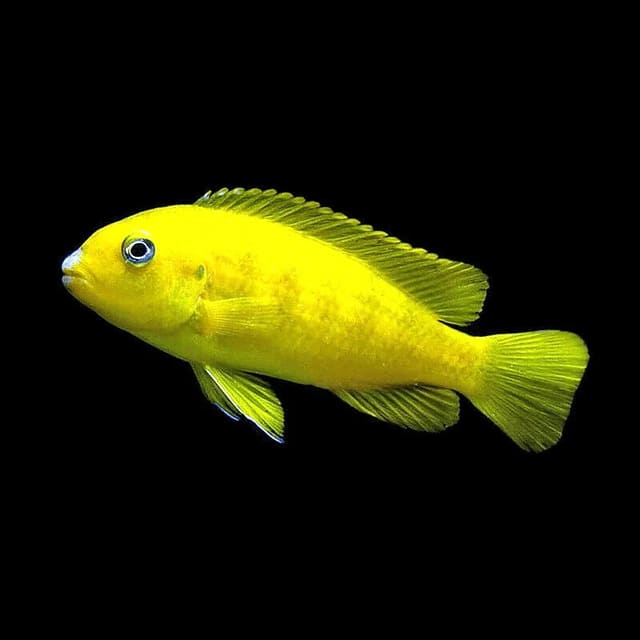
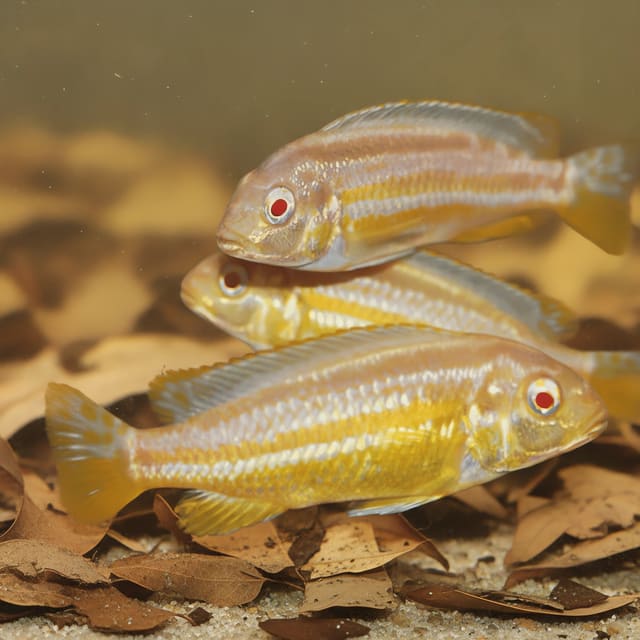
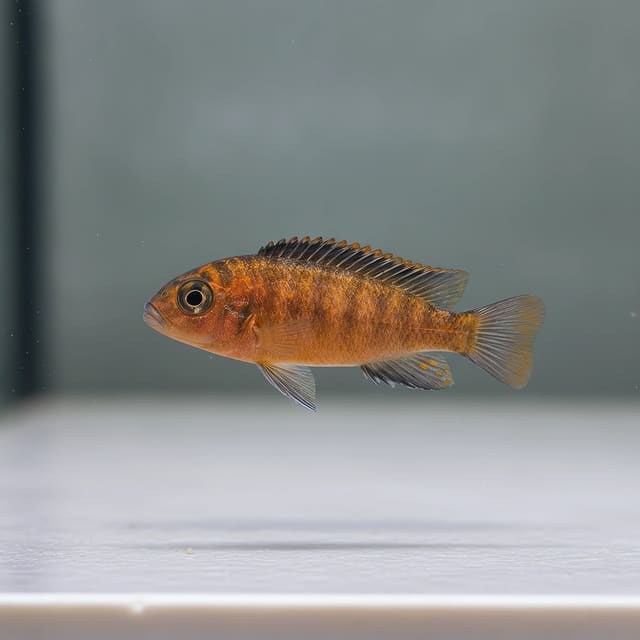
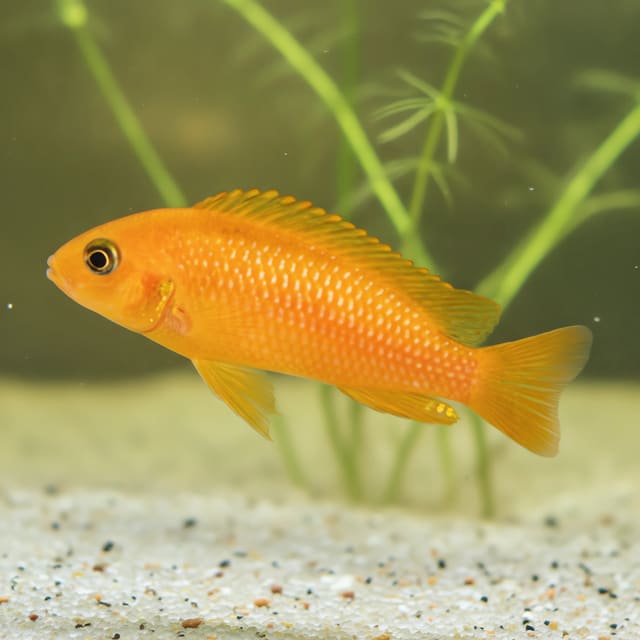
Juveniles and many females show the familiar golden ground colour with dark horizontal bands. Mature males can develop a much darker colour pattern, while stressed males may return towards the golden appearance and older females may darken. Colour by itself is therefore an unreliable way to promise the sex of a fish, especially at small dispatch sizes. Sex is guaranteed only when the selected option explicitly states male or female. This Golden Mbuna Cichlid listing has no sex-guaranteed option.
That distinction matters when planning a group. Species guidance commonly describes one male with several females, but an unsexed young fish cannot be bought as though it were a confirmed member of that ratio. A keeper adding juveniles should allow for the possibility that the eventual sex balance will need active management as the fish mature. Have a realistic rehoming or separation plan before territorial behaviour becomes severe.
Look beyond colour when settling the fish. A healthy newcomer should progress from sheltering to purposeful swimming and feeding, without being pinned into a corner or prevented from reaching food. Watch the established fish as closely as the newcomer: repeated pursuit, guarding of every route through the rocks or relentless attacks are different from a brief boundary display. A well-designed aquarium gives a chased fish several ways to leave a territory without crossing straight into another.
Gallery images have been digitally enhanced to improve image quality. Natural colour, pattern, size and maturity can vary between live animals.
Seriously Fish gives a 120 × 45cm base and about 205 litres as the absolute minimum for this species because of its highly aggressive nature. Treat the footprint as seriously as the litre figure. A tall aquarium with little floor area offers fewer usable territories than a longer tank of similar volume, and height alone does not create escape routes. Larger quarters make it easier to build several rock zones, maintain open water between them and reduce the chance that one dominant fish controls the entire aquarium.
Build the hardscape before the fish arrives. Arrange stable piles of aquarium-safe rock into caves, overhangs and visual barriers, with small areas of open water between them. Each pile should stand securely rather than resting on loose sand that digging fish can move. The aim is not to create one impressive central cave; it is to create a network in which a fish can disappear from another fish's view and emerge by more than one route. A sandy substrate reflects the species' natural rock-and-sand setting and allows normal interaction with the bottom.
Plants are optional and secondary to secure rockwork. The broad Malawi guidance notes that these cichlids often dig and rearrange substrate, which will uproot plants. If plants are used, choose robust specimens and protect their roots, but do not sacrifice cave structure or swimming space to maintain a delicate planted display. This species should never be selected as a calm planted-community fish simply because the gallery contains greenery.
A new aquarium must be biologically mature before livestock is added. The first tropical tank guide explains the preparation sequence. A mature filter is still only the starting point: adding several cichlids increases waste and feeding at once, so additions must be paced around the system's actual capacity rather than the nominal filter label.
Species-level aquarium guidance from Seriously Fish is 24–28°C, pH 7.6–8.8 and 10–25 dGH. FishBase also records a wild environmental range of 22–26°C, pH 7.0–8.5 and 10–15 dH. These records answer different questions, so the wild figures should not be substituted silently for routine captive-care guidance. For an established aquarium, stability within the chosen species-appropriate range matters more than chasing a particular decimal point.
Test the source water before planning the aquarium. Hard alkaline tap water may need little adjustment, whereas soft acidic water demands a deliberate and repeatable mineral strategy. Avoid sudden chemical swings created by reacting to a single test. The water chemistry guide explains pH, hardness and nitrogen-cycle readings, while the water matcher helps compare measured aquarium values with the stated guidance.
RSPCA guidance explains why a working biological filter is essential: fish release toxic ammonia, bacteria convert it to nitrite, and another bacterial stage converts nitrite to the safer nitrate. In a cichlid aquarium, active fish and regular feeding place a meaningful load on that process. Choose filtration for the stocked system and arrange the outlet so oxygenated water reaches the whole aquarium without turning every shelter into a high-speed jet.
Broad Malawi care guidance strongly recommends a partial water change of 25% at least once every week. That is a useful starting routine, then stocking density, feeding, nitrate trend and visible debris determine whether the aquarium needs more frequent maintenance. Siphon accessible waste without stripping the whole setup at once. A stable aquarium still needs observation: reduced appetite, abnormal breathing, unusual hiding, darker or paler colour and erratic swimming are prompts to test water and inspect the social situation rather than to medicate blindly.
FishBase describes Golden Mbuna feeding from the biocover by nibbling and picking at algae. Seriously Fish says it accepts many foods but that vegetable matter, including spirulina flakes and suitable greens, should form a large proportion of the diet. This is not a reason to offer only one food, nor is it permission to build the routine around rich meaty feeds. The useful approach is a varied, vegetable-rich mbuna menu in modest portions.
OATA's broad Malawi advice is to give only what the fish consume within a few minutes, twice a day. Watch body condition and waste rather than assuming a larger fish always needs a larger handful. Uneaten food breaks down, increasing the demand on the biological filter and making it harder to distinguish a social problem from poor water quality. If one fish hangs back, spread small portions along the length of the aquarium and observe whether it is being excluded.
Feeding time is also a daily welfare check. A previously eager fish that refuses food, chews and spits repeatedly, breathes heavily or cannot leave shelter deserves attention. Test ammonia and nitrite, review recent changes and watch for harassment. Do not compensate for social exclusion by pouring more food into the aquarium; the dominant fish will often eat the surplus while water quality worsens.
Rock surfaces that develop natural growth provide grazing opportunities and behavioural interest. Cleaning every surface to a sterile shine removes that resource. Clean viewing panes and remove troublesome debris, but allow safe established rocks to retain some mature biocover. The result should still be hygienic and easy to monitor, not neglected.
A successful Golden Mbuna aquarium is managed by trend, not crisis. Keep a simple record of temperature, pH, hardness where relevant, ammonia, nitrite and nitrate. The value of a notebook is not paperwork; it is seeing that nitrate is rising faster, pH is drifting or maintenance is no longer keeping pace with the fish. Test at a consistent point in the care cycle so results can be compared meaningfully.
Territorial pressure often shows in small ways before an obvious injury: one fish eats only after the others finish, remains behind the same stone, loses condition or uses the surface corner as a refuge. Those signs call for a stocking and layout review. Rearranging some decor can disrupt established territories, but it is not a cure for an impossible combination or an unsafe sex balance.
Colour change must be interpreted with care. Mature males are often darker than golden females and juveniles, yet stressed males can show the golden pattern and older females may darken. Use colour as one observation alongside behaviour, growth and body condition, not as a guarantee of sex. When a fish changes suddenly, test water and observe social pressure before assuming it is simply maturing.
Keep the basic equipment for a safe response before it is needed. A divider can create immediate breathing room, while a separate mature aquarium gives an injured or persistently targeted fish somewhere stable to recover. Nets alone are not a plan if there is nowhere suitable to move the animal. Check that spare equipment can maintain the same hard alkaline water and warm temperature, because moving a stressed fish into unsuitable chemistry simply exchanges one pressure for another.
Record changes to stocking and hardscape beside the water results. A sudden rise in chasing after a new fish, a moved cave or the maturation of a male can explain a behaviour shift that chemistry alone cannot. Likewise, a social problem can reduce feeding and body condition even when every test looks normal. Looking at environment and behaviour together produces better decisions than treating either in isolation.
If disease is suspected, identify the problem before using treatment. Many symptoms associated with infection can also follow ammonia, nitrite, poor oxygenation or relentless aggression. Moving quickly to an unsuitable medicine without correcting the environment can add stress. Quarantine facilities and professional aquatic advice are valuable when the cause is uncertain.
Prepare the aquarium and a quiet route from door to tank before the parcel arrives. Tropical Fish Co hand-packs livestock in oxygenated bags inside an insulated box, adding a heat pack when conditions call for it, and uses a licensed live-animal courier. The current delivery and Live Arrival Guarantee policy gives the full terms.
The first week is about access: access to shelter, food, open water and a route away from aggression. A new fish may hide at first, but it should not remain trapped by another fish. Offer modest food and confirm the newcomer can feed. Avoid major, unrelated changes during settling unless safety requires them; stable water and a well-planned hardscape give the fish the best chance to establish normal behaviour.
When adding to an occupied mbuna aquarium, consider altering part of the rock layout shortly before introduction so the established territories are less absolute. This can reduce the home advantage, but it does not make incompatible animals compatible. Keep separation equipment ready and act if pursuit becomes relentless.
Seriously Fish describes Melanochromis auratus as one of the most aggressive and territorial mbuna. It should not share an aquarium with peaceful species such as peacocks or utaka. Even among mbuna, fish with a similar pattern are a poor choice because resemblance can intensify hostility. This is a specialist compatibility problem, not a general hard-water community choice.
A commonly described species arrangement is one male with at least three females. Several females spread the male's attention, but females of this species can also be intolerant of one another. More than one male requires a very large aquarium and still carries a serious risk to subordinate males. Since the fish sold here is not sex guaranteed, do not build a plan that depends on receiving a particular sex. Juveniles may require later adjustment as their adult sex and behaviour become clearer.
Broad OATA guidance says Malawi cichlids may be maintained in deliberately busy communities to spread aggression, and that some species of Lake Malawi Synodontis catfish may be considered. That is a system-level method, not a promise that any particular fish is safe. Deliberate stocking density increases filtration, oxygen and maintenance demands; it should be designed by an experienced keeper, not copied as a simple number.
Rearranging decor can help when new fish are introduced because all residents must reassess territories. Additions are best planned together rather than dripped into a settled hierarchy one vulnerable fish at a time. The more aggressive species should generally be introduced later. Even a careful plan needs an exit route: a divider, spare mature aquarium or responsible rehoming arrangement.
Before choosing this fish, compare the proposed aquarium against the questions below. A single mismatch can be more important than several similarities. Two fish may both prefer hard water, for example, yet remain a poor match because one is peaceful, long-finned or too similar in pattern.
| Water | Can every resident thrive in the same stable hard alkaline conditions? |
|---|---|
| Temperament | Can the other fish withstand a highly territorial mbuna without being confined or injured? |
| Pattern | Could similar horizontal markings trigger focused aggression? |
| Diet | Can all fish be fed appropriately without turning this mbuna's menu into a rich meat-heavy routine? |
| Space | Are there several defensible zones, broken sight lines and open escape routes? |
| Contingency | Can a fish be separated promptly if the social plan fails? |
The Acei and Saulosi listings supplied in the related area are shopping alternatives, not endorsed tank mates. Each has its own adult behaviour, group needs and colour pattern. Choose a species after comparing the full aquarium plan, and never treat a related-product card as a stocking recommendation.
Observe interactions at different times of day. Feeding, lights-on and a change to the rockwork can expose pressure that is not obvious during a brief daytime glance. The decisive question is whether every fish can carry out normal behaviour: swimming, resting, feeding and leaving another fish's territory without continuous pursuit.
FishBase records a maximum of 11cm total length for Melanochromis auratus. Seriously Fish separately lists 110mm standard length. Total length includes the tail and standard length excludes it, so retain each labelled record rather than converting one into the other.
Seriously Fish gives a 120 × 45cm base and about 205 litres as the absolute minimum because the species is highly aggressive. More room is valuable for separate rock territories and escape routes; footprint is more useful than height alone.
Species guidance describes one male with at least three females, but females can also be intolerant and more than one male needs a very large aquarium. Use that ratio only when sexes are actually known and keep a separation plan.
No. Seriously Fish does not recommend it for beginners because of its intolerant nature. It suits a keeper able to manage hard alkaline water, substantial rockwork, deliberate stocking and rapid intervention when aggression becomes unsafe.
Make vegetable matter a large part of the diet, using suitable spirulina, algae-based and quality dried foods. Live or frozen foods can supplement that base. Feed modest portions and remove leftovers so the filtration is not burdened by decay.
Seriously Fish gives species-level aquarium guidance of 24–28°C, pH 7.6–8.8 and 10–25 dGH. Keep the aquarium stable within an appropriate part of that range rather than repeatedly adjusting it towards a single number.
It is one of the most aggressive and territorial mbuna. The greater concern is sustained chasing, harassment and injury rather than an occasional fin nip, so peaceful fish and slow vulnerable companions are unsuitable.
Only consider robust Lake Malawi mbuna with different patterning and matching water and dietary needs; OATA also notes that some Lake Malawi Synodontis may be considered. Every combination remains conditional on space, stocking and individual behaviour.
The fish is hand-packed in an oxygenated bag, insulated and given a heat pack when conditions call for it, then carried by a licensed live-animal courier. Record one continuous unboxing from the sealed parcel to the fish still in its sealed bag; the video is required evidence if a Live Arrival Guarantee claim is needed. Contact Tropical Fish Co the same day.
For identity, distribution, wild ecology and the recorded total length, see the FishBase species summary for Melanochromis auratus. The Seriously Fish species profile supports the aquarium footprint, water, diet and behavioural details above.
Broader UK husbandry context comes from the OATA African Malawi cichlid care sheet. The RSPCA fish environment guidance explains filtration and the nitrogen cycle. Broad group values remain labelled separately from species-level details.
No reviews for this item yet. Bought one? Honest reviews only, good or bad.
What customers say about ordering from us
I have a small group of long finned mountain minnows. So was delighted to be able to order ten of this variety to increase the genetics in my tank . The ones I recieved are healthy but it’s to early to give a verdict on wether they are of a long finned type since they are small currently.
Gordon Walker · 23 Sept 2026
100% success travel and "installation". Pleased with quality of purchase. The Siamese fighter a bit "shy" so have not yet seen him at his best yet but looking good. Happy customer. GG
George E Garratt · 21 Sept 2026
Reviews of our shop, collected by Judge.me, an independent third-party review collector. Newest first.