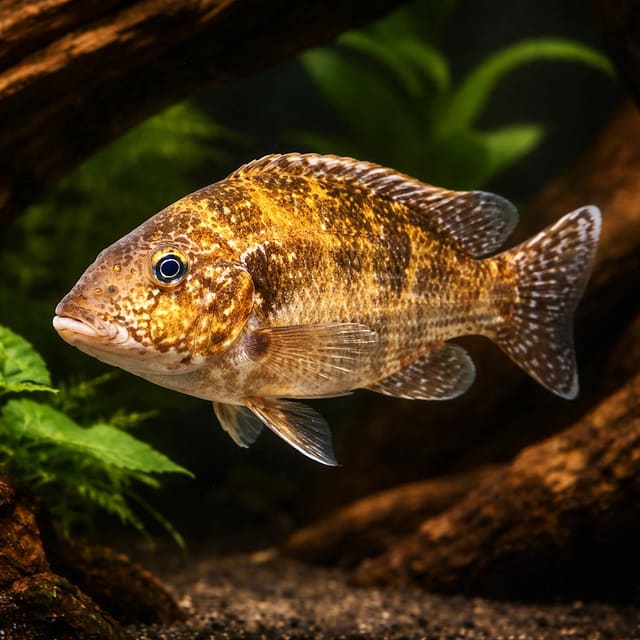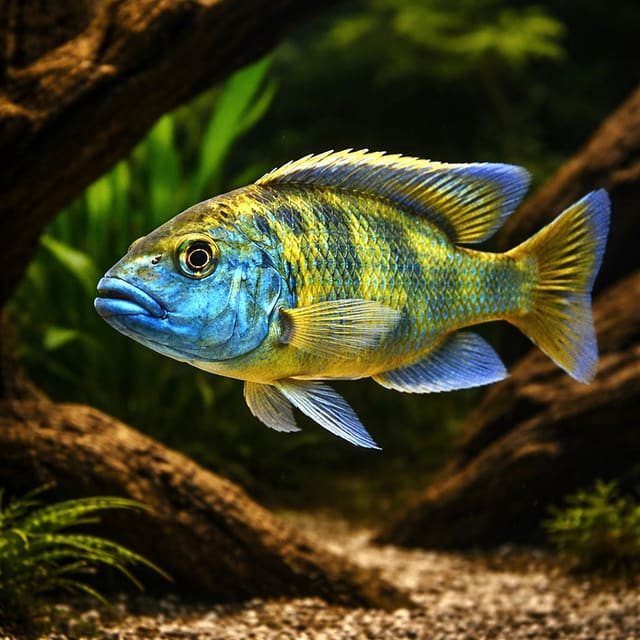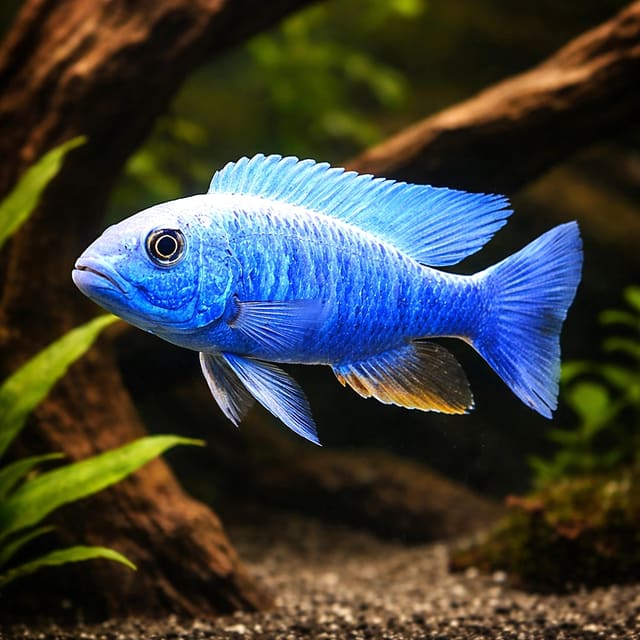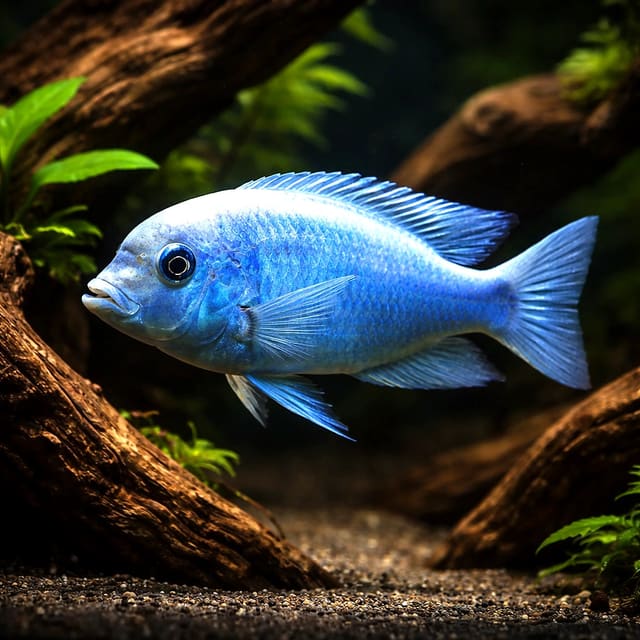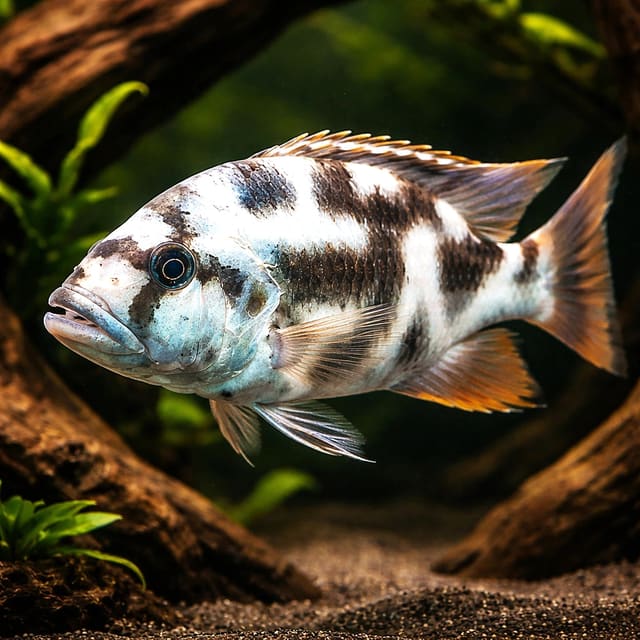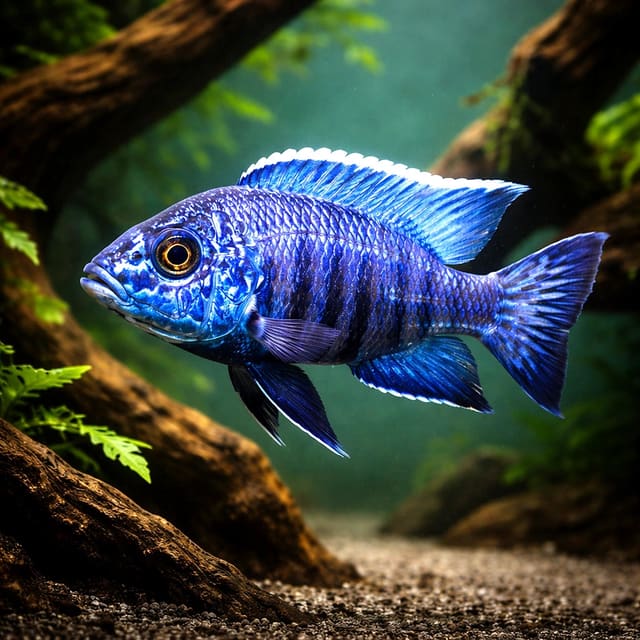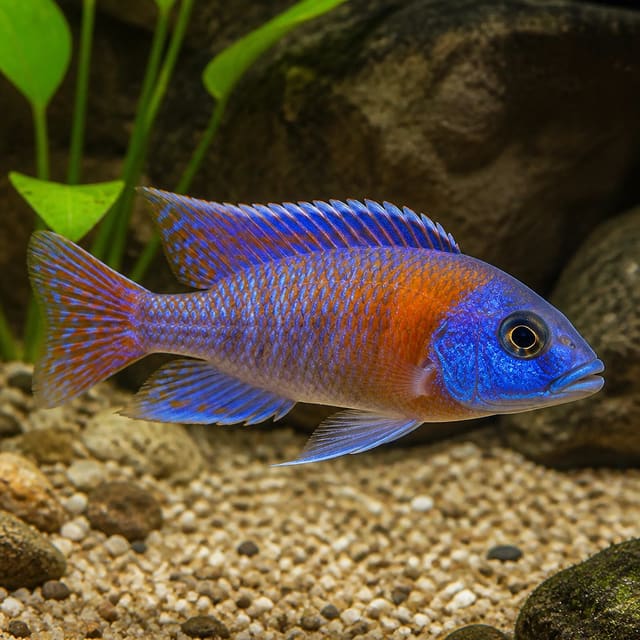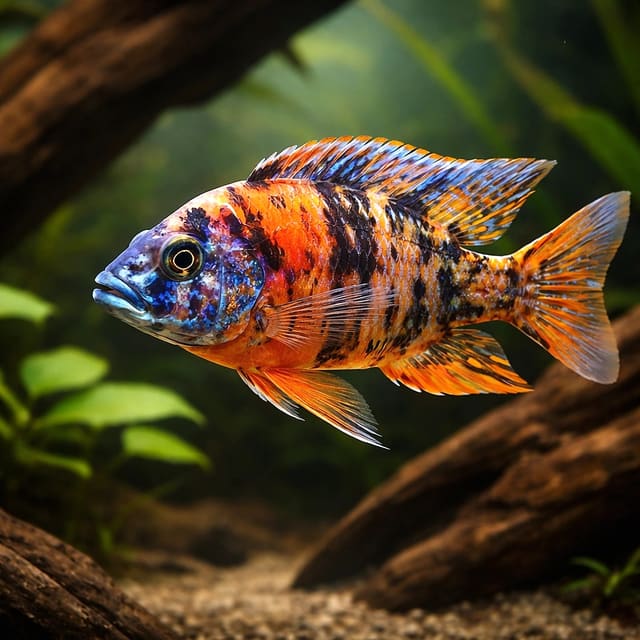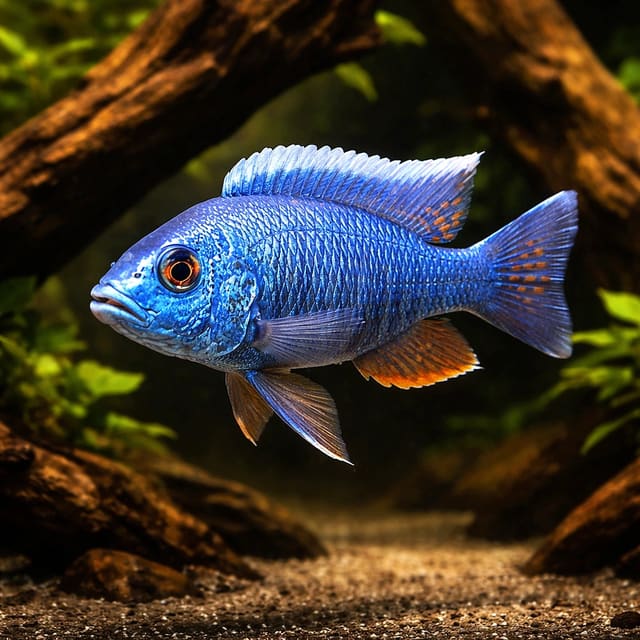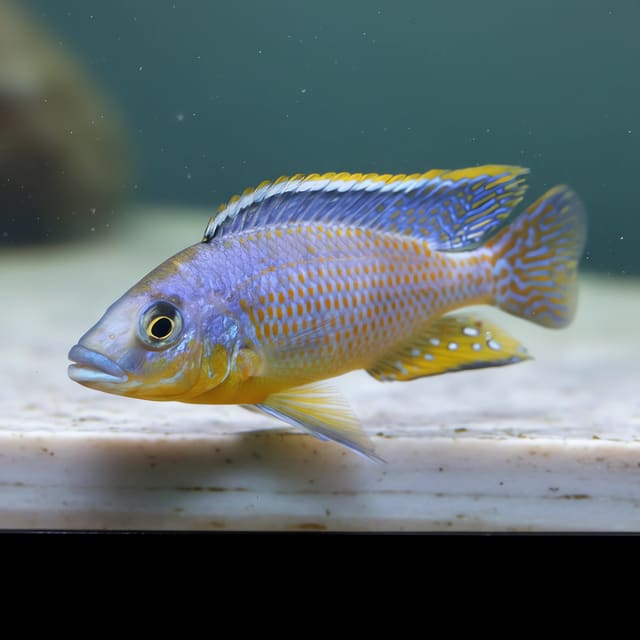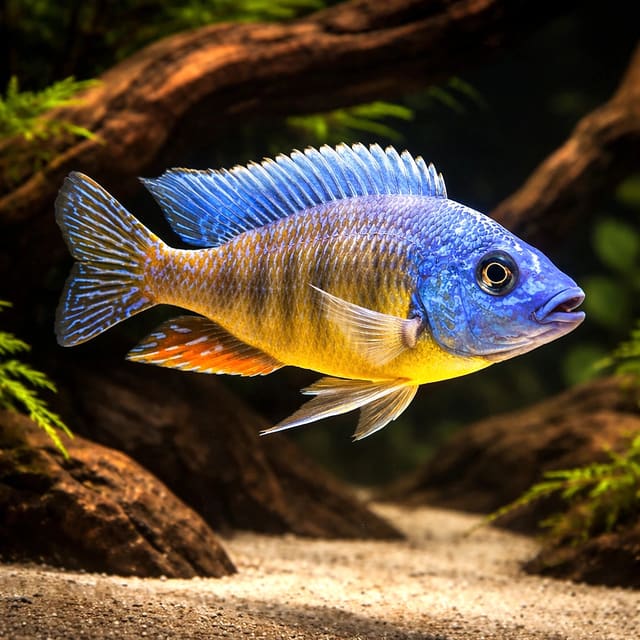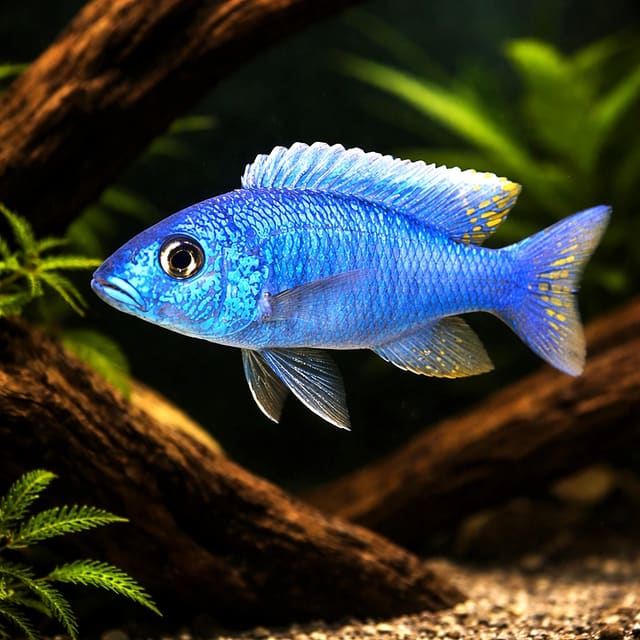
Electric Blue Hap (Sciaenochromis fryeri)
24–27°C · pH 8–8.6 · 304L
£42.99

Malawi Eye-Biter (Dimidiochromis compressiceps) is a large predatory Lake Malawi cichlid for experienced keepers. One fish is supplied in the chosen size; plan the adult aquarium before buying a juvenile, and never mix it with fish small enough to swallow.
Adult size is the maximum length this species reaches at full maturity (scientific sources). The livestock you receive will be younger and smaller — pick a size variant above for the actual shipping size. Product-photo provenance and any image-specific limitations are stated on the listing.
Dimidiochromis compressiceps
Save when buying multiple fish. Each quantity is one fish; sex and pair formation are not guaranteed unless the selected variant explicitly states them.
Malawi Eye-Biter (Dimidiochromis compressiceps) is a large predatory Lake Malawi cichlid for experienced keepers. One fish is supplied in the chosen size; plan the adult aquarium before buying a juvenile, and never mix it with fish small enough to swallow.
Adult size is the maximum length this species reaches at full maturity (scientific sources). The livestock you receive will be younger and smaller — pick a size variant above for the actual shipping size. Product-photo provenance and any image-specific limitations are stated on the listing.

Cichlids are a family of roughly 1,800 accepted species, not one care type. Before buying, identify the exact species and source, then compare adult measurement, usable tank dimensions, social system, territory, tested water, diet and an exit plan. No family-wide minimum tank, water range or tank-mate list is safe.
Maintain these water conditions for optimal health and vibrant colors
The Malawi Eye-Biter, Dimidiochromis compressiceps, is a Lake Malawi cichlid with an exceptionally narrow body, a long predatory mouth and a habit of holding among vegetation before taking small fish. Its dramatic name is memorable, but the practical buying question is straightforward: can your mature aquarium house a large fish eater without putting smaller residents at risk? This is a specialist choice for a planned Malawi system, rather than an addition to a small mixed community. Its shape and hunting behaviour are fascinating to watch when it has room to swim, places to retreat and companions selected by their adult size.
Each purchase supplies one live Malawi Eye-Biter in the size chosen. The size choices are 3–4 cm, 4–5 cm, 6–7 cm, 7–9 cm, XL and XXL. Choose the actual option shown for the order; these are supplied sizes and do not describe how large the fish stays. The size you select is the size supplied, not the adult size. A tiny juvenile still needs an adult plan, including a long tank, capable filtration and an answer to where it will go as it grows. Availability can change, so the current choice is shown by the live product selector rather than promised here. Sex is guaranteed only when the selected option explicitly states male or female. This Malawi Eye-Biter listing has no sex-guaranteed option. Colour, size and a photograph cannot determine the sex supplied, so do not plan a breeding ratio from this purchase.
FishBase records a maximum of 23 cm total length for the species. Seriously Fish gives a length of 25 cm standard length. Those are different measurements: total length includes the tail, while standard length stops at its base. They cannot be treated as a neat 23–25 cm range or converted casually for a particular animal. Both tell a keeper to plan for a substantial adult cichlid, not a permanent 4 cm fish. A young eye-biter may look less colourful and less imposing than an adult. Shape, pattern and intensity can change with growth, individual variation, social setting and lighting; no pictured pattern is a promise of the precise fish supplied.
The accepted scientific name in the species sources is Dimidiochromis compressiceps. An older trade record uses an older Haplochromis compressiceps label. This is a historical identity bridge, not a different animal or a reason to change its care. FishBase places the species in the cichlid family and records it from Lake Malawi, Lake Malombe and the upper Shire River. It describes shallow vegetated habitat and a diet of small fish, including juvenile shoaling fish. This explains why the unusual side-to-side compression matters: the animal can present a slim profile among upright cover and then strike at prey. In a home aquarium, that natural history means generous swimming length, some sheltered zones and an uncompromising rule against potential prey.
Before choosing a size, picture the fully grown animal turning in its permanent tank, feeding without frightening every other fish, and retreating without trapping a rival. Check the water already coming from your tap, the aquarium's tested values, the mature filter, and the adult sizes of every intended companion. Hard, alkaline Malawi-style water can suit this species, while a soft, acidic planted community built for small tetras usually cannot. A large tank alone cannot make a vulnerable tankmate safe. The best purchase is one made after the habitat and stocking plan are ready, not one that depends on a young predator staying peaceful because it currently looks small.
For a quick decision, ask four questions. Is the aquarium long enough for an adult, with open routes as well as shelter? Will its water remain stable in the species care range without sudden chemical adjustments? Are all companions safely beyond prey size, with compatible needs and a separation plan? Can you feed a carnivorous cichlid without degrading water quality? If any answer is uncertain, prepare the system first. A settled eye-biter can be an impressive focal fish, but its value comes from seeing natural behaviour in a suitable environment, not from forcing it into a display that has no room for its adult life.
| Supplied unit | One fish in the chosen size |
|---|---|
| Adult planning | Large predatory cichlid; a juvenile is temporary |
| Key risk | Fish small enough to swallow are unsafe |
Seriously Fish gives a species-specific aquarium base of 150 × 38 cm and an example volume around 257 litres for a tank of that base and 45 cm height. The length and usable footprint matter more than copying the volume alone: a taller vessel can add litres without making a narrow lane easier for a large cichlid to swim or turn in. Treat that published base as a reference for the species, then allow more space when keeping other sizable Malawi fish, providing multiple territories or managing a breeding group. The old statement that every eye-biter needs an exact 600 litre minimum was not supported by the reviewed species source. A keeper planning a complex adult community may sensibly choose a much larger aquarium, but should decide from fish size, stocking, layout and observed behaviour rather than a single unproven number.
Make an adult layout before buying a juvenile. Leave a broad open swimming lane through the centre or front of the tank, and use rocks to form secure caves and visual breaks at the sides or rear. Seriously Fish recommends rock piles, open water, sand and, where practical, patches of Vallisneria to echo the vegetated habitat. Rocks must sit securely so digging or maintenance cannot make them fall. A fine sandy substrate is comfortable for a Malawi arrangement and easier to inspect for leftovers than a deep, cluttered bed. Plants can provide useful vertical cover, but choose their placement around the fish's turning room; the species is not a reason to fill the entire aquarium with dense stems. Artificial cover can also break lines of sight when it has no sharp edges and does not obstruct circulation.
A juvenile grow-out tank is a temporary husbandry stage only if a suitable permanent system is already available or realistically prepared in time. Do not let the small dispatch grade set the permanent tank standard. Growing fish require increasing space, stronger filtration and companions whose own growth does not lag behind the predator's. A young eye-biter may initially leave small fish alone, then begin treating them as food as its mouth and confidence develop. Moving the predator after a loss is a poor substitute for designing the final stock list in advance. If the fish is to join an established Malawi aquarium, identify a way to rearrange shelter and separate an individual should territorial pressure develop.
Choose filtration for the adult feeding load and entire aquarium, not merely for a newly delivered fish. The RSPCA explains that a mature biological filter converts toxic ammonia to nitrite and then to less harmful nitrate. This process needs oxygen, flow through appropriate media and time to establish. A clear-looking tank can still have unsafe chemistry. Test ammonia and nitrite before adding livestock, then after changes in stock or feeding. OATA's Malawi guidance calls for zero measurable ammonia and nitrite and regular control of nitrate. Those are broad welfare and group recommendations, but they apply to the practical task of keeping a large predator in clean water. Keep a log of tests, water changes and feeding so a trend is noticed before fish show distress.
The water should move enough to filter and oxygenate the whole tank without creating a strong current through every resting area. Seriously Fish specifically advises against a strong current for this species. Position outlets so there are both circulating open areas and calmer cover, then watch where the fish chooses to rest and whether debris accumulates. Large predatory fish may produce substantial waste after meaty meals; remove uneaten pieces promptly and clean mechanical media when flow falls. Preserve the living biological media by rinsing it gently in removed aquarium water rather than under chlorinated tap water. Maintain aeration and surface movement, especially in a warm, heavily stocked system. The correct equipment is the equipment that holds stable measured water quality in the real stocked aquarium.
Secure lids and service access matter with a large active cichlid. Allow room to feed without cornering the fish, keep electrical equipment protected from knocks, and ensure heaters and intakes cannot injure an investigating animal. Use a consistent lighting period and sheltered areas so fish are not forced into continuous bright exposure. If more fish are added later, quarantine and observe them where appropriate, then introduce them with attention to territory and size. A planned divider or separate holding aquarium gives you an option if aggression escalates. Neither cover nor litres guarantee harmony; the aquarist must be able to respond to what the fish actually do.
Seriously Fish lists 23–28 °C, pH 7.5–8.8 and 10–25 dGH for aquarium care of Dimidiochromis compressiceps. OATA's Malawi cichlid sheet offers the narrower broad-group guide of 23–27 °C, pH 8.0–8.6 and 12–18 dGH. The OATA figures describe Malawi cichlids collectively, not a measured optimum for each eye-biter. FishBase's pH 8.0, 9–19 dH and 22–28 °C are environmental records, not instructions to force a home aquarium to a single pH point. For daily care, stable, well-buffered, oxygenated water within the species guidance is more useful than chasing a number by adding chemicals every time a test shifts slightly. Know the values of your source water before selecting rock, substrate or buffering methods.
Test pH and hardness with methods you can repeat, record the results, and watch for drift after water changes or changes of décor. Hardness and alkalinity are related but not interchangeable; a pH reading alone does not tell you whether the water resists sudden changes. If your tap water is naturally very soft, seek a consistent preparation plan before ordering rather than making sharp adjustments while the fish is in the aquarium. If it is already mineral-rich, avoid assuming that more mineral product is automatically better. The aim is a stable environment suited to the species and compatible residents. Our guide to aquarium water parameters explains what to test and why.
Temperature should be held steadily by reliable, appropriately guarded heating and checked with a separate thermometer. Position the reading point away from the heater so it reflects the water the fish uses. In a large aquarium, confirm circulation prevents hot and cool pockets. Sudden temperature changes during a major water change can stress fish even when the new value appears to be within the published range. Prepare replacement water with conditioner where tap disinfectants require it, and bring it close to the aquarium's temperature and chemistry before adding it. Add water steadily, avoiding a direct jet onto a resting fish or unstable rockwork.
OATA recommends at least a weekly partial water change of around a quarter for Malawi cichlid systems and weekly tests; the actual interval should also reflect this aquarium's stocking and nitrate trend. A heavily fed predator may require more attention than a lightly stocked display. Remove waste trapped behind rocks and in sand without dismantling every refuge at once. Inspect filter flow, intake guards and aeration while doing the water change. When biological media needs cleaning, use removed tank water and clean only what is necessary to restore flow. Replacing every mature filter medium at once can remove much of the bacterial capacity that protects the fish. After significant maintenance, test ammonia and nitrite again rather than relying on the water looking clear.
Watch the fish as well as the tests. Normal swimming, confident but not frantic feeding, intact fins and regular breathing are more informative together than colour on its own. A newly transported juvenile may hide, but persistent surface gasping, loss of balance, rapid breathing, rubbing, wounds, refusal of food or a sudden change in aggression deserves prompt investigation. Test temperature, ammonia, nitrite, pH and nitrate first; inspect equipment and review recent additions or food. Do not reach for a treatment based solely on a vague symptom. If signs persist, seek qualified aquatic veterinary or experienced retailer advice while keeping water stable and preventing bullying. Early observation also makes it easier to tell a genuine health problem from a social mismatch that requires separation.
A mature filter is the foundation of every new arrangement. If you are preparing the aquarium from scratch, follow a proper cycling process before the fish arrives and verify with tests that it can process waste. The ten-step first tropical tank setup guide covers the general preparation sequence; the eye-biter's large adult size and predatory behaviour add further stocking demands. A system that has merely been filled and warmed is not mature. Resist adding several large fish at once to an immature filter. Give the biological capacity time to respond to changes in feeding and stock, and record its performance rather than guessing from the age of the tank.
The water matcher can help compare measured aquarium values with stated care guidance; use your own repeatable tests to check stability.
FishBase describes the Malawi Eye-Biter taking small fish in vegetated habitat, especially juvenile shoaling fishes. Seriously Fish calls it a piscivore and notes that captive animals can learn to accept dead foods. Prawns, mussel, cockle and lancefish are among its examples. It also says dried foods such as pellets may be accepted but should not form the basis of the diet. This is more specific than a generic Malawi cichlid feeding card: a plant-heavy mbuna ration is not the model for this predator. Offer appropriately sized, varied meaty foods and judge the portion by what is eaten cleanly, the fish's body condition and the aquarium's water tests.
Ask what the fish has been eating when planning a transition. A recently moved fish may take time to recognise an unfamiliar food. Present small suitable pieces calmly, remove anything refused before it decomposes and try another appropriate food at a later feed. Do not turn a temporary refusal into a succession of large, uneaten offerings. Avoid food pieces so large that the fish struggles to swallow them, especially at juvenile dispatch sizes. Conversely, a growing fish may need portions reassessed as its mouth and body change. Feeding is a chance to observe posture, confidence and whether a companion steals every piece or intimidates the eye-biter away from a safe area.
Never use smaller community fish as a feeding test or rely on their speed to protect them. A fish that fits the predator's mouth remains at risk even if a particular eye-biter has ignored it so far. A carefully controlled dead-food diet also gives the keeper a clearer view of what enters the aquarium and what remains uneaten. Keep food hygienically stored and prepare it according to its supplier's instructions. Offer variety within the carnivorous diet rather than assuming one dried product supplies everything. A large specimen that has taken a substantial meal may require less at the next opportunity; the right routine is one that maintains condition and clean water, not a rigid timetable copied from another species.
After feeding, inspect the substrate and sheltered corners. Leftovers can lodge under rocks, where they degrade water and encourage the filter to work harder. Remove them promptly, but avoid chasing the fish around with a net or dismantling its retreat each time. If nitrate rises or ammonia appears after meals, reduce the ration, clean trapped waste and reassess filtration before adding further livestock. When several large cichlids share a tank, feeding at more than one accessible location may reduce crowding, but monitor who actually eats. A fish that looks aggressive at food can still be outcompeted by a faster resident elsewhere in the aquarium.
Body shape provides useful feedback over time. A steadily growing juvenile should not be hollow behind the head, while a persistently distended belly is not a sign of excellent care. Compare the same individual over weeks, not a day after one feed, and note both food intake and waste quality. Sudden appetite loss accompanied by abnormal breathing or swimming is a reason to check water and seek help, not simply to offer richer food. Feeding decisions, water changes and compatibility interact: the more large carnivores in a tank, the more carefully the aquarist must balance nutrition, waste removal and the space each fish needs to eat without being harassed.
The mouth is the first compatibility test. Seriously Fish warns against keeping this predator with fish under about five inches, as they may be eaten. That is a practical warning, not a guarantee that every longer fish is safe: body shape, maturity, behaviour, available space and the individual eye-biter all matter. A small tetra, juvenile utaka, guppy or other slender fish can become prey even when it has lived alongside the predator for some time. FishBase's natural-history account of small-fish predation supports taking this risk seriously. Never interpret a peaceful-looking young animal or a single calm week as proof of permanent compatibility.
Seriously Fish says the species can be peaceful enough with fish too large to eat, while males may become territorial during spawning. This distinction matters. Predation and territorial aggression are different problems, and one can occur without the other. A robust cichlid too large to swallow may still be bullied at a shelter or feeding point; a generally calm adult may defend a breeding area. Observe the whole tank at feeding, during quieter periods and after lights change. Check for a fish that stays hidden, holds its fins shut, loses condition or is repeatedly displaced. If behaviour changes as the eye-biter matures, act on the change rather than relying on an earlier stocking plan.
Do not add an eye-biter to a conventional small-fish community, a shrimp display or an aquarium with delicate long-finned fish on the theory that extra food will remove hunting behaviour. Avoid any animal that could be swallowed, and approach every larger companion conditionally. The broader OATA Malawi sheet says Malawi cichlids vary in aggression and should be mixed with care; its large group stocking advice is group-level guidance, not a rule to crowd this predatory species into fifteen fish. If considering other Malawi cichlids, compare adult dimensions, diet, water needs and temperament, and give each fish usable territory. No named shop product is an automatic safe tankmate just because it also comes from Malawi.
Sex and breeding plans need particular honesty here. This retail offer does not guarantee male or female. Seriously Fish recommends several females per male in a breeding arrangement and notes that males can become territorial around spawning. That is advice for a known, managed group, not a promise that ordering several unsexed juveniles yields a suitable harem. Mature males may be more colourful, while females tend to remain silver, but colour at dispatch cannot be used to guarantee sex. If a managed breeding group is your intention, arrange sex identification, sufficient space and contingency accommodation when the fish mature. Do not keep an unwilling female trapped with a persistent male merely to satisfy a target ratio.
Introduce new large fish with a plan for disputes. Rearranging a few rocks may reduce an established resident's advantage, but it cannot fix a tank that is too short or a companion small enough to eat. Give newcomers clear routes to shelter and watch them without constantly disturbing the aquarium. Have a divider or spare mature tank ready if chasing becomes sustained or a fish stops feeding. If you cannot separate incompatible fish, postpone the purchase. That practical reserve is particularly important where large animals are involved, because emergency relocation is harder than moving a small community fish.
For a keeper comparing African cichlids, the right question is which species fits the aquarium's existing adult plan. Our African cichlid collection is a browsing route, not a compatibility chart. Make the choice using the actual species' adult size, water needs and feeding behaviour. The eye-biter belongs where its predatory role is understood and protected, and where other fish are neither prey nor constantly under pressure. If the aquarium was designed for peaceful, small or soft-water species, choose a fish suited to that arrangement instead of trying to make the environment accommodate this predator.
Prepare the aquarium before delivery: confirm a mature filter, zero measurable ammonia and nitrite, stable temperature, suitable mineral content and a sheltered area away from persistent aggression. Decide where the fish will be released and how you will observe it without forcing it into a corner. A juvenile eye-biter may be more easily intimidated by established large fish than its future size suggests, even though it will later be a predator. If the planned community cannot offer a safe introduction, use an appropriate mature holding arrangement or postpone mixing the fish. Never put an arrival into uncycled water because the permanent tank is not yet ready.
The store's delivery and Live Arrival Guarantee policy explains current packing, timing and claim terms. It says live fish are packed in oxygenated bags and insulated boxes, with a heat pack when conditions call for one, and carried by a licensed live-animal courier. Someone must be at the address to receive the parcel. Open and inspect it on the day it arrives. If making a live-arrival claim, follow the policy's continuous video requirement showing the still-sealed parcel, opening and the fish in its sealed bag, and contact the store that day with the order number. Cover is conditional on the full current terms; the policy page, rather than a fixed sentence in this guide, should be checked before ordering.
For the fish's introduction, follow the supplied arrival instructions and compare the bag and tank temperatures before release. The store's current policy describes floating the bag for 20–30 minutes to equalise temperature and then acclimatising slowly. Avoid pouring transport water into the aquarium. Allow the animal to find cover without repeated disturbance. Do not turn the first evening into repeated photography, netting or rearrangement. Observe breathing, balance and ability to hold position. Offer a modest suitable feed after it has settled rather than assuming an immediate refusal proves illness. A large predator can still be stressed by a journey and unfamiliar fish.
Over the next week, check both the newcomer and residents. Measure water quality after the added feeding load, watch that the eye-biter can eat, and look for persistent hiding or chasing. A predation risk may emerge only after the fish gains confidence; continue observing rather than declaring the mix safe after the first day. If a resident is injured or trapped, separate fish promptly and reassess the stock list. If the new fish breathes rapidly, loses balance, develops visible lesions or refuses food persistently, test water and seek qualified help. A careful introduction is a sequence of measured decisions, not merely the moment the bag is opened.
Finally, remember that a delivery size is a short stage in a long-lived aquarium plan, even though no precise lifespan is promised here. Growth, feeding demand and social position will change. Review the layout and companions as the fish matures, and keep the adult accommodation ready before a larger size is needed. That continuing observation is what lets the species show its distinctive behaviour safely, while protecting the other animals already in your care.
FishBase records 23 cm total length; Seriously Fish reports 25 cm standard length. These are different measures. Plan for a substantial adult cichlid rather than the size supplied.
Seriously Fish gives a base of 150 × 38 cm and an example volume around 257 litres. Give an adult a long, mature aquarium with open swimming room, secure shelter and more space for a complex mix.
There is no fixed retail group size. Seriously Fish advises several females per male for managed breeding groups. This listing does not guarantee sex, so plan any group only when sex, space and a separation option can be managed.
It is a specialist predator for a keeper able to maintain a large hard-water aquarium, provide varied carnivorous food and manage adult compatibility. A small general community is unsuitable.
It eats small fish in nature. Seriously Fish says captive fish can accept dead meaty foods such as prawn, mussel, cockle and lancefish; dried pellets may be accepted but should not be the sole basis.
Seriously Fish lists 23–28 °C and pH 7.5–8.8 for this species, with 10–25 dGH hardness. Keep the water stable and test it rather than making abrupt corrections.
Its principal risk is predation on small fish. Seriously Fish says it can be peaceful with fish too large to eat, but males may become territorial during spawning; observe each actual mix.
Only consider fish too large to swallow and compatible in water needs and temperament, with enough space and a separation plan. Fish under about five inches are specifically warned against by Seriously Fish.
Tropical Fish Co's current delivery policy describes insulated packing, oxygenated bags and a licensed live-animal courier. Someone must receive and inspect the parcel; Live Arrival Guarantee claims require the policy's same-day contact and continuous sealed-parcel unboxing video.
FishBase: Dimidiochromis compressiceps supports the accepted identity, natural distribution, 23 cm total-length record and small-fish diet. Seriously Fish: Dimidiochromis compressiceps provides species-specific aquarium dimensions, water range, furnishings, food and compatibility advice. OATA's Malawi cichlid care sheet provides broader group water and maintenance guidance. The RSPCA aquarium environment guidance explains why mature filtration and testing matter. These sources address different questions: a wild maximum is not a dispatch grade, and a broad Malawi guide is not an exact eye-biter optimum.
Max adult size is the length this species reaches at full maturity (from scientific sources). The livestock you receive will be younger and smaller — pick a size variant on the buy box for the actual shipping size. Product-photo provenance and any image-specific limitations are stated on the listing.
Always research specific species before adding them to your tank. Consider:
No reviews for this item yet. Bought one? Honest reviews only, good or bad.
What customers say about ordering from us
I have a small group of long finned mountain minnows. So was delighted to be able to order ten of this variety to increase the genetics in my tank . The ones I recieved are healthy but it’s to early to give a verdict on wether they are of a long finned type since they are small currently.
Gordon Walker · 23 Sept 2026
100% success travel and "installation". Pleased with quality of purchase. The Siamese fighter a bit "shy" so have not yet seen him at his best yet but looking good. Happy customer. GG
George E Garratt · 21 Sept 2026
Reviews of our shop, collected by Judge.me, an independent third-party review collector. Newest first.