Moderate
Acei Cichlid (Pseudotropheus sp. “acei”)
24–26°C · pH 7.5–8.5 · 300L
£7.99

Red Dorsal Mbuna (Pseudotropheus sp.) is a Lake Malawi mbuna sold as one fish at 4–5 cm or 6–7 cm; its exact species is unidentified. It belongs in a hard, alkaline Malawi cichlid community of at least 15 fish in 200 litres or more, never a general community tank.
Pseudotropheus sp.
Shoaling fish: kept in a group they feel safer, stay calmer and show their best colour.
Red Dorsal Mbuna (Pseudotropheus sp.) is a Lake Malawi mbuna sold as one fish at 4–5 cm or 6–7 cm; its exact species is unidentified. It belongs in a hard, alkaline Malawi cichlid community of at least 15 fish in 200 litres or more, never a general community tank.
Cichlids are a family of roughly 1,800 accepted species, not one care type. Before buying, identify the exact species and source, then compare adult measurement, usable tank dimensions, social system, territory, tested water, diet and an exit plan. No family-wide minimum tank, water range or tank-mate list is safe.
Maintain these water conditions for optimal health and vibrant colors
The Red Dorsal Mbuna is a Lake Malawi cichlid of the genus Pseudotropheus, sold one fish per purchase at either 4–5 cm or 6–7 cm. It is a mbuna, one of the rock-dwelling Malawi cichlids, and it needs what every mbuna needs: hard, alkaline water, a large and strongly filtered aquarium, and a place in a carefully stocked Malawi community rather than a general tropical tank.
The fish is traded under the label Pseudotropheus “feinzilbergi” red dorsal. That species name does not appear in FishBase or in the World Register of Marine Species, whose genus record for Pseudotropheus Regan, 1922 confirms Pseudotropheus as an accepted cichlid genus. The exact species has not been identified, so the care advice here follows the genus Pseudotropheus and its care group. In practice, that group is the Lake Malawi cichlids covered by OATA's UK care sheet.
| Type | Lake Malawi mbuna, family Cichlidae |
|---|---|
| Scientific name | Pseudotropheus sp.; the exact species is unidentified |
| Sold as | One live fish per purchase |
| Sizes | 4–5 cm or 6–7 cm at dispatch |
| Adult size | Unknown for this form; most Malawi cichlids reach around 10 cm and some 25 cm |
| Aquarium | At least 200 litres for a Malawi community |
| Water | Hard and alkaline: 23–27°C, pH 8.0–8.6, 12–18 dGH, as OATA group guidance |
| Group | At least 15 Malawi cichlids, slightly overstocked |
| Tank mates | Other Malawi cichlids and Lake Malawi Synodontis only |
| Suits | A keeper building or extending a dedicated Lake Malawi cichlid aquarium |
This listing has two sizes, 4–5 cm and 6–7 cm. The size you select is the size supplied, not the adult size. A larger fish is the same form at a later stage of growth, not a different variety. Stock of each size can change, so check the size you want on the product page before planning a group purchase around it.
Listing the fish as Pseudotropheus sp. is a statement of what is known. The genus is confirmed, the care group is clear, and the practical requirements of a Malawi mbuna apply in full. What cannot be given with confidence are the details that depend on the exact species: the adult size, the final colour of each sex, and any behaviour that sets one species apart from its relatives. For those, plan for the Malawi group as a whole rather than for a guessed species.
Sex is guaranteed only when the selected option explicitly states male or female. This Pseudotropheus feinzilbergi red dorsal listing has no sex-guaranteed option. OATA notes that many Malawi cichlids only show differences between the sexes once they become adults, and that the main differences are colour or egg spots on the males' anal fin. A fish of either size may not yet show its sex, and several fish bought together can turn out to include more males than you planned.
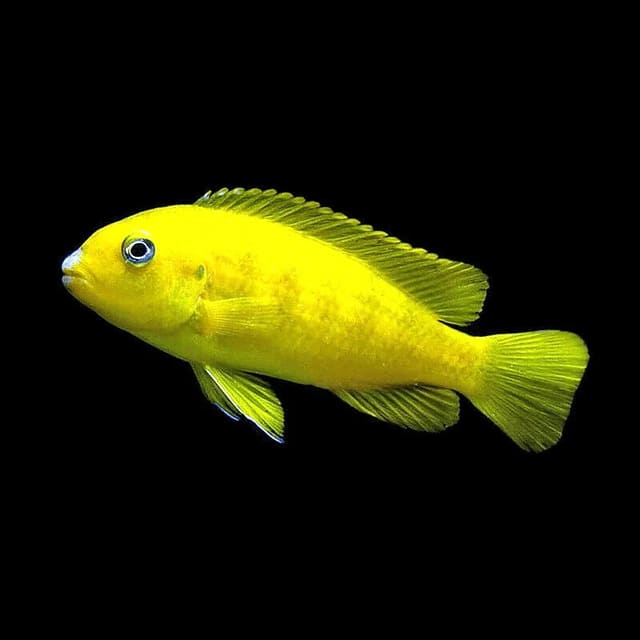
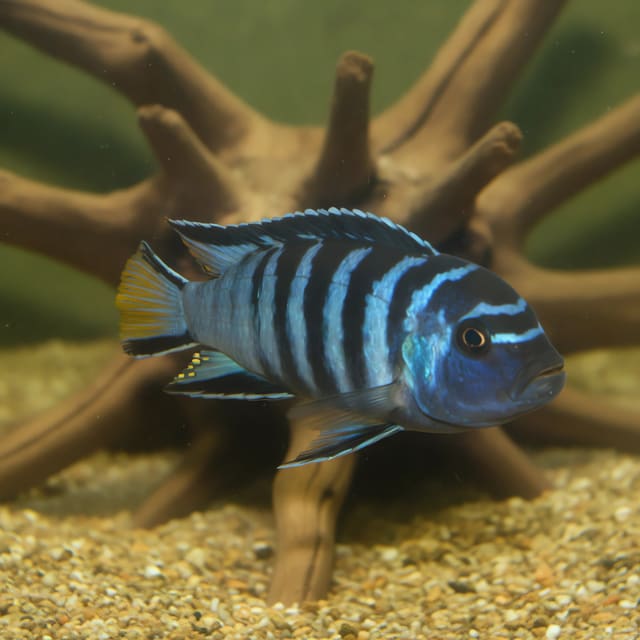
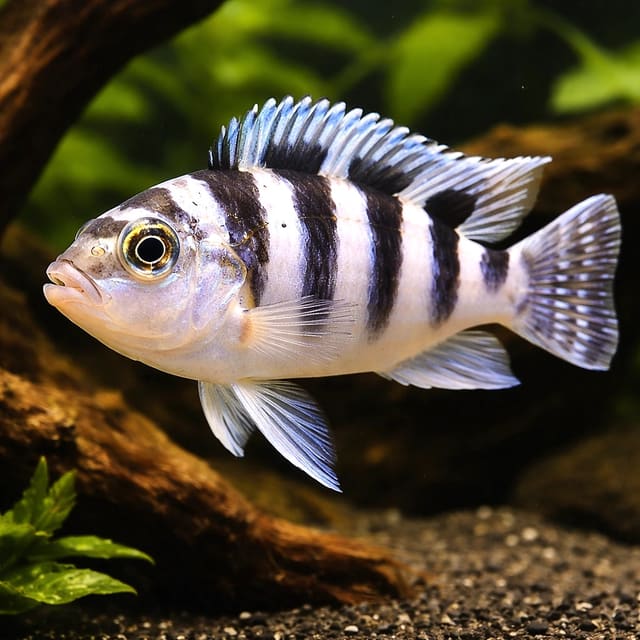
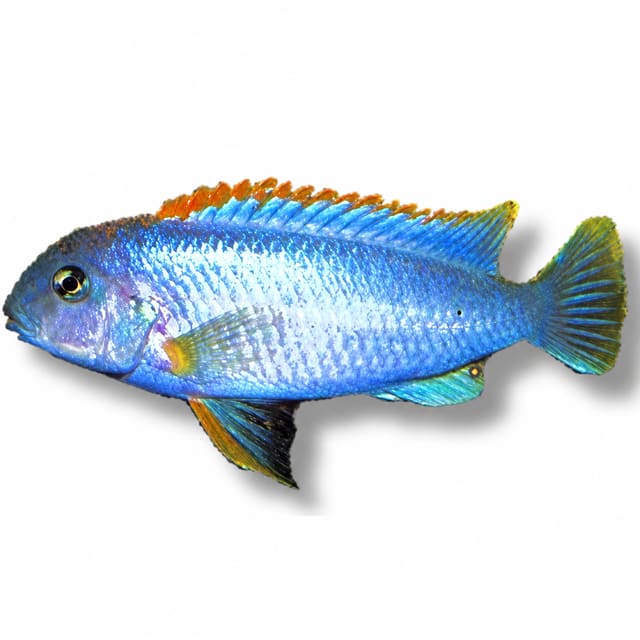
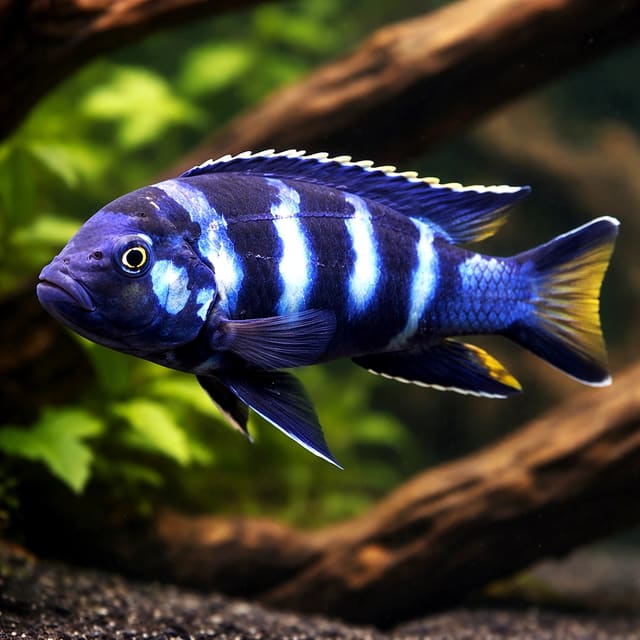
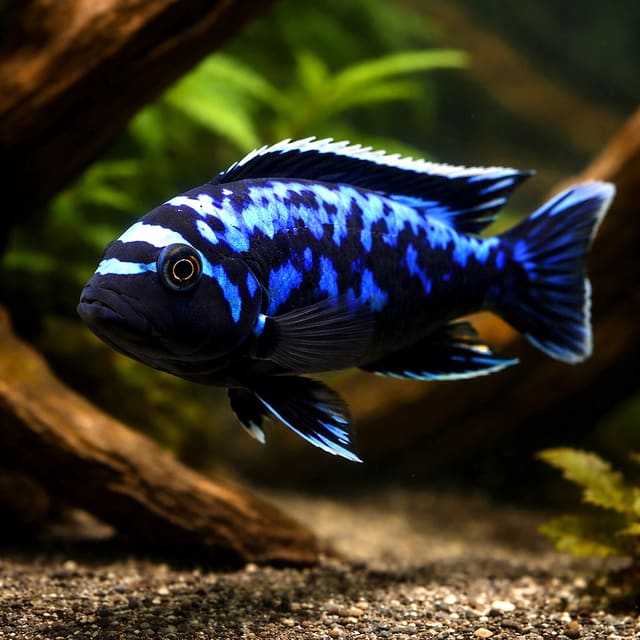
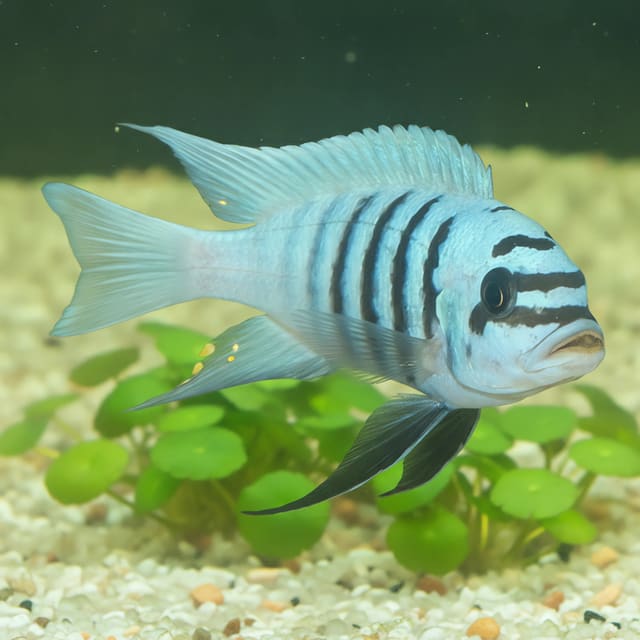
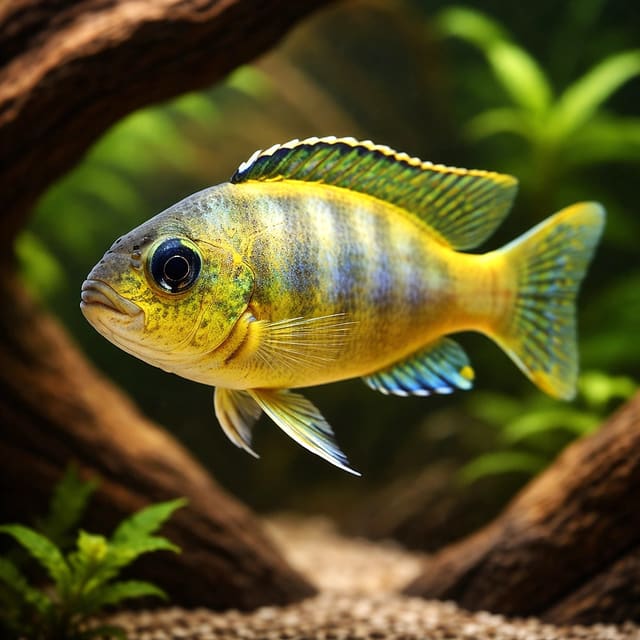
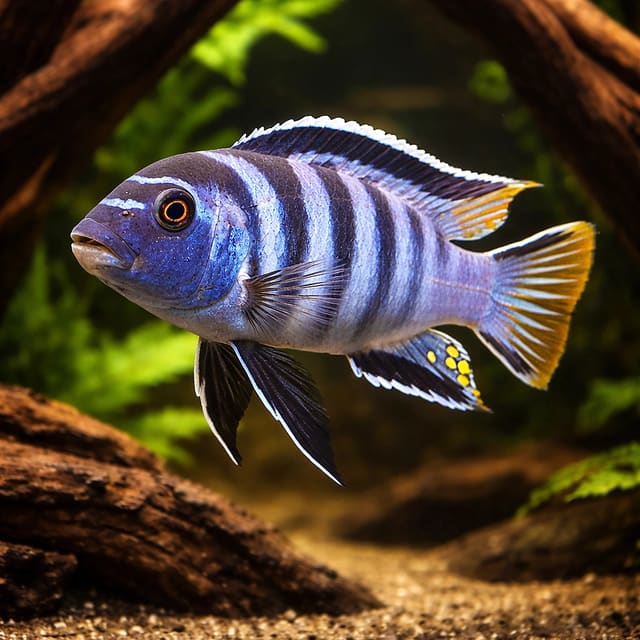
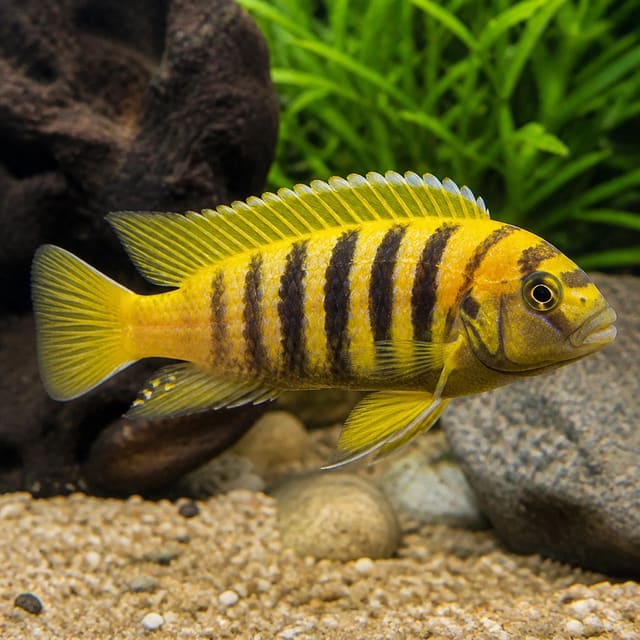
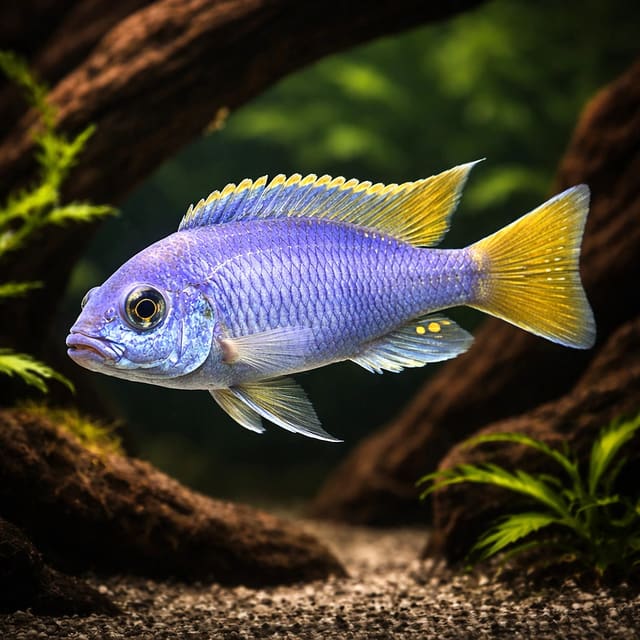
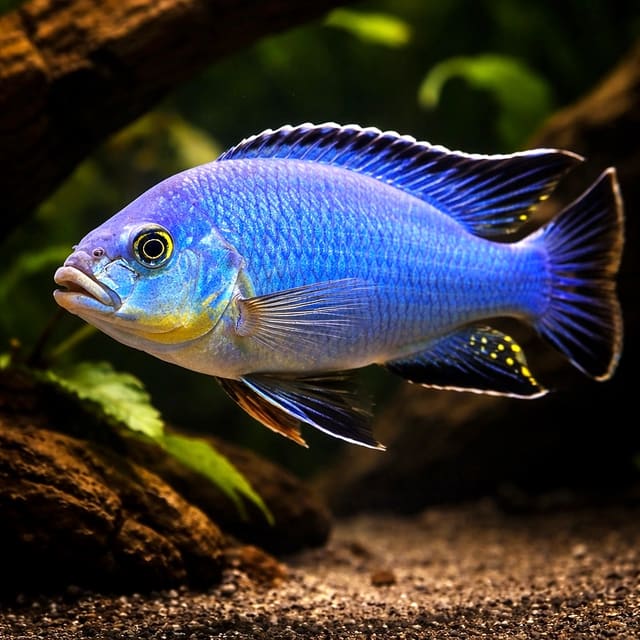
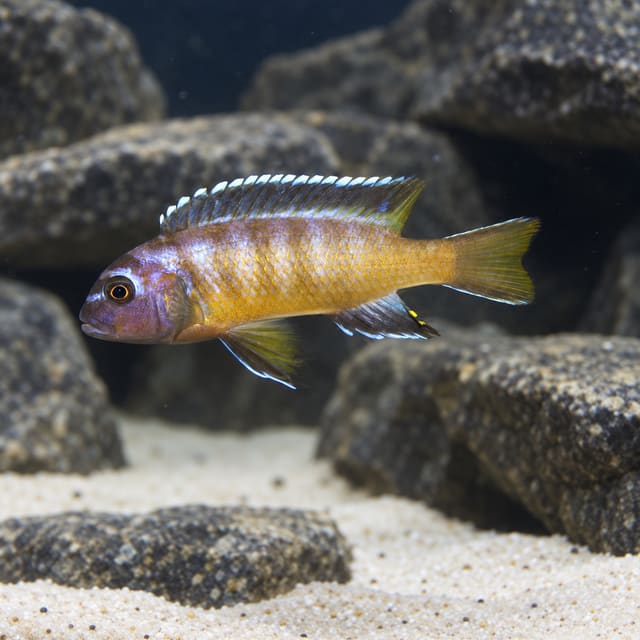
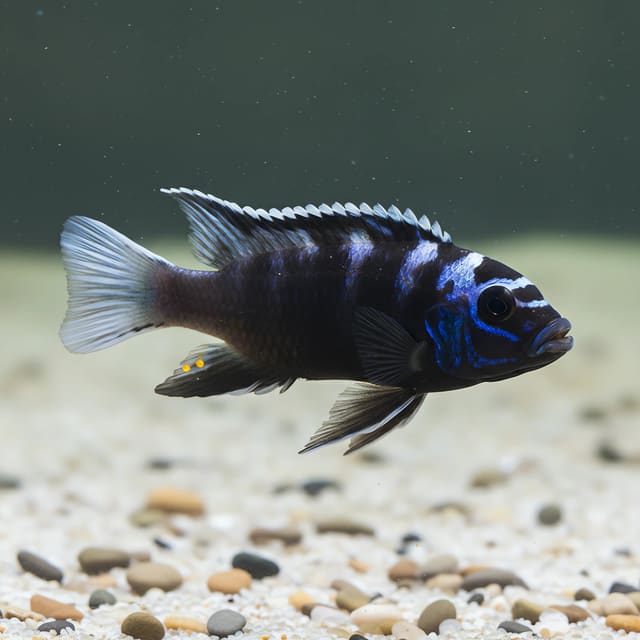
Gallery images have been digitally enhanced to improve image quality. Natural colour, pattern, size and maturity can vary between live animals. The pictures show a fish with black bars on a pale blue body, a dark face, an orange throat and orange-red tones along the dorsal fin, and one shows two fish facing each other. Use them as a guide to the look of this form rather than as a portrait of the fish you will receive.
To compare other cichlids from Africa's great lakes, browse our African cichlid range.
A single mbuna is rarely the whole purchase. The UK trade body OATA describes Malawi cichlids as colourful, diverse and aggressive; they are not social fish and can be highly aggressive, yet OATA recommends keeping them in groups of at least 15, slightly overcrowded, to limit that aggression. The aim is to spread aggression evenly across the whole population, so that no single fish takes all of it. OATA also warns that Malawi cichlids kept in small groups will often fight.
Because this listing sells one fish per purchase, work out the whole community before you buy. Decide the aquarium volume first, then how many Malawi cichlids it can carry with strong filtration, then the species mix. Buying one fish at a time into a tank without a plan leads straight to the small, unsettled group OATA warns against.
OATA recommends an aquarium of at least 200 litres for a reasonable-sized community of Malawi cichlids, while noting that some more specialist species can be kept in smaller aquariums. With an unidentified form, that specialist exception cannot be relied on. Treat 200 litres as the starting point and go larger if you can: the larger the aquarium, the more stable its temperature and water quality will be.
We cannot give an exact adult size for a fish whose species has not been identified. OATA's group figures are the planning reference instead: most Malawi cichlids grow to around 10 cm, but some will grow up to 25 cm. Size the aquarium and choose companions with room to spare, and do not treat the length at dispatch as the length the fish will keep.
Suppose you are setting up a new 200-litre aquarium for mbuna. OATA's guidance points to a community of at least 15 Malawi cichlids, so the Red Dorsal Mbuna becomes one decision among several: how many species to keep, how many fish of each, and which are more peaceful and which more aggressive, because that decides the order in which they go in. Write the plan down before the first purchase, including where a fish would go if it had to be moved, and budget for the oversized filter and strong aeration that a well-stocked Malawi tank relies on. The Red Dorsal Mbuna is then one line in that plan rather than the whole of it.
Malawi cichlids are a specialised group and need particular water parameters. OATA gives these values as a general guide for the group:
| Measure | Malawi cichlid guidance |
|---|---|
| Temperature | 23–27°C |
| pH | 8.0–8.6 |
| General hardness | Hard, 12–18 dGH |
| Carbonate hardness | Hard, 10–15 dKH |
| Ammonia | Zero |
| Nitrite | Zero |
| Nitrate | No more than 20 mg per litre above your tap water |
These are broad values for Malawi cichlids as a group rather than a measured optimum for this particular fish, which is another reason to keep them steady instead of fine-tuning towards one number.
General hardness (GH) reflects dissolved minerals such as calcium and magnesium. Carbonate hardness (KH) reflects the carbonate and bicarbonate that buffer the water against a falling pH. A Malawi aquarium needs both to be high, and it is the carbonate hardness that keeps the pH steady between water changes. OATA recommends coral sand or a similar substrate to help buffer the water.
UK tap water varies from area to area, so test your own supply before assuming it suits a Malawi tank, and test the aquarium itself at least once a week. Our guide to aquarium water parameters explains how to read GH, KH and pH results, and the water parameter matcher compares your readings with published ranges. Treat all replacement water with a tap water conditioner to remove chlorine or chloramine.
Hold the aquarium steadily within 23–27°C with a thermostatic heater, and check it with a thermometer rather than trusting the heater setting. Bring about any change to hardness or pH gradually, as part of normal water changes, rather than in a single step. A stable reading within the range serves the fish better than a chemistry that moves from week to week.
OATA is emphatic that a filter is always essential, whatever the size of the aquarium, and the RSPCA says no fish should be kept without a well set-up and maintained filter. Malawi communities raise the stakes. Because they are deliberately stocked slightly crowded, OATA recommends an oversized filter, together with aggressive aeration so there is enough dissolved oxygen for every fish.
Fish release ammonia, which is toxic. A working biological filter grows beneficial bacteria that convert ammonia to nitrite, which is also toxic, and then to nitrate, which is safer. Those bacteria live in the filter media, which is why the way you clean the filter matters as much as the model you buy.
A new filter needs time to build its bacterial population. Stocking too many fish, or stocking too quickly, can cause new tank syndrome: there are not enough nitrifying bacteria for the extra waste, ammonia and nitrite rise to unhealthy levels, and fish may become ill or die. Mature the filter before the first fish go in, confirm that ammonia and nitrite both read zero, and follow our step-by-step guide to setting up a first tropical tank. After that, add fish in stages, because the bacteria have to catch up every time the stock and the feeding increase.
Mbuna are the rock-dwelling Malawi cichlids, as opposed to the utaka, which swim in open water. Build the aquarium around that habit with a sand bed and rockwork, and make the layout secure, because Malawi cichlids will often dig and rearrange the substrate.
OATA explains that the dietary needs of Malawi cichlids vary. The smaller mbuna species are more herbivorous, while some of the larger utaka species are more predatory and need pellets with a higher animal content, with frozen foods such as brine shrimp, prawns or cockles. As a mbuna, this fish follows the first pattern.
Overfeeding is an easy mistake in a well-stocked mbuna tank. OATA warns that uneaten food breaks down and releases toxic waste into the water, and a deliberately crowded community already produces plenty of waste. Keep protein-rich foods designed for predatory utaka for the fish that need them; they are not the staple OATA describes for mbuna.
Feeding time is also the easiest daily health check. OATA lists reduced intake or lack of interest in food among the changes worth noticing, so watch that each fish comes forward to eat.
Our team hand-packs every order. Fish travel hand-bagged in pure oxygen inside an insulated poly box, with a heat pack when the weather calls for it, and a licensed live-animal courier carries the parcel on a tracked service. We email the tracking number and your confirmed delivery date so you know when to be in. Our delivery and Live Arrival Guarantee page sets out the full terms.
Before the fish goes in, confirm that ammonia and nitrite read zero and that the aquarium is large enough for the number of Malawi cichlids you intend to keep. OATA advises adding Malawi cichlids in groups so that no individual receives unnecessary aggression as it settles in. A lone newcomer in an established tank is exactly the fish that advice protects, so where you can, bring new fish in together rather than one at a time.
Over the first days, compare the newcomer with OATA's description of a healthy fish: clear, bright eyes, undamaged fins, intact scales, no ulcers or bumps and normal swimming. Hiding, fast breathing or a fish that stops coming forward to feed are the early changes to note.
OATA stresses that good husbandry is essential because Malawi cichlids can be stressed by even the smallest amounts of ammonia and nitrite. In a crowded mbuna aquarium, the weekly routine is the foundation of everything else.
In a Malawi aquarium the replacement water matters as much as the water you remove. If your tap water is softer or more acidic than the tank, each change pulls GH, KH and pH down a little, and the coral sand has to make up the difference. Test the tank the day after a water change until you know how your supply behaves, and keep the size and timing of changes consistent so the chemistry stays steady from week to week.
A twice-daily feeding routine and a well-stocked tank make holidays worth planning. Leave a carer with pre-measured portions and simple written instructions, show them how to read the thermometer, and ask them to feed less rather than more: OATA's warning about uneaten food fouling the water applies with extra force when someone unfamiliar with the tank is feeding it.
| Area | Change to note |
|---|---|
| Swimming | Hanging at the surface, sitting on the bottom or erratic movement |
| Colour | A darker or paler colour than normal |
| Temperament | A change in aggression, or more hiding than usual |
| Breathing | Gill covers moving faster or slower than normal |
| Appearance | White spots, fluffy growths, lost scales or damaged fins |
| Condition | Weight gain or loss |
| Feeding | Eating less, or no interest in food |
OATA's first step is to test the water quality and then seek experienced advice. Work through temperature, ammonia, nitrite, nitrate and pH, then think back over recent additions, layout changes and feeding. In a Malawi community, look at behaviour too: a fish that is hiding more than usual or carrying fresh damage may be losing out to aggression, and group size, stocking balance or a rearranged layout can matter as much as water quality. When signs are severe or persistent, speak to an experienced aquatic retailer or a vet with fish experience.
OATA says Malawi cichlids should only be kept with other Malawi cichlids or some species of Synodontis catfish, which also live naturally in Lake Malawi. That rules out a general tropical community, whatever the temperament of the other fish, because both the water chemistry and the behaviour of a Malawi aquarium are specialised.
Within the Malawi group, sizes and habits vary. Most species grow to around 10 cm and some to 25 cm, and the rock-dwelling mbuna live differently from the open-water utaka. Choose companions with the whole adult community in mind, not just the fish in front of you.
Overcrowding only works with filtration and aeration to match. A slightly overstocked tank relies on an oversized filter, strong aeration and the weekly maintenance routine; without them, the extra fish simply become a water-quality problem.
Watch the group rather than individual squabbles. The signs on OATA's list that matter most here are a change in aggression, a fish hiding more than normal, damaged fins or lost scales, and a fish that stops feeding. If one fish is being singled out, work through the causes that OATA's stocking advice points to:
Correct water quality first if the tests show a problem, then adjust the stocking. Where one fish is persistently targeted, moving it to another established Malawi aquarium may be kinder than waiting for the group to settle.
OATA names some species of Synodontis catfish as possible companions because they also occur naturally in Lake Malawi. Only those species qualify. A Synodontis from elsewhere falls outside this advice, so confirm where any catfish comes from in the wild before adding it to the aquarium.
Sex matters in a mbuna community because OATA recommends keeping more females than males of each species. It is also the hardest thing to control when buying unsexed fish: many Malawi cichlids only show differences between the sexes once they become adults, and the main differences are colour or egg spots on the males' anal fin.
This listing has no option that guarantees a sex, so treat the sex of each fish as unknown until it matures. If you buy several, be ready for the balance to turn out differently from your plan, and decide in advance where a surplus male could go if the group becomes unsettled.
If you plan to keep more than one Red Dorsal Mbuna, remember that OATA's advice on keeping more females than males applies within each species, and that these fish are sold unsexed. Buying a single fish of this form keeps the question simple; buying several means planning for an uncertain mix and having a fallback ready. Either way, the form still joins a community of at least 15 Malawi cichlids rather than standing alone.
The red dorsal of the trade name refers to the colour along the dorsal fin, which shows as orange-red tones in the gallery. Because colour is one of the main differences between the sexes and many Malawi cichlids only show those differences as adults, a young fish may not yet carry the full colour seen in the pictures. Judge colour after the fish has matured in stable, hard water, not in its first weeks.
Its exact species has not been identified, so we cannot give a reliable adult size. OATA says most Malawi cichlids grow to around 10 cm and some reach 25 cm, so plan the aquarium and its community for that group range rather than for the size at purchase.
OATA recommends at least 200 litres for a reasonable-sized community of Malawi cichlids, and a mbuna is planned as part of such a community. A larger aquarium is better, because it keeps temperature and water quality more stable.
OATA's Malawi guidance is a group of at least 15 cichlids, slightly overcrowded to spread aggression, because Malawi cichlids kept in small groups will often fight. Where possible, keep more females than males of each species.
OATA describes Malawi cichlids as usually undemanding and easy to keep apart from their aggression, but their needs are specific: hard, alkaline water, a large mature aquarium, an oversized filter and a carefully stocked group. A beginner who plans the whole community first can manage it; it is not a fish to add to an ordinary community tank.
OATA says the smaller mbuna species are more herbivorous and appreciate a specialised Malawi cichlid food with a high algae content, plus fresh vegetables. Feed twice a day, only what the fish can eat within a few minutes, and remove any leftovers.
OATA's broad guidance for Malawi cichlids is 23–27°C, pH 8.0–8.6, general hardness 12–18 dGH and carbonate hardness 10–15 dKH, with ammonia and nitrite at zero. These are group values rather than a measured optimum for this fish, so keep them stable and test your own water.
Yes. OATA says Malawi cichlids are all aggressive and should be mixed with caution, and that they will often fight in small groups. Keep it only with other Malawi cichlids, in a group large enough to spread aggression, never in a general community tank.
OATA says Malawi cichlids should only be kept with other Malawi cichlids or some species of Synodontis catfish that also live naturally in Lake Malawi. Add Malawi cichlids in groups, with the more peaceful species first and the more aggressive ones later.
It is hand-bagged in pure oxygen and packed in an insulated poly box, with a heat pack when the weather calls for it, then carried by a licensed live-animal courier on the delivery date we confirm by email. Be in to receive it, film a continuous unboxing video from the sealed parcel, open it the same day and float the bag for 20–30 minutes before releasing the fish without the bag water.
No reviews for this item yet. Bought one? Honest reviews only, good or bad.
What customers say about ordering from us
I have a small group of long finned mountain minnows. So was delighted to be able to order ten of this variety to increase the genetics in my tank . The ones I recieved are healthy but it’s to early to give a verdict on wether they are of a long finned type since they are small currently.
Gordon Walker · 23 Sept 2026
100% success travel and "installation". Pleased with quality of purchase. The Siamese fighter a bit "shy" so have not yet seen him at his best yet but looking good. Happy customer. GG
George E Garratt · 21 Sept 2026
Reviews of our shop, collected by Judge.me, an independent third-party review collector. Newest first.