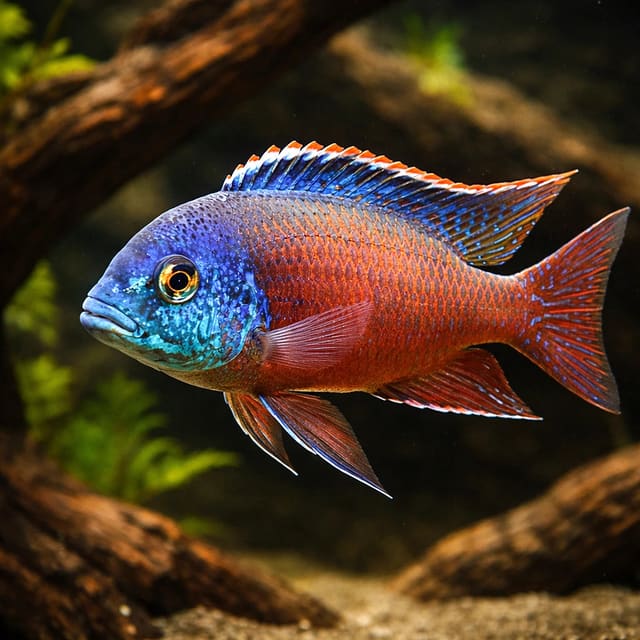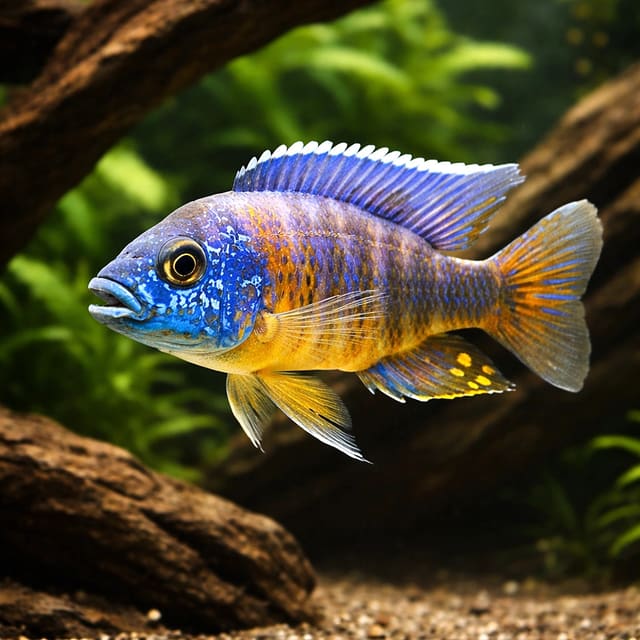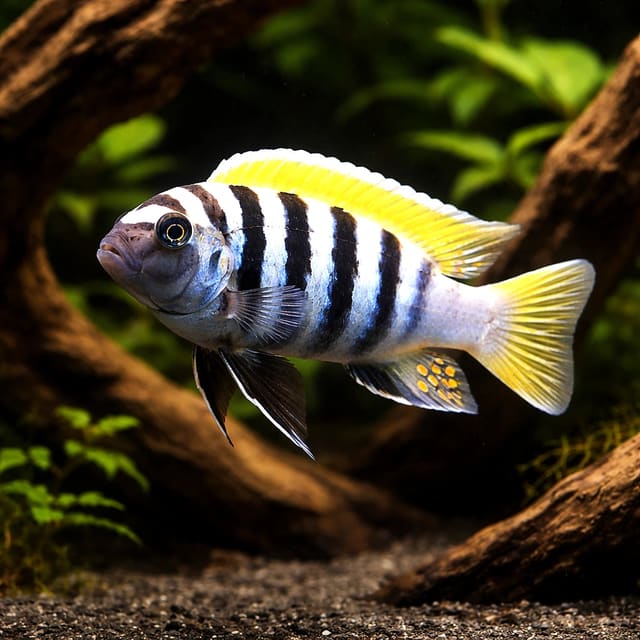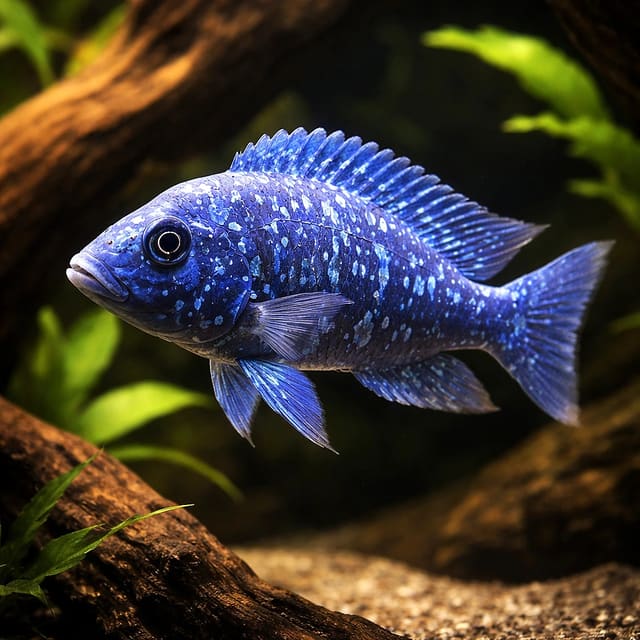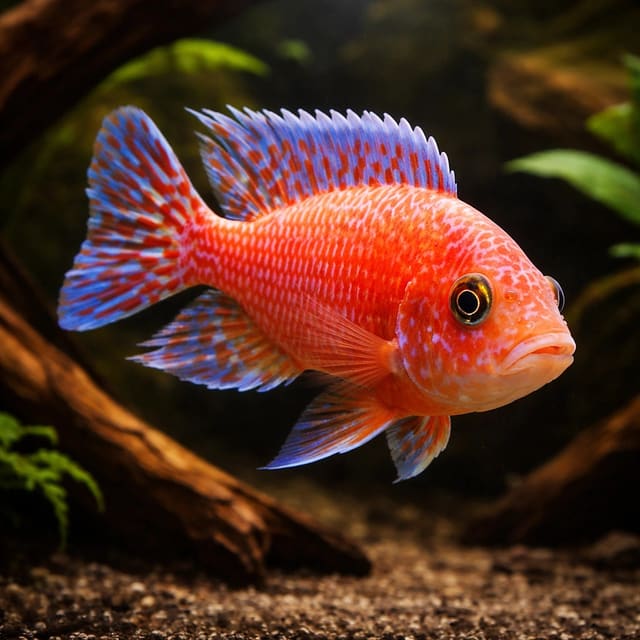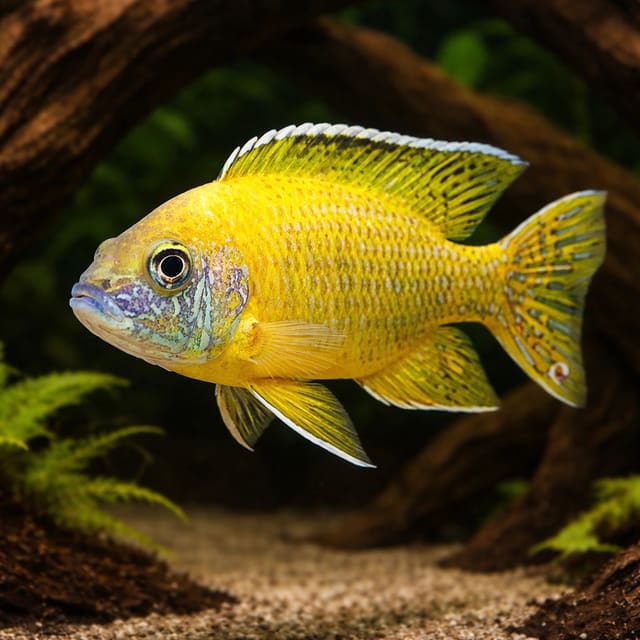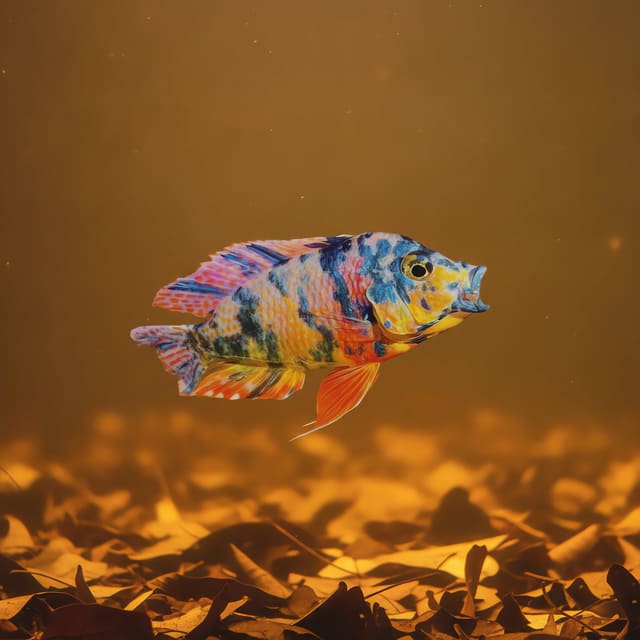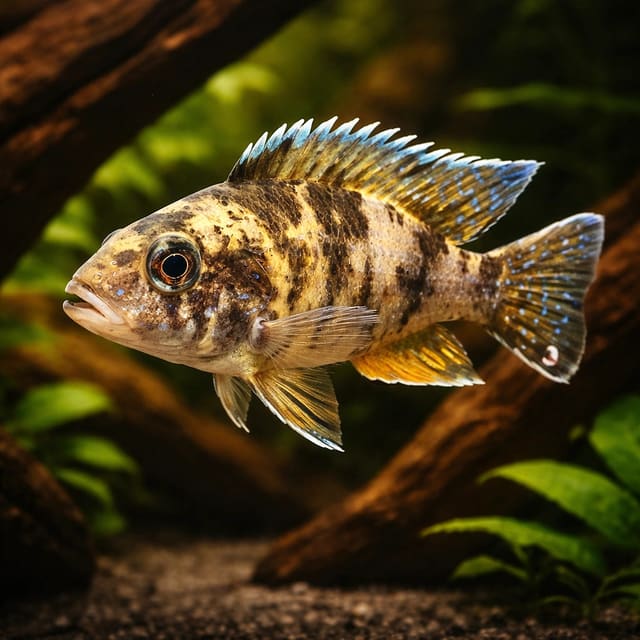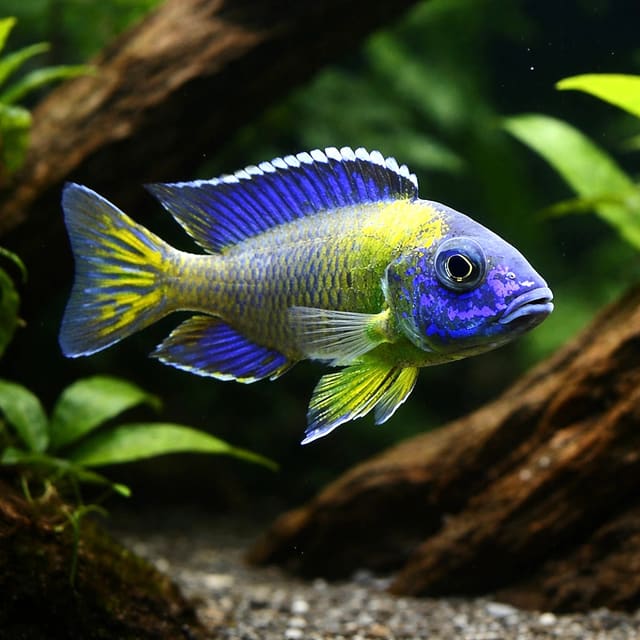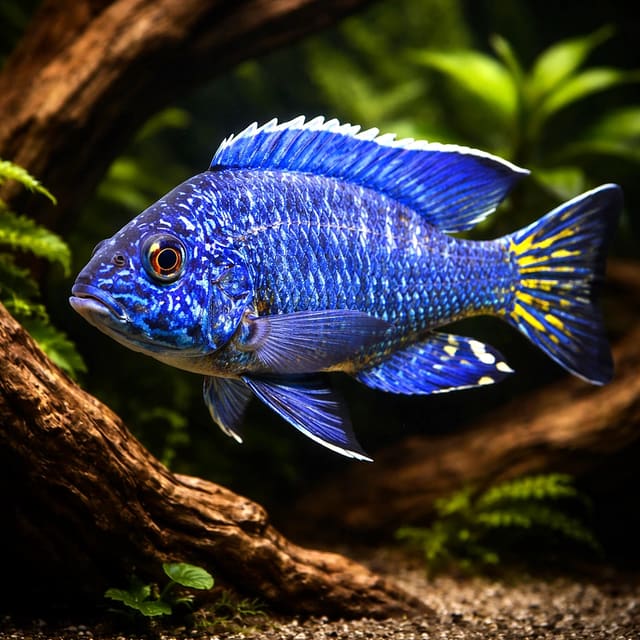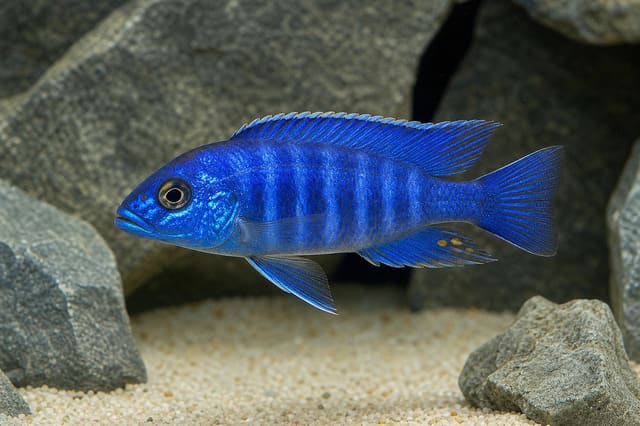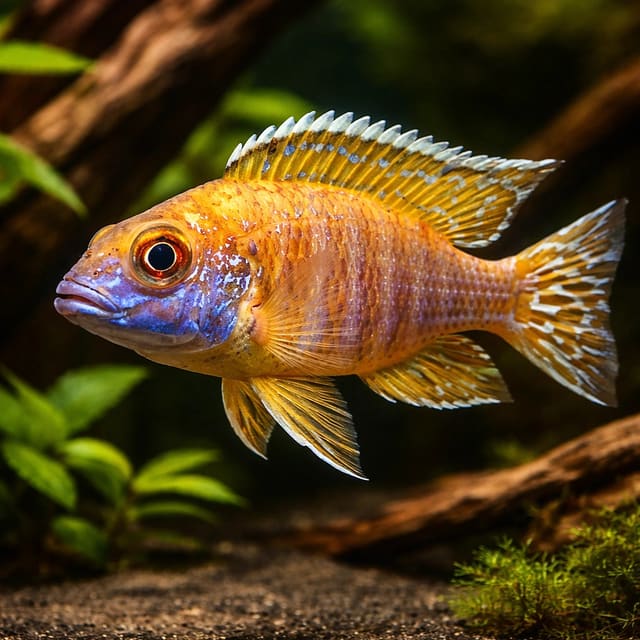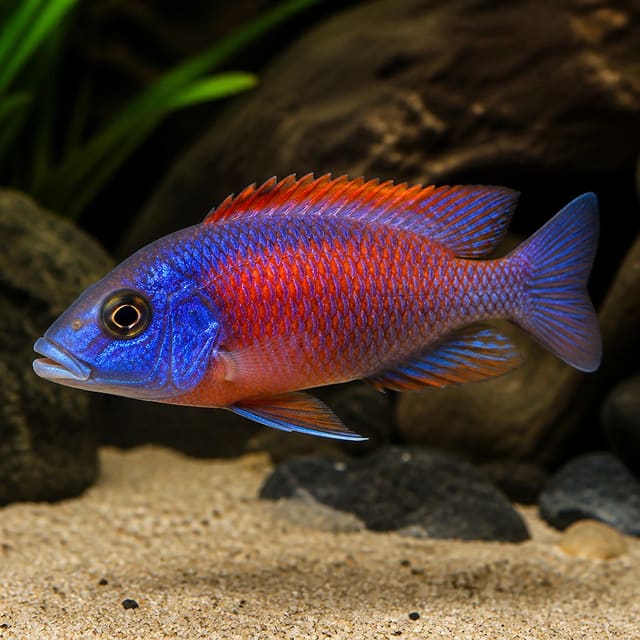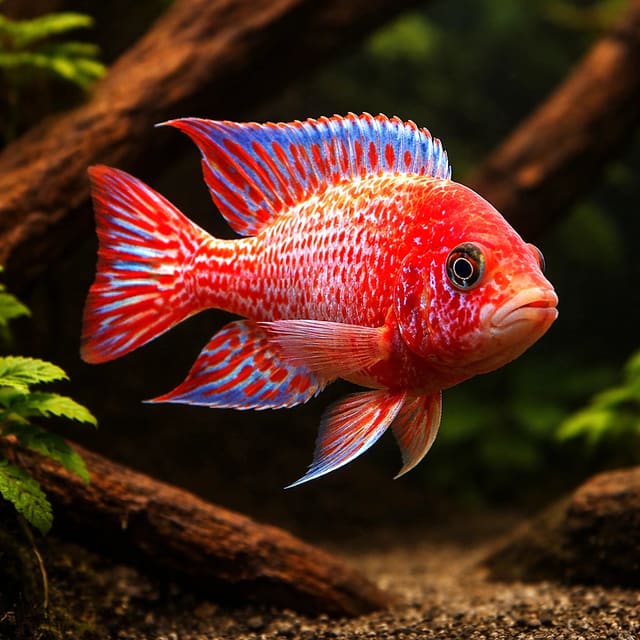
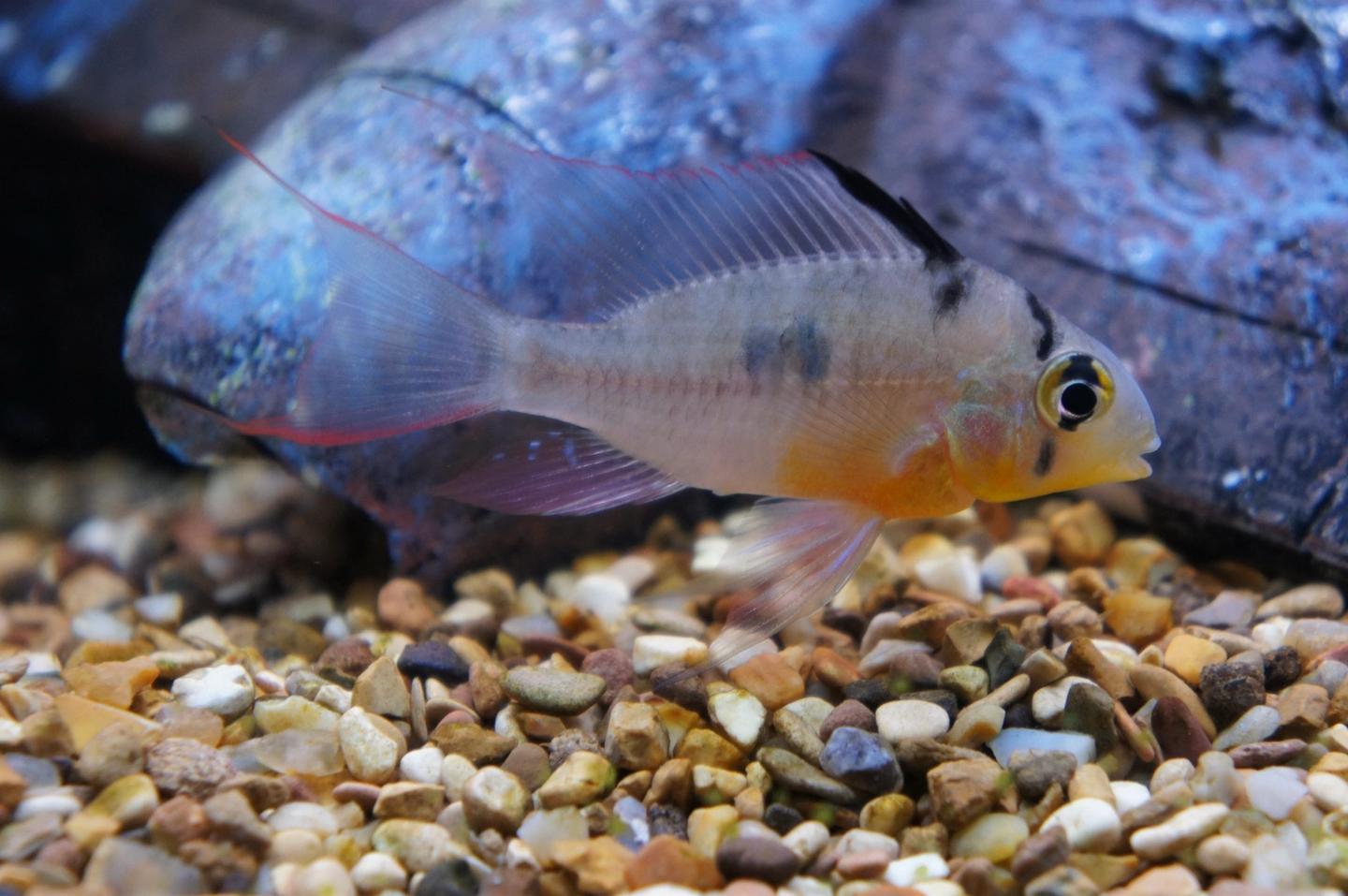
Red Dragon Peacock Cichlid (Aulonocara Hybrid)
23–27°C · pH 8–8.6
From £12.09Some sizes on sale
One unsexed Blue-Gold Peacock Cichlid (Aulonocara korneliae) in the chosen size grade. This Lake Malawi fish needs an established aquarium with hard, alkaline water, a sand-and-rock layout and a considered cichlid community.
Aulonocara korneliae
Save when buying multiple fish. Each quantity is one fish; sex and pair formation are not guaranteed unless the selected variant explicitly states them.
One unsexed Blue-Gold Peacock Cichlid (Aulonocara korneliae) in the chosen size grade. This Lake Malawi fish needs an established aquarium with hard, alkaline water, a sand-and-rock layout and a considered cichlid community.
Cichlids are a family of roughly 1,800 accepted species, not one care type. Before buying, identify the exact species and source, then compare adult measurement, usable tank dimensions, social system, territory, tested water, diet and an exit plan. No family-wide minimum tank, water range or tank-mate list is safe.
The Blue-Gold Peacock Cichlid sold here is Aulonocara korneliae, a Lake Malawi species. One purchase supplies one fish in the size grade you choose. Sex is guaranteed only when the selected option explicitly states male or female. This Blue-Gold Peacock Cichlid listing has no sex-guaranteed option. A colour name, photograph or larger grade cannot establish the appearance of the animal delivered. A suitable home is a mature, hard-water aquarium planned around cichlid behaviour, with secure rockwork, open sand and room to avoid a dominant neighbour. If your present aquarium is a soft-water community tank or is still cycling, prepare the right setup before choosing this fish.
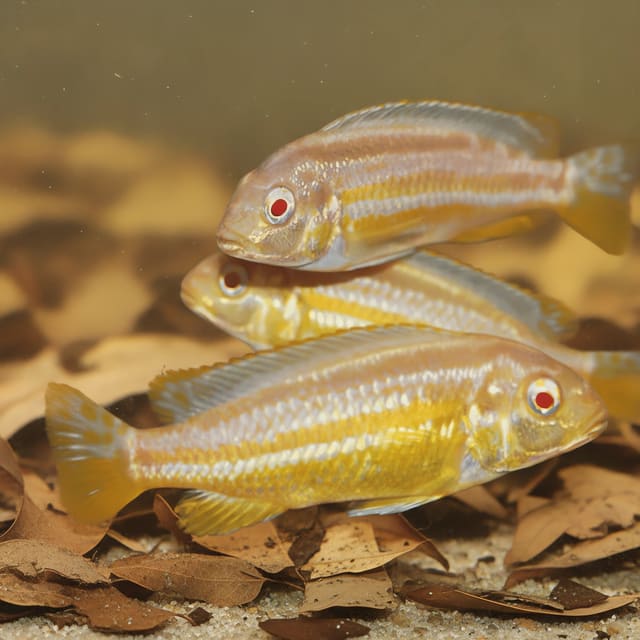
This Blue-Gold Peacock Cichlid is listed as Aulonocara korneliae and offered in four size grades: 4–5 cm, 6–7 cm, 7–9 cm and XL. The selector shows the actual grade offered at the time you order. These are dispatch grades, and XL is a trade size label rather than an exact centimetre promise. The size you select is the size supplied, not the adult size. You receive one animal per purchase, even if a photograph shows more than one fish. If you hope to keep several, first make a plan for the adult community and for an unexpected sex mix; multiplying the purchase quantity does not turn unsexed fish into a confirmed pair or group.
FishBase identifies Aulonocara korneliae as a cichlid from Chisumulu Island in Lake Malawi. That distribution describes the wild species. It does not tell us whether a fish sold through this shop was collected there, bred elsewhere or raised through a particular line. The trade name describes the blue and gold appearance associated with the type, but it is not a colour guarantee for every juvenile or unsexed individual. We cannot infer an individual fish's provenance, maturity or sex from this listing image. The right decision is whether you can provide a stable home for the species, including an animal whose eventual colour differs from the pictured fish.
FishBase records a maximum of 7.8 cm standard length for a male or unsexed specimen. Standard length is measured to the base of the tail, while a retail grade may use another measurement convention. Thus a 7–9 cm commercial grade and the published standard-length figure are different kinds of information. Neither number predicts the precise length of your individual as an adult. Allow space for the whole fish, its normal movement and the other cichlids, rather than choosing a tank by converting the scientific figure into a shopping rule. The FishBase species record is useful for the name, range and wild biology, while the live size selector describes what can be purchased here.
A clear aquarium is not necessarily biologically ready. Fish waste produces ammonia; a functioning filter supports bacteria that process it first to nitrite and then to nitrate. Both ammonia and nitrite are harmful, so confirm the filter can handle the planned stock and test the water rather than relying on the age or appearance of a tank. The RSPCA's aquarium guidance explains why established filtration is essential. For this cichlid, also check that the water is consistently suitable for a Malawi setup and that the layout gives a pursued fish a route out of view.
Before ordering, walk through the existing fish one by one. Check their adult size and feeding habits, whether they need the same water, and how each will use the rocks and sand. A small new arrival placed among established, larger cichlids may lose access to food. A larger newcomer can instead unsettle an existing hierarchy. Have a divider or separate mature accommodation available if repeated chasing begins. You can browse the current African cichlid collection for context, but products shown alongside this one are alternatives to assess, not automatically safe companions.
It is sensible to choose this fish for its biology and behaviour, not just the expected blue-and-gold display. Natural colour and markings vary with maturity and condition, and an unsexed grade may include an animal that never resembles a strongly coloured display male. Similarly, a gallery image cannot establish that the pictured specimen is the individual dispatched. Use the listing to choose an appropriate species and grade, then assess the actual animal's condition and welfare after arrival. The care sections below explain the practical checks that matter before and after purchase.
FishBase describes wild Aulonocara korneliae around rocky habitat, foraging over sand for sand-dwelling invertebrates. This is a helpful starting point for aquarium design, although it does not prescribe one perfect captive layout. Give the fish secure rock structures and accessible sand rather than filling the entire footprint with a solid wall of stone. Broken sightlines let one fish leave another's view; open passages let it move and feed normally. You want several usable places, not a decorative pile whose gaps trap a startled animal. Position heavy pieces so digging cannot undermine them, check that they cannot shift onto a fish or the glass, and leave room to clean the spaces behind them.
Fine, clean aquarium sand makes sense for an animal that explores a sand-and-rock boundary. Avoid sharp material that could injure a mouth or gill area during normal foraging. Do not assume that the fish must spend every moment sifting the bottom: open swimming space remains important. A long footprint provides more scope for a fish to retreat than a tall, narrow tank of the same volume. Before purchase, map where the existing residents feed and rest. If a dominant fish already controls the only open patch of sand, adding another peacock without changing the layout may concentrate conflict. A few separated rock groups and a clear crossing route are often more useful than adding more stones.
Plants are optional, and a well-run Malawi aquarium need not imitate a densely planted community display. If you use them, select species suitable for the aquarium's water and attach or protect them as appropriate. Do not compromise swimming room to achieve a planted look. Wood, ornaments and other materials should be chosen for safety and their effect on water, not merely for colour. Rinse suitable decor before use and avoid any item that could leach contaminants. A stable, accessible layout is especially valuable when you need to observe a newly introduced fish, remove uneaten food or catch an injured animal without dismantling the entire tank.
A single litre figure cannot account for every A. korneliae aquarium. Tank planning depends on length, floor space, filtration, the number and size of fish, sex composition, territorial behaviour and the keeper's ability to intervene. A modest arrangement still needs enough length for separate spaces and normal swimming. A mixed or larger cichlid community demands more room. If the planned aquarium is a short cube, the nominal litre figure alone will not create distinct territories. Work from the adult stocking plan and the physical layout, not the length of the juvenile you are about to receive.
Draw the layout and stocking plan before adding fish. Mark feeding stations, rock groups, open sand and clear routes between them. Ask whether a chased fish can reach shelter without being cornered, and whether every animal can feed without crossing a dominant individual's territory. Consider how maintenance equipment and a net will reach the back of the tank. If the plan relies on an exact number of males or females, this unsexed product cannot supply that certainty. Keep spare capacity rather than stocking to the limit on the assumption that every fish will be unusually calm. The most useful test of space is not a single published number; it is whether the chosen adult animals can use the aquarium without chronic stress.
A mature, correctly maintained filter is fundamental. It must support the full intended adult stock and continue to process waste even when feeding or behaviour changes. Test ammonia and nitrite during setup and after significant changes; either result should prompt investigation. Follow nitrate trends as part of a routine water-change plan. The water chemistry guide explains what these measures mean. Do not treat a single clear-water reading as proof that an aquarium is safe for another fish. If you clean filter media, protect the biological colony by following the filter maker's method and avoiding wholesale replacement of established media at once.
Circulation should move water through the aquarium and keep the surface exchanging gases without forcing the fish to fight a constant current. Check for trapped waste behind rocks and weak circulation in corners. A heater, thermometer and reliable testing routine help catch change before the fish shows distress. Keep equipment accessible: a hidden intake clogged by sand or a heater obstructed by rockwork is harder to spot. Observe the fish as well as the instruments. Gasping, loss of balance, persistent hiding, clamped fins or refusal to feed can have several causes, so start by checking water and social conditions rather than assuming a single disease or reaching for a treatment.
OATA's Malawi cichlid care sheet gives a broad group guide of 23–27 °C, pH 8.0–8.6 and hard water, including 12–18 °dH general hardness. It expressly says that species-specific needs should be checked with the retailer. FishBase also lists 23–27 °C as environmental context for this species. These figures do not prove a measured optimum for the individual stock sold here, and a wild environmental interval is not a reason to aim for its extremes. Use the group figures as planning context, measure your own water, and seek qualified advice before making a significant change for the fish you actually keep.
For day-to-day care, aim for stable conditions appropriate to an established Malawi aquarium and monitor the fish as well as the test results. In practical terms, avoid rapid correction of pH or hardness to chase a number on paper. Compare tap water and aquarium water over time, understand the minerals present, and make replacement water consistent with the established setup. The water matcher can help organise measured values; the fish still needs a stable, maintained aquarium rather than a tool result treated as a guarantee.
Check the temperature with a separate thermometer, especially after seasonal room changes or equipment replacement. Test source water before and after any deliberate mineral adjustment. If the tap supply is soft, plan a repeatable way to prepare replacement water and verify it with tests instead of adding an unmeasured product to an occupied aquarium. Change water according to the actual waste load and measured trend, not a fixed slogan. Match replacement water sensibly, dechlorinate it as required and avoid exposing the fish to abrupt changes. When several values move at once, pause and identify the cause; repeatedly adjusting pH while neglecting filtration or waste control can make the environment less stable.
FishBase records feeding on sand-dwelling invertebrates in the wild. That observation explains why this peacock should not be treated as an algae-grazing Mbuna simply because both are Malawi cichlids. In an aquarium, choose a complete food appropriate for Malawi cichlids as the nutritional base, following its directions and the needs of the whole stock. A suitable sinking or slow-sinking format can give the fish a chance to feed below the surface. Offer modest amounts that are eaten promptly; left-over food decomposes among rocks and can damage water quality. Introduce unfamiliar foods gradually and watch whether every fish has access.
Suitable aquatic-invertebrate foods can add variety in measured portions, but variety should not replace a complete staple or become an excuse for heavy feeding. The wild record does not specify an exact captive menu, meal frequency or supplement dose for the fish you will receive. Choose products appropriate for the animal and use appetite, body condition and water tests to judge the routine. During introduction, a timid fish may feed less because an established resident controls the feeding area. Try distributing food so one dominant fish cannot intercept everything, and investigate persistent refusal to feed. Do not simply increase the total ration when the issue is competition.
Observe feeding without making it a stress test. A fish that explores the lower and middle parts of the aquarium and takes food can still need time to settle after travel. A fish that repeatedly misses meals, is pushed from every feeding spot or has a markedly changed body shape needs attention. Check water and aggression first, then seek appropriate aquatic veterinary or experienced specialist help if signs continue. Avoid transferring a diagnosis or treatment schedule from another species. The sound general practice is a complete diet, restrained portions, clean water and access for the individual animal.
Prepare the aquarium and its social plan before delivery day. Confirm the filter is working, test the water, check that rocks are secure and have equipment ready to separate a fish if needed. Arrange for someone to receive a live-animal parcel. Once it arrives, follow the current delivery and arrival instructions promptly. Observe the animal's condition through the bag as instructed, then introduce it according to the shop's current guidance while avoiding a sudden temperature or water change. Do not pour transport water into the established aquarium. Keep the room calm and allow the fish to settle without constant disturbance.
Observe the newcomer and the existing residents over the following days. Some retreating and caution can occur during a new introduction, but sustained pursuit, blocked feeding or injury is a reason to act. Rearranging a small portion of the rockwork may break an established territory, yet it is not a substitute for enough space or a separate accommodation plan. Quarantine can be valuable when a keeper has an established, correctly prepared system for it; an uncycled spare tank is not a safe alternative. Do not impose a universal number of quarantine days on this species. The decision should account for the health of the new fish, the existing community and the keeper's facilities.
Handle fish as little as practical. If a move is necessary, prepare the destination and equipment first, minimise chasing and protect fins and skin. Do not force a fish through tight gaps in rockwork while trying to catch it. Continue regular testing after an introduction because increased feeding and biomass can change the filter's workload. Record unusual behaviour and the actual water readings; those details help a specialist assess a problem. Good acclimation does not override poor water or social incompatibility, and a mature filter does not remove the need to watch individual fish.
The trade name can invite an expectation of a bright display fish on arrival. Colour is affected by development, stress and social context, and the selected size is not a sex selection. Do not infer health or sex from colour alone. A newly delivered animal may be subdued while it settles. Assess more useful signs together: balance, breathing, skin and fin condition, willingness to explore and eventually to feed. A sudden or persistent deterioration deserves investigation, starting with tested water and possible harassment. There is no evidence here for a fixed species-specific lifespan, colour timetable or breeding outcome, so plan care around the animal in front of you rather than a promised milestone.
If you intend to breed peacocks, identify the adults reliably before making claims about a pair or lineage. An unsexed purchase is not a breeding guarantee. Where several similar cichlids are kept together, keep records of identity and avoid distributing uncertain offspring as a named pure species. For most buyers, the immediate priority is a stable community, a workable feeding routine and space for the fish to withdraw. The best long-term assessment is whether the fish can carry out ordinary behaviour without chronic pursuit or deteriorating condition, not whether it achieves a particular shade of blue.
Aulonocara korneliae is a Lake Malawi cichlid, so start with water needs, adult size, food and territorial space. OATA's group guidance notes that Malawi cichlids may be aggressive and that keeping arrangements can change their interactions. It does not certify a universal combination for this individual species. A fish that is similar in length may still be a poor companion if it needs soft water, has a very different feeding strategy or competes intensely for the same small territory. Conversely, two fish described as peaceful can clash when the aquarium offers only one usable retreat.
Do not add this peacock to a small soft-water community solely because both aquariums happen to run at a similar temperature. The broader water requirements and social behaviour differ. Very small animals may be vulnerable around a foraging cichlid, while forceful cichlids may intimidate this fish or monopolise food. Think in terms of risks and observation rather than a simplistic approved list. If you are considering other Malawi cichlids, assess each adult species, its diet and likely use of rocks and sand, then leave enough room for individuals to pass without repeated confrontation. A related product is an alternative to compare, not proof of compatibility.
This offer supplies one unsexed fish in the selected size grade. Neither the blue-and-gold name nor the photograph allows the shop to promise a male, and a larger grade does not create a sex guarantee. If adding several fish, plan for the possibility of more than one territorial adult and for an uneven sex mix. Do not buy two on the assumption that they form a pair. Arrange an exit route in the aquarium and a separate mature space or rehoming plan before conflict becomes chronic. Introducing fish of very different sizes can create an additional disadvantage for the smaller animal at feeding time.
Watch behaviour over time rather than judging only the first hour. Repeated chases, a fish confined to one corner, missed meals, damaged fins or rapid breathing are practical signals that the arrangement needs review. Check water alongside behaviour, because poor water can magnify stress and alter normal activity. A rock rearrangement can sometimes interrupt a territorial pattern, but persistent harassment may require separating fish. Avoid solving a cramped setup by simply adding more animals. Group-level advice about Malawi cichlid numbers cannot be converted into a guaranteed safe count for this particular aquarium and unsexed purchase.
Colourful peacocks are often chosen for a display, but similar-looking forms can be difficult to distinguish once they mature or when colour changes with social position. Keep purchase identities and notes if you maintain several types. Where breeding is possible, take extra care with species identity before passing on offspring. The current offer does not supply a sexed or lineage-certified fish, so it should not be sold onward with a collection history that has not been documented. A planned display may still work well when the fish have enough space, suitable water and a keeper willing to adjust the arrangement, but no written compatibility list can replace observing the actual animals.
Before ordering, make a simple decision list: can every fish use the same water, can each feed on an appropriate diet, is there enough length and cover for them to avoid one another, and is there a safe response if one fish becomes dominant? If any answer is uncertain, resolve it before adding a new cichlid. Ask about the current residents by species and adult size rather than relying on a broad label such as 'African cichlids'. A good community is a set of compatible needs and workable behaviours in a particular aquarium, not a collection of attractive product photographs.
FishBase reports a maximum of 7.8 cm standard length for Aulonocara korneliae. That measurement stops at the base of the tail, so it is not directly comparable with every retail size grade.
Choose a long, established aquarium with room for rock groups, open sand and escape routes. A litre figure alone cannot make a layout suitable; plan the footprint and adult community together.
There is no fixed group number for this unsexed offer. The safe plan depends on adult size, sex composition, available territories and the other fish; arrange a way to separate an individual if aggression develops.
It is best for a keeper who can maintain an established hard-water aquarium, test water and manage cichlid behaviour. A new or uncycled tank is unsuitable for any fish.
FishBase describes this species feeding on sand-dwelling invertebrates in nature. In the aquarium, use a complete food appropriate for Malawi cichlids and offer suitable aquatic-invertebrate foods in modest portions.
OATA's broad Malawi-cichlid guide gives 23–27 °C and pH 8.0–8.6, with hard water. Those are group-level planning values, not a measured optimum for this exact fish; keep conditions stable and check your aquarium before ordering.
Malawi cichlids can be territorial. Watch for repeated chasing, blocked feeding or damaged fins, and provide broken sightlines and a separation plan. No individual fish comes with a temperament guarantee.
Consider only fish whose adult size, water needs, feeding and temperament are compatible with a planned Malawi aquarium. OATA warns that Malawi cichlid interactions can be aggressive; a name on a tank-mate list cannot guarantee peace.
Tropical Fish Co uses its current live-fish delivery arrangements. Have someone present to receive the parcel, inspect it the day it arrives and follow the published arrival guidance; Live Arrival Guarantee claims require a continuous sealed-parcel unboxing video.
The scientific name, Chisumulu Island distribution, rock-and-sand foraging and 7.8 cm maximum standard length are reported by FishBase. The standard-length figure excludes the tail and describes a recorded maximum, not the dispatch grade or a prediction for each adult.
OATA's Malawi cichlid guide supplies broad group-level water and welfare context, with its own caveat to check species-specific needs. RSPCA aquarium guidance supports the importance of established filtration and water testing. The retailer's delivery policy controls current arrival and claim requirements. The size grades and one-fish retail unit come from this product's offer; none of these public references identifies the sex, provenance or precise water optimum of the individual supplied.
No reviews for this item yet. Bought one? Honest reviews only, good or bad.
What customers say about ordering from us
Easy website plenty of info on fish your buying great to pick a time slot
TRACEY DURRANT · 7 Oct 2026
Got some lovely fish thank you
Kevin Mackie · 7 Oct 2026
Reviews of our shop, collected by Judge.me, an independent third-party review collector. Newest first.