Moderate
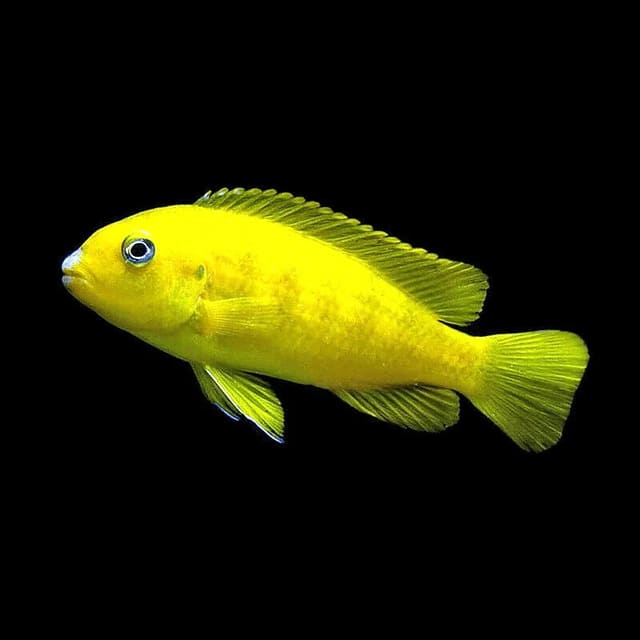
Acei Cichlid (Pseudotropheus sp. “acei”)
24–26°C · pH 7.5–8.5 · 300L
£7.99

New Blue Orchid Peacock Cichlid (Aulonocara sp.) is a Lake Malawi peacock for a dedicated Malawi aquarium with hard, alkaline water and a well-stocked community of Malawi cichlids. Each purchase is one live fish in your chosen size, from 3–4 cm up to 7–9 cm or XL.
Aulonocara sp.
Save when buying multiple fish. Each quantity is one fish; sex and pair formation are not guaranteed unless the selected variant explicitly states them.
New Blue Orchid Peacock Cichlid (Aulonocara sp.) is a Lake Malawi peacock for a dedicated Malawi aquarium with hard, alkaline water and a well-stocked community of Malawi cichlids. Each purchase is one live fish in your chosen size, from 3–4 cm up to 7–9 cm or XL.
Cichlids are a family of roughly 1,800 accepted species, not one care type. Before buying, identify the exact species and source, then compare adult measurement, usable tank dimensions, social system, territory, tested water, diet and an exit plan. No family-wide minimum tank, water range or tank-mate list is safe.
Maintain these water conditions for optimal health and vibrant colors
The New Blue Orchid Peacock Cichlid is a peacock from the genus Aulonocara, a group of cichlids found only in Lake Malawi in East Africa, one of the most biodiverse lakes in the world. You receive one live fish per purchase, at the size you choose. The most important thing to understand before buying is that peacocks belong in a dedicated Malawi cichlid aquarium: hard, alkaline water, a crowded community of other Malawi cichlids, and plenty of filtration.
Aulonocara are haplochromine cichlids, and in the aquarium hobby they are widely known as peacock cichlids, aulonocaras or simply peacocks. Every species in the genus is a maternal mouthbrooder, and the genus is strongly sexually dichromic, which means males and females look very different once they are adult. The Wikipedia summary of Aulonocara covers the genus in more detail.
New Blue Orchid is a trade name rather than a scientific species. FishBase lists Aulonocara as a genus containing 22 species, and the fish sold here has not been matched to one of them. The exact species has not been identified, so the care advice here follows the genus Aulonocara and its care group. That care group is the Lake Malawi cichlids covered by the Ornamental Aquatic Trade Association (OATA), which notes that the majority of Malawi cichlids in the aquarium trade are captive bred.
| Suits | Keepers building or running a dedicated Lake Malawi cichlid aquarium with hard, alkaline water |
|---|---|
| Not for | Mixed community tanks, soft-water set-ups or aquariums well under 200 litres |
| Water (OATA Malawi guidance) | 23–27°C, pH 8.0–8.6, general hardness 12–18 °dH |
| Temperament | Aggressive, like all Malawi cichlids; mix with caution |
| Sold as | One live fish per purchase: 3–4 cm, 4–5 cm, 6–7 cm, 7–9 cm or XL |
The New Blue Orchid is listed in five sizes: 3–4 cm, 4–5 cm, 6–7 cm and 7–9 cm, plus an XL grade. The size you select is the size supplied, not the adult size. Stock of each size changes, so check the product page to see which you can order. If you are buying several, increase the quantity when you add them to your basket: OATA's advice is to add Malawi cichlids in groups rather than one at a time.
Sex is guaranteed only when the selected option explicitly states male or female. This New Blue Orchid listing has no sex-guaranteed option. Young peacocks are also hard to sex. OATA explains that many Malawi cichlids only show differences between the sexes once they become adults, not as juveniles, and that the main differences are colour or egg spots on the male's anal fin.
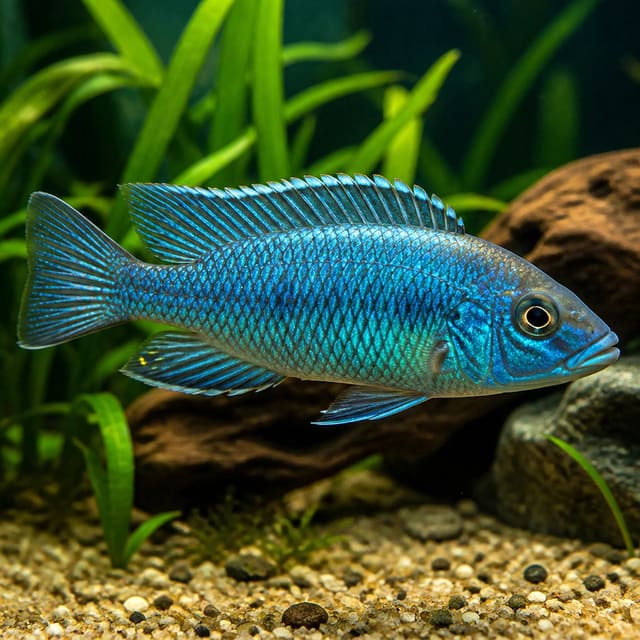
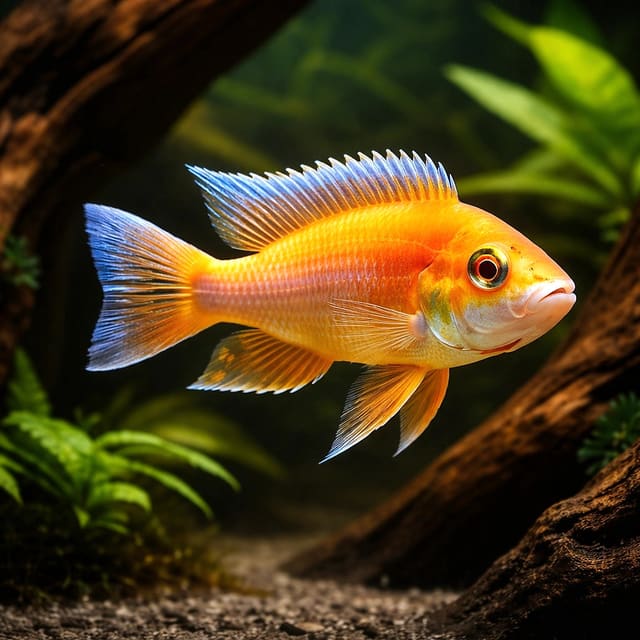
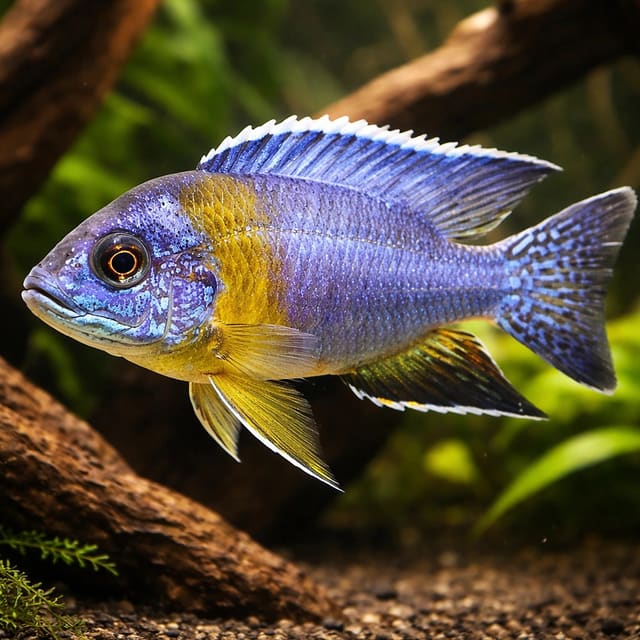
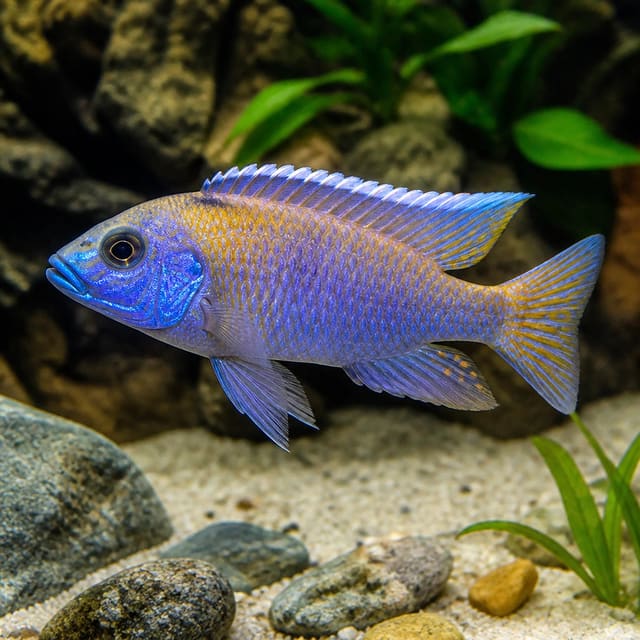
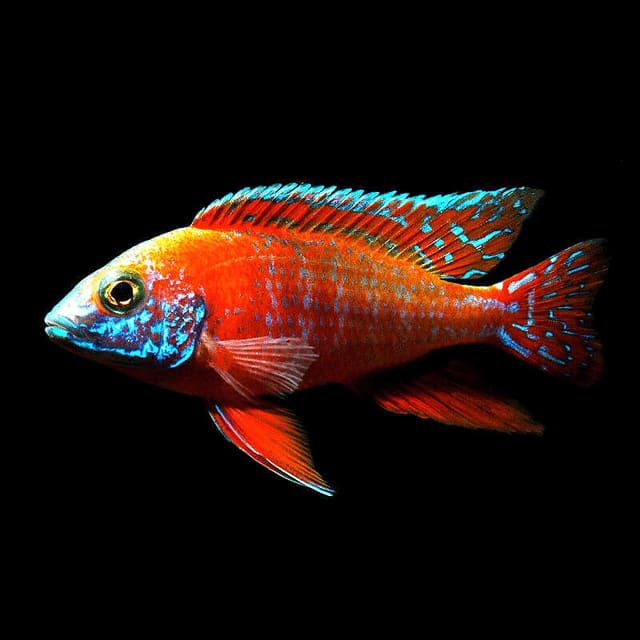
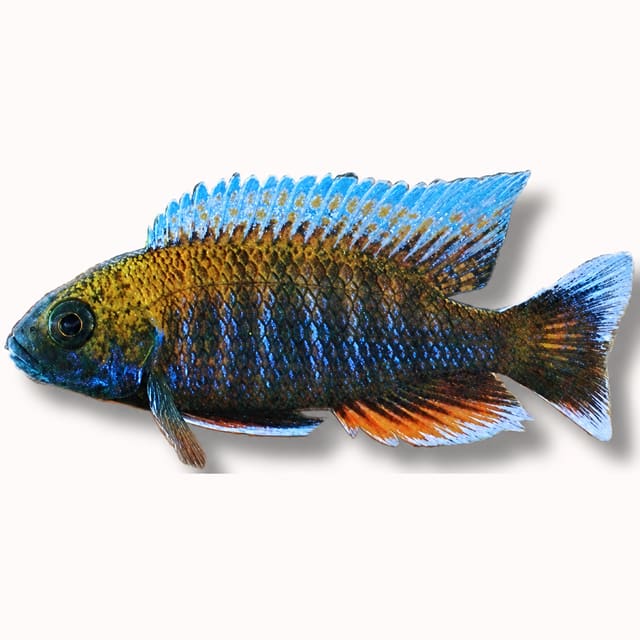
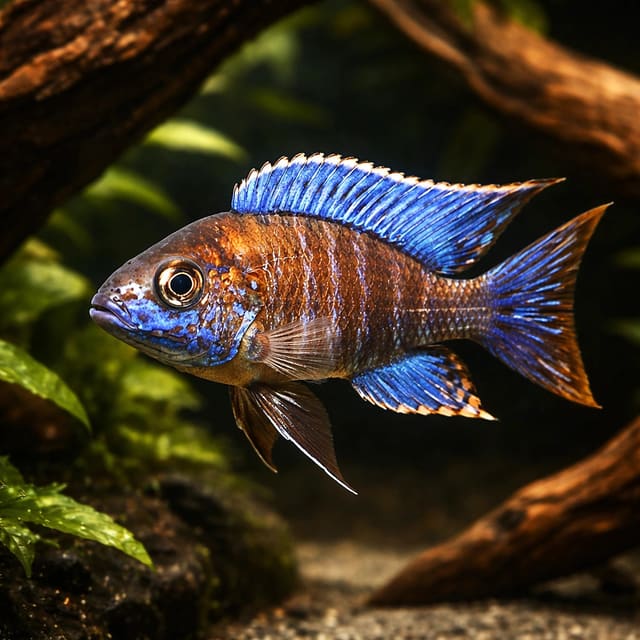
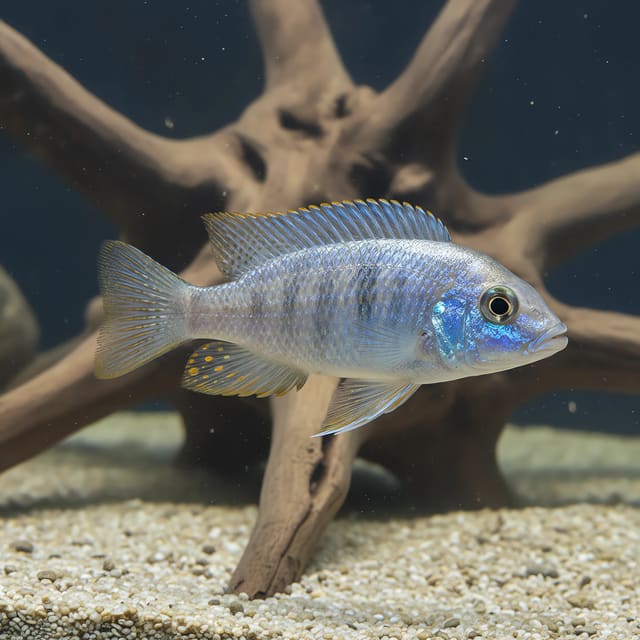
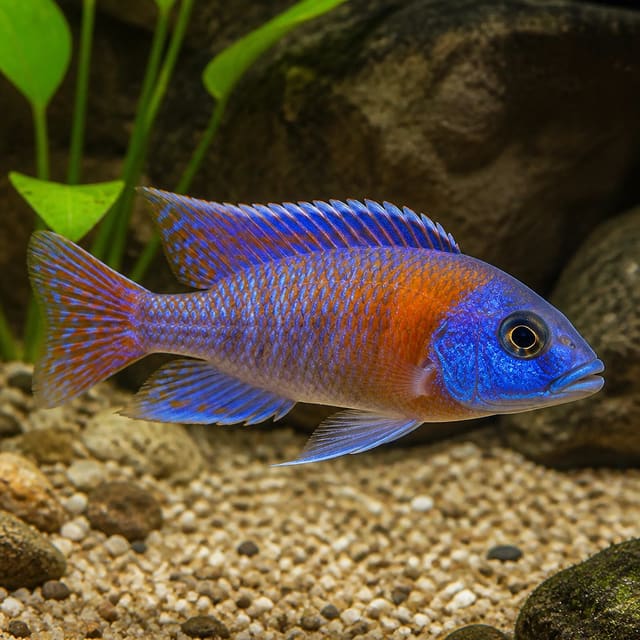
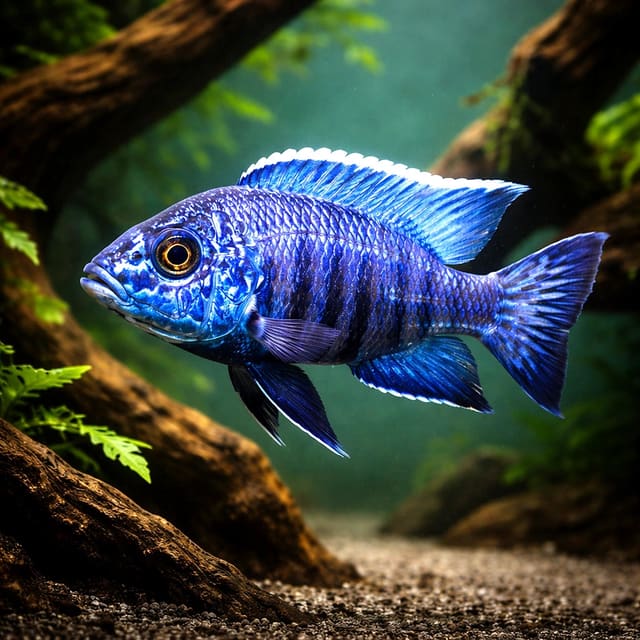
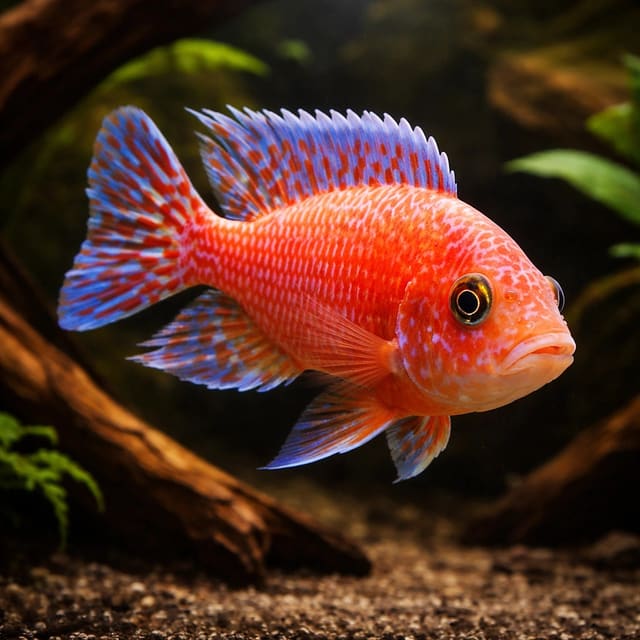
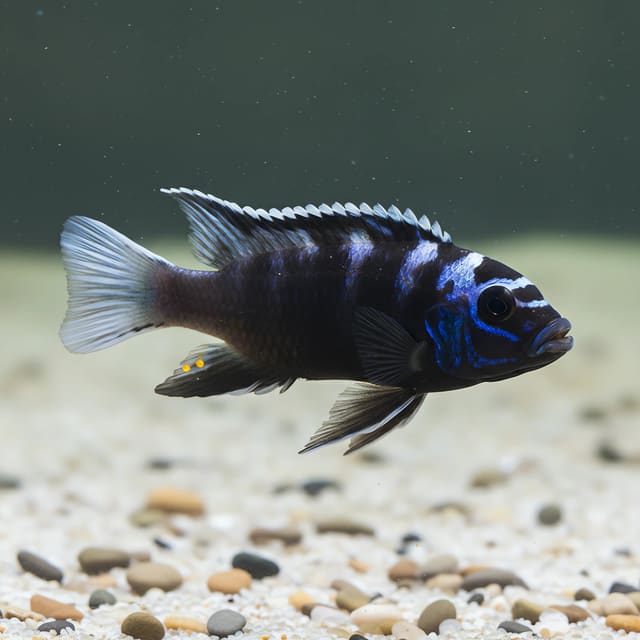
The photographs show a peacock with a blue face, a gold-speckled head and back, dark flanks with blue-edged scales, and orange and white trim on the lower fins. Gallery images have been digitally enhanced to improve image quality. Natural colour, pattern, size and maturity can vary between live animals. Because peacocks are strongly dichromic and young fish show few sex differences, a juvenile at the smaller sizes may not yet look like the fish pictured. The planted, driftwood settings in some photographs are backdrops rather than a set-up recommendation; the care section explains why a Malawi aquarium is built differently.
Peacocks do best in an aquarium designed around Lake Malawi cichlids from the start, rather than in a general tropical set-up adapted later. OATA's guidance for the group covers the size, filtration, aeration and substrate.
OATA's general rule is to buy an aquarium as large as you reasonably can, and it recommends at least 200 litres for a reasonable-sized community of Malawi cichlids. Some specialist species can live in smaller aquariums, but a peacock kept in a community group needs room. The larger the aquarium, the more stable the temperature and water quality will be.
Fit a heater that holds the water steadily within OATA's 23–27°C range, and a thermometer you can read at a glance. A larger volume of water also changes temperature more slowly, which is one more reason to buy the biggest aquarium you can.
Use coral sand or a similar substrate, which helps to buffer the water towards the hard, alkaline conditions Malawi cichlids need. Expect the fish to reshape it: Malawi cichlids will often dig and rearrange the substrate, which will uproot any plants present, so only the hardiest plants are worth trying.
Plan décor that you can move. OATA notes that rearranging the aquarium décor can help to reduce aggression as fish find new territories, which is useful when you add new fish or when one individual is being singled out.
Mature the filter fully before the first fish arrive. Our guide to setting up your first tropical tank takes you through the cycling process step by step, and the water section below covers the Malawi targets to aim for once the filter is ready.
Malawi cichlids are a specialised group that need particular water conditions, and hard, alkaline water is the heart of keeping them well. The figures below come from the OATA care sheet for African Malawi cichlids. They are a general guide for the whole group, so they are not a measured optimum for this particular peacock.
| Temperature | 23–27°C |
|---|---|
| pH | 8.0–8.6 |
| General hardness | 12–18 °dH (hard) |
| Carbonate hardness | 10–15 °dKH (hard) |
| Ammonia | Zero |
| Nitrite | Zero |
| Nitrate | No more than 20 mg per litre above your normal tap water level |
OATA sets the nitrate limit against your own tap water rather than as a single number. Test your tap water first, note its nitrate reading, and then keep the aquarium no more than 20 mg per litre above that figure between water changes.
Good husbandry is essential, because Malawi cichlids can be stressed by even the smallest amounts of ammonia. Ammonia and nitrite should always read zero in a mature aquarium, and any trace is a signal to check the filter and your stocking before anything else.
Our guide to aquarium water parameters and what to test explains what each reading means and how to test it reliably. To see how your own water compares with Malawi conditions before you buy, enter your readings into the water parameter matcher.
General hardness measures the minerals dissolved in the water, and carbonate hardness measures its buffering capacity, which is what holds the pH steady. Malawi cichlids need both to be high: OATA classes 12–18 °dH and 10–15 °dKH as hard. If your tap water is soft, a buffering substrate such as coral sand helps to reach and hold those values, but confirm the result with regular tests rather than assuming the substrate has done the job.
OATA points out that the dietary needs of Malawi cichlids vary from one group to another, which matters for a peacock whose exact species is not known.
| Smaller mbuna | More herbivorous; they appreciate specialised Malawi cichlid foods with a high algae content, plus fresh vegetables |
|---|---|
| Some larger utaka | May be more predatory; they need pellets with a higher animal content, plus frozen foods such as brine shrimp, prawns or cockles |
Use a specialised Malawi cichlid food as the everyday diet. Our team can tell you which formulation we recommend for your New Blue Orchid before you settle on a long-term menu.
OATA's two diet styles match what you will find on Malawi cichlid foods: some formulas lead on algae and vegetable content, others on animal content. Knowing which style suits your fish makes the choice straightforward, which is why it is worth asking before you buy a large tub.
In a crowded community, spread each feed across the surface so that every fish gets a share, and use feeding time to check that all of them are eating.
A Malawi aquarium stays healthy through a steady weekly routine. These steps follow OATA's maintenance advice for the group.
Each water change should leave the aquarium within the Malawi range rather than knocking it back. Treat the new water with conditioner, and use your weekly test to confirm that pH and hardness have held after the change as well as checking ammonia and nitrite.
When the filter needs cleaning, do not run it under the tap, because any chlorine or chloramine present may kill the beneficial bacterial population that has become established in the media. Rinse it lightly in tank water removed during a partial water change instead, which reduces the amount of bacteria lost.
That bacterial population is what keeps the fish safe. As the RSPCA explains in its advice on fish environments, fish release toxic ammonia, and a working biological filter lets beneficial bacteria convert it to nitrite, which is also toxic, and then to nitrate, which is safer. No fish should be kept in a tank without a well set-up and maintained filter.
Malawi cichlids can live several years in a well-matured set-up with good water quality. Plan the aquarium, filtration and weekly routine with that span in mind rather than for the first few months.
All fish vary a little in behaviour and appearance. Keeping an eye on the following helps you to catch a problem before it becomes a real health issue.
| Swimming | Hanging at the surface, sitting on the bottom or swimming erratically |
|---|---|
| Colour | Turning darker or paler than normal |
| Temperament | A change in aggression, or hiding more than normal |
| Breathing | Gill covers moving faster or slower than normal |
| Appearance | White spots or fluffy growths, or loss of fins or scales |
| Condition | An increase or decrease in body weight |
| Feeding | Reduced intake or no interest in food |
A healthy fish has clear, bright eyes, undamaged fins, intact scales, no ulcers or bumps, and normal swimming behaviour. Take a good look at each fish in the first days after arrival so you know what normal looks like for your group.
Test the water quality first, as OATA advises, and then contact us with your results and a description of what you have seen.
Because Malawi cichlids are aggressive, a fish that hides more than normal may also be under pressure from tank mates. OATA's measures against aggression are a slightly overstocked group, more females than males of each species, and rearranging the décor so that territories are redrawn.
The problems below are the ones OATA's guidance for Malawi cichlids helps you prevent or put right. Start with the water test in every case, then work through the likely cause.
| Constant fighting or one fish chased | The group is too small or territories are settled. Keep at least 15 Malawi cichlids, slightly overcrowded, add newcomers in groups and rearrange the décor. |
|---|---|
| A female singled out by males | Too few females. Keep more females than males of each species where possible. |
| Plants pulled up | Normal behaviour: Malawi cichlids will often dig and rearrange the substrate. Use only the hardiest plants. |
| Ammonia or nitrite above zero | Stocking or feeding has outpaced the filter. Stop adding fish, feed less, keep up the weekly water change and test until both read zero again. |
| pH or hardness drifting down | Buffering is not keeping up. Check that the substrate is coral sand or similar, and test after every water change. |
| Nitrate climbing | Waste is building between changes. Keep nitrate no more than 20 mg per litre above your tap water level, and do not skip the weekly 25% change. |
| Hiding, colour change or poor appetite | Test the water first, then look for pressure from tank mates and check the signs in the health section. |
Our team hand-packs every order. Each fish is bagged in pure oxygen inside an insulated poly box, with a heat pack when the weather calls for one, and the parcel travels with a tracked live-animal courier that is licensed to carry live fish. You will receive an email with the tracking number and your confirmed delivery date, so you know when to be at home. Full details are on our delivery and Live Arrival Guarantee page.
Before the delivery date, test the aquarium to confirm that ammonia and nitrite read zero and that the temperature sits within 23–27°C, so the fish can go straight in once they have floated.
That unboxing video is what a Live Arrival Guarantee claim relies on. If a fish has not arrived well, send us your order number and the video on the same day, using WhatsApp for the fastest reply, and we will arrange a replacement or refund.
Before any fish go in, make sure ammonia and nitrite both read zero and that the aquarium is large enough for the number of Malawi cichlids you plan to keep. Then build the stocking up slowly: the beneficial bacteria in the filter need to increase every time more fish are added and feeding increases.
Overstocking, or stocking too quickly, can result in new tank syndrome. There are then not enough nitrifying bacteria to cope with the extra waste, and ammonia and nitrite rise to levels that may cause fish to become ill or die. With Malawi cichlids this has to be balanced against their need for a crowded community, which is why the filter should be oversized and mature before the group is completed.
OATA advises adding Malawi cichlids in groups, so that no individual fish receives unnecessary aggression while it settles in. Rearranging the décor at the same time gives every fish, old and new, territories to find again, which helps to spread attention across the group.
Aulonocara are strongly sexually dichromic, even by the standards of other haplochromine cichlids. In Malawi cichlids generally, OATA explains that the main differences between the sexes are colour or the presence of egg spots on the male's anal fin, and that many species only show these differences once they are adult. Egg spots are small, egg-like markings on the anal fin.
For a buyer, that means young peacocks at the smaller sizes can look alike, and the adult colours develop later. Since this listing does not offer a choice of sex, be ready to rebalance the group as the fish mature and their sexes become clear.
The smallest sizes, 3–4 cm and 4–5 cm, are young fish that are unlikely to show clear differences between the sexes. The 6–7 cm and 7–9 cm sizes and the XL grade are further along, so they are closer to the age at which OATA says the sexes become distinguishable. Whichever you choose, the adult colours develop as the fish mature, and the aquarium needs to be planned for adult fish from the start.
Where possible, OATA advises keeping more females than males of each species. This prevents males from harassing one individual female.
All Aulonocara species are maternal mouthbrooders: the female carries the eggs in her mouth rather than leaving them on a surface.
Plan the aquarium around adult fish rather than the juveniles you receive. OATA notes that most Malawi cichlids grow to around 10 cm, while some grow up to 25 cm, and with the species unidentified, those group figures are the fairest guide to the space your peacocks will eventually need.
Stocking is where Malawi cichlid keeping succeeds or fails. OATA describes Malawi cichlids as colourful, diverse and aggressive; they should be mixed with caution, but apart from that they are usually undemanding aquarium inhabitants and easy to keep.
OATA advises keeping Malawi cichlids only with other Malawi cichlids or with some species of Synodontis catfish, which also live naturally in Lake Malawi. Peacocks do not belong in a general community tank. You can browse suitable fish in our African cichlid collection, but check each species' needs and temperament before adding it.
Malawi cichlids are not social fish and can be highly aggressive, yet OATA recommends keeping them in groups of at least 15, slightly overcrowded, to limit aggression. Malawi cichlids kept in small groups will often fight, and OATA's reasoning is that a slight overstock spreads aggression evenly throughout the population.
Some Synodontis catfish are the only non-cichlids OATA names for a Malawi aquarium, because those species also live naturally in Lake Malawi. Choose one that shares the same hard, alkaline water, and check its adult size and needs before adding it to the plan.
Start from the aquarium and work outwards. Allow at least 200 litres for a reasonable-sized community, with an oversized filter and strong aeration. Choose the Malawi species you want, plan for at least 15 fish with more females than males of each species, and add them in groups with the more peaceful species first. Leave room in the plan for the slight overstock that spreads aggression.
OATA loosely divides Malawi cichlids into mbuna, which live among the rocks, and utaka, which swim in open water. The two groups differ in diet as well as habitat, so when you plan a mixed Malawi community, check that each species can share the same feeding routine as your peacocks.
Its exact species has not been identified, so plan with OATA's Malawi cichlid figures: most Malawi cichlids grow to around 10 cm, and some grow up to 25 cm. Plan the aquarium for adult fish, not juveniles, because the space they need grows with them.
OATA recommends an aquarium of at least 200 litres for a reasonable-sized community of Malawi cichlids, with an oversized filter and strong aeration. A larger aquarium keeps temperature and water quality more stable, which matters for fish that can be stressed by even small amounts of ammonia.
Malawi cichlids are not social fish, but OATA advises keeping them in groups of at least 15, slightly overcrowded, to spread aggression; kept in small groups they will often fight. Where possible, keep more females than males of each species.
OATA describes Malawi cichlids as usually undemanding and easy to keep, apart from their aggression. The challenge is planning: hard, alkaline water, an aquarium of 200 litres or more, a 25% water change every week and a well-stocked community of Malawi cichlids only.
Malawi cichlid diets vary, so use a specialised Malawi cichlid food and ask us which formulation suits your fish. Feed twice a day, only as much as the fish eat within a few minutes, and avoid overfeeding, because uneaten food breaks down into toxic waste.
OATA's Malawi cichlid care sheet gives 23–27°C, pH 8.0–8.6, general hardness of 12–18 °dH and carbonate hardness of 10–15 °dKH, with ammonia and nitrite at zero and nitrate no more than 20 mg per litre above your tap water level.
Yes. OATA describes all Malawi cichlids as aggressive fish that should be mixed with caution. A large, slightly overcrowded group, adding fish in groups and rearranging the décor all help to spread and reduce aggression.
OATA advises keeping Malawi cichlids only with other Malawi cichlids or some species of Synodontis catfish, which also live naturally in Lake Malawi. Add the more peaceful species first and the more aggressive ones later, and bring new fish in as groups rather than singly.
Each order is hand-packed in bags of pure oxygen inside an insulated poly box, with a heat pack when the weather calls for it, and travels with a tracked, licensed live-animal courier. Someone must be at home to receive it. Record a continuous unboxing video from the sealed parcel to the fish in the sealed bag, then float the bag for 20–30 minutes before releasing the fish; the video is needed for any Live Arrival Guarantee claim.
No reviews for this item yet. Bought one? Honest reviews only, good or bad.
What customers say about ordering from us
I have a small group of long finned mountain minnows. So was delighted to be able to order ten of this variety to increase the genetics in my tank . The ones I recieved are healthy but it’s to early to give a verdict on wether they are of a long finned type since they are small currently.
Gordon Walker · 23 Sept 2026
100% success travel and "installation". Pleased with quality of purchase. The Siamese fighter a bit "shy" so have not yet seen him at his best yet but looking good. Happy customer. GG
George E Garratt · 21 Sept 2026
Reviews of our shop, collected by Judge.me, an independent third-party review collector. Newest first.