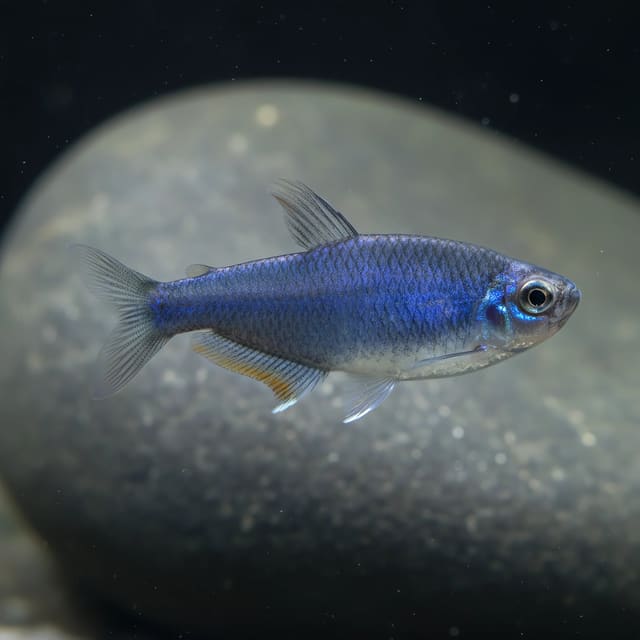
Moderate
Acei Cichlid (Pseudotropheus sp. 'Acei')
24–26°C · pH 7.5–8.5 · 300L
£7.99
Labidochromis sp. mbamba (Mbamba cichlid) is an unidentified Labidochromis cichlid from a genus endemic to Lake Malawi in East Africa. It suits intermediate Malawi keepers; OATA's group guidance uses communities of at least 15 fish, 23–27°C, pH 8.0–8.6 and 12–18°dH. Sold individually in 3–4 cm, 5–6 cm and XL dispatch sizes.
Labidochromis sp. mbamba
Shoaling fish: kept in a group they feel safer, stay calmer and show their best colour.
Labidochromis sp. mbamba (Mbamba cichlid) is an unidentified Labidochromis cichlid from a genus endemic to Lake Malawi in East Africa. It suits intermediate Malawi keepers; OATA's group guidance uses communities of at least 15 fish, 23–27°C, pH 8.0–8.6 and 12–18°dH. Sold individually in 3–4 cm, 5–6 cm and XL dispatch sizes.
Cichlids are a family of roughly 1,800 accepted species, not one care type. Before buying, identify the exact species and source, then compare adult measurement, usable tank dimensions, social system, territory, tested water, diet and an exit plan. No family-wide minimum tank, water range or tank-mate list is safe.
Maintain these water conditions for optimal health and vibrant colors
The Mbamba cichlid (Labidochromis sp. mbamba) is an unidentified Labidochromis cichlid from Lake Malawi in East Africa. It belongs to the family Cichlidae and suits keepers prepared to manage hard, alkaline water, substantial filtration and the aggression found in Malawi cichlid communities. We classify its care level as intermediate because success depends less on complicated daily work than on making the correct aquarium, water and stocking decisions before the fish is introduced.
WoRMS recognises Labidochromis as an accepted genus within Cichlidae. The name on this fish identifies the genus and a trade form called “mbamba”; it does not assign a formally identified species. That distinction matters because an adult size or behaviour reported for one named Labidochromis species should not automatically be applied to every member of the genus.
Wikipedia describes Labidochromis as endemic to Lake Malawi and notes that the genus contains 18 formally described species as well as several undescribed ones. This makes a Lake Malawi aquarium the correct planning context, while the unidentified species calls for conservative decisions around growth, aggression and mixing related fish.
Mbuna is a useful aquarium-group word retained for this fish. OATA separates Malawi cichlids broadly into rock-dwelling mbuna and open-water utaka. Use that group context to plan a Malawi-focused aquarium rather than treating this fish as a general tropical community species.
The key first decision is therefore compatibility with the aquarium you already run. Hard, alkaline Malawi water and an aggression-managed cichlid community are suitable starting points. A soft, acidic community or a lightly filtered aquarium planned around peaceful fish is the wrong framework.
Keep the aquarium at 23–27°C, pH 8.0–8.6 and 12–18°dH general hardness, with carbonate hardness of 10–15°dKH. OATA’s African Malawi cichlid guidance gives these values for the group; use them as the working range for this unidentified form. Ammonia and nitrite must remain at zero mg/l, while nitrate should stay no more than 20 mg/l above the normal level in your tap water.
For a reasonable Malawi community, plan an aquarium of at least 200 litres. OATA recommends groups of at least 15 Malawi cichlids and explains that small groups often fight, while slight overstocking can spread aggression. Those figures describe the planned community rather than a requirement to keep 15 examples of this one fish. An oversized filter and strong aeration are part of the same plan because a crowded cichlid community creates a substantial oxygen and waste-management demand.
| Suits | Not suited to |
|---|---|
| A planned Lake Malawi cichlid community | A general peaceful tropical community |
| Hard, alkaline water at pH 8.0–8.6 | Soft, acidic aquarium conditions |
| At least 200 litres for a reasonable community | A small group placed in restricted space |
| Oversized filtration and strong aeration | An unfiltered or newly prepared aquarium |
| A keeper ready to observe and manage aggression | Stocking based only on colour or appearance |
These linked decisions are why we give an intermediate suitability assessment. Once the aquarium is mature and the community has been planned carefully, the routine is clear: feed controlled portions, test every week, change water every week and respond quickly to changes in behaviour or appearance.
You can compare this fish with the wider African cichlid collection, but select companions by water requirements and behaviour rather than colour alone.
One purchase supplies one fish in the size chosen on the live selector. The size labels are 3–4 cm, 5–6 cm and XL. The size you select is the size supplied, not the adult size. XL is a named dispatch grade rather than a stated measurement, so do not convert it into a centimetre figure when planning the aquarium.
The exact species has not been identified, so the care advice here follows the genus Labidochromis and its care group. OATA reports that most Malawi cichlids grow to around 10 cm, while some may grow up to 25 cm. Those group figures are useful for conservative planning but do not assign an adult length to this particular fish. Allow the aquarium and community plan to accommodate growth rather than treating any dispatch grade as the final size.
Sex is guaranteed only when the selected option explicitly states male or female. This Labidochromis sp. mbamba listing has no sex-guaranteed option.
Do not infer sex from dispatch size, colour or a gallery scene. OATA notes that many Malawi cichlids show sex differences only as adults, while juveniles may not show them. This offer should therefore be planned as an unsexed fish, including where a future community might ideally contain more females than males.
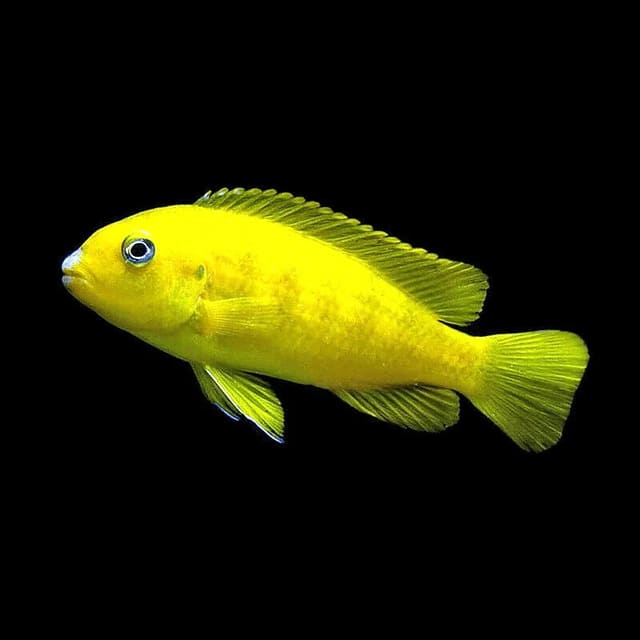
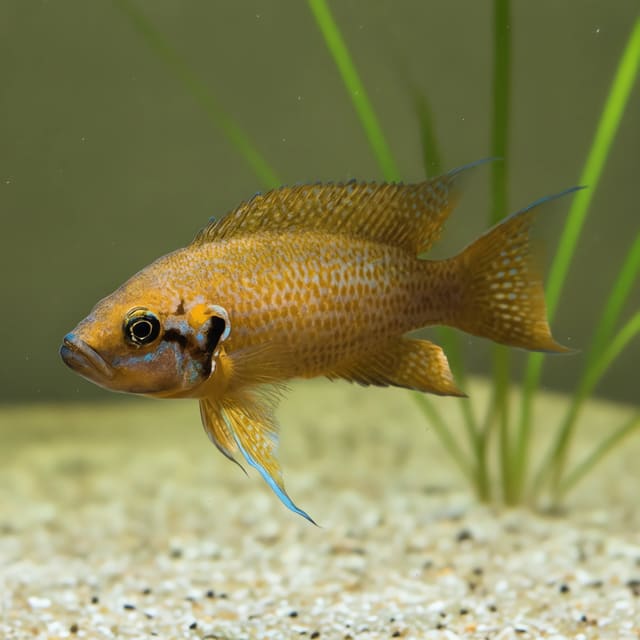
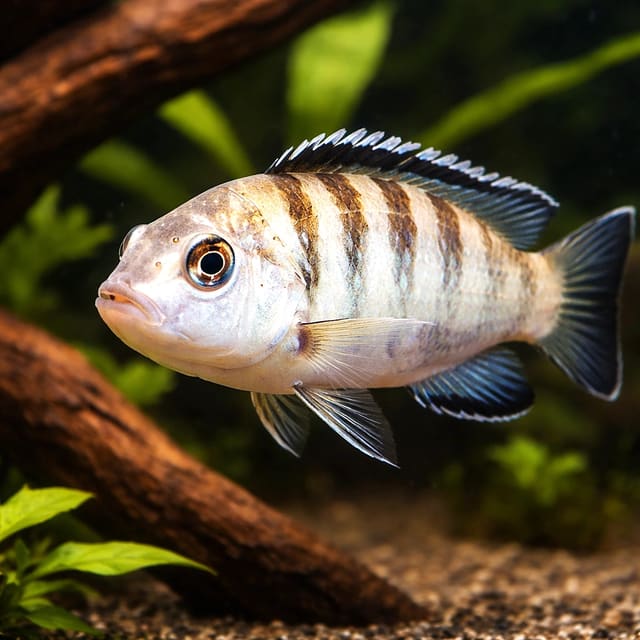
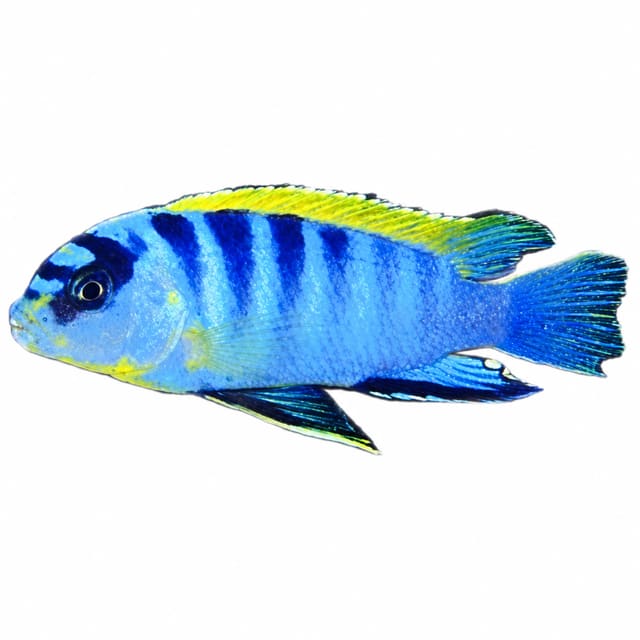
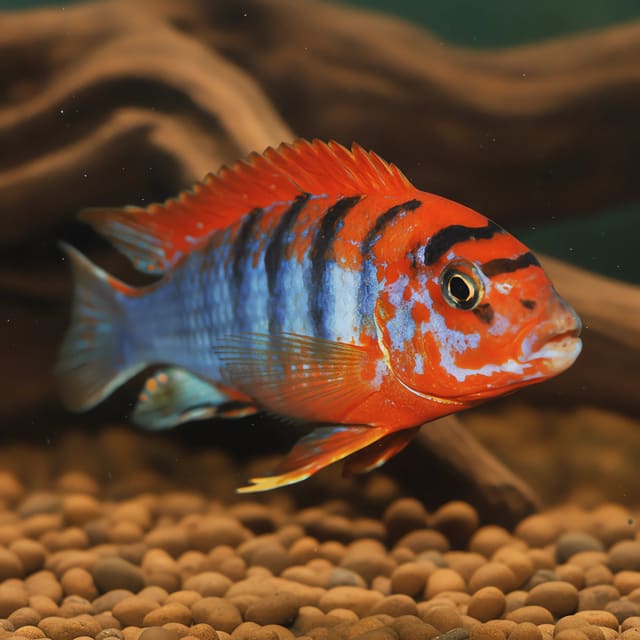
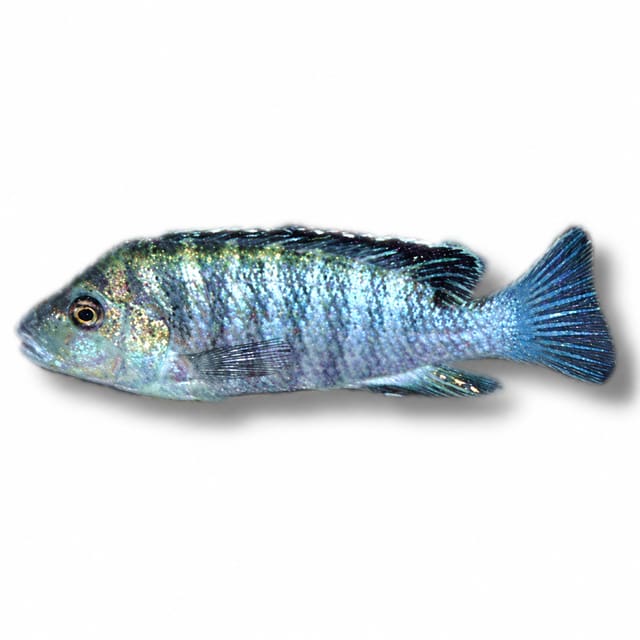
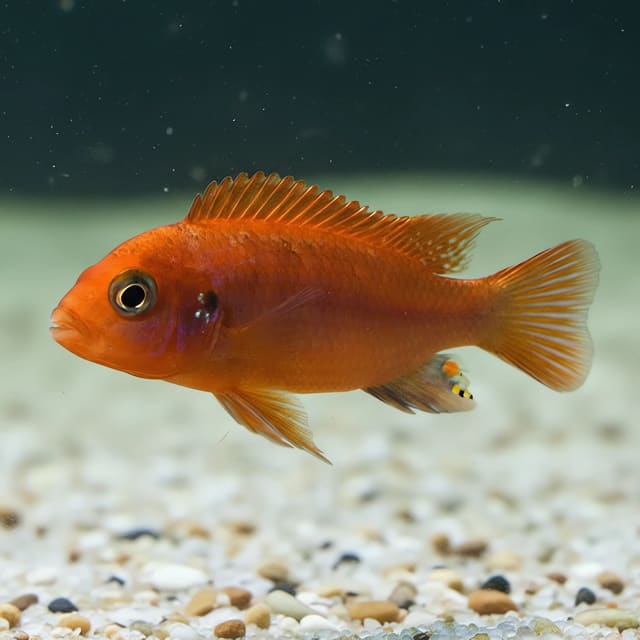
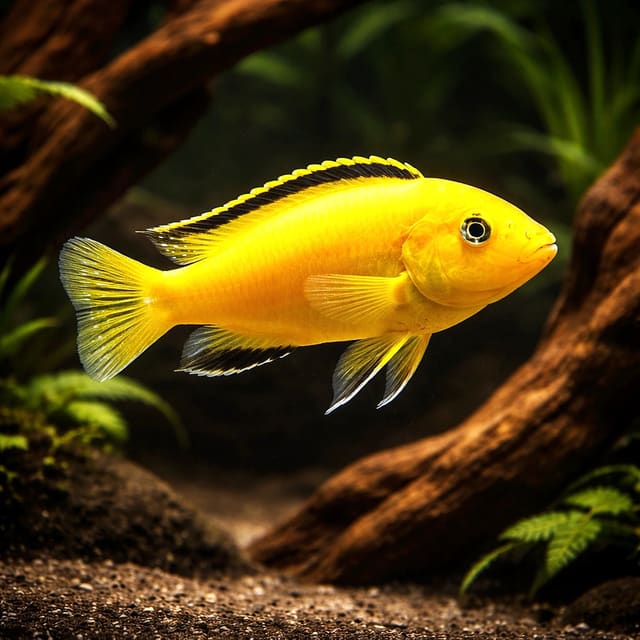
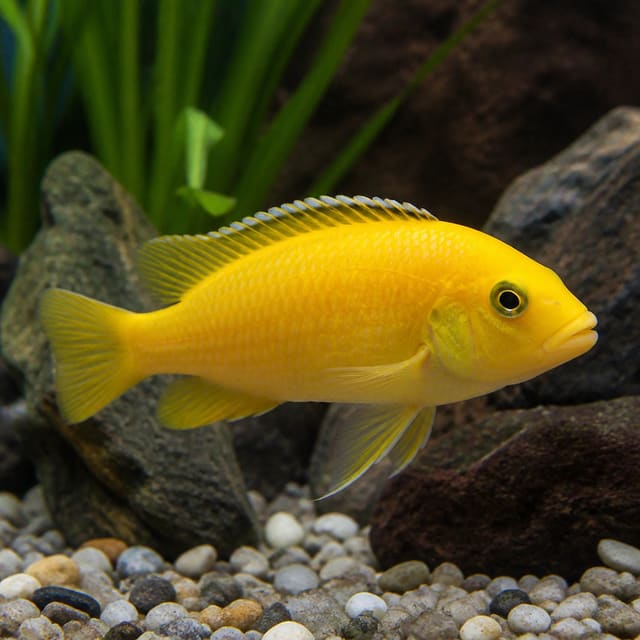
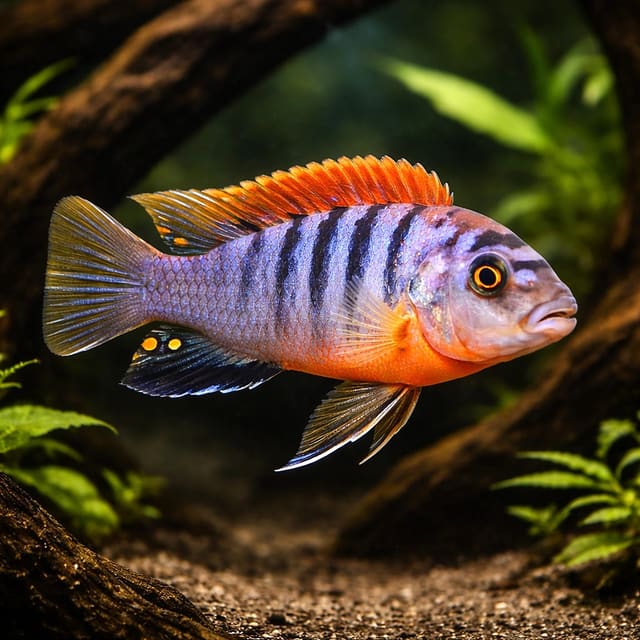
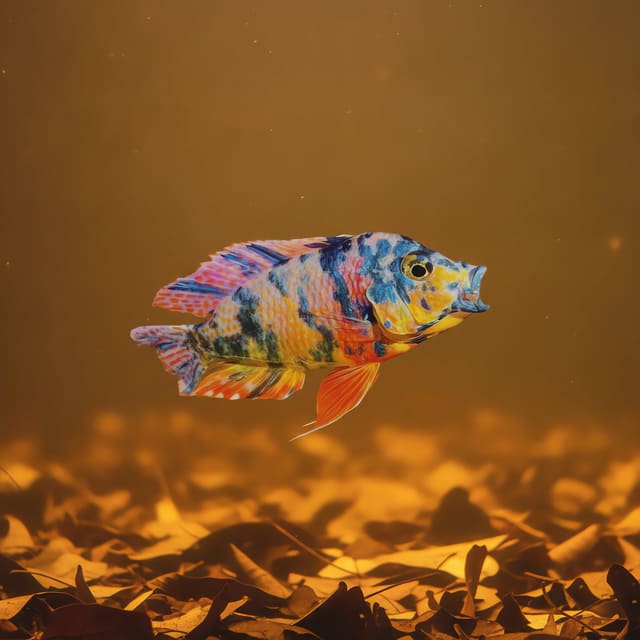
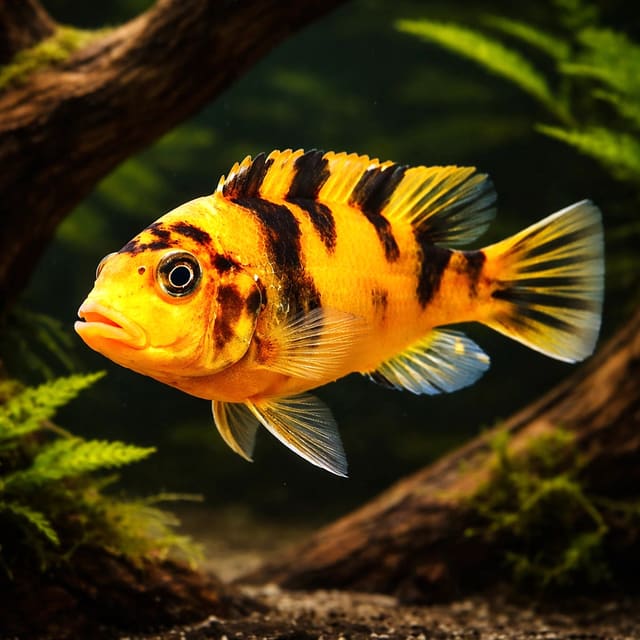
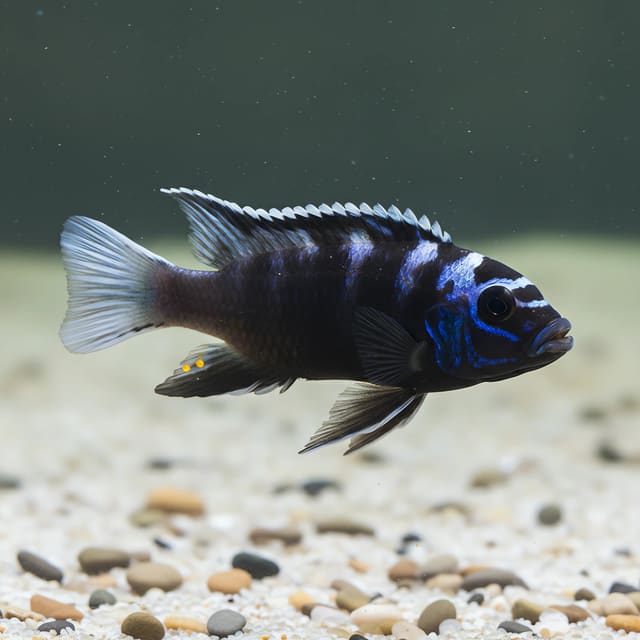
The gallery images are representative, based on reference photographs of this kind of animal, so colours can look slightly different from the live animal.
The scenes help show the general blue, barred cichlid form represented by the gallery, but they do not establish sex, exact markings or the appearance of the individual fish supplied. Make the purchase decision from the identity, dispatch grade and care requirements rather than expecting an exact visual match to an illustration.
Start with at least 200 litres for a reasonable Malawi cichlid community and assess the complete stocking plan, not this fish in isolation. The figure is OATA’s group recommendation, and the same guidance favours an aquarium that is as large as reasonably possible because greater water volume makes temperature and water quality more stable.
Community size and aquarium volume must be planned together. OATA advises keeping Malawi cichlids in groups of at least 15 because small groups often fight. It also recommends slight overstocking to spread aggression, but that method is safe only when filtration, aeration and maintenance are increased to match the extra waste and oxygen demand. “Slight” is important: it is not permission to add fish without checking capacity.
A worked example shows why these checks cannot be separated. A 200-litre aquarium may meet the broad volume recommendation, but it is not ready for a large addition if its filter has matured only under a much smaller biological load. Additions increase food input and fish waste immediately, while the beneficial bacterial population needs time to grow. Testing, gradual stocking and close observation provide the evidence that the aquarium is coping.
Do not use the group’s upper size reference of 25 cm as a prediction for this fish, and do not use the 3–4 cm or 5–6 cm dispatch label as an adult-size estimate. Treat growth as an open planning variable within a substantial Malawi setup. If the present aquarium only works while every fish remains at dispatch size, the plan has no margin for normal development.
Before combining an established collection with this unidentified form, contact us with the aquarium volume, measured water values, existing species and fish numbers for a stocking assessment.
Use coral sand or a similar substrate that helps buffer the water. OATA recommends this type of substrate for Malawi cichlids. Malawi cichlids will often dig and rearrange the substrate, which will uproot any plants present. Expect the layout to change, and choose décor and planting that can tolerate that behaviour rather than relying on a precisely arranged substrate.
Mbuna are the rock-dwelling side of OATA’s broad Malawi grouping, so a durable, territory-conscious layout is more appropriate than a delicate planted display. Décor also has a practical role during stocking: OATA advises that rearranging it may reduce aggression because fish must establish new territories. This can be useful when adding a group or responding to repeated territorial pressure.
Avoid treating decoration as a substitute for adequate space or stocking structure. Décor can alter territories, but it cannot make a small aquarium support the waste load of a sizeable community. Likewise, adding more fish to spread aggression only works when the filter and aeration have the capacity to support them.
Observe what the fish do after any rearrangement. Normal individual behaviour varies, but repeated hiding, a sudden change in aggression, damaged fins, abnormal swimming or reduced feeding requires a water test and a review of the community. If one fish continues to receive focused aggression, reassess the stocking plan rather than repeatedly changing decoration without addressing the underlying mismatch.
Maintain 23–27°C, pH 8.0–8.6, general hardness of 12–18°dH and carbonate hardness of 10–15°dKH. Keep ammonia and nitrite at zero mg/l. Nitrate should not rise more than 20 mg/l above the normal level in your tap water.
Measure the aquarium rather than assuming that a hard-looking substrate or Malawi-style layout has produced the right chemistry. Our water chemistry guide explains the values to track, while the water matcher lets you compare measured results with the working range for this fish.
| Reading | Action |
|---|---|
| Temperature outside 23–27°C | Restore the aquarium to the stated range and check stability |
| pH outside 8.0–8.6 | Review source water, buffering substrate and recent maintenance |
| General hardness below 12°dH | Do not add the fish until the hard-water plan is resolved |
| Ammonia or nitrite above zero | Stop further stocking and address biological filtration |
| Nitrate rising excessively | Review feeding, waste removal and water-change routine |
Test at least once each week and include tap water in the assessment when interpreting nitrate. The nitrate instruction is relative: the aquarium level should be no more than 20 mg/l above the normal tap-water level. For example, a tap reading of 10 mg/l makes 30 mg/l the stated upper aquarium limit, while a tap reading of 20 mg/l makes 40 mg/l the corresponding limit.
Treat replacement water with conditioner before it enters the aquarium so chlorine or chloramine does not harm the fish or biological filter. A larger aquarium gives more stability, but volume does not remove the need for regular measurements. A stable-looking fish can still be exposed to toxic ammonia or nitrite before visible changes become obvious.
When a reading moves away from its normal pattern, check recent feeding, additions, filter flow and maintenance together. These factors interact: extra food or livestock increases waste, a blocked filter reduces processing and circulation, and missed water changes allow nitrate and solid waste to accumulate.
Run a mature, well-maintained filter at all times and use an oversized filter for a Malawi community. OATA pairs oversized filtration with strong aeration because the slightly crowded stocking used to distribute aggression also increases waste production and oxygen demand.
The RSPCA explains why biological filtration is essential: fish release toxic ammonia, beneficial bacteria convert it to nitrite, which is also toxic, and other bacteria then convert nitrite to the safer nitrate. Zero mg/l ammonia and nitrite therefore depend on an established biological filter, not simply clear-looking water.
Prepare and mature the aquarium before livestock arrives. Our first tropical aquarium guide provides the setup sequence. Once fish are present, increase numbers gradually because the bacterial population established under one waste load needs time to respond when more fish and food are added.
Stocking too quickly can cause new tank syndrome. OATA describes this as a shortage of nitrifying bacteria relative to the increased waste, allowing ammonia and nitrite to reach harmful levels. The practical response is prevention: test before every planned addition, avoid introducing the whole intended population without regard to biological capacity and pause additions whenever ammonia or nitrite is detectable.
Clear water is not a substitute for testing. Ammonia and nitrite are invisible, and an aquarium can look clean while its biological capacity is falling behind the fish load. Conversely, a careful filter-cleaning routine preserves the bacteria that make the system safe while still removing blockages that reduce flow.
Use a specialised Malawi cichlid food with a high algae content as the main prepared food and include fresh vegetables for variety. This follows OATA’s feeding guidance for smaller mbuna, which are described as more herbivorous than the larger, more predatory utaka group.
Feed only what the fish can finish within a few minutes, twice a day. The time limit is more useful than a fixed number of pellets because food size, fish size and community competition vary. Watch the whole group through each feeding and stop when the portion has been consumed rather than adding extra food simply because one fish remains active.
Overfeeding creates a water-quality problem as well as a dietary one. Uneaten food breaks down and adds toxic waste, placing more demand on the biological filter and contributing to rising nitrate. If ammonia, nitrite or nitrate begins to rise, review portion size alongside filtration, stocking and maintenance instead of changing only one part of the system.
Use body condition and feeding response as ongoing checks. OATA includes both an increase and a decrease in body condition, as well as reduced food intake, among the changes that deserve attention. A fish that suddenly stops joining a familiar feeding routine may be experiencing water-quality stress, aggression or a health problem, so test the water before assuming it has simply become selective.
Fresh vegetables add the variety recommended for smaller mbuna, but portions still need to fit within the same short feeding window. Remove leftovers rather than leaving vegetable matter to decay. Keep the routine consistent enough that a genuine change in appetite is easy to recognise.
Change 25% of the aquarium water at least once every week. For a 200-litre aquarium, 25% is 50 litres, giving a clear minimum weekly planning figure. Use a siphon during the change to remove solid waste from the substrate, especially where digging and décor create places in which debris collects.
Treat all replacement tap water with conditioner before adding it so chlorine or chloramine is removed. Use some of the extracted aquarium water for any necessary filter-media rinse, then discard it. This keeps tap-water disinfectants away from the beneficial bacterial population.
Daily observation makes the weekly measurements more useful. Watch for hanging at the surface, sitting on the bottom, erratic swimming, unusually fast or slow gill movement, darker or paler colour, increased aggression, unusual hiding, white spots, fluffy growths, damaged fins, missing scales, changes in body condition or reduced feeding.
If any of these changes appear, test water quality immediately. Ammonia and nitrite must be zero, so any detectable result requires prompt attention to filtration, stocking, feeding and maintenance. A behavioural change can be the first visible sign that the biological system or social structure is under strain.
Contact us for further guidance when a concerning health change continues after you have measured the water and recorded the fish’s behaviour and appearance. Do not add medication or attempt a disease treatment based only on one general symptom; accurate observations and water readings make the next decision safer.
Fish are hand-bagged in pure oxygen, placed in an insulated poly box and packed with a heat pack when weather conditions call for it. A licensed live-animal courier carries the parcel, with tracking details sent by email.
Follow our delivery and Live Arrival Guarantee policy when the parcel arrives.
OATA’s Malawi cichlid guidance calls for a mature, filtered aquarium with suitable water quality before fish are added.
After introduction, judge settling by the fish’s behaviour and by the response of the established community. OATA recommends adding Malawi cichlids in groups so one newcomer does not receive all the aggression. It also advises adding more peaceful species before more aggressive ones and rearranging décor when a reset of territories may help.
Population increases must remain gradual even when a social plan favours a grouped introduction. The filter’s beneficial bacteria need to respond to the added waste and feeding. Test ammonia and nitrite after the addition and do not proceed with another planned increase while either is detectable.
During the first days, compare swimming, breathing, colour, feeding and hiding with the expected pattern. Also watch how established fish distribute chasing. A brief observation of only the newcomer may miss aggression beginning elsewhere in the aquarium. Test the water whenever behaviour changes rather than assuming every settling problem is social.
Keep this fish only within a carefully planned Lake Malawi community or with a suitably assessed Synodontis catfish. OATA limits Malawi cichlid companions to other Malawi cichlids or some Synodontis species. This is a screening boundary, not a claim that every fish within either group will be compatible.
Assess prospective companions against four questions: do they share the required hard, alkaline water; can the aquarium support the combined adult growth and waste load; will the group structure distribute aggression rather than focus it; and does the stocking order place more peaceful fish before more aggressive ones?
| Candidate | Decision |
|---|---|
| Another Malawi cichlid | Consider only after matching water, aggression and community structure |
| A Synodontis catfish | Consider only when the particular species suits the same setup |
| A peaceful general-community fish | Avoid; OATA describes Malawi cichlids as aggressive and limits their companions |
| A fish requiring soft, acidic water | Avoid because the required chemistry conflicts with pH 8.0–8.6 and hard water |
| A second Labidochromis species | Avoid because members of the genus can hybridise readily |
Introduce Malawi cichlids with a plan for aggression. OATA recommends grouped additions to reduce the chance of one fish receiving all the pressure. Adding peaceful species first and more aggressive species later can also improve the initial balance. If established territories cause focused conflict, rearranging décor may prompt the fish to establish territories again.
Observe the result instead of assuming that a technically suitable group name settles the matter. Individual behaviour varies. Look for persistent chasing, increased hiding, altered feeding, damaged fins, abnormal swimming or a change in body condition. Assess fin condition and chasing rather than assuming a predictable fin-nipping pattern for an unidentified Labidochromis.
Avoid keeping a second Labidochromis species in the same aquarium. Members of the genus can hybridise readily, and Wikipedia recommends keeping only one species from the genus in an aquarium. Because this form is not identified to species, separating it from other Labidochromis is the clearest practical rule.
Do not use apparent sex as the basis of a stocking ratio for this offer. OATA notes that many Malawi cichlids show sex differences only after reaching adulthood, and this fish is sold without a sex guarantee. Where an established population has reliably known sexes, OATA favours more females than males of each species to reduce the chance of one female receiving repeated harassment.
Slight overstocking is a group-management method, not a stand-alone cure. It must sit inside an aquarium of suitable volume with oversized filtration, strong aeration and weekly 25% water changes. Adding fish to spread aggression while ignoring biological capacity replaces one welfare problem with another.
Likewise, a large aquarium does not make every Malawi pairing suitable. Water chemistry, temperament, group structure and genus identity still matter. Use the same screening process for every proposed addition, even when a previous combination has worked elsewhere, because the existing population and territory pattern shape the result.
Plan this fish as an unidentified Labidochromis, not from its dispatch size. OATA says most Malawi cichlids reach around 10 cm and some may reach up to 25 cm, but those are group planning figures rather than an adult length assigned to this fish.
OATA recommends at least 200 litres for a reasonable Malawi community. Labidochromis sp. mbamba should be planned as part of that complete community, with oversized filtration and strong aeration.
OATA advises communities of at least 15 Malawi cichlids because small groups often fight. This is a total community figure, not an instruction to keep 15 of this unidentified form.
We classify it as intermediate because the keeper must maintain hard, alkaline water, plan an aggression-managed Malawi community and support it with oversized filtration, strong aeration and weekly maintenance.
Follow OATA’s smaller-mbuna guidance: use specialised Malawi cichlid food with a high algae content and include fresh vegetables. Feed only what it can finish within a few minutes, twice daily.
OATA’s Malawi group guidance is 23–27°C and pH 8.0–8.6, with general hardness of 12–18°dH and carbonate hardness of 10–15°dKH.
Treat this fish as an aggressive Malawi cichlid. Monitor chasing, hiding, feeding and fin condition, and reassess space, group structure and territories if one individual receives persistent pressure.
OATA limits companions to carefully selected other Malawi cichlids or some suitable Synodontis catfish. Avoid another Labidochromis species because members of the genus can hybridise readily.
It is hand-bagged in pure oxygen, placed in an insulated poly box with a heat pack when needed and carried by a licensed live-animal courier. Once the parcel has been received, start a continuous unboxing video before opening it, showing the sealed parcel, the opening and the fish still in the bag. Be present to receive it, float the bag for 20–30 minutes and never pour bag water into the aquarium.
No reviews for this item yet. Bought one? Honest reviews only, good or bad.
What customers say about ordering from us
Easy website plenty of info on fish your buying great to pick a time slot
TRACEY DURRANT · 7 Oct 2026
Got some lovely fish thank you
Kevin Mackie · 7 Oct 2026
Reviews of our shop, collected by Judge.me, an independent third-party review collector. Newest first.