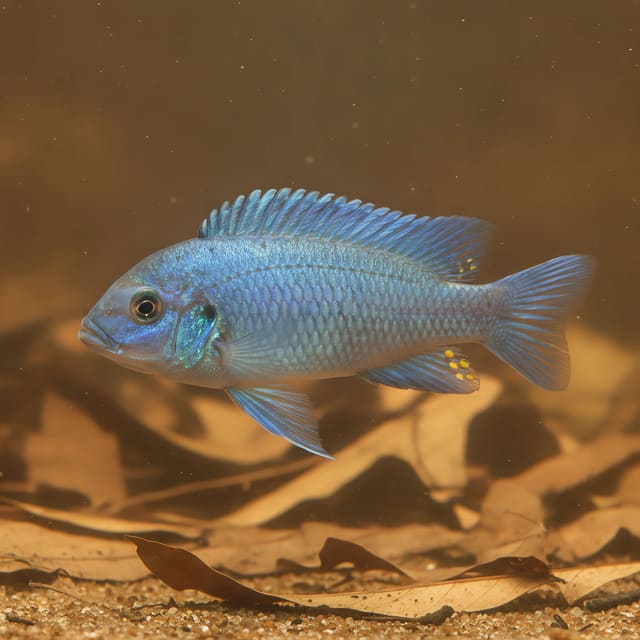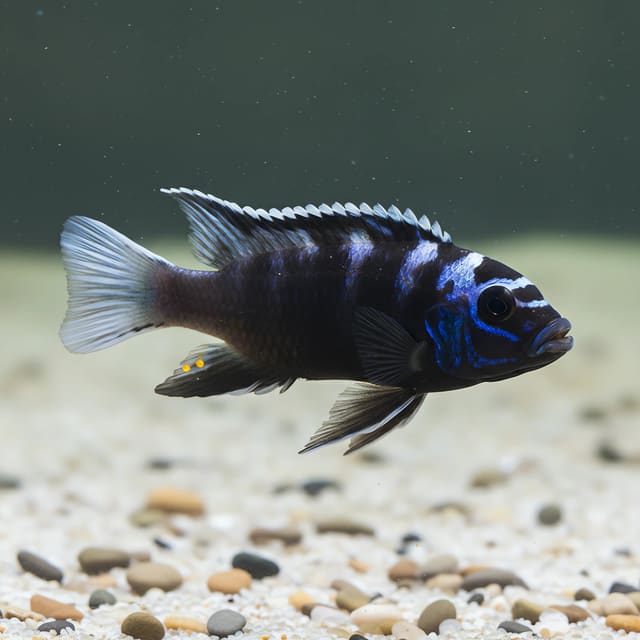
Moderate
Acei Cichlid (Pseudotropheus sp. “acei”)
24–26°C · pH 7.5–8.5 · 300L
£7.99

Nkali Labidochromis Mbuna (Labidochromis sp. 'nkali') is a genus-level Lake Malawi cichlid. One purchase supplies one animal. Plan it within a mature Malawi community using hard, alkaline water, substantial filtration and cautious compatibility screening.
Labidochromis sp. 'nkali'
Save when buying multiple fish. Each quantity is one fish; sex and pair formation are not guaranteed unless the selected variant explicitly states them.
Nkali Labidochromis Mbuna (Labidochromis sp. 'nkali') is a genus-level Lake Malawi cichlid. One purchase supplies one animal. Plan it within a mature Malawi community using hard, alkaline water, substantial filtration and cautious compatibility screening.
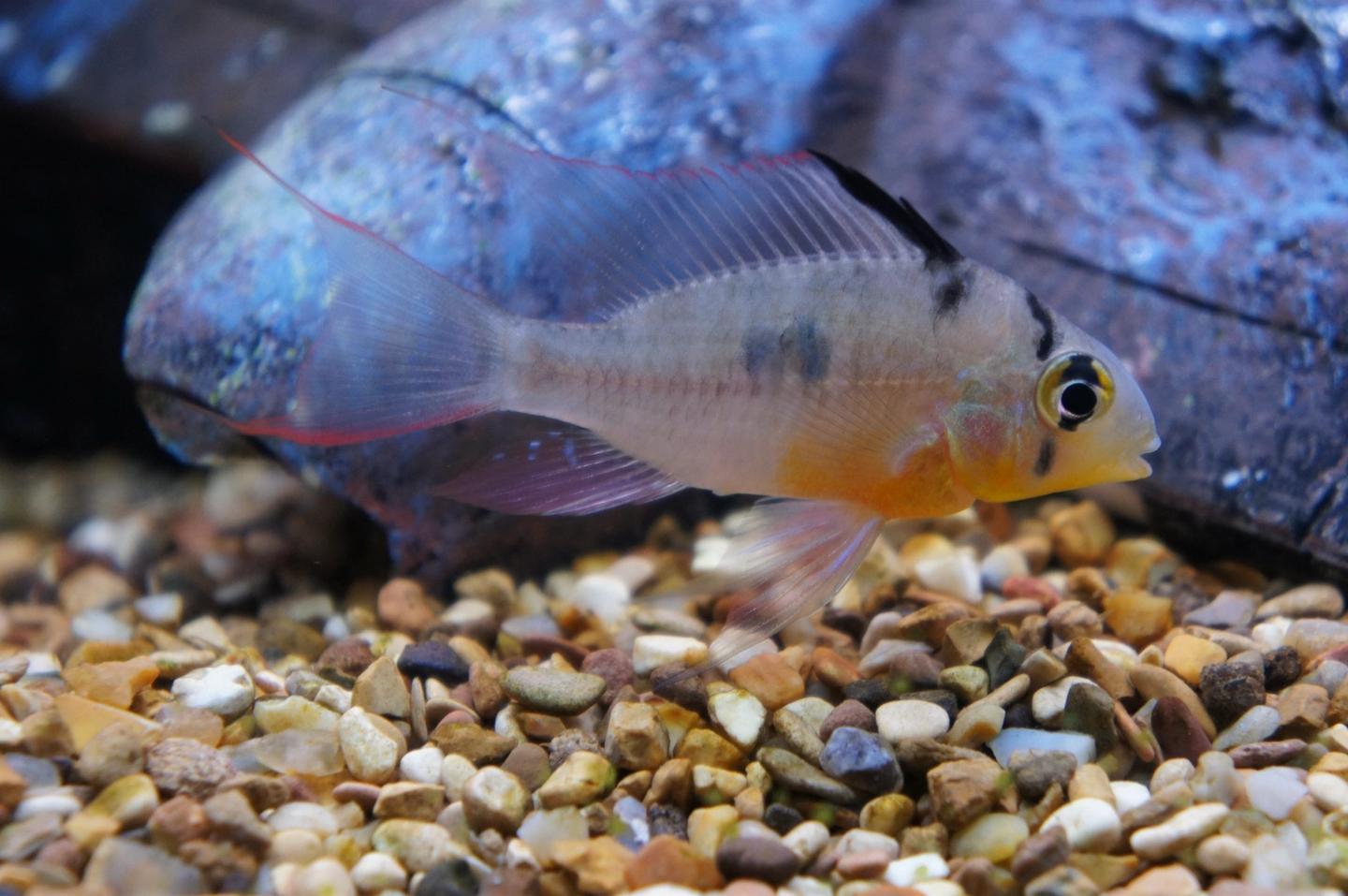
Cichlids are a family of roughly 1,800 accepted species, not one care type. Before buying, identify the exact species and source, then compare adult measurement, usable tank dimensions, social system, territory, tested water, diet and an exit plan. No family-wide minimum tank, water range or tank-mate list is safe.
Maintain these water conditions for optimal health and vibrant colors
Nkali Labidochromis Mbuna is identified as Labidochromis sp. 'nkali'. WoRMS recognises Labidochromis as a genus within the cichlid family Cichlidae, while the name attached to this fish stops at genus level rather than naming a formal species.
The exact species has not been identified, so the care advice here follows the genus Labidochromis and its care group. The “sp.” in the name is important: it prevents a trade-form label from being treated as a more precise scientific identity.
A natural-history summary of Labidochromis describes the genus as endemic to Lake Malawi in East Africa. It contains formally described and undescribed species, including fish kept in cichlid aquariums. Nkali is also described as mbuna, the rock-dwelling part of the Malawi cichlid community.
This identity calls for a dedicated Malawi plan rather than a general tropical-community approach. The decisive questions are whether the aquarium maintains hard, alkaline water, whether its filter can support a substantial cichlid community and whether the layout gives aggressive fish several territories and escape routes.
Plan from the requirements shared by Malawi cichlids and mbuna without assigning traits from one named Labidochromis species to Nkali. That means using the documented group ranges for water, community volume and feeding while leaving room for variation in adult size and behaviour. The genus-level name also matters when choosing companions: another fish carrying the Labidochromis name creates a hybridisation concern even if its colour and trade label look very different.
One purchase quantity supplies one animal.
Sex is guaranteed only when the selected option explicitly states male or female. This Nkali Labidochromis Mbuna listing has no sex-guaranteed option.
Do not use body size, colour, bars, fin markings or a gallery scene to assign sex. Build the stocking plan so it still works if the eventual sex balance differs from the preferred community balance. OATA advises keeping more females than males where possible for Malawi cichlids, but this offer should not be used to assemble a guaranteed ratio.
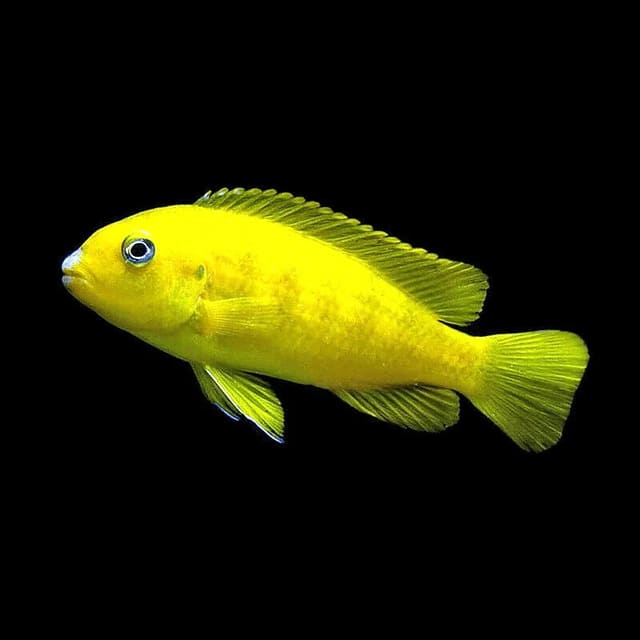
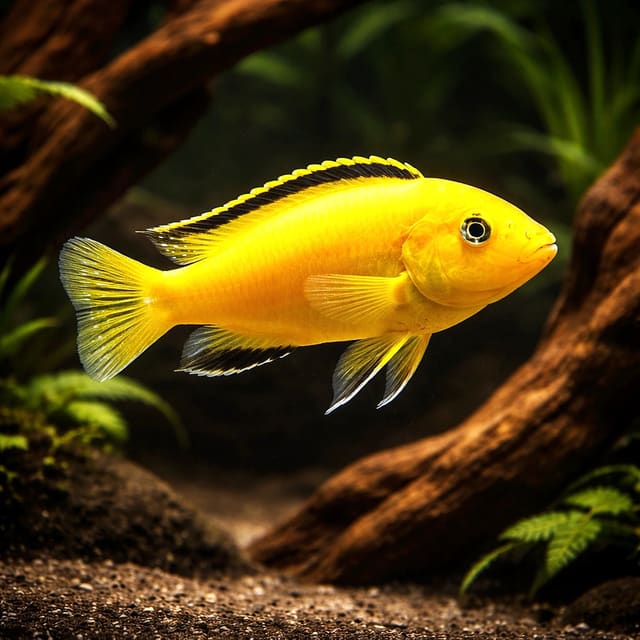
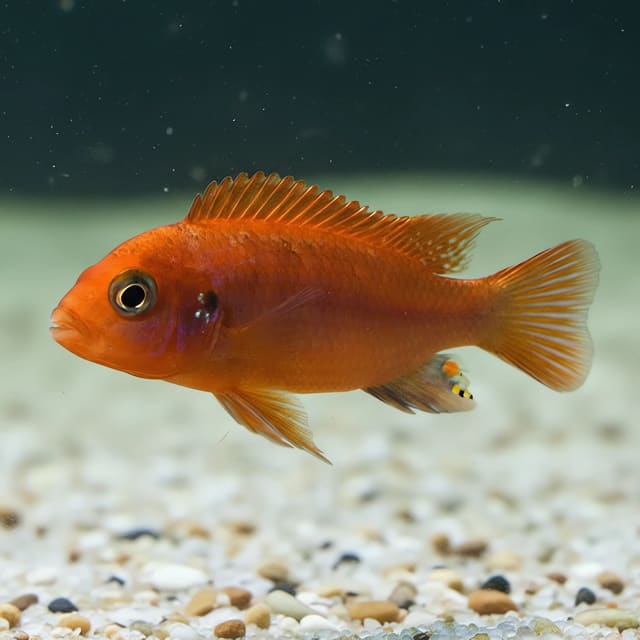
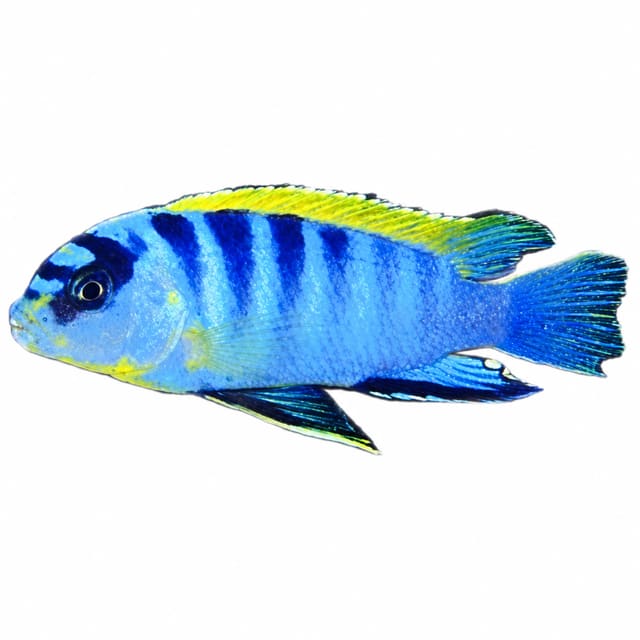
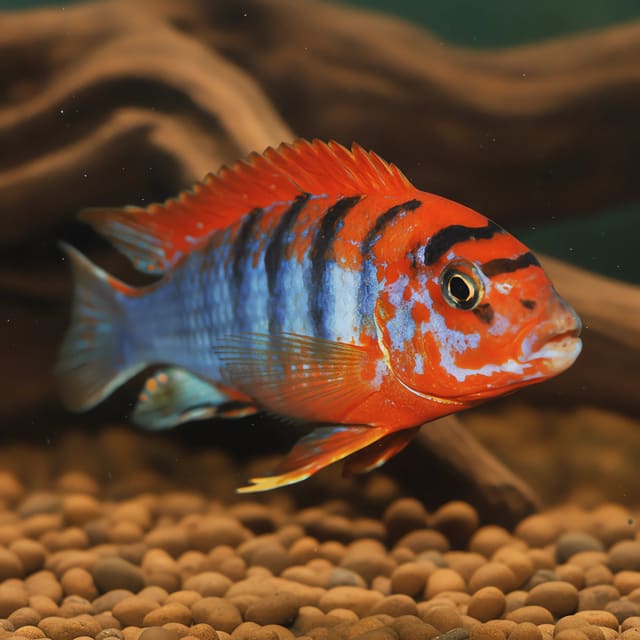
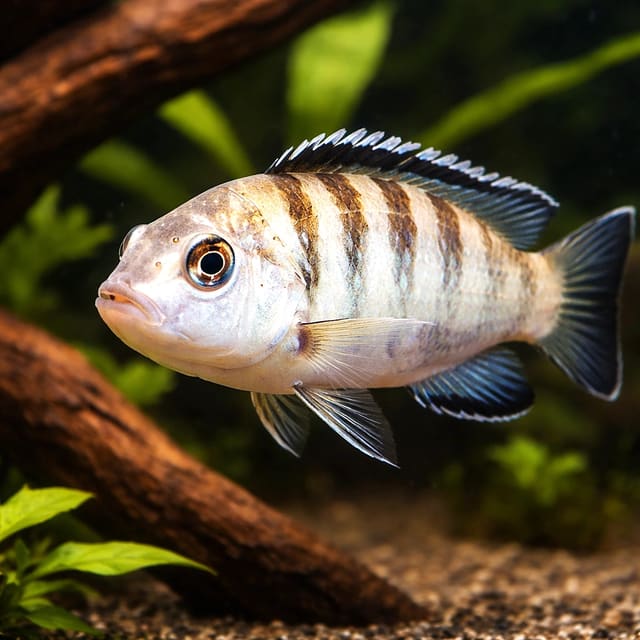
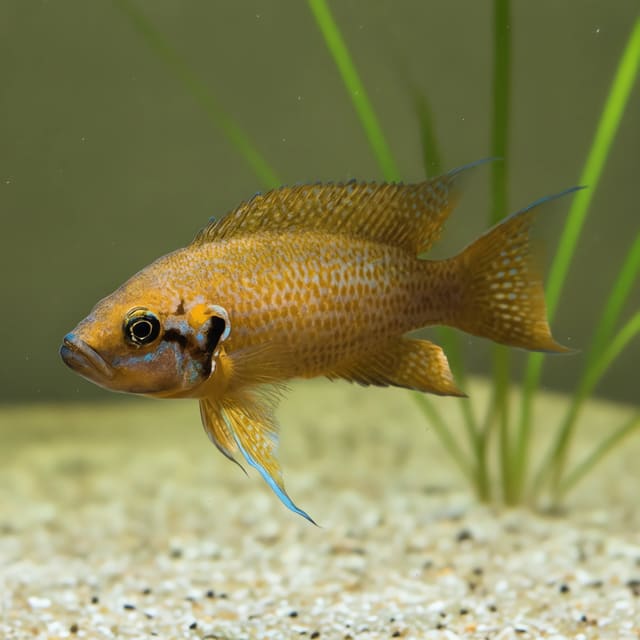
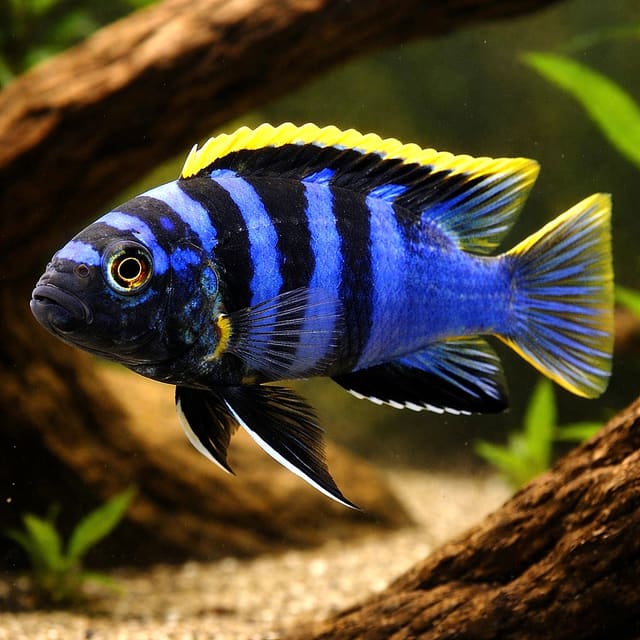
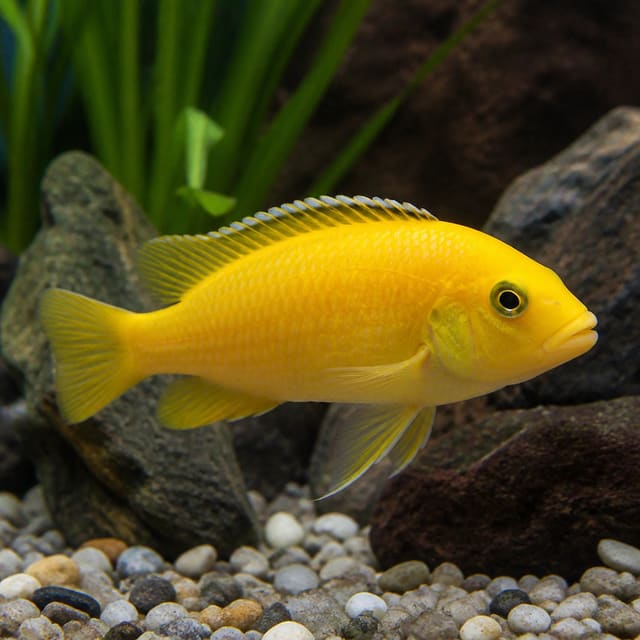
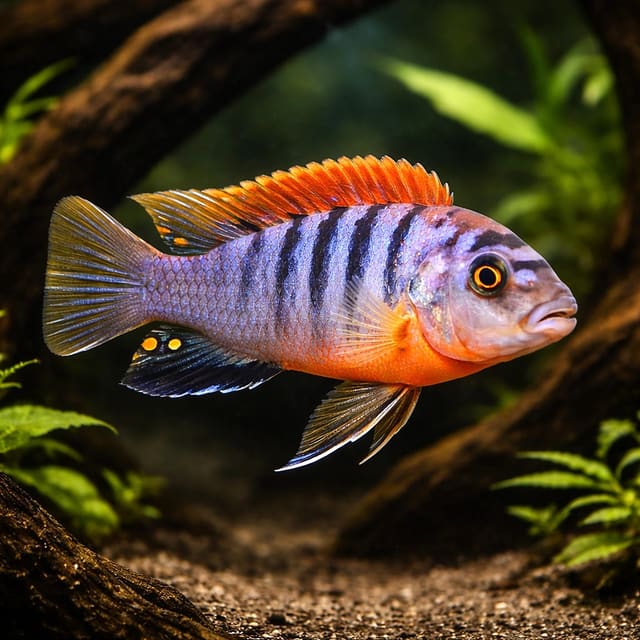
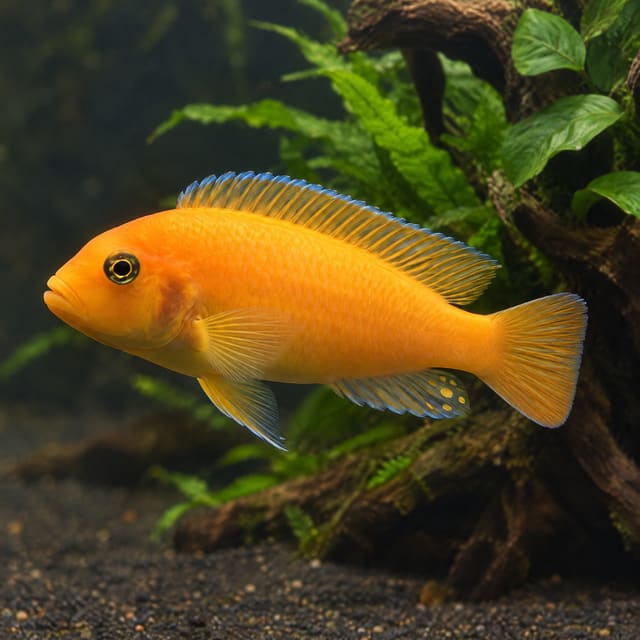
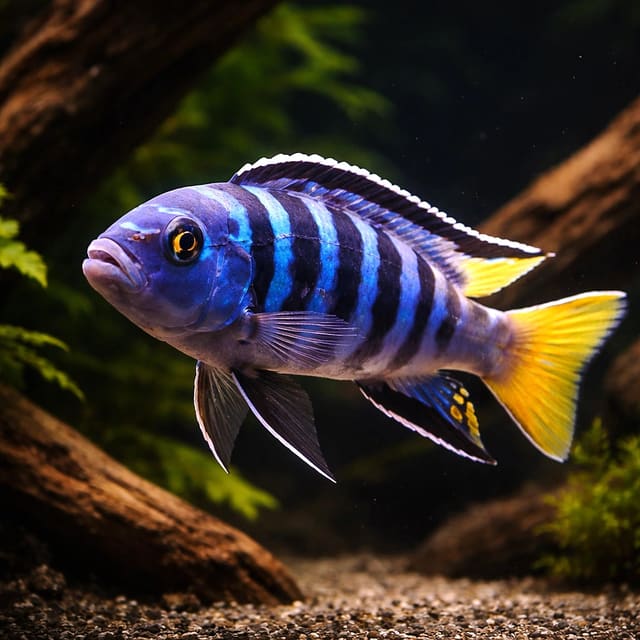
Some gallery images have been digitally enhanced to improve image quality. They show the listed type of animal rather than guaranteeing the exact markings of the individual supplied, so natural colour and pattern can vary.
Two fish may appear together in a gallery scene, but that visual count does not change the sold unit. Increase the purchase quantity only when the complete Malawi stocking plan, aquarium capacity and filtration can safely support the resulting number of fish.
Before setting the purchase quantity, write down the number of Malawi cichlids the aquarium is intended to hold and count every fish already living there. Then assess the resulting group against the at-least-15 group guidance, the 200-litre community baseline and the filter’s established capacity. A quantity of one means one addition to that plan; it does not turn a solitary or undersized arrangement into a suitable Malawi community.
OATA’s African Malawi cichlid guidance gives 23–27°C, pH 8.0–8.6 and hard water at 12–18°dH for the group. Use these values as the routine range for this genus-level offer. Carbonate hardness is given as 10–15°dKH, ammonia and nitrite should remain at zero, and nitrate should not exceed 20 mg per litre above the normal tap-water level.
| Planning decision | Working reference |
|---|---|
| Adult planning | Most Malawi cichlids reach around 10 cm; some grow up to 25 cm |
| Community aquarium | At least 200 litres for a reasonable-sized Malawi community |
| Community number | Groups of at least 15 are advised; small groups often fight |
| Water | 23–27°C, pH 8.0–8.6 and 12–18°dH |
The adult figures are planning references for Malawi cichlids rather than an adult prediction for Nkali. Choose the aquarium and community conservatively, leaving capacity for adult territories, waste production and a fish that may sit above the group’s typical size.
The 200-litre figure applies to a reasonable community, not to every possible combination. More fish, larger adults or a more aggressive mix can require more space. Treat volume, filtration, oxygenation, rock layout and the behaviour of the whole group as one decision.
A 200-litre aquarium with weak circulation around crowded rockwork does not meet the plan merely because its stated volume reaches the baseline. In the same way, a group of 15 does not become workable if the filter cannot process its waste or if one territory controls every shelter. Approve the setup only when the volume, mature biological filter, strong aeration, secure layout and measured water values work together.
| Suits | Not suited to |
|---|---|
| Stable aquarium water maintained at 23–27°C and pH 8.0–8.6 | Water outside 23–27°C and pH 8.0–8.6 |
| Carefully screened Malawi cichlids | Other Labidochromis species because the genus may hybridise |
Prepare a Malawi-style aquarium with rocks, caves, passages and open water for movement. Mbuna are rock dwellers, so the layout should offer several distinct places to shelter rather than one feature that a dominant fish can control. A chased fish needs a route around the décor and another place to settle.
OATA recommends coral sand or a similar substrate that helps buffer the water. Malawi cichlids will often dig and rearrange the substrate, which will uproot any plants present, so do not rely on planting as the main territorial structure or as the only cover for a pressured fish.
An aquarium of at least 200 litres is the starting point given for a reasonable Malawi community. Choose a larger aquarium when the planned adult population, aggression or waste load calls for it. Aquarium dimensions and rock placement must let the whole community use the space; nominal volume alone cannot create separate territories.
If this will be your first livestock aquarium, follow our guide to preparing and maturing a first tropical tank before choosing fish. A newly filled aquarium is not ready merely because its temperature and pH look correct; the biological filter must already be processing waste.
Trace several paths from the open feeding area to cover. Each path should lead past more than one shelter and should let a fish move out of another fish’s direct view without entering a closed pocket. After maintenance or digging changes the substrate, repeat this check and steady any rock that has shifted. Remove trapped waste during the weekly siphon rather than allowing inaccessible pockets to build behind the structure.
Keep the aquarium at 23–27°C, with pH 8.0–8.6, general hardness of 12–18°dH and carbonate hardness of 10–15°dKH. These values belong together: temperature, mineral content, buffering and biological waste control all shape the conditions experienced by the fish.
Read our aquarium water chemistry guide to understand what each test measures, then use the water matcher to compare measured aquarium values with the working range. Test the aquarium itself rather than assuming its water matches a regional description of UK tap water.
| Test | Action point |
|---|---|
| Ammonia | Maintain zero mg per litre |
| Nitrite | Maintain zero mg per litre |
| Nitrate | Do not exceed 20 mg per litre above the normal tap-water level |
| Temperature | Keep within 23–27°C |
The nitrate limit is relative to the tap-water baseline. If normal tap water tests at 10 mg per litre, the aquarium should not rise above 30 mg per litre. If the tap-water result changes, recalculate from the new baseline rather than continuing to use the old ceiling.
Test at least weekly and repeat the tests whenever breathing, colour, swimming, appetite or aggression changes. Record the results so gradual movement is visible before it becomes a large change. Use replacement water treated with tap-water conditioner to remove chlorine or chloramine, and keep each water change consistent with the aquarium’s established temperature and mineral routine.
Start by repeating the test correctly and comparing it with the written weekly log. If ammonia or nitrite is detectable, pause further livestock additions, inspect filtration and feeding, and restore zero readings. When nitrate is approaching its calculated ceiling, complete the partial water change and remove trapped solid waste. A gradual shift in pH, hardness or temperature also deserves attention before the next fish is introduced, because the aim is a stable routine inside the stated range rather than repeated movement between its limits.
The RSPCA’s aquarium welfare guidance explains why every fish aquarium needs a well-set-up and maintained filter. Fish release toxic ammonia; biological filter bacteria convert it to nitrite and then to the safer nitrate measured during routine testing.
Malawi communities combine active fish with the waste load created by group keeping and twice-daily feeding. OATA therefore recommends an oversized filter and strong aeration. Choose filtration for the planned adult community, not just for the number and size of fish on the first day. Ensure water can circulate around the rockwork and that surface movement remains strong enough to support oxygen exchange.
Tap water may contain chlorine or chloramine that harms the beneficial bacteria living in filter media. Cleaning media in removed aquarium water reduces bacterial loss and preserves the biological capacity needed to process ammonia and nitrite.
Never use slight overcrowding as a substitute for filtration capacity. The aggression-management method described for Malawi communities increases the importance of oxygenation, waste removal and weekly maintenance. If ammonia or nitrite appears, stop increasing the population and restore safe water quality before making another stocking decision.
A filter can continue making noise while its useful flow is reduced by a blockage, so inspect circulation as well as whether the unit is running. Compare the movement at the surface and around rockwork with its normal pattern. Pair that observation with the weekly ammonia, nitrite and nitrate results: zero ammonia and nitrite show that biological processing is keeping pace, while a rising nitrate pattern indicates how quickly the community is adding waste between water changes.
Dietary needs vary across Malawi cichlids. OATA describes smaller mbuna as more herbivorous and advises specialised Malawi cichlid food with a high algae content, together with fresh vegetables. Use that as the routine for this Nkali mbuna rather than applying the higher-animal-content feeding pattern described for larger, more predatory utaka.
Feed twice a day, offering only what the fish can finish within a few minutes. Portion size is determined by observation, not by continuing to add food until every fish appears full. Uneaten food breaks down and releases waste, raising the load placed on the biological filter.
Fresh vegetables can add variety to the algae-rich prepared diet, but they still count towards the total meal. Do not leave excess food to decay. The objective is consistent body condition and clean water rather than rapid growth through oversized portions.
Judge feeding success across the whole group. One fish repeatedly missing meals may be under social pressure even when the total quantity is generous. Adding more food can worsen water quality without solving that access problem; review territories and group behaviour instead.
If food is still visible after the group has stopped eating, remove what can be removed and make the next portion smaller. If every portion disappears immediately but one fish never reaches it, divide the same controlled amount between separate feeding areas rather than increasing the total. Record a sudden change in appetite and check it against water results, breathing and recent aggression, because feeding behaviour is both a nutrition decision and a daily observation point.
Before arrival, confirm that the aquarium is mature, filtered and within the working water range. Ammonia and nitrite must both be zero. The planned community and rock layout should already have been assessed so the new fish has more than one route to shelter.
Follow the current delivery and Live Arrival Guarantee policy. Be present to receive the parcel. Start filming before the sealed parcel is opened, keep the outer box visible and continue in one take through opening it to the fish still inside the sealed bag. Float the bag for 20–30 minutes before releasing the fish, and do not pour bag water into the aquarium.
| Checkpoint | What to confirm |
|---|---|
| Before release | 23–27°C, zero ammonia, zero nitrite and secure cover |
| First day | Balanced swimming, normal breathing and access to shelter |
| First week | Feeding access, intact fins and no persistent cornering |
| First month | Stable weekly tests, dependable filter flow and workable territories |
Additions increase feeding and waste, so the beneficial bacterial population must grow with the bioload. Increase the aquarium population slowly enough for the filter to respond. Stocking too quickly can create new tank syndrome, in which ammonia and nitrite rise because bacterial capacity has not caught up.
There is an important balance for Malawi fish: OATA advises adding them in groups to reduce pressure on one newcomer, while also warning against increasing the population too quickly. Resolve that balance before purchase by considering the filter’s mature capacity, the aquarium’s total planned population and the aggression likely during introduction.
Do not move from one stocking stage to the next simply because a fixed number of days has passed. Stable tests, normal feeding access and workable territories are the conditions for proceeding. Detectable ammonia or nitrite means the biological load is ahead of the filter; persistent cornering means the social arrangement is failing. Pause additions and correct the relevant problem before changing the community again.
Learn the normal behaviour and appearance of each fish after it settles. Individual cichlids vary, but a change from that baseline can reveal deteriorating water quality, social pressure or illness early enough for a practical response.
| If you see | Check first |
|---|---|
| Hanging at the surface | Breathing rate, filter flow, aeration, ammonia and nitrite |
| Sitting on the bottom | Temperature, water tests and aggression |
| Erratic swimming | Water quality and recent social conflict |
| Darker or paler colour | Hiding, feeding access and territorial pressure |
| Damaged fins or missing scales | Chasing, cornering and unstable décor |
| White spots or fluffy growths | Full water tests and the condition of every fish |
| Reduced feeding | Water quality, breathing and access to food |
Also watch for changes in body condition, bumps, ulcerated areas and gill covers moving faster or slower than normal. Do not judge health from colour alone because appearance and temperament can change with social conditions.
When a change appears, run the full water tests, inspect filter flow and observe the group before choosing the next action. Correct measurable husbandry problems promptly. If the fish remains unwell or the correct response is unclear, contact us for health guidance.
Continue a 25% partial water change at least once every week, regular testing and filter inspection even when the aquarium looks clear. Clear water can still contain ammonia, nitrite or an excessive rise in nitrate, while a working biological filter protects fish through processes that are not visible.
When several fish change breathing or swimming at the same time, prioritise water tests, filter flow and aeration because the cause may affect the whole aquarium. When one fish alone is repeatedly chased, excluded from food or held in a corner, map where the dominant fish controls space and review the community arrangement. Both patterns require prompt action, but distinguishing a tank-wide change from pressure on one individual helps direct the first check.
Malawi cichlids are aggressive fish and must be mixed with caution. Nkali should therefore be planned as part of the whole adult community rather than judged only against one proposed companion. Aquarium volume, rockwork, feeding access, sex balance and the order of introduction can all change where pressure falls.
OATA advises groups of at least 15 and notes that Malawi cichlids kept in small groups often fight. Slight overcrowding may spread aggression, but it must remain within the aquarium’s safe filtration, oxygenation and maintenance capacity. It is a deliberate management method, not permission to add fish without measuring the resulting bioload.
Where possible, OATA recommends more females than males of each Malawi species to reduce repeated male attention towards one female. This offer carries no sex-guaranteed option, so do not build an exact ratio by assumption. A separation plan remains important whenever the final balance is uncertain.
When adding Malawi cichlids, introduce more peaceful species before more aggressive ones. Rearranging the décor can disrupt established territories and make each fish establish its position again. That step may help during a carefully assessed introduction, but it cannot compensate for inadequate space, filtration or an unsuitable combination.
OATA advises keeping Malawi cichlids only with other Malawi cichlids or with some species of Synodontis catfish associated with the lake. Avoid adding general tropical-community fish merely because they tolerate the same temperature. Every candidate must also match the hard, alkaline water, available adult space and the aggression level of the complete community.
No Malawi species is a universal companion. Before selecting from the African cichlid collection, compare the proposed fish by adult planning size, water requirements, feeding strategy, territorial behaviour and likely use of the aquarium. Screen any Synodontis to exact species rather than treating the whole genus as interchangeable.
Labidochromis species may hybridise readily in aquariums. Keep only one species from this genus in the same aquarium to reduce that risk. Because Nkali is identified at genus level, avoid combining it with another Labidochromis on the assumption that a different colour or trade label guarantees reproductive separation.
The honest compatibility decision is conditional: carefully screened Malawi cichlids and some exact Synodontis species may fit, while aggression and individual behaviour still require observation. Avoid non-Malawi fish apart from a specifically assessed Synodontis choice.
Nkali Labidochromis Mbuna is Labidochromis sp. 'nkali', a genus-level mbuna identity from Lake Malawi. The name does not assign this trade form to a formally identified species.
One purchase quantity supplies one animal. Sex is not guaranteed by this offer, and a gallery scene showing two fish does not change the sold unit.
OATA says most Malawi cichlids grow to around 10 cm and some up to 25 cm. These are group planning references rather than an adult-size prediction for Nkali Labidochromis Mbuna, so leave capacity for a fish above the typical figure.
Use a mature, filtered Malawi aquarium with secure rockwork, caves, hard alkaline water and strong aeration. OATA recommends at least 200 litres for a reasonable-sized Malawi cichlid community.
OATA advises keeping Malawi cichlids in groups of at least 15 and notes that small groups often fight. Plan this fish within the whole community, using adequate filtration, aeration, territory and a response plan for aggression.
OATA’s African Malawi cichlid group guidance gives 23–27°C, pH 8.0–8.6 and 12–18°dH, with carbonate hardness of 10–15°dKH. Maintain ammonia and nitrite at zero and nitrate no more than 20 mg per litre above the normal tap-water level.
Feed specialised Malawi cichlid food with a high algae content and include fresh vegetables. Offer only what the fish can finish within a few minutes, twice a day.
Start filming before opening the sealed parcel, keep the outer box visible and continue in one take through opening it to the fish still inside the sealed bag. Be present to receive the parcel, float the bag for 20–30 minutes and acclimatise slowly before releasing the fish. Do not pour the bag water into the aquarium.
Screen other Malawi cichlids or an exact suitable Synodontis species for hard-water needs, adult space, diet and aggression. Avoid non-Malawi fish apart from a specifically assessed Synodontis, and keep only one Labidochromis species in the aquarium because the genus may hybridise.
No reviews for this item yet. Bought one? Honest reviews only, good or bad.
What customers say about ordering from us
I have a small group of long finned mountain minnows. So was delighted to be able to order ten of this variety to increase the genetics in my tank . The ones I recieved are healthy but it’s to early to give a verdict on wether they are of a long finned type since they are small currently.
Gordon Walker · 23 Sept 2026
100% success travel and "installation". Pleased with quality of purchase. The Siamese fighter a bit "shy" so have not yet seen him at his best yet but looking good. Happy customer. GG
George E Garratt · 21 Sept 2026
Reviews of our shop, collected by Judge.me, an independent third-party review collector. Newest first.