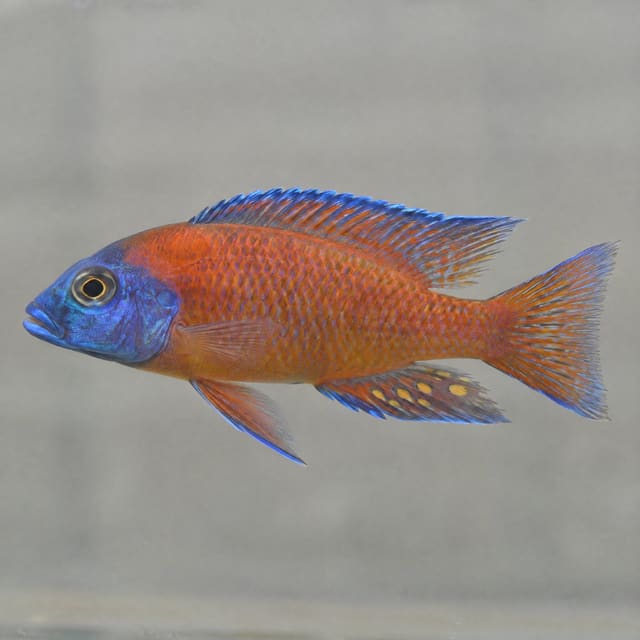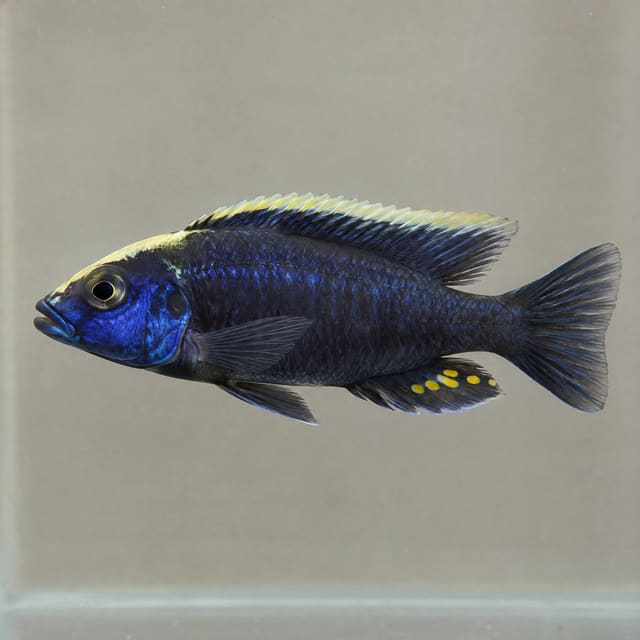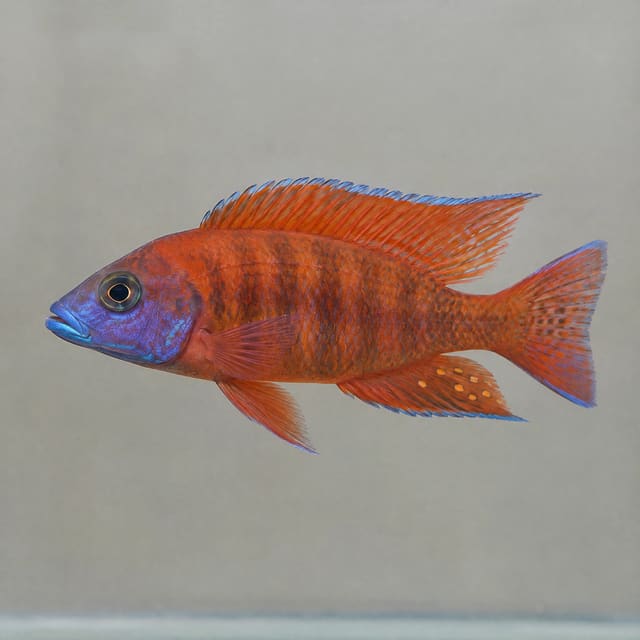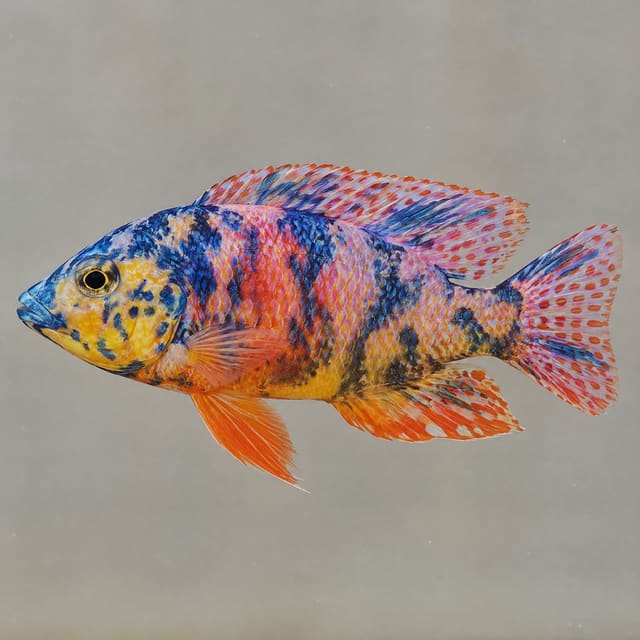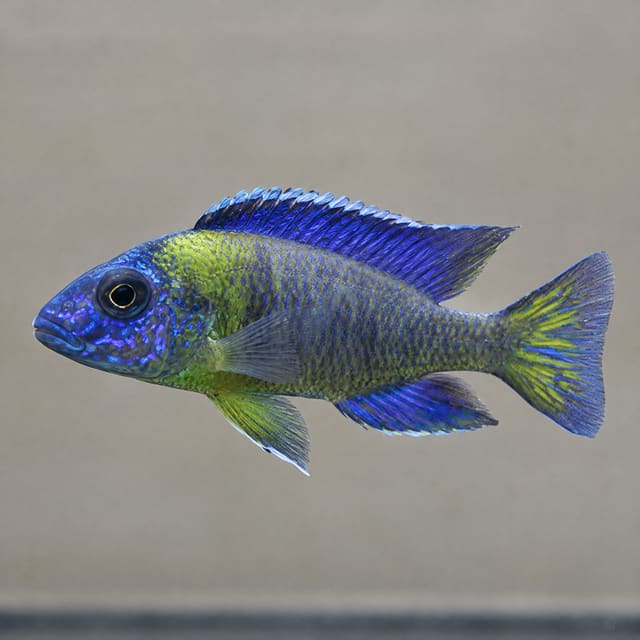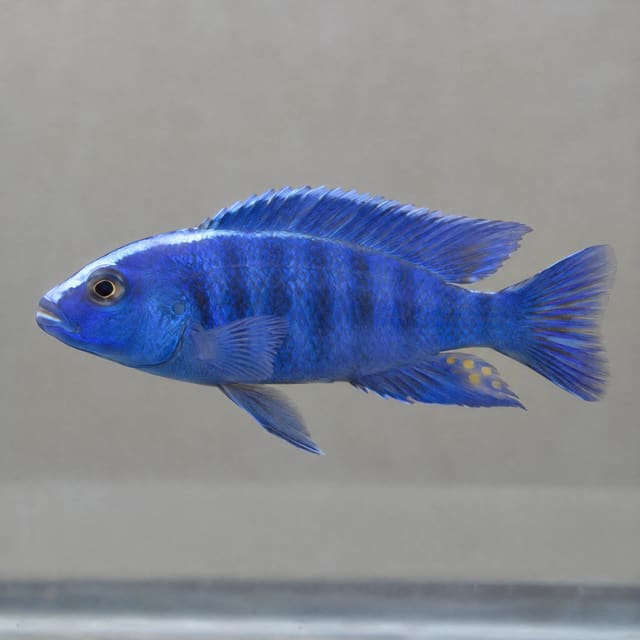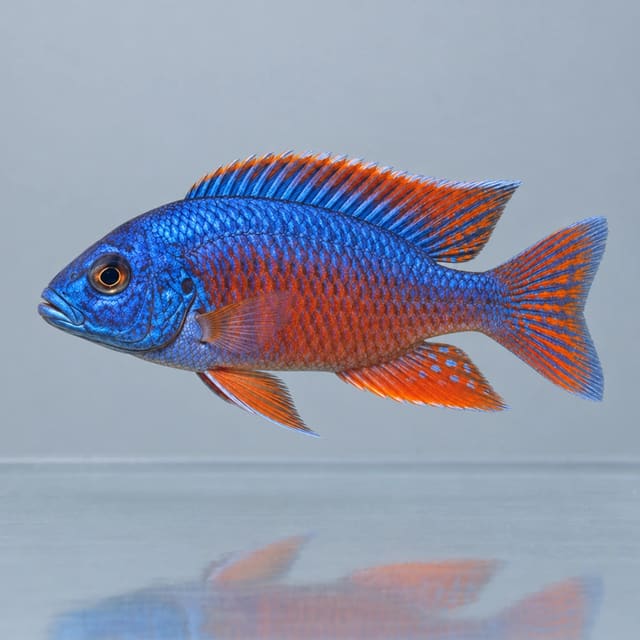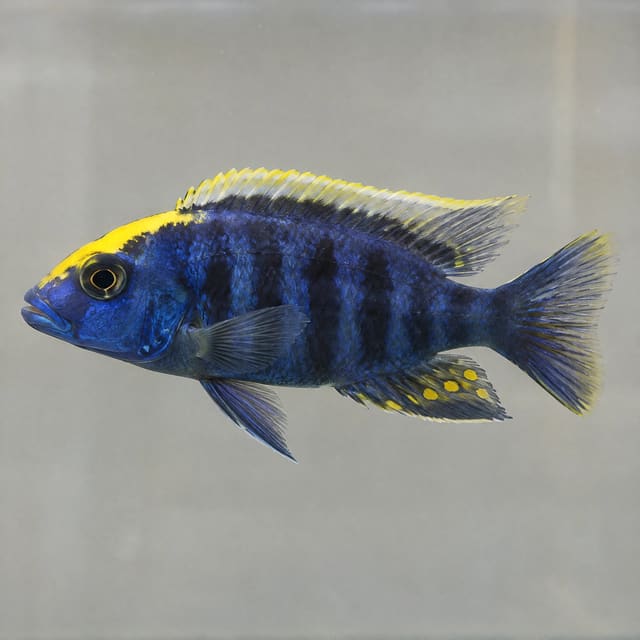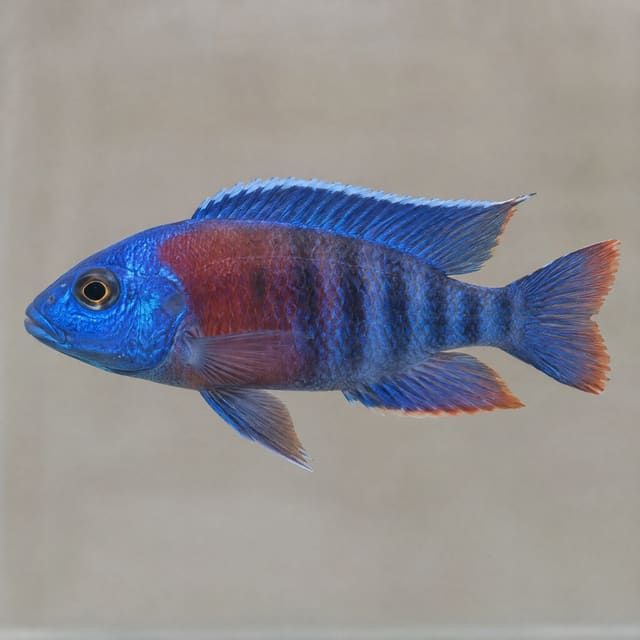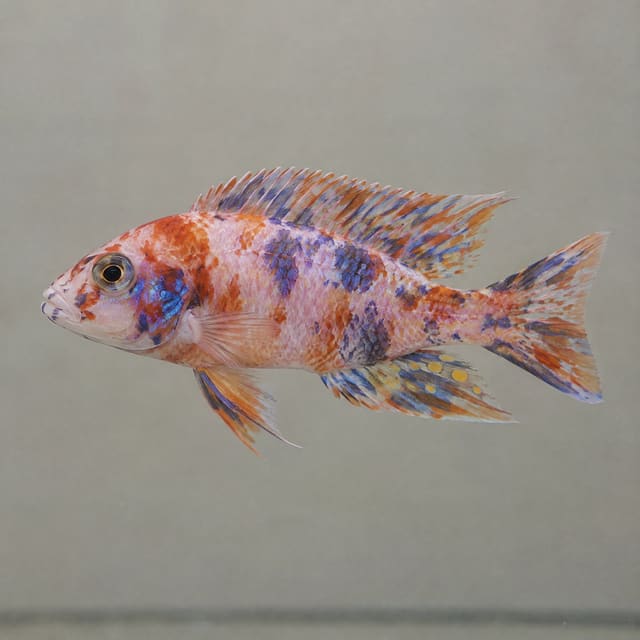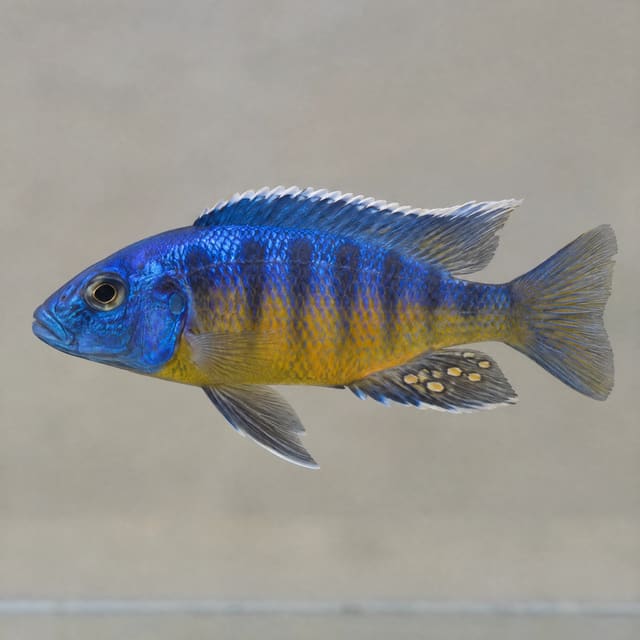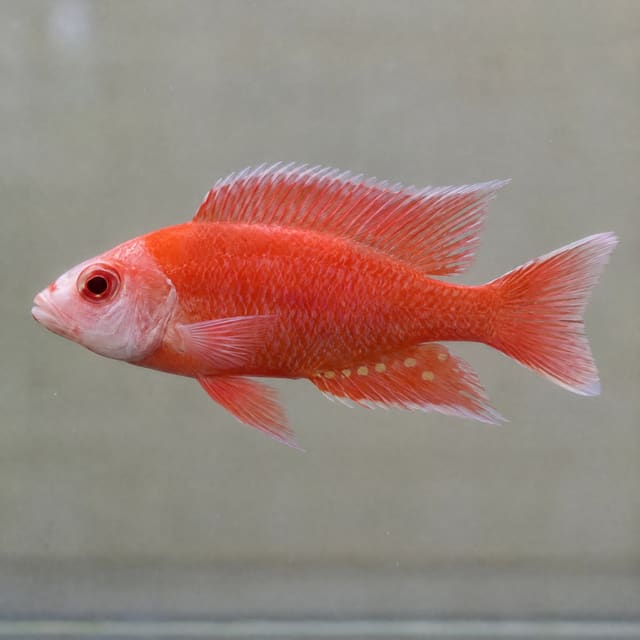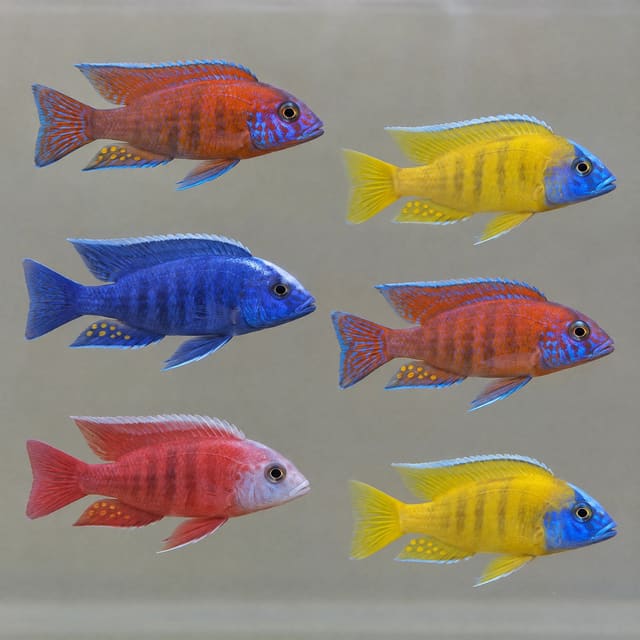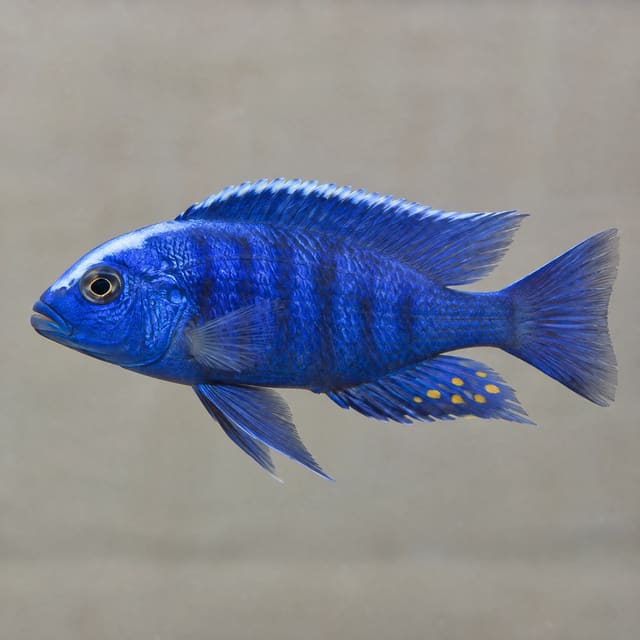
New Blue Orchid Peacock Cichlid (Aulonocara sp.)
23–27°C · pH 8–8.6
£11.99
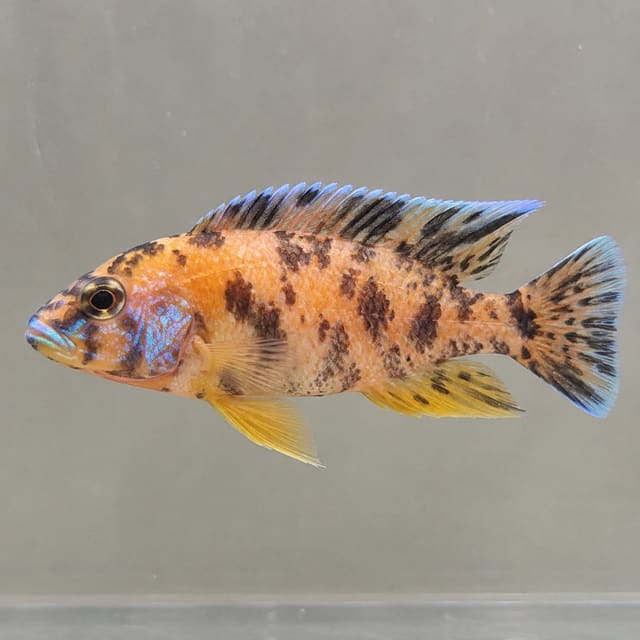
The Albino OB Peacock is an aquarium-bred albino form of the orange blotch peacock cichlid: a pale peach-white Lake Malawi-type peacock splashed with orange blotches, with red or pink eyes, growing to about 12 to 13 cm. It needs a mature aquarium at least 120 cm long with fine sand, rockwork and hard, alkaline water. One live fish per purchase.
Adult size is the maximum length this species reaches at full maturity (scientific sources). The livestock you receive will be younger and smaller. Product-photo provenance and any image-specific limitations are stated on the listing.
Aulonocara sp. 'OB' albino
Save when buying multiple fish. Each quantity is one fish; sex and pair formation are not guaranteed unless the selected variant explicitly states them.
The Albino OB Peacock is an aquarium-bred albino form of the orange blotch peacock cichlid: a pale peach-white Lake Malawi-type peacock splashed with orange blotches, with red or pink eyes, growing to about 12 to 13 cm. It needs a mature aquarium at least 120 cm long with fine sand, rockwork and hard, alkaline water. One live fish per purchase.
Adult size is the maximum length this species reaches at full maturity (scientific sources). The livestock you receive will be younger and smaller. Product-photo provenance and any image-specific limitations are stated on the listing.
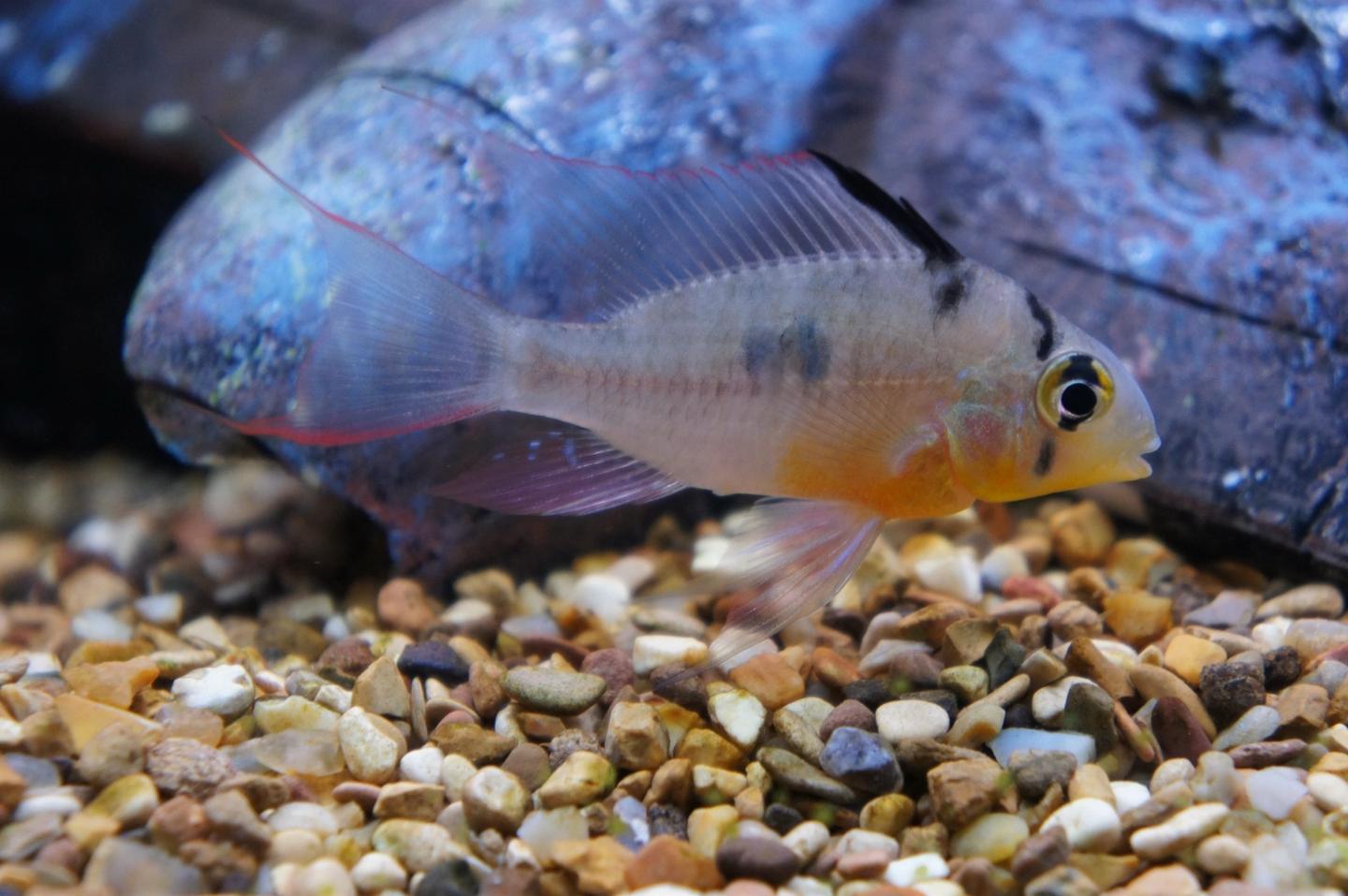
Cichlids are a family of roughly 1,800 accepted species, not one care type. Before buying, identify the exact species and source, then compare adult measurement, usable tank dimensions, social system, territory, tested water, diet and an exit plan. No family-wide minimum tank, water range or tank-mate list is safe.
Read the full care guidance when planning conditions for your aquarium.
The Albino OB Peacock is a pale, peach-white peacock cichlid splashed with bright orange blotches, with red or pink eyes and long, orange-streaked fins. "OB" stands for orange blotch, and this is the albino form of the OB peacock, sold under the genus name Aulonocara. It is a fish made in aquariums, not collected from Lake Malawi: there is no wild population, and every Albino OB Peacock comes from line-bred stock.
A UK species profile of OB and calico peacocks describes the strain as a hybrid, believed to start from a cross between an Aulonocara and possibly another haplochromine cichlid, with the offspring then crossed again with an orange-blotched mbuna. Breeders then selected for the peacock body shape and calmer temperament. The orange-blotch gene is the mbuna contribution; albinism removes the dark pigment, leaving the orange on a pale ground.
| Name you may see | What it tells you |
|---|---|
| Albino OB Peacock | The usual trade name for this fish |
| OB, orange blotch | Irregular orange patches on a paler body, a colour gene from OB mbuna |
| Albino | No dark pigment; red or pink eyes |
| Aulonocara sp. 'OB' | A trade label: the fish is not a described species |
| Peacock cichlid | The common name for Aulonocara, the sand-dwelling peacocks of Lake Malawi |
Because it is a hybrid strain, plan its care from the wild peacocks it resembles. This page uses the Seriously Fish profile of Grant's peacock (Aulonocara stuartgranti) as the baseline for size, footprint and behaviour, OATA's UK guidance for Malawi cichlids for water and maintenance, and Practical Fishkeeping's article on farm-bred albino peacocks for the extra needs of pink-eyed fish. Where these sources give different numbers, the page says so and recommends the overlap.
Browse more of our Malawi cichlids, the wider African cichlids range, all Lake Malawi and Victoria cichlids or the full Aulonocara peacock cichlids range to compare colour forms, including other line-bred peacocks such as the Strawberry Peacock Cichlid and the Calico Peacock Cichlid.
One purchase supplies one live Albino OB Peacock in the standard size we stock. The size at dispatch is a juvenile or young adult size, not the adult size, so plan the aquarium for a fish of about 12 to 13 cm. The sex is not selected or guaranteed.
The photographs show the colour form, not the individual fish. OB patterns are irregular by nature, so the blotches on the fish you receive will sit in different places, and colour deepens as the fish matures. Young albino peacocks are often paler than the adults shown, and males usually develop the longest fins and the strongest orange.
Because sex cannot be chosen, buy a few more young fish than you need and plan to rehome extra males as they colour up. Check our delivery and Live Arrival Guarantee policy before you order, and have the aquarium matured and tested first.
Give an Albino OB Peacock an aquarium at least 120 cm long. Practical Fishkeeping recommends a long-term minimum of 240 litres and 120 cm for farm-bred albino peacocks. Seriously Fish gives a 120 x 45 cm footprint, about 243 litres, for Grant's peacock, and OATA advises at least 200 litres for a reasonable Malawi community, adding that larger tanks are more stable. The three agree: plan on 120 cm and 200 litres or more, and go bigger for a mixed group.
Length matters more than height. Peacocks patrol the open sand in front of the rocks, and males need room to display without pinning a rival in a corner. A tall, narrow tank of the same volume gives less of the floor space they actually use.
| Step | What to check |
|---|---|
| Measure | At least 120 cm long and about 45 cm front to back |
| Count adults | Plan every fish at its adult size, about 12 to 13 cm for this peacock |
| Count groups | Allow for one male with four to six females, plus every other species' full group |
Our tank volume calculator works out real litres from your measurements, and the stocking calculator helps you add up adult sizes before you buy. Fit a tight cover: startled cichlids can jump.
In Lake Malawi, wild peacocks live where rocky shores give way to open sand with scattered rocks. Copy that zone: a fine sand floor with piles of rock and open gaps between them. Seriously Fish recommends fine sand rather than gravel or pebbles, which can hinder feeding, damage the gill filaments and be swallowed, because peacocks take mouthfuls of sand and sift food from it.
OATA suggests coral sand or a similar substrate to help buffer the water, and complex rockwork so that each fish can hold a territory and lines of sight are broken, which reduces aggression. Build rock piles on the tank floor, not on top of the sand, so digging fish cannot undermine them.
| Area | Purpose |
|---|---|
| Open sand at the front | Sifting, feeding and male display |
| Two or three separate rock piles | Territories and retreats for subordinate fish |
| Flat stones and sandy gaps | Spawning sites |
| Open water above | Swimming space |
Plants are optional. Most Malawi cichlids dig and uproot them, so OATA says only the hardiest plants fixed to rocks are likely to last. Strong lighting is not needed for the fish; keep a regular day and night cycle with overhead lights.
Peacocks come from hard, alkaline lake water and are sensitive to sudden changes. Seriously Fish warns that they should not go into a biologically immature tank. Keep the values steady inside the overlap of the published ranges rather than chasing a single number.
| Reading | OATA, Malawi cichlids | Seriously Fish, Grant's peacock | Aim for |
|---|---|---|---|
| Temperature | 23-27°C | 23-29°C | 24-26°C |
| pH | 8.0-8.6 | 7.5-9.0 | 8.0-8.5 |
| General hardness | 12-18 dGH | 10-25 dGH | 12-18 dGH |
| Carbonate hardness | 10-15 dKH | not given | 10-15 dKH |
| Ammonia and nitrite | zero | not given | zero |
| Nitrate | no more than 20 mg/l above tap water | not given | as low as possible |
The UK OB profile gives a slightly cooler 22-26°C and pH 7.5-8.5, which still overlaps the aim column. Test pH, hardness, ammonia, nitrite and nitrate every week, and more often while the tank is new or after adding fish.
UK tap water varies from soft to very hard depending on where you live, so test it before you plan. Hard, alkaline tap water may need little more than dechlorinating. In a soft-water area, raise and hold the hardness with coral sand or aragonite in the filter, as the OB profile suggests, and keep every replacement water change the same so the pH does not swing. Our water chemistry guide explains pH, GH and KH, and the water matcher compares your readings with this fish's range.
Malawi cichlids are heavy eaters, so the filter has to cope with a lot of waste. OATA calls a filter essential, recommends an oversized one and asks for vigorous aeration. Seriously Fish recommends heavy filtration, such as a canister filter or sump. Our guide to aquarium filtration explains how to size it.
The two sources differ on water changes: OATA asks for at least 25% every week, while Seriously Fish suggests 30-50% a week for peacocks. Start at 25% and move towards the larger figure if nitrate climbs, matching the temperature and hardness of the new water each time.
Never replace all the biological media at once, and never add a full group of new fish to a filter that has not grown with the stock.
Wild peacocks feed on the bottom: they hover over the sand, sense small animals moving through enlarged sensory pores on the head, then take a mouthful of sand and sift out the food. In the aquarium, Seriously Fish recommends a high-quality fine food that includes plant matter such as spirulina, with live or frozen foods such as bloodworm, brine shrimp and mosquito larvae. The OB profile adds small frozen meaty foods such as mysis and some vegetable matter.
Seriously Fish suggests three or four small meals a day rather than one large one; OATA suggests feeding twice a day, only what is eaten within a few minutes. Either works if the total stays small. Practical Fishkeeping notes that pink-eyed peacocks have impaired vision, so make sure an albino fish actually gets its share, especially among faster tank mates.
A fish that stops feeding is telling you something. Test the water, check whether it is being chased away from food, and look at its breathing before changing the diet.
Before the fish arrives, confirm that ammonia and nitrite read zero, that the temperature, pH and hardness are in range and that the tank has space for the full adult group. Add fish slowly: each addition makes more waste, and the filter bacteria need time to catch up. OATA recommends adding the more peaceful species first and the more aggressive ones last, and moving the rockwork when you add fish so that territories are re-formed rather than defended.
| Checkpoint | What to do |
|---|---|
| Day 1 | Lights off, no food until the next day |
| Days 2-3 | Small meals; check the new fish reaches food |
| Every day | Look at breathing, fins, colour and hiding |
| Day 3 and day 7 | Test ammonia and nitrite after the stocking rise |
Our guide to acclimatising new fish covers the same steps with pictures. Expect a new peacock to hide at first; worry only if it cannot leave cover, stays pale for days or is chased constantly.
OATA's rule for Malawi cichlids is simple: keep them only with other Malawi cichlids or certain Synodontis catfish from Lake Malawi, and never mix them with Tanganyikan cichlids. Peacocks are relatively peaceful by Malawi standards, but the UK OB profile notes that the mbuna in the OB line raised its aggression compared with pure Aulonocara. Seriously Fish adds that peacock males are aggressive towards fish with a similar colour pattern, and that most mbuna are too boisterous to be good companions.
| Suits | Avoid |
|---|---|
| Calm haps such as the Electra Deep-Water Hap and the Yellowfin Borleyi Cichlid | Aggressive mbuna that outpace a fish with poor eyesight |
| Easy-going mbuna such as the Yellow Lab Cichlid | Females of true Aulonocara species, which it can hybridise with |
| Lake Malawi catfish such as the Malawi Squeaker | Tanganyikan cichlids and any soft-water community fish |
| Other farm-bred peacocks, such as the Red Albino Peacock or Albino Firefish Peacock, in a large tank | Small fish that fit in its mouth |
Our tank mates tool checks a planned mix, the Lake Malawi cichlid guide explains how peacocks, haps and mbuna differ, and our cichlid care guide covers territory and aggression in more depth.
A healthy Albino OB Peacock has clear eyes, intact fins and scales, steady breathing and a good appetite. OATA lists clamped fins, flicking against rocks or sand and shimmying as signs of trouble, and advises against buying a healthy-looking fish from a tank where others are sick.
| If you see | Do this first |
|---|---|
| Hanging at the surface or fast breathing | Test ammonia, nitrite and temperature; increase aeration |
| Hiding all day, torn fins | Look for a bully; add rock piles or rehome extra males |
| White spots or fluffy growths | Test the water and seek fish-health advice before treating |
| Swollen belly, stringy white droppings, refusing food | Stop feeding for a day, test the water, review the diet |
| Thin fish that never reaches food | Feed in more places; check its vision is not leaving it behind |
Test before you treat. Many problems in Malawi tanks start with water quality, overfeeding or one dominant male, and fixing the cause is better than adding medicine to the water.
Peacocks are maternal mouthbrooders. Seriously Fish describes the male courting at a chosen site, the female laying eggs and picking them up, then taking in sperm while nosing at the egg-spots on the male's anal fin. The female carries the brood for up to four weeks and does not eat during that time; the UK OB profile gives about three weeks. OATA's wider Malawi range is 21 to 40 days.
Practical Fishkeeping asks keepers not to cross farm-bred albino peacocks with true species, because it undermines fish meant to be genuine wild species. Breed Albino OB to Albino OB, label any young as a hybrid strain and never release fish or tank water into the wild. A stressed brooding female may spit or swallow the brood, so move her only with care.
It is an aquarium-bred albino form of the orange blotch (OB) peacock cichlid, sold under the genus name Aulonocara. OB peacocks are line-bred hybrids with no wild population: the orange-blotch colour is believed to come from crossing an Aulonocara with an orange-blotched mbuna. The albino form lacks dark pigment, so the body is pale peach-white with orange blotches and the eyes are red or pink.
Plan for about 12 to 13 cm. A UK species profile of OB peacocks gives up to 12 cm, Practical Fishkeeping gives up to 12.5 cm for males of a similar farm-bred albino peacock, and the wild Grant's peacock reaches 13 cm standard length. Males grow larger than females.
Use an aquarium at least 120 cm long. Practical Fishkeeping recommends a long-term minimum of 240 litres and 120 cm for farm-bred albino peacocks, Seriously Fish gives a 120 x 45 cm footprint for a wild peacock, and OATA advises at least 200 litres for a Malawi community.
Hard, alkaline, very clean water. The published ranges overlap at about 23 to 26 degrees C, pH 8.0 to 8.5 and 12 to 18 dGH, with zero ammonia and nitrite and nitrate no more than 20 mg/l above your tap water.
It can share a peacock or hap community, but keep it away from females of true Aulonocara species if you want those lines pure, because peacocks hybridise readily. Avoid boisterous mbuna, since albino fish see less well and can lose out at feeding time.
One purchase supplies one fish of unspecified sex. Peacock males are territorial, so plan one male with four to six females, or a larger, slightly crowded Malawi community, rather than a single fish on its own.
A fine-sized cichlid pellet or flake containing plant matter, plus small frozen foods such as mysis, brine shrimp and daphnia. Give two to four small meals a day, only as much as is eaten within a few minutes, and spread the food so it reaches the sand.
They are maternal mouthbrooders and will spawn in an aquarium. Because the line is already a hybrid, breed albino OB to albino OB only and never release or sell the young as a wild species.
No reviews for this item yet. Bought one? Honest reviews only, good or bad.
What customers say about ordering from us
Easy website plenty of info on fish your buying great to pick a time slot
TRACEY DURRANT · 7 Oct 2026
Got some lovely fish thank you
Kevin Mackie · 7 Oct 2026
Reviews of our shop, collected by Judge.me, an independent third-party review collector. Newest first.
Moved by UK carriers licensed to handle live animals
Hand-packed with oxygen bags, poly box, heat pack
Email photos the same day; an optional unboxing video helps us review problems faster — claim terms apply
Klarna & PayPal Pay in 3 at checkout