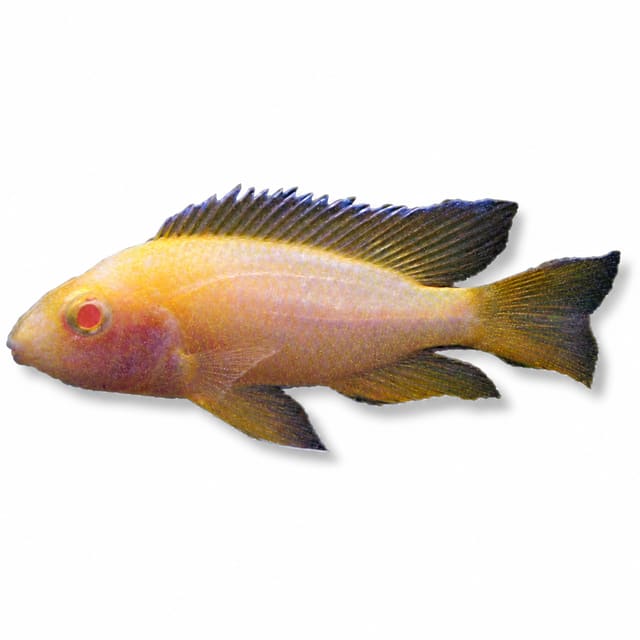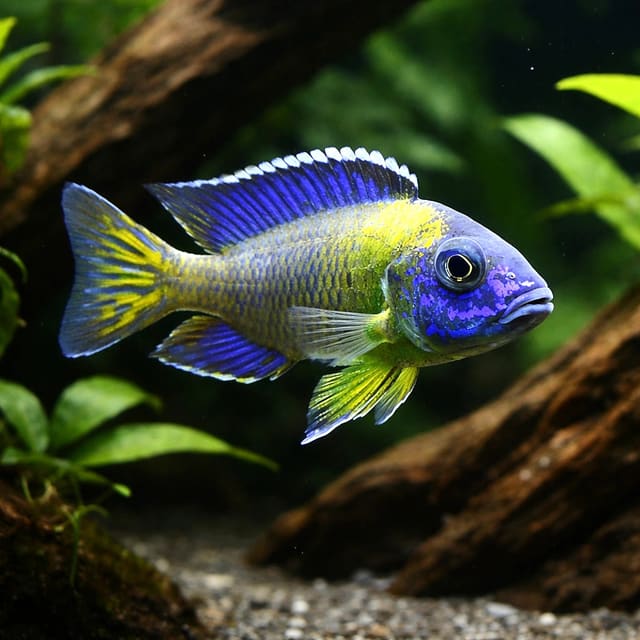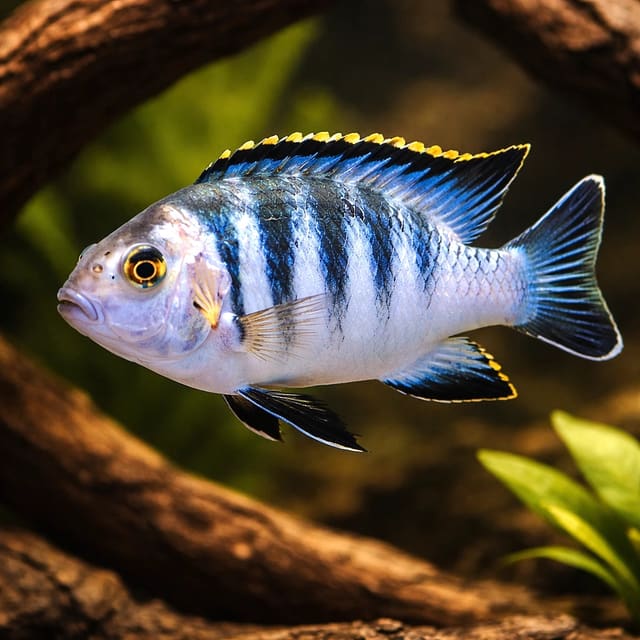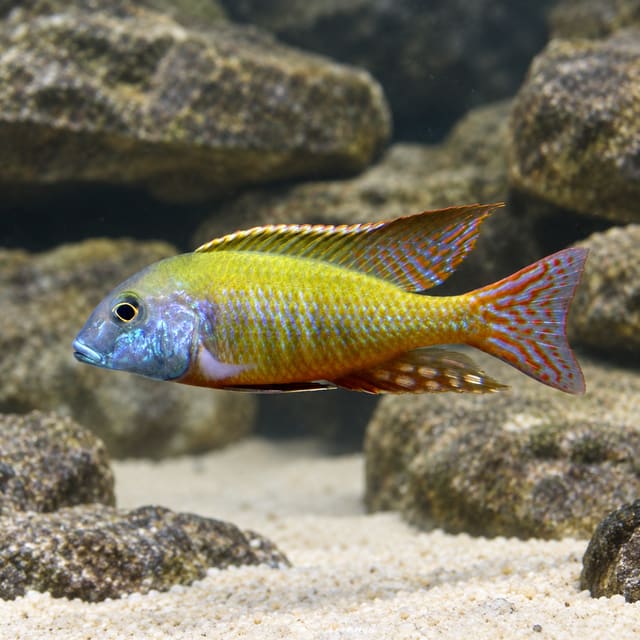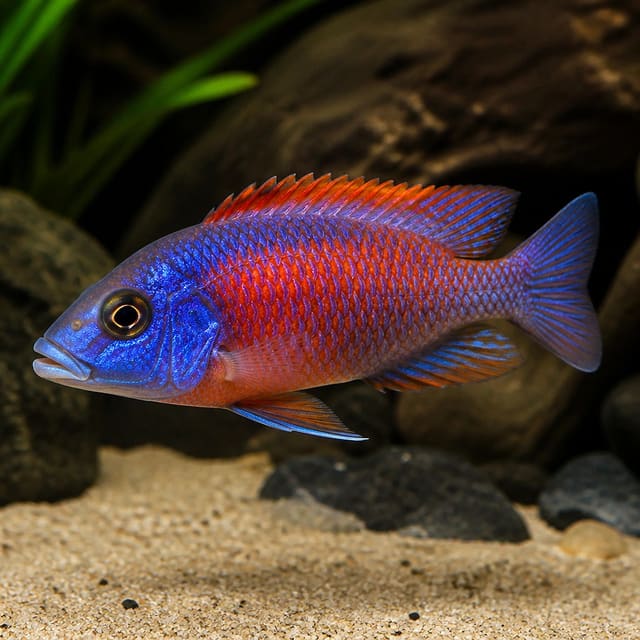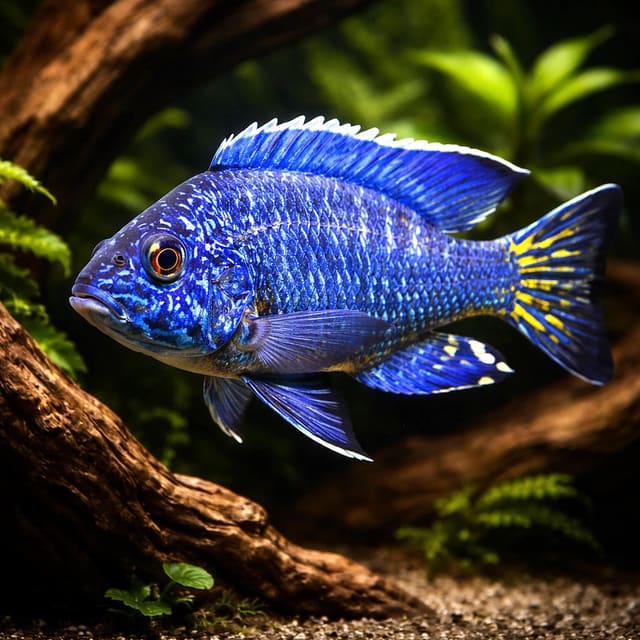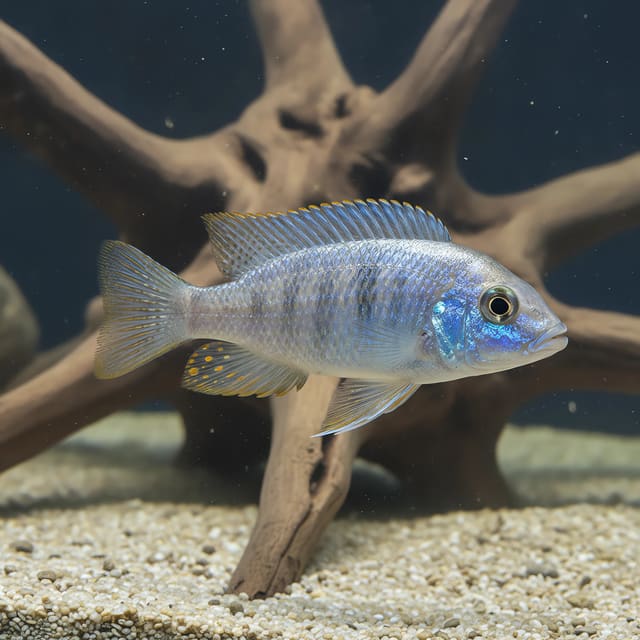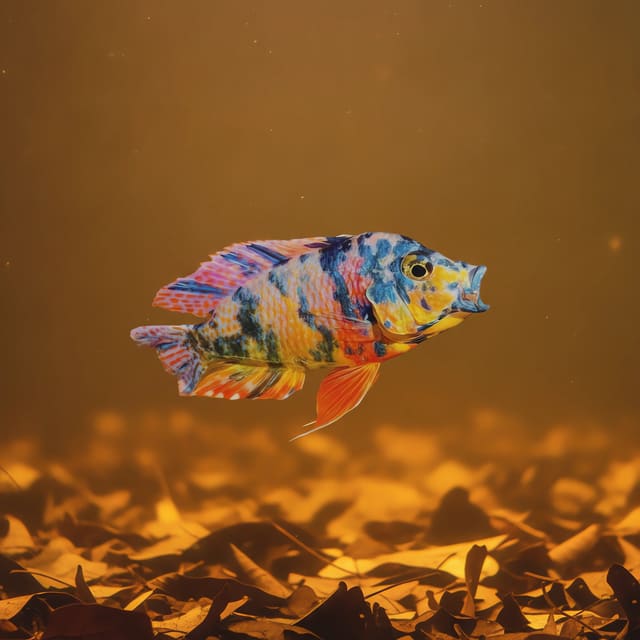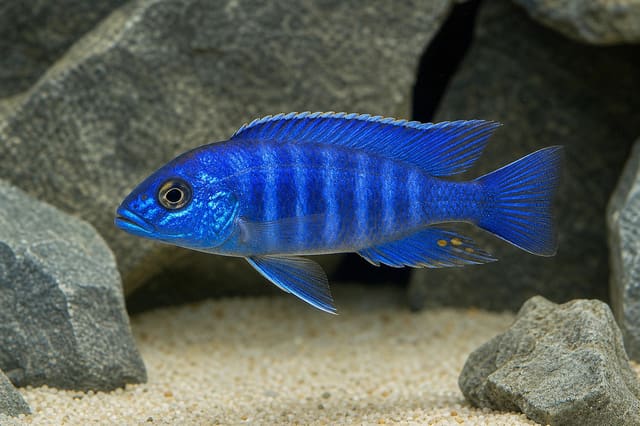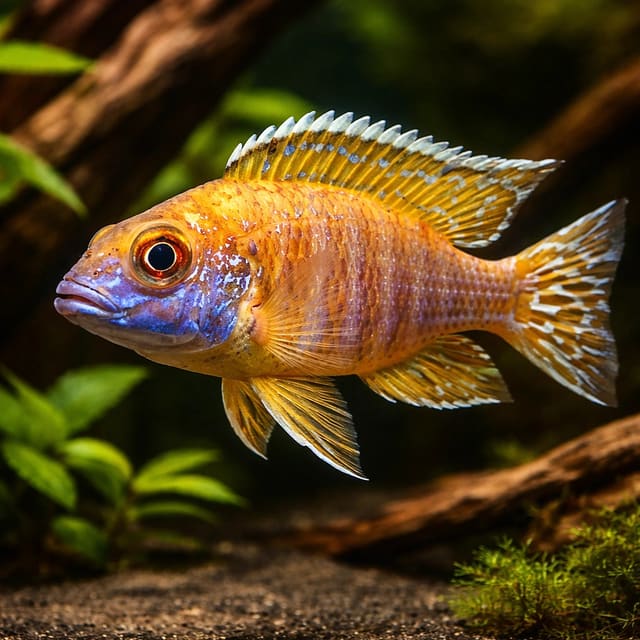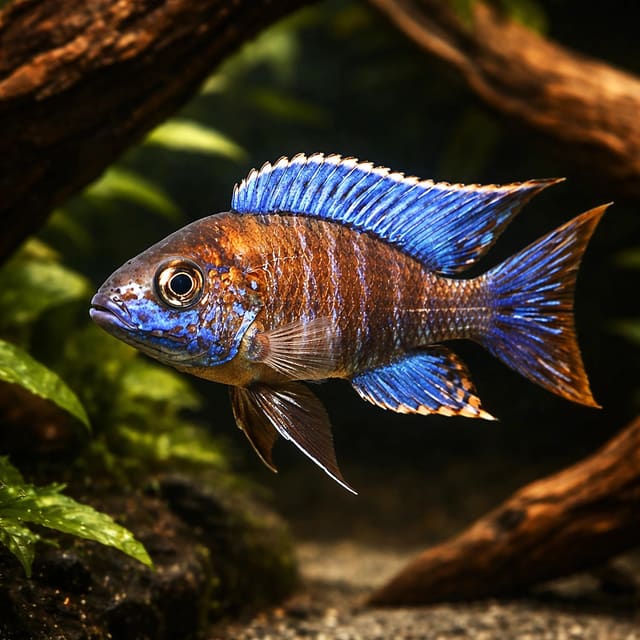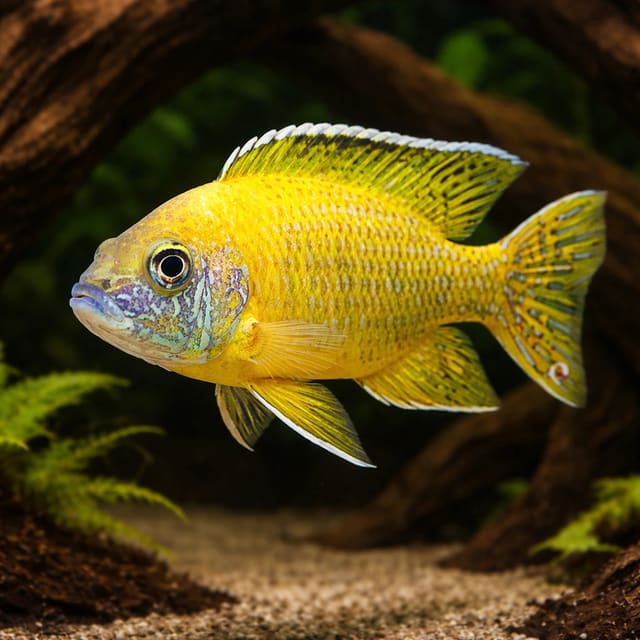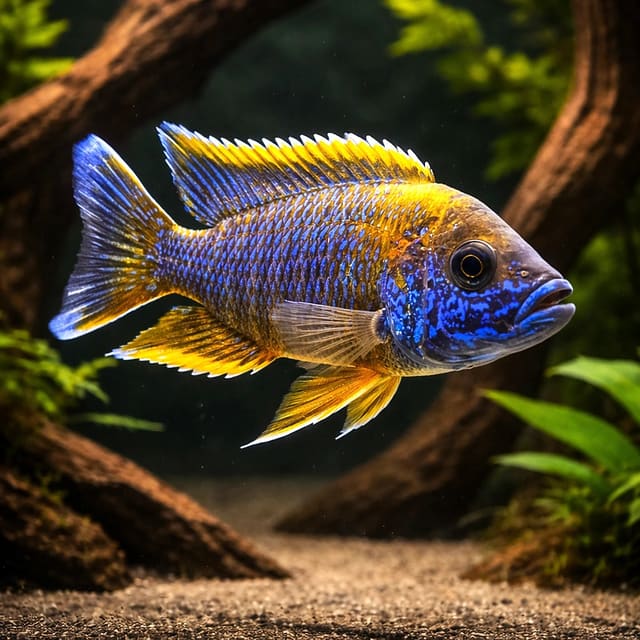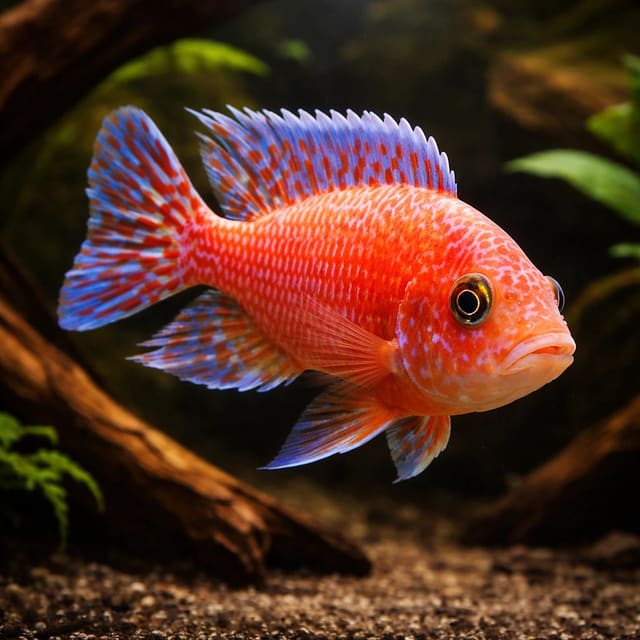
Firefish Peacock Cichlid (Aulonocara sp.)
23–27°C · pH 8–8.6
From £7.99Some sizes on sale
Photo coming soon
The size, price and care details on this page are for this listing.
The Albino Firefish Peacock Cichlid (Aulonocara sp.) is an aquarium-bred albino peacock, not a wild species. Each unit is one unsexed youngster at 3-4 cm or 4-5 cm. Give it a 120 cm Malawi tank with hard, alkaline water, fine sand, shaded rockwork and gentle lighting.
Aulonocara sp.
Save when buying multiple fish. Each quantity is one fish; sex and pair formation are not guaranteed unless the selected variant explicitly states them.
The Albino Firefish Peacock Cichlid (Aulonocara sp.) is an aquarium-bred albino peacock, not a wild species. Each unit is one unsexed youngster at 3-4 cm or 4-5 cm. Give it a 120 cm Malawi tank with hard, alkaline water, fine sand, shaded rockwork and gentle lighting.
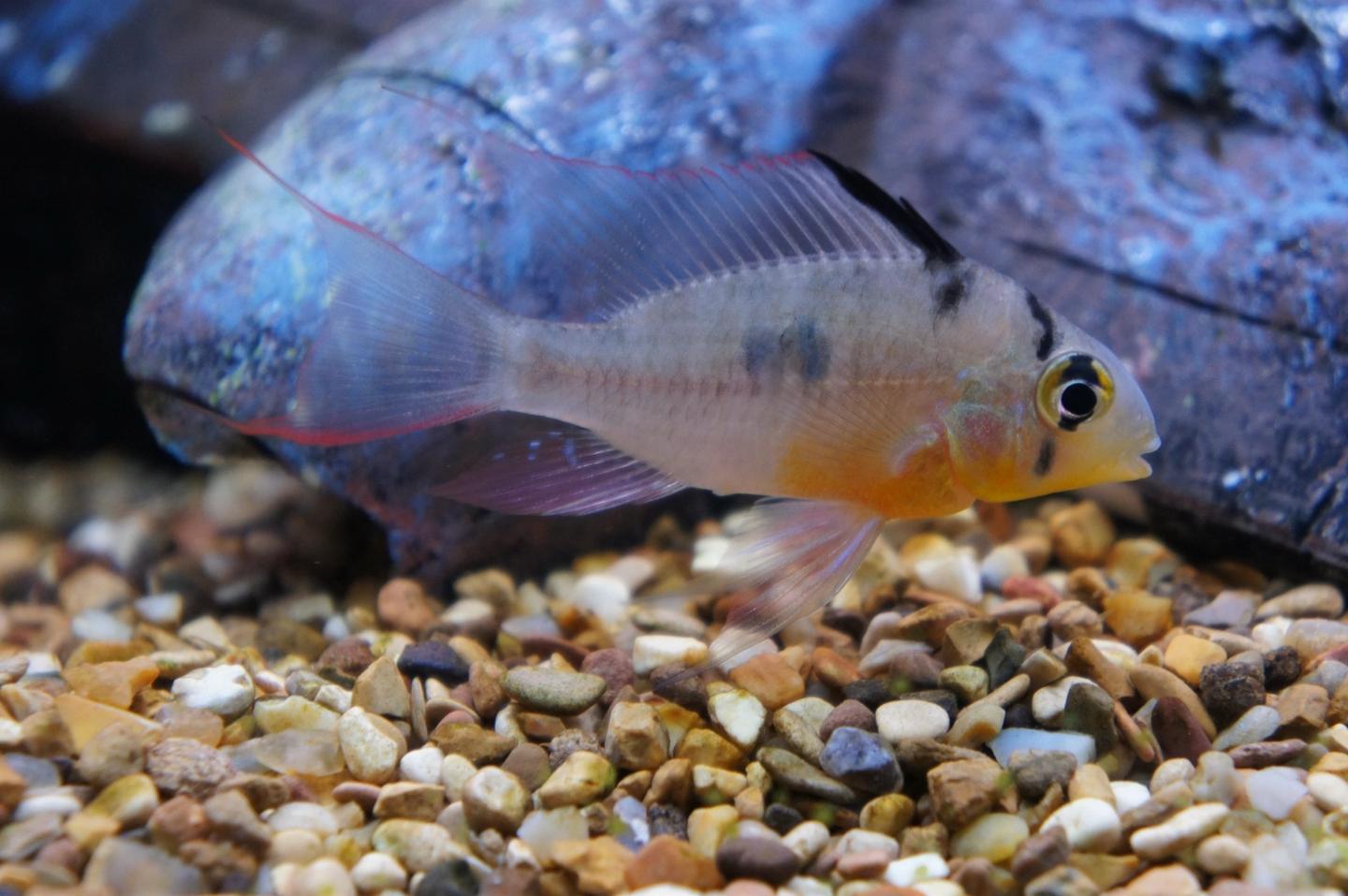
Cichlids are a family of roughly 1,800 accepted species, not one care type. Before buying, identify the exact species and source, then compare adult measurement, usable tank dimensions, social system, territory, tested water, diet and an exit plan. No family-wide minimum tank, water range or tank-mate list is safe.
Maintain these water conditions for optimal health and vibrant colors
This is a peacock cichlid bred in aquaria and sold under the trade name firefish, in this case as an albino: a fish born without the dark pigment that normally colours peacocks. It is sold as Aulonocara sp. because it is not a described species. Of the 22 Aulonocara species on FishBase, none carries the name firefish, and there is no wild population you could point to on a map. Treat it as what it is, a man-made aquarium form of a Lake Malawi genus, and keep it the way you would keep the wild peacocks it comes from.
| Quick fact | Albino Firefish Peacock |
|---|---|
| Name used | Aulonocara sp. (no species epithet: an aquarium form) |
| Genus home | Lake Malawi, East Africa |
| What you receive | One fish per unit, unsexed, at 3-4 cm or 4-5 cm |
| Planning size | Up to about 15 cm as an adult (no formal record for this form) |
| Tank | 200 litres minimum; a 120 cm long tank is the better choice |
| Water | 24-28 °C, pH 7.5-8.5, 10-20 °dGH |
| Diet | Omnivore: fine-grade cichlid food plus small frozen foods |
| Lighting | Moderate, with shaded areas; albino eyes are vulnerable to intense light |
You pick one of two sizes, 3-4 cm or 4-5 cm, and each unit is a single fish of that length at dispatch. These are young fish with most of their growth ahead of them. We do not sell them by sex, so they arrive unsexed. Seriously Fish notes that peacocks usually become sexable at about four months, which means that at the sizes we send, nobody can promise you a male or a female.
We have no gallery photos on this listing yet, so we will not describe a colour we cannot show you. What we can say with confidence is what albinism does to a fish, what the trade name does and does not mean, and how to look after a fish that combines the two. The rest of this guide sets that out.
Wikipedia defines albinism as the congenital absence of pigmentation; in mammals and many other vertebrates, the missing pigment is melanin, the one that gives black and brown tones. An albino fish therefore loses its dark markings, while other colours may remain. The most obvious giveaway is the eye. Because the iris holds no pigment, the colour of the blood in the retina shows through, so albino animals have eyes that look red or pink. On a pale juvenile those eyes are usually the first thing you notice.
Fish are more complicated than mammals here, because melanin is not their only pigment. Wikipedia points out that the usual melanin-based definitions of albinism ignore the several other pigments non-mammalian animals carry, and it describes zebrafish mutants that lack melanophores, the black pigment cells, yet still show silver and yellow colour from their other pigment cells. Reptiles without melanin can still be pale yellow, orange or red. So an albino fish is not automatically white: it is a fish without the dark layer, and whatever other colour it carries shows through more cleanly. The same article separates albinism from leucism, where melanin is at least partly missing but the eyes keep their normal colour. That gives you a simple check at home: a pale peacock with dark eyes is not an albino, while red or pink eyes are the albino signature.
Albinism is not peculiar to aquarium fish. Wikipedia describes it as reasonably common among the teleosts, the large group of bony fish that includes cichlids, and especially frequent in flatfish. The same article carries a photograph of an albino peacock cichlid labelled Aulonocara sp., and notes that intentionally bred albino strains of some animals are kept as pets. In the wild, though, the trait carries a cost: Wikipedia points out that albino animals lack the camouflage that helps others hide from predators.
"Firefish" here is a trade name for a peacock form, not a scientific one, and it is easy to confuse with something else entirely. The marine fish sold as the fire goby or magnificent fire fish is Nemateleotris magnifica, a small goby of Indo-Pacific coral reefs that Wikipedia gives a maximum length of 9 cm. It needs sea water and has nothing to do with this cichlid. If you came here searching for a fire fish from Lake Malawi, you are in the right place: this is a freshwater peacock cichlid for a hard-water Malawi aquarium.
If you would rather have a firefish with its normal dark pigment, we also list the Firefish Peacock Cichlid, and for another pale peacock form there is the Red Albino Peacock Cichlid. Read the section on tank mates before you think about keeping any of these together.
The one way an albino peacock differs from its pigmented relatives in daily care is light. Wikipedia's article on albinism records that albino vertebrates exposed to intense light typically lose photoreceptors, the light-sensing cells of the retina, through cell death. It also notes that albinism goes with abnormal development of the eyes. With no pigment in the iris, an albino eye has less protection from bright light than a normal one.
Peacocks are well equipped to find food without relying on sharp eyesight. Seriously Fish explains that they carry enlarged sensory pores on the head which help them detect tiny movements in the sand. Even so, keep an eye on a young albino at mealtimes in a busy tank and make sure it is getting its share. If quicker fish are taking everything, feed in two or three places at once or drop sinking food close to where the albino likes to sit.
The lack of camouflage that would be a problem in the lake has a practical side in the aquarium too. A pale fish is conspicuous, and in a crowded Malawi tank a conspicuous newcomer can attract attention. Give it plenty of broken cover, add it alongside other fish rather than on its own into a settled group, and watch the first few days closely.
Every Aulonocara species comes from Lake Malawi, which Wikipedia describes as a deep, clear, alkaline rift lake bordered by Malawi, Mozambique and Tanzania. Its surface water runs at 24-29 °C and pH 7.7-8.6, and it holds at least 700 cichlid species, nearly all of them endemic. Peacocks live at the meeting point of rock and sand, in what Seriously Fish calls the intermediate zones, and they feed by taking in mouthfuls of sand and sifting out small invertebrates, expelling the grains through the gills and mouth. An aquarium for an albino firefish should copy that border country.
It helps to picture the scale of the place. Wikipedia puts the lake at somewhere between 560 and 580 km from end to end and up to 75 km across, reaching 706 m at its deepest, with oxygen only in roughly the top 250 m. In good conditions you can see 20 m through the water, though visibility of just under half that is the norm. Hobbyists divide its cichlids broadly into the mbuna, small rock-dwellers that are often brightly coloured in both sexes, and the haps, a broader mix that includes the open-water utaka and bigger predatory fish. Peacocks are neither the rough-and-tumble mbuna nor the big predators, which is why they suit a calmer Malawi community.
There is no formal size record for this aquarium form, so we plan from the wild genus. FishBase lists Aulonocara species from 5.5 cm standard length up to 18 cm total length, with several, including A. jacobfreibergi and A. maylandi, at 15 cm total length. Seriously Fish gives 130 mm standard length for males of A. stuartgranti. A 3-4 cm youngster could therefore end up four times its arrival length, so we plan for an adult of up to about 15 cm and size the tank accordingly.
The OATA care sheet for Malawi cichlids sets a minimum of 200 litres for a community. Seriously Fish recommends a footprint of 120 by 45 cm, roughly 243 litres, for a group of a single peacock species. We would treat 200 litres as the lowest acceptable figure and steer you towards a 4ft tank. Length and floor area count for more than depth, because these fish live low in the tank and sort out their territories across the bottom.
Seriously Fish advises fine sand and explains why: gravel and small pebbles can stop a peacock feeding naturally, damage its gill filaments and be swallowed, with a risk of internal damage or blockage. OATA suggests coral sand or something similar, which also helps keep the water hard and alkaline. A thin to moderate layer is all a sand-sifter needs.
Seriously Fish suggests piles of rock with open sand between them; OATA asks for complex rockwork so individual fish can hold territories. For an albino, design those rock piles with deliberate shade: overhangs, caves and shadowed gaps. Leave some flat stones beside open sand, which Seriously Fish describes as typical peacock spawning sites. Seat the rocks on the bottom glass before adding sand so they cannot shift.
Plan for an oversized filter, strong aeration and a heater, as OATA recommends, and cycle the filter fully before any fish go in; Seriously Fish warns against stocking peacocks in a biologically immature aquarium. Choose a light you can turn down.
A Malawi peacock needs water quite unlike a soft-water community tank. The figures our care specification uses, and where they come from:
Seriously Fish describes peacocks as extremely susceptible to falling water quality and to swings in chemistry. In practice that means a stable tank slightly off the ideal is better than a perfect tank that lurches every weekend. Test weekly, as OATA asks, and keep a simple log of pH, nitrate and hardness so that you notice a drift before the fish do.
OATA's minimum is a 25% change every week. Seriously Fish suggests 30-50% weekly for the peacock species it profiles. Somewhere around a third each week is a realistic routine in a properly filtered tank. Dechlorinate the new water, match its temperature, and if your source water is soft, buffer it before it goes in rather than adding buffer to the tank afterwards.
Before buying, test the hardness of your tap water. If it is soft, coral sand helps, and crushed coral in the filter or a Malawi buffer can help too. Raise hardness and pH slowly over days, testing as you go, and have everything stable for a week or more before your fish arrive.
The filter bacteria are what keep ammonia and nitrite at zero. OATA's advice is to rinse filter media gently in water taken from the tank, never under the tap, because chlorinated water kills those bacteria. Avoid cleaning the filter on the same day as a big water change, so the tank is never disturbed on two fronts at once.
At 3-5 cm your albino firefish is a growing juvenile, and good feeding now shapes the adult it becomes. In Lake Malawi, peacocks sift the sand for small invertebrates; FishBase notes that A. stuartgranti feeds on invertebrates living in sand. Seriously Fish's aquarium advice for peacocks is a high-quality, fine-grade prepared food as the staple, backed up with small live or frozen foods such as bloodworm (chironomid larvae), Artemia and mosquito larvae.
Feed with the tank light on low or with the room light only, which makes mealtimes easier on the eyes. Sinking food suits a bottom-feeding peacock better than flakes left floating at the surface. In a mixed tank, check that the albino reaches the food at all; if livelier fish beat it every time, scatter food widely or feed a second portion near its favourite spot.
A healthy young peacock should come out for food readily and pick at the sand between meals. Loss of appetite is one of the earliest signs that something is wrong, either with the fish or with the water, so a fish that suddenly ignores food is worth a water test the same day. OATA's Malawi sheet also notes that larger Malawi species such as the utaka may need pellets with more animal content alongside frozen fare, which fits a peacock's naturally invertebrate-based diet as it matures.
Keep food fresh. Pellets lose quality once opened, so buy tubs you will use within a few months and keep them sealed and dry. Store frozen foods properly and never refreeze anything that has thawed.
Peacocks have a gentler reputation than many Malawi cichlids. Wikipedia's article on the genus calls them less aggressive than their mbuna counterparts and suggests other medium-sized, non-aggressive Malawi cichlids as companions. Seriously Fish describes the peacock species it covers as relatively peaceful, with one important exception: males act aggressively towards any fish with a similar colour pattern. Our care specification therefore lists the albino firefish as semi-aggressive. Expect a mature male to guard his patch firmly and to save his worst temper for look-alikes.
For a single peacock species, Seriously Fish suggests one male to four to six females, and OATA's general Malawi advice is to keep more females than males. Because we send these fish unsexed and young, a common plan is to start with several, grow them on together and keep the group balanced once their sex becomes clear at around four months. Have somewhere for spare males to go before they reach that point.
Seriously Fish names differently patterned Copadichromis, Placidochromis and Otopharynx lithobates, plus peaceful mbuna such as Labidochromis caeruleus. OATA's sheet adds that Malawi cichlids are best kept with other Malawi cichlids or with some species of Synodontis catfish. For an albino specifically, favour companions that are calm at feeding time, so the pale fish is not pushed off its food.
Put the sources together and a workable community for a 120 cm tank looks something like this: a group of young albino firefish grown on until you can settle on one male and several females, a small group of a peaceful mbuna such as Labidochromis caeruleus, and a few Synodontis of a species suited to Malawi water to work the bottom. If you want another hap-type cichlid, choose one from the genera Seriously Fish names that looks nothing like a pale peacock. Leave space in the plan; a Malawi tank that starts half full has room to absorb a surprise male or two.
OATA recommends adding Malawi cichlids as groups and putting the most peaceful species in first. Young albino peacocks are a good early addition to a new Malawi tank. If you are adding them to an established community, rearrange some rockwork on the same day so that resident fish have to re-establish territories and the newcomers are not walking into fixed boundaries.
If you would like a wild peacock species with a proper name as part of a separate display, the Steveni Blue Neon Peacock (Aulonocara stuartgranti) is one we list; keep it apart from your albino firefish if either is to breed.
A pale body has one advantage for the keeper: marks and damage are easy to spot. Get into the habit of a quick look at every fish at each feed. OATA's Malawi care sheet sets out what healthy looks like, namely bright, clear eyes, fins without tears, scales intact and no ulcers or lumps on the body. With an albino, judge the eyes by their clarity rather than their colour; red or pink eyes are normal for an albino and are not a sign of illness.
The same sheet lists the behaviours that should prompt a closer look: fins clamped against the body, flicking or rubbing against sand or decor, and shimmying, a shaking motion on the spot. It also asks keepers to watch for changes in swimming, colour, temperament, breathing rate, body condition and feeding response. In a peacock, rapid breathing near the surface usually means it is time to test the water and check the filter and aeration.
Because Seriously Fish describes peacocks as extremely sensitive to poor water and chemical swings, the first response to any of these signs is a full water test: ammonia, nitrite, nitrate, pH and hardness. A water change is often the most useful single action. Many medications affect filter bacteria, so do not add treatments until you know what you are treating, and ask us or a vet with fish experience if you are unsure.
Torn fins in a Malawi tank are more often the work of tank mates than of disease. Spend a few quiet minutes watching who chases whom. A fish that is constantly hiding, pinned to the surface or kept away from food needs more cover, a rearranged tank or a different home. For an albino, also check whether it spends all its time hiding from the light; if so, dim the lighting or add more shade.
Seriously Fish's warning about gravel is relevant here. Coarse substrate can damage the gill filaments of a fish that sifts it and can be swallowed. Fine sand avoids both problems, which is one reason we push it so firmly.
Since albino vertebrates under intense light tend to lose retinal cells, it is sensible to watch how your albino responds to your lighting. A fish that seems to bump into decor, misses food it should see, or hides for long periods after the lights come on may be telling you the tank is too bright.
Like every member of its genus, a peacock of this type breeds as a maternal mouthbrooder: Wikipedia states that all Aulonocara species brood their young in the female's mouth. Seriously Fish describes the process for the wild peacocks it covers. Males carry egg spots on the anal fin, which play a part in fertilisation; spawning takes place on flattish rocks beside open sand; and the female then carries the brood for up to four weeks before releasing fully formed, free-swimming fry. OATA gives 21-40 days for Malawi mouthbrooders in general.
Wikipedia notes that most forms of albinism follow a recessive pattern of inheritance. If this line follows that usual pattern, the outcome is predictable. Two albino parents produce albino young. An albino crossed with a normally pigmented fish usually gives normally coloured young that carry the albino gene hidden. Those carriers, bred together, would be expected to give a mix in which roughly a quarter are albino. We cannot test the genetics of this line for you, so treat that as the textbook expectation, not a promise.
Seriously Fish advises that newly released fry may still have some yolk left and need nothing until it has been used up; fry released with the yolk gone can take newly hatched Artemia nauplii straight away. OATA adds that Malawi mouthbrooder fry are larger than most fry and feed readily. Seriously Fish also mentions that some breeders strip the fry from the female at around two weeks; that is an experienced breeder's technique, and for most keepers leaving her undisturbed is the better choice. Albino fry should be raised under gentle light, for the same reasons as the adults.
Seriously Fish warns that most Aulonocara can hybridise, and this form has no recorded wild ancestry to begin with. If you breed albino firefish, pass the young on under the name they deserve, as albino firefish peacocks or albino peacocks, never under a wild species name. If you keep wild-type peacocks too, give them separate tanks. That way the next keeper knows exactly what they are buying, just as you do now.
Have the aquarium fully running before you order: filter cycled and established, water tested, heater set and temperature matched to the 24-28 °C range above. Please read our delivery and live-arrival information first; everything is on our delivery page. Plan to be at home on the delivery day, because someone has to be at the address to take in live fish.
We send your fish in bags filled with oxygen, packed inside insulated boxes, with heat packs added when the weather needs them. A tracked courier licensed to carry live animals brings them to your door, and you will receive an email with the confirmed delivery date and tracking.
Keep the parcel sealed and start filming. Our live-arrival policy needs one continuous video that begins on the unopened box and carries on, in the same take, until you have shown the fish inside their still-sealed bags. Should any fish arrive dead, dying or obviously compromised, send that video with your order number to hello@tropicalfishco.co.uk on the day of delivery. Photographs alone are not enough under the policy. We will then replace the affected fish with your next order or refund them, subject to the guarantee terms.
The two options are close together, so the choice is mostly about your tank. The 3-4 cm fish are the youngest we offer and a good way to start a group that grows up together, which suits a new aquarium where the albinos will be among the first residents. The 4-5 cm fish are a little more robust and a better pick if they are joining a tank that already holds other Malawi cichlids, because a few extra centimetres helps a newcomer hold its own. Neither size can be sexed yet, and both will need the full 120 cm tank in time.
Leave the light low for the rest of arrival day and keep the following days gentle. A young albino will probably head for the darkest cave it can find and may ignore food at first; offer a small amount the next day and remove anything left over. Through the first week, watch how it breathes, whether it starts eating and how it behaves around the other fish. Testing the water more often than usual in that first week, as OATA advises for new arrivals, catches any problem before it becomes serious.
After a week or two, most young peacocks are exploring the sand and taking food eagerly. From then on, the routine in this guide, steady hard water, fine sand, shaded rockwork and small regular meals, is what lets an albino firefish grow into a healthy adult.
The facts in this guide come from the sources below, all of which are worth reading before you set up a Malawi aquarium.
No reviews for this item yet. Bought one? Honest reviews only, good or bad.
What customers say about ordering from us
Easy website plenty of info on fish your buying great to pick a time slot
TRACEY DURRANT · 7 Oct 2026
Got some lovely fish thank you
Kevin Mackie · 7 Oct 2026
Reviews of our shop, collected by Judge.me, an independent third-party review collector. Newest first.