
Aquarium Filter Guide: Types, Sizing & Maintenance

Choose an aquarium filter by the animals' needs, the aquarium's actual water volume and waste load, the media and oxygenated flow it can sustain, and how reliably you can maintain it. Sponge, internal, hang-on-back and external canister filters can all work in the right system. A printed tank-size rating or universal turnover rule cannot prove suitability: install the complete filter, establish its biofilter, monitor real flow and water tests, and adjust from evidence.
An aquarium filter is part solids collector, part habitat for an attached microbial community and part water-moving device. Choosing one begins with the aquarium and its animals—not a brand leaderboard.
- List the planned animals at adult size, including their flow tolerance and intake risk.
- Calculate the aquarium's actual water volume, allowing for substrate, decor and the operating water line.
- Compare filter formats on usable media, working flow, placement, access, noise, leak paths and current instructions.
- Install the complete system, establish the biofilter before animals enter, and confirm circulation and surface movement.
- Judge capacity from water tests, animal behaviour and dependable real flow—not the carton alone.
If fish are breathing abnormally, several animals change behaviour together, or ammonia or nitrite is detected, go to When filtration may be failing. A different filter is not a substitute for immediate welfare action.
What does an aquarium filter actually do?
“Filter type” has two meanings that are often mixed together. Sponge, internal, hang-on-back and canister describe where the hardware sits and how water travels through it. Mechanical, biological and chemical describe jobs that media can perform.
| Function | What happens | What it can show you | What it cannot guarantee |
|---|---|---|---|
| Mechanical | Foam, floss, screens or similar media intercept suspended solids | Captured debris and changing flow resistance | Safe dissolved ammonia, nitrite or oxygen |
| Biological | Attached microorganisms process nitrogenous waste on oxygenated wet surfaces | Capacity can be challenged and monitored with water tests | A particular bacterial species, unlimited stocking or permanent stability |
| Chemical | A chosen adsorbent or ion-exchange medium targets certain dissolved substances | A purpose defined by the exact medium and instructions | A universal replacement for biofiltration or water changes |
| Circulation | The pump and outlet move water through media and around the aquarium | Surface movement, distribution and access to the filter | Biological capacity from litres per hour alone |
The Royal Veterinary College describes nitrifying microorganisms living principally on wet surfaces such as filter media and substrate.[4] Aquarium research also shows that the familiar “two named bacteria do everything” story is too simple: different ammonia- and nitrite-oxidising groups were important in the systems studied.[8][9][10] For a keeper, the useful question is not which genus a box promises. It is whether the established system processes the measured waste load.
Mechanical capture protects that process by keeping excessive solids from loading media and passages. Aquaculture engineering literature identifies surface area, oxygen, uniform water flow, void space and resistance to clogging as connected design constraints.[7] Those principles transfer; commercial production-system numbers do not become a home-aquarium recipe.
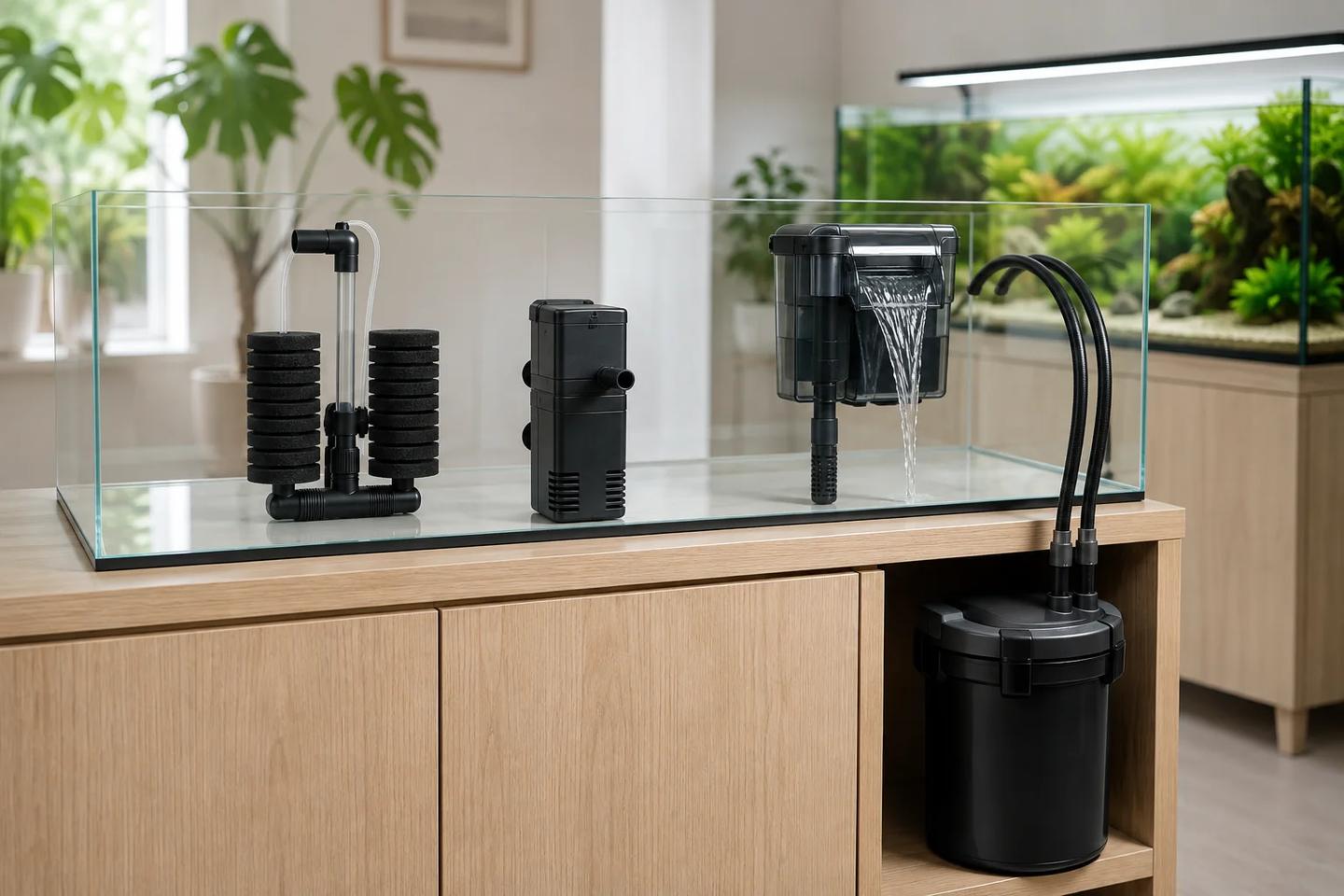
Aquarium filter types compared
No row below is a guaranteed tank-size band. Each format can be small or large, well designed or poorly matched.
| Hardware format | Often useful when | Main compromises to inspect | Maintenance access |
|---|---|---|---|
| Air-driven sponge | Gentle flow, guarded intake, breeding or support filtration is needed | Requires a suitable air pump; visible equipment; circulation may be local rather than tank-wide | Lift out carefully and clean the foam only as needed |
| Powered internal | Compact all-in-one installation and simple access matter | Occupies aquarium space; intake and outlet position can conflict with plants or resting areas | Usually direct, but disconnect before removal or opening |
| Hang-on-back (HOB) | Media access from above and an external body suit the tank rim | Clearance, lid fit, water level, restart behaviour and intake safety matter | Often convenient, provided the rear remains reachable |
| External canister | Larger configurable media space and hidden equipment are valuable | Hoses, lift, seals, priming, trapped air, cabinet access and leak detection add complexity | Less frequent access may be possible, but each service is more involved |
| Undergravel | The substrate bed is intentionally part of water movement and biological surface | Decor, roots and detritus management can make later changes difficult | Routine substrate care is part of filter care |
| Sump | A larger or specialist system benefits from open equipment space and staged treatment | Overflow design, return capacity, power-off water level, noise and flood margin must be engineered | Excellent access when safely designed; excessive for many small home systems |
The mobile UK result for “aquarium filter types” mixes advice, product pages, videos and image packs. The recurring user questions ask which type is “most effective” or “best”. A truthful answer is conditional: format follows the system's constraints. Product availability and prices change, so this guide does not invent a permanent winner.
Sponge filter or powered filter?
An air-driven sponge has a broad guarded intake and can create relatively gentle movement, but “gentle” depends on air rate, lift-tube design and placement. A powered internal or HOB can move water more directly through staged media, but its intake and jet may need guards or adjustment for small animals, long fins or quiet-water species. Do not choose from the label alone; inspect the actual intake openings and the movement throughout the aquarium.
Internal or external filter?
An internal unit reduces external hoses and keeps a possible leak within the tank, but it uses swimming or planting space. A canister can provide flexible media volume outside the tank, but every hose, seal, tap and cabinet connection becomes part of the maintenance and leak-check system. The canister is not automatically “better”; it exchanges visible tank equipment for external complexity.
One large filter or two smaller filters?
Two independent units may improve distribution or preserve some circulation while one is serviced, but this is not automatic redundancy. They can share one power circuit, both can be undersized or poorly placed, and neither has verified capacity merely because two are present. If using two, record what each contributes, keep both maintained, and avoid cleaning or replacing all established media together.
How to choose an aquarium filter
Use these seven questions in order.
1. Which animals will live there at adult size?
Flow tolerance, oxygen needs, body shape, fin length, behaviour and the risk of fry, shrimp or snails entering an intake all matter. Start with reliable species requirements. Do not buy a filter for a generic “community” and decide the animals afterwards.
2. What is the actual operating water volume?
External dimensions overstate water volume because glass, substrate, decor, equipment and the gap below the rim occupy space. Measure internal dimensions and operating depth, then treat the result as an estimate rather than false precision.
Tank Volume Calculator
Enter length, width, and height to get your real water volume in litres.
Open tool →Volume helps compare equipment but does not describe waste. Two tanks holding the same litres can have very different feeding, adult biomass, temperature, oxygen demand and debris.
3. What waste load should the system process?
Consider adult stocking, food type and amount, growth, digging behaviour, plant debris and the keeper's maintenance. MSD Veterinary Manual notes that carrying capacity depends partly on filtration capacity that can be evaluated through water-quality testing.[5] This is why an attractive clear tank or a printed “up to” volume is not proof.
4. What media is usable in the real filter?
Look beyond an empty case volume. Ask:
- Is there accessible coarse mechanical media before easily clogged fine or biological media?
- Can established biological media remain in place while the clogged part is serviced?
- Does water pass through the media rather than around it?
- Are replacement consumables compulsory, or can durable media be maintained as instructed?
- Can you obtain current seals, impellers, sponges and other service parts?
More surface area can support more attached organisms, but very fine media can clog and lose uniform flow. The best media arrangement balances contact, oxygenated flow and serviceability.[7]
5. What flow reaches the aquarium after installation?
Nominal turnover is:
printed litres per hour ÷ aquarium litres
That calculation is useful for comparing claims, but it is not a biological-capacity test. Media, dirt loading, hose diameter, bends, lift from cabinet to tank and outlet hardware can all change working flow. Manufacturers also use different test conditions. Avoid the old universal “4–6×”, “10× for messy fish” or “buy 1.5× the tank rating” rules unless the exact livestock and equipment instructions independently justify them.
Instead, confirm:
- the unit is operated within its current manual and head-height limits;
- the intake and return create useful distribution without trapping or blasting animals;
- surface movement and any additional aeration suit the setup;
- debris is not collecting everywhere beyond the filter's reach;
- flow remains observable as media loads;
- ammonia and nitrite remain appropriately controlled under the actual feeding and stocking plan.
6. Can it be installed and maintained safely?
Measure the tank rim, lid, cabinet openings, hose path and the space needed to remove media trays. A filter that fits only until its first service is a poor fit. Use the exact manual for water level, priming, cable routing, drip loops, dry-running limits and disassembly. Keep plugs and sockets dry and disconnect equipment before approved user maintenance. HSE guidance describes an RCD as useful additional protection, not protection from every electrical fault.[12] If the installation, cable or socket is questionable, stop and use qualified help.
7. Can you verify and respond to performance?
Before adding animals, establish the complete biofilter and prove its processing capacity. OATA describes filter maturation, recurring tests and cautious stocking rather than treating installed hardware as readiness.[2] The dedicated fish tank nitrogen-cycle guide owns that test-led process. After stocking, retain a simple baseline: normal return appearance, sound, water level, temperature, ammonia, nitrite and the animals' behaviour. A changed baseline tells you more than somebody else's calendar.
Installing for useful flow and safer access
Follow the filter manual first. These observation checks do not override it.
| Check | What to look for | Why it matters |
|---|---|---|
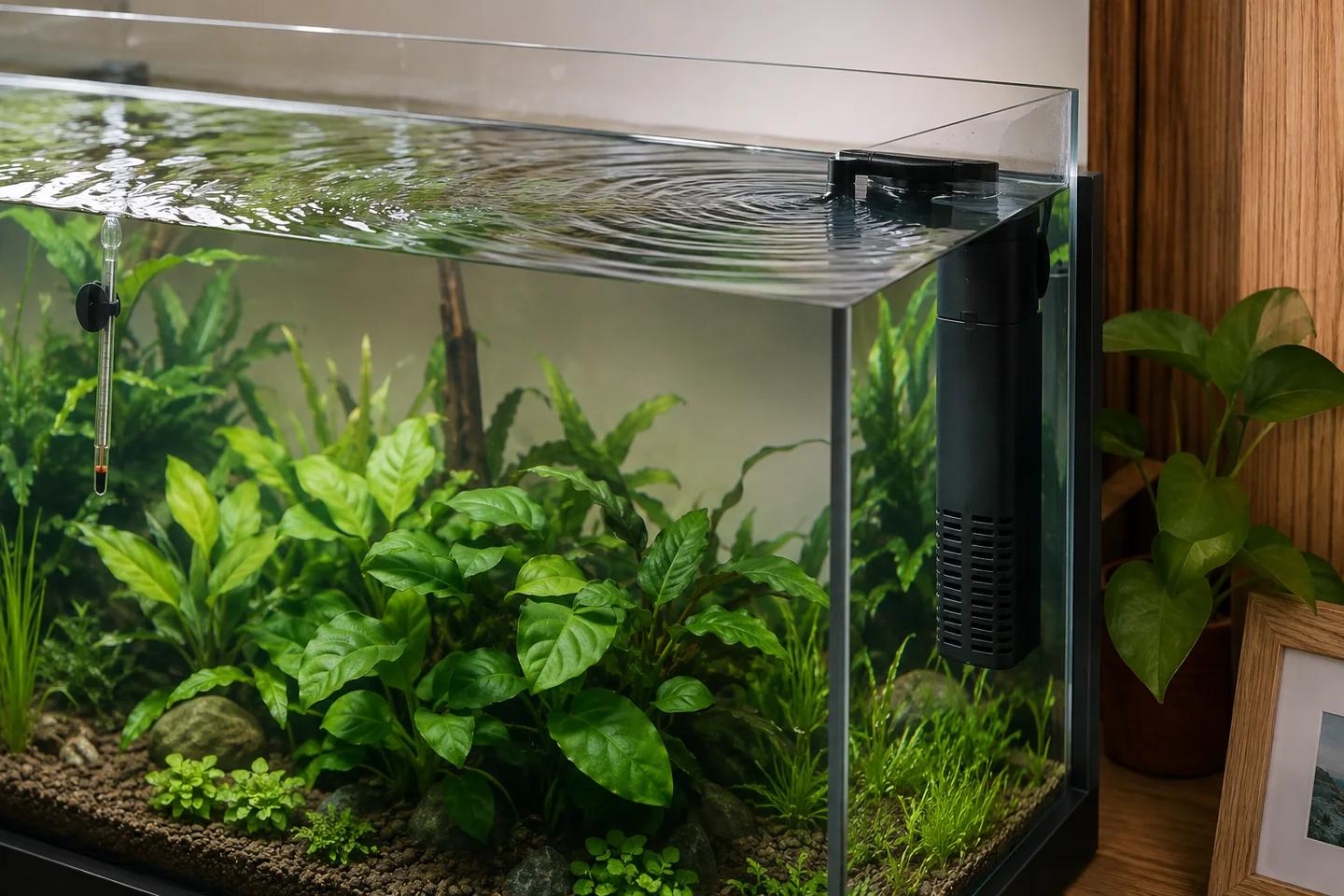
| Intake | Clear of leaves and substrate; suitably guarded for intended animals | Reduces blockage and entrainment risk |
| Return | Visible movement without an unsuitable jet or dry splash | Helps verify circulation and surface exchange |
| Whole-tank path | No persistent dead area caused by decor, while quiet refuges remain where species need them | Distribution must fit both filtration and behaviour |
| Water level | Within the unit's operating range | Some formats lose flow, become noisy or fail to restart at the wrong level |
| Service clearance | Media, impeller cover and hoses can be reached without moving the aquarium | Makes necessary care more likely and safer |
| External connections | Dry, supported and observable; cabinet has a safe power-off water margin where relevant | Makes leaks, siphoning and overflow risk easier to detect |
Surface ripples are evidence of movement, not a dissolved-oxygen measurement. Temperature, animal load, plants, air-water contact and the biofilter itself affect oxygen demand. OATA notes that beneficial filter organisms favour oxygenated areas with greater water movement.[3] Use observation and appropriate testing rather than promising that one outlet position fixes every aquarium.
Media order and chemical media
Many filters work best when coarse mechanical media meets dirty water before easily blocked fine or biological media. The exact direction and tray order differ, so copy the manual rather than a generic diagram.
Biological media
An established biofilm grows on all suitable wet surfaces, not only branded rings. Protect it from drying, prolonged oxygen loss, untreated disinfectant and unnecessary wholesale replacement. Do not chase “spotless” media: remove the obstruction while preserving working surfaces.
Fine mechanical media
Fine floss can polish suspended particles but loads quickly. If it repeatedly collapses flow, reduce the amount, improve coarse prefiltration or address the source of debris. Do not let cosmetic clarity compromise circulation.
Activated carbon, resins and zeolite
These media have defined, finite tasks. Check what the exact product binds, its freshwater suitability, exhaustion or replacement instruction, and any interaction with medicines. Remove or replace it when directed. Never present carbon as routine biological capacity, and do not repeat the unsupported claim that every saturated carbon product “leaches toxins back”.
Aquarium filter maintenance without a risky calendar
Maintenance should be condition-led within the manufacturer's schedule. MSD includes filter flow in regular aquarium checks and recognises that all filter systems require maintenance.[6] The interval changes with feed, animals, plants, prefiltration, media and filter design.
A practical observation rhythm
- Each day you view the aquarium: confirm the return looks and sounds normal; check animals, temperature, leaks and water level.
- At routine water testing: compare ammonia, nitrite and other relevant results with the aquarium's established baseline.
- When flow drops or debris loads: service the intake and mechanical stage identified by the manual.
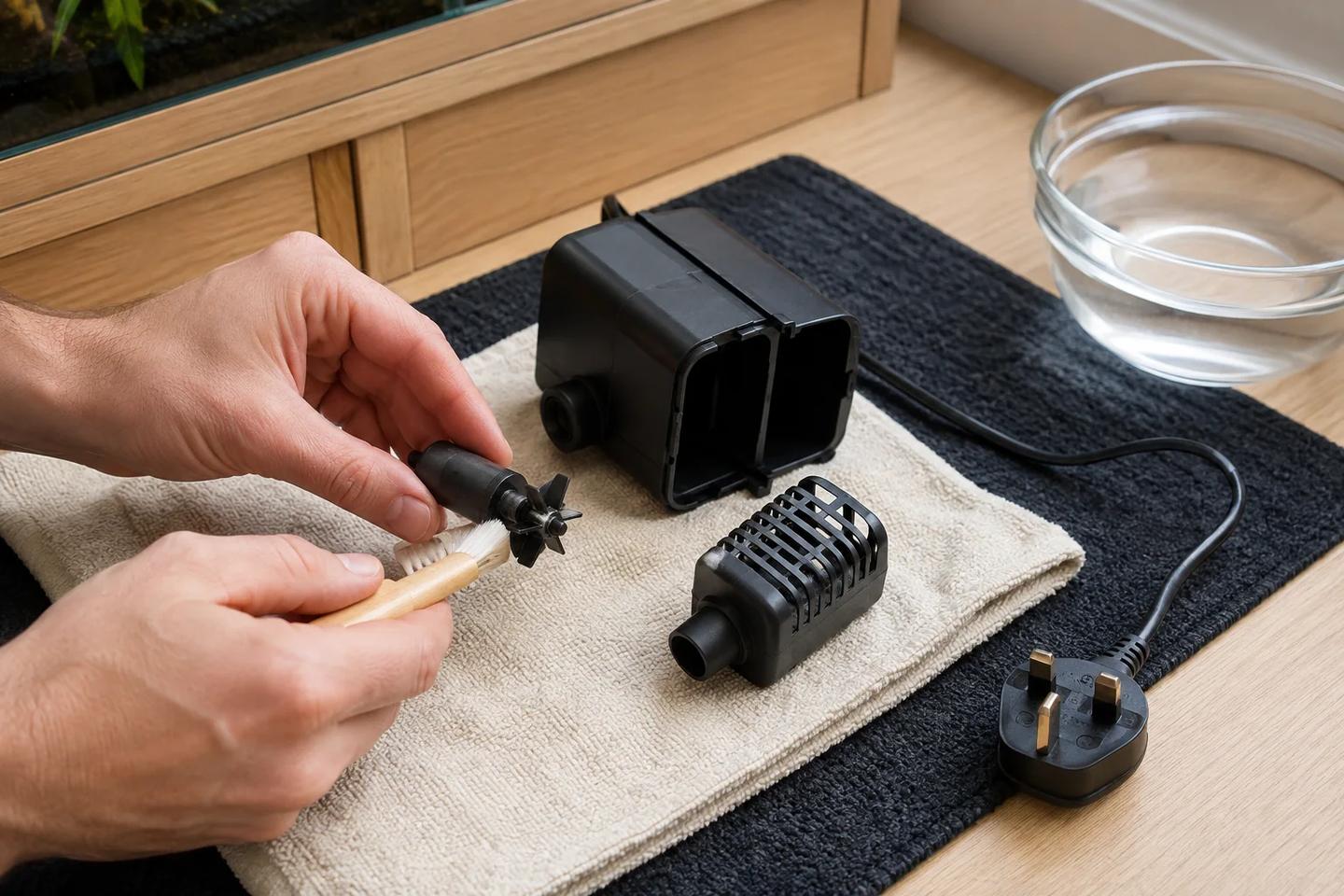
- At the unit's stated interval or when symptoms point there: inspect user-serviceable impeller, hoses, seals and air paths.
- After a material change: run the system, confirm there is no leak or abnormal sound, and retest water rather than assuming success.
Cleaning established media
- Prepare tools and suitable rinse water before stopping the filter.
- Disconnect the unit as its instructions require; keep electrical connections dry.
- Keep established biological media wet and avoid leaving it stagnant longer than necessary.
- Clean only the blocked or debris-loaded parts. A gentle squeeze or swish is different from sterilising the media.
- RSPCA and OATA guidance recommends aquarium water removed during a water change for established media.[1][3] If additional water is required, use appropriately conditioned, temperature-compatible water according to current product guidance.
- Do not replace every established biological stage together. If a part is damaged or a product requires replacement, retain other functioning media where the design safely permits.
- Reassemble exactly, prime if required, restore power, inspect flow and leaks, and monitor water results.
This means a careful filter clean can happen during a partial water change. The old claim that the two must always be on different days was unsupported: RSPCA specifically describes swishing media in water removed during maintenance.[1] The real risks are excessive simultaneous disruption, untreated water, drying, incorrect reassembly and failing to test after a large change.
UK tap water and filter media
The Drinking Water Inspectorate states that residual disinfectant in England and Wales may be free or combined chlorine, and that the amount and form can vary.[11] MSD notes that chlorine and chloramine are toxic to fish and necessary aquarium bacteria.[5] That supports avoiding untreated tap water on established biological media; it does not prove an “instant kill” time or one conditioner dose. Identify your supplier, read the current water report, and follow a conditioner that covers the actual source water.
Low flow, noise and other filter symptoms
Disconnect powered equipment before approved inspection. Never run a water-cooled pump dry, force a sealed part or improvise an electrical repair.
| Symptom | Check first | Do not assume |
|---|---|---|
| Return flow has weakened | Water level, intake guard, prefilter, loaded mechanical media, kinked hose and permitted impeller access | That the biological stage is “too dirty” and should all be replaced |
| Rattle or grinding | Trapped air, seating, debris and wear described in the manual | That every sound is a worn impeller |
| HOB will not restart | Required water level and priming process | That repeated dry running is harmless |
| Canister leaks | Stop safely; inspect hose taps, seals, seating and damage according to the manual | That overtightening or lubricant not specified by the maker is safe |
| Particles remain visible | Source of debris, flow path, coarse and fine mechanical stages | That clear water would prove safe chemistry |
| Water is cloudy | Test water; review a recent setup, feeding, disturbance or media change | That cloudiness identifies one bacterial species or will clear on a fixed day |
| Fish avoid the outlet | Species needs, outlet direction and available calm areas | That maximum movement is always healthier |
| Fish gather at the surface | Treat as a welfare warning; check aeration, temperature, equipment and water promptly | That buying a larger filter is the only response |
If abnormal noise persists, a cable is damaged, a motor overheats, water reaches an electrical connection or a leak cannot be controlled, stop using the device and contact the manufacturer, retailer or a competent professional.
Power cuts and stopped filters
There is no evidence-based universal “30 minutes safe, 31 minutes dead” rule. Oxygen consumption and stagnation depend on filter design, media, organic loading, temperature, interruption duration and whether water or air continues to move. Nitrification is aerobic, so restoring safe oxygenation matters.[7]
During an interruption:
- Confirm whether the problem is the filter, the socket or the wider supply without exposing anyone to electrical risk.
- Prioritise safe aeration and animal observation; warm, heavily stocked systems may lose oxygen faster.
- Keep established media wet. Where the design and manual allow, avoid leaving it sealed in heavily loaded stagnant water.
- Do not add animals or extra food while capacity is uncertain.
- When supply returns, inspect the unit and follow its restart or priming instructions. Do not repeatedly dry-run a pump.
- Test ammonia and nitrite, record the interruption and monitor the animals and water over the following period.
For a long outage, abnormal smell from trapped filter water, repeated ammonia or nitrite, or distressed animals, seek experienced aquarium or veterinary help. The correct response depends on the exact system; blindly pouring stagnant canister water back, sterilising all media or replacing everything can compound the problem.
When filtration may be failing
Clear water does not rule out ammonia, nitrite, low oxygen or another water-quality problem. OATA explicitly warns that much aquarium pollution is invisible.[3] If several fish breathe rapidly, gather at the surface, become unusually still, lose equilibrium, or change together:
- Check the filter return, aeration, temperature and power immediately.
- Test ammonia and nitrite with a valid method and record analyte, unit and time; check pH and temperature for context.
- Stop adding livestock and remove obvious dead material without dismantling the whole biofilter.
- Make appropriately conditioned, temperature-compatible partial water changes guided by confirmed results and animal needs, then retest.
- Preserve working wet media and restore appropriate flow or temporary aeration safely.
- Contact an aquatics-capable vet or experienced specialist promptly for distress, repeated detections, several affected animals or uncertainty.
Replacing the whole filter can remove the established biofilm exactly when the aquarium needs it. Protect the animals, verify the water and equipment, preserve functioning media where safe, and solve the measured cause.
A filter-selection worksheet
Use this before comparing products. It turns “What is best?” into an answerable brief.
| Question | Your evidence |
|---|---|
| Actual operating water volume | Internal length × width × water depth, adjusted for displacement |
| Planned animals at adult size | Species, number, behaviour, flow tolerance, intake risk |
| Expected waste pattern | Feeding, adult biomass, digging, plant debris |
| Required filter functions | Mechanical stage, established biological stage, any defined chemical task |
| Installation constraints | Rim, lid, cabinet, hose lift, socket, service clearance, noise |
| Candidate working limits | Current manual, media path, flow controls, head limits, dry-run and restart instructions |
| Verification plan | Fishless maturation method, water tests, normal-flow baseline, leak and maintenance checks |
Keep the completed worksheet with the unit model and manual. If the aquarium changes, review the brief: larger animals, heavier feeding, new plants or rearranged decor can change flow and load without changing the glass volume.
What the old version got wrong
The previous guide looked decisive because it used exact numbers. Several were not supportable across real aquariums:
- It prescribed one 1.5× tank rating and fixed 2–3×, 4–6× or 10× turnover bands without equipment- or species-specific evidence.
- It called named products the “safest UK choices”, supplied volatile price bands and predicted no-brand failures without verified comparative testing.
- It said untreated tap water kills all filter bacteria “instantly”, rather than explaining variable disinfectant and safe media handling.
- It claimed bacteria suffocate after 30 minutes and imposed a 30–60 minute power-cut deadline.
- It said two species do all nitrification and that almost all useful bacteria live only in the filter.
- It prescribed fixed cleaning and carbon-replacement calendars, called sponges permanent and claimed saturated carbon releases contaminants back.
- It warned never to clean a filter during a water change, although cited UK welfare guidance uses removed aquarium water for that job.
- It used invented first-person experience, brand advocacy and unsupported price and reliability claims.
- Its generic planted-tank hero was shared by three other queued pages and did not show filter choice or care.
Those claims are removed. The replacement gives a repeatable way to choose, install, verify and maintain a filter while leaving model-specific instructions to the manufacturer and animal-specific needs to the relevant care evidence.
Related guides
- Fish Tank Nitrogen Cycle: A Test-Led UK Guide — establish and verify the biological filter before stocking
- How to Set Up a Tropical Fish Tank — choose the animals, site the aquarium and sequence the complete setup
- Aquarium Water Parameters — interpret ammonia, nitrite, nitrate, pH, GH and KH in context
- Aquarium Temperature Guide — match temperature to species and understand oxygen-related trade-offs
- How to Acclimate New Fish — plan transfer only after the receiving system is ready
See installation checks and safe impeller access
Frequently asked questions
Browse our UK live-fish range
From this article straight into the catalogue.
Beginner Fish
The best tropical fish for beginners UK — hand-picked easy-care species that thrive with minimal fuss. Perfect starter community tank candidates.
Community Tank Fish
Peaceful tetras, rasboras, corydoras, platies and gouramis chosen to live together — temperament, adult size and water range per listing so the mix works.
Tetras
Premium Tetras for sale UK — Cardinal, Ember, Black Neon, Rummy Nose, Serpae, Diamond, Glowlight and more. Peaceful community schoolers.
Betta Fish
Halfmoon, plakat, koi, giant and wild-type Betta splendens, males and females, tail type and size stated per listing. Bagged singly, live arrival covered.
Guppy
Fancy guppies bred for colour — Moscow, Cobra, Dumbo ear and Endler lines as males, females or pairs. Hardy in UK tap water; live arrival guarantee.
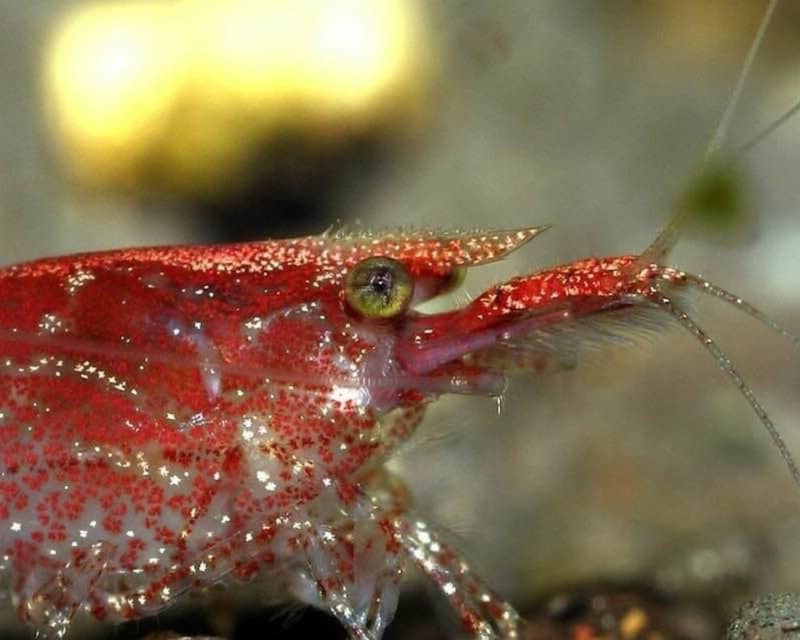
Cherry Shrimp
Red, blue, yellow, black and Rili cherry shrimp (Neocaridina) graded per listing, with mature-tank and water guidance so a new colony settles and breeds.
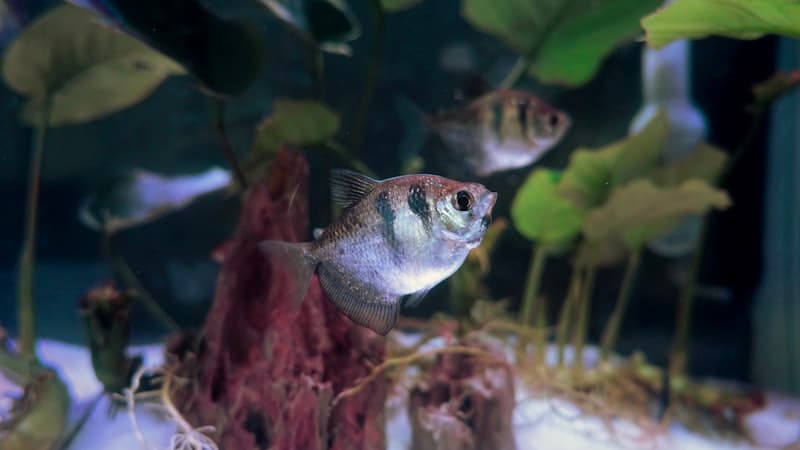
Corydoras
Shop current Corydoras catfish listings in the UK. Compare scientific identity, size and sale unit, with price and availability shown per product.
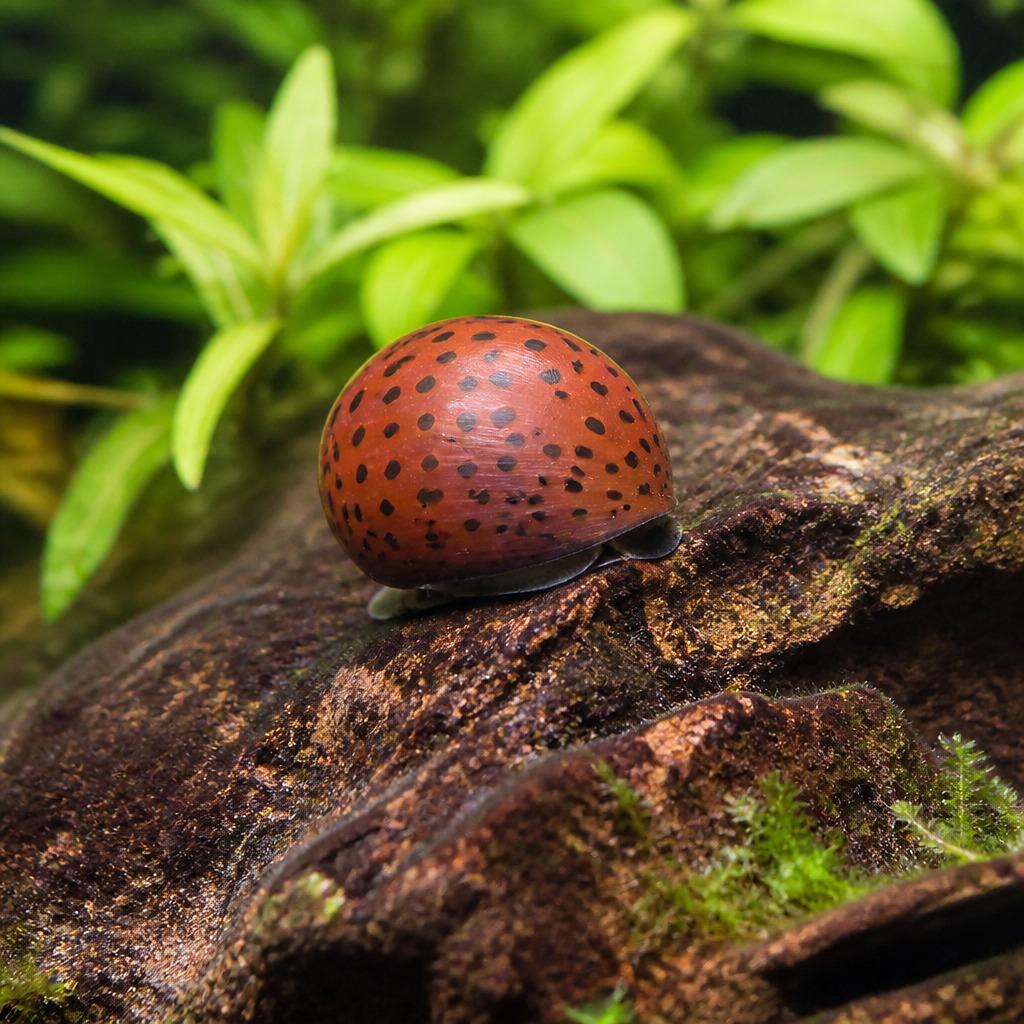
Freshwater Snails
Shop freshwater aquarium snails in the UK. Compare current species, adult size, water needs, diet, breeding risk, compatibility, prices and availability.
Sources & further reading
Material factual claims cite the sources below; store policy and cautious inference are labelled in the article. Sources are grouped by type so you can judge their weight at a glance.
Peer-reviewed study (3)
- [8]Hovanec, T. A. & DeLong, E. F. (1996). Comparative analysis of nitrifying bacteria associated with freshwater and marine aquaria. Applied and Environmental Microbiology 62(8), 2888–2896. DOI: 10.1128/AEM.62.8.2888-2896.1996. View source
Primary aquarium research showing that a familiar two-species explanation does not reliably describe the ammonia oxidisers in every aquarium biofilter.
- [9]Hovanec, T. A., Taylor, L. T., Blakis, A. & DeLong, E. F. (1998). Nitrospira-like bacteria associated with nitrite oxidation in freshwater aquaria. Applied and Environmental Microbiology 64(1), 258–264. DOI: 10.1128/AEM.64.1.258-264.1998. View source
Primary evidence associating Nitrospira-like organisms with nitrite oxidation in the freshwater aquarium systems studied; not a home test for microbial identity.
- [10]Sauder, L. A. et al. (2011). Aquarium nitrification revisited: Thaumarchaeota are the dominant ammonia oxidizers in freshwater aquarium biofilters. PLOS ONE 6(8), e23281. DOI: 10.1371/journal.pone.0023281. View source
Study showing ammonia-oxidising archaea can be important in established freshwater biofilters, further limiting simplistic universal microbe claims.
University extension (1)
- [7]Masser, M. P., Rakocy, J. & Losordo, T. M.. Principles of Water Recirculation and Filtration in Aquaculture. Southern Regional Aquaculture Center. View source
Current Texas A&M AgriLife resource hub linking the named SRAC engineering publication used for media surface area, dissolved oxygen, uniform flow, clogging, solids removal and interacting sizing variables. Production-system figures are not copied into home-aquarium rules.
Veterinary reference (3)
- [4]Royal Veterinary College Exotics Service (2024). Aquarium Health: The Nitrogen Cycle. Royal Veterinary College. View source
Veterinary overview of waste accumulation, attached nitrifying microorganisms and partial water changes. It supports preserving an established biofilter but not a fixed filter-size multiplier.
- [5]Francis-Floyd, R. & Petty, B. D. (2026). Providing a Home for Fish. MSD Veterinary Manual. View source
Veterinary guidance that aquarium carrying capacity depends partly on filtration capacity verified through water-quality testing, and that chlorine or chloramine in municipal water is toxic to fish and necessary aquarium bacteria.
- [6]Francis-Floyd, R. & Petty, B. D. (2026). Routine Health Care of Fish. MSD Veterinary Manual. View source
Veterinary maintenance reference covering observation, water testing, filter-flow checks and regular servicing across filter types. Product-specific replacement instructions still take precedence.
Animal-welfare charity (1)
- [1]Royal Society for the Prevention of Cruelty to Animals. Creating a Good Environment for Fish. RSPCA. View source
UK welfare guidance for maintained filtration, biological and mechanical functions, conditioned replacement water, checking the impeller, water testing and fishless cycling. Its stocking and maintenance examples are treated as guidance, not universal values.
Trade-body guidance (2)
- [2]Ornamental Aquatic Trade Association. How to set up and look after a freshwater tank or aquarium. OATA. View source
UK trade-body guidance for filter maturation, gradual stocking, recurring water tests and adjusting water-change frequency to stocking and other conditions.
- [3]Ornamental Aquatic Trade Association. How to test water quality in your freshwater tank or aquarium. OATA. View source
UK source for invisible water-quality problems, oxygenated biofilter surfaces, ammonia and nitrite monitoring and gently washing media in removed aquarium water rather than untreated tap water.
Government / regulatory (2)
- [11]Drinking Water Inspectorate. Chlorine. Drinking Water Inspectorate. View source
Explains that residual disinfectant in England and Wales may be free or combined chlorine and can vary by supply and maintenance conditions. It is not an aquarium conditioner or dosing source.
- [12]Health and Safety Executive (2025). Work using electrically powered equipment. Health and Safety Executive. View source
General electrical-safety source for suitable equipment, condition checks and the limited additional protection of an RCD. It does not replace domestic electrical advice or a filter manual.
Spotted something that needs a fix?
Fishkeeping moves fast and we want every guide spot-on. If you think something here is wrong, out of date, or could be clearer, tell us — our team reads every message and updates the page.
Suggest an edit
Tropical Fish Co Editorial Team
Evidence-led aquarium editorial team
The Tropical Fish Co editorial team compiles care guidance from the sources cited on each page, separates published evidence from practical husbandry policy, and checks retail links against the current catalogue. First-hand experience is included only when a named contributor and the observation have been verified.
Related care guides
How to Set Up a Tropical Fish Tank: 10 Safe Steps
Choose the intended fish before the aquarium, place the tank on a suitable level support, install a filter and thermostatic heater, condition and test the water, then complete a fishless cycle. Add fish only after the chosen maturation process reaches its defined endpoint and repeated tests show zero ammonia and zero nitrite; elapsed days alone do not prove readiness.
Aquarium Water Parameters: What to Test and Why
There is no universal set of perfect freshwater aquarium parameters. Identify the animals, learn what the test and unit actually report, establish your local source-water baseline, and compare repeat measurements. In an established aquarium, a confirmed ammonia or nitrite detection needs investigation; pH, GH, KH, temperature and nitrate decisions depend on the species, life stage and whole system.
Live Aquarium Plants for Beginners: 7 Easy Picks
For a first low-tech planted aquarium, start with one or two correctly labelled lower-demand species, match their mature size to the tank, keep the rhizomes of Java fern and Anubias above the substrate, and change only one lighting or feeding variable at a time.