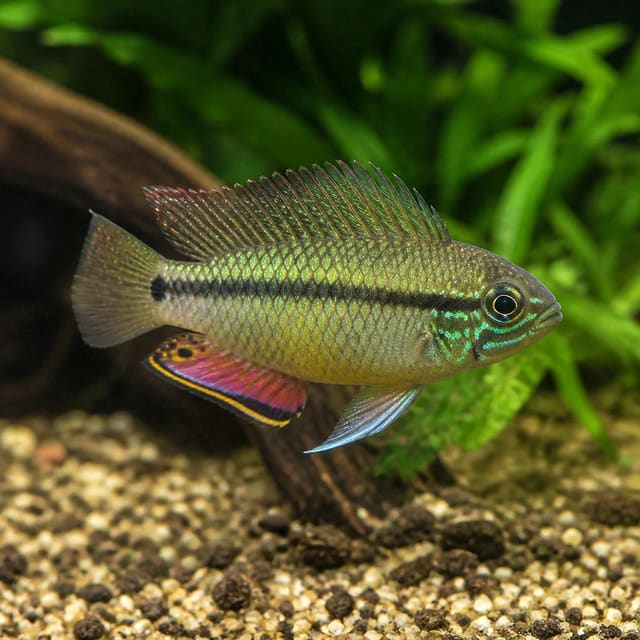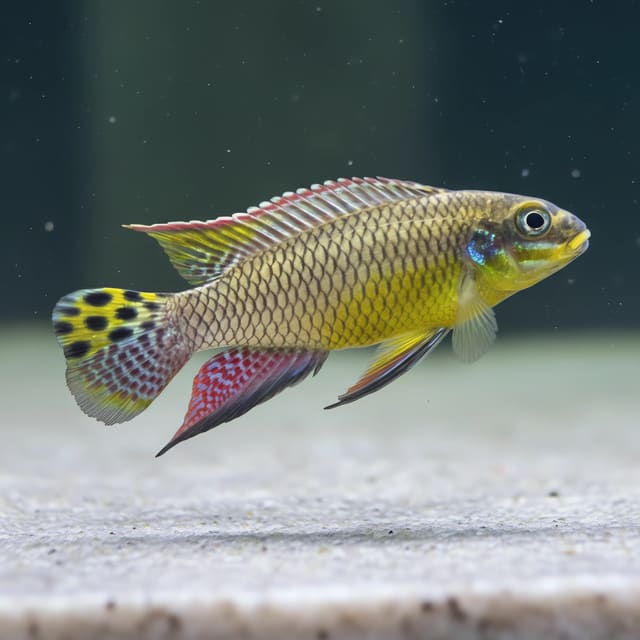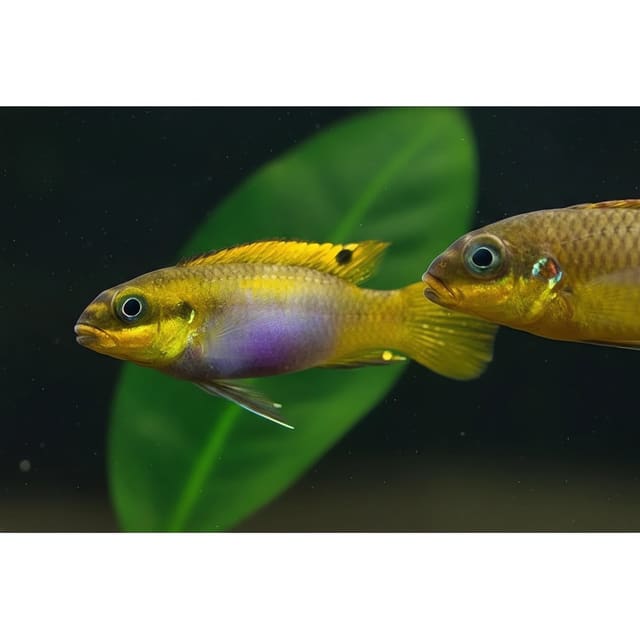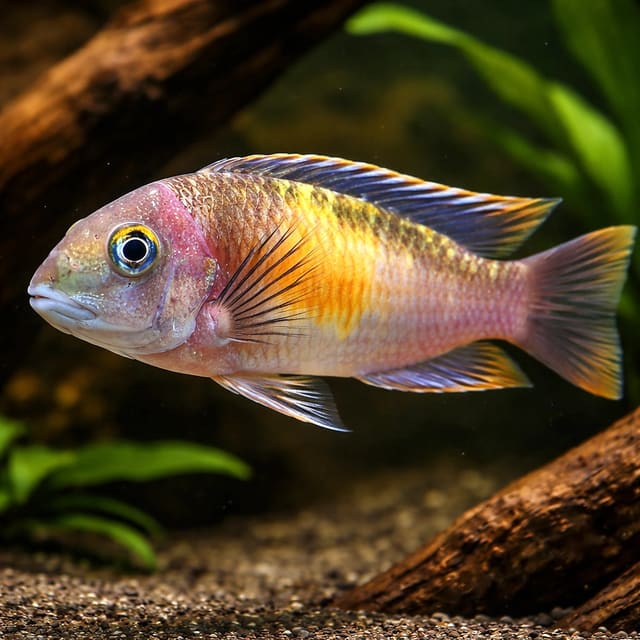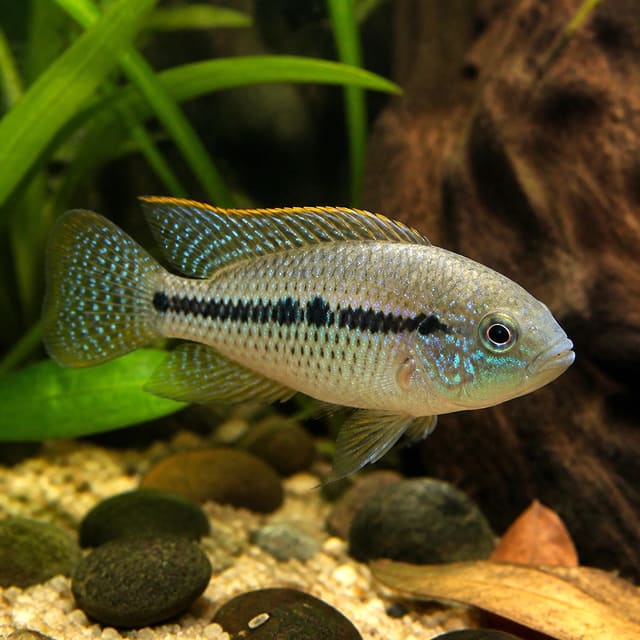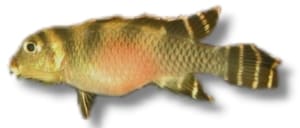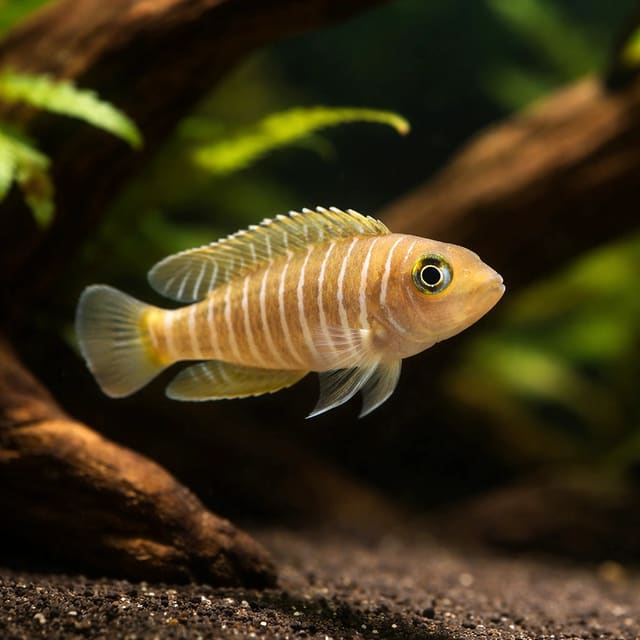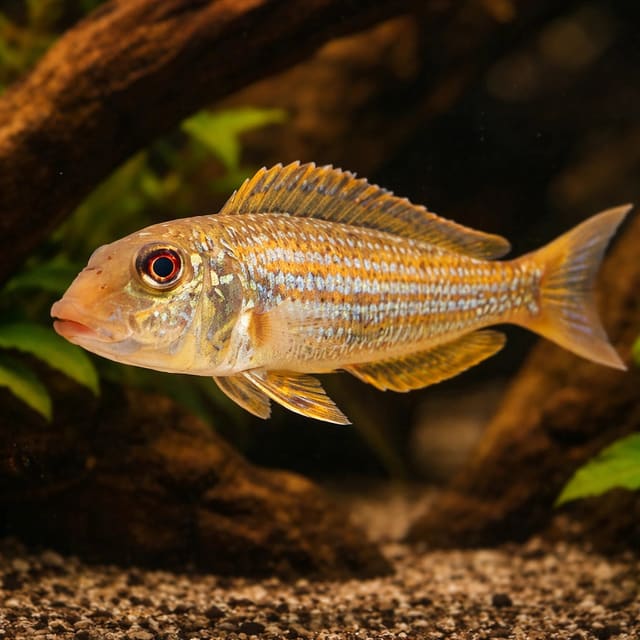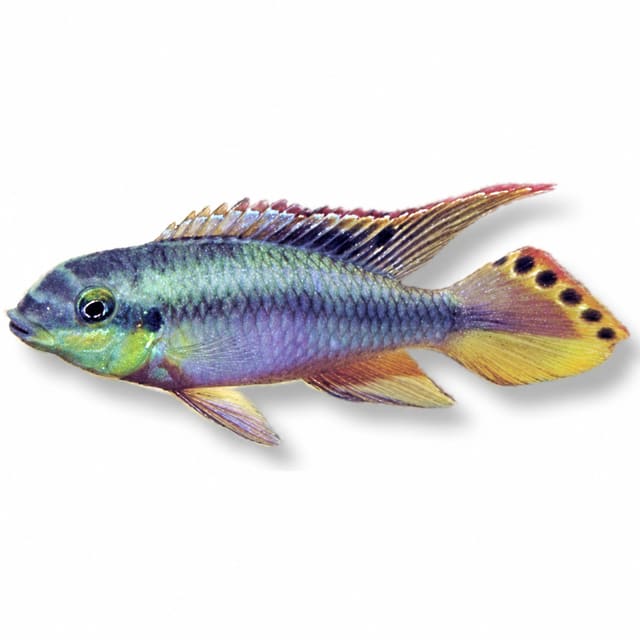
Common Krib Blue, Dwarf Rainbow (Pelvicachromis pulcher)
24–27°C · pH 5–7.5
£14.99
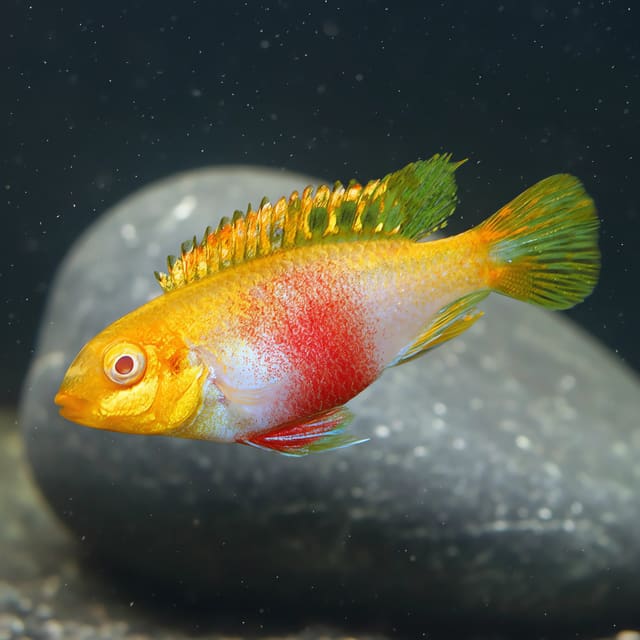
The Common Krib Gold-Albin is a pale golden form of Pelvicachromis pulcher. One purchase supplies one 3-4 cm fish; sex is not guaranteed. Plan a mature, well-covered aquarium with caves, calm companions and extra care around breeding territory.
Adult size is the maximum length this species reaches at full maturity (scientific sources). The livestock you receive will be younger and smaller. Product-photo provenance and any image-specific limitations are stated on the listing.
Pelvicachromis pulcher
Save when buying multiple fish. Each quantity is one fish; sex and pair formation are not guaranteed unless the selected variant explicitly states them.
The Common Krib Gold-Albin is a pale golden form of Pelvicachromis pulcher. One purchase supplies one 3-4 cm fish; sex is not guaranteed. Plan a mature, well-covered aquarium with caves, calm companions and extra care around breeding territory.
Adult size is the maximum length this species reaches at full maturity (scientific sources). The livestock you receive will be younger and smaller. Product-photo provenance and any image-specific limitations are stated on the listing.
Cichlids are a family of roughly 1,800 accepted species, not one care type. Before buying, identify the exact species and source, then compare adult measurement, usable tank dimensions, social system, territory, tested water, diet and an exit plan. No family-wide minimum tank, water range or tank-mate list is safe.
Maintain these water conditions for optimal health and vibrant colors
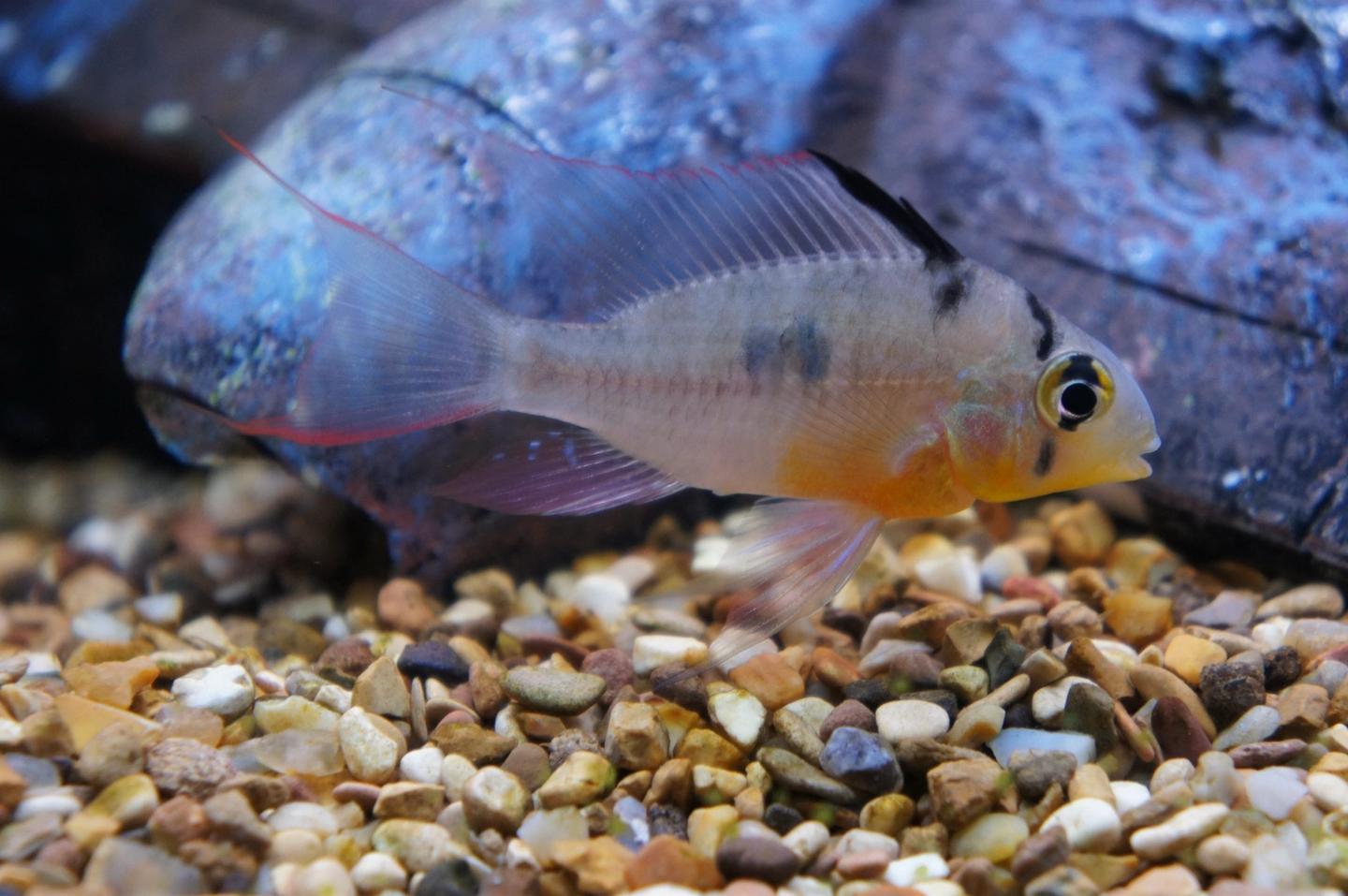
The Common Krib Gold-Albin is the pale golden aquarium form of Pelvicachromis pulcher, the familiar West African dwarf cichlid often called the Kribensis or simply the krib. The accepted species name is Pelvicachromis pulcher; “gold-albino” describes the trade form and is not part of the scientific binomial. Its cream-to-gold appearance differs from the darker standard form, while the practical husbandry remains that of the same cave-oriented cichlid.
One purchase supplies one live fish at the supplier’s 3-4 cm dispatch grade. The dispatch measurement describes the young fish supplied, not its eventual adult measurement. FishBase records a maximum of 11 cm total length for male or unsexed fish, while the Seriously Fish profile gives 100 mm standard length. Standard length stops at the base of the tail; total length includes the tail.
Sex is guaranteed only when the selected option explicitly states male or female. This Common Krib Gold-Albin listing has no sex-guaranteed option. Colour, size and the gallery cannot be used to promise sex, and buying two unsexed fish does not guarantee that they will become a compatible pair. If your aim is a pair, build the aquarium so each fish can retreat, and be ready to separate fish that do not settle together.
This is a small cichlid with a large amount of behaviour. It explores the lower aquarium, checks caves and sheltered edges, and may become much more assertive when a spawning site is chosen. It suits a keeper who wants an observable, characterful fish and can manage territory.
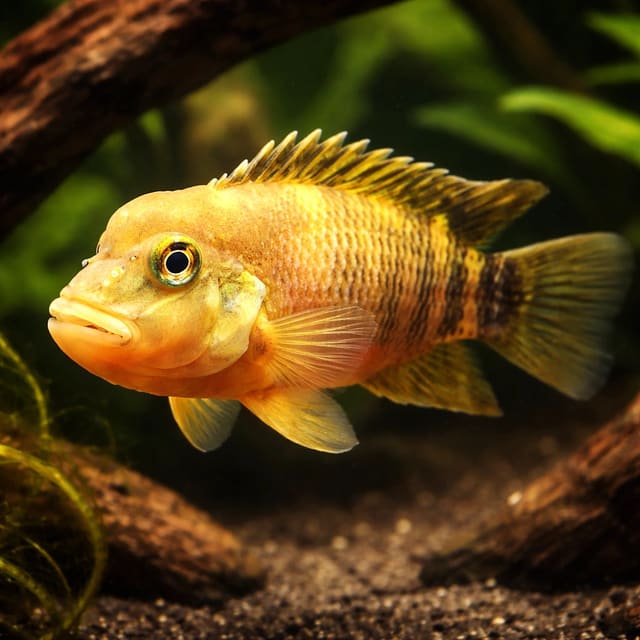
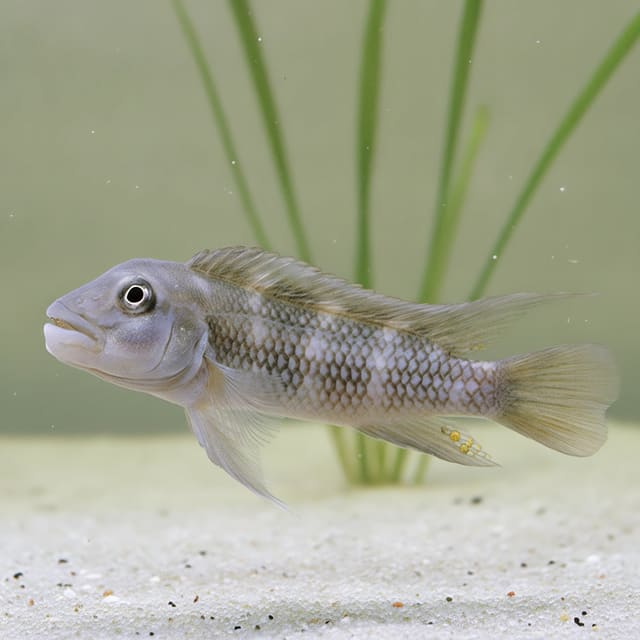
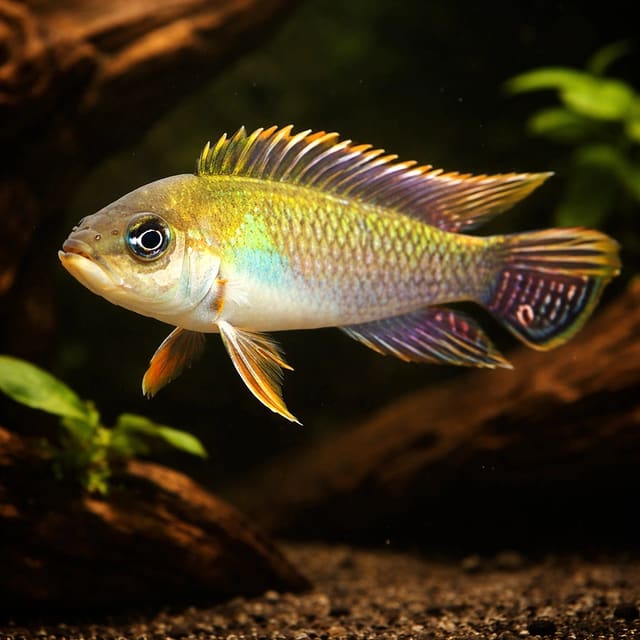
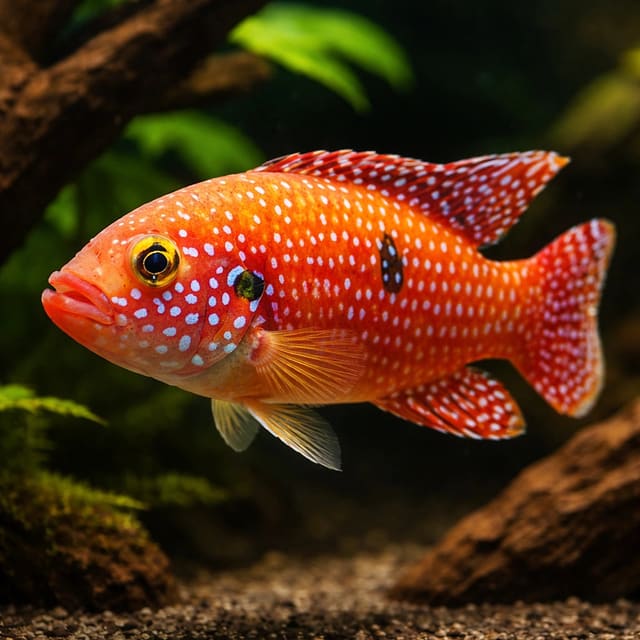
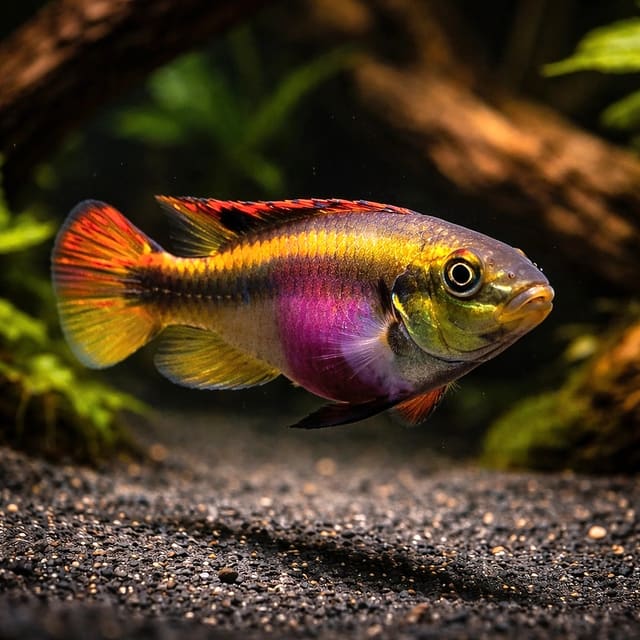
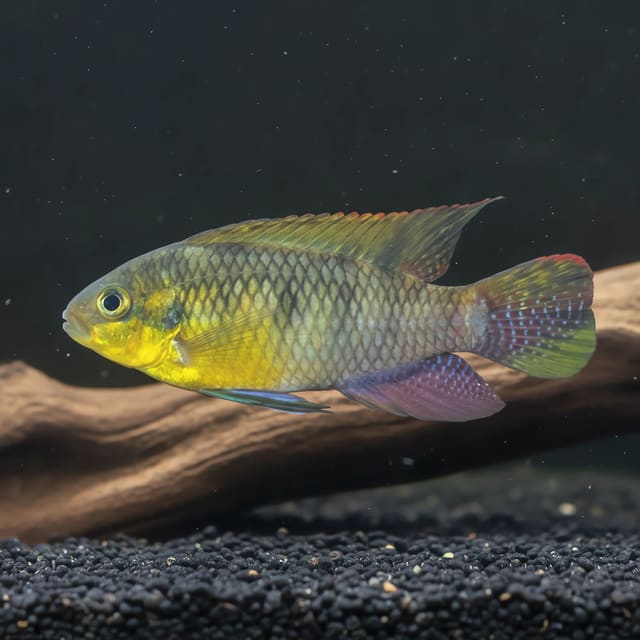
Gallery images have been digitally enhanced to improve image quality. Natural colour, pattern, size and maturity can vary between live animals.
A good home starts with floor space, cover and a mature biological filter. Seriously Fish describes a 60 x 37.5 x 30 cm aquarium, about 71 litres, as suitable for a single pair. FishBase gives an 80 cm minimum aquarium length, while OATA’s broader dwarf-cichlid guidance says at least 80 litres is needed when these fish share a community. Those measures are useful together: litres alone do not show whether the fish have enough horizontal territory.
Aim for 24-27 °C, pH 5.0-7.5 and 0-12 dGH as the species-level aquarium range given by Seriously Fish. Stability matters more than chasing one “perfect” point inside the range. Measure the source and aquarium water, make changes gradually, and use the aquarium water guide if pH, GH and KH are unfamiliar.
Build the lower level with fine gravel or sand, roots, wood, plants and more than one potential cave. Leave open feeding space, but break direct sight lines so a chased fish can get out of view.
This gold krib can be a manageable first dwarf cichlid for a keeper who understands the nitrogen cycle and is prepared for territorial behaviour. The care routine itself is straightforward: stable warm water, a quality staple food, measured variety, regular testing and sensible maintenance. The judgement comes in social planning. A fish that is shy in open water can still defend a cave vigorously, particularly once a pair or spawning site forms.
Choose this fish if you can offer cover, a suitable footprint and a plan for conflict. Reconsider if the aquarium contains very vigorous large fish, several territorial bottom dwellers, or tiny fish that cannot be moved when breeding behaviour intensifies. A peaceful appearance in a shop is not a permanent promise of behaviour in every home.
For a wider view of related livestock, browse the current African cichlid collection. The related-product field below holds the specific alternative products; they are comparisons, not automatic tank-mate recommendations.
The Common Krib spends much of its time close to the substrate and around structure, so usable territory matters. The species profile’s approximately 71-litre single-pair aquarium is a practical minimum for a genuinely compatible pair, not a promise that any two fish will coexist in that volume. FishBase’s 80 cm minimum length is a helpful reminder to look at footprint as well as nominal capacity. If other fish are added, OATA’s 80-litre broad community starting point still needs to be adjusted for their adult size, activity and use of the bottom.
Start with a fully cycled aquarium. A tank is ready because tests show that the established filter can process waste, not because a certain number of calendar days has passed. Ammonia and nitrite should remain at zero. Nitrate, temperature and pH should be monitored often enough that you notice a trend before the fish show distress. The RSPCA notes that a functioning biological filter is essential because it supports bacteria that convert toxic ammonia and nitrite into the less harmful nitrate stage.
If this is your first livestock aquarium, work through the first tropical tank guide before ordering. Add fish gradually so the filter’s bacterial population can adjust to the extra waste. Overstocking or adding too much livestock at once can overwhelm a filter even when the aquarium previously tested well.
Plants are not essential to the species profile, but they add cover and help a shy fish move between sheltered areas. Tough rooted plants, plants attached to wood and floating cover can all be useful. Expect some local digging near a chosen cave and protect delicate roots accordingly.
For routine aquarium care, use the species profile's 24-27 °C, pH 5.0-7.5 and 0-12 dGH range. This is aquarium guidance for Pelvicachromis pulcher, rather than a number copied from a our stock records. FishBase records a broader pH and hardness envelope from species records and a narrower 24-25 °C tropical value; those records are useful biological context, but the species profile gives the clearer day-to-day aquarium recommendation.
Do not adjust pH by repeatedly dosing against the buffering capacity of the water. Test GH and KH as well as pH before deciding whether a change is needed. When tap water differs from the established aquarium, prepare replacement water consistently and avoid sudden elective swings. The water parameter matcher can help compare measured values with the stated guidance, but it does not replace testing or observation.
Temperature should be checked with a separate thermometer, not inferred only from the heater dial. Position the heater where water movement distributes warmth without creating a harsh current through the fish’s main resting area. Stable warmth and good oxygen exchange matter; “calm water” never means stagnant water.
OATA’s group-level sheet gives 22-27 °C, pH 6.0-8.0, 4-12 dGH and 3-10 dKH for dwarf cichlids as a broad group. It also calls for zero ammonia and nitrite and advises keeping nitrate no more than 20 mg/l above the normal tap-water level. These figures are useful background for maintenance, while the species-level range above remains the direct target for this fish.
Test after any unusual event: a filter interruption, overfeeding, a dead plant, a large stock change or unexplained behavioural change. If ammonia or nitrite is detectable, treat it as a water-quality problem needing prompt action rather than waiting for the next routine maintenance day.
Pelvicachromis pulcher accepts a broad aquarium diet. Seriously Fish recommends a good-quality cichlid pellet as the staple, varied with live and frozen foods. OATA’s dwarf-cichlid guidance also supports quality flake or granules with small live or frozen items such as daphnia, brine shrimp or tubifex. The useful principle is a complete staple plus sensible variety, not a menu made entirely of rich treats.
Offer a measured portion that the fish can finish within a few minutes. Watch where food falls: a krib often feeds low in the aquarium, and fast mid-water fish can take the share before it reaches the intended fish. Sinking or slowly sinking pieces can help, but uneaten food should not be left to decay around caves. Excess food becomes waste, and waste increases the load on the biological filter.
Use body condition and feeding response as trends. A fish that suddenly refuses food, loses condition or is repeatedly driven away may be stressed, unwell or socially excluded. Check water first and observe the whole aquarium rather than reaching immediately for additives or medication. Colour-enhancing food is not required to prove the gold form, and no food can guarantee an exact shade.
OATA recommends a partial water change of about 25% at least weekly as a broad starting routine for dwarf cichlids. Actual frequency should respond to testing, feeding, stocking and filter performance. Use a siphon to remove waste from open substrate while leaving the fish’s chosen cave stable unless it creates a safety problem. New water should be temperature-matched closely and treated for chlorine or chloramine before it enters the aquarium.
Check filters for reduced flow and blockages. When media needs cleaning, rinse it gently in removed aquarium water rather than tap water, which can harm the bacteria the filter depends on. Do not replace all mature media at once unless the manufacturer’s safety instructions require it. A filter can look mechanically clean while the aquarium is biologically unstable, so testing remains part of maintenance.
Inspect the fish during ordinary care. Clear eyes, intact scales, open fins, regular breathing and a reliable interest in food provide a useful personal baseline. Warning changes include hanging at the surface, unusual sitting, erratic swimming, rapid or slow gill movement, darker or paler colour, increased hiding or aggression, white spots, fluffy growth, damaged fins, weight change and loss of appetite. These signs do not diagnose a disease; they tell you to test water and obtain competent help.
Small regular tasks are safer than dramatic corrections. Record test results if your source water changes seasonally. Clean one part of the system at a time, preserve established biological media and make elective chemistry changes gradually.
FishBase describes pair bonding, cave spawning and substrate brooding, and its aquarium note says the species is kept in pairs. Seriously Fish also recommends pairs, but adds an important practical warning: buying one male and one female does not guarantee a compatible bond and can leave an unwilling fish exposed to aggression. This listing does not guarantee sex, so the customer must not treat two purchases as a promised breeding pair.
Provide several candidate caves before adding fish. Clay pots placed safely on their sides, purpose-made caves, coconut shells, roots and wood can all create shelter. Arrange entrances so one dominant fish cannot watch every refuge at once. Fine substrate is helpful because the fish may excavate pits around the chosen site.
When a compatible pair spawns, territorial defence can extend well beyond the cave. Parents may guide fry around the lower area and drive other fish away. That behaviour is fascinating, but it changes the community’s usable space. A tank mate that was tolerated for months can become unwelcome near eggs or fry. Plan separation space before it is needed rather than assuming the community will absorb the change.
Sexual differences described for the species are context, not an offer promise. Seriously Fish notes that males are generally larger with more pointed dorsal, caudal and anal fins, while females in spawning condition may become rounder and show a purple belly. Those traits should not be used to guarantee the sex of the young fish supplied here.
Breeding is not required for good welfare. Do not raise temperature, alter pH or crowd fish merely to trigger a spawn. If fry are not the goal, good cover and enough space still matter because courtship and territorial behaviour can occur without producing a successful brood.
Prepare the aquarium before the delivery date. Confirm that temperature is stable, ammonia and nitrite are zero, the filter is running normally and shelters are available. Avoid redesigning the tank while the fish is acclimating.
Use the current store delivery procedure. The policy advises floating the sealed bag for 20-30 minutes before release and acclimatising slowly. Do not pour transport water into the aquarium. Once released, let the fish settle and watch breathing, balance and the reaction of established tank mates. A quiet first period is normal; persistent distress needs water checks and prompt advice.
The Live Arrival Guarantee is a delivery protection, not a care technique. Someone must be present to receive live fish. If there is a problem, contact Tropical Fish Co on the day of arrival with the order number and a continuous unboxing video showing the parcel still sealed, the opening, and the fish still inside the sealed bag. Do not release the fish before recording the evidence needed for a claim.
The Common Krib can live in a carefully planned community, but “community fish” is not a guarantee of universal peace. Seriously Fish describes the species as suitable for a general community while warning that it becomes very territorial when breeding. It advises against very vigorous or large companions because the krib can be shy and retiring away from its defended site.
Potential companions named in the species profile include small characins, barbs, danios, rasboras, Corydoras, gouramis and Loricariids. Each option remains conditional. Check adult size, water overlap, activity, feeding speed and the space each animal uses. A fast, boisterous shoal can prevent a shy fish from feeding; a bottom-dweller can be peaceful yet still enter the cave territory repeatedly.
OATA suggests shoals of suitable dither fish for dwarf cichlids because their open-water movement may help the cichlids feel secure and they can move away if territorial behaviour begins. That does not make every small shoaling fish safe. Choose robust species of suitable adult size and give the upper and middle levels genuine open room.
Review the community at feeding time and again when the room is quiet. A fish that feeds confidently in the open may still be excluded from a cave area, while a fish hidden for much of the day may need more cover or relief from pressure. Check both sides of wood and plants rather than judging only the front view. Changes in chasing, hiding or access to food are reasons to reassess the layout and stocking before fins are damaged.
| Check | Keeper decision |
|---|---|
| Adult size | Avoid fish so large or vigorous that the krib is intimidated, and do not assume very small fish are safe around a breeding pair. |
| Tank level | Keep cave entrances and the lower territory free from constant traffic. |
| Temperament | Avoid persistent bullies and plan for the krib’s own breeding aggression. |
| Water | Use a shared stable range rather than forcing one species to an edge. |
| Feeding | Make sure food reaches the lower level before faster fish take it all. |
Seriously Fish notes that other cichlids, especially West African dwarf species, may be possible when the aquarium provides enough room for territories. This is a space-and-observation decision, not a simple species-name approval. Two cave-oriented pairs can divide a tank on paper and still choose overlapping sites in practice.
More than one pair requires a substantially larger aquarium, several separated cave zones and clear visual barriers. Watch the whole lower level after any change. Repeated cornering, torn fins, a fish excluded from food or a fish unable to leave cover means the plan is failing. Separation is better than waiting for a hierarchy to “work itself out”.
Do not buy a second fish solely to fix shyness. The offered fish is unsexed, and a random addition may create competition rather than companionship. Pair planning should include a spare mature setup or a realistic rehoming route.
Compatibility must be reviewed again as fish mature. A juvenile community can appear calm because territories and adult body sizes are not yet developed. The responsible plan includes the aquarium the fish will need later, not only the behaviour visible on the day of purchase.
FishBase records 11 cm total length for male or unsexed Pelvicachromis pulcher, while Seriously Fish gives 100 mm standard length. Total length includes the tail; standard length does not. The fish supplied is 3-4 cm, so plan for the adult rather than the dispatch grade.
Seriously Fish gives 60 x 37.5 x 30 cm, about 71 litres, for a single pair, and FishBase states an 80 cm minimum aquarium. OATA’s broad dwarf-cichlid guidance says at least 80 litres is needed for a community. Prioritise floor space, several caves and broken sight lines.
The species is normally planned as a pair, but this listing does not guarantee sex or a bond. Two random fish may not accept each other. Provide several shelters and have a safe separation plan; more than one pair needs a much larger aquarium with distinct territories.
It can suit a prepared beginner who has a mature filtered aquarium and can manage caves, water testing and breeding territory. The daily care is straightforward, but the keeper must recognise aggression, avoid assuming two fish are bonded and be able to separate incompatible fish.
Use a good-quality cichlid pellet, granule or suitable flake as the staple, then add small live or frozen foods for variety. Feed only what is eaten within a few minutes, make sure food reaches the lower level and remove leftovers before they affect water quality.
Seriously Fish gives 24-27 °C and pH 5.0-7.5, with hardness of 0-12 dGH, for aquarium care. Keep values stable, measure GH and KH before changing chemistry and avoid abrupt elective adjustments.
It is often calm in a well-planned community, but it is still a cichlid and can become strongly territorial around a cave, eggs or fry. Avoid very vigorous fish, protect the lower territory and intervene if another fish is repeatedly chased, cornered or prevented from feeding.
Seriously Fish names small characins, barbs, danios, rasboras, Corydoras, gouramis and Loricariids as possible companions. Treat these as conditional choices: match adult size and water, avoid boisterous bullies, and keep enough room around the cave territory, especially during breeding.
Tropical Fish Co hand-packs live fish in oxygen with an insulated box and a heat pack when conditions call for it, then uses a licensed live-animal courier. Read the current delivery and Live Arrival Guarantee policy. Be present, inspect the parcel the same day and record one continuous video from the sealed parcel to the fish still in the sealed bag if there is a problem.
This page makes no fixed lifespan, guaranteed sex, guaranteed pair bond, universal tank-mate or guaranteed-breeding promise.
No reviews for this item yet. Bought one? Honest reviews only, good or bad.
What customers say about ordering from us
Easy website plenty of info on fish your buying great to pick a time slot
TRACEY DURRANT · 7 Oct 2026
Got some lovely fish thank you
Kevin Mackie · 7 Oct 2026
Reviews of our shop, collected by Judge.me, an independent third-party review collector. Newest first.