Easy
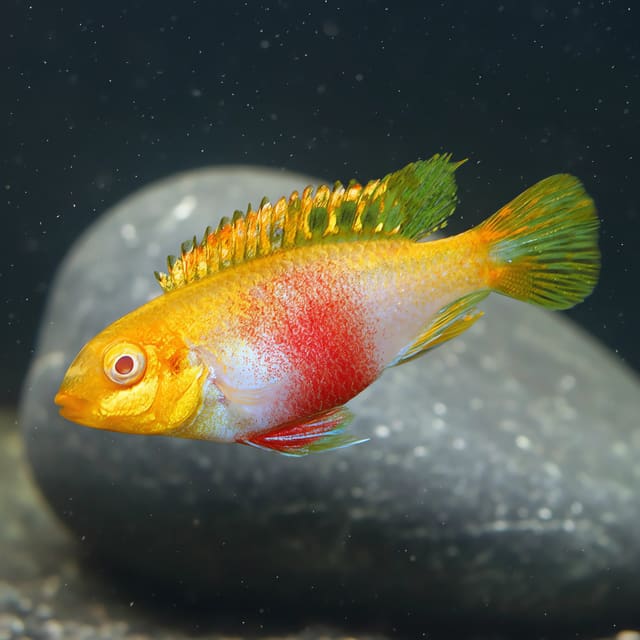
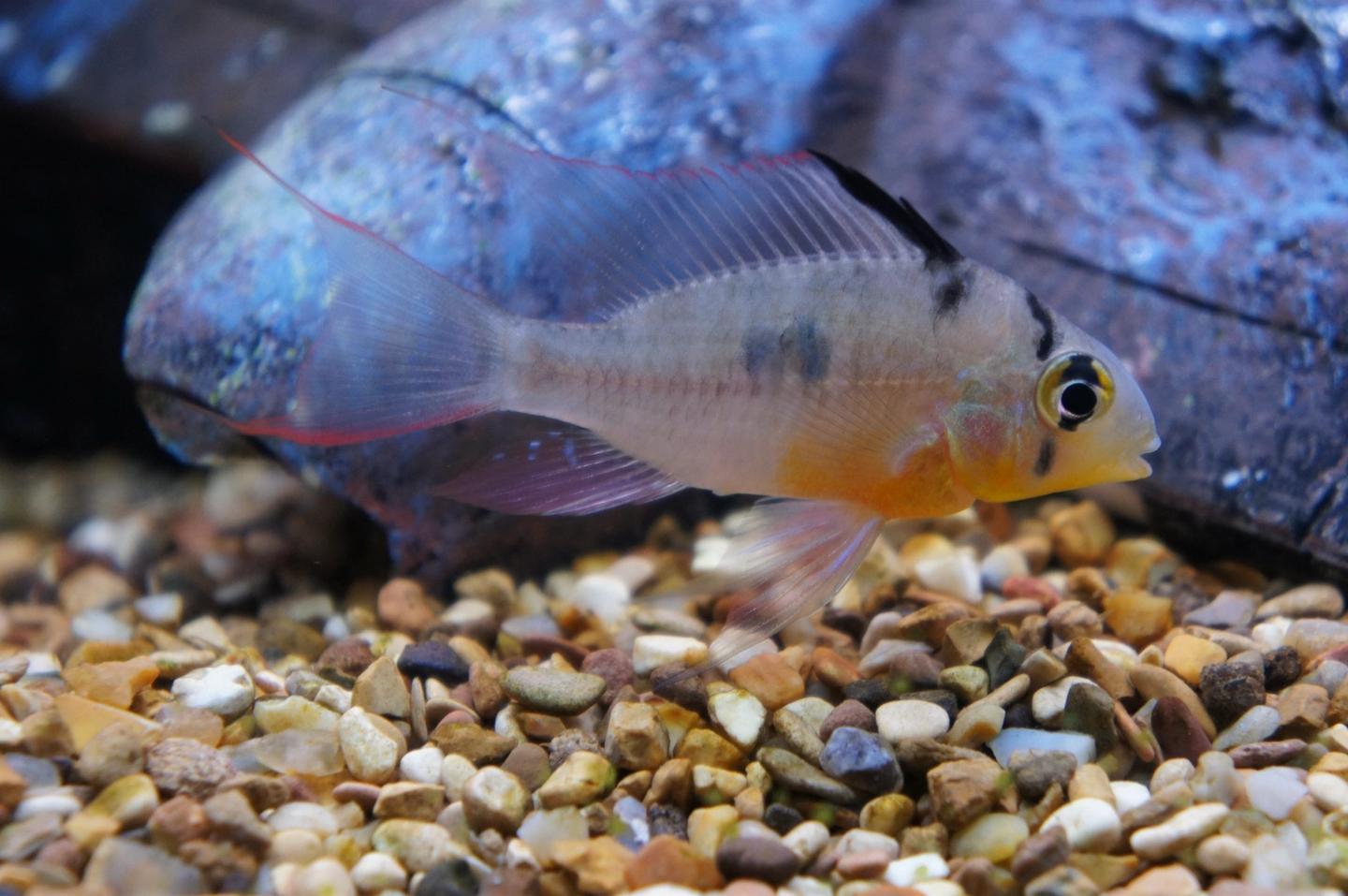
Common Krib Gold-Albin (Pelvicachromis pulcher)
24–27°C · pH 5–7.5 · 71L
£13.99
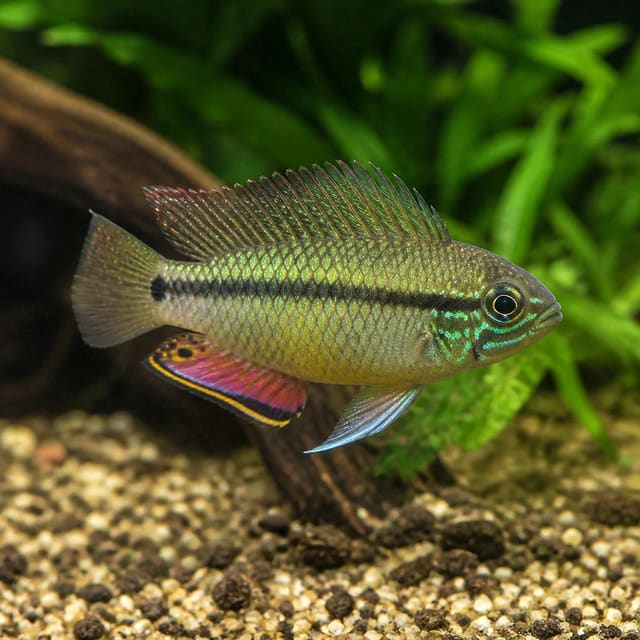
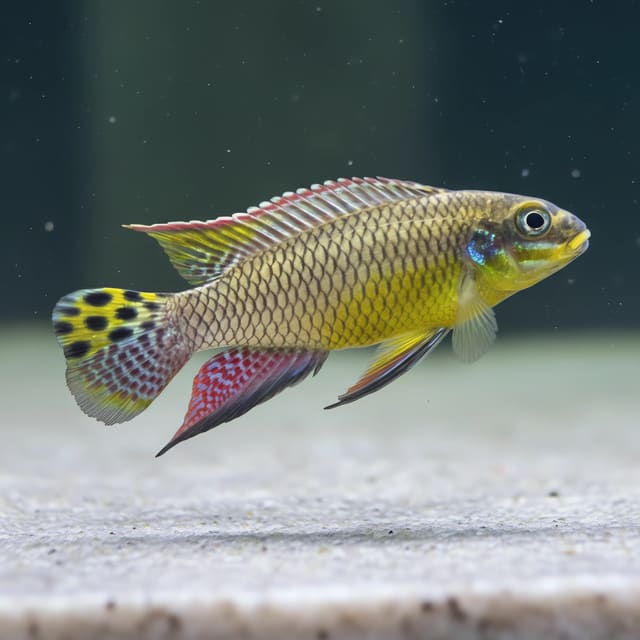
Common Krib Blue, Dwarf Rainbow (Pelvicachromis pulcher) is a West African dwarf cichlid for a mature aquarium with shelters and space for territorial behaviour. One purchase supplies one fish at the listed 4 cm grade, not a bonded pair.
Pelvicachromis pulcher
Save when buying multiple fish. Each quantity is one fish; sex and pair formation are not guaranteed unless the selected variant explicitly states them.
Common Krib Blue, Dwarf Rainbow (Pelvicachromis pulcher) is a West African dwarf cichlid for a mature aquarium with shelters and space for territorial behaviour. One purchase supplies one fish at the listed 4 cm grade, not a bonded pair.
Cichlids are a family of roughly 1,800 accepted species, not one care type. Before buying, identify the exact species and source, then compare adult measurement, usable tank dimensions, social system, territory, tested water, diet and an exit plan. No family-wide minimum tank, water range or tank-mate list is safe.
Maintain these water conditions for optimal health and vibrant colors
Common Krib Blue, Dwarf Rainbow is the blue trade form of Pelvicachromis pulcher, a West African dwarf cichlid with a strong interest in the lower part of its aquarium. A sheltered territory, suitable water and carefully chosen companions let you enjoy its behaviour at close quarters. The important commitment is space: a fish described as a dwarf cichlid can still defend its surroundings vigorously, especially when breeding.
Tropical Fish Co supplies one live fish per purchase quantity. The listed dispatch grade is 4 cm. This is a single offer, with no choice of sizes. A purchase does not supply a bonded pair, and ordering two fish does not establish that they will accept each other. Plan any introduction with that distinction in mind rather than relying on the familiar advice to keep kribs as a pair.
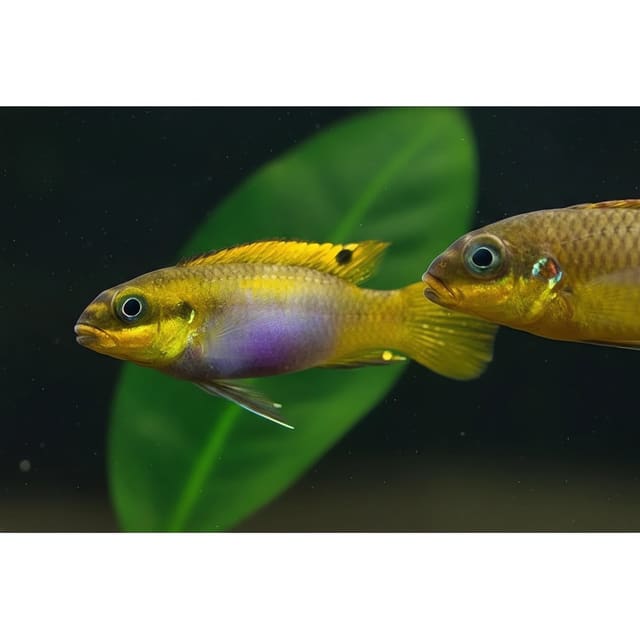
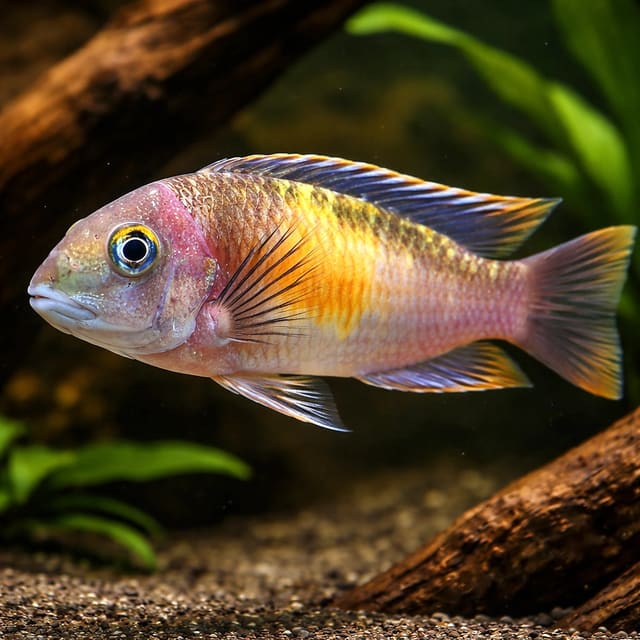
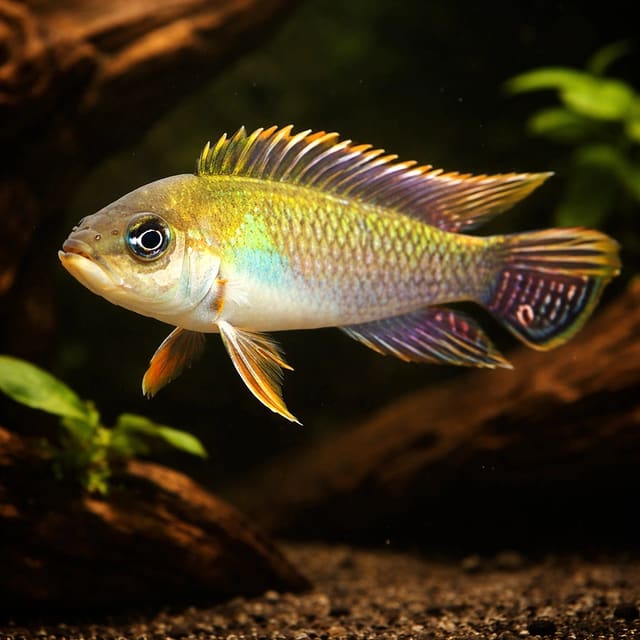
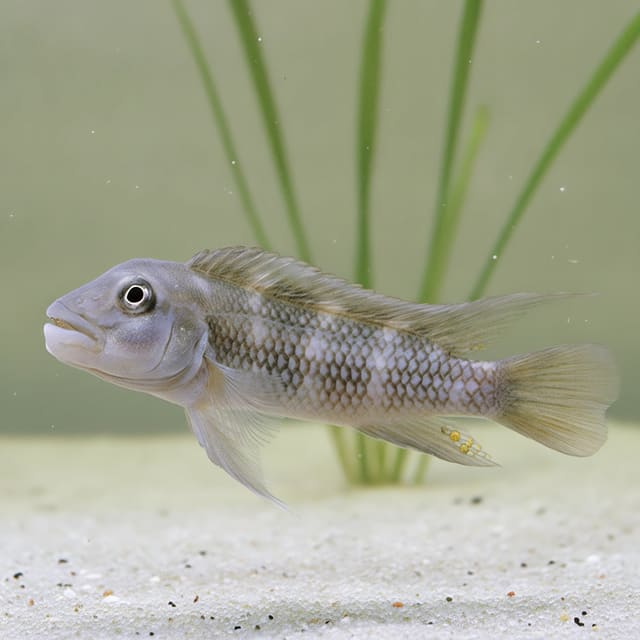
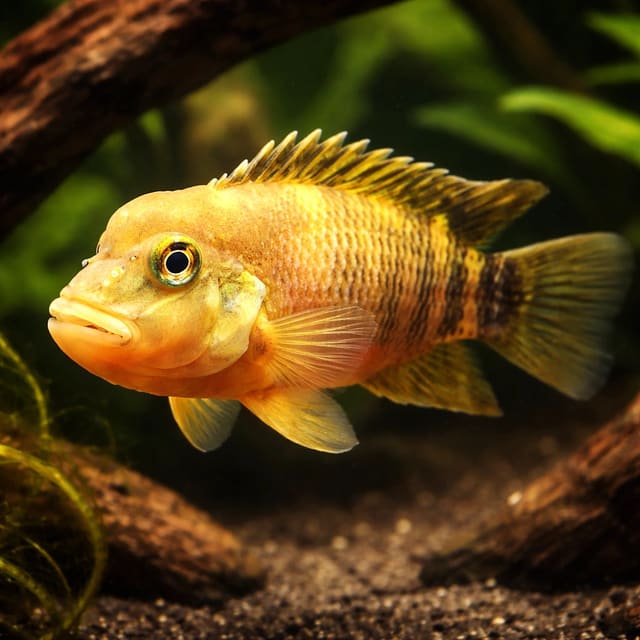
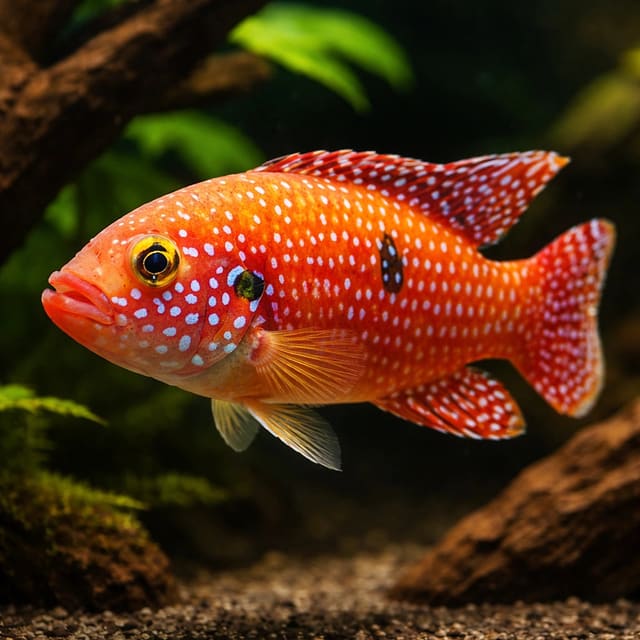
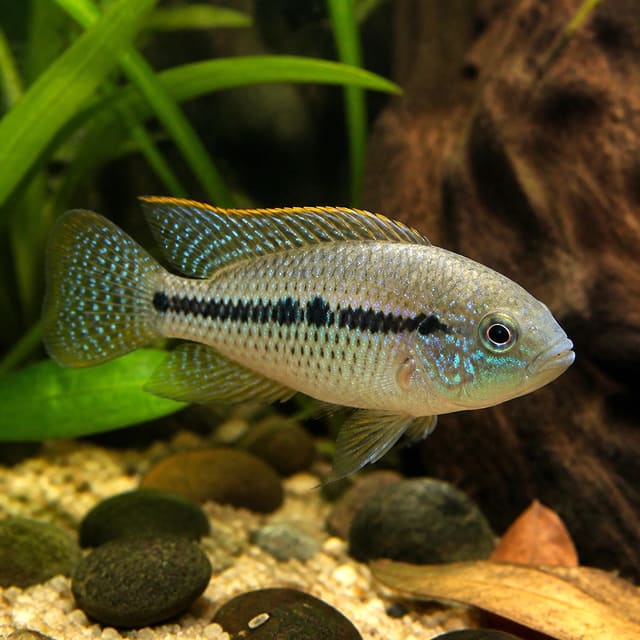
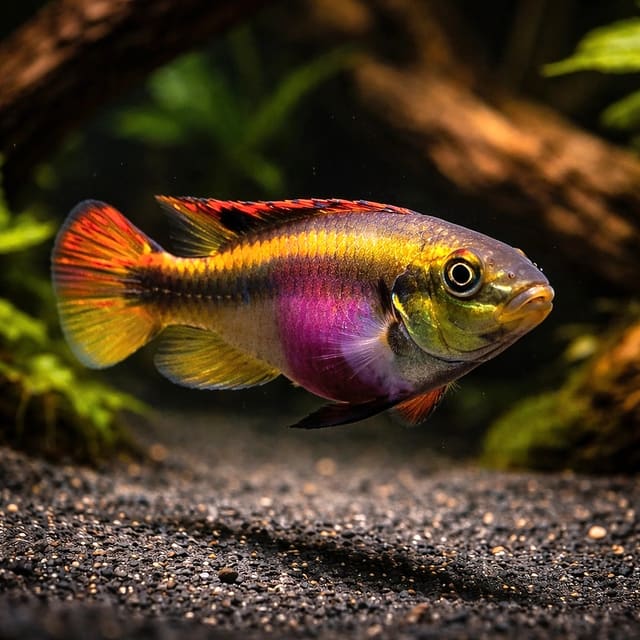
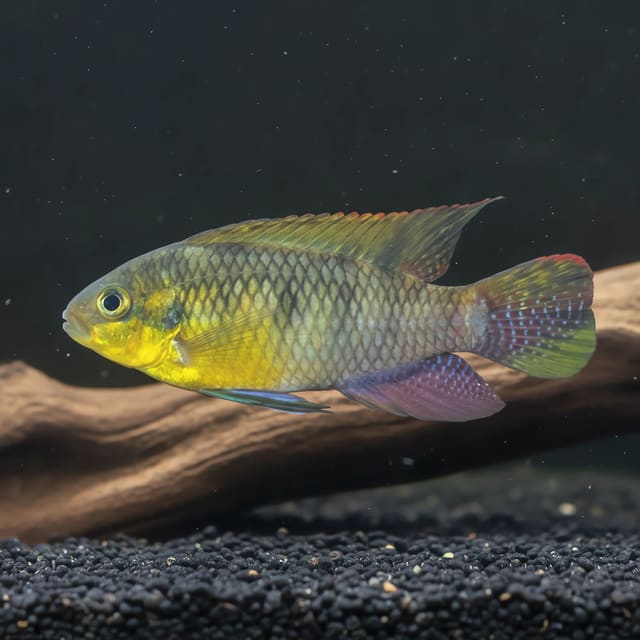
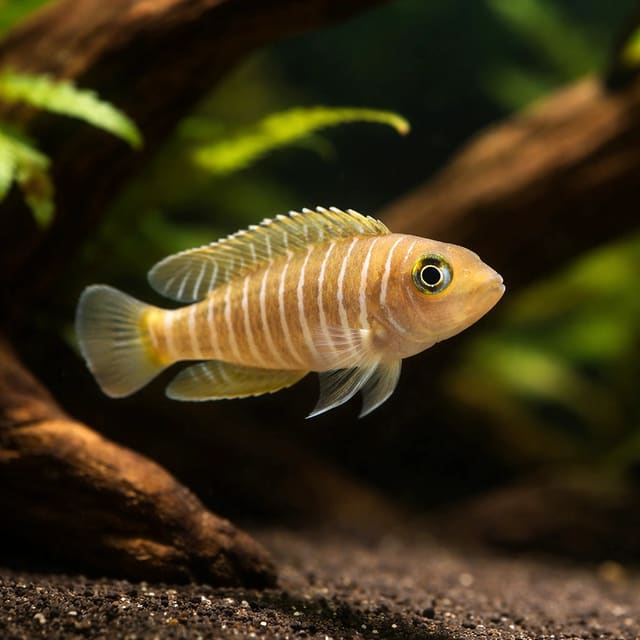
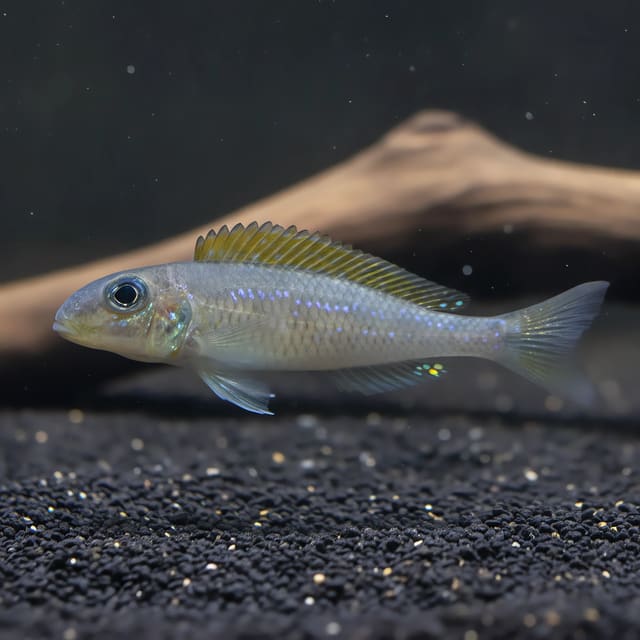
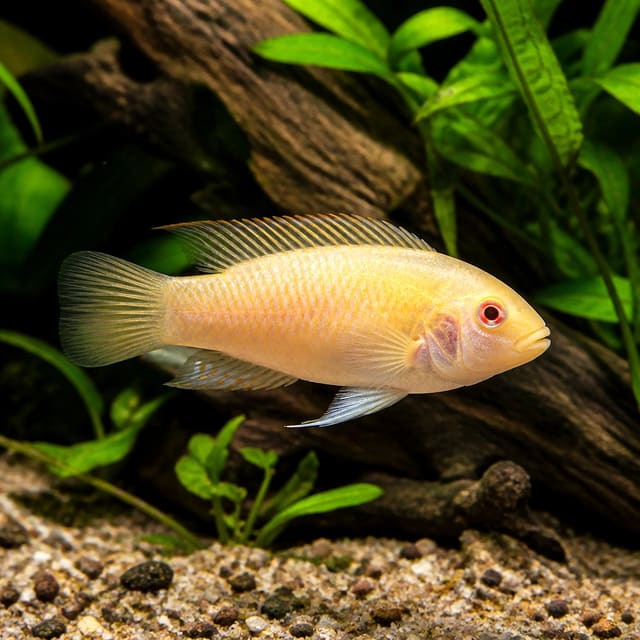
Sex is guaranteed only when the selected option explicitly states male or female. This Common Krib Blue, Dwarf Rainbow listing has no sex-guaranteed option. The gallery images are representative of this type of animal rather than photographs of the exact animal supplied, so colours can look slightly different from the live animal.
This species can suit an aquarist who wants to observe territorial and pair behaviour in a mature, thoughtfully arranged aquarium. It is a better choice when you can provide several retreats and respond if an introduction goes badly. Enjoyment comes from watching how the fish use their surroundings, not from expecting every individual to behave peacefully with every community.
The species aquarium guidance is 24–27°C, pH 5.0–7.5 and general hardness of 0–12 dGH. Those ranges are a starting point for checking your existing water and its stability. They are not an instruction to push conditions to an extreme, and the soft-water endpoint is not a recipe for filling a tank with unmineralised water. Check a proposed community against the needs of every species.
For planning, favour an aquarium at least 80 cm long, with enough width to arrange distinct shelters and leave open routes between them. Extra volume is useful, but an upright tank with a narrow floor may give bottom-oriented fish little usable territory. A mixed community needs more space than a pair-only arrangement, and several pairs require a substantially larger aquarium.
FishBase records a maximum length of 11 cm total length for male/unsexed fish. Seriously Fish gives 10 cm standard length in its species profile. Total length includes the tail; standard length does not. These are differently scoped measurements, rather than two exact promises for the size of an individual. The 4 cm dispatch grade is smaller than the adult fish for which the aquarium must be planned.
The natural species range includes eastern Benin, southern Nigeria and western Cameroon. That geographical background does not identify the source of the particular fish supplied. Blue is the trade-form description on this offer, while Pelvicachromis pulcher is the scientific name. The familiar name kribensis is often shortened to krib by fishkeepers.
If the colour form is your main choice, compare this listing with the Kribensis Cichlid listing for the same species before ordering. That comparison helps you choose an offer; it does not mean different forms should be placed together. The African cichlid collection includes fish with different needs, so use the individual care information as well as the collection label.
Above all, choose the aquarium around the adult behaviour you want to accommodate. A cave, a favourite sheltered route and an area in which other fish can move away all matter. When those details are planned before the purchase, the fish is easier to observe and any change in the relationships between inhabitants is easier to recognise.
FishBase gives a minimum aquarium length of 80 cm for this species. Seriously Fish describes a single-pair aquarium as suitable at 71 litres. Use the longer footprint as a conservative planning starting point, then allow additional space for other fish and for the way the tank is furnished. A quoted pair-only example is not an allowance for a fully stocked community.
OATA's broader dwarf-cichlid advice calls for at least 60 litres for a pair and at least 80 litres when these fish are mixed with other species. Those are group-level figures, so the individual species, its companions and the usable floor still need to be considered. A community must give other fish somewhere to go if the kribs begin defending a breeding area.
Measure the internal space that remains after large decorations are installed. An aquarium can contain plenty of water while offering only a narrow strip of accessible bottom. Leave room for fish to travel around shelters and for you to reach the substrate during cleaning. If every route passes directly in front of the same cave, reconsider the arrangement before adding livestock.
Clay pots, suitable caves, roots and aquarium-safe driftwood can provide retreats and potential spawning sites. Inspect openings and edges before putting them in the tank. Arrange shelters where the occupants can be observed without repeatedly lifting the ornaments. This makes it easier to tell the difference between a fish resting quietly and one that has stopped feeding or is being excluded.
More than one sheltered area is useful when relationships change. Even well-settled pairs will often chase each other, so a single cave should not be the aquarium's only refuge. Think about where an unwanted companion could move away and whether a larger fish could block that route. These practical details matter more than matching all the ornaments to one decorative theme.
Plants are optional in the species setup, but their cover can be helpful. Use them where they add shelter without making the entire floor difficult to inspect. Leave access to the areas where food collects and make sure plant growth does not quietly close a route between ornaments. Review the layout as it develops rather than assuming it remains useful exactly as first planted.
Use sand or fine gravel; the species is known to excavate pits when breeding. Account for that movement when positioning ornaments and equipment. Place substantial items securely rather than depending on a loose pile of substrate to hold them in place. A fish moving material should not be able to destabilise something above its retreat.
Keep the surface accessible to a siphon. Food and debris around cave entrances can be easy to miss, especially if you view the aquarium only from the front. Check these areas during routine maintenance without repeatedly disturbing an occupied shelter. A simple arrangement that you can clean carefully is often more useful than a crowded display with several inaccessible pockets.
Provide an appropriate cover and inspect spaces around equipment. Plan how you would safely separate fish if necessary, before a conflict develops. Separation requires a suitable, prepared environment; a hurried move into unfiltered water exchanges one problem for another. If you cannot provide a practical response to aggression, choose a less complicated stocking plan from the start.
| Water measure | Aquarium guidance |
|---|---|
| Temperature | 24–27°C |
| pH | 5.0–7.5 |
| General hardness | 0–12 dGH |
These are the aquarium figures in the species husbandry profile. Start with your measured source water, the established tank and the needs of the other inhabitants. Conditions need to remain manageable after routine water changes, not merely reach a chosen reading on the day you buy the fish. Ask for advice before introducing them if your source water requires substantial adjustment.
A broad range allows you to assess suitability; it does not mean all points within it should be used interchangeably. Keep a stable temperature and a consistent water-preparation routine. The lowest hardness value describes the published range, not a recommendation to remove every mineral. Very soft water requires informed management, so choose conditions you understand and can reproduce safely.
Use the water chemistry guide to distinguish pH, general hardness and the other tests. Each describes a different property. Changing one reading does not automatically fix another, and a product intended to alter a value should not replace an understanding of why the water is unsuitable in the first place.
The water matcher can help compare measurements with care recommendations. Follow that comparison with a check of adult size, territory and feeding. Two fish may tolerate overlapping water ranges while being a poor behavioural combination, particularly when both require the same small patch of aquarium floor.
Install and mature the aquarium before livestock arrives. A biological filter supports the bacteria that process ammonia and nitrite from the fish and their food. It does not become ready simply because the water looks clear or a new pump is running. Follow a sound preparation process, such as the steps in the first tropical tank guide, and verify readiness with tests.
OATA's general husbandry guidance requires zero ammonia and zero nitrite. Test before introducing fish, and keep records so changes are easier to identify. Note additions, unusual feeding, maintenance and equipment changes alongside the readings. When a problem occurs, that short history can be more informative than a single test taken after several attempted fixes.
Increase stocking gradually. More fish usually mean more feeding, which also increases the load on the filter. Allow the established system to cope with changes and pause further additions if water quality is not right. A pair defending a cave may seem to occupy only one corner, but its waste still contributes to the whole aquarium's maintenance needs.
OATA recommends a partial water change of 25% at least once each week and water testing at least weekly. This is broad dwarf-cichlid guidance and a starting routine to review against your aquarium's readings. Condition replacement water to remove chlorine or chloramine and check that its temperature is suitable before adding it. Avoid making the fish cope with a sudden, poorly matched refill.
The same guidance sets nitrate at no more than 20 mg per litre above normal tap-water levels. Test the source water so you can interpret that comparison. Track trends as well as individual readings. Rising nitrate or accumulating debris may show that the feeding, stocking or maintenance routine needs adjustment, even if the display still looks attractive.
Check the filter for blockages and monitor its normal outlet flow. When cleaning is needed, lightly rinse filter media in aquarium water removed during the water change; do not run it under the tap. Keep the manufacturer's directions available so you can maintain the equipment without guessing which parts should be disturbed. Useful bacteria and reliable flow are both part of the filtration system.
After maintenance, check the fish as well as the equipment. Look for normal movement and make sure every inhabitant still has access to shelter. Record any unexpected change. If a fish becomes distressed, test the water and seek help promptly rather than assuming the change is simply territorial behaviour.
A good quality cichlid pellet can form the staple, with regular variety from suitable live or frozen foods. The broader OATA dwarf-cichlid guidance also includes flakes or granules and small foods such as daphnia or brine shrimp. Choose a particle size the individual fish can take easily and observe whether it swallows the food rather than repeatedly mouthing and dropping it.
FishBase describes a varied natural diet, with invertebrates in the general account and substantial algae, plant material and detritus in observations from one Nigerian river. That supports offering variety rather than treating the species as a specialist that needs only one rich food. It does not mean you should substitute aquarium debris for a complete prepared diet.
Place food where the krib can reach it without losing every portion to faster fish above. Watch how it feeds around its chosen area. If food consistently drifts behind inaccessible wood, adjust where it is offered rather than increasing the total quantity. A sinking product still needs to reach the fish, not simply vanish below the plants.
OATA's general guidance is a once-daily portion eaten within a few minutes. Use this as a starting routine and seek individual advice if size, condition or other circumstances require a different approach. Remove uneaten food where you can. Repeatedly adding food in response to a shy fish can raise waste levels while leaving the underlying feeding problem unresolved.
If more than one krib is present, watch each fish eat. A territorial animal may approach immediately while its companion waits behind cover. Feeding access is an important part of assessing whether their relationship works. A pair appearing together briefly does not establish that both are feeding properly through the rest of the day.
Keep a simple note if appetite or condition changes. Describe which food was offered, where the fish was and whether another animal prevented access. Test water quality as part of the investigation. A persistent loss of appetite deserves advice; repeatedly swapping foods or choosing a treatment without understanding the cause can make a clear picture harder to obtain.
Store food according to its label and keep the normal portion clear to anyone helping with the aquarium. Demonstrate where the fish normally feeds and which sheltered area it uses. A helper who knows the routine can notice a meaningful change rather than compensating for a hidden fish with a larger pinch of food.
Check the lower corners during maintenance for leftovers. A fish's interest in a cave can draw your attention away from the surrounding substrate, where missed food may accumulate. Cleaning those areas carefully and keeping feeding measured are everyday parts of maintaining a stable home, regardless of whether the fish is displaying breeding behaviour.
Confirm that the aquarium is ready, the water tests are suitable and the equipment is working. Arrange your time so someone can receive the fish and inspect the parcel calmly. If the fish is joining an existing community, consider which animals occupy the intended area and how you will observe the introduction. Prepare any necessary separate holding arrangement before it is needed.
Read the current delivery and Live Arrival Guarantee policy. The parcel needs to be received and opened for inspection on the same day. For any Live Arrival Guarantee claim, make a continuous unboxing video that starts with the sealed parcel and shows the fish inside the sealed bags. This provides evidence for the claim rather than replacing the care the fish needs on arrival.
Follow the supplied acclimatisation instructions. The store policy describes floating the bag for 20–30 minutes to equalise temperature and acclimatising slowly. Transfer the fish without pouring transport water into the aquarium. Contact the team promptly if the fish or its packaging raises concern, providing the order number and clear evidence of its condition.
Give the new fish time to use the available shelter while you observe from a little distance. Do not repeatedly lift caves to make it visible. Feeding, movement and use of space together give a better picture than whether it appears at the front glass immediately. A fish can be naturally retiring while still leaving shelter to feed and exploring when the surroundings are quiet.
Pay particular attention if another krib is already present. Persistent pursuit, blocked access to food or confinement to one small corner needs intervention. A familiar species name and a presumed male-female combination cannot establish a compatible bond. Ask for help if you cannot confidently distinguish a workable introduction from escalating conflict.
OATA highlights changes in swimming, breathing, feeding, body condition and appearance as reasons to investigate. Damaged fins, white spots, unusual growths or sustained surface hanging should not be dismissed as ordinary settling. Test the water, record what has changed and obtain advice from an experienced aquatic retailer or fish-health professional.
Species care references recommend pair keeping, but compatibility between individuals matters. Two purchased fish may reject each other, and an unwilling partner can be seriously injured. Observe their behaviour and have a suitable separation plan. Do not use the usual pairing advice as a reason to leave persistent aggression unresolved.
The species is a cave-spawning cichlid and can become very territorial while breeding. That possibility belongs in the aquarium plan even if breeding is not your intention. An area that several fish used peacefully may become defended, changing access to shelters and feeding places. Give companions space to move away rather than placing every useful resource near one cave.
A larger aquarium is needed for more than one pair. Extra caves alone do not create separate territories if all their entrances open into the same small area. Consider the full floor plan, the routes between shelters and the space available to the remaining inhabitants. If the setup cannot offer that room, choose a simpler arrangement.
Seriously Fish names small characins, barbs, danios, rasboras, Corydoras, gouramis and loricariids as potential companions. Use those groups to begin researching exact species, not as a universal shopping list. Check adult size, temperament, water needs and feeding behaviour for each candidate. Members of the same broad group can differ greatly in the space they need.
Avoid very vigorous or large species, which may intimidate this generally retiring cichlid. Equally, make sure potential companions have room to withdraw when the krib becomes territorial. A fish that is small enough to fit into a community physically may still be a poor choice if it continually approaches a defended cave or cannot reach food without passing it.
Bottom dwellers require particularly careful planning. Corydoras and loricariids are named in the species reference, but they use some of the same floor area. Their food and resting places should remain accessible if a krib begins defending a territory. Do not assume that a peaceful reputation prevents a conflict over location.
Other cichlids deserve caution and enough space for separate territories. A shared West African origin is not proof of compatibility, and a similar appearance does not tell you whether the animals will accept each other. Review the exact species and the available aquarium before combining them. The alternatives shown on a product page are choices to research, not suggested neighbours.
Observe the community during feeding and at quieter times. Look for fish that have changed their usual area, become reluctant to approach food or repeatedly lose access to shelter. Those details often reveal a developing problem more clearly than a brief chase. Respond to the effect on the affected fish instead of waiting for visible injury.
Keep an honest limit on stocking. A community needs room for adults, complete social groups where relevant and the territorial behaviour of the kribs. If adding another species removes the spare space that lets the existing inhabitants move away from one another, the aquarium may already have reached its useful limit.
FishBase records 11 cm total length for male/unsexed fish, while Seriously Fish gives 10 cm standard length. Total length includes the tail and standard length excludes it. These differently scoped records guide adult planning rather than promising the size of every individual.
Plan around a tank at least 80 cm long, with useful floor space and several shelters. FishBase gives that length; Seriously Fish describes a 71-litre single-pair example. A community or multiple pairs needs more room, and volume alone does not show how much territory is available.
Species references recommend a compatible pair. Compatibility must be assessed between individuals; simply putting two fish together does not create a bond. Persistent pursuit or exclusion from food needs action, with an appropriate separate aquarium available if the introduction fails.
It can be a rewarding introduction to cichlids for a prepared keeper with a mature aquarium and a practical plan for territorial behaviour. Maintain water quality, provide shelters and observe interactions. A small adult size does not remove the need to manage aggression.
Offer a good quality cichlid pellet with variety from suitable live or frozen foods. Choose food the individual can swallow and ensure it reaches the fish. OATA's broad dwarf-cichlid guidance is a once-daily portion finished within a few minutes, with uneaten food removed.
The species aquarium guidance is 24–27°C, pH 5.0–7.5 and general hardness of 0–12 dGH. Keep conditions stable and check replacement water. The low hardness endpoint is not an instruction to use unmineralised water; seek advice if substantial water adjustment is needed.
Yes. Kribs can become very territorial, especially while breeding. Provide several shelters and enough space for other fish to move away. Persistent chasing, damaged fins or a fish losing access to food requires attention rather than being accepted as harmless pair behaviour.
The species reference names small characins, suitable barbs, danios, rasboras, Corydoras, gouramis and loricariids. Check exact species and floor space. Avoid very vigorous or large fish, and be cautious with other cichlids or bottom dwellers around defended breeding areas.
Tropical Fish Co uses oxygen-filled bags, insulated packaging and a licensed live-animal courier. Receive and inspect the parcel on the confirmed day. For a Live Arrival Guarantee claim, provide continuous sealed-parcel unboxing video and contact the team the same day with the order number, under the current policy.
FishBase's species account records natural range, labelled size and aquarium length. Seriously Fish's kribensis profile covers water, feeding and territorial behaviour. OATA's dwarf-cichlid care sheet provides general maintenance guidance, and the RSPCA aquarium environment page explains filtration and water quality.
No reviews for this item yet. Bought one? Honest reviews only, good or bad.
What customers say about ordering from us
Easy website plenty of info on fish your buying great to pick a time slot
TRACEY DURRANT · 7 Oct 2026
Got some lovely fish thank you
Kevin Mackie · 7 Oct 2026
Reviews of our shop, collected by Judge.me, an independent third-party review collector. Newest first.