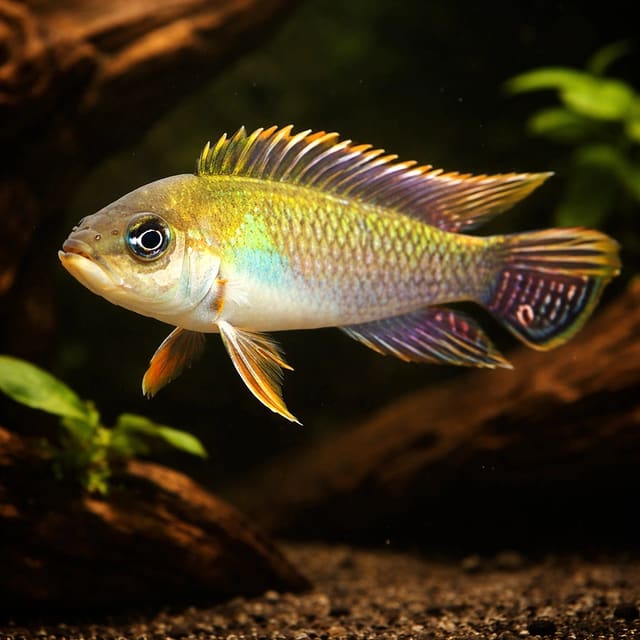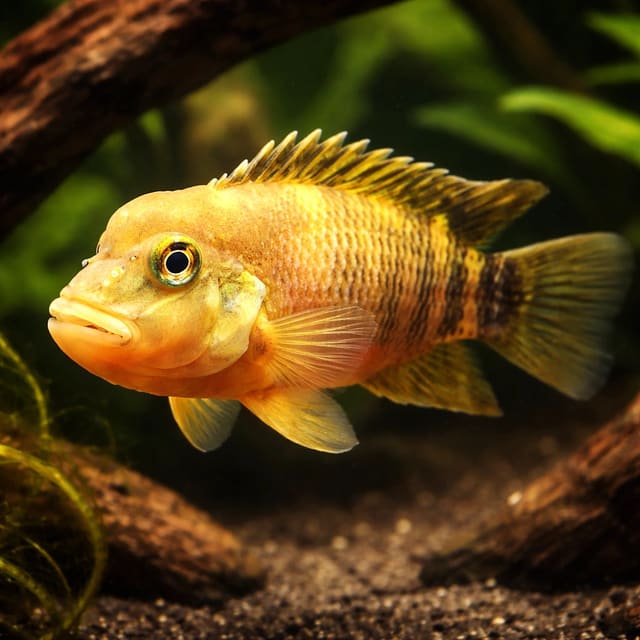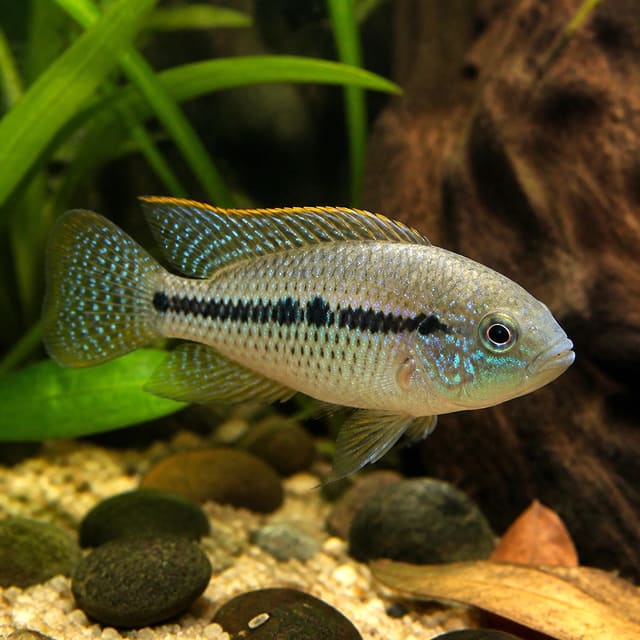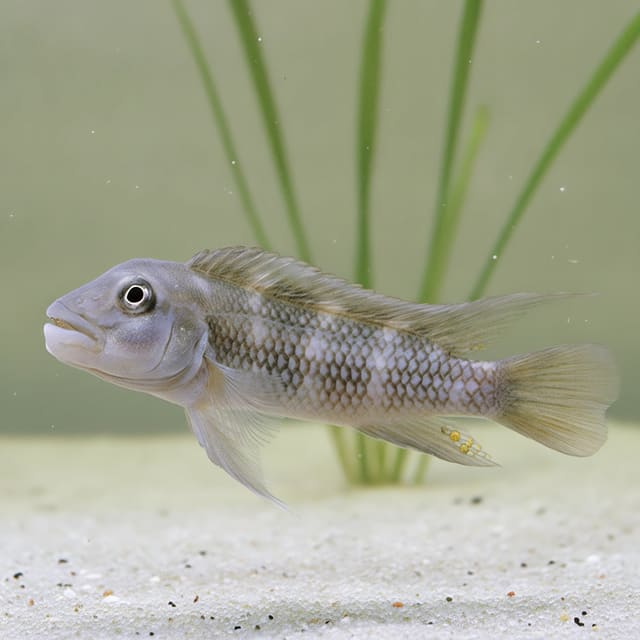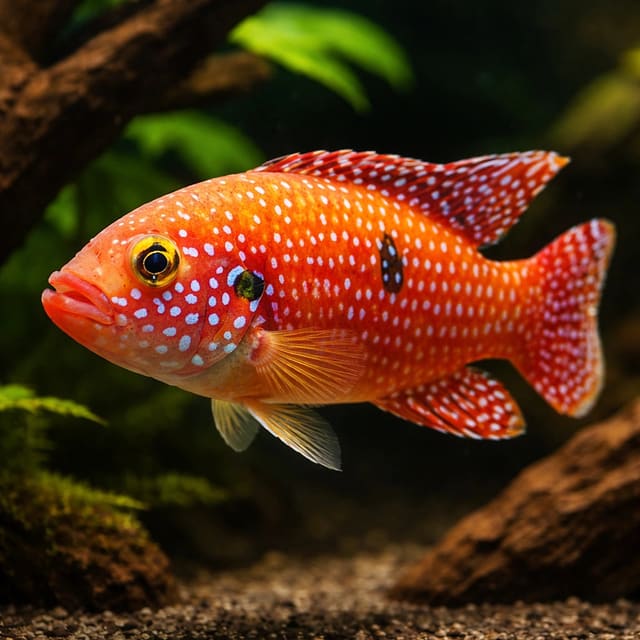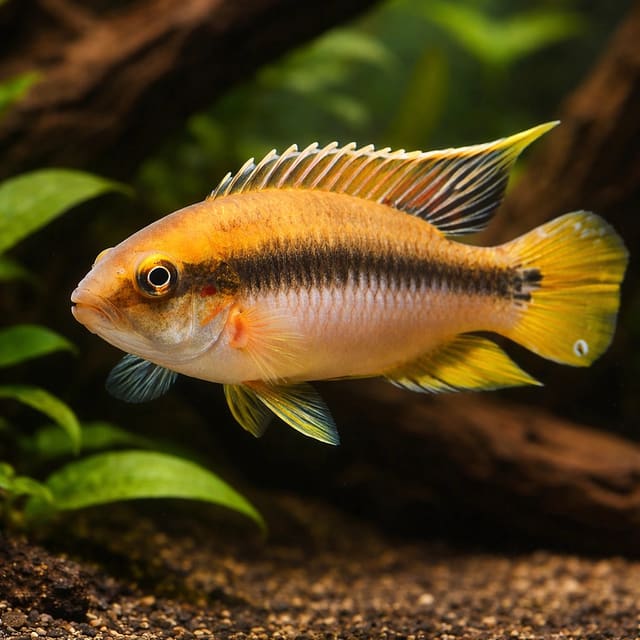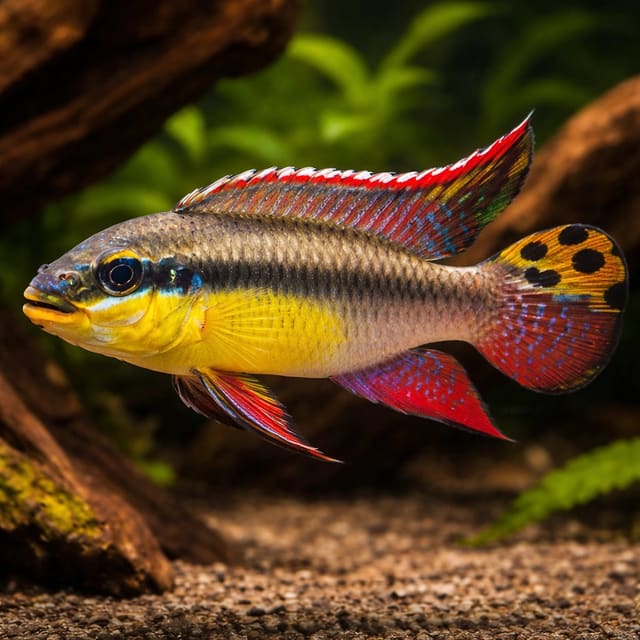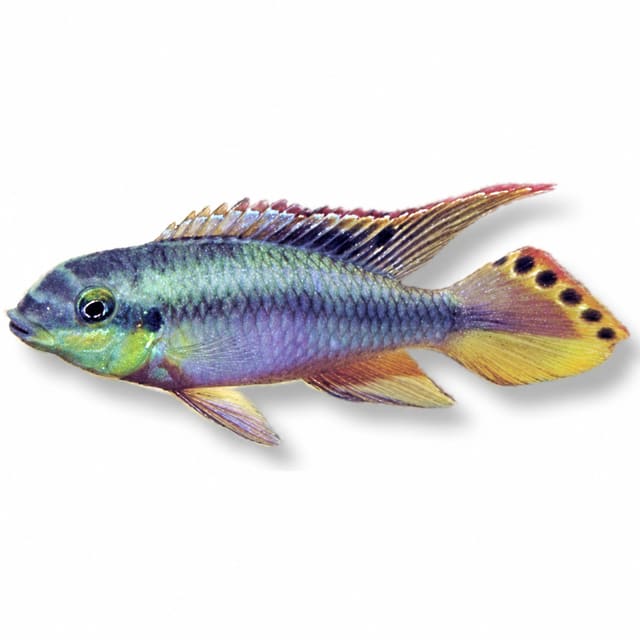
Common Krib Blue, Dwarf Rainbow (Pelvicachromis pulcher)
24–27°C · pH 5–7.5
£14.99

Matadi Violet Ocellated Kribensis is an uncommon Pelvicachromis subocellatus locality form for mature, cave-rich planted aquariums with calm tank mates.
Adult size is the maximum length this species reaches at full maturity (scientific sources). The livestock you receive will be younger and smaller — pick a size above for the actual shipping size. Product-photo provenance and any image-specific limitations are stated on the listing.
Pelvicachromis subocellatus
Save when buying multiple fish. Each quantity is one fish; sex and pair formation are not guaranteed unless the selected variant explicitly states them.
Matadi Violet Ocellated Kribensis is an uncommon Pelvicachromis subocellatus locality form for mature, cave-rich planted aquariums with calm tank mates.
Adult size is the maximum length this species reaches at full maturity (scientific sources). The livestock you receive will be younger and smaller — pick a size above for the actual shipping size. Product-photo provenance and any image-specific limitations are stated on the listing.
Cichlids are a family of roughly 1,800 accepted species, not one care type. Before buying, identify the exact species and source, then compare adult measurement, usable tank dimensions, social system, territory, tested water, diet and an exit plan. No family-wide minimum tank, water range or tank-mate list is safe.
Maintain these water conditions for optimal health and vibrant colors
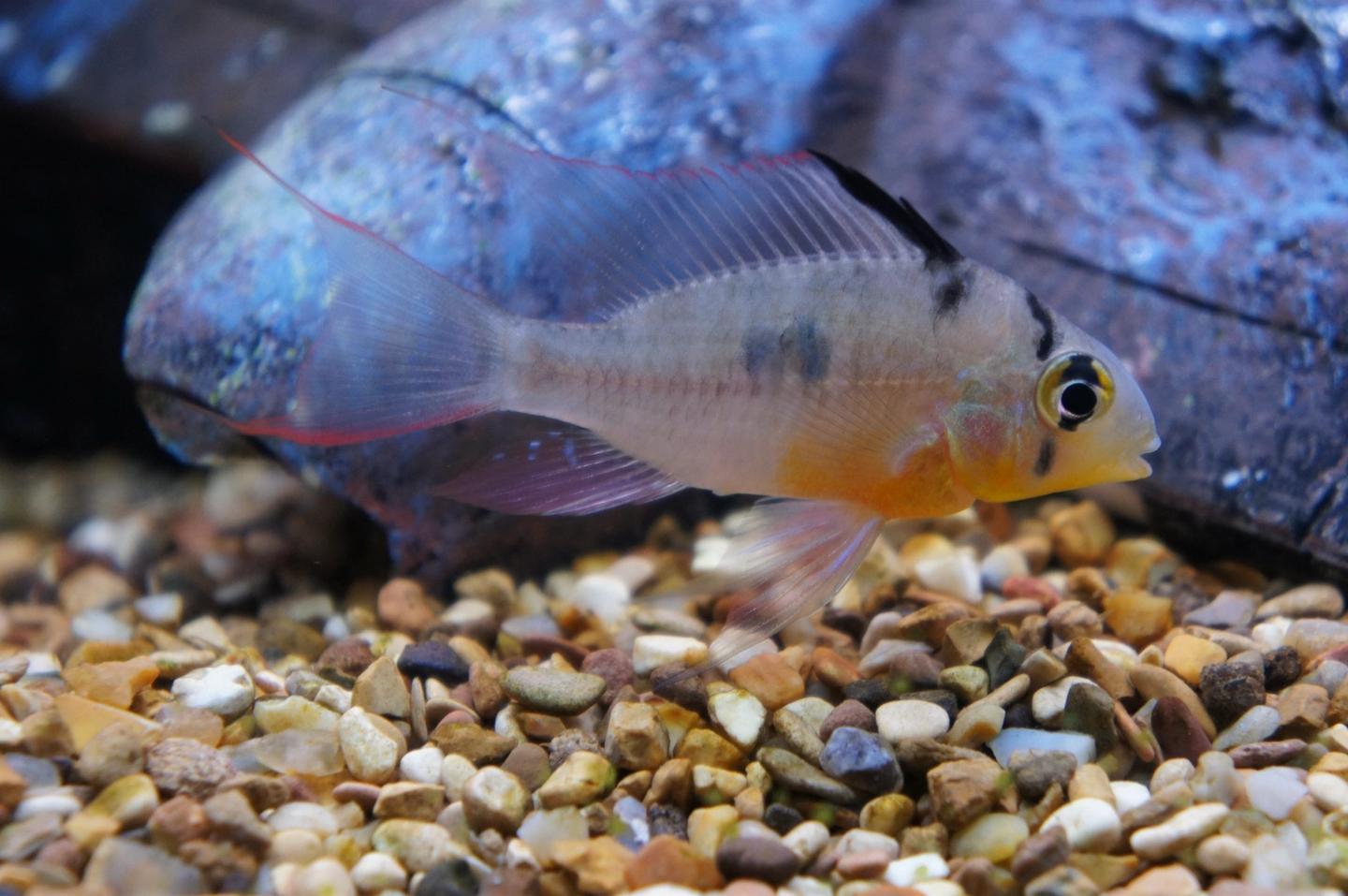
The Matadi Violet Ocellated Kribensis is the locality form of Pelvicachromis subocellatus often sold to specialist aquarists as “Matadi Violet”. It is a West/Central African dwarf cichlid with the confidence and pair-bonding behaviour people enjoy in kribensis, but with a more unusual violet-bronze colour pattern and a calmer, bottom-oriented presence than many larger cichlids.
This is a good choice for a mature planted aquarium or riverbank-style community where the layout has caves, roots, shaded cover and fine substrate. Adults are compact, usually around 7-9 cm, but they are still cichlids: a pair may defend a cave when breeding. Keep them with peaceful midwater fish and avoid crowding them with other bottom cichlids that want the same territory.
Before choosing this form, look beyond colour and price. It needs stable water, a settled aquarium and careful preparation for arrival. The cave layout and the habits of existing tank mates matter as much as the fish's unusual appearance.
Pelvicachromis subocellatus belongs to the African dwarf cichlid group, a branch of cichlids valued for manageable size, pair bonding, and complex parental care. In the aquarium hobby, the Matadi form is admired for its violet wash and refined patterning. It sits alongside other dwarf cichlids as a more unusual alternative to standard kribensis, making it highly desirable among keepers of specialist West African fish.
The natural home of Pelvicachromis subocellatus lies in Central Africa, especially coastal and lower river systems associated with the Congo basin region. The name “Matadi” refers to a locality linked with the lower Congo area, and that gives useful clues about the natural habitat. These fish are typically found in slow-moving margins, creek-like channels, and sheltered river edges where roots, leaf litter, sunken branches, and pockets of softer substrate create cover. Water in these habitats can vary seasonally, but it is often slightly acidic to neutral, warm, and relatively low in hardness compared with harder Rift Lake environments.
Understanding this wild setting helps explain why its care depends so much on structure. In nature, these fish are not open-water cruisers. They stay low in the tank, investigate crevices, and use caves or protected hollows as refuge and breeding sites. The bottom-oriented lifestyle also explains why they appreciate calm zones and visual barriers. A tank that mimics tangled roots, sand, and broken sight lines will encourage more confident behaviour and better colour.
Wild feeding behaviour is equally important. This species is an opportunistic omnivore that picks through fine substrate and biofilm-rich surfaces for tiny invertebrates, insect larvae, organic matter, and edible plant fragments. That is why a good diet in captivity should not rely on one dry food alone. Variety matters. When aquarists reproduce the natural mix of shelter, warm water, and mixed feeding, the fish usually show stronger colour, better pair bonding, and more reliable spawning behaviour.
The locality-based form appeals to keepers who enjoy regional variation in West African dwarf cichlids. Its behaviour is especially rewarding in a carefully arranged river-style aquarium.
Mimicking the natural habitat with sand, caves, leaf-litter style décor, and shaded zones often improves colour, reduces tension between pairs, and brings out the calm but inquisitive behaviour this fish is known for.
A thoughtful setup is the key to success with this species. A good aquarium layout balances open swimming space with bottom cover and cave options. Although this fish is sometimes sold as suitable for mixed aquariums, it still behaves like a dwarf cichlid and needs territory. For a single pair, the recommended tank size starts at 80 litres, which matches the practical minimum for stable water quality and territory separation. In larger tanks of 100-120 litres or more, the fish are generally calmer, especially if you want to keep dither fish in the upper levels.
The recommended minimum is 80 litres for a pair, but more space is always better. A pair in a cramped tank may become defensive, especially near a chosen cave. If you are considering a community setup, think in terms of footprint rather than just volume. A longer aquarium gives these fish room to establish a bottom territory while midwater species stay out of the way. A community needs enough floor area and décor to provide that separation.
The ideal water conditions are stable rather than extreme. Aim for a temperature range of 22-27°C, with 24-26°C being a very comfortable everyday target. The temperature range is broad enough for mixed tropical setups, but avoid sudden swings. The preferred pH range is 6.0-7.5, and water hardness should sit around 3-12 dGH. Slightly softer, mildly acidic water often helps colour and breeding response, but healthy captive fish can adapt well if changes are gradual.
Use efficient filtration with moderate flow. These fish do not enjoy being blasted around the tank, so avoid overly turbulent output. A mature internal filter, external canister with spray bar, or sponge-assisted setup works well. The goal is clean, oxygenated water without stripping the aquarium of calmer resting zones near caves and plants. If you are building a dedicated dwarf cichlid system, pair this species with reliable filtration and a stable heater from your main tropical setup range.
Fine sand is the best substrate choice. It allows natural foraging, is gentle on the mouth and gill area, and suits the bottom-dwelling habits of this fish. Substrate choice affects confidence and behaviour. A natural sand or smooth, fine gravel also makes the violet and bronze tones stand out more clearly. Darker tones can intensify contrast, especially under warm lighting.
Planted aquariums work well because this fish generally leaves established plants alone while using them as cover. Hardy species such as Anubias, Java fern, Cryptocoryne, and floating cover can all help. Add caves made from coconut shells, rock piles, ceramic shelters, or wood arches. If you keep other dwarf cichlids, this is the same principle: break the line of sight, provide several caves and let each fish retreat without being chased across open water.
Moderate lighting is ideal. Very bright light without cover can make the fish more cautious, while moderate planted-tank lighting with floating shade helps bring out the body sheen. Aim for 7-9 hours daily and avoid sudden on-off shock if the tank is in a dark room.
Always cycle the tank for 4-6 weeks before adding a new pair. Stable biological filtration matters far more to this species than chasing a perfect number on a test chart.
Newly shipped fish benefit from a calm, mature environment. Prepare the aquarium before arrival so the fish can settle, explore its shelters and begin feeding confidently.
Feeding is straightforward once you understand the species is an omnivore with a strong preference for variety. In the wild, these fish pick through substrate and browse for tiny invertebrates and edible organic matter. In the aquarium, a varied diet combines a quality small cichlid pellet or granule with frozen foods and occasional flakes. This balance supports colour, body condition, and breeding readiness.
A sinking or slow-sinking micro pellet should form the staple diet. Choose a food designed for small cichlids or omnivorous tropical fish. Feed only what the pair can finish in 30-60 seconds. This species is not a reckless eater, but it will overconsume if food accumulates near its territory.
Frozen bloodworm, daphnia, brine shrimp, cyclops, and finely chopped mysis are all useful additions. These are especially valuable for conditioning pairs and supporting a healthy body shape. A varied menu also helps bring out the fish's richer tones. Many keepers notice stronger violet and rose belly colour after several weeks of mixed feeding.
Before breeding attempts, offer frozen foods 3-4 times a week. This is one of the easiest ways to encourage stronger courtship and improve egg production. Varied protein also keeps the fish more active and confident.
Feed adults twice daily in small portions. Juveniles can be fed 2-3 smaller meals. Remove uneaten food promptly, especially in warm tanks where waste breaks down quickly. This matters because overfeeding can undermine water quality long before visible symptoms appear.
| Time | Food | Amount |
|---|---|---|
| Morning | Small cichlid pellet or quality flake | What they finish in 30-60 seconds |
| Evening | Frozen brine shrimp, daphnia, or bloodworm | Small pinch or a few thawed pieces each |
For this species, choose small cichlid granules, quality flakes and frozen foods such as daphnia, brine shrimp or bloodworm in modest portions. Keep foods small enough for a dwarf cichlid to take cleanly.
Overfeeding causes ammonia spikes, cloudy water, and rising nitrate. Dwarf cichlids often look hungry even when they are well fed, so portion control matters more than enthusiasm at the glass.
Diet quality after arrival affects how quickly the fish settles. Offer a newly introduced pair small, easy meals rather than large feeds. A beginner can keep this species when they understand how food variety and water quality work together.
The appeal of this fish is obvious once the pair colours up. Adult size usually tops out around 8 cm, making it compact enough for smaller cichlid aquariums while still large enough to show detail. The body is elongated but deep enough to carry classic dwarf cichlid posture, with a slightly sloping forehead, rounded belly, and well-developed dorsal and anal fins.
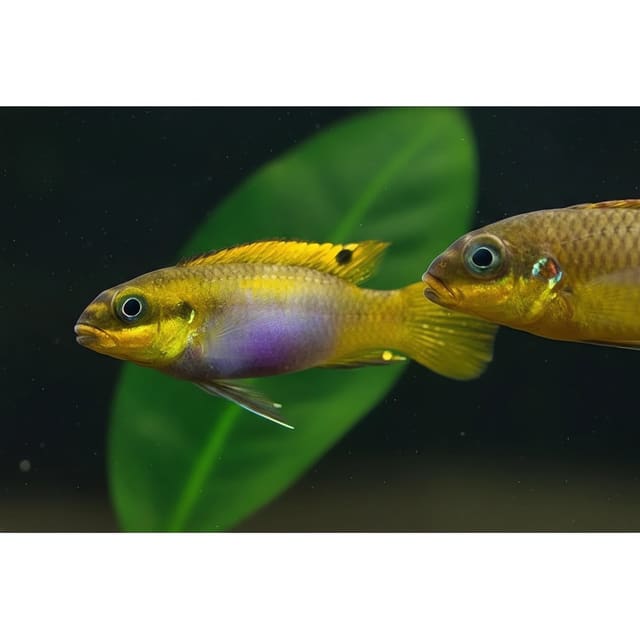
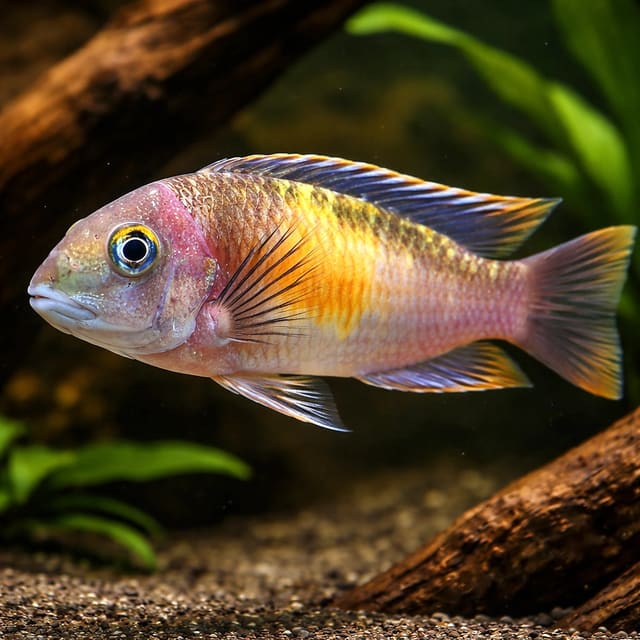
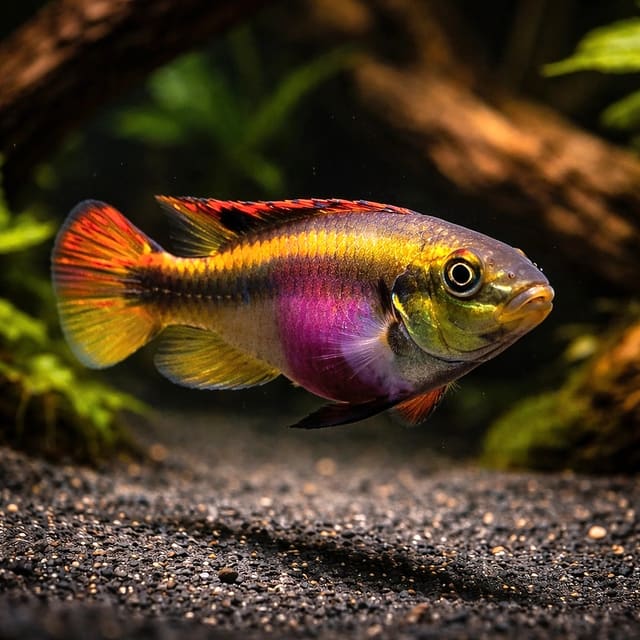
The “ocellated” part of the common name refers to eye-like spotting, usually visible in the caudal area or fin patterning depending on mood, age, and sex. The Matadi form is valued for its violet sheen layered over earthy bronze, beige, olive, and warm brown tones. In good condition, the flanks can flash lilac or purplish iridescence, while the belly on females becomes richer during courtship. The effect is subtler than the bright colours of some other display fish.
Females are usually more intensely coloured around the belly and often appear slightly smaller and deeper-bodied. Males tend to be longer, more streamlined, and may show more extended finnage. In a settled pair, the contrast between the sexes becomes easier to read. The sheen and pattern contrast become clearer as the fish settles and colours up.
Compared with standard kribensis, the Matadi form generally looks more nuanced and locality-specific, with a cooler violet cast and a more specialist appeal. Under warm-spectrum lighting, dark substrate, and a varied diet, the Matadi form can become one of the most elegant dwarf cichlids in a planted display.
One of the biggest questions buyers ask is whether this species really is peaceful enough for a community tank. The answer is yes, with conditions. This is a peaceful dwarf cichlid compared with many cichlids, but it is still territorial around the bottom of the aquarium, especially when breeding. That means compatibility depends less on aggression level alone and more on tank footprint, décor, and the habits of the other fish.
The safest companions are calm midwater fish that do not compete for caves. Small tetras, peaceful rasboras and carefully chosen Corydoras can work in larger tanks, although even Corydoras may be moved away from a breeding cave. Other Pelvicachromis, Apistogramma or bottom-dwelling cichlids are better kept in separate aquariums unless the tank is very large and deliberately structured.
Avoid other bottom cichlids in modest tanks, aggressive substrate claimers, and large boisterous fish. Comparisons with ram cichlids can be misleading: both are dwarf cichlids, but they should not simply be mixed because they occupy similar lower zones. Also avoid very large, boisterous or predatory fish, which are unsuitable due to size, feeding pressure and stress.
In an 80-litre tank, keep one pair only with perhaps a small, peaceful upper group if the layout is dense and water quality is excellent. In 100-120 litres, a pair with a modest school of small tetras is far more realistic. That gives the pair room to establish its territory. The fish need a defined bottom territory while the dither fish occupy the middle and upper water.
Snails are usually tolerated, but shrimp may be viewed as food, especially small juveniles. Large Amano shrimp may survive in a heavily planted tank, but there are no guarantees. If breeding is underway, the pair will become much more defensive and may patrol a surprisingly wide area.
| Species | Compatible? | Notes |
|---|---|---|
| Other dwarf cichlids | ⚠️ Caution | Similar bottom territory needs; best kept separately unless tank is very large and expertly structured. |
| Small peaceful livebearers | ⚠️ Caution | Possible in larger peaceful communities, but guppy fry may be eaten and water preference differs slightly. |
| Other bottom cichlids | ❌ Avoid | Territory disputes are common, especially during spawning. |
Always quarantine new arrivals for 2-4 weeks and rearrange décor before introducing them to an established pair. Breaking old territory lines can reduce chasing dramatically.
Choose tank mates before buying. In the right mature aquarium, this fish can make a peaceful but characterful display, provided the pair has its own bottom territory and enough space when spawning.
Breeding is best described as moderate. It is not as automatic as standard common kribensis in every aquarium, but it is very achievable for prepared keepers. Start with a compatible pair in a species-focused or carefully managed community tank. The best breeding temperature is usually around 25-26°C, with soft to moderately soft water and excellent food variety. While the normal temperature range is 22-27°C, a stable warm point within that range often helps trigger spawning.
Use an 80-litre or larger aquarium with several cave options so the pair can choose. Fine sand, leaf-litter style décor, and low disturbance all help. Keep pH toward the mildly acidic to neutral side if possible. The ideal breeding setup resembles a scaled-down riverbank with shade and privacy rather than a bright open display.
When ready, the female becomes more colourful and begins displaying near the chosen cave. The pair may excavate sand around the entrance. Courtship includes body quivering, lateral displays, and cave inspection. This is one of the most rewarding reasons people keep kribensis-type dwarf cichlids: their pair interaction is intelligent and highly visible.
Eggs are laid inside the cave, where they remain mostly hidden. The female usually guards the eggs while the male patrols the surrounding territory. Hatching time depends on temperature but often occurs within a few days, with fry becoming free-swimming after yolk absorption. During this period, avoid major tank changes or intrusive maintenance.
Once the fry are free-swimming, offer infusoria, powdered fry food, microworms, and newly hatched brine shrimp. Parents often herd fry as a group, which is one of the joys of keeping this species. Frequent small water changes support growth, but match temperature carefully to avoid stress.
The most common problems are incompatible pairs, too much traffic from tank mates, poor cave placement, and over-hard water. If the pair repeatedly spawns and loses eggs, increase privacy and reduce disturbance. If they never show interest, improve conditioning foods and review the cave layout.
Offer at least three cave choices with different entrance sizes and angles. Many pairs become far more confident when they can select a cave themselves rather than being forced into a single obvious shelter.
For aquarists exploring Pelvicachromis species beyond the standard forms, breeding the Matadi locality can be especially satisfying. It rewards patience, stable water, and close observation rather than constant intervention.
Compare this form with standard kribensis, taeniatus or rams when choosing a dwarf cichlid. The Matadi form sits in an appealing middle ground: more unusual than common kribensis, usually hardier than delicate rams, and visually subtler than brighter dwarf cichlids.
| Feature | Matadi Violet Ocellated Kribensis | Standard Kribensis (P. pulcher) |
|---|---|---|
| Max Size | About 8 cm | About 10 cm |
| Care Level | Moderate | Easy to moderate |
| Temperature | 22-27°C | 24-27°C |
| Temperament | Peaceful outside breeding | Peaceful but often bolder |
| Best For | Specialist dwarf cichlid keepers and planted displays | General community cichlid keepers |
| Feature | Matadi Violet Ocellated Kribensis | Ram Cichlid |
|---|---|---|
| Water Tolerance | Fairly adaptable | More sensitive |
| Breeding Style | Cave spawner | Open spawner |
| Community Suitability | Good with planning | Good but more delicate |
| Visual Style | Subtle violet and ocellated patterning | Brighter metallic and yellow-blue tones |
| Best For | Naturalistic West African setups | Warm, calm South American displays |
Compared with Pelvicachromis pulcher, the Matadi fish usually wins on rarity and nuance, while pulcher wins on availability and beginner familiarity. Compared with P. taeniatus, the Matadi form often appeals to aquarists who want a calmer visual palette and a more locality-driven fish. Compared with ram cichlids, choose the Matadi if you want stronger cave-breeding behaviour, slightly broader tolerance, and a distinctly West African character.
The violet and ocellated patterning makes this an uncommon but practical display fish for a suitably prepared aquarium.
Healthy Matadi Violet Ocellated Kribensis are alert, curious, and responsive to food. They should show clear eyes, intact fins, a rounded but not swollen body, and steady breathing. A settled pair will patrol the lower tank, inspect caves, and display confidently. If colour washes out for more than a short adjustment period, or the fish hide constantly, review water quality first.
Like many dwarf cichlids, this species can suffer from stress-related issues if water quality slips. Common problems include ich, bacterial fin damage after territorial disputes, internal issues linked to poor diet, and bloat caused by overfeeding or chronic digestive stress. Newly imported or recently shipped fish may also be vulnerable to external parasites if not quarantined properly.
Start with diagnosis, not guesswork. Test ammonia, nitrite, nitrate, pH, and temperature before medicating. Many apparent “disease” cases are actually environmental. Perform measured water changes, improve oxygenation, and isolate affected fish when needed. Use medications appropriate for cichlids and always follow dosage directions carefully.
The best prevention is stable water, suitable diet, and low stress. Keep the water conditions stable, avoid overcrowding, and give the pair enough caves and visual barriers. Plan for its lifespan too: a fish that should live around 5 years needs long-term consistency, not just a good first month.
Never use copper-based medications in mixed systems containing shrimp or sensitive invertebrates. If treatment is needed, move the fish to a separate hospital tank whenever possible.
Preparation matters as much as choosing the fish. Allow time for careful acclimation after delivery, and observe appetite and behaviour while this specialist dwarf cichlid settles into its display.
Its behaviour is one of the species’ biggest strengths. Outside breeding, these fish are calm, observant, and often surprisingly interactive with their keeper. They spend much of the day exploring the lower tank, sifting gently around caves, and making short patrols through plant cover. They are not hyperactive, but they are rarely dull.
As a bonded pair, they show classic dwarf cichlid social structure. Each fish has a role, and during breeding this becomes more obvious, with one guarding the cave more closely and the other watching the surrounding territory. This is why the species can seem very peaceful one week and much more assertive the next. The change is usually linked to spawning, not a bad temperament.
If you want to encourage natural behaviour, provide several shelters, keep the tank calm, and avoid mixing them with fish that constantly invade the bottom zone. In the right setup, this fish becomes a model example of why many aquarists love West African dwarf cichlids: intelligence, pair bonding, subtle displays, and a strong sense of place within the aquarium.
Specialist dwarf cichlids reward careful preparation. Check that your aquarium is mature, the water is stable and the fish will have caves and cover before ordering.
Live-fish orders travel in insulated packaging with seasonal heat support when needed. Read the delivery and live-arrival terms before ordering, and arrange for someone to receive the parcel.
When your fish arrive, float and acclimate them carefully, keep lights low at first and let them find the caves and cover before offering a full meal. A mature, stable aquarium with clean water and broken sight lines is the best way to see the violet colour, pair behaviour and cave-spawning confidence that make this locality form special.
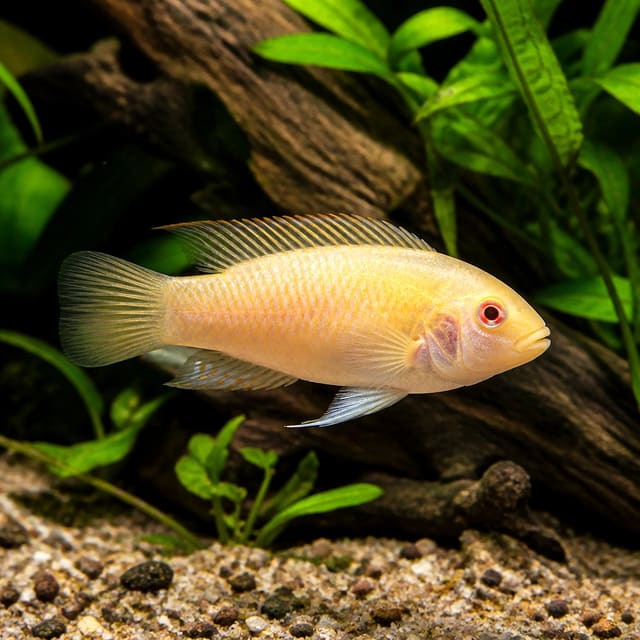
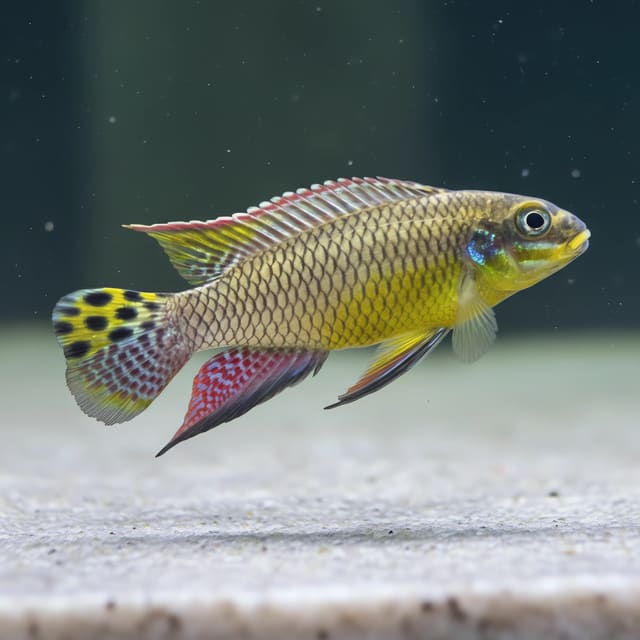
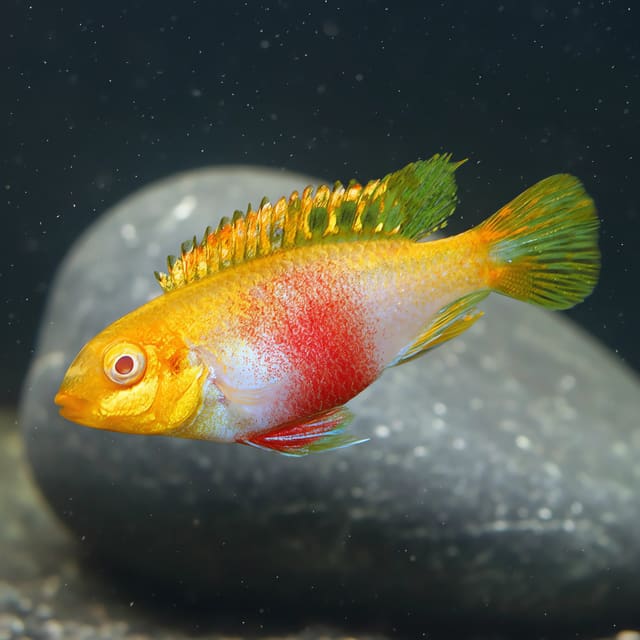
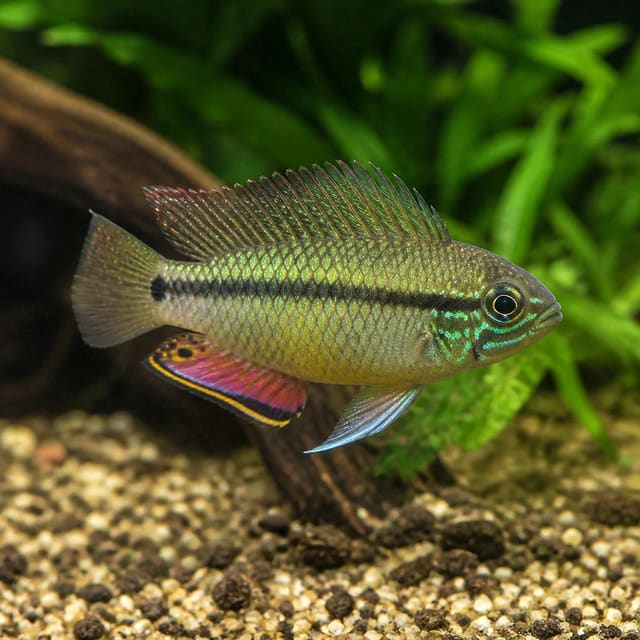
Compare this Matadi Violet form with Albino Red Kribensis (Pelvicachromis pulcher) and Super Red Kribensis Cichlid when choosing a dwarf cichlid display. Other forms include Common Krib Blue Dwarf Rainbow, Pelvicachromis taeniatus Kienke and Pelvicachromis taeniatus Lobe. These are comparisons; do not combine bottom-dwelling cichlids without assessing their territory and water requirements.
Species references: FishBase, Seriously Fish, Aquarium Glaser and Maidenhead Aquatics.
No reviews for this item yet. Bought one? Honest reviews only, good or bad.
What customers say about ordering from us
I have a small group of long finned mountain minnows. So was delighted to be able to order ten of this variety to increase the genetics in my tank . The ones I recieved are healthy but it’s to early to give a verdict on wether they are of a long finned type since they are small currently.
Gordon Walker · 23 Sept 2026
100% success travel and "installation". Pleased with quality of purchase. The Siamese fighter a bit "shy" so have not yet seen him at his best yet but looking good. Happy customer. GG
George E Garratt · 21 Sept 2026
Reviews of our shop, collected by Judge.me, an independent third-party review collector. Newest first.