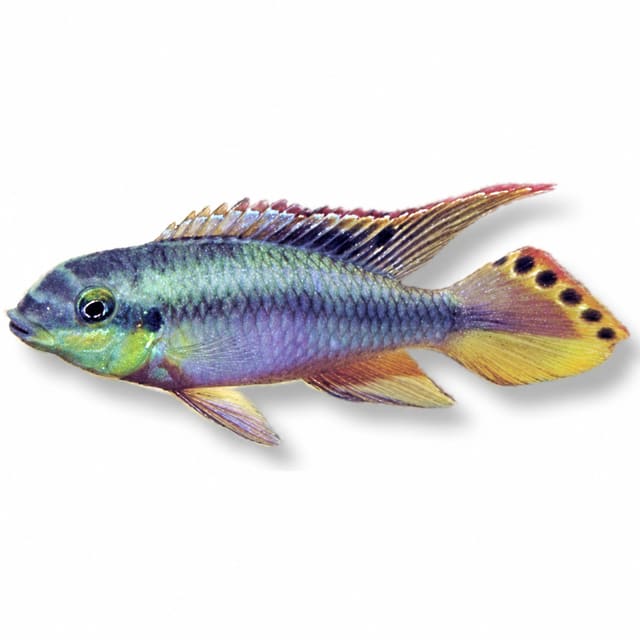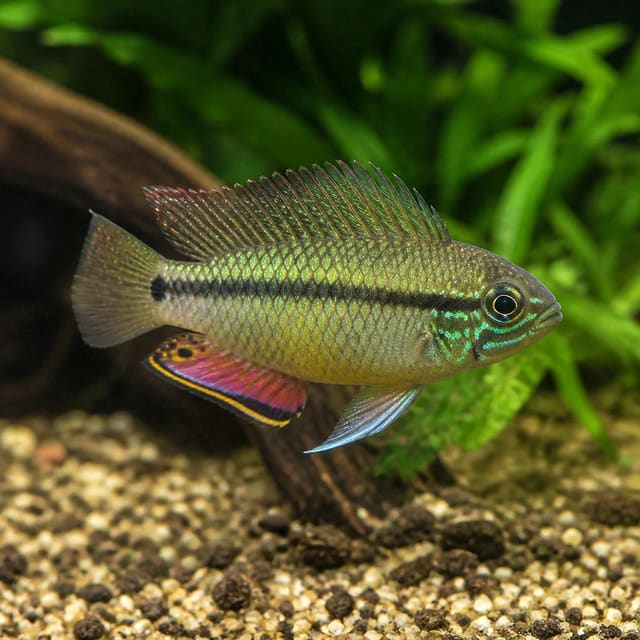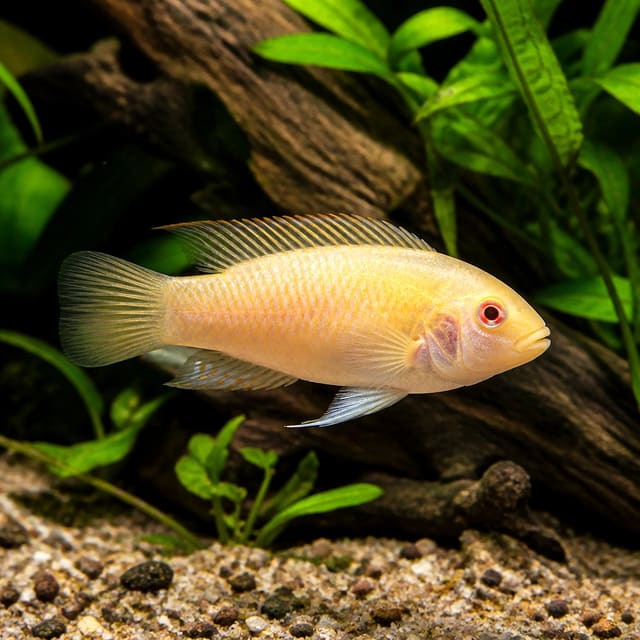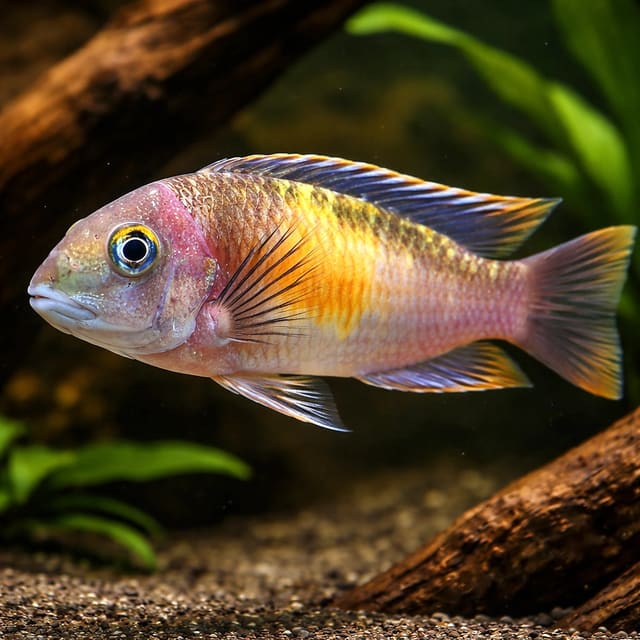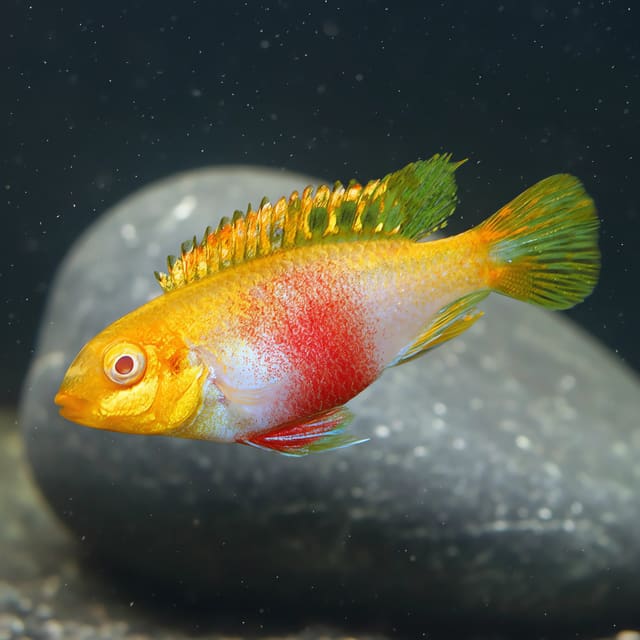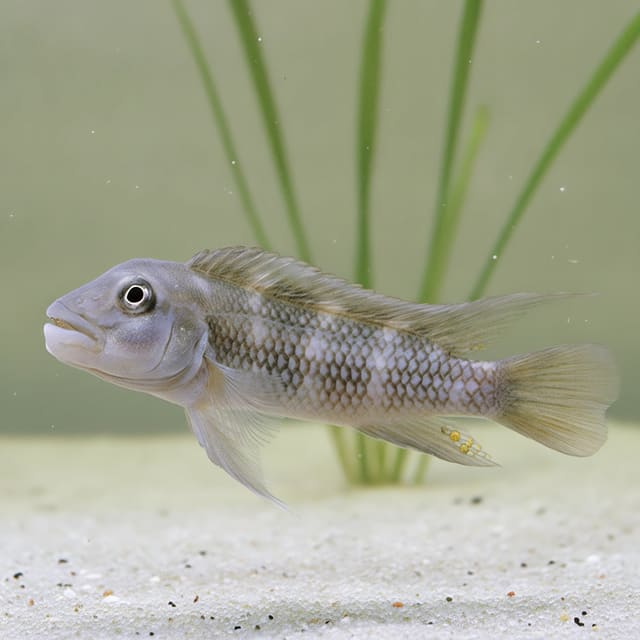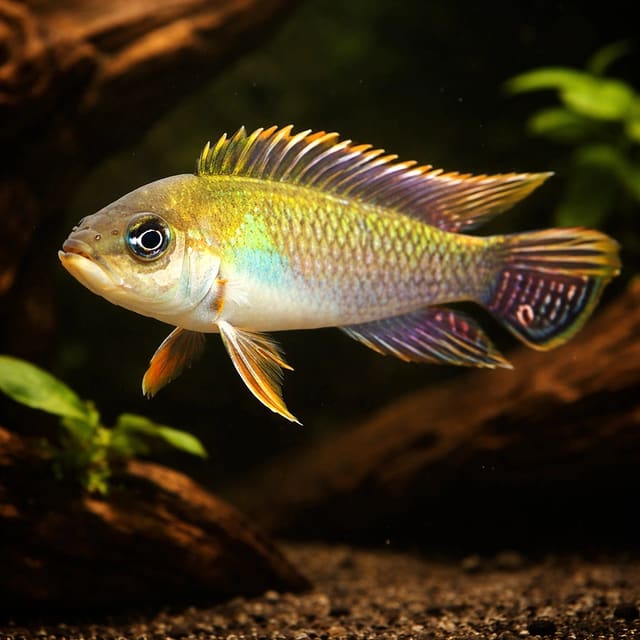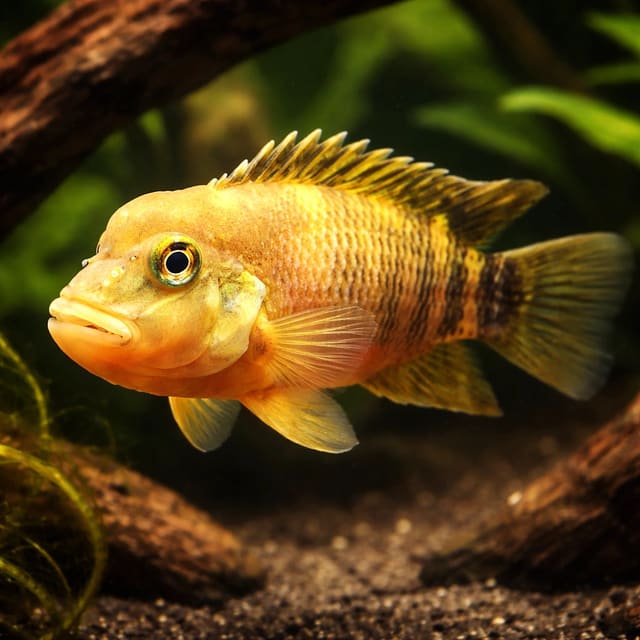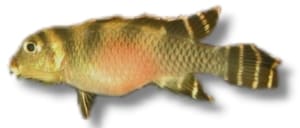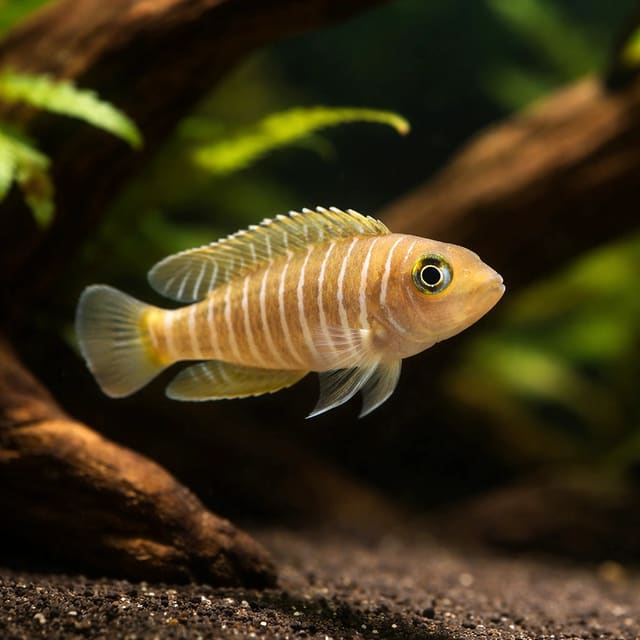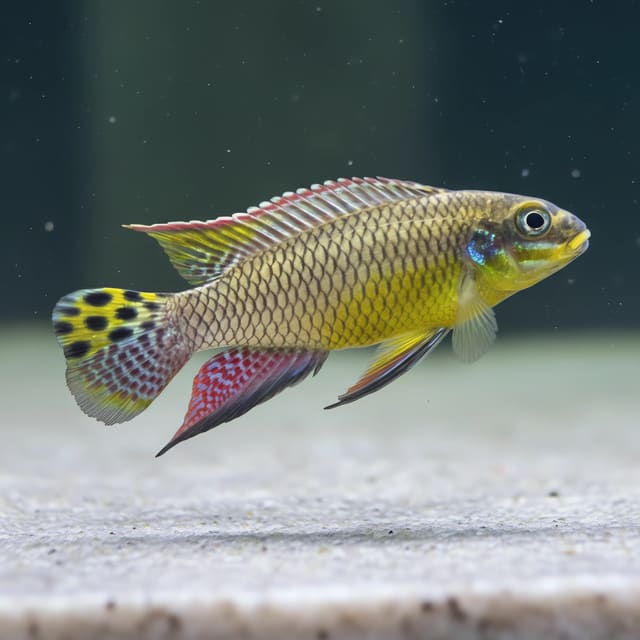
Pelvicachromis taeniatus kienke
22–26°C · pH 6–7.5 · 71L
£41.99
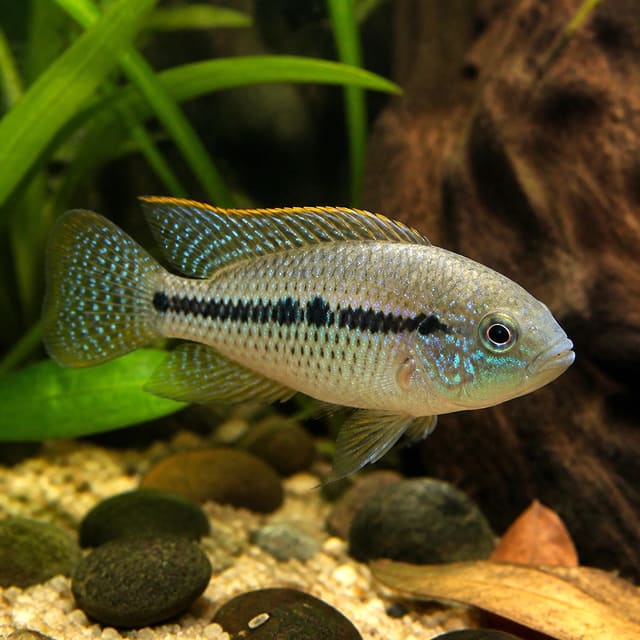
Pelvicachromis taeniatus — Lobe is an unsexed West African dwarf cichlid offered in 3–4 cm and XL dispatch sizes. Plan for a compatible pair only with adequate cover, stable species-appropriate water and room to manage territorial behaviour.
Adult size is the maximum length this species reaches at full maturity (scientific sources). The livestock you receive will be younger and smaller — pick a size above for the actual shipping size. Product-photo provenance and any image-specific limitations are stated on the listing.
Pelvicachromis taeniatus
Save when buying multiple fish. Each quantity is one fish; sex and pair formation are not guaranteed unless the selected variant explicitly states them.
Pelvicachromis taeniatus — Lobe is an unsexed West African dwarf cichlid offered in 3–4 cm and XL dispatch sizes. Plan for a compatible pair only with adequate cover, stable species-appropriate water and room to manage territorial behaviour.
Adult size is the maximum length this species reaches at full maturity (scientific sources). The livestock you receive will be younger and smaller — pick a size above for the actual shipping size. Product-photo provenance and any image-specific limitations are stated on the listing.
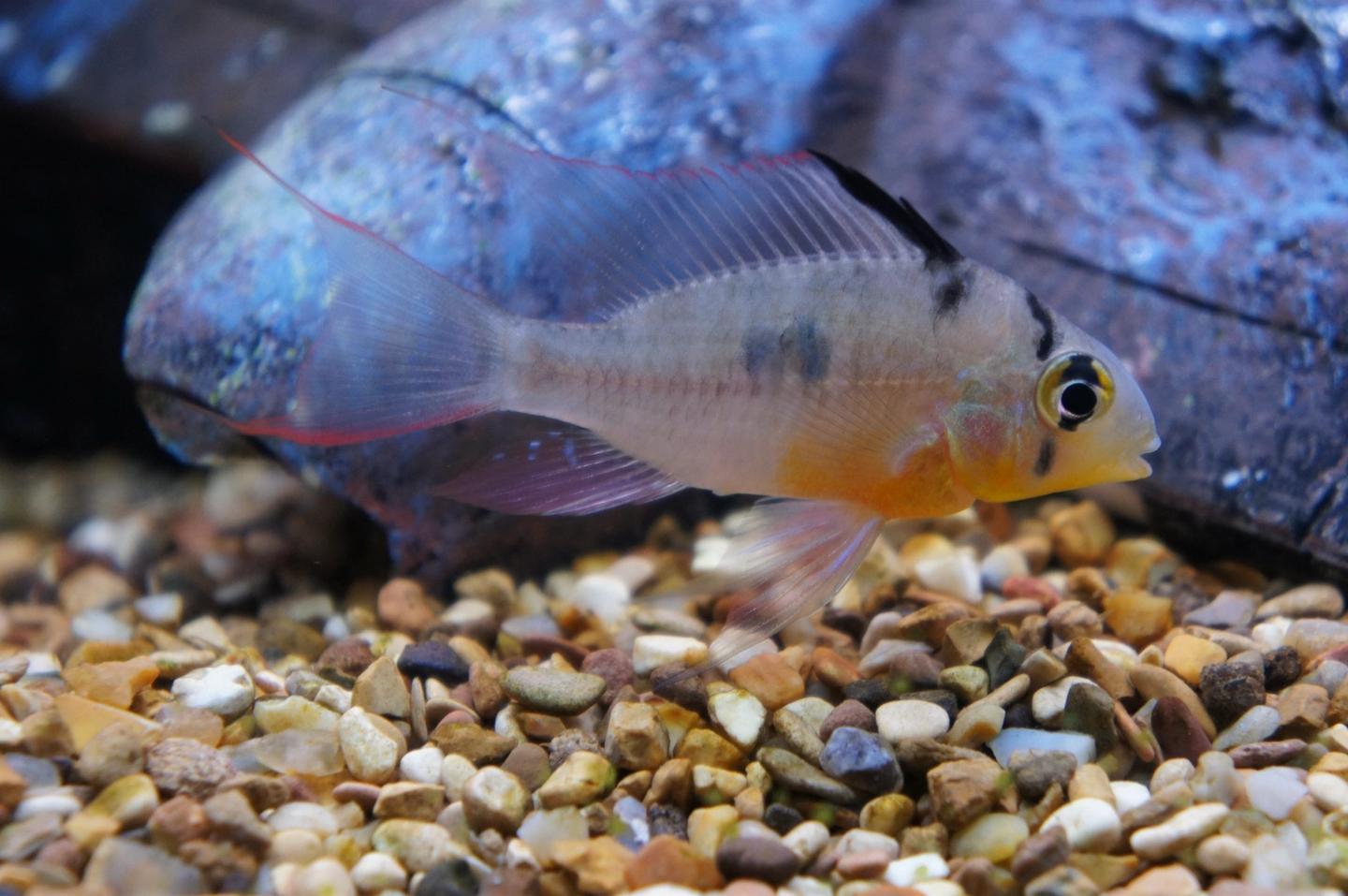
Cichlids are a family of roughly 1,800 accepted species, not one care type. Before buying, identify the exact species and source, then compare adult measurement, usable tank dimensions, social system, territory, tested water, diet and an exit plan. No family-wide minimum tank, water range or tank-mate list is safe.
Maintain these water conditions for optimal health and vibrant colors
Pelvicachromis taeniatus — Lobe is a West African dwarf cichlid listing in which “Lobe” is the supplied trade-form label. The accepted species name is Pelvicachromis taeniatus. FishBase places that species in the family Cichlidae and records its accepted distribution from eastern Benin to Nigeria, including coastal freshwater areas and the Niger delta. FishBase also says that reports from Cameroon and Bioko belong to Pelvicachromis kribensis. “Lobe” here names the trade form; it does not certify Lobe River, Cameroon provenance or a locality-specific genetic line.
One purchase supplies one live, unsexed fish. The current offer has 3–4 cm and XL dispatch choices. The size you select is the size supplied, not the adult size. “XL” is the supplier’s grade label rather than a centimetre measurement. FishBase records a species maximum of 7.1 cm standard length, while Seriously Fish records 8 cm standard length. Standard length excludes the tail fin; use the larger 8 cm record for conservative adult-space planning, and keep both adult records separate from dispatch grade.
This fish is best considered by a keeper who can offer a mature, filtered aquarium, stable water, cave-like shelter, broken sightlines and a response plan if two fish do not form a compatible pair. FishBase records aquarium keeping in pairs and an 80 cm minimum aquarium length. Seriously Fish gives a 60 × 37.5 × 30 cm, 71-litre aquarium as suitable for one pair. Those figures describe different parts of aquarium planning: volume alone does not replace useful floor space, and length alone does not account for biological load, cover or companions.
Seriously Fish provides species-level aquarium guidance of 22–26°C, pH 5.0–7.5 and 5–12°dGH. FishBase gives 22–25°C, pH 6.0–8.0 and 5–12°dH as environmental values in its species record. This page uses the Seriously Fish range for routine aquarium guidance and identifies the FishBase values as a separate wild or environmental record rather than blending the two ranges. Test the actual aquarium and source water; the water matcher can help compare measured values with the stated guidance.
| Good fit when | Choose a different plan when |
|---|---|
| The aquarium is mature, filtered and stable, with a useful footprint, caves and visual barriers. | The tank is uncycled, has no retreat space, or its water falls outside the species range. |
| The keeper can observe a prospective pair and separate fish if chasing becomes persistent. | Two unsexed fish are being purchased on the assumption that they must become a compatible pair. |
| Companions are calm enough, share the water range and leave room for a territory. | Large or very vigorous fish dominate the aquarium, or several cichlid territories are being forced into a small footprint. |
The store retains “easy” as a customer-facing suitability label, not as a scientific fact or a guarantee that every community will work. The routine tasks are straightforward for a prepared keeper, but behaviour changes when a territory or breeding site is defended. Seriously Fish describes the species as shy and retiring in general while warning that it becomes territorial when breeding. A calm fish on one day is not proof that the social plan will remain unchanged.
Sex is guaranteed only when the selected option explicitly states male or female. This Pelvicachromis taeniatus lobe listing has no sex-guaranteed option.
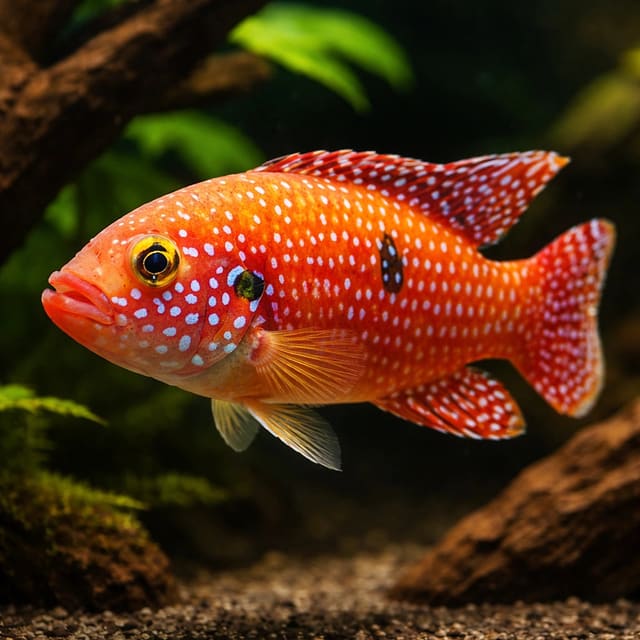
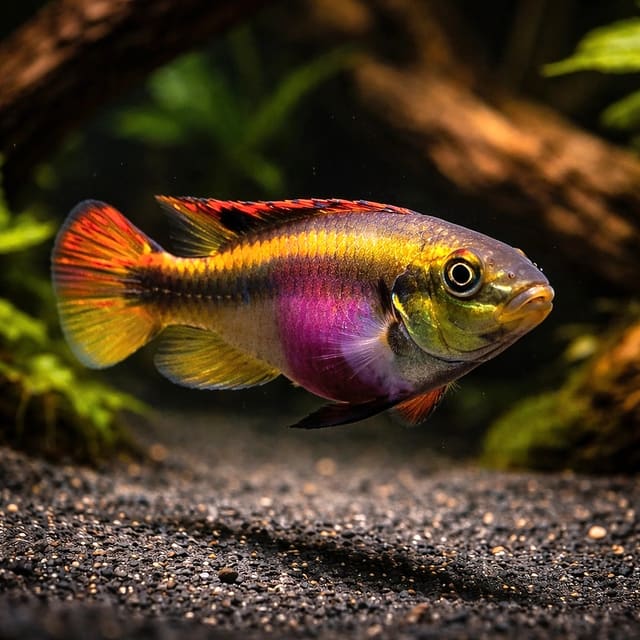
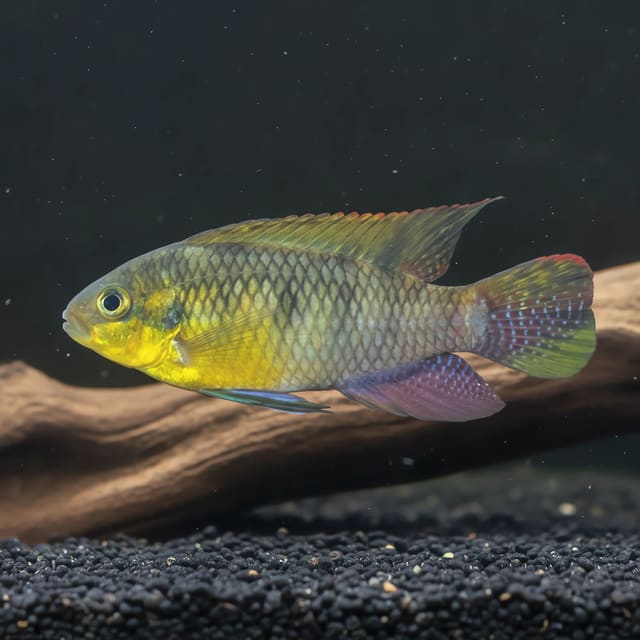
Gallery images have been digitally enhanced to improve image quality. Natural colour, pattern, size and maturity can vary between live animals.
Browse the African cichlid collection to compare other current choices. Products in that collection are alternatives to research, not automatic tank mates for this fish.
Seriously Fish gives 71 litres in a 60 × 37.5 × 30 cm aquarium as suitable for one pair. FishBase records an 80 cm minimum aquarium length. Rather than treating either number as permission to ignore the other, use them together as conservative planning inputs. A long, well-structured floor area gives a bottom-oriented cichlid more practical space for caves and separate routes than a narrow, tall aquarium of similar volume. If other fish are present, choose the aquarium around the complete adult community and its territories.
The source guidance says the species should be kept in pairs. That does not mean any two unsexed fish will be compatible. A purchased fish is not sex-guaranteed, and body shape or colour in one listing photograph is not a reliable way to assign the sex of the animal supplied. When introducing two individuals, provide more than one shelter, observe access to food and resting areas, and be ready to separate them into another mature, heated and filtered aquarium if one fish is persistently excluded.
More than one pair needs a much larger aquarium under the Seriously Fish guidance because each pair may require its own territory. Do not multiply the 71-litre figure mechanically or assume that extra caves can make a cramped floor plan safe. Territorial boundaries change with maturity and breeding condition. If repeated chasing spans the whole aquarium, fins are damaged, or one fish remains hidden and misses meals, the layout or stocking plan has failed even if the nominal volume appears adequate.
A new aquarium must be biologically mature before these fish arrive. A filter needs an established population of bacteria to convert toxic ammonia to nitrite and then nitrate. Work through the first tropical tank guide before setting an arrival date if the aquarium has not already completed a verified cycle. Add livestock gradually and test after each addition; biological capacity does not appear simply because water has been circulating for a few days.
| Planning point | Care reference |
|---|---|
| Routine aquarium temperature | 22–26°C from the Seriously Fish species profile |
| Routine aquarium pH | 5.0–7.5 from the Seriously Fish species profile |
| General hardness | 5–12°dGH from the Seriously Fish species profile |
| FishBase environmental record | 22–25°C, pH 6.0–8.0 and 5–12°dH; retained as a separate scope |
| Ammonia and nitrite | 0 mg/L under broad OATA dwarf-cichlid guidance |
| Nitrate | No more than 20 mg/L above normal tap-water level under OATA guidance |
| Single-pair aquarium | 71 litres in a 60 × 37.5 × 30 cm tank from Seriously Fish, alongside FishBase’s 80 cm minimum length |
Routine care should favour stability within the species range rather than repeated chemical correction to chase one exact number. Test tap water and aquarium water for pH and hardness before purchase. If the source water requires constant large adjustments, a fish naturally suited to that water may be a safer choice. The water chemistry guide explains how pH, hardness, ammonia, nitrite and nitrate interact, so the values can be managed as a system.
OATA’s dwarf-cichlid sheet gives a broader group range of 22–27°C, pH 6.0–8.0, 4–12°dH and 3–10°dKH. That group-level envelope is helpful context for general maintenance, but it does not displace the narrower species-level aquarium guidance from Seriously Fish. OATA also gives the zero-ammonia, zero-nitrite and nitrate-above-tap-water values on this page. Every numerical value keeps its source and scope rather than being assembled into a new composite target.
Temperature influences oxygen demand and metabolism. Use a reliable heater where room conditions cannot keep the chosen temperature stable, and check it with a separate thermometer. Avoid direct sun, radiators, cold draughts and rapid changes during water replacement. A heater guard may be appropriate where fish can rest against equipment, and all electrical equipment should be installed with safe drip loops.
Seriously Fish recommends plenty of caves and cover, with roots and branches creating shaded places. It says plants are not essential but can be included, and it permits sand or fine gravel. Build several potential shelters rather than one prized central cave that every fish must contest. Arrange wood, robust planting and other aquarium-safe décor to interrupt direct sightlines while preserving routes around the layout.
Secure stones and wood so digging or maintenance cannot collapse a structure. Caves should not trap waste or create an opening in which a fish can become wedged. Leave enough accessible substrate for siphoning, and avoid sharp edges around narrow entrances. A darker retreat can help a shy fish settle, while open feeding space lets the keeper confirm that each animal eats.
Territory is not just the cave itself. A breeding fish may defend an area around it, so crowding every shelter into one cluster can create a single contested zone. Spread shelters across the footprint and use roots or plants as visual dividers. If companions are included, make sure their normal routes do not force them through the cichlid’s only retreat. The ability to move out of sight is often more useful than decorative density alone.
Use a secure lid and protect large filter-intake openings. Maintain surface movement for oxygen exchange without turning the entire tank into a high-speed channel. Observe the fish: it should be able to hold position, feed and leave a defended area without continuous effort. If the return creates a harsh jet, diffuse or redirect it rather than assuming stronger flow is always healthier.
The RSPCA states that no fish should be kept without a well-set-up and maintained filter. Fish release ammonia, and an established biological filter converts ammonia to nitrite and then nitrate. Clear water can still contain dangerous dissolved waste, so appearance is not a substitute for testing. Check ammonia and nitrite whenever a fish is added, feeding changes, the filter slows, or behaviour becomes unusual.
OATA recommends weekly testing and a weekly water change of about 25% for dwarf cichlids. Use that as a routine starting point and adjust according to measured nitrate, stocking and feeding. Condition tap water for chlorine or chloramine and bring replacement water close to the aquarium temperature. Avoid abrupt pH or temperature changes, especially when the established aquarium differs from the tap.
Rinse dirty biological media gently in water removed from the aquarium, not under the tap. Do not replace all mature media at once. Check the intake, impeller and return so a decline in flow is identified early. Siphon accessible debris while leaving stable planted areas intact, and inspect caves for trapped food. Maintenance should remove waste without dismantling the entire territory every week.
Record temperature, pH, ammonia, nitrite and nitrate. Add hardness when source water varies or when a move changes the supply. A short log reveals trends that a single test can miss. Rising nitrate, reduced flow and leftover food together point towards a load or maintenance problem; adding another product without correcting the cause is unlikely to help.
Seriously Fish says P. taeniatus accepts most foods offered but recommends live and frozen varieties as the bulk of the diet. Choose correctly sized, reputable foods and use variety rather than one rich item at every meal. Frozen and live foods should be suitable for aquarium use; avoid collecting from polluted or uncertain outdoor water.
Offer a modest amount and watch both access and waste. In a pair, one fish may control a preferred feeding spot even without obvious injury. Use more than one small feeding point where necessary and confirm that the less dominant fish swallows food. Remove persistent leftovers and reduce the next portion. Food decomposing in caves can raise the load on the filter before it is obvious from the front glass.
Body condition, activity and steady feeding are more useful than a rigid scoop size. A newly arrived fish may be hesitant, but repeated large meals will not solve transport stress. Offer a small portion at the normal feeding time, remove waste and review water quality if feeding interest remains poor. Sudden refusal in an established fish is a reason to test and observe, not proof of one specific disease.
Measure the aquarium’s actual dimensions and estimate usable volume after substrate and décor. Confirm that the filter is mature, the heater is stable and the lid closes around cables. Test the water before the parcel is due, prepare conditioner and a clean aquarium-only bucket, and decide which shelters can be adjusted if one fish is cornered. A spare mature separation aquarium is safer than improvising an uncycled container during a conflict.
Plan the social arrangement honestly. One purchase is one unsexed fish. Two purchases do not create a sex guarantee or a compatibility guarantee. If adding a fish to an existing individual, use visual barriers and close observation; do not place a new arrival directly into the only occupied cave. If the aquarium already contains cichlids, map their territories before assuming another can be fitted into unused-looking water.
Check compatibility at adult size. Very vigorous or large fish are specifically discouraged by Seriously Fish because this cichlid is generally shy outside territorial periods. Even a nominally peaceful companion can fail if it takes every meal, occupies the bottom cover or needs different water. The right question is whether the complete community can feed, retreat and move without chronic pressure.
The full packing, receipt and guarantee terms remain on the delivery page. Temperature matching and gradual chemistry adjustment solve different parts of the introduction, so neither should be shortened into “float and release.” If source and destination water differ sharply, work calmly within the applicable introduction guidance and avoid transferring shipping water.
During the first week, check ammonia and nitrite after the new biological load is added. Observe breathing, balance, appetite, fin condition and access to shelter. Transport colour is not a reliable guide to sex or permanent pattern. If one fish is pursued whenever it emerges, cannot eat, or shows worsening damage, use the prepared separation plan rather than waiting for the pair to “sort itself out.”
Seriously Fish recommends this species for a general community but adds two important limits: it becomes territorial when breeding, and it should not be kept with very vigorous or large species because it is generally shy and retiring. Those statements describe a conditional community fish, not a universally peaceful one. Aquarium footprint, cover, adult size, swimming pace, water overlap and access to food all need to work at the same time.
The source names small characins, barbs, danios, rasboras, Corydoras, gouramis and loricariids as possible companion kinds. Treat these as categories to assess, not guarantees for every species or individual. Some barbs are much more vigorous than others, some gouramis defend space, and some loricariids compete for caves. Compare the exact species, adult size and water requirements before deciding.
Very vigorous or large fish are the clearest avoid category from the species profile. Fast, forceful feeders can leave a shy cichlid underfed even when no overt attack occurs. A large fish may also treat a smaller individual as prey or keep it permanently hidden. Feeding success, posture and use of the aquarium should therefore be monitored alongside obvious chasing.
Other cichlids require enough space for territories. Seriously Fish identifies West African dwarf cichlids as a possible group but says territory formation must be accommodated. This is not a recommendation to combine several cave-spawning species in a small tank. Sketch where each territory, feeding route and retreat would be, then leave margin for boundaries to expand during breeding.
A compatible pair is still capable of defending a breeding area. Use multiple caves and visual breaks, and avoid placing the only feeding station beside the preferred shelter. If companions repeatedly lose access to part of the tank, the community is not working simply because there are no torn fins. Chronic hiding, skipped meals and rapid breathing are meaningful welfare signals.
Do not use colour or shape from the gallery to select a male or female. The offer is unsexed, and the exact fish supplied may differ in colour, maturity and condition. Seriously Fish describes general sexual dimorphism for the species, but those general traits cannot assign sex to the fish supplied or pictured. If a particular sex is essential to a stocking plan, choose an offer that explicitly states it.
Compatibility remains an observation after introduction, not a conclusion reached at checkout. Introduce fish only to a stable aquarium, monitor more than the first few minutes, and intervene before persistent exclusion becomes injury. Water tests should accompany behavioural checks because poor water can intensify stress and make normal social behaviour harder to interpret.
Seriously Fish records 8 cm standard length and FishBase records 7.1 cm standard length. Use the larger 8 cm figure for conservative adult-space planning while keeping the source difference visible. Dispatch size is a separate measurement of the fish supplied.
Seriously Fish gives 71 litres in a 60 × 37.5 × 30 cm aquarium as suitable for a single pair, while FishBase records a minimum aquarium length of 80 cm. Treat both as planning inputs: footprint, caves, sight breaks and room for any companions still matter.
FishBase and Seriously Fish describe pair keeping. This listing is unsexed, so purchasing two fish does not guarantee a male-female or compatible pair. Watch behaviour closely and have a safe separation plan if persistent chasing prevents normal feeding or resting.
The store retains an easy care label as a retailer assessment, but a keeper still needs a mature filtered aquarium, water testing, suitable cover and a plan for pair incompatibility or breeding territoriality. It is not a good shortcut for an uncycled first tank.
Seriously Fish says it accepts most offered foods but recommends that live and frozen varieties form the bulk of the diet. Use correctly sized foods, vary the offering and feed only what the fish can finish without leaving waste to decay.
Seriously Fish gives species-level aquarium guidance of 22–26°C, pH 5.0–7.5 and 5–12°dGH. FishBase records a narrower 22–25°C wild environmental temperature and pH 6.0–8.0; do not merge those different scopes into a claimed optimum.
Seriously Fish describes it as generally shy but territorial when breeding. The main risk is territorial chasing rather than a promise of constant peacefulness. Use caves, cover and sight breaks, watch all fish, and separate individuals if one cannot feed or rest normally.
Seriously Fish names small characins, barbs, danios, rasboras, Corydoras, gouramis and loricariids as possible kinds, but not universal guarantees. Avoid very vigorous or large fish, require overlapping water needs, and provide enough territory before considering other cichlids.
Tropical Fish Co hand-packs live fish in oxygen-filled bags inside an insulated box and uses a tracked courier licensed for live animals. Someone must receive the parcel. Start a continuous video before opening the sealed box and keep the unopened bag in view if a Live Arrival Guarantee claim may be needed.
FishBase: Pelvicachromis taeniatus supports the accepted name, family, recorded distribution, 7.1 cm SL maximum, environmental values, pair keeping and 80 cm aquarium-length note. Its Cameroon reassignment is why this page does not claim verified Lobe River provenance.
Seriously Fish: Pelvicachromis taeniatus provides the 22–26°C, pH 5.0–7.5 and 5–12°dGH range, the single-pair aquarium example, diet, layout and conditional community guidance.
OATA: how to look after dwarf cichlids supplies group-level water-quality, maintenance, feeding and full introduction guidance. Group values are labelled as broad rather than substituted for the species profile.
RSPCA aquarium environment guidance explains biological filtration and the conversion of ammonia through nitrite to nitrate. Current packing, receipt and claim requirements are on the delivery page already linked in the care section.
No reviews for this item yet. Bought one? Honest reviews only, good or bad.
What customers say about ordering from us
Easy website plenty of info on fish your buying great to pick a time slot
TRACEY DURRANT · 7 Oct 2026
Got some lovely fish thank you
Kevin Mackie · 7 Oct 2026
Reviews of our shop, collected by Judge.me, an independent third-party review collector. Newest first.