By Tropical Fish Co Editorial Team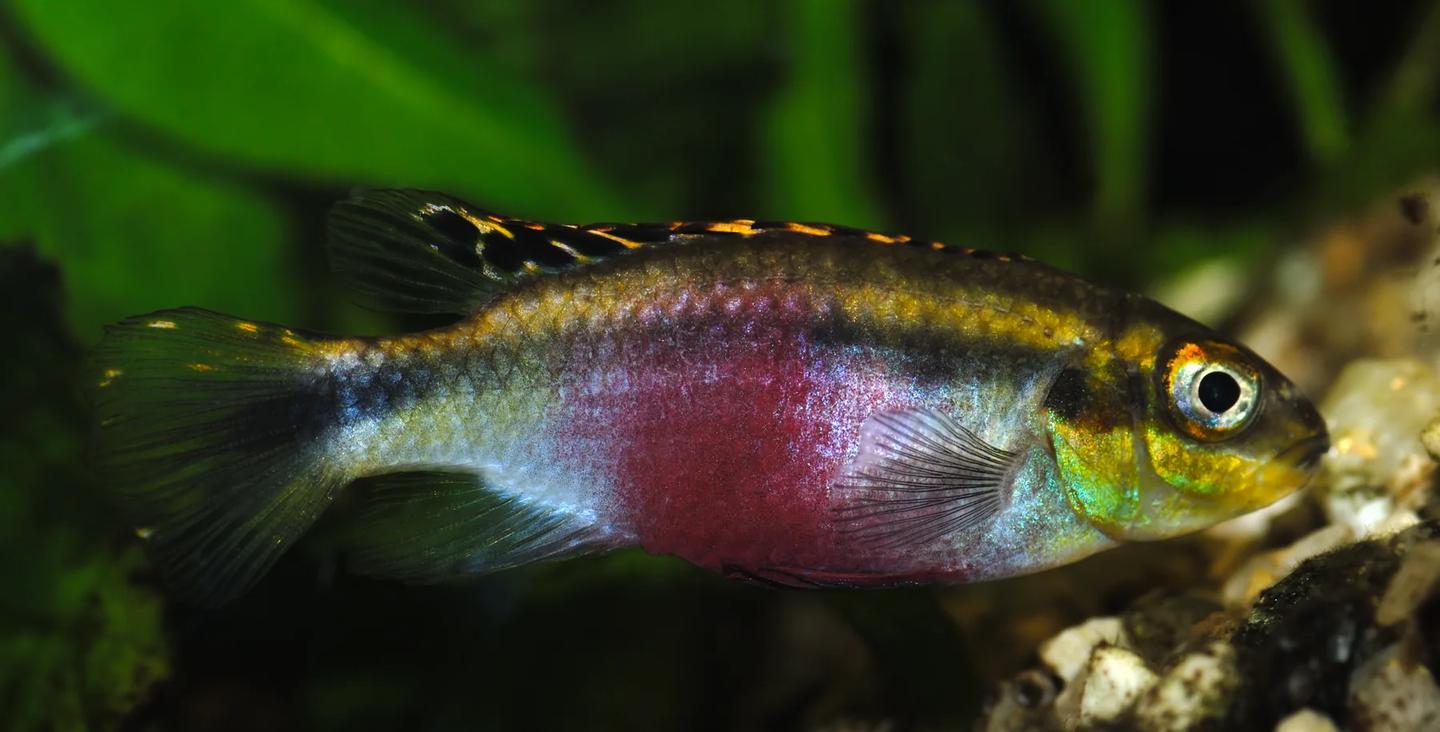
Is a kribensis right for your aquarium?
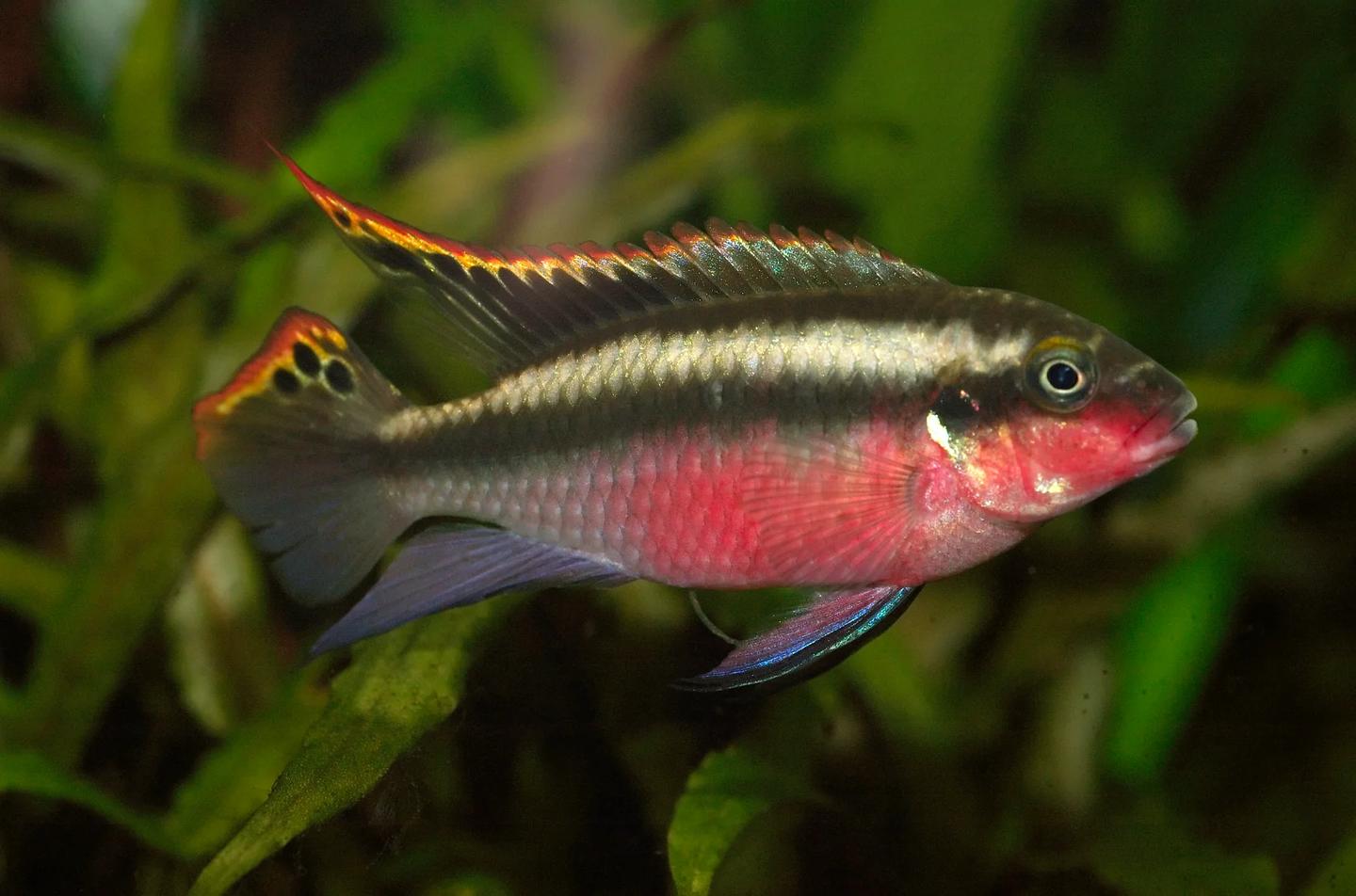
The standard kribensis in UK shops is Pelvicachromis pulcher: a West African cichlid that uses caves and lower-level territory. It can be a manageable first cichlid in a mature, carefully planned aquarium, but “beginner fish” must not be read as “works anywhere”. A pair can defend a cave and the surrounding floor strongly, especially when breeding [4][6].
Use four checks before buying:
- Identity: the listing says P. pulcher, not simply “krib”, and the photographed or selected form matches the product.
- Space: the aquarium is at least 80 cm long and about 80 litres for one established compatible pair, with more room for other fish.
- Stability: the filter is mature; ammonia and nitrite remain at non-detectable test levels; temperature and chemistry are measured.
- Behaviour: several shelters and sight breaks are ready, and you have a real separation option if the pair or community becomes incompatible.
If you are shopping, use the current catalogue links on this page when they appear or browse current African cichlids. The product pages own changing stock, price, size and sale-unit information. This guide does not promise that a photographed fish, sex, pair or colour is available now.
Current Pelvicachromis pulcher product pages
These exact catalogue links were verified for this guide. Open the product page to check the current identity, form, price, size, sale unit and checkout availability before buying.
- Exact fish: scientific name, form, sale unit and dispatch size are clear
- Aquarium: mature, at least 80 cm long and about 80 litres for one established pair
- Layout: several caves, broken sightlines and usable floor territory
- Water: stable and tested, with the seller's current water considered before any gradual change
- Fallback: a cycled separation space or practical return/rehoming plan exists
Tank Volume Calculator
Enter length, width, and height to get your real water volume in litres.
Open tool →“Kribensis” is a common name, not a complete identity
The Catalog of Fishes accepts Pelvicachromis pulcher as a valid species, and this is the fish most UK aquarists mean by kribensis, krib or rainbow krib [1]. The name is also used loosely for other members of the genus. That matters because a common label can hide a genuinely different species.
Pelvicachromis kribensis is itself a valid species from Cameroon—not another spelling of P. pulcher [2]. A 2014 revision also restricted P. taeniatus, revalidated P. kribensis and described P. drachenfelsi [3]. P. subocellatus is different again.
| Name seen in trade | What it means | Safe buying response |
|---|---|---|
| Kribensis / rainbow krib | Usually P. pulcher, but the common name alone is incomplete | Confirm the scientific name on the exact listing |
| Pelvicachromis pulcher “albino”, “gold” or other colour label | A supplier may be describing an aquarium appearance within P. pulcher | Confirm that the listing and image really refer to P. pulcher; colour is not a care guarantee |
| Pelvicachromis taeniatus plus a locality | A separate species label whose taxonomy and locality need exact checking | Do not assume it is a colour form or that every P. pulcher statement transfers unchanged |
| Pelvicachromis kribensis | A valid separate species | Treat as a separate identity and research it separately |
| Pelvicachromis subocellatus | A separate species | Do not fold it into a generic P. pulcher buying decision |
This page owns the broad UK search intent for P. pulcher kribensis care and buying. It deliberately does not merge every supplier-labelled locality or related Pelvicachromis species into one “same care” promise.
Tank size: use both length and litres
FishBase gives an 80 cm minimum aquarium length for P. pulcher [4]. That is length, not 80 litres. OATA's broader dwarf-cichlid guidance gives at least 60 litres for a pair and 80 litres when other fish are present [6].
Tropical Fish Co combines those sources into a cautious purchasing screen: at least 80 cm long and about 80 litres for one established compatible pair. Increase the footprint and volume for a community. This is an editorial welfare policy, not a statutory minimum, and it does not guarantee two unacquainted fish will accept one another.
Floor plan matters because caves and lower-level territory concentrate interactions. Build the aquarium around choices:
- provide more than one stable cave or shelter with entrances the keeper can inspect;
- break long sightlines with wood, rocks and established plants;
- keep open substrate for feeding and normal movement;
- secure structures so digging cannot undermine them;
- leave more than one route away from a defended cave;
- keep the heater protected and the cover secure;
- reserve genuinely usable space for adult tank mates, not just their current shop size.
A second pair is not a simple “double the litres” calculation. Two pairs may establish overlapping territories, and the least dominant fish still needs somewhere to escape. A single established pair is the clearer default for most home aquariums.
Water: match the fish, not the postcode
FishBase compiles 24–25°C, pH 5.0–8.0 and 5–19 dH for the species [4]. OATA's group-level dwarf-cichlid guidance is broader for temperature but narrower for chemistry: 22–27°C, pH 6–8 and 4–12 dGH [6]. Published ranges are context, not instructions to move a fish between their edges.
Use 24–25°C as the species-led starting range, then confirm the seller's stable water and the needs of every companion. Make any necessary chemistry change gradually. RSPCA guidance supports a fully cycled filter, a thermostatically controlled heater, an independent thermometer, dechlorination and routine testing before fish are added [7].
The practical priorities are:
- ammonia and nitrite remain at non-detectable test levels;
- temperature stays stable and is checked independently;
- pH, GH/KH and nitrate trend are measured rather than guessed;
- replacement water is conditioned and reasonably matched;
- filtration provides oxygenation without preventing normal swimming or feeding;
- maintenance avoids abrupt temperature or chemistry swings.
UK tap-water hardness varies by local geology and supplier. The Drinking Water Inspectorate directs consumers to their local water company for source-water information [8]. That report is useful context, but it does not replace testing the aquarium or the water you are about to add.
Water Parameter Matcher
Enter your tap water readings to see if this species will thrive.
Open tool →Freshwater—not a reason to add routine salt
FishBase's environmental classification includes freshwater and brackish records, while the River Sombreiro field study documented P. pulcher in upstream cold, soft and acidic freshwater [4][5]. Neither source justifies adding aquarium salt routinely. Keep this species as a freshwater fish unless a suitably qualified fish-health professional gives a case-specific reason for a treatment.
Pairing, territory and tank mates
“Peaceful community cichlid” is too simple. Kribensis can coexist with other fish in a well-designed aquarium, but a compatible pair may defend its cave and nearby floor. Behaviour varies with individual, space, cover, maturity and breeding state [6][12].
There is no universal safe-fish list. Assess each proposed companion:
| Question | Lower-risk answer | Warning sign |
|---|---|---|
| Do their stable water and temperature needs overlap? | All species can remain within one stable evidence-led range | One fish is merely tolerating the other's preferred conditions |
| Do they compete for the same floor or cave? | Companion mainly uses another level and can leave the territory | Corydoras, loaches or another cichlid repeatedly enter the cave zone |
| Can either animal swallow or injure the other? | Adult size and mouth size make predation less likely | Very small fish, fry, shrimplets or vulnerable moulting shrimp |
| Can every fish reach food? | Each animal is observed swallowing an appropriate diet | Fast feeders repeatedly take food first |
| Can pressure be interrupted? | Sight breaks and several routes let fish disengage | A subordinate fish is pinned behind equipment or at the surface |
| Is separation available today? | A mature alternative space or immediate safe plan exists | The plan depends on buying a tank after injury occurs |
Mid-water fish may create less direct cave competition than other bottom-oriented species, but “less direct” is not “safe”. Corydoras are especially poor candidates for a blanket recommendation because they repeatedly use the same floor space and may not respect a breeding boundary. Other cichlids can add territorial conflict. Very small fish, eggs, fry and shrimp may be eaten.
What does incompatibility look like?
Do not wait only for torn fins. Persistent hiding, a fish held at the surface or behind equipment, repeated blocked access to food, rapid breathing, weight loss and continuous chasing can all show that the arrangement is failing. Test water first because poor water can mimic or amplify behavioural stress, then separate incompatible animals safely.
For a wider comparison process, use our cichlid care guide. A related guide or product link is evidence to compare, not a compatibility guarantee.
Male and female kribensis: use several clues
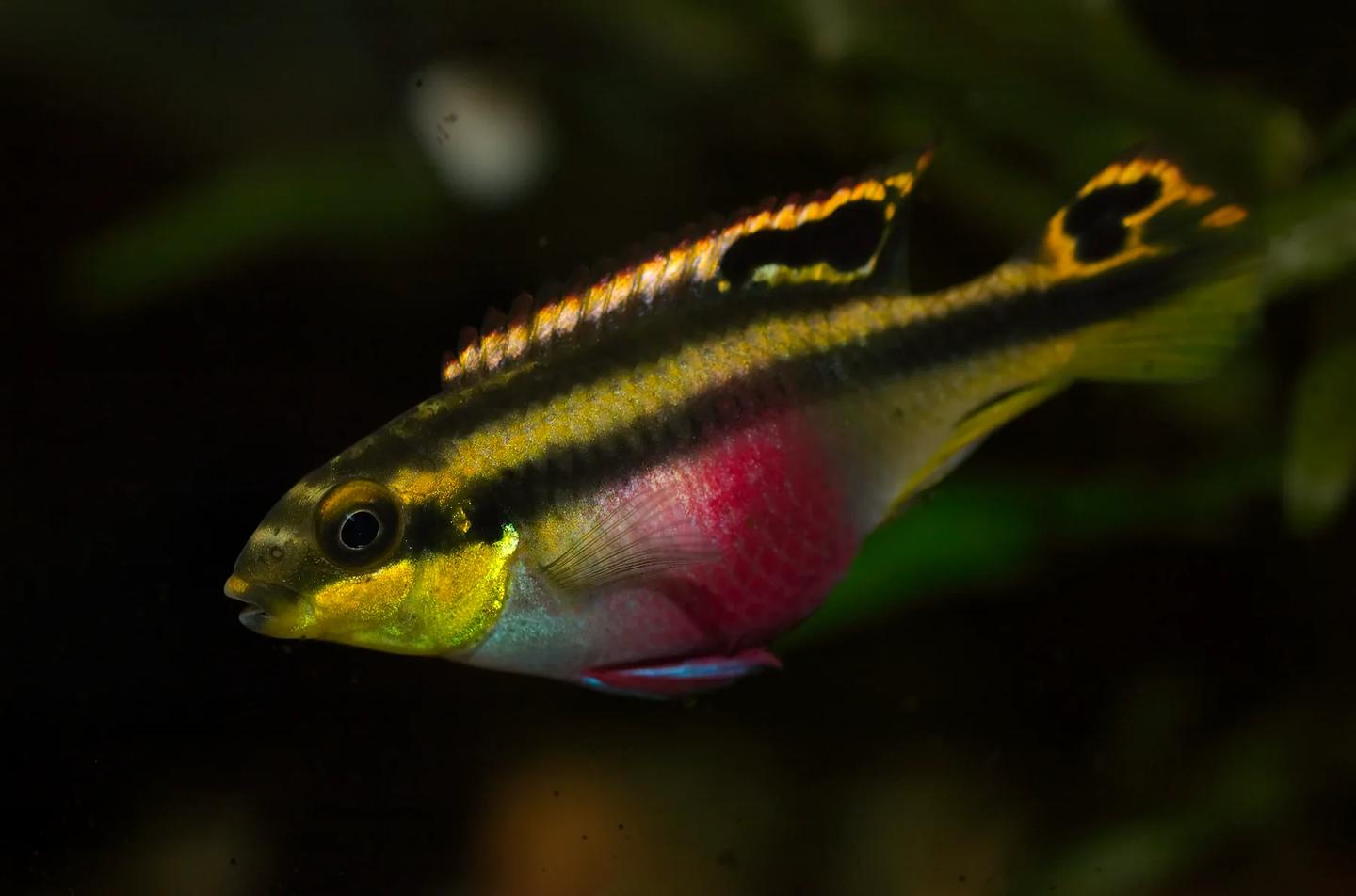
Adult females are often shorter and deeper-bodied, with a more rounded abdomen that can become purple-red. Adult males are often longer and may have more extended dorsal, anal and caudal fin tips. Practical Fishkeeping treats these visible features as useful sexing clues [12].
No single feature guarantees sex. Juveniles may not show adult differences; stress, condition, aquarium strain and individual variation can alter colour or outline. A seller's sex label or one photograph should therefore be treated as information to verify, not proof that two fish form a compatible pair.
Pair compatibility is also separate from sex. A male and female can reject or injure one another. Watch their behaviour, offer multiple shelters and retain a separation option even when the sale unit is described as a pair.
Feeding and natural history
The River Sombreiro study found benthic algae, higher-plant material, detritus and copepods in the diet, while FishBase also compiles worms, crustaceans and insects [5][4]. That supports a varied omnivorous diet; it does not mean a captive fish “eats anything”.
Use a nutritionally complete cichlid food of suitable particle size as the staple and add appropriate prepared, frozen or live variety. Feed amounts that are taken cleanly, remove persistent waste and observe each fish actually swallowing. In a community, food entering the water is not proof that a slower or subordinate fish ate enough.
Sudden appetite loss is not a diagnosis. Check temperature, ammonia, nitrite, other water trends, social pressure and recent changes. Isolate when necessary and use a fish-experienced vet or label-led professional advice rather than improvised heat, salt or medication recipes [13][14].
Breeding and parental care: fascinating, not guaranteed
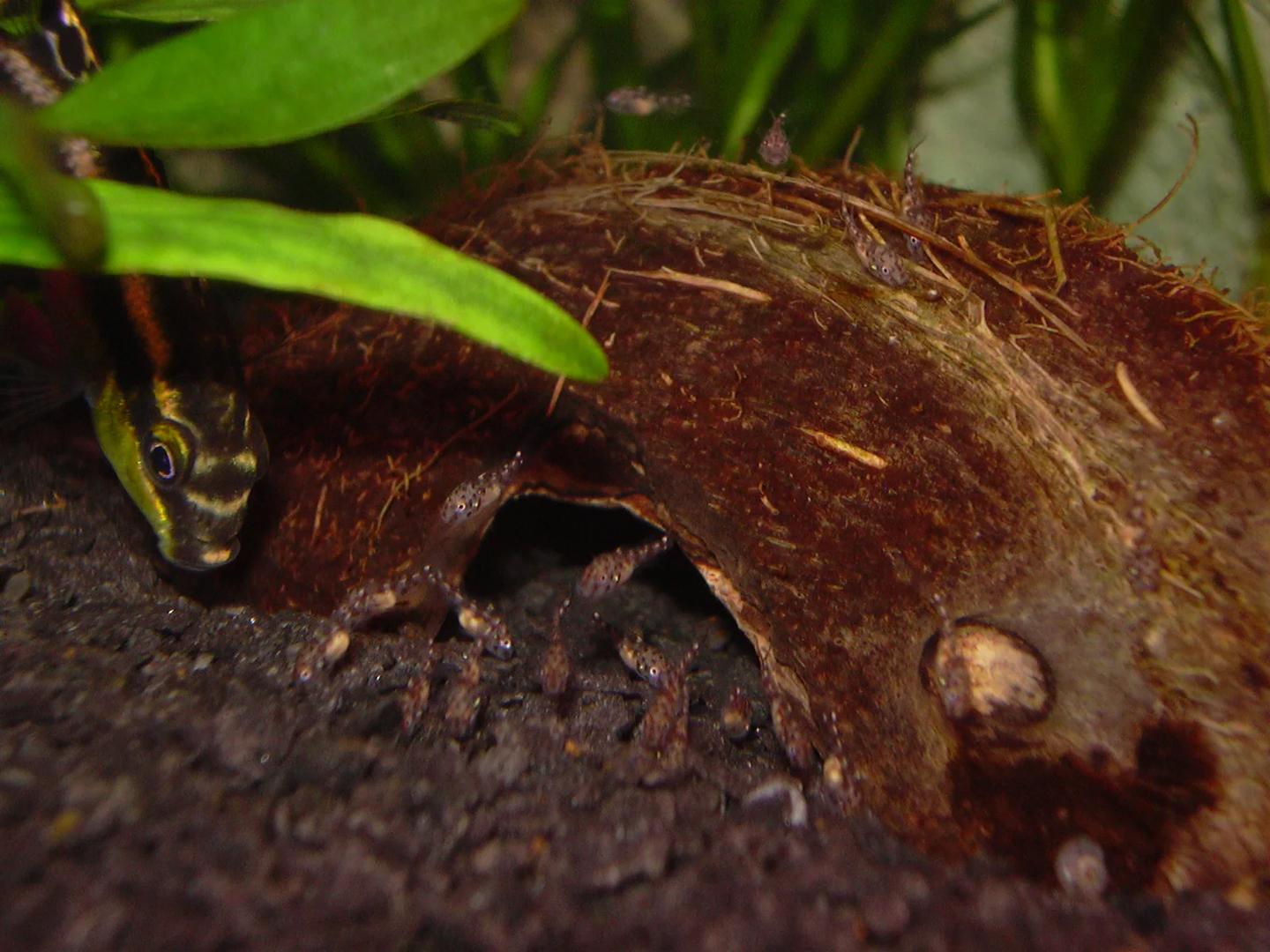
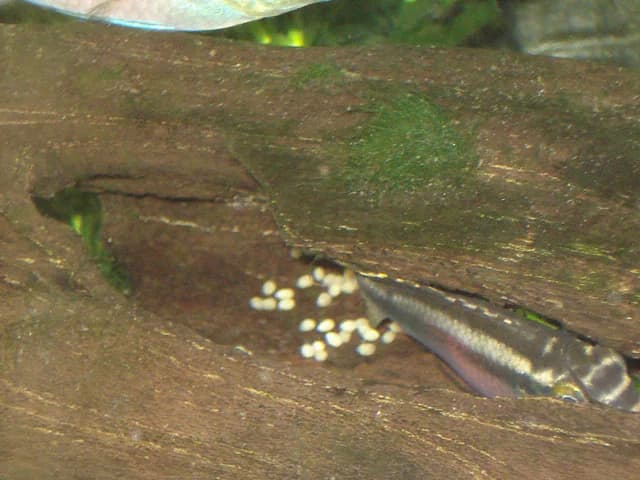
P. pulcher is a cave spawner. FishBase reports pairing and cave spawning, while experimental work supports a parental state in which adults can recognise and care for young [4][11]. The gallery photographs show real examples of an adult with young and a female beside eggs.
Those facts do not promise that any two fish will pair, that every clutch will hatch or that every adult will protect fry. In Nelson and Elwood's experiment, non-breeding adults ate young conspecifics [11]. Adults can also redirect aggression towards a partner or tank mates. Provide several shelters, watch both adults, keep separation available and arrange responsible homes before deliberately producing fry.
The pH and sex-ratio finding—correctly stated
A controlled study found that developmental pH influenced both sex ratio and male morph in P. pulcher [9]. In the reported treatments, pH 5.5 produced a higher proportion of males than pH 6.5. That is the reverse of the common online claim that more acidic water automatically produces more females. A later review places the result in the wider, complex field of environmental sex determination [10].
This is a probabilistic research result, not a precise switch and not a reason to manipulate a home aquarium at the expense of stability or welfare. The previous version of this guide stated the direction incorrectly; the primary paper has now been allowed to control the correction.
Buying kribensis online in the UK
Before payment, check the exact listing rather than relying on a search-result title or generic image:
- Scientific identity: does it say P. pulcher, or is another Pelvicachromis species/locality involved?
- Sale unit: one fish, a selected sex, or an established pair?
- Dispatch size: what size is being sent, and is that clearly different from adult size?
- Current water: what temperature, pH and hardness is the fish living in now?
- Photograph scope: is the image of the exact fish, the exact trade form, or only a representative species photograph?
- Delivery instructions: what does the seller require on arrival and under its live-arrival policy?
Use our delivery information for the current Tropical Fish Co process. Follow the current seller instructions supplied with the order; this page deliberately avoids a universal float time or drip rate because bag water, journey conditions and local water differ.
Product links on this page are explicit catalogue matches, not stock promises. If a product page is unavailable, that is not an invitation to treat an old article sentence as stock confirmation. Search again later or browse the African cichlid collection.
What this guide corrected
This revision removed unsupported promises that kribensis are always peaceful, ideal for every beginner, equally suited to all UK tap water or guaranteed to raise fry. It corrected the direction of the published pH/sex-ratio result, separated P. pulcher from valid related species, removed an unevidenced exact lifespan, replaced fixed acclimation instructions, and stopped presenting generic illustrations as current facility or stock photographs.
The article combines current taxonomy, scientific records, peer-reviewed studies, UK welfare guidance and clearly labelled specialist context. Retail availability is commercial information and can change; husbandry claims are kept separate from the product cards. If you find a source conflict or a factual problem, use the visible correction channel on this page so the claim can be checked against the cited work.