
 By Priya Ramesh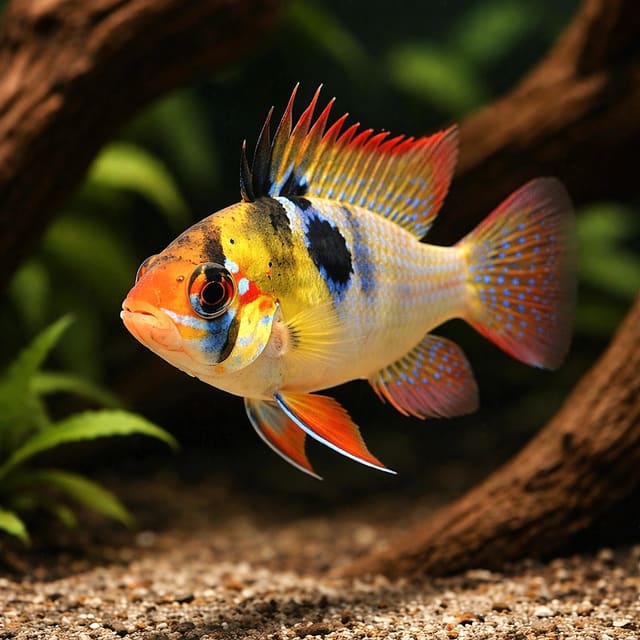
Asia Form Ram Cichlid (Mikrogeophagus ramirezi)
27–30°C · pH 4–7 · 54L
£5.99
South American Cichlids · Buying Guide
German blue ram care made honest — warm 27–30°C, soft stable water, tank size, tank mates and the electric blue & gold rams in stock. Shop now.
11 products in stock today
Live prices and stock. Every fish covered by our Live Arrival Guarantee.
27–30°C · pH 4–7 · 54L

27–30°C · pH 5.5–7 · 60L
27–30°C · pH 4–7 · 54L
27–30°C · pH 5–7 · 54L

21–25°C · pH 5–7
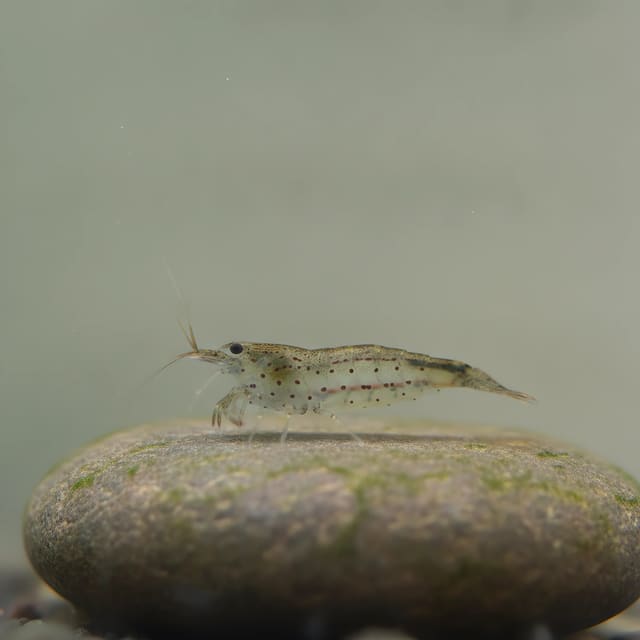

27–30°C · pH 5.5–7 · 60L

27–30°C · pH 5–6 · 54L
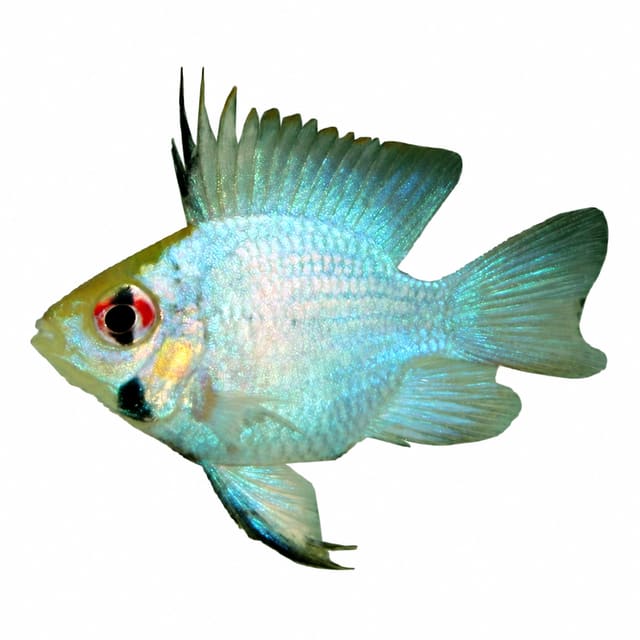
27–30°C · pH 5–6 · 54L
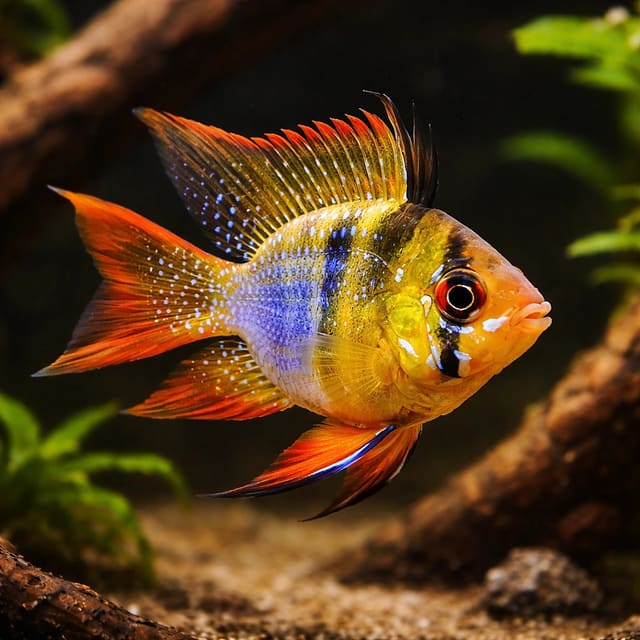
24–27°C · pH 6–7.5 · 60L

27–30°C · pH 4–7 · 54L
The shaded band shows the range german blue ram is comfortable in. Match it to your tap water before you buy.
Our trained assistant knows this german blue ram page inside out. Ask it anything — water parameters, tank mates, how many to buy — or have it read the guide aloud while you set up your tank.
You have probably already decided you want a German blue ram. Most people have — they see that gold-and-electric-blue body with the red eye in a shop tank and they're sold before they've read a word of care advice. The problem is that almost every guide online either skips the awkward truth or buries it: the german blue ram is a genuinely sensitive fish, and far more of them die in their first month than anyone admits.
I'm Priya, the dwarf-cichlid and discus keeper here at Tropical Fish Co. I've bred South American dwarf cichlids for years and I keep rams in my own soft-water tanks at home, so this isn't library research — it's what I'd actually tell you across the counter. And what I'd tell you is this: the ram cichlid is one of the most beautiful small fish in the hobby, and one of the easiest to kill if you treat it like a hardy community starter.
This page is the answer we give when a customer asks, "I love that little blue cichlid — can I just put a pair in my tank?" The honest reply is maybe, but only if your tank is warm, soft, mature and stable. Get those four things right and a ram will give you years of colour and the best personality of any nano cichlid. Get them wrong and you'll be back in a fortnight wondering why your fish is hiding and refusing food. Let's make sure it's the first outcome.
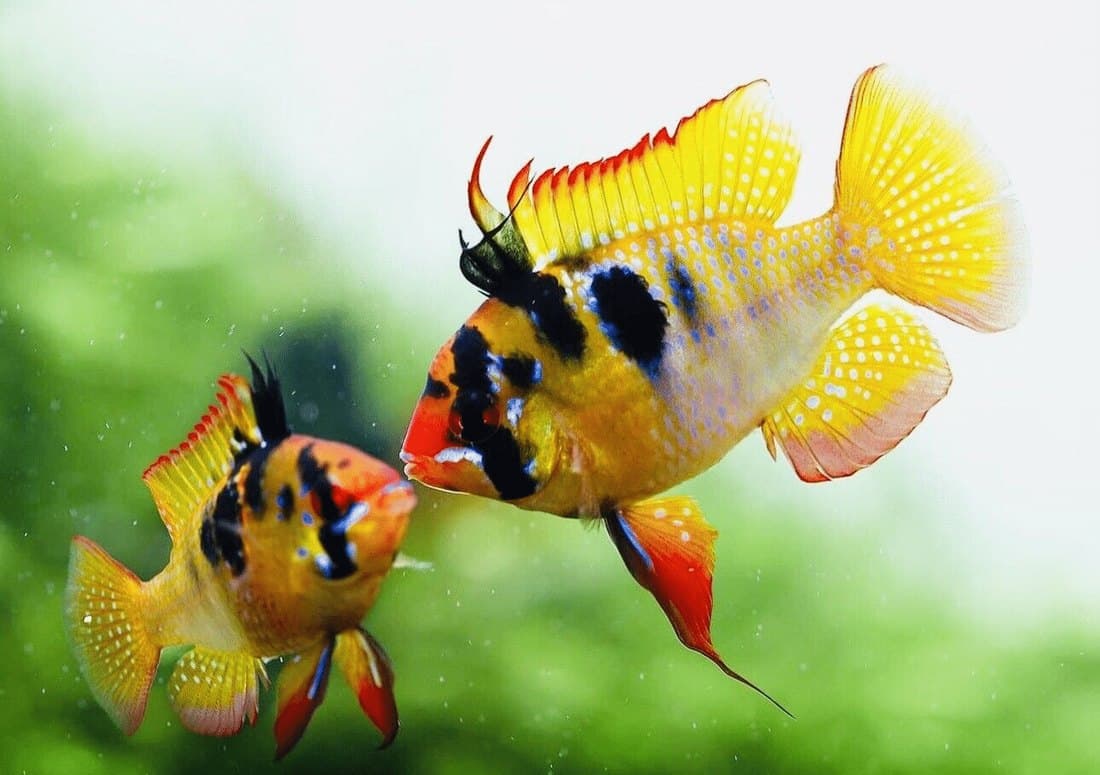
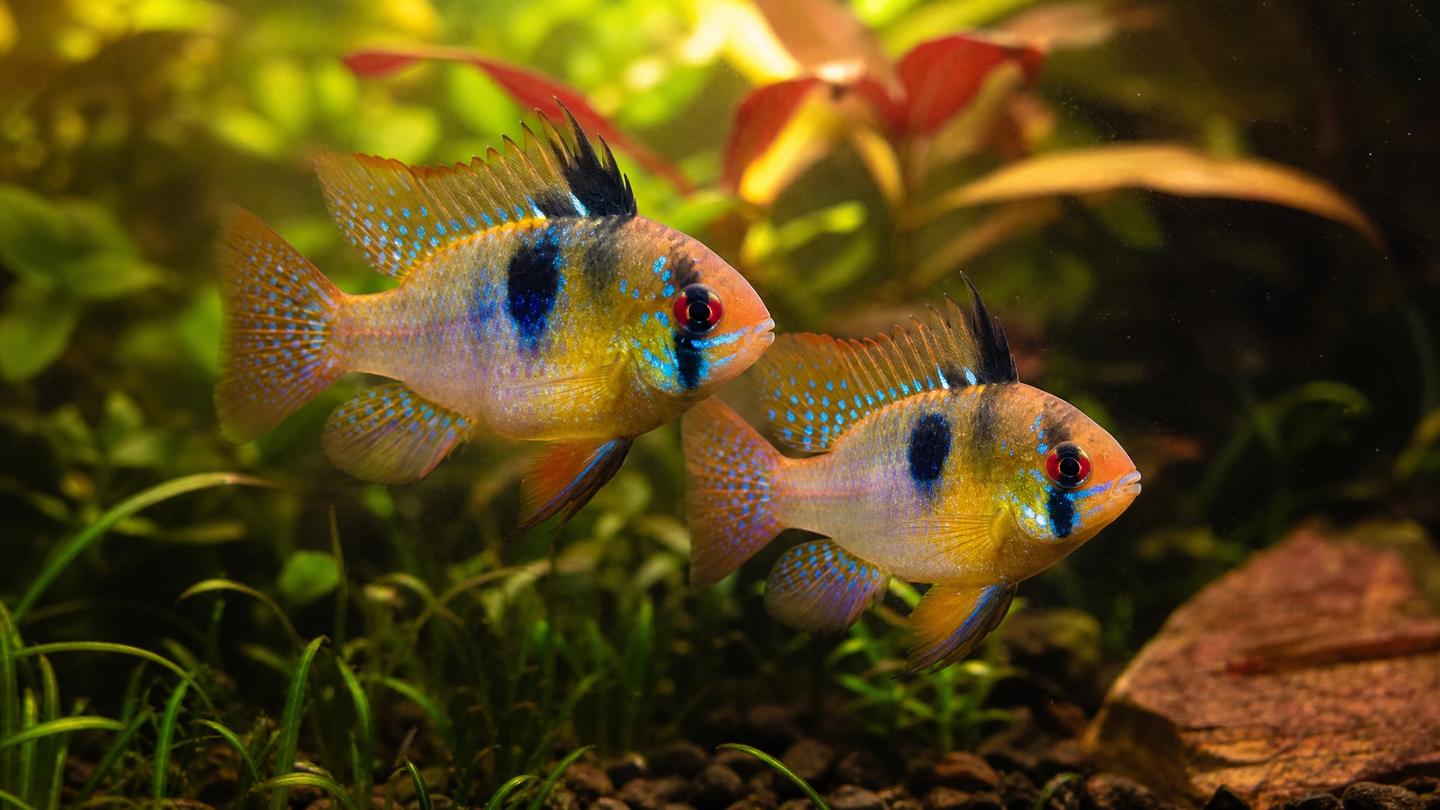
Mikrogeophagus ramirezi — the gold body, scattered electric-blue scales, red eye and black vertical eye-bar are textbook. This is one of our in-stock rams, photographed in our facility. Credit: Tropical Fish Co.
The German blue ram is sensitive, not hardy. It needs warm water (27–30 °C), soft acidic conditions, and a fully matured, biologically stable tank. Never add rams to a new aquarium, and never let the temperature drift down to "ordinary tropical" 24 °C. Almost every ram that dies young in a UK tank dies for one of those two reasons.
The ram is far more interesting than its shop-tank reputation suggests. Five things worth knowing before you buy:
Rams evolved in shallow, sun-warmed llanos pools that sit well above typical "tropical" tank temperatures. At 27–30 °C their immune system and metabolism work as intended; held cooler, they become markedly more prone to ich and bacterial infection. FishBase records the species specifically in the 27–30 °C band [1], and it's the parameter we see ignored most often.
This is where most buyers get confused, so let's settle it. The German blue, electric blue, gold and balloon rams are all the same species (Mikrogeophagus ramirezi) in different colour or body forms — their care is identical. The Bolivian ram is a different species (Mikrogeophagus altispinosus), and it's the one genuinely sensible swap if you're not ready for the demands of a ramirezi.
| Attribute | German blue ram | Electric blue ram | Gold ram | Bolivian ram |
|---|---|---|---|---|
| Species | M. ramirezi | M. ramirezi | M. ramirezi | M. altispinosus |
| Colour | Gold body, blue speckle, black bar | Near-solid neon blue | Xanthic gold/yellow | Beige-gold, dark spot, red fin edges |
| Adult size | 5–7 cm | 5 cm | 5–7 cm | 7–8 cm |
| Temperature | 27–30 °C (warm) | 27–30 °C (warm) | 27–30 °C (warm) | 23–28 °C (more flexible) |
| Water | Soft, acidic | Soft, acidic | Soft, acidic | More tolerant of harder water |
| Hardiness | Sensitive | Often the most delicate | Sensitive | Hardiest of the group |
| Beginner-friendly | No | No | No | Closest to "yes" |
The honest read: if you have a warm, soft, mature, stable tank, pick whichever colour you love — they all need the same care. If your tank runs cooler, your water is hard, or you're newer to the hobby, the Bolivian ram is the forgiving alternative that still gives you that ram shape and behaviour.
The single most common buying mistake we see: paying extra for an electric blue or gold ram believing it's tougher than a plain German blue. It isn't. If anything, the more intensely line-bred a colour form is, the more delicate it tends to be [3]. Buy on looks, not on an imaginary hardiness ranking.
If you take one section seriously, make it this one. Three things keep rams alive:
1. Warmth. 27–30 °C, target about 28 °C [1]. Use a reliable, appropriately-sized heater and check it with an independent thermometer — don't trust the dial. A ram tank that drifts to 24 °C overnight is a tank that breeds ich.
2. Soft, acidic, and above all stable water. pH 5.5–7.0, hardness 2–10 dGH [1]. Rams come from very soft water and Seriously Fish records wild pH down into the 4s [3]. But stability beats chasing a perfect number — a rock-steady pH 7.0 is far better than one bouncing between 6.5 and 7.8.
3. A mature tank with near-zero waste. Ammonia and nitrite must read zero; keep nitrate low. Rams should never go into a new or biologically immature aquarium — it's the explicit warning from Seriously Fish and the reason so many fail in week one [3].
Most of southern England runs hard, alkaline tap water. Thames Water classes the London area as hard to very hard [5]. Straight from the tap that's the opposite of what a ram wants. The fix isn't dramatic: cut your tap water with RO (reverse osmosis) water, or use a remineralised soft-water mix, to bring hardness down. Northern and western soft-water areas (much of Scotland, Wales, the South West) have an easier time of it — check your own supplier's hardness page before you buy. Our water chemistry care guide walks through exactly how to do this.
Rams appreciate a planted tank with gentle flow, some leaf litter or driftwood, and a few caves or flat stones for cover and potential spawning sites — a calm, shaded scape suits them far better than bright, bare, high-current setups [4]. For the wider cichlid-keeping fundamentals — filtration, maturation, water changes — see our cichlid care guide.
Rams are peaceful cichlids — that's their charm — and they only turn territorial around a spawning site [3]. But their gentleness is also their weakness: they're slow, poor competitors at feeding time and will quietly starve if they're always last to the food [3]. So tank mates have two jobs: share the ram's warm, soft water, and not bully it off its dinner.
| Tank mate | Verdict | Why |
|---|---|---|
| Neon & cardinal tetras | ✅ Good | Warm-water schoolers |
| Ember tetras | ✅ Good | Tiny, peaceful |
| Harlequin rasboras | ✅ Good | Calm mid-water |
| Corydoras (warm species) | ✅ Good | e.g. sterbai — like it warm |
| Otocinclus | ✅ Good | Gentle algae crew |
| Amano & peaceful shrimp | ✅ Good | Clean-up crew (adult shrimp) |
| Angelfish | ⚠️ Risky | OK in a big warm tank, but can out-compete rams |
| Dwarf gouramis | ⚠️ Risky | Fine if calm — watch feeding |
| Guppies | ⚠️ Risky | Want harder water than rams |
| Tiger & boisterous barbs | ❌ Avoid | Fast, greedy, nippy |
| Larger / aggressive cichlids | ❌ Avoid | Will dominate or eat rams |
| Coldwater fish | ❌ Avoid | Can't tolerate 28 °C |
| Large catfish | ❌ Avoid | Predatory on small rams |
The reason the warm-water requirement keeps coming up is that it quietly rules out a lot of "standard community" fish. As Aquarium Co-Op puts it, the elevated temperature is what limits your options — your tetras, cories and shrimp all have to be happy at 28 °C too [6]. For a broader shortlist of small, peaceful, warm-water species that work, browse our community tank fish hub, and for the bigger South American centrepieces see the South American cichlids hub. If you're weighing a ram against an angelfish as your centrepiece, our angelfish care guide compares the two properly.
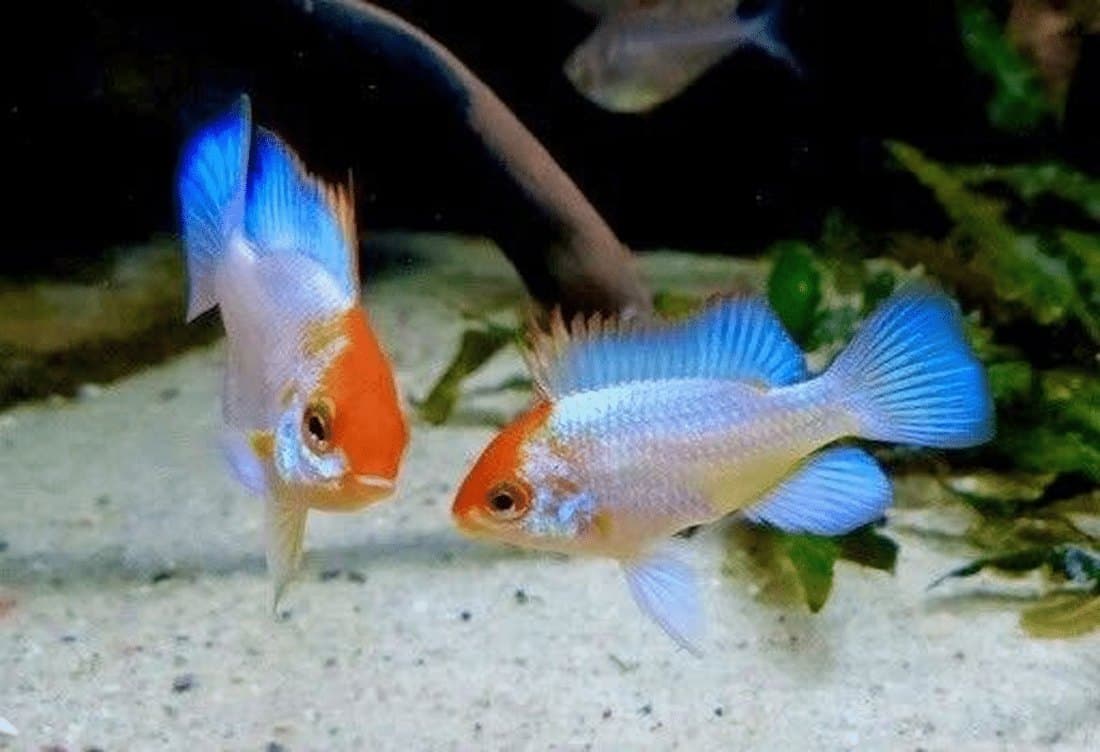
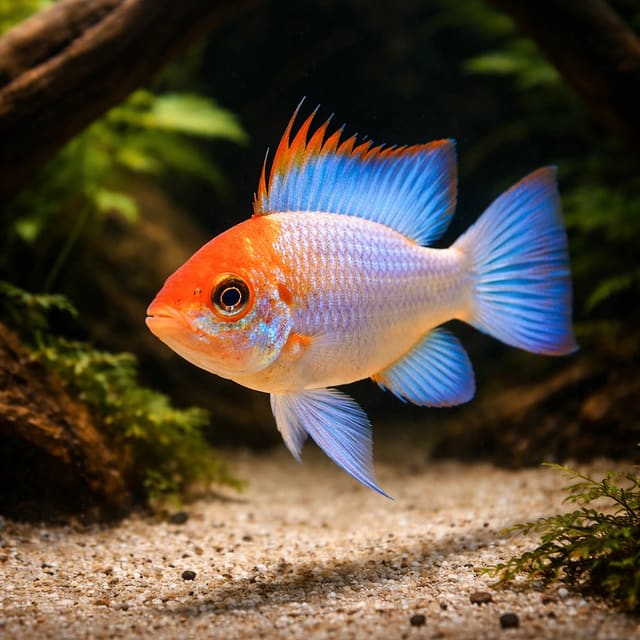
The electric blue ram is the same species as the German blue — just selected for an almost solid neon-blue body. Stunning, but no hardier, and it needs exactly the same warm, soft, stable water. One of our in-stock rams. Credit: Tropical Fish Co.
Rams are sensitive and the journey is stressful, so this is one species where rushing acclimation genuinely costs lives. Our delivery and on-arrival routine is tuned for a delicate, warm-water dwarf cichlid:
Rams are monogamous and the male chooses his female by her breeding colours [2]. A genuine bonded pair settles faster and may spawn on a flat stone in warm, soft water [4]. But two random rams in a bag are not automatically a pair — un-bonded fish, especially two males, can squabble. Ask us which of our rams are sold as pairs, or buy a small group in a larger tank and let a pair form naturally.
A quick diagnostic table — symptom, likely cause, and the fix — because rams fail in predictable ways:
| What you see | Most likely cause | What to do |
|---|---|---|
| New ram hiding, dark, off food in week 1 | Immature/unstable tank, or shipping stress | Test ammonia/nitrite (must be 0); tempt with frozen food; ensure tank is fully cycled before buying |
| Recurring ich / white spots | Tank too cool | Raise and hold 28 °C; check heater with a separate thermometer |
| Pitting on the head / face | Head & lateral-line erosion from poor water | Improve water changes, lower nitrate, vary diet [3] |
| Ram always last to food, thinning | Out-competed by faster tank mates | Remove boisterous fish; target-feed the ram |
| One ram bullying another | Two un-bonded fish (often two males) | Provide more space/cover, or rehome to form a true pair |
Even done perfectly, most commercially-bred German blue rams live 2–4 years [3]. That's the nature of the heavily line-bred stock, not a reflection of your care. Stable warm water, low waste, and a varied frozen/live diet give them the best shot at the upper end of that range.
Build the tank around the fish, not the other way round — these guides and pages take it further:
If your tap water is hard and you'd rather not run RO, the honest move might be to keep Lake Malawi cichlids instead — they want the hard alkaline water that fights you with rams. But if you can give a ram warm, soft, stable conditions, few small fish reward the effort like this one.
Visual route into the rest of our UK live-fish range.
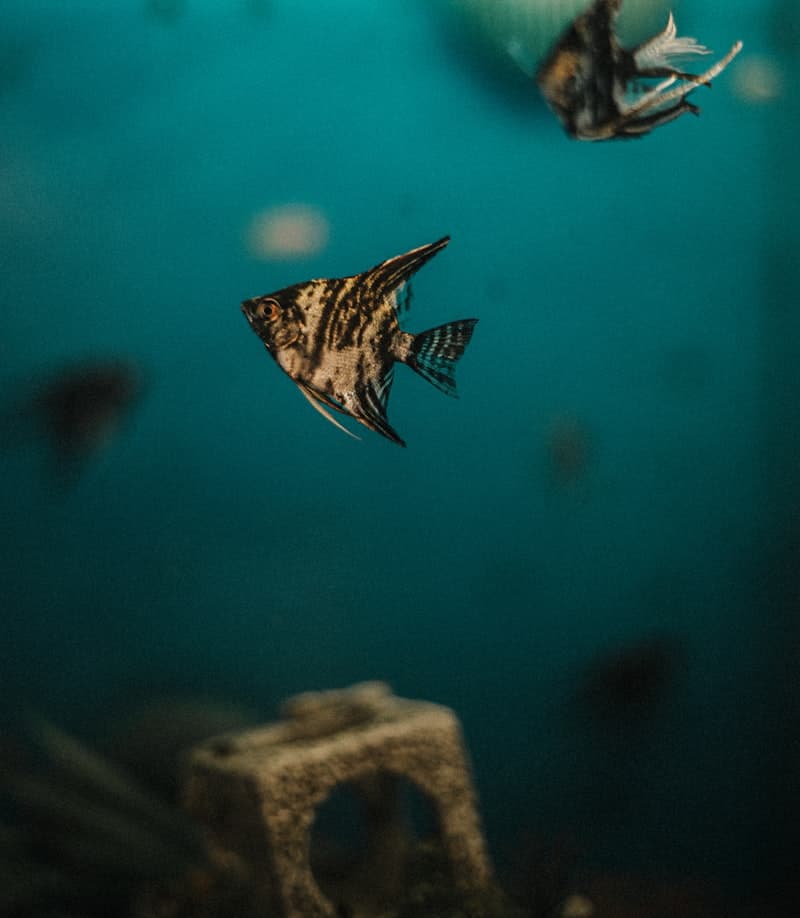
South American Cichlids for sale UK — Apistogramma, Rams, Oscars, Severums, Geophagus, Pikes, Discus and Angelfish.
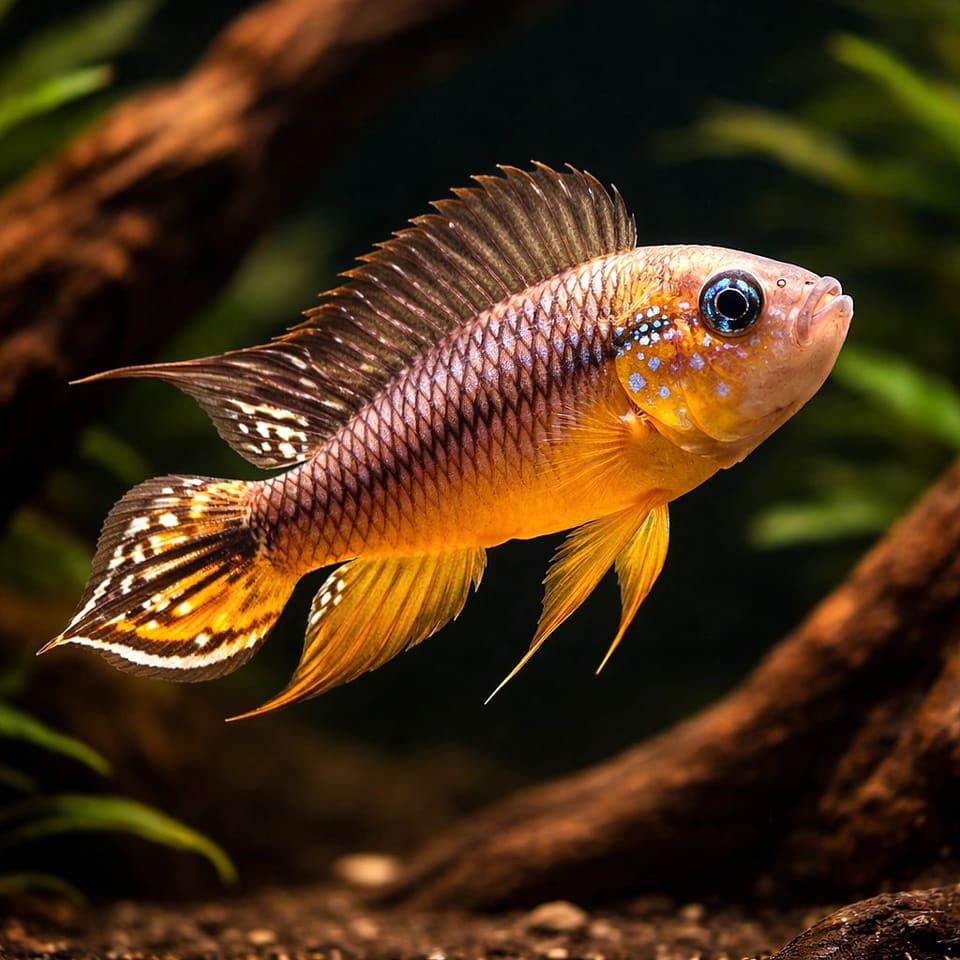
Peaceful tetras, rasboras, corydoras, platies and gouramis chosen to live together — temperament, adult size and water range per listing so the mix works.
Material factual claims cite the sources below; store policy and cautious inference are labelled in the article. Sources are grouped by type so you can judge their weight at a glance.
Peer-reviewed evidence that males select females by the breeding pink-belly ornament; the species is monogamous.
Source for max size (4.2 cm SL), temperature 27–30 °C, distribution (Orinoco llanos), IUCN Least Concern.
Independent husbandry cross-check — pristine water requirement, never add to immature tanks, poor competitor, weak commercial genetics.
UK hobbyist reference on the 'German blue' strain origin, warm-water spawning, and pair behaviour.
Expert video on warm-water husbandry and why temperature limits compatible tank mates.
UK authority — most of southern England is hard/very hard, so London-area keepers need RO or remineralised soft water for rams.
Fishkeeping moves fast and we want every guide spot-on. If you think something here is wrong, out of date, or could be clearer, tell us — our team reads every message and updates the page.
Suggest an editSouth American Cichlids for sale UK — Apistogramma, Rams, Oscars, Severums, Geophagus, Pikes, Discus and Angelfish.
Peaceful tetras, rasboras, corydoras, platies and gouramis chosen to live together — temperament, adult size and water range per listing so the mix works.
Compare African lake, South American and Central American cichlids by adult size, water, social behaviour and aquarium footprint before choosing.
Learn which freshwater aquarium water parameters to test, how to read ammonia, nitrite, nitrate, pH, GH and KH, and when a result needs action.
Evidence-checked UK angelfish care: adult size and height, tank planning, pair or group needs, water, feeding, tank mates, health and breeding.
Discus & Cichlid Expert · 15+ years in the hobby
Priya has bred discus commercially in Leicester since 2016 — supplying Tropical Fish Co and two other UK retailers with F1 tank-bred juveniles. Before that she spent seven years on South American dwarf cichlids. Her discus and cichlid guides on this site are written from the perspective of someone who has actually hatched, grown out, and shipped the fish — not from library research alone.