−13%
Electric Blue Ram (Mikrogeophagus ramirezi)
27–30°C · pH 4–7 · 54L
£10.43£11.99
The German Blue Ram is the classic bred form of Mikrogeophagus ramirezi, a South American dwarf cichlid of about 4 cm with an orange-red face, blue-spangled body and black dorsal crest. Sold singly in five sizes from 2.5 to 5 cm, sex not selected. Needs a mature tank at 27–30 °C with soft, acidic, very clean water.
Adult size is the maximum length this species reaches at full maturity (scientific sources). The livestock you receive will be younger and smaller — pick a size above for the actual shipping size. Product-photo provenance and any image-specific limitations are stated on the listing.
Mikrogeophagus ramirezi
Save when buying multiple fish. Each quantity is one fish; sex and pair formation are not guaranteed unless the selected variant explicitly states them.
The German Blue Ram is the classic bred form of Mikrogeophagus ramirezi, a South American dwarf cichlid of about 4 cm with an orange-red face, blue-spangled body and black dorsal crest. Sold singly in five sizes from 2.5 to 5 cm, sex not selected. Needs a mature tank at 27–30 °C with soft, acidic, very clean water.
Adult size is the maximum length this species reaches at full maturity (scientific sources). The livestock you receive will be younger and smaller — pick a size above for the actual shipping size. Product-photo provenance and any image-specific limitations are stated on the listing.

Cichlids are a family of roughly 1,800 accepted species, not one care type. Before buying, identify the exact species and source, then compare adult measurement, usable tank dimensions, social system, territory, tested water, diet and an exit plan. No family-wide minimum tank, water range or tank-mate list is safe.
Maintain these water conditions for optimal health and vibrant colors
The German Blue Ram is the best-known aquarium form of Mikrogeophagus ramirezi, the small South American cichlid most keepers simply call the ram. It is the fish that stops people in front of a shop tank: a warm orange-red face, a red eye, a body flecked all over with electric-blue scales and a short black crest at the front of the dorsal fin. It also has a reputation for being difficult, and that reputation is mostly about water. FishBase and Seriously Fish both describe a fish of warm, soft, acidic water, and Seriously Fish is blunt that it needs pristine conditions and should never be added to a new or biologically immature aquarium. Meet those needs and a ram is one of the most absorbing small fish you can own. Ignore them and you are setting it up to struggle.
This listing sells one fish per unit, and you choose the size from five options: 2.5–3 cm, 3–3.5 cm, 3.5–4 cm, XL (4–4.5 cm) and XXL (4.5–5 cm). Those figures describe the fish at the point it is packed for you, not a forecast of how big it will grow; the adult size is set out in the next section. The listing does not choose or guarantee a sex. If you order two, think of them as two unsexed rams rather than a matched pair, and read the notes on pairing and territory further down before you decide how many to buy. If you would rather order two fish as a single line, we also list a separate pack, the 2 × Assorted Ram Cichlids.
George Myers and R. R. Harry described the species in 1948 as Apistogramma ramirezi. Wikipedia records that it was named after Manuel Ramirez, an early collector and importer of the fish for the aquarium trade. It has been shuffled between genera ever since, and you will still meet it labelled Papiliochromis ramirezi or Microgeophagus ramirezi. FishBase now gives the accepted name as Mikrogeophagus ramirezi, and Seriously Fish explains that Mikrogeophagus is the oldest available genus name and is now generally accepted. Our stock records still file this fish under the older Papiliochromis name as the blue, red-headed ram, which is a fair description of the animal in our photograph.
"German Blue" is a trade name, not a separate species. Wikipedia lists German blue ram among the common names for M. ramirezi, alongside ram, blue ram, Asian ram, butterfly cichlid and Ramirez's dwarf cichlid. Seriously Fish uses "German Blue" for a bred form that was once regarded as good-quality stock and is now produced in a number of different countries. In practice, when a shop says German Blue it means this normally coloured, blue-and-gold ram rather than one of the gold, electric blue, balloon or long-finned forms.
| Point | What the sources say |
|---|---|
| Scientific name | Mikrogeophagus ramirezi (Myers & Harry, 1948), family Cichlidae |
| Wild range | Orinoco River basin, in the llanos of Venezuela and Colombia |
| Adult size | 4.2 cm standard length (FishBase); 40 mm standard length (Seriously Fish) |
| Temperature | 27–30 °C |
| pH | 5.5–7.0 in the aquarium; FishBase gives 5.0–6.0 |
| Hardness | 1–10 dGH |
| Minimum tank | 60 cm long; Seriously Fish suggests a 60 × 30 cm base, about 54 litres, for one pair |
| Diet | Omnivore that sifts the substrate; frozen and live foods plus sinking dried food |
| Temperament | Peaceful towards other species; males do not tolerate other males; territorial when breeding |
| Care level | Moderate: easy to feed, unforgiving of poor water |
| Conservation | Least Concern on the IUCN Red List (FishBase, assessed 2020) |
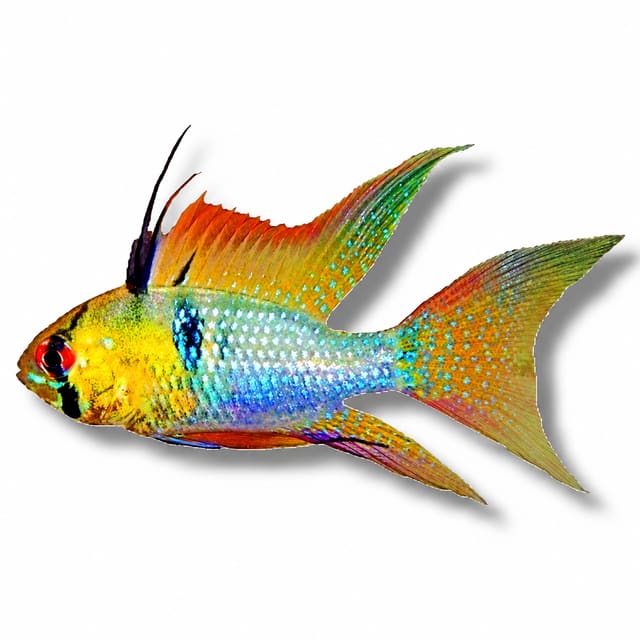
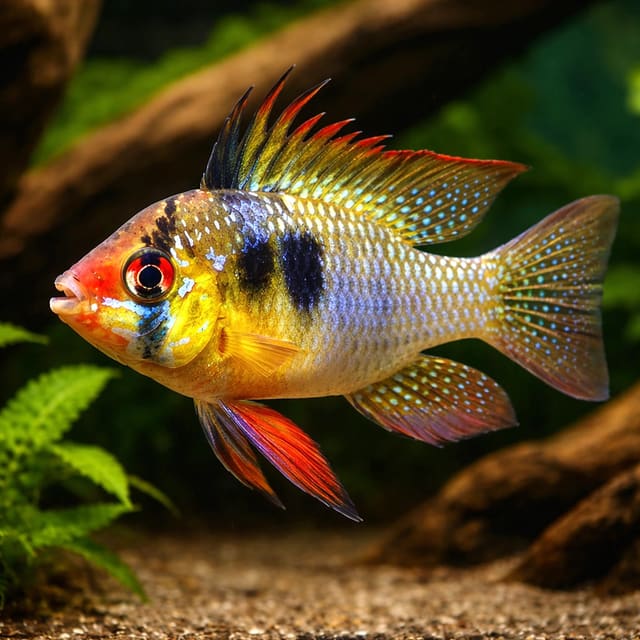
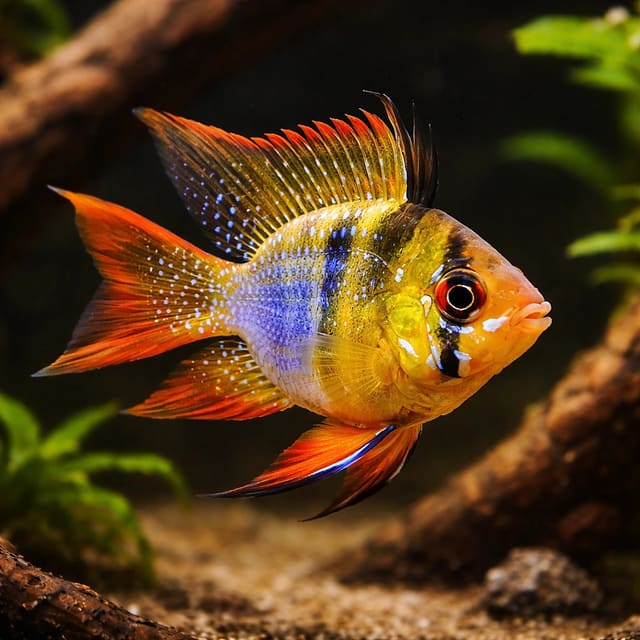
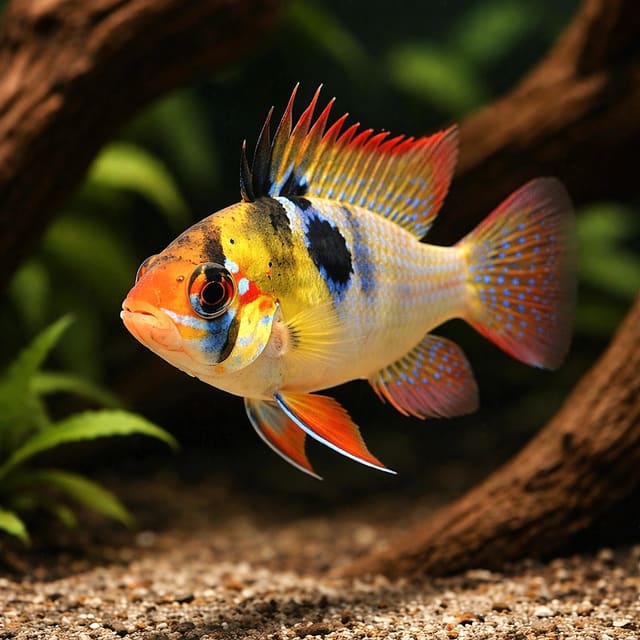
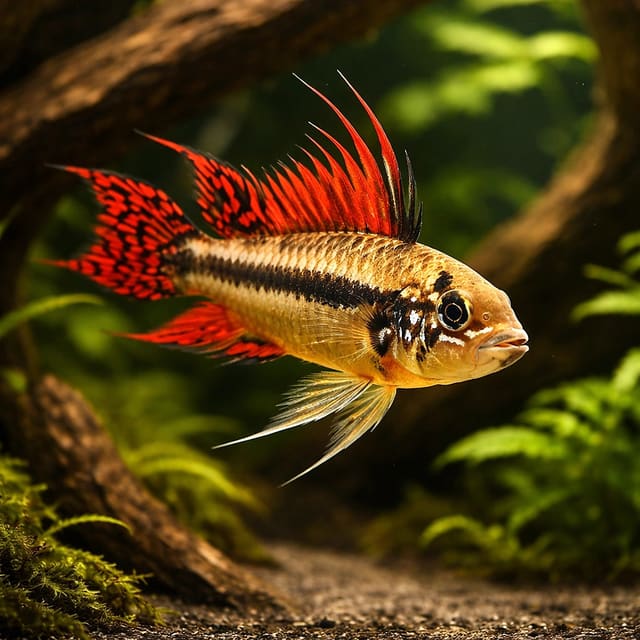
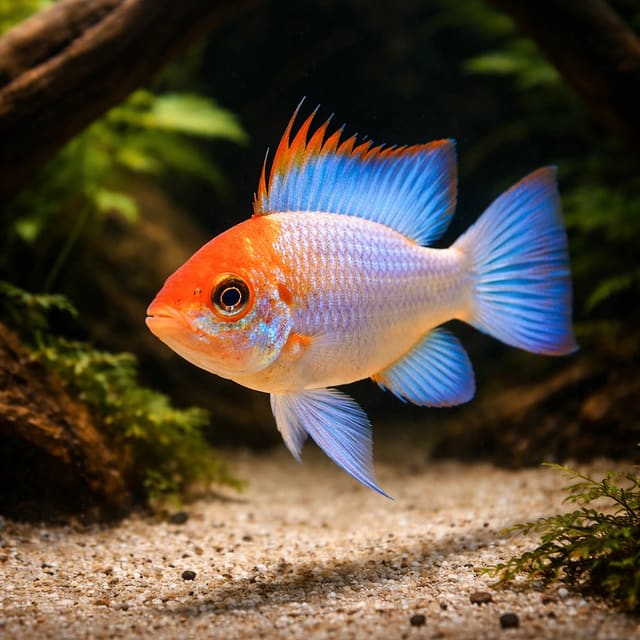
The fish in our photograph shows exactly the look this listing is about. The forehead, snout and cheeks are a warm orange-red, and the eye itself is red with a dark pupil. Behind and below the eye, turquoise scales spread over the gill cover. The flanks carry a violet-blue sheen with gold showing through towards the belly, and just below the front half of the dorsal fin sits a solid black blotch. The first few dorsal rays are black and stand up as a short, spiky crest, while the rest of the dorsal fin, the anal fin and the tail are dotted with rows of bright blue spots. The pelvic fins are blue with a darker leading edge. Overall the body is deep and compact, more the shape of a fish that works the bottom than one that cruises open water.
Seriously Fish notes that farmed rams are often raised on foods rich in carotenoid pigments to intensify their colour, so expect some variation between individual fish, and between a fish in its first hours out of the bag and the same fish after weeks on your own feeding. Judge it once it has settled into a mature, warm, soft-water tank.
This is a genuinely small cichlid. FishBase gives a maximum of 4.2 cm standard length for males and unsexed fish. Seriously Fish gives 40 mm standard length, and Wikipedia states that males reach 34–40 mm and are slightly larger than females. Standard length is measured from the tip of the snout to the end of the body where the tail fin begins, so the tail is not included. A full-grown ram measured from nose to tail tip therefore looks a little bigger in the hand than the 4.2 cm headline suggests.
That is worth knowing when you compare our size options with the adult figure. Dispatch sizes and scientific maximums are not the same measurement, so do not be surprised that the XL and XXL bands appear to run past 4.2 cm. A fish in either of those bands has comparatively little growing left to do, while a 2.5–3 cm fish is still a youngster and will give you the pleasure of watching it colour up and fill out.
Sexing rams is possible with adults but rarely certain with small fish, which is one reason this listing does not sell a sex. These are the differences the sources describe:
Because every one of these is an adult trait, they are least reliable on the smaller size bands. If sexing matters to you, the larger sizes give you more to look at, but sexing a juvenile ram by eye is never certain.
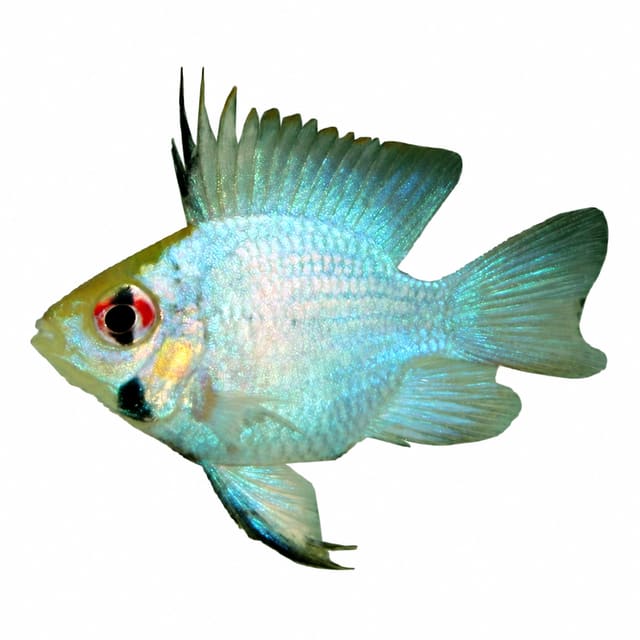
All the coloured rams on the market are M. ramirezi. Wikipedia describes gold and electric blue rams as xanthic forms, and lists high-bodied balloon forms and long-finned varieties as further bred lines. Seriously Fish adds pearl and "super neon blue gold" to the list. If the species appeals but you want a different look, we also list the Electric Blue Ram, the Longfin Ram Cichlid and the Black Ram Cichlid. Each of those has its own listing and its own care notes. Being one species, they share the same water needs, and the same rule about males not tolerating other males applies whatever the colour.
FishBase places the ram in the Orinoco River basin, in the llanos of Venezuela and Colombia, and Wikipedia describes it as endemic to that basin. Seriously Fish adds one oddity: a single specimen reportedly collected from the rio Purus in Brazil, an Amazon tributary. For practical purposes, though, this is an Orinoco fish.
The llanos are not jungle. Seriously Fish describes them as a vast system of tropical savannah grasslands, seasonally flooded plains and forests covering almost 600,000 square kilometres, with distinct wet and dry seasons and high temperatures all year round. The plains flood in the wet season and the water retreats in the dry season. Rams live in the warm, slow water of that landscape.
Wikipedia gives some useful measurements from those habitats: water at 25.5–29.5 °C, pH 5.2–6.7, generally slow-flowing, with few dissolved minerals, and ranging from clear to darkly stained with tannins. The fish are usually found where aquatic or submerged plants give cover. FishBase classes the species as benthopelagic, meaning it lives on and just above the bottom rather than up in the water column.
The IUCN Red List assessment quoted on FishBase, dated 29 October 2020, puts the ram at Least Concern. FishBase lists it as of no interest to fisheries and of commercial interest to the aquarium trade, and notes that it has been used in behavioural studies.
FishBase recommends keeping rams in pairs with a minimum aquarium size of 60 cm. Seriously Fish gives a little more detail: a base of 60 × 30 cm, roughly 54 litres, is enough for a single pair. We list 60 litres as the minimum, which sits comfortably within those figures. Think of 60 cm as the size for one pair of rams together with a shoal of small companion fish, not as a tank for several rams.
The reason is territory. Seriously Fish describes how juveniles are sociable but, once they mature, begin to pair off, and a breeding pair commands a territory a couple of feet across. A couple of feet is about 60 cm, which is the whole length of a starter tank. If you want more than one pair, you need a longer tank with the layout broken up so that each pair can claim its own patch without staring at the other all day.
Seriously Fish recommends a soft, sandy substrate for a naturalistic set-up, and the reason becomes obvious once you watch the fish feed. Rams take mouthfuls of the bottom, sift out anything edible and push the rest back out through the gills and mouth. Fine, smooth sand lets them do that comfortably. Coarse or sharp gravel does not. Sand also shows off the fish well, because the blue spangling stands out against a pale or mid-toned bottom.
Seriously Fish suggests plants that can be grown attached to the décor, naming Microsorum (Java fern and its relatives), Taxiphyllum (the moss genus that includes Java moss), Cryptocoryne and Anubias. Attached plants suit a sand-sifting fish because they are not uprooted when the fish works the bottom. Around them, the same source recommends wood roots and branches arranged to create plenty of shady spots and caves, plus one or two flat rocks or similar surfaces as potential spawning sites. Ceramic flowerpots and short lengths of plastic piping also work as cover if you prefer a simpler layout.
Seriously Fish also suggests dried leaf litter. It adds to the natural look, supports colonies of beneficial microbes, and becomes a valuable secondary food source for fry if you get as far as breeding. Leaves also release tannins, which tint the water in the way Wikipedia describes for the fish's wild habitat.
Seriously Fish advises that filtration, or at least water flow, should not be very strong. Choose a filter rated for the tank and spread or baffle the outlet so that there are quiet zones near the bottom. A reliable heater with a thermostat is essential, because the target range of 27–30 °C is warmer than many community tanks are kept. Check the temperature with a separate thermometer rather than trusting the dial on the heater.
Let the tank run and mature fully before the fish arrive. Seriously Fish is explicit that this species should never go into a new or biologically immature aquarium.
Water is where rams are won or lost. The sources line up well on the main points, with some honest differences in the detail.
| Parameter | FishBase | Seriously Fish | Wild habitat (Wikipedia) | What we recommend |
|---|---|---|---|---|
| Temperature | 27–30 °C | 27–30 °C | 25.5–29.5 °C | 27–30 °C |
| pH | 5.0–6.0 | 4.0–7.0 | 5.2–6.7 | 5.5–7.0, softer and lower being better |
| Hardness | 5–12 dH | 1–10 dGH | Few dissolved minerals | 1–10 dGH |
Both aquarium references give 27–30 °C, and that is the range we now list. Wild readings dip slightly lower, to 25.5 °C, but those are field measurements across seasons rather than a target. Holding the tank at 27 °C or above keeps you inside every source's range. Bear in mind that this temperature limits your choice of companions, because many popular community fish are happier cooler.
All three sources point to soft, acidic water. FishBase's 5.0–6.0 is the strictest; Seriously Fish allows 4.0–7.0; the wild habitat readings sit between them. We list pH 5.5–7.0 and 1–10 dGH as a workable aquarium range, with the softer, more acidic end of that range closer to what the species lives in. What rams do not like is hard, alkaline water, and Seriously Fish specifically advises against keeping them with species that need harder water.
If your tap water is hard, the usual approach is to mix it with reverse osmosis or other demineralised water until you reach your target, then make every water change with the same mix so the chemistry does not swing. Test before you buy the fish, not after.
Seriously Fish says this species requires pristine water quality. Ammonia and nitrite should read zero in a mature tank, and nitrate should be kept low. Interestingly, the same source recommends regular changes of 10–15% rather than very large ones, which keeps conditions steady for a fish that needs stability. A small weekly change, with the new water matched for temperature and chemistry, does more good than an occasional dramatic clean-out.
A sensible routine for a 60 cm ram tank looks like this:
Seriously Fish warns that when conditions deteriorate, rams become susceptible to a condition similar to the head and lateral line erosion, or hole-in-the-head, seen in other species. That is the clearest possible reason to keep on top of the routine.
Seriously Fish describes rams as benthophagous by nature: they take mouthfuls of substrate, sift them for anything edible and expel the rest through the gill openings and mouth. They also browse solid surfaces and snatch items directly from the water column. Watch a settled pair over sand and you are likely to see all three in a single feed.
Seriously Fish recommends a variety of live and frozen foods, naming bloodworm, Artemia (brine shrimp), Daphnia and grindal worm, supplemented by good-quality sinking dried foods. It also mentions home-made, gelatine-bound recipes containing dried fish food, puréed shellfish, fresh fruit and vegetables, which some keepers use to control exactly what goes in.
A practical weekly menu for a pair might be:
Seriously Fish calls the ram a poor competitor, and that matters at feeding time. A shoal of quick tetras can clear food from mid-water before it ever reaches the rams on the bottom. Feed sinking foods, let them settle onto open sand near the rams' favourite spot, and watch that both fish get their share. If one ram is consistently missing out, try feeding at both ends of the tank at once.
Feed small amounts that are eaten within a couple of minutes. Uneaten food breaks down and fouls the water, and with a fish this sensitive to water quality, overfeeding is a far bigger risk than a slightly lean diet.
Seriously Fish notes that farmed rams are usually raised on dried foods high in protein and carotenoid pigments, which accelerate growth and intensify colour. A newly arrived German Blue is therefore likely to recognise a sinking dried food, and that is a sensible first offering once the fish has settled. Introduce frozen foods alongside it over the following weeks to build the varied diet the species is described as taking.
Rams are peaceful towards fish that leave them alone, but they are still cichlids. Wikipedia notes that they form monogamous pairs before spawning and that males do not tolerate other males. Seriously Fish describes juveniles as gregarious, pairing off as they mature, with each breeding pair defending a territory a couple of feet across. Plan the tank around those two facts and most problems never happen.
Since this listing does not sell a sex, ordering two fish gives you two rams of unknown sex. They may pair, they may both turn out female and get along, or they may both be male and quarrel. Watch them closely as they settle, and have a plan to separate them if one is being harried.
Seriously Fish advises that the ram is not recommended for the general community aquarium, because it requires pristine water and is a poor competitor. That does not mean it must live alone. The same source specifically recommends groups of peaceful, open-water characins as tank mates, explaining that the presence of small shoaling fish seems to be taken by the rams as a sign that there is no immediate threat. A calm shoal swimming in mid-water can therefore help the rams feel secure enough to spend time out in the open.
Seriously Fish names the cardinal tetra (Paracheirodon axelrodi) and the green neon tetra (Paracheirodon simulans) as companions that meet the ram's temperature requirements. That temperature match is the main reason they suit a 27–30 °C ram tank.
A settled ram spends much of its day close to the bottom, hovering, sifting sand and inspecting surfaces. Once a pair has formed, the two fish share their patch of the tank, and when they are preparing to breed they will claim a flat stone or a patch of sand and chase other fish away from it. That territorial spell is normal, and in a properly sized tank with plenty of cover the other fish have room to keep out of the way.
Most of what goes wrong with rams traces back to water, stress or weak stock, and the sources are frank about all three.
Seriously Fish states that the species requires pristine water and should never be added to new or immature aquaria. It also warns that when conditions deteriorate, rams become susceptible to a condition similar to head and lateral line erosion, the pitting around the head and along the lateral line sometimes called hole-in-the-head in other species. Stable, warm, soft, clean water with steady small water changes is the single biggest thing you can do for their health.
Seriously Fish is candid that artificially reared ram forms tend to be genetically weak, susceptible to disease and shorter-lived than wild fish, and that hormones may be used to boost production. It notes that the German Blue, once regarded as good-quality stock, has suffered as production spread to many countries. Wild fish are described as genetically superior but more demanding, and arguably suitable only for experienced keepers. Wikipedia makes a similar point, noting that many bred varieties show lower fertility, health problems or reduced brood care compared with wild-type fish.
We tell you this not to put you off but because it shapes how you should treat a new ram. Give it a mature tank, matched water, calm companions and a good diet from the first day, and do not rush it into a busy display.
It is a fair question, and we would rather give you an honest answer than a neat number. None of our three references, FishBase, Seriously Fish or Wikipedia, gives a lifespan figure for the species. What Seriously Fish does say is that artificially reared forms tend to have shortened life-spans compared with wild fish. In practice the things you control, a mature tank, steady warm and soft water, small regular water changes, a varied diet and calm companions, are what give any ram its best chance of a long life.
If you already keep fish, a separate quarantine tank for new arrivals protects your established stock, and it gives a new ram a quiet place to settle and start feeding. Run it with mature filter media from your main tank, keep it at the same temperature and chemistry, and add a little cover.
Watch your rams every day, especially in the first weeks. These are general warning signs in any aquarium fish, and they all call for a water test before anything else:
If something looks wrong, test ammonia, nitrite, nitrate, pH and temperature first. With rams, a poor result on any of those is usually the root of the problem, and correcting it gently is the first step. If you are unsure what you are seeing, ask us for advice.
Rams are rewarding to breed because both parents are usually involved. Seriously Fish describes the species as a biparental substrate spawner, with male and female participating equally in brood care, and Wikipedia agrees. FishBase records only that the female cares for the eggs and larvae, so the sources differ slightly; most of what you will read, and what you are likely to see, is both fish taking turns.
Wikipedia notes that rams form monogamous pairs before spawning. The eggs are small, 0.9–1.5 mm, and adhesive. They are laid on a flat stone or into a small depression dug in the gravel, and Seriously Fish adds that driftwood, a broad plant leaf or the aquarium glass can also be used. The female lays a row or rows of eggs and the male moves in to fertilise them, and this is repeated many times. Wikipedia gives a typical clutch as 150–300 eggs, with clutches of up to 500 reported.
The parents fan water over the eggs. Wikipedia states that the eggs hatch in about 40 hours at 29 °C, and Seriously Fish gives incubation as 2–3 days. The larvae then stay largely immobile for around five more days, during which time they need no extra food.
Once the fry are free-swimming, Wikipedia describes them being escorted in a dense school by one or both parents while they forage. Seriously Fish recommends microworm, infusoria and other microscopic foods for the first 2–3 days, after which larger foods such as freshly hatched Artemia nauplii can be introduced. Leaf litter helps here too, because Seriously Fish notes the microbes it supports are a useful secondary food for fry.
If breeding is your aim, give the pair a tank of their own or a well-planned community with a single pair, very soft water held steadily within 27–30 °C, a couple of flat stones, and leaf litter. Then leave them to it.
Before you order, please read our delivery and live-arrival information. A ram arrives as a living animal, and it does best when everything is ready for it.
Your fish travel in oxygen-filled bags inside insulated packaging, with heat packs when conditions call for them, by a tracked courier licensed to carry live animals. We email you the confirmed delivery date and tracking.
Start a continuous video before you open the parcel, while it is still sealed, and keep filming in the same take as you open it and show the fish in the still-sealed bag. If a fish arrives dead, dying or clearly compromised, email hello@tropicalfishco.co.uk on the day of delivery with your order number and that video. Photos alone do not meet our live-arrival policy. Where a claim is accepted, the resolution is a replacement with your next order or a refund for the affected fish, subject to the guarantee terms.
Keep the lights low for the rest of the first day and let the ram find the cover you have built. Do not worry if a new ram hides for a while at first; judge it over days rather than hours. Offer a small amount of sinking food once it is moving about and exploring, and remove anything left uneaten.
Over the first week, watch breathing, appetite and behaviour every day. A ram that is sifting sand, taking food and holding its fins open is settling well. Keep to your small water changes, test the water a couple of times during the week, and resist the urge to add more fish until the newcomer is clearly established. If you ordered more than one ram, keep a close eye on how they treat each other as they settle and start to claim space.
These are the references we used for the facts on this page. They are worth reading in full if you want to go deeper into the species.
No reviews for this item yet. Bought one? Honest reviews only, good or bad.
What customers say about ordering from us
Easy website plenty of info on fish your buying great to pick a time slot
TRACEY DURRANT · 7 Oct 2026
Got some lovely fish thank you
Kevin Mackie · 7 Oct 2026
Reviews of our shop, collected by Judge.me, an independent third-party review collector. Newest first.