−10%
Moderate
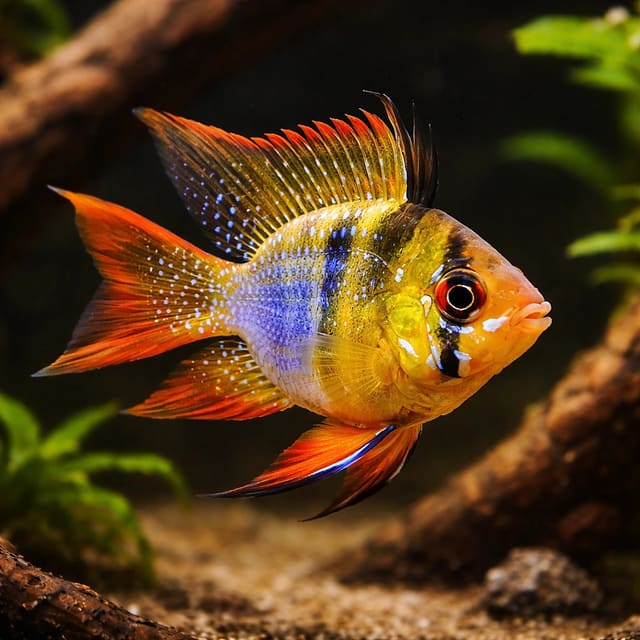
Balloon Ram (Mikrogeophagus ramirezi) – 2.5–3cm & XL Size Grades
24–27°C · pH 6–7.5 · 60L
£12.59£13.99

Assorted Ram Cichlid (Mikrogeophagus ramirezi), supplied as one unsexed fish in the selected size. This original-form South American dwarf cichlid needs a mature aquarium, stable 27-30 C water, calm tank mates and careful feeding.
Mikrogeophagus ramirezi
Save when buying multiple fish. Each quantity is one fish; sex and pair formation are not guaranteed unless the selected variant explicitly states them.
Assorted Ram Cichlid (Mikrogeophagus ramirezi), supplied as one unsexed fish in the selected size. This original-form South American dwarf cichlid needs a mature aquarium, stable 27-30 C water, calm tank mates and careful feeding.
Cichlids are a family of roughly 1,800 accepted species, not one care type. Before buying, identify the exact species and source, then compare adult measurement, usable tank dimensions, social system, territory, tested water, diet and an exit plan. No family-wide minimum tank, water range or tank-mate list is safe.
Maintain these water conditions for optimal health and vibrant colors
Assorted Ram Cichlid (Mikrogeophagus ramirezi) is a compact South American dwarf cichlid with iridescent blue spotting, warm gold and red tones, dark body markings and attentive cichlid behaviour. Our stock records identifies every size on this product as the assorted or original form of the ram. It does not identify the fish as an Electric Blue, Gold, Balloon, Longfin or other guaranteed colour morph.
One quantity supplies one live, unsexed fish in the size selected. It is not a male-and-female pair, and ordering two fish does not guarantee compatible sexes or pair formation. Choose the available dispatch-size variant before adding the fish to your basket. Natural colour, markings, fin shape and apparent size vary between individuals and can change with age, sex, mood, lighting and settling time.
The accepted scientific name is Mikrogeophagus ramirezi. The supplier also uses the older name Papiliochromis ramirezi, which remains familiar in aquarium catalogues. Rams need a warm, mature and consistently clean aquarium. They are peaceful compared with many cichlids, but they are sensitive to cold, unstable or polluted water and can defend a territory when pairing or spawning.
| Product | One unsexed Assorted Ram Cichlid in the selected dispatch size |
|---|---|
| Accepted name | Mikrogeophagus ramirezi (Myers & Harry, 1948) |
| Older supplier name | Papiliochromis ramirezi |
| Adult size | Usually about 5-7 cm total length; FishBase reports 4.2 cm maximum standard length |
| Aquarium planning | OATA recommends at least 60 litres for a pair and at least 80 litres when mixing dwarf cichlids with other fish; footprint and territory still matter |
| Temperature | Very warm water, normally 27-30°C; avoid sudden temperature changes |
| Water | Soft, acidic to neutral water is preferred; a practical target is about pH 5.5-7.0 and 2-12 dGH |
| Temperament | Generally peaceful, but locally territorial around a mate, eggs or fry |
| Diet | Small quality granules plus suitably sized frozen or live foods |
| Care level | Intermediate; best for an established aquarium with reliable heat and water testing |
The live supplier name for these variants is “Assorted Ram” and describes the original-style ram rather than a guaranteed modern colour strain. A supplied fish may show a grey-gold base, blue-green iridescent spots, a dark shoulder patch, a dark bar through the eye, red around the eye and warm colour in the fins. The balance of those features varies naturally. Newly transported fish may initially appear pale or hold their fins close before recovering their normal colour.
“Assorted” is not a promise of a random named morph, a chosen sex or a breeding pair. It should not be interpreted as Electric Blue, Blue Brilliant, Gold, Black, Balloon or Longfin stock unless the selected product explicitly says so. If a particular colour form matters to your aquarium plan, compare this fish with the separately listed Electric Blue Ram, Electric Blue Balloon Ram product or Balloon Ram.
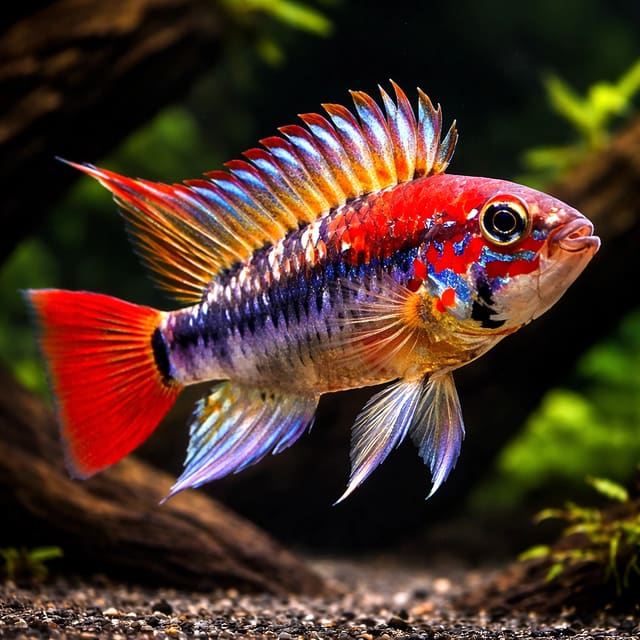
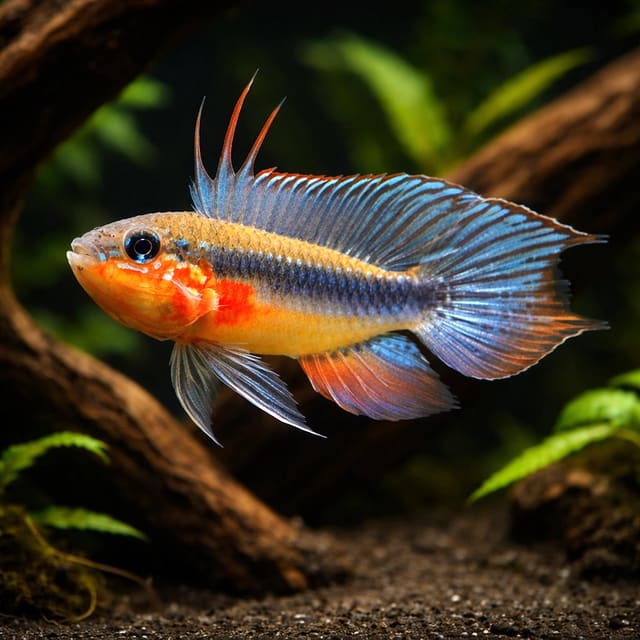
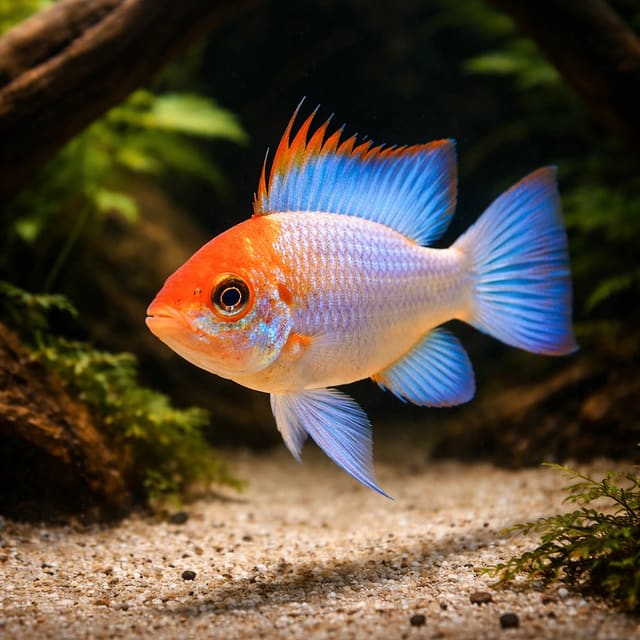
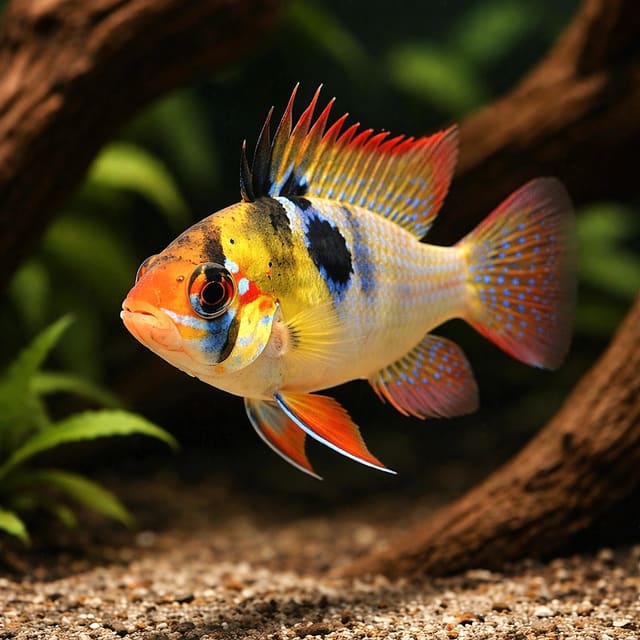
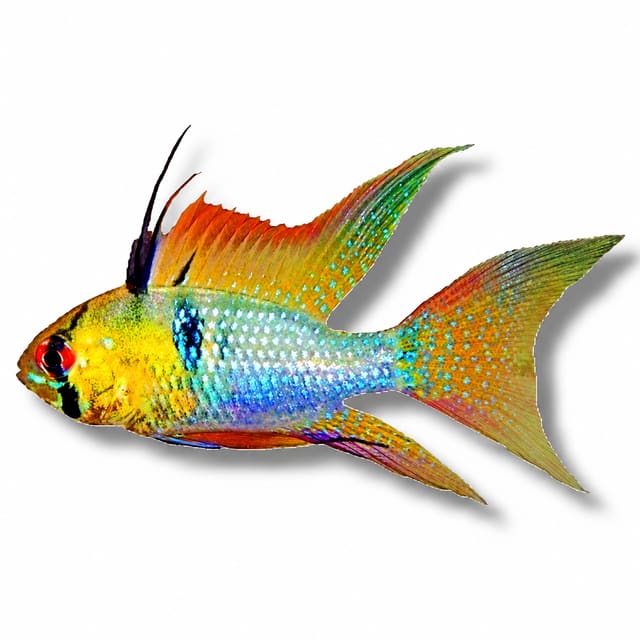
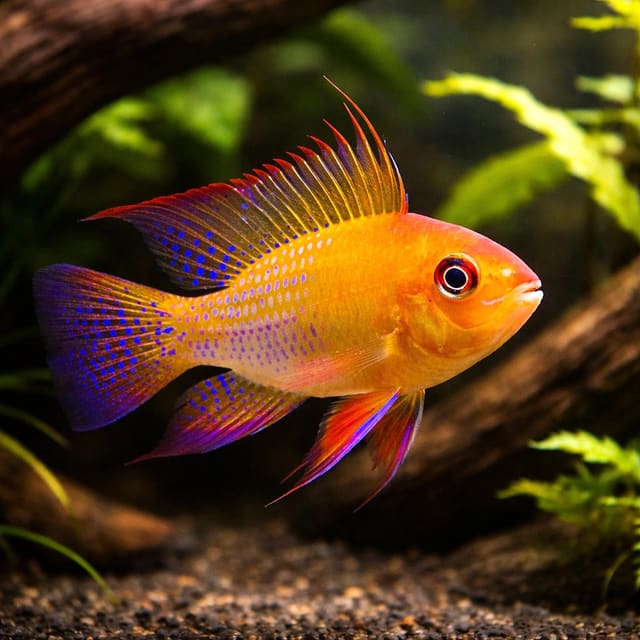
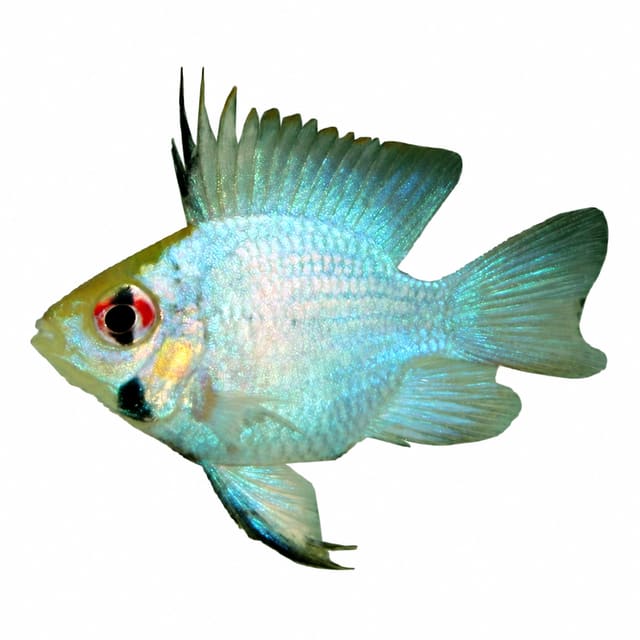
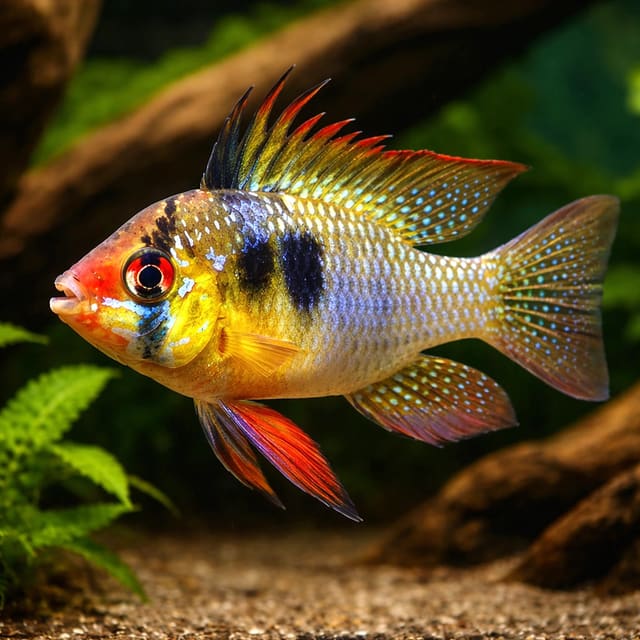
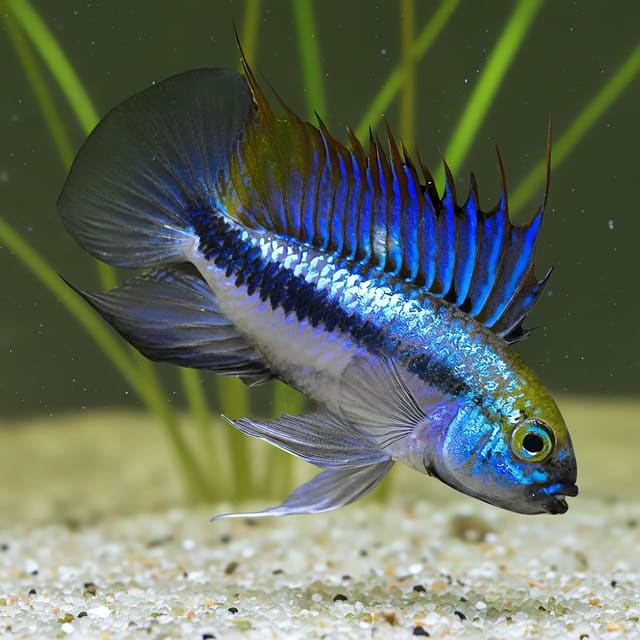
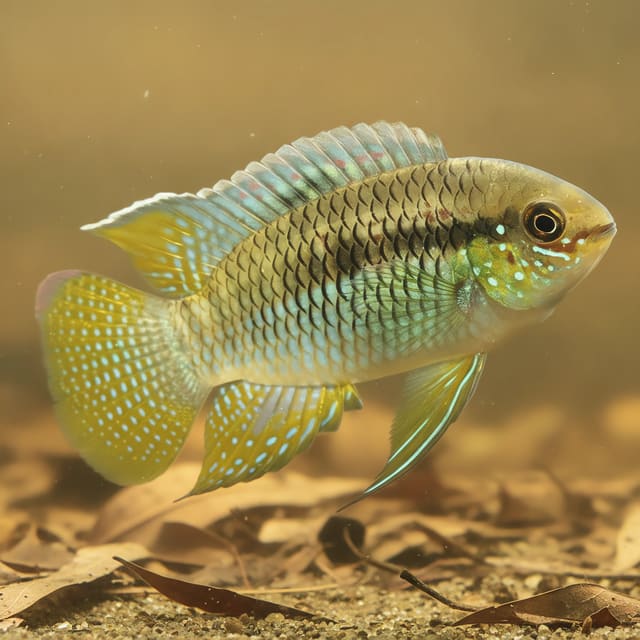
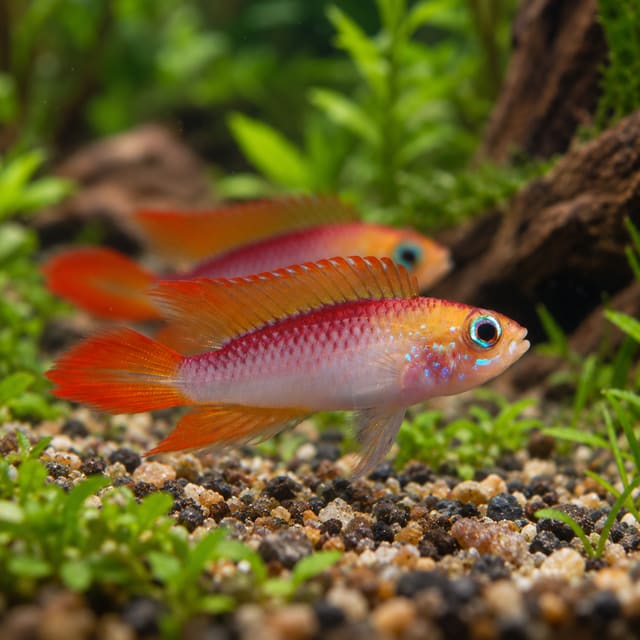
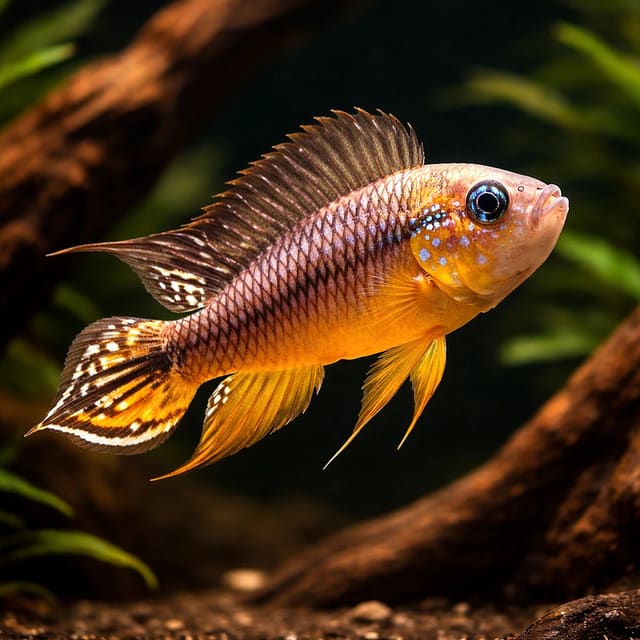
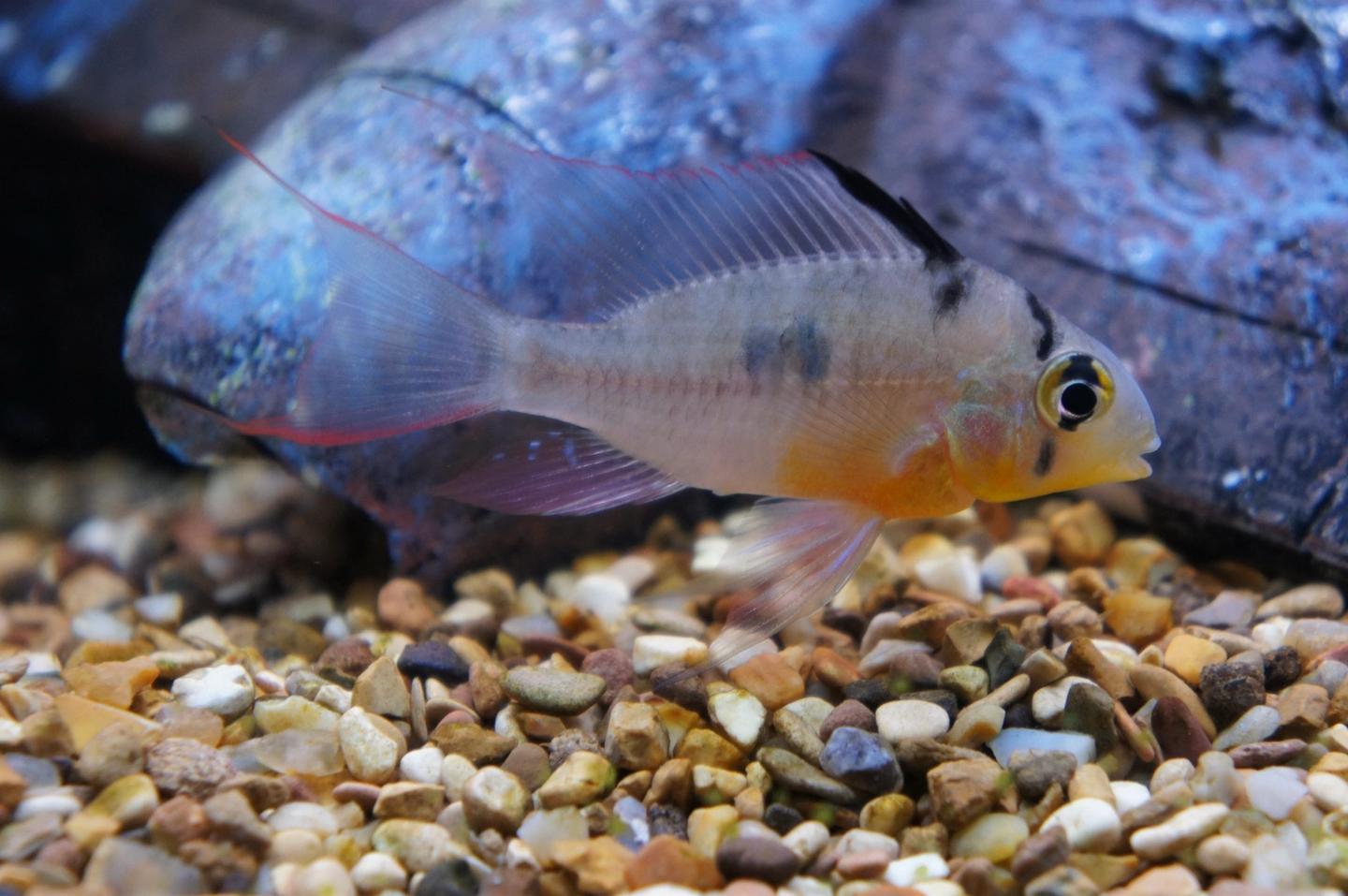
The first gallery image is the reference photograph for this stock line. The four additional aquarium scenes are illustrations based on the same general ram identity. They help show the fish in different compositions, but they are not photographs of the exact animal dispatched. The two-fish scene does not change the sale unit: one quantity remains one unsexed fish.
An Assorted Ram can be a rewarding centrepiece for a carefully planned warm-water aquarium. It is a good choice when you enjoy close observation, can test water regularly and are willing to choose tank mates around the ram's temperature and feeding needs. It is a poor choice for a new, uncycled aquarium, a cool general community, a hard-water setup that cannot be adjusted safely, or a busy tank full of aggressive and fast-feeding fish.
| Suitable plan | Unsuitable plan |
|---|---|
| Mature, fully cycled aquarium | Newly filled or biologically unstable aquarium |
| Stable heater and thermometer | Unheated tank or large day-night temperature swings |
| Soft, acidic to neutral water | Very hard, strongly alkaline water with no safe adjustment plan |
| Calm companions that tolerate 27-30°C | Cool-water fish, persistent fin-nippers or aggressive cichlids |
| Fine substrate, cover and open feeding areas | Bare, brightly exposed layout with no territory breaks |
| Keeper able to observe appetite and water quality | Tank where faster fish prevent the ram from feeding |
This is not a disposable “easy community fish.” Rams often fail because the aquarium is too cool, newly cycled, overstocked or allowed to accumulate waste. Their compact size can create the false impression that they need very little preparation. In reality, stable water and compatible stocking matter more than the fish's body length.
OATA's dwarf-cichlid guidance recommends an aquarium of at least 60 litres for a pair and at least 80 litres when dwarf cichlids are mixed with other fish. FishBase also gives a minimum aquarium length of 60 cm for M. ramirezi. These are planning baselines, not promises that every 60-litre tank will work. A long, well-structured footprint is more useful than a tall tank with little bottom area, and a community requires extra room for companions and separate territories.
For one ram, plan around the same stable 60-litre class aquarium rather than treating a single fish as suitable for a tiny nano tank. For a compatible pair, use at least 60 litres with multiple shelters and visual barriers. An 80-litre or larger aquarium is the more forgiving choice for a community because it provides greater water stability, more feeding space and more ways for fish to avoid one another. Increase the footprint again if you plan more than one ram territory or another dwarf cichlid species.
One quantity on this page supplies one unsexed fish. Although the product may show multi-buy pricing, that is a quantity offer rather than a sex or bonding guarantee. Two unsexed fish may be two males, two females or an incompatible combination. Same-sex or incompatible fish can chase one another, especially in a small or exposed tank. If your aim is a pair, arrange a plan for sexing mature fish, provide enough territory and be prepared to separate individuals that do not settle together.
Do not use a litre number alone to decide stocking. Consider the aquarium's length, width, planting, filtration, oxygenation at high temperature, maintenance routine and the adult needs of every tank mate. Warm water holds less dissolved oxygen than cool water, while the fish and filter still need adequate gas exchange. Keep the surface moving gently without turning the tank into a high-flow river setup.
Build the aquarium around the adult fish before ordering. A mature 80-litre planted tank with a calm stocking plan is usually easier to keep stable than a heavily stocked 60-litre tank, even when both satisfy a headline minimum.
Mikrogeophagus ramirezi comes from the Orinoco basin llanos of Venezuela and Colombia. FishBase reports very warm wild conditions of 27-30°C, pH 5.0-6.0 and 5-12 dH. Captive aquarium strains can be maintained across a somewhat broader managed range, but this does not make them suitable for abrupt changes or strongly alkaline community water. A practical display target is 27-29°C, with the aquarium kept within roughly 27-30°C.
Aim for soft, acidic to neutral water. Around pH 5.5-7.0 and approximately 2-12 dGH is a sensible working range for most captive rams, provided the value is stable and matches the source water closely during acclimation. Breeding pairs usually benefit from the softer, more acidic part of that range. Do not chase a particular number with large chemical corrections. A stable value near the edge of an appropriate range is safer than repeated swings caused by aggressive adjustment.
Ammonia and nitrite must remain at zero. Keep nitrate low through sensible stocking, controlled feeding, plant growth where appropriate and regular partial water changes. OATA advises weekly testing and a weekly partial change of about 25% for dwarf cichlids. The exact change volume can vary with the aquarium, but replacement water should always be conditioned and closely matched for temperature. Sudden exposure to cooler water is stressful for a fish that needs such warm conditions.
The biological filter must be mature before the fish arrives. A tank can look clear while still lacking enough nitrifying bacteria to process waste. Complete a fishless cycle or otherwise prove that the system can keep ammonia and nitrite at zero under its intended load. Continue testing after adding fish because the filter's workload changes with every new animal and every increase in feeding.
| Measure | Planning range | Practical meaning |
|---|---|---|
| Temperature | 27-30°C | Use a reliable heater and thermometer; avoid cool community species |
| pH | About 5.5-7.0 | Stability matters more than forcing an exact decimal |
| General hardness | About 2-12 dGH | Soft water is preferred, especially for breeding |
| Ammonia | 0 mg/L | Any detectable result requires immediate investigation |
| Nitrite | 0 mg/L | Any detectable result indicates a biological-filter problem |
| Nitrate | Keep low and stable | Use test results, stocking and water changes to control accumulation |
High temperature increases metabolic demand and reduces the amount of oxygen water can hold. Use steady surface movement, avoid clogged filter media and watch breathing during hot weather. A filter should provide dependable biological capacity without forcing the fish to fight a powerful current all day. Sponge filters, carefully directed internal filters and suitably sized external filters can all work when maintained correctly.
Rams spend much of their time in the lower half of the aquarium, inspecting the substrate and defending small areas when settled. Fine sand or smooth fine gravel makes a useful base. Avoid sharp, dirty or very coarse material that traps waste and makes natural feeding difficult. Leave some open foreground where the fish can find food, and use planting or wood around the sides and back to provide security.
Live plants are helpful because they soften the layout, provide shade and break lines of sight. Cryptocoryne, Amazon swords, Java fern and Anubias-type plants can be arranged around wood and smooth stones, while floating plants reduce harsh overhead light. Choose plants that tolerate the same warm conditions. Keep enough open swimming and feeding space that the fish is visible and can reach food without entering another animal's territory.
Provide several potential shelters rather than one prized cave. Wood, leaf litter used safely, broad leaves, smooth stones and plant clumps let a chased fish move out of sight. Rams are substrate spawners rather than dedicated cave spawners, so flat stones or broad leaves can also become spawning sites. Secure all hardscape so digging or routine maintenance cannot make it collapse.
Lighting can be moderate. Bright plant lighting is easier for the fish to tolerate when floating cover, tall plants and shaded areas are available. A consistent day-night schedule supports normal behaviour. Avoid placing the aquarium beside direct sun, speakers, slamming doors or other sources of abrupt movement and temperature change.
Rams are omnivorous micropredators that respond well to varied, appropriately sized foods. Use a quality small granule or soft micro-pellet as a dependable staple, then rotate small frozen or live foods such as brine shrimp, daphnia, cyclops and suitable insect larvae. The food must fit the fish's mouth, particularly for the smaller dispatch sizes.
Offer controlled portions rather than one large feed. OATA advises feeding only what dwarf cichlids can consume within a few minutes and warns that uneaten food breaks down into harmful waste. In a community, watch the ram rather than assuming food has reached it. Fast tetras and livebearers can clear the water column before a cautious new ram has eaten. Distribute small feeds near the fish's preferred area or use slowly sinking granules so every animal has a fair chance.
New arrivals may not recognise a particular dry food immediately. A small amount of familiar frozen or live food can encourage feeding, but do not compensate for poor appetite by adding repeated large portions. Remove obvious uneaten food and test the water if the fish refuses several feeds. Appetite loss can reflect transport stress, unsuitable temperature, aggression, water-quality problems or illness; it is not a diagnosis on its own.
For breeding condition, variety and consistency matter more than excessive richness. Small live or frozen foods can support conditioning, but overfeeding quickly damages water quality. Avoid making mammalian meat or large, hard food items part of the routine. Keep frozen food properly stored, thaw only what is needed and never introduce collecting water from an unsafe live-food source.
An established ram is alert and inquisitive. It patrols the lower and middle levels, examines leaves and stones, and may recognise regular feeding routines. It is not a schooling fish. Social behaviour is usually centred on a mate or a local territory, while calm open-water fish can make the aquarium feel safer.
FishBase describes aquarium keeping in pairs, and OATA notes that dwarf cichlids can do well as male-female pairs. That guidance does not turn unsexed retail stock into an automatic pair. Compatibility is individual, and two fish of opposite sex may still reject one another. A bonded or proven breeding pair is a different sale claim and is not included here.
Territorial behaviour becomes more obvious around courtship, eggs and fry. Chasing over a short distance can be normal, but repeated cornering, torn fins, refusal to feed or a fish being unable to leave cover means the layout or stocking plan is not working. Add visual barriers only if they can be introduced safely, and separate fish when aggression cannot be resolved promptly.
Multiple pairs require a substantially larger footprint with distinct territories. Do not use one crowded aquarium to “let them sort it out.” A larger tank does not automatically prevent conflict if every desirable spawning site is in the same open area. Spread shelters and sight breaks across the aquarium and make sure each fish can reach food without crossing a defended zone.
The best companions are calm fish that tolerate the ram's very warm water, do not nip fins and do not dominate feeding. Small peaceful tetras and pencilfish are common options when their own temperature range overlaps. Bottom dwellers need extra thought because they use the same territory. Some Corydoras prefer cooler water, so never add one merely because both species are South American.
Otocinclus may be considered only in a mature aquarium with suitable food and water, and their social requirements still apply. Snails are usually easier companions. Adult shrimp may coexist in a well-planted tank, but small shrimp and shrimplets can be eaten. No cichlid should be marketed as reliably shrimp-safe.
Avoid aggressive cichlids, persistent fin-nippers, large predatory fish, rough barbs and cool-water species. Boisterous livebearers can also be a poor match where they crowd feeding areas or prefer harder, more alkaline water. Discus and some warm-water South American fish may overlap in temperature, but their size, social needs, feeding and tank volume make them a specialist community rather than a simple recommendation.
Mixing different dwarf cichlids is possible only with enough space and careful territory planning. It is usually safer to choose one focal dwarf-cichlid species in a modest aquarium. If you want a related but distinct species that is often kept slightly cooler, compare the Bolivian Ram Cichlid. If you prefer the supplier's separate domestic trade form, review the Asia Form Ram Cichlid and compare its exact listing before choosing.
| Companion type | Guidance | Reason |
|---|---|---|
| Small warm-water tetras | Often suitable | Choose calm species and leave enough room for a ram territory |
| Pencilfish | Often suitable | Usually occupy higher water and can provide calm open-water activity |
| Warm-tolerant Corydoras | Use caution | Temperature and bottom-territory overlap must both be checked |
| Adult shrimp | Use caution | Small shrimp and shrimplets may be hunted |
| Other dwarf cichlids | Specialist plan | Territories can overlap even when body size is similar |
| Large or aggressive cichlids | Avoid | High risk of stress, injury and feeding exclusion |
| Cool-water fish | Avoid | The ram's 27-30°C requirement may exceed their healthy range |
FishBase reports a maximum of 4.2 cm standard length, which excludes the tail fin. Aquarium references commonly describe adults at roughly 5-7 cm total length. This distinction explains why different sources appear to give different maximum sizes. The dispatch sizes on this product are trade size bands, not a promise of immediate adult length or a precise measurement for every individual.
Healthy original-form rams can show blue-green spangling across the body and fins, a dark eye stripe, a darker shoulder patch, red around the eye and warm yellow or gold areas. Colour can be subdued after transport and strengthens with settling, maturity, diet, social context and lighting. Photographs taken under different aquarium lights can make the same fish look more blue, green, gold or red.
Mature males often develop longer front dorsal rays and more extended fins, while females may remain smaller and show a pinker abdomen. These are tendencies rather than a reliable promise for juveniles. Young fish, stressed fish and domestic strains can be difficult to sex from a single photograph. This listing therefore sells unsexed fish unless a variant explicitly states otherwise.
Prevention begins with a mature filter, stable heat, sensible stocking and regular testing. OATA recommends checking water weekly and carrying out a weekly partial water change. Rinse filter media gently in removed aquarium water when cleaning is needed; untreated tap water can damage the beneficial bacteria that support the biological cycle. Do not replace every filter medium at once unless the manufacturer and an emergency situation require a specific action.
Observe the fish during feeding. A settled ram should show steady breathing, open fins, balanced swimming and interest in its surroundings. Temporary paleness or hiding after transport can occur, but the fish should trend toward normal behaviour. Warning signs include persistent rapid breathing, clamped fins, repeated flashing, white spots, fuzzy growths, sores, loss of balance, a sunken or swollen body, refusal of food or being continuously driven into a corner.
These signs do not identify one disease by themselves. Test temperature, ammonia, nitrite, nitrate and pH first, then review recent additions and aggression. Seek a diagnosis before choosing medication. Randomly combining treatments can stress the fish, damage the biological filter and harm tank mates. Check every product's instructions and suitability, especially in aquariums containing invertebrates.
A separate mature observation or quarantine aquarium can reduce the risk of introducing disease. It must be heated, filtered and maintained to the same standard as the display; an uncycled container is not a safe quarantine system. Use separate nets and equipment where practical, and monitor appetite, breathing, skin, fins and waste during the observation period.
Do not use salt, temperature changes or medication automatically. Raising temperature is not a universal cure and this species is already kept very warm. Any treatment plan must account for the suspected condition, oxygen level, other livestock and the manufacturer's directions. When the cause is uncertain or the fish is deteriorating, obtain qualified aquatic-veterinary or experienced retailer guidance.
Prepare the aquarium before dispatch. Confirm that the heater is stable, the filter is mature, ammonia and nitrite are zero, and suitable food is available. Keep the lights low when the fish arrives and follow the acclimation instructions supplied with the order. The aim is to reduce abrupt temperature and chemistry changes without leaving the fish in transport water longer than necessary.
Do not assume that a long drip acclimation is always safer. Transport-water chemistry changes after a bag is opened, and the correct method depends on the supplied instructions and the difference between source and aquarium water. Work calmly, avoid pouring transport water into the display where the guidance advises against it, and never leave the bag in direct sun.
After transfer, leave the fish space to settle. Offer a small feed only when it is alert enough to respond, and remove uneaten food. Watch breathing, balance, colour recovery, appetite and interactions during the first week. Test the water promptly if the fish remains distressed or if several animals show the same change.
Livestock cover is governed by the current UK delivery and Live Arrival Guarantee terms, including contact times and evidence requirements. The guarantee supports the delivery process but does not replace the need for a cycled aquarium, compatible water, correct temperature and careful acclimation.
Ram cichlids are open substrate spawners. A compatible pair may clean a flat stone, broad leaf or shallow area before laying adhesive eggs. Both adults can participate in territory defence and brood care, although inexperienced or stressed pairs sometimes eat eggs or fry. Breeding behaviour should never be used as proof that two unsexed fish will form a pair.
A dedicated breeding aquarium gives the keeper more control over water, feeding and disturbance. FishBase reports aquarium keeping in one or more pairs with a 60 cm minimum aquarium length, while OATA recommends at least 60 litres for a pair. The 2023 aquarium-breeding paper used 26-30°C, pH 6.5-7.0 and 1-8 dGH in its breeding guidance. Treat those figures as a documented method rather than the only possible formula.
Condition adults with varied small foods while protecting water quality. Provide several flat spawning surfaces, gentle filtration and calm surroundings. If a pair repeatedly attacks one another, more breeding food is not the solution; separate them and reassess compatibility, space and cover. A fish should not be left exposed to injury in the hope that a bond will form.
Eggs may hatch after roughly two to three days in warm water, with fry becoming free-swimming later. Once free-swimming, fry require very small live or prepared foods and exceptionally stable water. Overfeeding is a major risk because tiny foods can foul a small tank quickly. Gentle aeration, frequent observation and carefully matched small water changes are more useful than dramatic interventions.
Do not add antifungal chemicals or other treatments to eggs as a routine copied from a single breeding report. Methods vary, and some chemicals can injure eggs, fry, adults or filter bacteria when used incorrectly. Breeding plans should be based on direct observation, reliable water tests and experienced guidance.
The original or assorted form is the best choice when you want the familiar mixed blue, gold, red and dark pattern of M. ramirezi without a guarantee of a named ornamental morph. The Electric Blue form is selected for more extensive metallic-blue colour. Balloon Rams have a shortened domestic body shape. The Asia Form name is a supplier trade label rather than a statement that the species originates in Asia.
| Listing | Main distinction | What remains similar |
|---|---|---|
| Assorted Ram | Original-style appearance; exact colour and sex vary | Warm, mature water and calm tank mates |
| Electric Blue Ram | Domestic blue colour form | Same species-level need for stable warm conditions |
| Balloon Ram | Domestic short-bodied form | Same species identity, with form-specific considerations |
| Asia Form Ram | Separate supplier trade form | Same accepted species name |
| Bolivian Ram | Different species, Mikrogeophagus altispinosus | Small South American cichlid with its own care range |
Choose by verified identity, body form and care needs rather than by a photograph alone. Similar common names do not make products interchangeable, and a colour-form page should not be used as the care source for a different species. The South American dwarf cichlid collection provides a broader comparison of currently listed fish.
One quantity supplies one live, unsexed fish in the selected size. Multi-buy pricing does not mean that the fish are a sexed pair. Order quantities only after planning adequate space and a safe response if fish do not become compatible.
No named blue morph is guaranteed. The current supplier identifies these variants as Assorted Ram or the original form of M. ramirezi. Natural blue iridescence is normal, but the fish should not be assumed to be the separately sold Electric Blue, Gold, Balloon or Longfin form.
The accepted name is Mikrogeophagus ramirezi. The older combination Papiliochromis ramirezi appears in our stock records and historical aquarium literature. Both names refer to the same species in this context.
OATA recommends at least 60 litres for a pair of dwarf cichlids and at least 80 litres when they are mixed with other fish. FishBase also lists a 60 cm minimum aquarium length for this species. Footprint, filtration, territory design and the complete stocking plan may require more.
Plan for very warm water, normally 27-30°C. A stable 27-29°C is a useful display target. Check every tank mate against this range and maintain surface movement because warm water holds less oxygen.
They can, but it is not guaranteed. Two fish may be the same sex, may be immature or may simply be incompatible. Provide cover and enough space, watch for sustained aggression and be ready to separate fish that cannot coexist safely.
Some calm tetras suit warm ram aquariums. Corydoras need species-by-species checking because many prefer cooler water and use the same bottom area. Match temperature, water chemistry, adult size, behaviour and feeding access rather than relying on a general community-fish label.
No. The first image is the reference photograph for the stock line, while the four additional scenes are illustrations. They show the general species appearance, not the exact individual dispatched. Colour, sex, markings and size vary.
It is better treated as an intermediate fish. A keeper who can maintain a mature, warm aquarium and test water reliably may succeed, but the species is less forgiving of cold, ammonia, nitrite, accumulated waste and abrupt changes than many common community fish.
The supplier photograph is the most direct visual reference for the current stock identity. The four images are disclosed as illustrations and remain useful for showing a planted-aquarium context and side profile. None is a promise of the exact animal, colour intensity, sex or a two-fish sale unit. The selected dispatch-size band is the reliable product choice shown at purchase.
Fish can look different after transport, under warm or cool lighting, and as they mature. Judge a settled fish by overall health, balanced swimming, appetite and species-appropriate behaviour rather than expecting a frame-for-frame match with a processed image.
The product identity and dispatch sizes come from our stock records. Taxonomy, distribution, size and species-level environmental information are cross-checked against authoritative fish databases. Aquarium planning also uses UK trade-welfare guidance and specialist references. Source ranges describe evidence and planning context; they are not a reason to make abrupt changes to an established aquarium.
No reviews for this item yet. Bought one? Honest reviews only, good or bad.
What customers say about ordering from us
I have a small group of long finned mountain minnows. So was delighted to be able to order ten of this variety to increase the genetics in my tank . The ones I recieved are healthy but it’s to early to give a verdict on wether they are of a long finned type since they are small currently.
Gordon Walker · 23 Sept 2026
100% success travel and "installation". Pleased with quality of purchase. The Siamese fighter a bit "shy" so have not yet seen him at his best yet but looking good. Happy customer. GG
George E Garratt · 21 Sept 2026
Reviews of our shop, collected by Judge.me, an independent third-party review collector. Newest first.