Moderate
Trifasciata Dwarf Cichlid (Apistogramma trifasciatum)
20–25°C · pH 5–7 · 41L
£11.99

Red-Tailed Dwarf Cichlid red mask is Apistogramma macmasteri, a compact South American cave cichlid for mature, gently filtered aquariums. Choose 3–4 cm or XL; one fish is supplied per purchase. Keep at 24–28 °C, pH 5.5–7.0 and 0–5 dGH with soft sand, caves, wood and calm, carefully chosen neighbours.
Adult size is the maximum length this species reaches at full maturity (scientific sources). The livestock you receive will be younger and smaller — pick a size above for the actual shipping size. Product-photo provenance and any image-specific limitations are stated on the listing.
Apistogramma macmasteri
Save when buying multiple fish. Each quantity is one fish; sex and pair formation are not guaranteed unless the selected variant explicitly states them.
Red-Tailed Dwarf Cichlid red mask is Apistogramma macmasteri, a compact South American cave cichlid for mature, gently filtered aquariums. Choose 3–4 cm or XL; one fish is supplied per purchase. Keep at 24–28 °C, pH 5.5–7.0 and 0–5 dGH with soft sand, caves, wood and calm, carefully chosen neighbours.
Adult size is the maximum length this species reaches at full maturity (scientific sources). The livestock you receive will be younger and smaller — pick a size above for the actual shipping size. Product-photo provenance and any image-specific limitations are stated on the listing.
Cichlids are a family of roughly 1,800 accepted species, not one care type. Before buying, identify the exact species and source, then compare adult measurement, usable tank dimensions, social system, territory, tested water, diet and an exit plan. No family-wide minimum tank, water range or tank-mate list is safe.
Maintain these water conditions for optimal health and vibrant colors
Red-Tailed Dwarf Cichlid red mask is the trade name used here for Apistogramma macmasteri, a small member of the cichlid family from Colombia. FishBase places the species in the upper Meta River drainage, within the Orinoco basin. It is a benthopelagic fish, so its life is closely connected with the lower part of the aquarium rather than open water alone. A thoughtfully furnished footprint matters more than an empty tall tank: shaded cover, a soft floor and several separate retreats allow the fish to explore without remaining exposed.
This listing supplies one live fish per purchase. Choose either the 3–4 cm grade or the XL grade shown by the live selector. The size you select is the size supplied, not the adult size. FishBase records a maximum of 7 cm total length and also reports 5.5 cm standard length for male or unsexed fish; Seriously Fish gives about 5.5 cm standard length for males and 4 cm for females. Total length includes the tail while standard length does not, so those figures describe different measurements rather than competing promises. Seven centimetres is therefore used as the conservative upper adult-size reference, not as a guaranteed final size for every animal.
Sex is guaranteed only when the selected option explicitly states male or female. This Red-Tailed Dwarf Cichlid red mask listing has no sex-guaranteed option. Adult males are generally larger, more colourful and more extended in the fins than females, but juvenile appearance, stress and individual variation make casual sexing unreliable. Choose this listing for the species and dispatch grade, not for an assumed sex based on a photograph.
| Suits | Needs preparation |
|---|---|
| Keepers with a mature filtered aquarium and reliable liquid tests | Keepers whose aquarium is still cycling or changes chemistry sharply |
| Layouts with soft sand, several caves and broken sight lines | Bare tanks with one exposed shelter or strong flow across the whole base |
| Calm, carefully researched stocking in the same water range | Busy communities chosen only from generic peaceful-fish labels |
This is an intermediate-care fish rather than a carefree first purchase. It needs a mature, biologically filtered aquarium, stable species-appropriate water and a layout that manages territorial behaviour. A keeper who can test water, match source and aquarium chemistry, maintain gentle filtration and observe interactions should find it rewarding. Someone setting up a first tank should complete the nitrogen cycle and learn the basics before adding any dwarf cichlid; our first tropical tank guide explains that foundation.
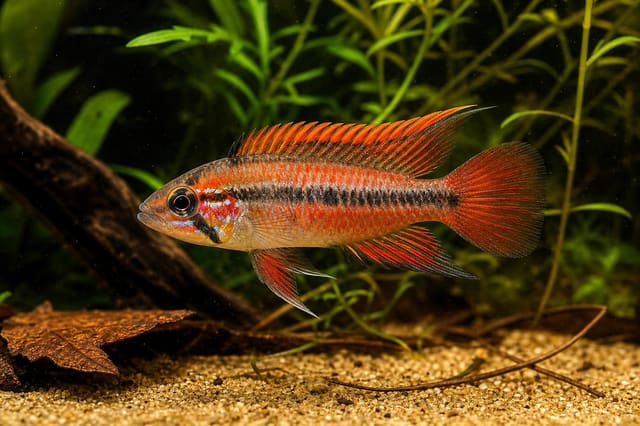
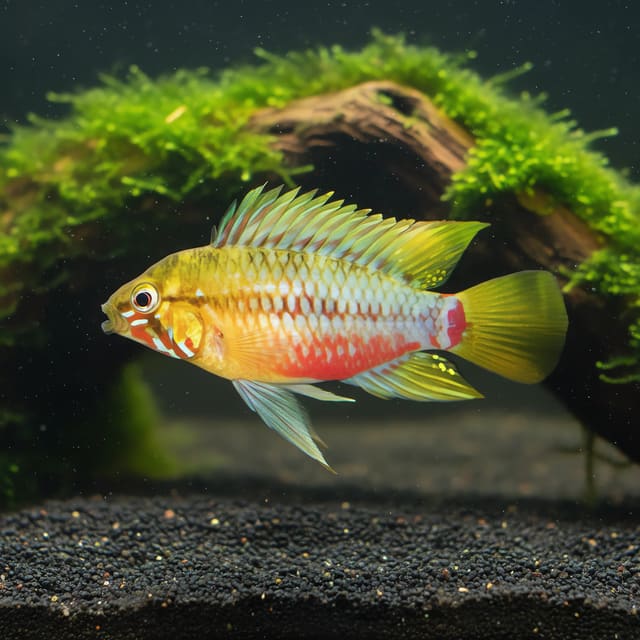
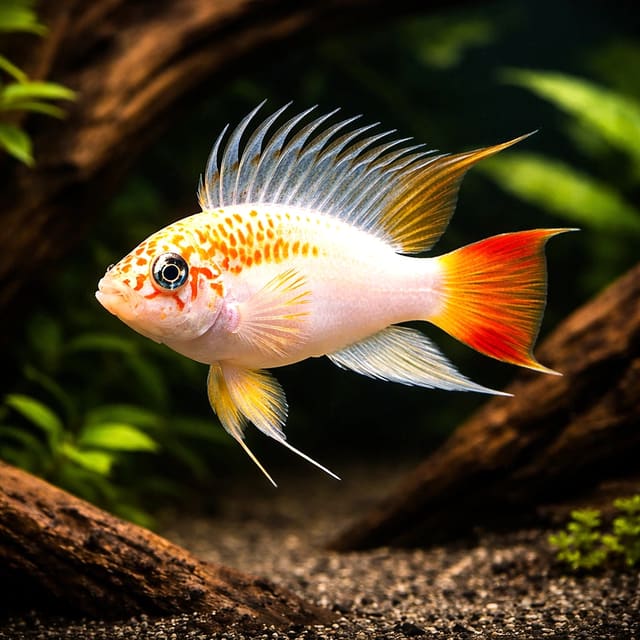
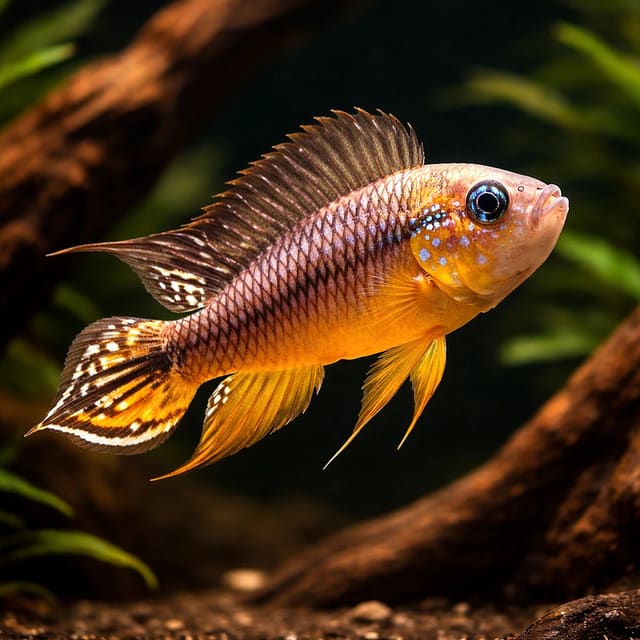
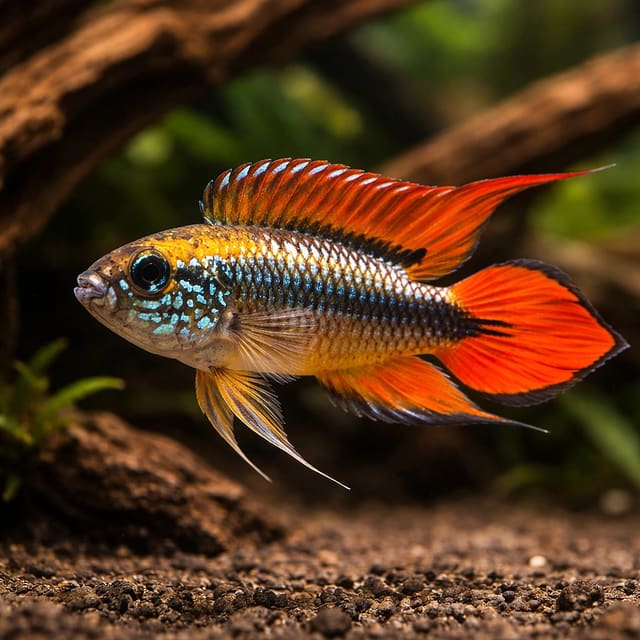
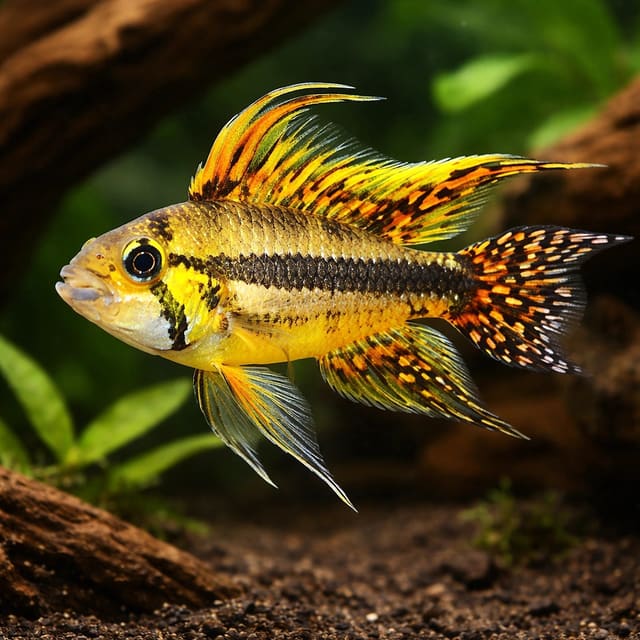
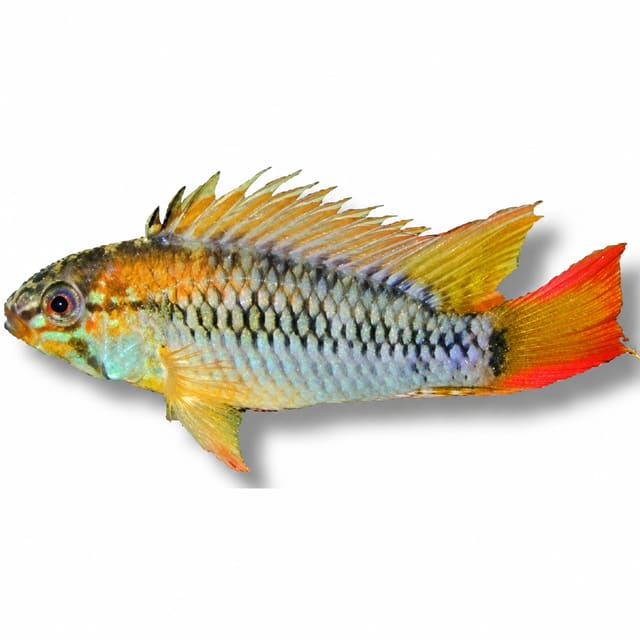
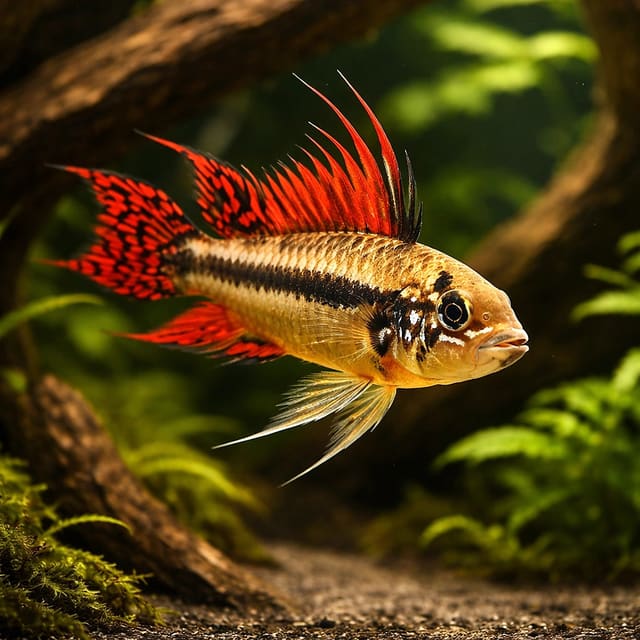
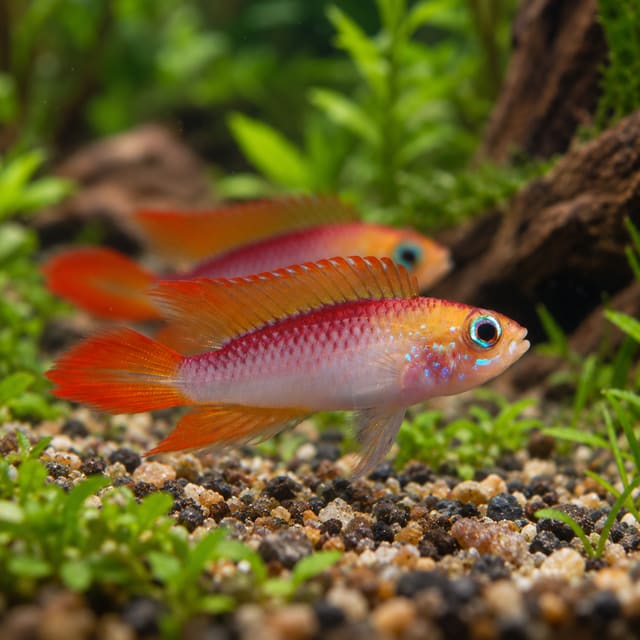
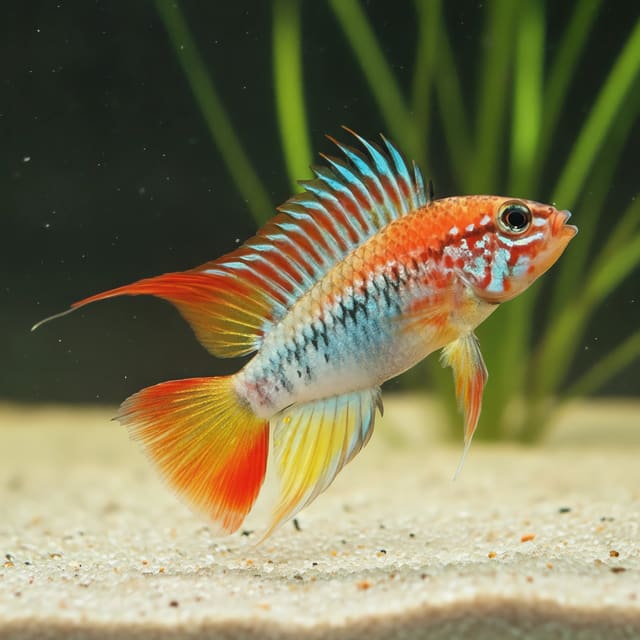
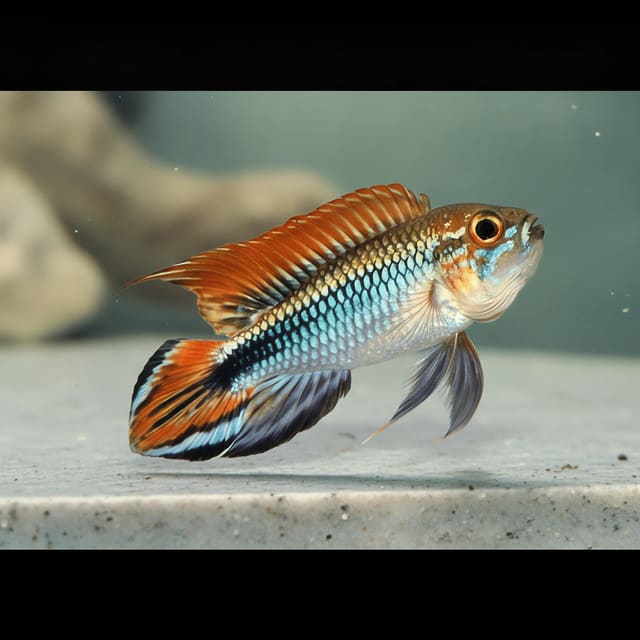
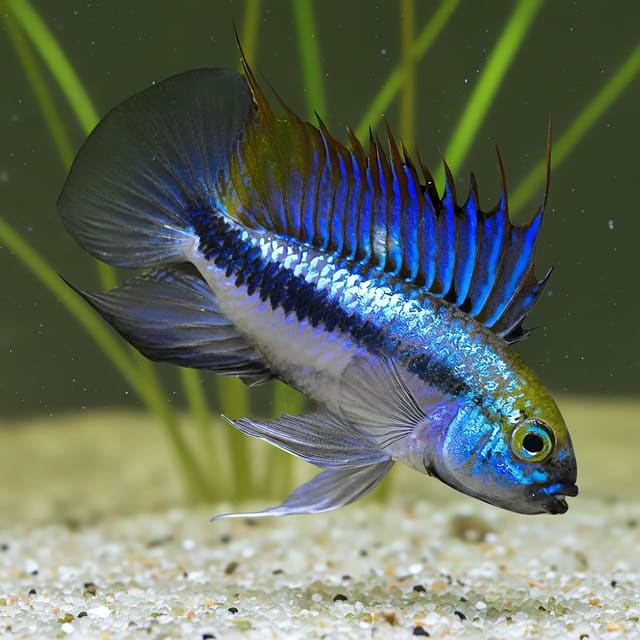
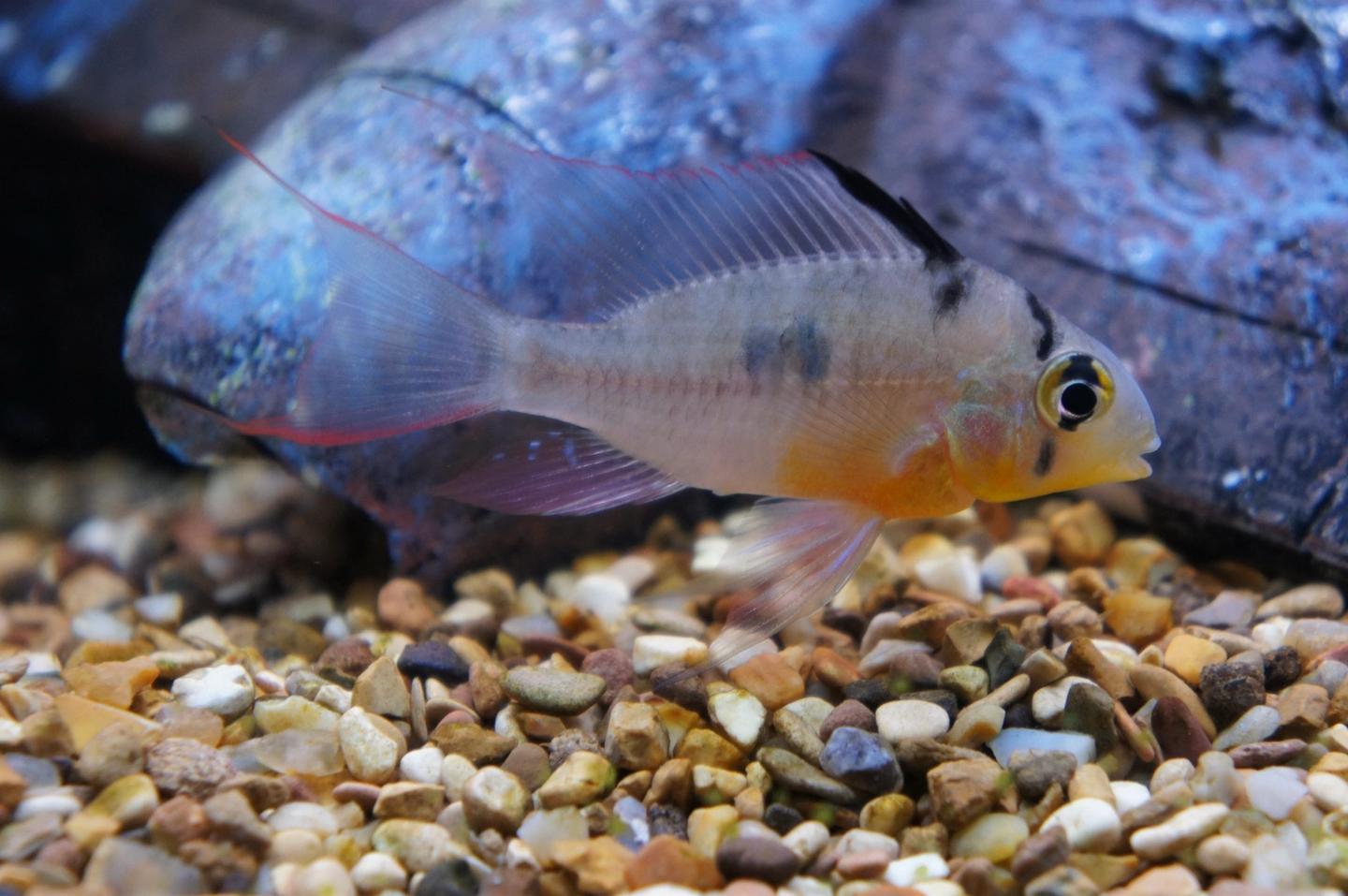
The red-mask trade form is sold for its strong cichlid character in a compact body, but colour and pattern are naturally variable. Mood, maturity, sex, lighting and background can all change how an individual appears. Gallery images have been digitally enhanced to improve image quality. Natural colour, pattern, size and maturity can vary between live animals. The gallery is representative presentation rather than a promise that the dispatched fish will match one pictured pose or marking exactly.
Browse the wider South American cichlid collection for other separately listed species and forms. Those listings are alternatives to compare, not automatic companions for this fish. Compatibility depends on aquarium size, water chemistry, temperament and the particular individuals involved.
For a single fish or a carefully managed pair, a base measuring about 45 × 30 cm and roughly 41 litres is the smallest specialist starting point reported by Seriously Fish. That figure is not a universal community-tank allowance. More room is needed for a group, for mixed-species stocking or whenever the layout cannot provide clearly separated territories. FishBase also gives a 60 cm minimum aquarium length and reports several females per male as the social arrangement used in aquarium keeping. OATA's broader dwarf-cichlid guidance is more cautious for mixed stocking, recommending at least 60 litres for a pair and at least 80 litres when mixing dwarf cichlids with other fish. These figures address different scenarios; use the larger requirement that fits the planned inhabitants and footprint.
Use soft sand as the substrate and create a network of roots, branches, caves and shaded areas. Ceramic pots, short sections of inert pipe and other aquarium-safe shelters can work where a natural layout is not practical. Dried beech, oak or catappa leaves can add cover and support small microbial communities as they break down. Arrange the hardscape so each retreat has an interrupted line of sight to the next. A single decorative cave in an exposed tank is not equivalent to a structured habitat, especially if more than one cichlid shares the aquarium.
Plants are useful for cover and for breaking sight lines. Choose species that suit the aquarium light and water conditions, and leave open patches of sand for natural lower-level foraging. Secure wood and stone so digging cannot undermine them. Any rockwork must be stable before water and fish are added. Fit a lid because frightened fish can jump, and keep the aquarium away from frequent knocks, loud vibration and sudden lighting changes.
Keep captive Apistogramma macmasteri at 24–28 °C, pH 5.5–7.0 and 0–5 dGH. These are the species-level routine aquarium figures from Seriously Fish. FishBase records 23–30 °C, pH 6.0–6.5 and 2–4 dH from its broader species record, including wild-environment data; those extremes are not used here as targets for routine captive care. OATA gives 22–27 °C, pH 6.0–8.0, 4–12 dGH and 3–10 dKH for dwarf cichlids as a group. That group sheet is useful for general husbandry but does not override the narrower species profile.
Stability matters as much as the number on a test. Measure the source water and aquarium before purchase, then plan any chemistry adjustment gradually. The water chemistry guide explains pH, general hardness and carbonate hardness, while the water matcher helps compare an aquarium with the stated species range. Never make a large, sudden correction solely to chase a nominal value. If the local supply is substantially harder or more alkaline, prepare suitable water consistently rather than relying on an abrupt one-off treatment.
Ammonia and nitrite must remain at zero. OATA advises keeping nitrate no more than 20 mg/l above the normal tap-water level in its general dwarf-cichlid guidance. Use an established biological filter with gentle movement rather than a strong jet across the entire footprint. RSPCA guidance explains why a working biological filter is essential: beneficial bacteria convert toxic ammonia first to nitrite and then to the less harmful nitrate. Protect that bacterial population whenever the filter is serviced.
Test at least weekly and whenever behaviour or appetite changes. OATA recommends a partial water change of about 25% at least once a week, using a conditioner on replacement tap water. Match replacement water closely for temperature and chemistry. Check the filter for blockages, but do not rinse biological media under the tap; lightly rinse it in removed aquarium water when needed. Siphon accessible waste without stripping every sheltered area at once. Consistent small maintenance is safer than allowing waste to accumulate and then making an extreme correction.
Run the aquarium fully before livestock is introduced. Confirm that the heater holds a stable temperature across day and night, the filter operates quietly without blasting the floor, and ammonia and nitrite remain at zero after normal feeding of the established inhabitants. Record pH and hardness on more than one day. This gives a realistic baseline and reveals whether water changes produce a large swing. Place a thermometer where it can be read easily rather than relying only on a heater dial.
Inspect every planned shelter from the fish's level. A retreat should have an entrance the fish can use without being trapped by a larger neighbour, and the route away from it should not lead directly into another territory. Leave maintenance access around wood and rock so waste can be removed. If a community is planned, map where each existing fish sleeps and feeds before assigning the remaining floor space to a dwarf cichlid.
Prepare routine supplies in advance: dechlorinator, reliable tests, a clean dedicated bucket, siphon, varied foods and a safe way to isolate a fish if behaviour changes. Do not wait for an emergency to discover that the spare container is unheated or uncycled. A small established sponge filter held in another healthy aquarium can provide contingency filtration, but it still needs temperature control, appropriate water and observation.
This species feeds mainly on small bottom-associated invertebrates in nature. In the aquarium, offer appropriately sized live or frozen foods such as Artemia, Daphnia and bloodworm, alongside a good prepared food. Seriously Fish notes that many individuals learn to accept dried foods and tend to prefer pellets over flakes. Introduce new foods patiently and use a varied rotation rather than depending on a single rich item.
Feed small portions that are consumed promptly. Watch that the fish actually eats; shy individuals can lose out when housed with faster open-water feeders. Place food near cover if necessary, without allowing it to collect beneath wood or leaves. Remove obvious leftovers and reduce the next portion if food remains. OATA's group guidance suggests feeding only what can be eaten within a few minutes and warns that overfeeding contributes to toxic waste. Body shape, activity and appetite are more useful guides than a rigid universal portion.
Check breathing, posture, colour, fins, scales and appetite every day. A fish that hides more than usual, darkens, becomes pale, breathes rapidly, clamps its fins or stops eating may be responding to poor water, aggression or illness. Test the water first because ammonia, nitrite, temperature and rapid chemistry changes are common avoidable causes of distress. Separate a fish only with an appropriate prepared space; an uncycled emergency container can create another problem.
This listing does not prescribe a disease treatment. If water is within range and abnormal signs persist, seek help from a suitably experienced aquatic retailer or veterinary professional. Do not add medication blindly to a community aquarium, and never combine products without checking their active ingredients and livestock restrictions.
Apistogramma macmasteri can be kept in a carefully planned community, but peaceful-looking dwarf cichlids are still cichlids. Territorial intensity can rise around caves and spawning behaviour. Seriously Fish recommends captive-raised fish for community aquariums, while wild examples are better maintained alone or with small, calm dither fish such as Nannostomus. It also advises against mixing wild examples with other Apistogramma. Because the offered fish's rearing history is not confirmed, choose the cautious layout and monitor closely.
Suitable neighbours are small, calm fish that share the stated soft-water range and spend much of their time away from cave entrances. Pencilfish are a commonly cited example of gentle upper-water dither fish. This is a conditional suggestion, not a universal stocking list. Check adult size, temperature, pH, hardness, feeding pace and swimming level for every proposed species. Add the combined waste load to the plan, and allow far more space than the minimum single-fish footprint when building a community.
Avoid boisterous feeders that prevent the cichlid from eating, aggressive or much larger cichlids, and fish likely to occupy or raid the same shelters. Other Apistogramma are a particular territorial risk, especially in small aquariums. Long-finned or very slow fish can also be poor choices if either animal begins chasing. Bottom-dwelling neighbours are not automatically suitable simply because they are described as peaceful; shared use of the lower footprint can create repeated conflict.
Within the species, FishBase reports several females per male as an aquarium arrangement. That should not be read as an instruction to put a group into a small tank. A group requires a larger, well-structured aquarium with multiple retreats and enough separation for each female to avoid the male and one another. A pair can also chase, and the female may become strongly defensive around eggs or fry. Seriously Fish notes that a male may need removal in a smaller aquarium if the female becomes highly aggressive after spawning. Any removal plan needs a mature, heated and filtered alternative aquarium ready before conflict develops.
The listing supplies one fish, not a pair or group. It also makes no sex guarantee. If a particular social plan depends on sex, obtain only animals explicitly sold as sexed and do not infer sex from juvenile colour. Introduce deliberately, observe during feeding and after daily activity changes, and keep a divider or suitable second aquarium available when combining territorial fish.
Good compatibility is visible in behaviour: each fish can feed, rest and move through its normal area without constant pursuit. Repeated hiding, damaged fins, refusal to feed or one fish being pinned to a corner indicates that the arrangement needs intervention. More ornaments added after conflict begins may help only if there is enough floor space to create genuinely separate territories. Sometimes separation is the responsible answer.
Check more than the dominant fish. A subordinate animal may appear calm because it has stopped leaving a refuge. Watch the whole aquarium at feeding time, shortly after room activity begins and while routine maintenance is performed. Record persistent chasing rather than dismissing each short event in isolation. If one fish loses access to food or open water, act before visible injury develops.
Rearranging wood can reset territory boundaries, but it also removes familiar routes and may trigger another contest. Make changes with a clear purpose, keep water conditions stable and observe continuously afterwards. Do not repeatedly dismantle the aquarium in response to every display. Brief displays can be normal; relentless pursuit, damaged fins and exclusion from resources are not.
Product suggestions elsewhere on this page are alternatives to compare, not declared tank mates. The Asia Form Ram and Longfin Ram have their own care and behaviour requirements. Never purchase an alternative species on the assumption that sharing a retail category means it can safely share an aquarium with this fish.
FishBase records Apistogramma macmasteri to 7 cm total length and also gives 5.5 cm standard length for male or unsexed fish. Seriously Fish gives about 5.5 cm standard length for males and 4 cm for females. Seven centimetres is used as the conservative upper reference because total length includes the tail. Individual adult size is not guaranteed.
A 45 × 30 cm base of roughly 41 litres is the specialist minimum reported for a single fish or carefully managed pair, while FishBase gives a 60 cm minimum tank length. Use a larger aquarium for groups or communities; OATA's broader guidance recommends at least 60 litres for a pair and 80 litres when mixing dwarf cichlids with other fish.
One fish can be maintained with appropriate cover. FishBase reports several females per male as an aquarium arrangement, but that requires a larger, well-structured footprint with multiple territories. This listing supplies one fish and does not guarantee sex, so do not build a pair or group plan around an assumed juvenile sex.
It is best treated as an intermediate-care fish. A keeper should be able to maintain a mature biological filter, test soft acidic water, feed a varied diet and respond to territorial behaviour. A careful beginner can prepare for those needs, but it is not a suitable shortcut around cycling and stable water management.
Offer small live or frozen foods such as Artemia, Daphnia and bloodworm, with a quality prepared food. Many fish learn to take dried foods and may prefer pellets to flakes. Feed portions that are eaten promptly, make sure shy fish receive food, remove leftovers and vary the diet.
Use 24–28 °C, pH 5.5–7.0 and 0–5 dGH as the routine captive range. Keep ammonia and nitrite at zero, use gentle established filtration and avoid sudden adjustments. The wider figures found in wild records or general dwarf-cichlid guidance are not the target range used for this listing.
It can be calm in a suitable community but remains territorial, especially around caves and spawning activity. Persistent chasing and fin damage are possible when space or cover is inadequate. Break sight lines, provide several retreats, avoid boisterous or aggressive neighbours and be prepared to separate incompatible fish.
Consider small, calm upper-water fish that share its temperature and soft-water range; pencilfish are one cited example. Avoid assuming that any community fish will work. Check adult size, feeding speed and use of the lower footprint, and be particularly cautious with other Apistogramma or larger cichlids.
Tropical Fish Co hand-packs live fish in an insulated box and uses a tracked, licensed live-animal courier for the confirmed delivery date. Be present to receive it. Before opening, record one continuous unboxing video showing the sealed parcel, outer box and fish still in the sealed bag; this is required for a Live Arrival Guarantee claim. Float the sealed bag for 20–30 minutes, add small amounts of aquarium water over up to 20 minutes to adjust chemistry, and release the fish while adding as little bag water as possible. Contact Tropical Fish Co the same day if there is a problem. Full terms and current service details are on the delivery page.
FishBase provides the accepted name Apistogramma macmasteri, family Cichlidae, Colombian upper Meta River distribution and recorded maximum length. The profile also reports wild-environment values and aquarium notes. Habitat records help describe the species but are not automatically ideal day-to-day targets for a captive aquarium.
The Seriously Fish species profile supplies the routine 24–28 °C, pH 5.5–7.0 and 0–5 dGH aquarium range, the 45 × 30 cm base and roughly 41-litre single-or-pair starting point, furnishing guidance, diet and behavioural cautions. That narrower species-level range is used instead of broadening the recommendation to every extreme reported from habitat records.
OATA's dwarf-cichlid sheet supports general husbandry practices: a mature aquarium, zero ammonia and nitrite, regular testing, conditioned replacement water, weekly partial changes, protection of filter bacteria and cautious introduction. Its group-level water table and stocking volumes remain explicitly broader than the species profile. RSPCA guidance supports the explanation of biological filtration and why an established filter is essential, without being treated as proof of a species-specific optimum.
The exact identity, one-fish sold unit, 3–4 cm and XL dispatch grades, and absence of a sex-guaranteed selection come from the current Tropical Fish Co offer and matched supplier identity. Delivery and Live Arrival Guarantee steps come from Tropical Fish Co's delivery policy. Service dates, stock and other changeable commerce details should always be read from the live selector and current policy rather than frozen into care copy.
Where figures differ, this page does not average them. It selects the narrower specialist range for routine care, keeps wild and group-level values in their proper context, and uses the most conservative documented adult-size measure. Aquarium-size figures are scenario-dependent: the specialist single-or-pair footprint is not presented as a community allowance, and the broader pair/community volumes do not erase the importance of tank length and floor structure.
Do not assume a guaranteed lifespan, universal tank-mate list, disease treatment, sex from appearance or home-breeding outcome. These depend on facts that are not part of this offer and, in several cases, on individual fish and aquarium conditions. The care page is practical preparation for choosing the fish, not a substitute for observing the animal and testing the keeper's own aquarium.
The distinction between dispatch size and adult size is especially important. The 3–4 cm and XL labels describe what is selected for supply. Adult measurements describe the mature species and use different scientific conventions. A fish selected at the larger grade may still grow, while a fish selected at 3–4 cm is not promised to reach one identical final length. Nutrition, sex, age and individual development influence the eventual result.
Likewise, a minimum footprint is a planning boundary rather than a design goal. Water volume, base area, cover, filter maturity and the behaviour of every inhabitant work together. A longer aquarium with usable territories can be more appropriate than a taller vessel of similar volume. When stocking becomes more complex, increase space and simplify the social plan rather than treating the smallest figure as an entitlement to add more fish.
The two dispatch grades allow the buyer to choose the supplied size description without changing the underlying species contract. Both belong to the same parent listing, both represent one live fish per purchase, and neither states a sex. The photographs help show the trade form, but they do not turn colour, fin shape or body pattern into a selection guarantee. Read the grade label and sex disclosure together before deciding.
The aquarium should be ready for the adult species, not merely the fish's dispatch size. A smaller grade does not justify a temporary uncycled tank, and an XL grade does not mean the fish has finished growing. Plan the final footprint, water range and territorial cover before ordering. This avoids a rushed move later and makes it easier to judge whether existing fish leave enough lower-level space.
Measure new water before it enters the aquarium when the household supply varies through the year. A change in water company source, heavy rainfall, drought restrictions or home water treatment can alter hardness and pH. Keep a simple log of aquarium temperature, pH, hardness, ammonia, nitrite and nitrate. The purpose is to recognise a trend before the fish shows distress.
Prepare replacement water in a clean aquarium-only container. Add the correct amount of conditioner for the new-water volume and bring it close to aquarium temperature. Remove water with a siphon, concentrating on exposed waste while leaving deliberately placed leaf litter and established shelter largely undisturbed. Refill slowly so the substrate and cave entrances are not blasted. Recheck the heater and filter after the water level is restored.
Do not replace all biological media on a schedule. Mechanical pads can be rinsed when flow falls, while biological material should be handled gently and retained unless it is physically failing. If a manufacturer cartridge combines carbon and filter media, plan how bacterial capacity will be preserved before replacing it. Never switch off a loaded filter for long periods; stagnant media can lose oxygen and no longer perform as expected when restarted.
During hot weather, verify the actual water temperature rather than assuming the heater setting controls it. Increase surface movement carefully if oxygen may be reduced, while preserving the calm lower-area flow the cichlid uses. Avoid rapid cooling with ice or a large cold water change. During winter, check that cold replacement water and draughts do not cause a sudden drop. Stable adjustment is safer than a dramatic correction in either direction.
This rhythm connects water data with what the fish is doing. A single reading can be misleading, but repeated results alongside appetite and behaviour make developing problems easier to identify. Keep the schedule realistic enough to follow every week rather than designing an elaborate routine that will be abandoned.
Do not add several territorial fish at once merely to finish the aquarium quickly. Introduce livestock at a pace the established filter can support and reassess the social map after each change. If this cichlid enters an established community, make sure shelters are not already controlled by another bottom-oriented fish. If it is the first territorial fish, remember that later additions may be treated as intruders.
Feeding is a useful compatibility test. Place suitable food where the cichlid can reach it without crossing an aggressive neighbour's core area. Watch whether fast shoaling fish take every item before it sinks. A fish that emerges only after food is gone is not succeeding simply because no biting is visible. Adjust food form and placement without increasing the total amount so far that water quality suffers.
Temporary displays should end with both fish able to retreat. An aquarium is not socially stable when one animal controls every cave, feeding point and route to the surface. The response may be a layout change, reduced stocking or permanent separation. Adding another fish to distract aggression often increases competition and waste rather than solving the cause.
Review the arrangement again as fish mature. A community that appears calm around juveniles can change as body size, sex characteristics and spawning behaviour develop. Keep the planned alternative space functional, not packed away or left without a mature filter.
The store policy and the broad OATA introduction guidance serve different purposes. The store policy sets the Live Arrival Guarantee evidence and 20–30 minute floating steps. OATA's general method adds gradual mixing of small amounts of aquarium water for up to 20 minutes. Used together, they create a clear order: record the sealed unboxing first, float the unopened bag, adjust water chemistry gradually, then release the fish without pouring unnecessary transport water into the aquarium.
That arrival sequence cannot repair an unsuitable aquarium. Temperature equalisation does not cycle a filter, lower permanent hardness or create missing territories. Test and prepare the destination beforehand, and treat acclimatisation as the final transition into an already suitable environment.
A minimum footprint is a planning boundary rather than a design target. Water volume, base area, cover, filter maturity and the behaviour of every inhabitant work together. A longer aquarium with usable territories can be more appropriate than a taller vessel of similar volume. When stocking becomes more complex, increase space and simplify the social plan rather than treating the smallest figure as permission to add more fish.
No reviews for this item yet. Bought one? Honest reviews only, good or bad.
What customers say about ordering from us
I have a small group of long finned mountain minnows. So was delighted to be able to order ten of this variety to increase the genetics in my tank . The ones I recieved are healthy but it’s to early to give a verdict on wether they are of a long finned type since they are small currently.
Gordon Walker · 23 Sept 2026
100% success travel and "installation". Pleased with quality of purchase. The Siamese fighter a bit "shy" so have not yet seen him at his best yet but looking good. Happy customer. GG
George E Garratt · 21 Sept 2026
Reviews of our shop, collected by Judge.me, an independent third-party review collector. Newest first.