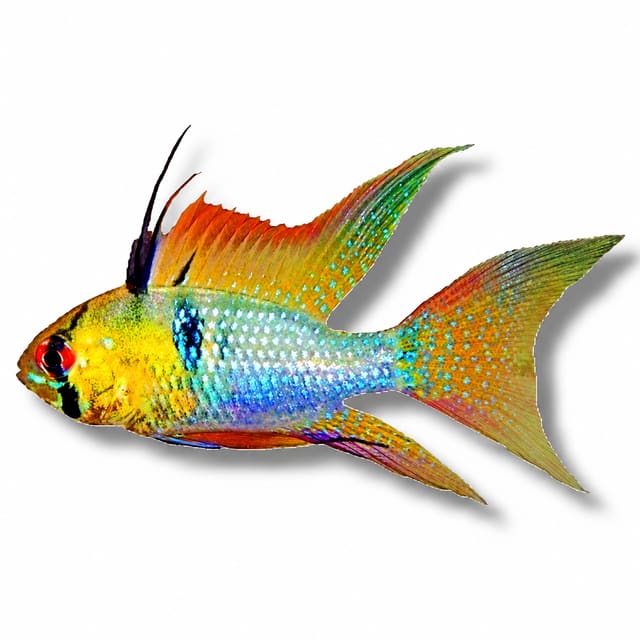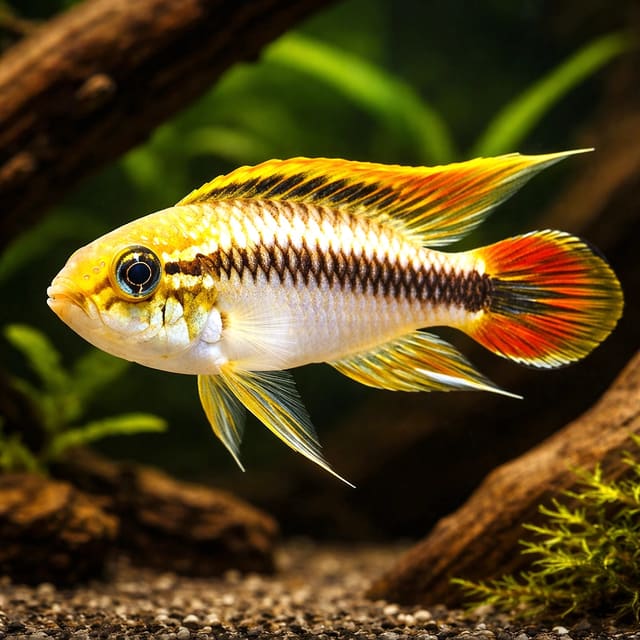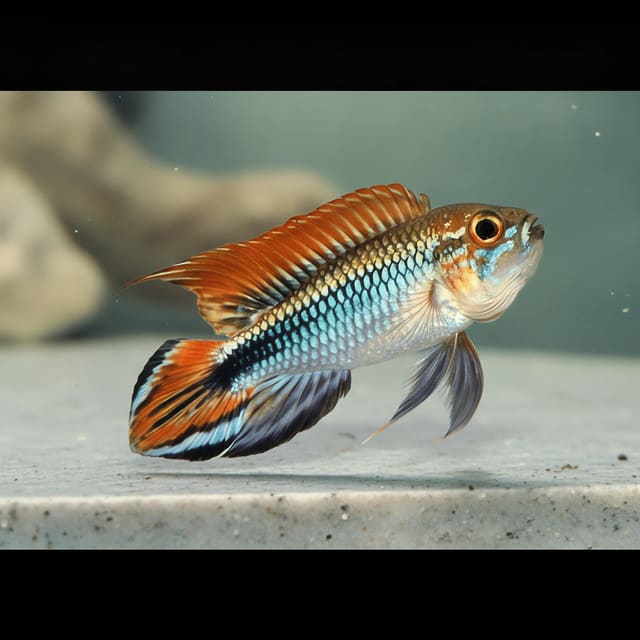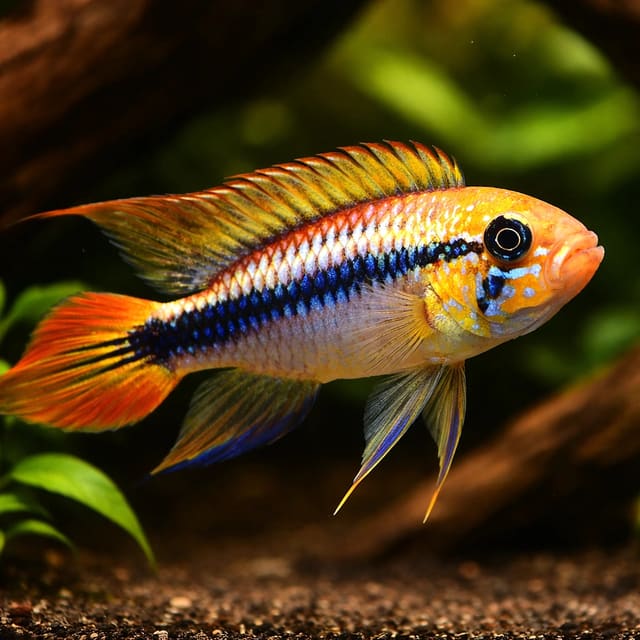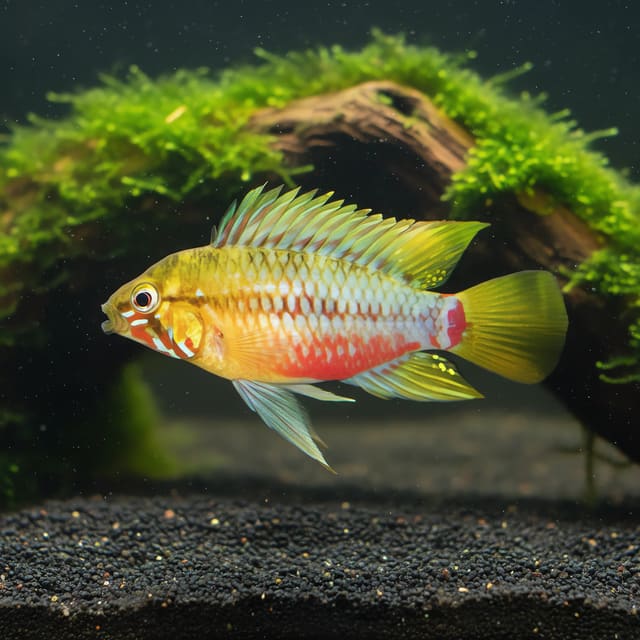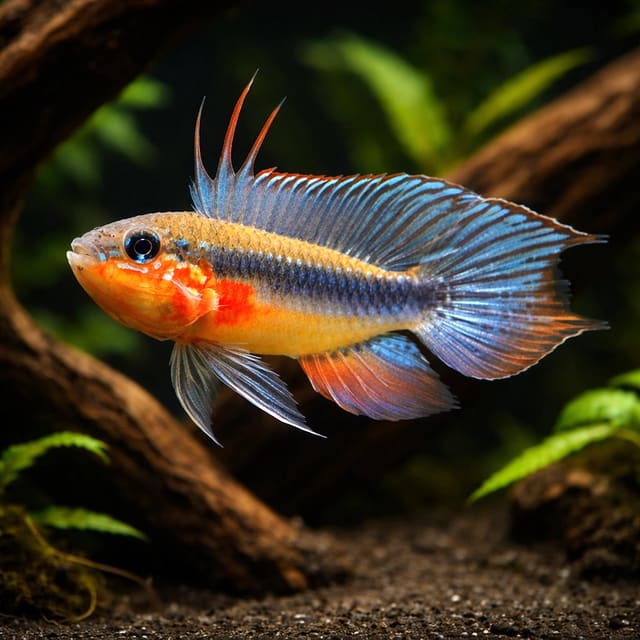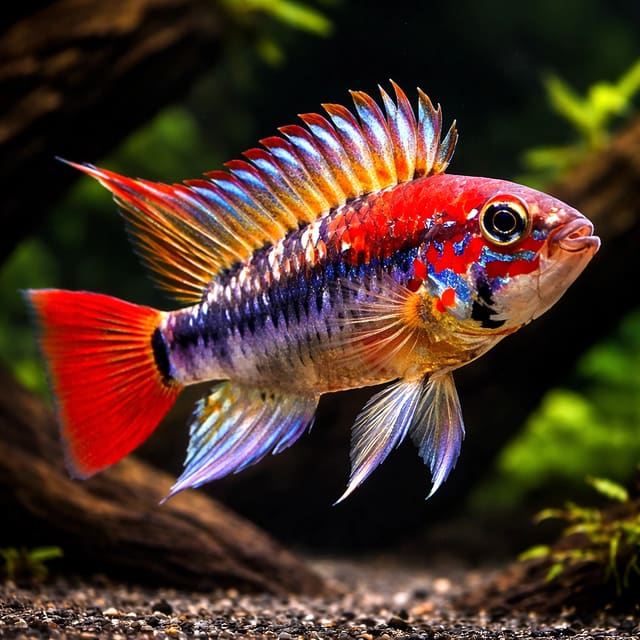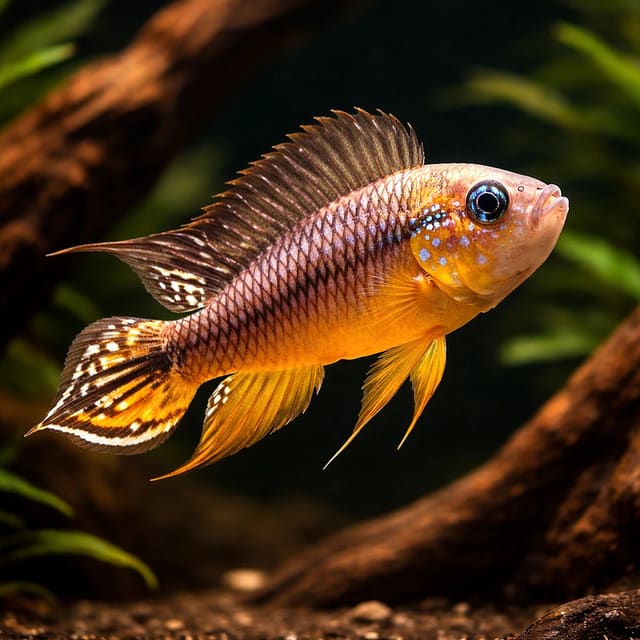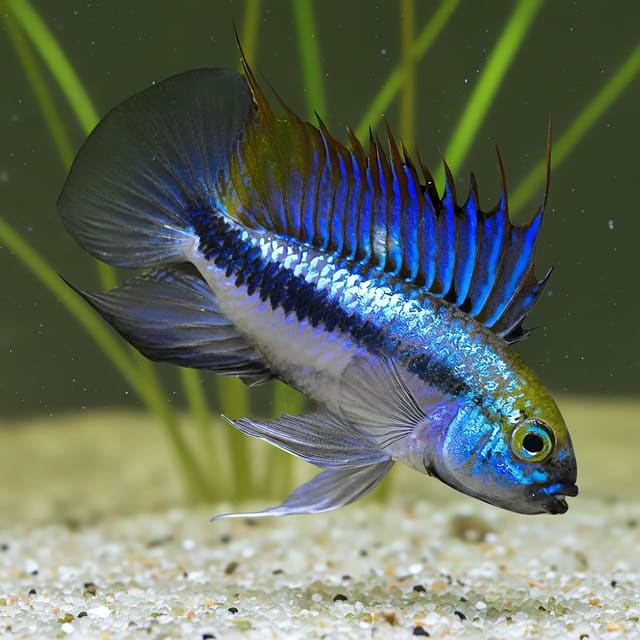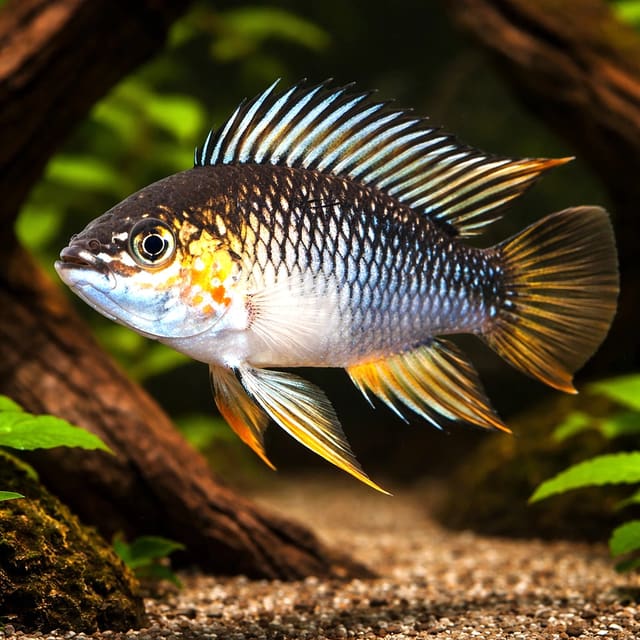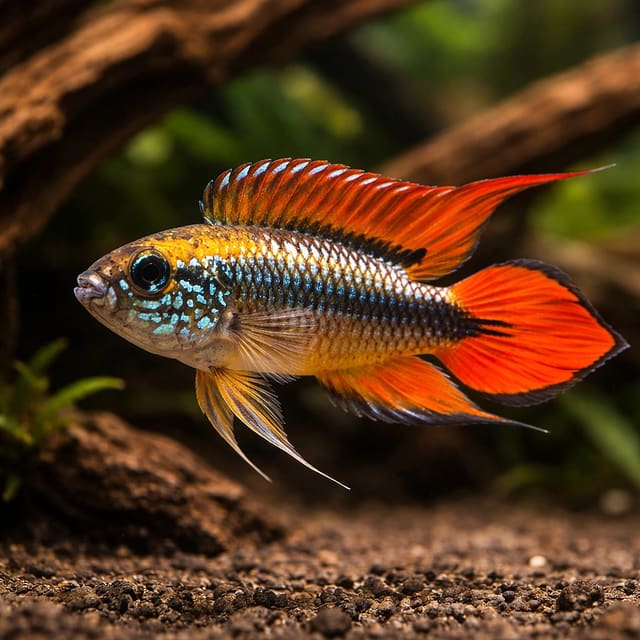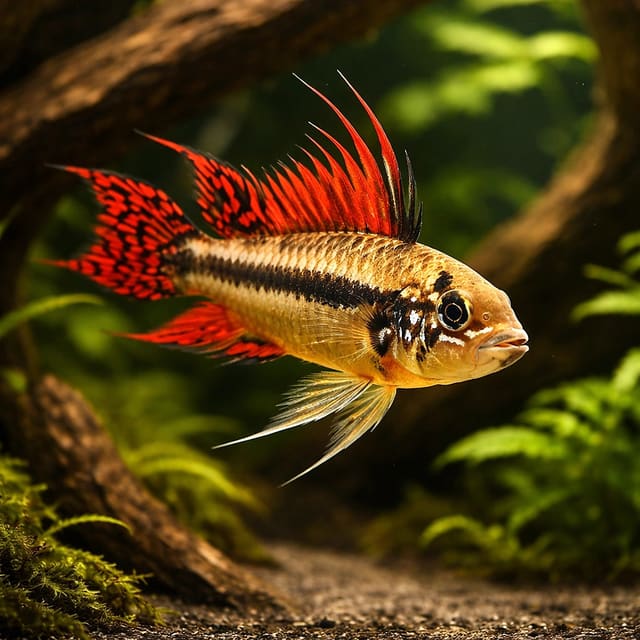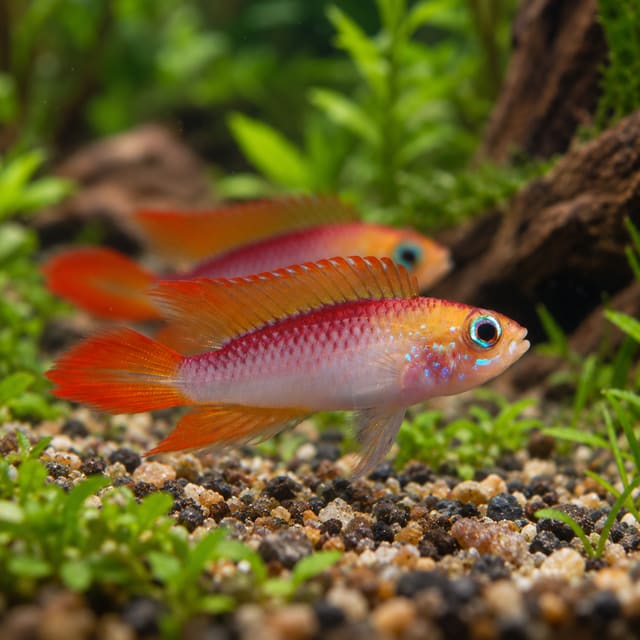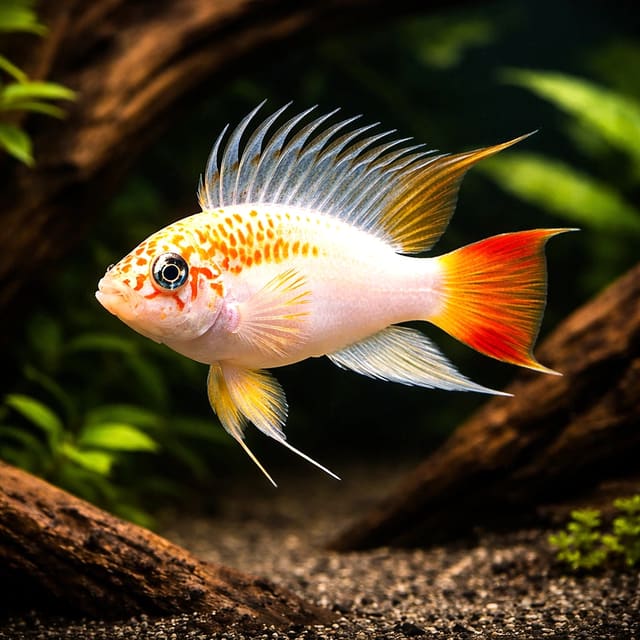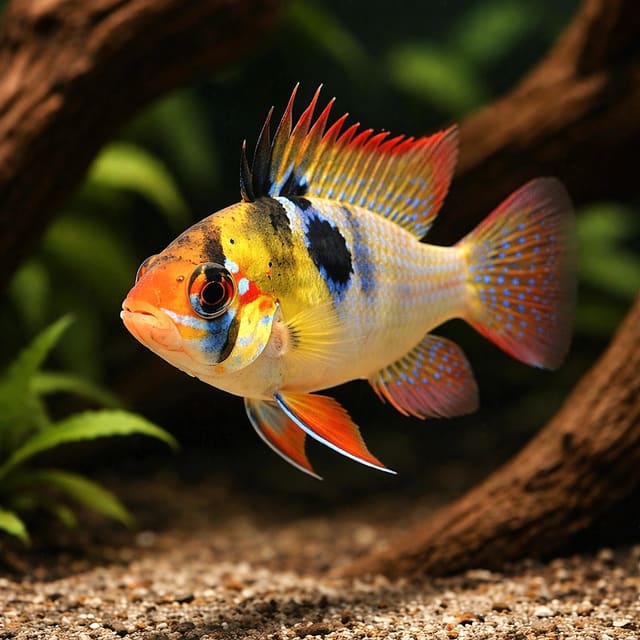
Asia Form Ram Cichlid (Mikrogeophagus ramirezi)
27–30°C · pH 4–7 · 54L
£5.99

The Veijia Dwarf Cichlid (Apistogramma sp.) is a South American dwarf cichlid for a mature, well-filtered aquarium furnished with plants, wood and caves. It can be shy among boisterous fish and territorial when breeding, so a calm shoal of dither fish suits it best. Each purchase is one live fish, supplied at 3–4 cm or in the larger XL grade.
Apistogramma sp.
Save when buying multiple fish. Each quantity is one fish; sex and pair formation are not guaranteed unless the selected variant explicitly states them.
The Veijia Dwarf Cichlid (Apistogramma sp.) is a South American dwarf cichlid for a mature, well-filtered aquarium furnished with plants, wood and caves. It can be shy among boisterous fish and territorial when breeding, so a calm shoal of dither fish suits it best. Each purchase is one live fish, supplied at 3–4 cm or in the larger XL grade.

Cichlids are a family of roughly 1,800 accepted species, not one care type. Before buying, identify the exact species and source, then compare adult measurement, usable tank dimensions, social system, territory, tested water, diet and an exit plan. No family-wide minimum tank, water range or tank-mate list is safe.
Maintain these water conditions for optimal health and vibrant colors
The Veijia Dwarf Cichlid is a small freshwater cichlid from South America, sold as Apistogramma sp. Each purchase is one live fish, and it belongs in a mature, well-filtered aquarium with plenty of cover and calm company. Like other members of its genus it can be quite shy among very active tankmates and can become territorial, especially when breeding, so the way you furnish and stock the tank matters as much as the size of the tank itself.
The exact species has not been identified, so the care advice here follows the genus Apistogramma and its care group. Apistogramma is an accepted genus in the cichlid family, Cichlidae, as the World Register of Marine Species genus record shows, and it is a large genus native to South America whose members are widely kept in aquariums. The water values, tank sizes and feeding routine on this page come from the Ornamental Aquatic Trade Association (OATA) guidance for dwarf cichlids, and each figure is labelled as group guidance where it appears.
| Suits | Think twice if |
|---|---|
| A mature, filtered aquarium where ammonia and nitrite already read zero | The tank was set up recently and is still maturing |
| A layout with live plants, wood, caves or plant pots and leaf litter | You prefer an open, sparsely furnished display |
| A calm community built around a shoal of quick dither fish | The tank already holds very active or boisterous fish |
| A keeper who tests the water and changes a quarter of it every week | Maintenance tends to slip for weeks at a time |
| Feature | Detail |
|---|---|
| Family | Cichlidae |
| Genus | Apistogramma, species unidentified |
| Genus range | South America |
| Sold as | One live fish per purchase, 3–4 cm or XL |
| Water (group guidance) | 22–27°C, pH 6.0–8.0, 4–12°dH |
| Tank (group guidance) | 60 litres for a pair; 80 litres with other fish |
| Diet | Omnivorous: flake or granule plus small live or frozen foods |
| Temperament | Can be shy; can be territorial, especially when breeding |
Dwarf cichlids are popular for their small size and bright colours, and OATA names the genus Apistogramma, alongside rams and kribensis, among the most popular dwarf cichlids in the trade. Rams sit under the same OATA dwarf cichlid care sheet, so if you have kept one, the water values and weekly routine here will be familiar.
“Veijia Dwarf Cichlid” is the trade name this fish is sold under; because the species behind it has not been confirmed, its scientific label stops at the genus. That matters when you plan. Apistogramma species differ from one another, and the Wikipedia overview of the genus notes that breeding behaviour varies with the exact species. Rather than borrow numbers from a species this fish may not be, this guide keeps to advice that holds for the whole group. For size, the useful planning figure is OATA’s note that the larger dwarf cichlid species do not exceed 10 cm; treat that as the top end for the group, not a forecast for your fish.
About the photographs: Gallery images have been digitally enhanced to improve image quality. Natural colour, pattern, size and maturity can vary between live animals.
If you are still deciding which dwarf cichlid to keep, you can compare this fish with the others in our South American cichlid collection.
OATA describes dwarf cichlids as usually undemanding of water chemistry and publishes one set of values for the whole group, with a reminder to check for any species-specific needs before buying. With this fish’s species unidentified, those group values are the right planning band for the Veijia Dwarf Cichlid. They are set out below as the OATA dwarf cichlid care sheet gives them.
| Water value | OATA dwarf cichlid guidance |
|---|---|
| Temperature | 22–27°C |
| pH | 6.0–8.0 |
| General hardness (GH) | 4–12°dH, soft to medium |
| Carbonate hardness (KH) | 3–10°dKH, soft to medium |
| Ammonia | Zero mg per litre |
| Nitrite | Zero mg per litre |
| Nitrate | No more than 20 mg per litre above normal tap water levels |
A range marks out safe ground for the group; the fish itself does best when conditions stay put. Choose a temperature comfortably inside 22–27°C, set the heater’s thermostat to it and read a thermometer every day for the first few weeks. The same principle sits behind OATA’s preference for larger aquariums: more water keeps temperature and water quality more stable, and a stable tank is easier on a small fish than one that drifts between the ends of the band.
Every water change brings in fresh tap water, so the values coming out of your tap decide how easy this fish will be to keep. Test pH, general hardness (GH) and carbonate hardness (KH) straight from the tap and compare them with the table using our water parameter matcher. If your supply already sits inside the dwarf cichlid band, keep it there with routine water changes rather than adjusting it. If it sits well outside, talk to us before ordering so we can work out together whether this fish suits your water. Our guide to which aquarium water values to test and why explains what each reading tells you.
OATA sets the nitrate limit relative to your supply: no more than 20 mg per litre above normal tap water levels. Test the tap first, then add 20 to find the ceiling for your tank. If the tap reads 10 mg per litre, for example, keep the aquarium at or below 30 mg per litre. A reading creeping towards that ceiling is a prompt to look again at how much you feed and whether the weekly water change is keeping up.
Both belong at zero at every test, not just on the day the fish arrives. Any measurable reading means the filter is not keeping pace with the waste in the tank, and it deserves attention the same day: test again, check the filter is running freely, and hold back on food until the reading returns to zero.
OATA’s advice is to buy an aquarium as large as you reasonably can. For dwarf cichlids as a group it recommends at least 60 litres if just a pair is kept, and an aquarium of at least 80 litres will be needed to mix these fish with other species. Larger volumes keep temperature and water quality more stable, and that stability is the real reason to go bigger.
Because each purchase is one fish, you decide how many to keep. The 60 litre figure is written for a pair, and buying two fish does not choose their sexes, so plan for two individuals rather than a ready-made couple. If the Veijia Dwarf Cichlid will share its home with dither fish or any other species, the 80 litre figure applies. Every fish added means more waste, so the filter and the weekly water change have to keep pace as the population grows.
A filter is essential whatever the size of the tank. The RSPCA’s guidance on the aquarium environment is plain about it: no fish should be kept without a well set up and maintained filter, because fish release ammonia, which is toxic. A working biological filter grows the bacteria that convert ammonia into nitrite, which is also toxic, and then into nitrate, which is safer. Those bacteria live in the filter media, so keep the filter running at all times and look after the media carefully when you clean it.
Use aquarium gravel or sand for the floor and, ideally, live plants for cover, which OATA singles out as especially important for the shyer species. Even well settled pairs will often chase each other, so plenty of cover is essential rather than decorative. If you would rather not grow live plants, plastic plants and suitable ornaments do the same job: plant pots, model caves, wood and leaf litter all give shelter.
Fit a heater with a thermostat sized for the aquarium, and a thermometer you can read at a glance. Between them they hold the tank inside the 22–27°C dwarf cichlid band and let you spot a failing heater before the fish does.
The group figures become easier to use once they are turned into a real plan. Both set-ups below assume a mature filter and a tank holding steady inside the dwarf cichlid water values; the difference is whether the Veijia Dwarf Cichlid shares its home.
Whichever you choose, the tests and the weekly water change stay the same. What changes is the load on the filter, which grows with every fish, and the amount of cover the cichlid needs to feel secure.
A new fish is only as safe as the filter waiting for it. OATA calls the problem ‘new tank syndrome’: when there are not enough nitrifying bacteria to cope with the waste, ammonia and nitrite climb to unhealthy levels, which may cause fish to become ill or die. The cure is patience before purchase, so the Veijia Dwarf Cichlid arrives into a tank that has already learned to deal with waste.
Our step-by-step guide to setting up and maturing a first tropical tank walks through the process in order, from filling the tank to the first fish.
Only increase the number of fish slowly. The beneficial bacteria in the filter have to multiply every time more fish are added and feeding increases, so overstocking, or stocking too quickly, can bring on the same ammonia and nitrite spike as an immature filter. If you are building a community around this fish, add it and its companions in stages, test between each addition and wait until ammonia and nitrite read zero again before adding more. Before the first fish goes in, check that the aquarium is an appropriate size for the number of dwarf cichlids you plan to keep.
Members of the genus Apistogramma mostly feed on tiny animals, and OATA describes dwarf cichlids as omnivorous fish that will take most food types. In the aquarium that translates into a good quality staple food with small live or frozen foods added for variety.
Feed only what the fish can eat within a few minutes, once a day. Uneaten food breaks down and releases toxic waste into the water, so overfeeding works against everything the filter is doing. A small portion that disappears quickly is the aim; if food is still lying on the floor after a few minutes, the next portion should be smaller.
In a mixed tank the within-a-few-minutes rule applies to the whole community: judge the portion by what all the fish clear, not by what the cichlid alone takes. A dither shoal adds mouths and waste, so the weekly water test is also a check on whether the portion size and the water change still balance each other.
Watch the Veijia Dwarf Cichlid at every feed during its first weeks. OATA lists reduced intake or lack of interest in food among the changes that can signal a problem, and a shy fish in a busy tank is easy to overlook at feeding time. If it is not eating, test the water before anything else, then look at whether its companions are too active for it.
Good husbandry is essential with this group, because dwarf cichlids can be stressed by even the smallest amounts of ammonia. The routine OATA sets out is simple and weekly, and it works best as a fixed habit.
If the filter needs cleaning, do not run it under the tap. Chlorine or chloramine in tap water may kill the beneficial bacteria that have established in the media. Rinse the media lightly in the tank water you have just removed during the water change instead, which keeps as much of the bacterial population as possible.
| When | What to do |
|---|---|
| Daily | Read the thermometer and watch the fish feed |
| Weekly | 25% partial water change with conditioned water, siphon the floor, test the water |
| Weekly | Check the filter for blockages |
| When the filter needs it | Rinse the media lightly in removed tank water |
Your fish is hand-bagged in pure oxygen and packed in an insulated poly box, with a heat pack when the weather calls for it, then carried by a licensed live-animal courier. We email the tracking number and your confirmed delivery date so you know when to be in. Someone needs to be at the delivery address to receive the parcel, because live fish cannot be left unattended, and the parcel should be opened and inspected the same day it arrives.
The video keeps claims quick, clear and fair: our licensed live-animal courier may ask us for continuous unboxing evidence when we raise a claim. Full details are on our delivery and Live Arrival Guarantee page.
Expect a shy Apistogramma to use the cover you have provided while it settles. Over the first days, look for the signs OATA associates with a healthy fish: clear, bright eyes, undamaged fins, intact scales, no ulcerations or bumps, and normal swimming. Test the water during the first week too, since one new fish adds to the load on the filter.
All fish vary a little in behaviour and appearance, so spend the first weeks learning what normal looks like for your fish. It is the change that matters: a shy cichlid that has always used its cave is not necessarily unwell, but one that suddenly stops coming out to feed deserves a closer look. These are the signs OATA lists:
| Watch | What a change looks like |
|---|---|
| Swimming | Hanging at the surface, sitting on the bottom or erratic swimming |
| Colour | Turning darker or paler than normal |
| Temperament | More aggression than usual, or hiding more than normal |
| Breathing | Gill covers moving at a slower or faster rate than normal |
| Appearance | White spots or fluffy growths, or loss of fins or scales |
| Condition | A noticeable gain or loss in body weight |
| Feeding | Reduced intake or lack of interest in food |
If you are concerned, test your water quality before anything else: ammonia, nitrite, nitrate, pH and temperature. Then contact us with the readings and a description, or a short clip, of what you have seen, so we can help you decide on the next step. Acting on the water first matters with dwarf cichlids, because a small ammonia reading is enough to stress them.
A notebook or phone note with the date, your test readings, the water change and anything unusual you noticed turns a vague worry into something you can act on. When a change appears, you can see at a glance whether a reading moved, whether a new fish went in or whether a water change was missed, and it gives us far more to go on if you get in touch.
Dwarf cichlids can be kept in community aquariums, and a Veijia Dwarf Cichlid can share a tank when the community is planned around its shy, territorial side. OATA’s guidance for the group comes down to three points: choose the right kind of companion, give everyone enough space, and think ahead to breeding.
Dwarf cichlids are best kept with shoals of dither fish. A calm shoal moving through open water gives the cichlid a sense of security, and dither fish are quick enough to swim away if the cichlid becomes territorial. When you choose a shoal, check that the species shares the dwarf cichlid water values in the care tab and that it swims as a group rather than darting about the whole tank.
Some species, including those in the genus Apistogramma, can be quite shy and will not do well in aquariums with very active or boisterous tankmates. Leave out lively, pushy species even when they are small; size alone does not make a companion suitable.
| Good signs in a companion | Reasons to leave it out |
|---|---|
| Swims in a calm shoal | Very active or boisterous |
| Quick enough to move away from a territorial cichlid | Likely to disturb spawning sites |
| Comfortable in the same dwarf cichlid water values | Needs water outside those values |
| Leaves eggs and fry alone | Likely to prey on fry |
Mixed tanks need the larger footprint set out under tank size in the care tab, and the reason is territory. Tankmates need enough space should the cichlids start breeding, because some dwarf cichlids can be territorial, especially when breeding. Spread caves and planting through the tank so that a guarding fish can hold one area while the rest of the community carries on elsewhere.
Breeding behaviour in Apistogramma varies with the exact species, so there is no single routine to follow for a fish whose species is unconfirmed. Since sex cannot be chosen on this listing, two fish are not a guaranteed pair. If you do intend to breed dwarf cichlids, OATA advises avoiding tankmates that might disturb spawning sites or prey on the fry, which usually means a quieter community, or the fish on their own in a furnished tank of the right size.
Some African lake species, such as the shell dwellers, are sometimes called dwarf cichlids too. They have specific care requirements and are not suitable for community aquaria, so their care does not transfer to an Apistogramma, and they are not companions for this fish.
The exact Apistogramma species behind this trade name has not been identified, so there is no species maximum to quote. As a group guide, OATA notes that the larger dwarf cichlid species do not exceed 10 cm. The size you choose, 3–4 cm or XL, is the size supplied, not the adult size.
OATA’s dwarf cichlid guidance recommends at least 60 litres if just a pair is kept, and an aquarium of at least 80 litres will be needed to mix these fish with other species. A larger tank keeps temperature and water quality more stable.
OATA’s smallest tank figure for dwarf cichlids is for a pair: at least 60 litres. Each purchase is one fish and sex cannot be chosen, so two fish are not a guaranteed pair; give any two plenty of cover, because even well settled pairs will often chase each other.
It suits a keeper whose tank is already mature and who tests and changes water every week. OATA describes dwarf cichlids as usually undemanding, but they can be stressed by even the smallest amounts of ammonia, and fish from this genus can be quite shy.
Apistogramma mostly feed on tiny animals, and OATA describes dwarf cichlids as omnivorous. Offer a good quality flake or granule as the staple, with small live or frozen foods such as daphnia, brine shrimp or tubifex. Feed only what it can eat within a few minutes, once a day.
For the Veijia Dwarf Cichlid, use OATA’s dwarf cichlid group guidance: 22–27°C, pH 6.0–8.0 and general hardness of 4–12°dH, with ammonia and nitrite at zero. Hold one steady value inside those bands rather than letting the tank drift across them.
Expect territorial behaviour rather than constant aggression. Some dwarf cichlids can be territorial, especially when breeding, and well settled pairs will often chase each other, so plenty of caves, wood and plants are essential.
Shoals of dither fish suit dwarf cichlids best, because they give the cichlid a sense of security and are quick enough to swim away if it becomes territorial. Avoid very active or boisterous tankmates, and allow at least 80 litres for a mixed tank.
It is hand-bagged in pure oxygen in an insulated poly box, with a heat pack when the weather calls for it, and carried by a licensed live-animal courier. Someone must be in to receive it. Film a continuous unboxing video from the sealed parcel, then float the bag for 20–30 minutes before releasing; the Live Arrival Guarantee needs that video for any claim.
No reviews for this item yet. Bought one? Honest reviews only, good or bad.
What customers say about ordering from us
I have a small group of long finned mountain minnows. So was delighted to be able to order ten of this variety to increase the genetics in my tank . The ones I recieved are healthy but it’s to early to give a verdict on wether they are of a long finned type since they are small currently.
Gordon Walker · 23 Sept 2026
100% success travel and "installation". Pleased with quality of purchase. The Siamese fighter a bit "shy" so have not yet seen him at his best yet but looking good. Happy customer. GG
George E Garratt · 21 Sept 2026
Reviews of our shop, collected by Judge.me, an independent third-party review collector. Newest first.