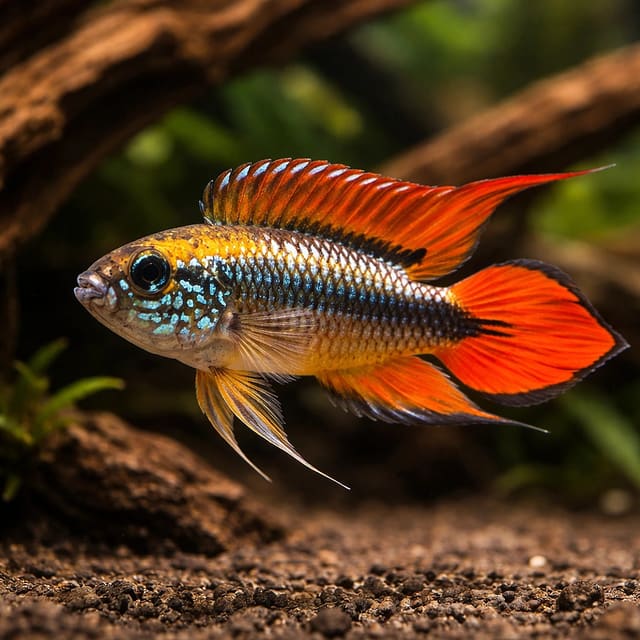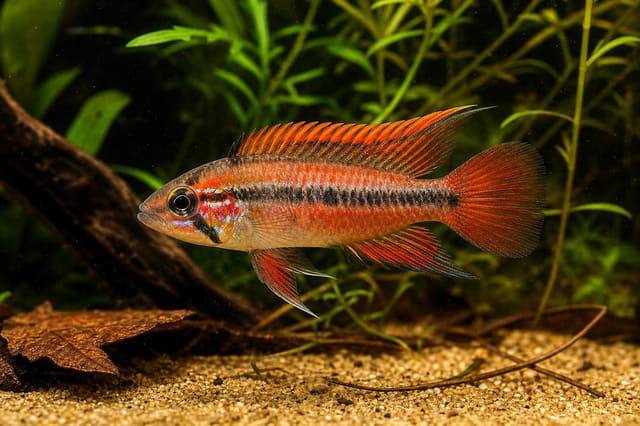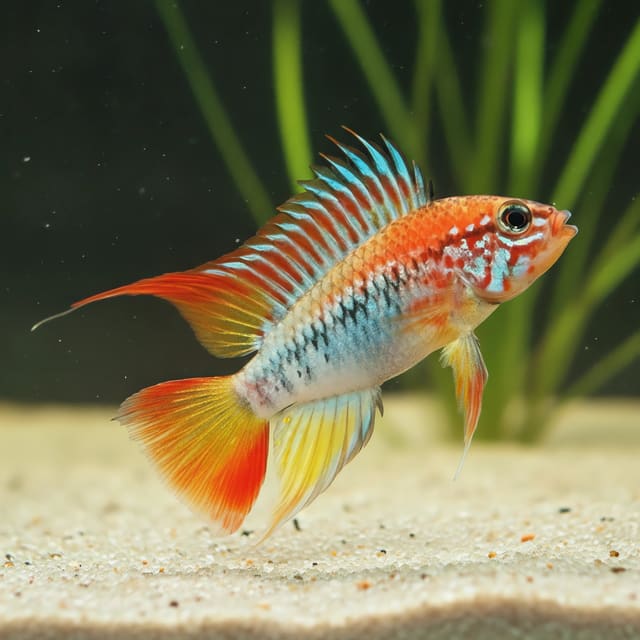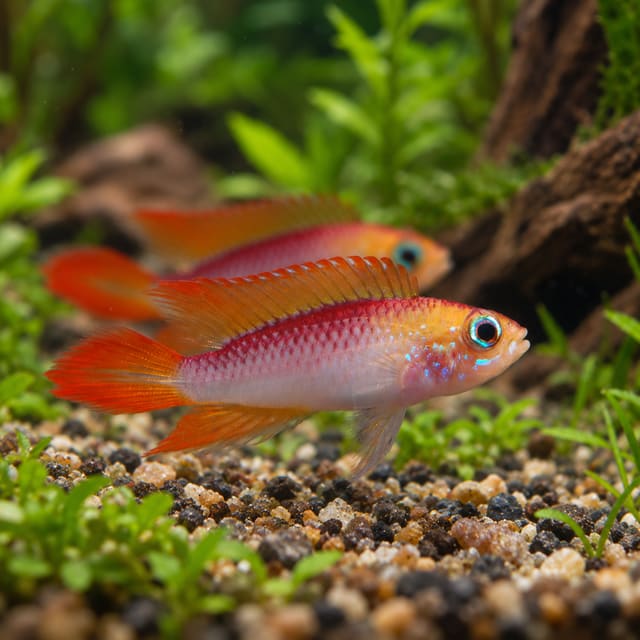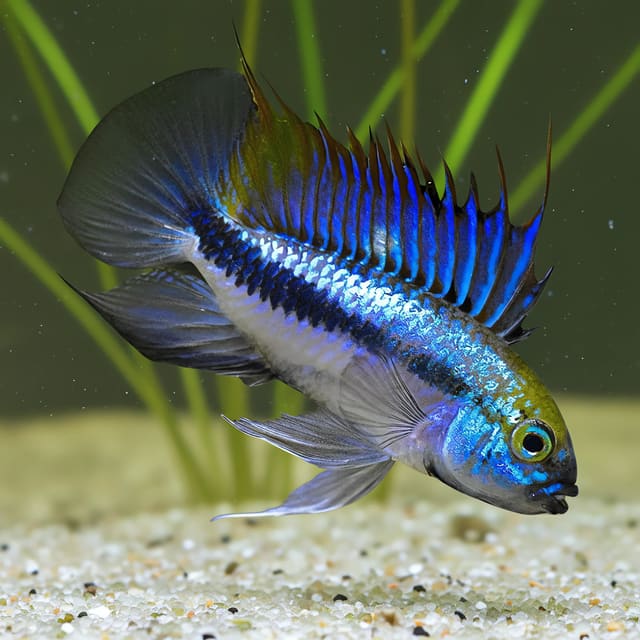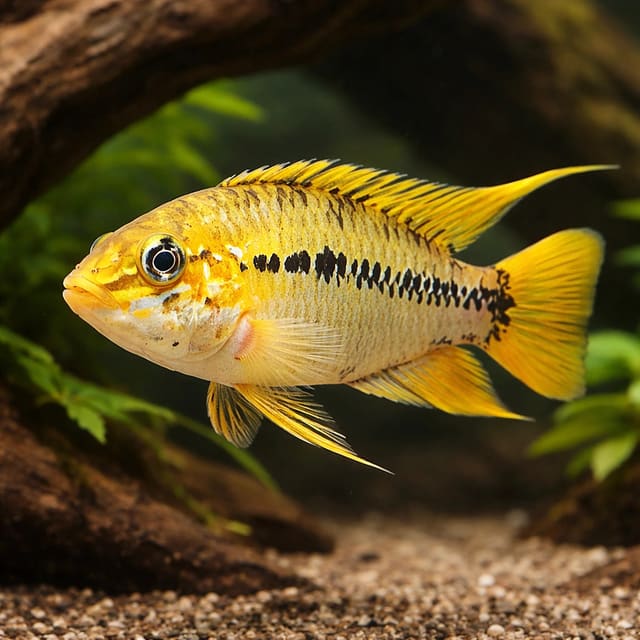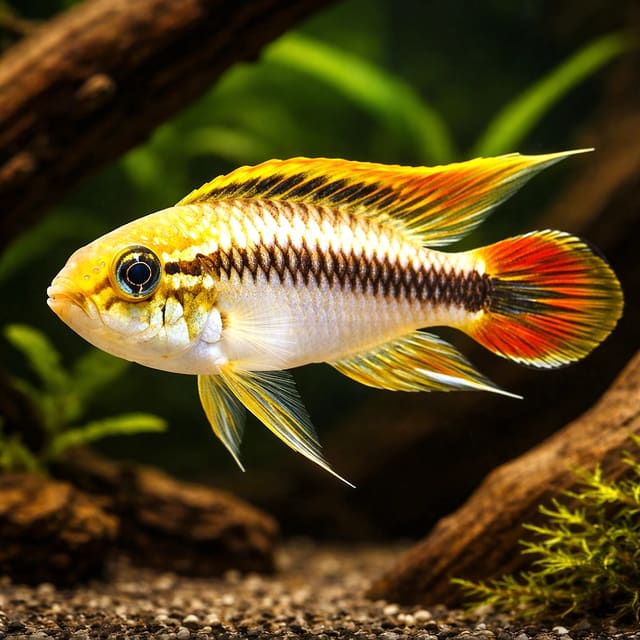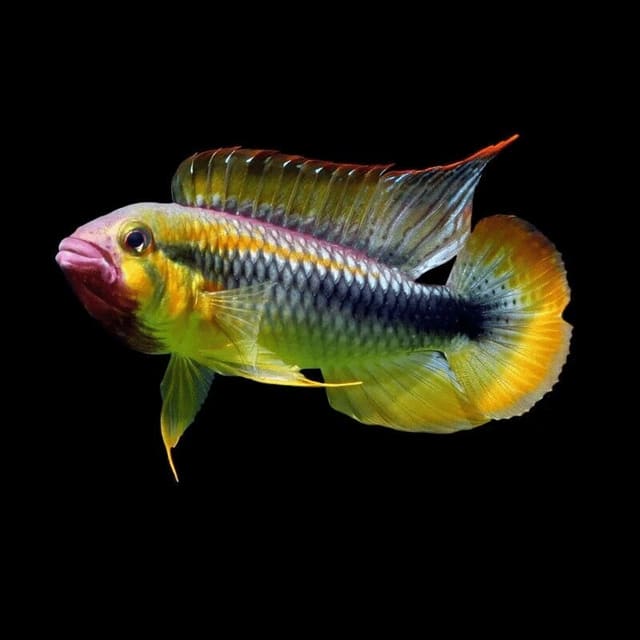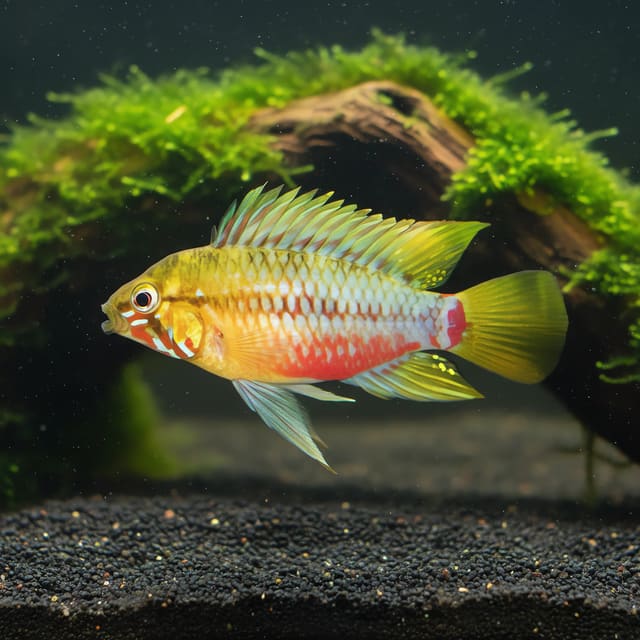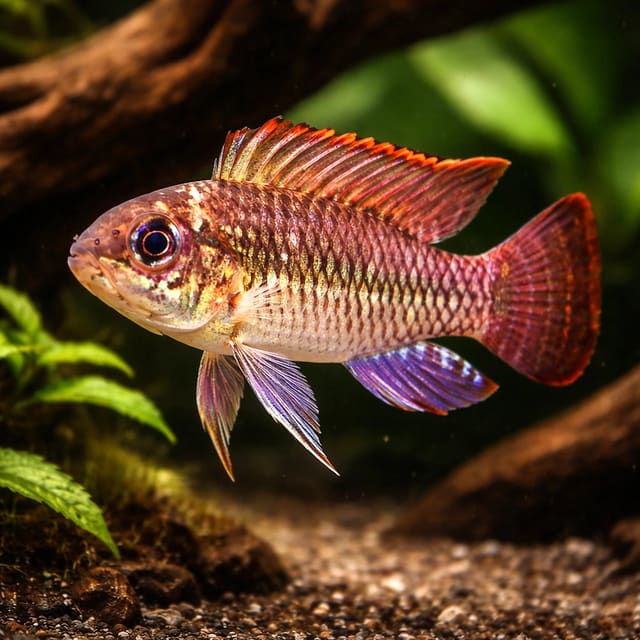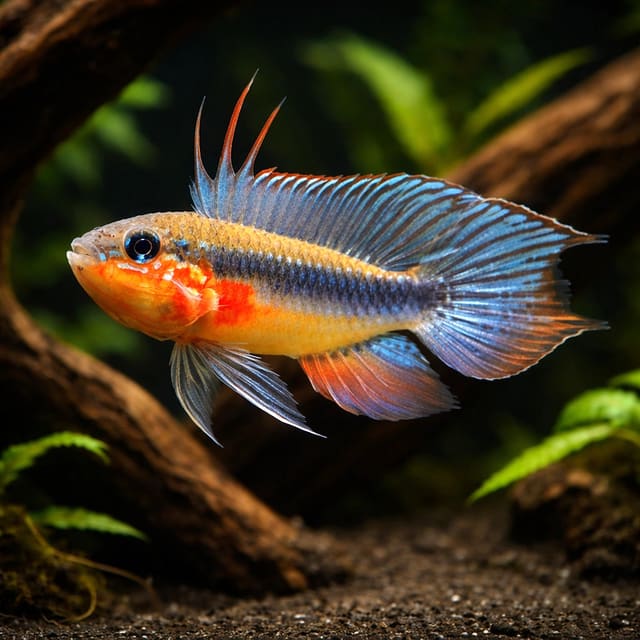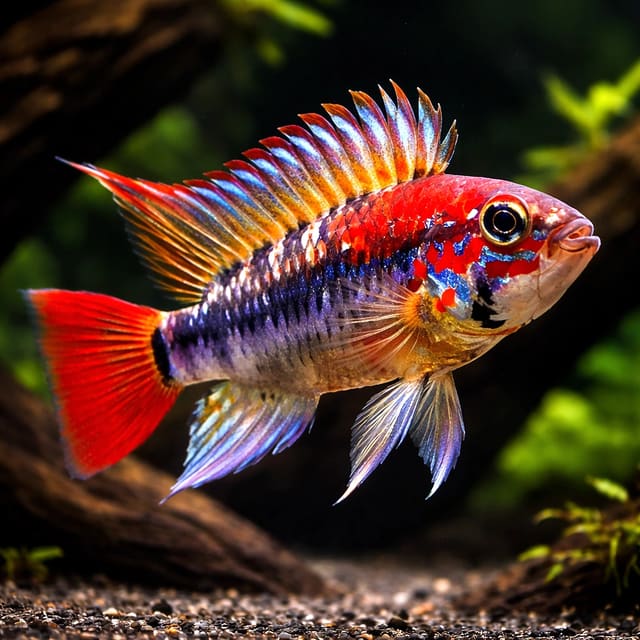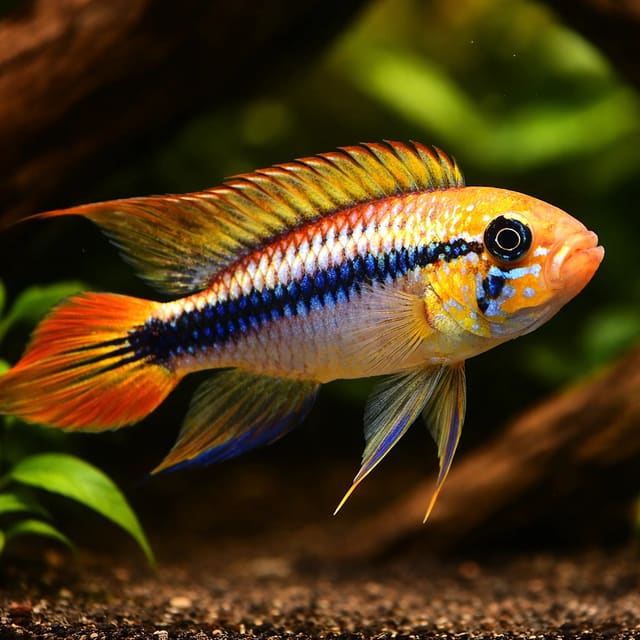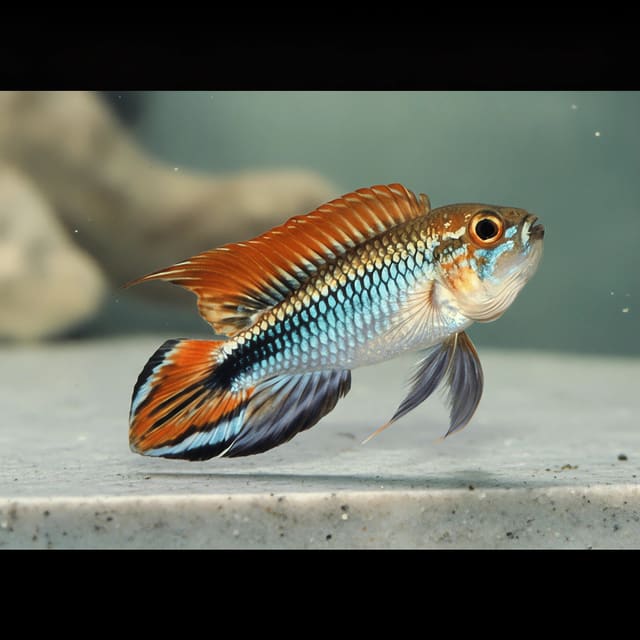
Red Dorsal Agassiz's Dwarf Cichlid (Apistogramma agassizii) – Trade Colour Form
26–27°C · pH 6–7 · 54L
£22.99
One unsexed Agassiz’s Dwarf Cichlid (Apistogramma agassizii) for a mature freshwater aquarium with a sandy floor, shaded retreats and calm tank mates. Plan floor space and territories before adding another dwarf cichlid.
Apistogramma agassizii
One unsexed Agassiz’s Dwarf Cichlid (Apistogramma agassizii) for a mature freshwater aquarium with a sandy floor, shaded retreats and calm tank mates. Plan floor space and territories before adding another dwarf cichlid.
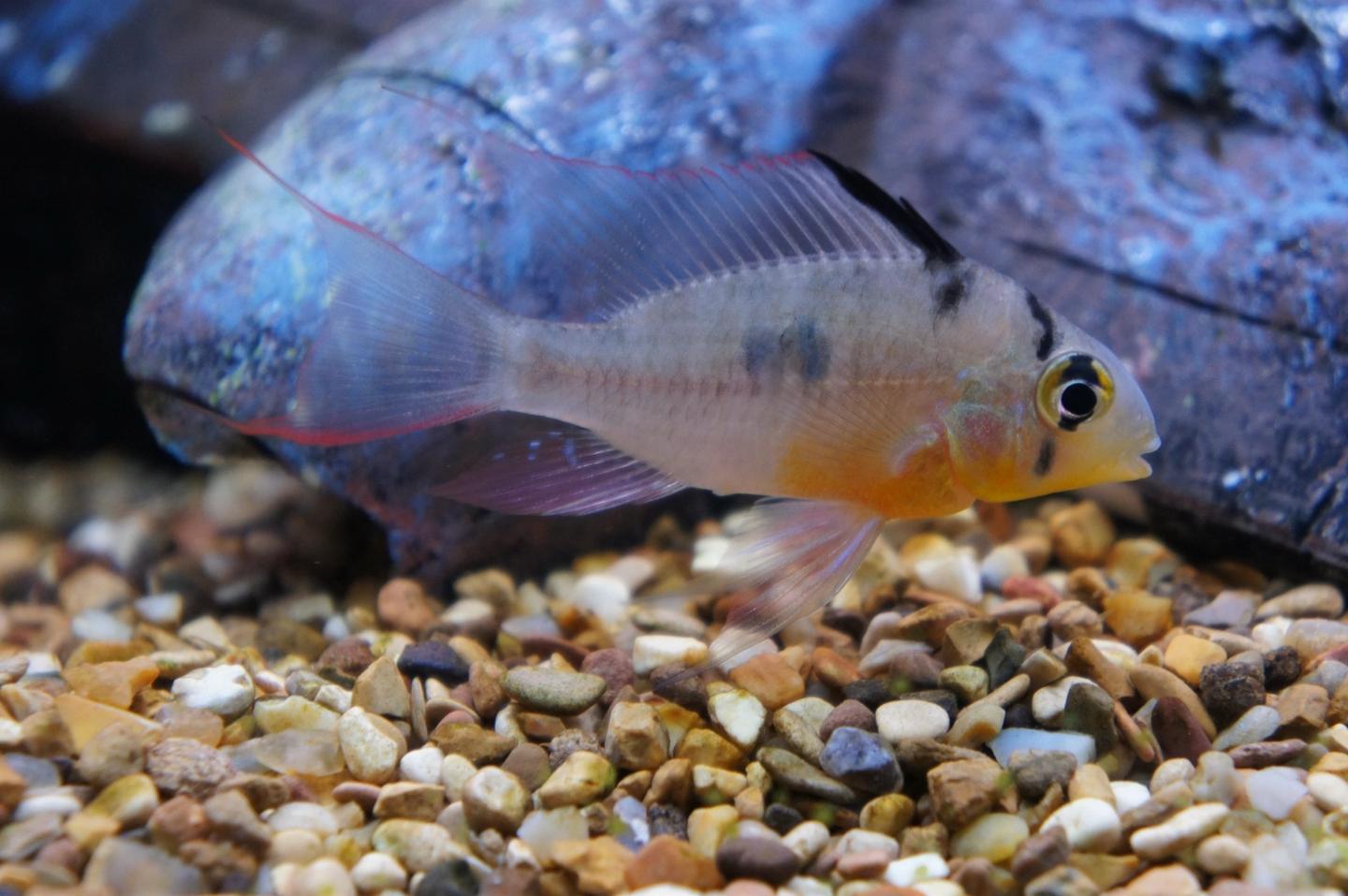
Cichlids are a family of roughly 1,800 accepted species, not one care type. Before buying, identify the exact species and source, then compare adult measurement, usable tank dimensions, social system, territory, tested water, diet and an exit plan. No family-wide minimum tank, water range or tank-mate list is safe.
Agassiz’s Dwarf Cichlid, Apistogramma agassizii, is a South American freshwater cichlid associated with the Amazon basin. This listing supplies one live fish per purchase. Sex is guaranteed only when the selected option explicitly states male or female. This Agassiz’s Dwarf Cichlid listing has no sex-guaranteed option. Its appeal is the behaviour as much as the colour: an attentive little fish exploring cover and the lower parts of a settled aquarium. It is best chosen by someone ready to give it a sheltered patch of floor, clean stable water and room away from boisterous neighbours. FishBase records the species as a freshwater benthopelagic fish; that describes where it lives, rather than giving a complete home-care recipe.
This listing offers a 3–4 cm grade and an XL trade grade; XL does not specify a measured centimetre dispatch length. It is not a promise of a particular adult size, colour form or sex. Adult size figures also need care: FishBase records 4.4 cm standard length for a male or unsexed fish, while the Seriously Fish species profile gives 7.5 cm for males and 5 cm for females, also as standard lengths. Standard length runs from the snout to the base of the tail, excluding the tail fin; it is not total length. Allow generous floor space instead of measuring the tank against the smaller record.
This is a fish for a mature, filtered tropical aquarium, not a new bowl or an uncycled display. A gentle environment can still be biologically robust: the filter should process waste, the keeper should test water, and the floor should provide places to forage and retreat. An individual can be kept without assuming a pair. A pair or group needs deliberate space and observation because the species may defend a cave, especially around spawning. If you are planning your first aquarium, use our first tropical tank guide to establish the filter before buying livestock. This page then helps decide whether its particular layout and community suit this dwarf cichlid.
Start with the footprint, the existing residents and the water you actually maintain. The species profile gives a base of at least 60 × 30 cm for a single pair, with larger quarters for a group. That is a useful species-level starting point, not permission to crowd a mixed aquarium. A long floor with several visual barriers often serves a territorial fish better than the same volume in a tall, narrow shape. The UK OATA dwarf-cichlid care sheet suggests at least 60 litres for a pair and 80 litres when mixing dwarf cichlids with other fish; those are broader group guidelines. For this individual, look at both sources, then allow more space if tank mates already occupy the bottom or if you hope to keep more than one cichlid.
Ask whether the aquarium has matured enough to process a feeding increase. The biological filter should be established, with ammonia and nitrite testing at zero before adding fish. The RSPCA explains why filtration matters: fish waste becomes toxic ammonia, then nitrite, before bacteria convert it further. A filter that has only just been installed has not necessarily built that bacterial population. Water that looks clear is not proof that it is ready. Test before purchase and after introduction, particularly if the tank is modest in size or already well stocked.
Consider temperament as carefully as numbers. This is not a constantly open-water fish that needs a bright empty tank for display. Shaded edges, an accessible cave and quiet routes through plants or wood let it behave naturally and withdraw. Very active tank mates, competing bottom dwellers and other Apistogramma may make the same footprint feel crowded. A calm mixed aquarium can work after assessing the individual fish and available territories; it is not an automatic community addition. Browse our South American cichlid collection for context, while assessing each species and aquarium separately.
Plan the aquarium from the bottom upwards. A 60 × 30 cm base is the specialist profile’s minimum example for a pair, and a group needs more. The number is a base dimension, not a claim that every 60 cm tank is adequate regardless of shape, stocking or filtration. If a neighbouring fish can reach every cave in one short swim, the layout needs improvement even if the nominal volume looks generous. Use wood, robust planting and separate shelters to break lines of sight. A small fish that can leave an encounter without crossing another fish’s territory is less likely to be repeatedly chased.
Make at least one retreat that can be entered from the fish’s usual route along the floor. Ceramic flowerpots, suitable pipe sections or stable aquarium caves are described by the species profile, alongside roots and branches for a more natural appearance. Check that every opening is safe for the fish and that stacked décor cannot shift. A cave is useful only when the fish can enter and leave it without being trapped. Place cover so that there are several quiet approaches rather than a single defended doorway. Floating or taller plants can shade parts of the floor while leaving open feeding space in front of the shelter.
The species profile describes a soft sandy substrate with wood and shaded spots. Sand lets a small bottom-oriented fish investigate the floor without forcing it across coarse, exposed gravel. Keep the surface clean with careful maintenance, since food settling between objects can foul the water. Leaf litter can provide cover and a more natural-looking margin if maintained thoughtfully; as leaves decay, they also change the tank’s appearance and may affect water, so introduce them gradually and keep testing. You do not need to reproduce a blackwater habitat or pursue extreme acidity to give a sheltered aquarium. Ask about this fish’s holding conditions before adjusting water chemistry.
Keep the water stable and measure it rather than guessing from its colour or clarity. Seriously Fish lists 22–29 °C for A. agassizii as aquarium guidance. OATA’s 22–27 °C is a general dwarf-cichlid range, not a species-specific optimum. The overlap is a sensible area for discussion with the retailer when the exact origin of a fish is unknown, but there is no evidence here for the ideal temperature of this particular individual. Choose and maintain a steady suitable temperature, then avoid abrupt swings during water changes and introduction. FishBase’s 26–29 °C entry is an environmental species record and should not be treated as a universal thermostat setting for this offer.
Water chemistry needs the same distinction. FishBase records pH 5.0–7.0 and 0–12 dH in its species account. The specialist profile explains that commercially produced and wild populations can differ, including much more acidic breeding conditions for some wild fish. OATA’s pH 6.0–8.0 and 4–12 dH are broad group guidance. None of those ranges establishes the origin or acclimation history of the individual sold here. For routine care, discuss the water in which the fish has been held, compare it with your measured tank water, and value stability over attempts to hit an extreme published number. Do not abruptly acidify a community aquarium to imitate a wild breeding condition.
Record temperature, pH and hardness before you buy, and test ammonia and nitrite particularly closely around the addition. The aquarium water chemistry guide explains the different measurements and why a result must be interpreted in context. A single pH reading does not tell you whether the biological filter is mature. Conversely, zero ammonia does not tell you that existing fish have compatible territorial needs. When using a water parameter matcher, enter real test results and remember that broad published ranges need species and stock context. A calm decision made before purchase is kinder than rapid correction after the fish arrives.
Use a working biological filter even if the aquarium is planted. Beneficial bacteria in filter media process waste, but their capacity develops with a stocked, maintained system; it does not appear simply because the equipment has run for a few hours. Before introduction, test for zero ammonia and nitrite. After adding the fish, keep checking while the filter adjusts to the extra food and waste. If the results rise, address the water quality promptly and review feeding and stocking. A fish sitting quietly on the bottom may be sheltering normally, but unusual breathing, refusal to feed or persistent distress should trigger a water test rather than an assumption about personality.
OATA advises weekly partial water changes, regular testing and conditioning replacement tap water to remove chlorine or chloramine. Its suggested 25% weekly change is general dwarf-cichlid guidance, so adjust maintenance to actual test results, aquarium size and stocking without making abrupt changes. Siphon waste from open areas while leaving necessary cover intact. If filter media needs cleaning, rinse it gently in removed aquarium water rather than under the tap, since chlorine or chloramine may harm its beneficial bacteria. Replace water at an appropriate temperature and avoid a sudden chemistry shift. Consistent small care is usually less disruptive than waiting for water quality to deteriorate and then making a large correction.
Flow should allow the fish to use its cave and feeding areas without fighting a strong current. The specialist profile discusses gentle movement for this species. A diffuser, spray bar or carefully placed return can soften an overly direct jet while preserving filtration and oxygen exchange. Do not turn the filter off to make the aquarium appear calmer. Check how the water moves around the shelters and whether uneaten food collects in still pockets. A good layout balances low-stress refuge with accessible maintenance, rather than hiding all of the floor under hardscape that cannot be cleaned.
Seriously Fish describes this species as primarily carnivorous, feeding mainly on bottom-dwelling invertebrates in nature. In the aquarium it recommends regular live or frozen foods such as Artemia, Daphnia and chironomid larvae, with many fish learning to take suitable dry foods, particularly small pellets. That is more helpful than assuming an all-purpose flake alone will meet every need. Offer food small enough to be taken easily and watch whether it reaches the fish rather than being intercepted by faster open-water neighbours. A fish that hides through every feeding can be underfed even in a tank where plenty of food is added.
Start with a modest amount and observe what is actually eaten. Remove obvious leftovers before they decay in the sand or beneath wood. A varied diet should not become a licence to overfeed; waste can raise ammonia and nitrite and burden the filter. OATA’s group sheet recommends feeding only what dwarf cichlids consume within a few minutes, generally once a day, and warns against uneaten food. Use the fish’s appetite and body condition to guide the amount while keeping water tests in view. Foods introduced from external cultures or packages should be handled cleanly and stored according to their instructions.
If the fish ignores one dry food at first, do not respond by leaving more of it in the tank. Try an appropriately sized alternative, feed in a calmer spot, and observe whether territorial pressure is preventing the fish from emerging. Appetite can change during settling, so assess it alongside breathing, posture and test results. Persistent refusal to feed is a reason to check the whole environment and seek informed advice, not to add arbitrary medicines. This approach respects both the species’ natural foraging style and the limits of a small enclosed aquarium.
Have the aquarium running, the shelter arranged and recent water tests to hand before arranging delivery. Avoid rebuilding the layout on arrival day: changing caves, substrate and tank mates at once makes it harder for a new fish to settle or for you to identify a problem. Make sure someone can receive the parcel at the delivery address. The current delivery and Live Arrival Guarantee policy gives the service and claim conditions, including same-day inspection and a continuous video that begins with the parcel still sealed and shows the fish in its bag. Follow that page for current terms rather than relying on a brief product description.
Once the parcel has been inspected, introduce the fish gradually. The store’s arrival guidance says to float the bag for 20–30 minutes before release and not to pour transport water into the aquarium. Minimise handling and give the fish a route to cover. Observe from a distance rather than trying to coax it out for an immediate photograph. A shy first day can be normal, but check breathing, swimming and the response of established residents. If another fish claims the intended cave, the aquarium may need a different territorial layout.
Do not add several new fish at once merely because the water test was good before delivery. OATA notes that beneficial bacteria need time to increase as stocking and feeding rise. Retest after introduction, feed lightly at first and maintain the usual water-change routine. A fish may take time to explore a new space, and its colour can vary with condition and lighting; this listing’s XL grade does not tell you what every dispatched individual will look like. What matters first is safe water, an undisturbed retreat and a chance to feed.
An Apistogramma that moves between a cave, leaf edges and open patches of sand is using the habitat it was given. Constant hiding can also signal a poor fit: bright exposure, rapid traffic, a dominant neighbour or water quality trouble. Look for changes from the fish’s own settled pattern rather than judging a single moment. A normal brief retreat after disturbance differs from never emerging to feed. Watch whether it can leave shelter without being chased and whether it has quiet access to food.
OATA lists changes in swimming, breathing, colour, feeding and body condition among signs worth investigating for dwarf cichlids. These are prompts to test water and review the aquarium, not a diagnosis by themselves. Record the test results and recent changes such as a filter clean, new tank mate or unusually heavy feed. Seek retailer or qualified aquatic advice when distress persists. Avoid changing several variables at once without understanding the cause, especially with pH and temperature. Stability is an active part of care, not an excuse to leave a failed test unaddressed.
Be aware that territorial behaviour can intensify if a cave becomes a spawning site. Seriously Fish notes that the female tends eggs and fry, and that aggression may increase in smaller aquaria during this period. This is species biology, not a prediction that the unsexed fish offered here will breed or a reason to buy a second fish on impulse. If you later plan a pair or group, prepare extra floor space, visual barriers and a way to separate fish if one is persistently harassed. Observe actual interactions rather than assuming a formula will guarantee harmony.
Agassiz’s Dwarf Cichlid may work in a carefully planned community, but its small body does not remove its cichlid territory. The species profile recommends captive-raised animals for a general community; this fish’s origin should be checked before choosing tank mates. It also advises that wild examples are better kept alone or with small dither fish such as Nannostomus, ideally apart from other Apistogramma. These are conditional examples, not a universal shopping list or a promise that any named species will be safe in every aquarium. Check the actual fish, water needs, available floor and behaviour before combining them.
The first conflict to assess is often on the bottom. Two fish that both want the same cave can repeatedly meet even in a tank with generous open water above. Provide more than one suitable retreat, space entrances apart and break sight lines with wood and plants. Watch for a fish being confined to one corner, prevented from feeding or chased after every emergence. An occasional display can be part of territorial communication; persistent exclusion means the arrangement is failing. A taller tank does not necessarily solve competition for a narrow floor.
Small, peaceful open-water fish may act as dither fish in an appropriate setting, while very active or boisterous fish can make a shy dwarf cichlid reluctant to come out. OATA notes both territorial risk and the difficulty some Apistogramma have with hectic tank mates. Avoid assuming that size alone makes a neighbour harmless: its pace, feeding behaviour, preferred water and use of caves all matter. Reassess after any stocking change because territories are made by the animals living in the tank, not by the label on a compatibility chart.
This offer is for one fish without a sex choice. It therefore does not create a breeding pair or specify the sex balance of a group. An individual can be given an appropriate home on its own. If you hope to keep more, plan the adult territories and a contingency for incompatibility before purchase. The specialist profile describes at least a 60 × 30 cm base for a single pair and larger quarters for a group. FishBase’s note about several females for one male is a species account observation, not a rule to apply blindly to an unsexed retail offer or a small mixed tank.
A pair is not simply two fish that happen to be bought together. Sex, maturity, individual temperament and the ability to retreat can all influence whether they coexist. Caves should be placed so one fish cannot guard every entrance. In smaller quarters, breeding can change the balance quickly: the female’s defence of eggs and fry may put even a previously tolerated companion under pressure. Be ready to separate a fish that is injured, unable to feed or continually driven away. Do not wait for visible damage merely because the layout looked adequate on paper.
For groups, add floor area and distinct shelters rather than only increasing the water column. Ask how other bottom-oriented residents will use the same space and whether each fish can claim a quiet route to food. If the aquarium already contains other dwarf cichlids, treat an additional Apistogramma as a territorial decision requiring particular caution. The species profile specifically discourages mixing wild examples with other Apistogramma; because this animal’s origin is unknown, it would be wrong to promise easy mixing. A single well-housed fish is preferable to a forced group.
Stand in front of the aquarium and follow the routes at floor level. Is there a shaded shelter the cichlid can reach without passing a resident’s defended site? Can it take food without a faster fish removing everything first? Are the bottom and cave entrances already occupied? Does the tank have enough base area to let fish move apart after a display? These questions give a more useful answer than a simple peaceful or aggressive label. They also explain why a species that looks settled in one community may struggle in another.
Compare the needs of every proposed neighbour, including temperature and water chemistry, without treating a broad group range as a precise compatibility certificate. A small fish that likes very different water is not a sensible partner just because it is gentle. Fish that disturb caves or predate on fry are particularly unsuitable if breeding is later attempted, as OATA notes for dwarf cichlids generally. For an ordinary display, allow room for each resident to feed and rest, and retain the ability to move a fish if the social arrangement changes.
After introduction, check at several times of day. A fish may be untroubled when lights are low but displaced at feeding time. Watch whether the cichlid returns to its shelter voluntarily or is forced into it. Keep records of repeated pursuit, fin damage or missed meals and act on a pattern promptly. Compatibility is ongoing husbandry: layout, water quality, maturity and breeding behaviour all affect the result. A care decision can be revised without treating the fish as defective.
Published standard lengths differ: FishBase records 4.4 cm for a male or unsexed fish, while Seriously Fish lists 7.5 cm for males and 5 cm for females. Standard length excludes the tail fin. Do not plan the aquarium around one smaller figure or read this listing’s XL grade as a centimetre guarantee.
Seriously Fish gives at least a 60 × 30 cm base for a pair and more for a group. OATA’s general dwarf-cichlid guide suggests at least 60 litres for a pair and 80 litres with other fish. Floor space, cover, filtration and existing territories matter alongside volume.
One can be housed as an individual in a suitable aquarium. This offer supplies one unsexed fish; it does not make a guaranteed pair. If adding more later, provide a larger footprint, separate shelters and a way to respond if one fish is persistently chased.
It suits a keeper able to maintain a mature filtered tank, test water and watch territorial behaviour. It is a more considered choice than a fish for a newly set-up aquarium. A first-time keeper with an established tank and suitable floor layout can prepare carefully.
The species feeds largely on small bottom-dwelling invertebrates in nature. Offer appropriately sized live or frozen foods such as Artemia or Daphnia regularly; many individuals learn to take small pellets. Check that faster tank mates do not take everything and remove uneaten food.
Seriously Fish lists 22–29 °C for the species, while OATA’s 22–27 °C is broad dwarf-cichlid guidance. Keep a stable suitable temperature and ask about the fish’s holding conditions. FishBase’s 26–29 °C environmental record is not a universal aquarium target.
Choose stable water suitable for the fish’s holding history rather than a universal pH target. FishBase’s pH 5–7 is a species-account environment range; OATA’s pH 6–8 is general dwarf-cichlid guidance, while the specialist profile notes origin-dependent requirements. Test your water and avoid abrupt attempts to recreate extreme wild breeding conditions.
It can defend a cave or patch of floor, especially around spawning. The sources support territorial caution, not a blanket claim that it routinely nips fins. Give it cover and observe whether another fish is repeatedly chased or prevented from feeding.
Quiet small open-water fish may work where water needs and space match; Seriously Fish mentions small dither fish such as Nannostomus for wild examples. Avoid assuming any species is universally compatible, and use particular caution with other Apistogramma and competing bottom dwellers.
Tropical Fish Co’s current delivery policy describes live-animal packing and a licensed courier. Someone must receive the parcel. For a Live Arrival Guarantee claim, inspect on arrival and provide a continuous unboxing video beginning with the sealed parcel and showing the fish still in its bag; see the policy for full terms.
For species identity and recorded wild context, see FishBase’s Apistogramma agassizii account. For detailed aquarium layout, feeding and behavioural guidance, see the Seriously Fish species profile. OATA’s UK dwarf-cichlid sheet explains general aquarium preparation and maintenance; its ranges apply to the group and should not replace advice for the fish’s actual origin. The RSPCA’s fish-environment advice explains the biological filter. The store’s delivery page gives current service and claim conditions. These sources have different scopes, so a keeper should use them together with measured tank water and direct observations.
No reviews for this item yet. Bought one? Honest reviews only, good or bad.
What customers say about ordering from us
Easy website plenty of info on fish your buying great to pick a time slot
TRACEY DURRANT · 7 Oct 2026
Got some lovely fish thank you
Kevin Mackie · 7 Oct 2026
Reviews of our shop, collected by Judge.me, an independent third-party review collector. Newest first.