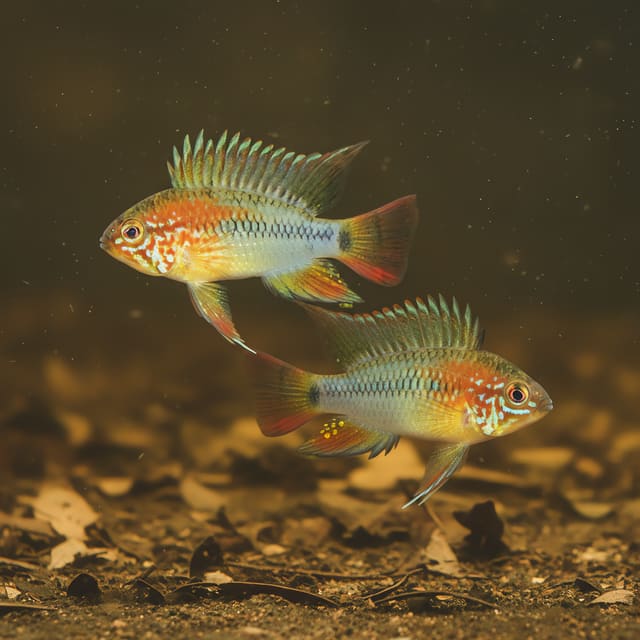
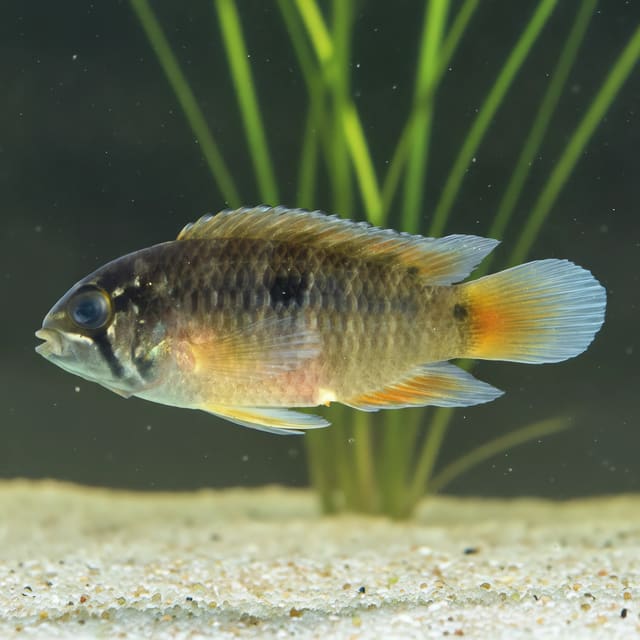
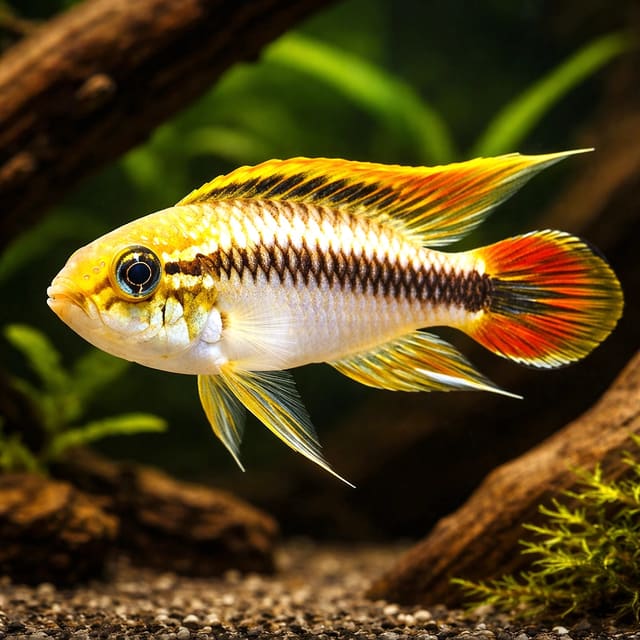
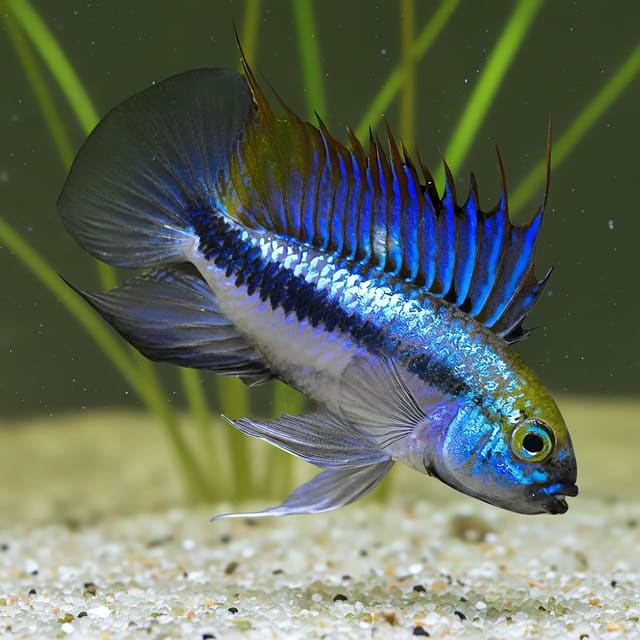
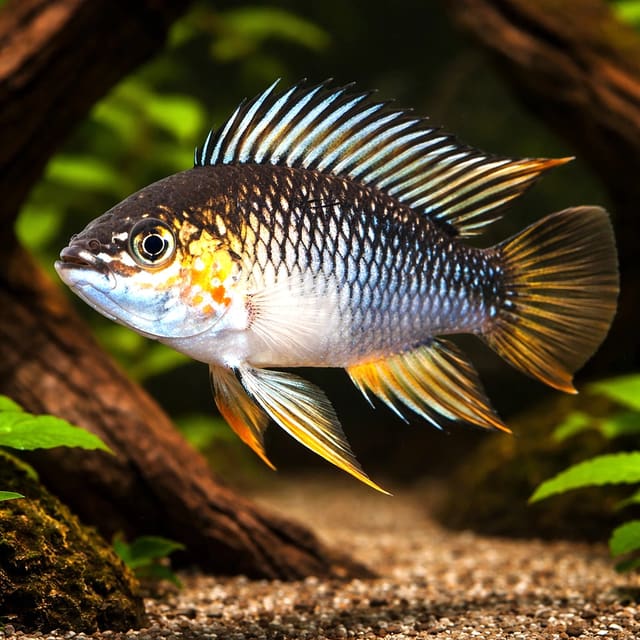
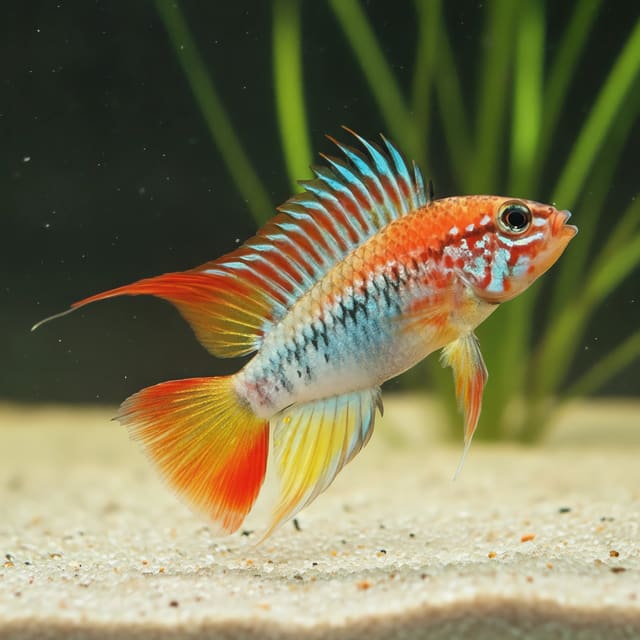
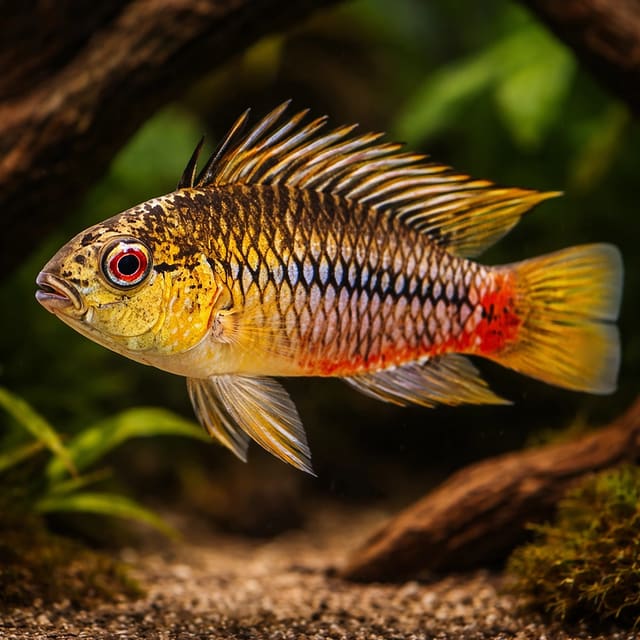
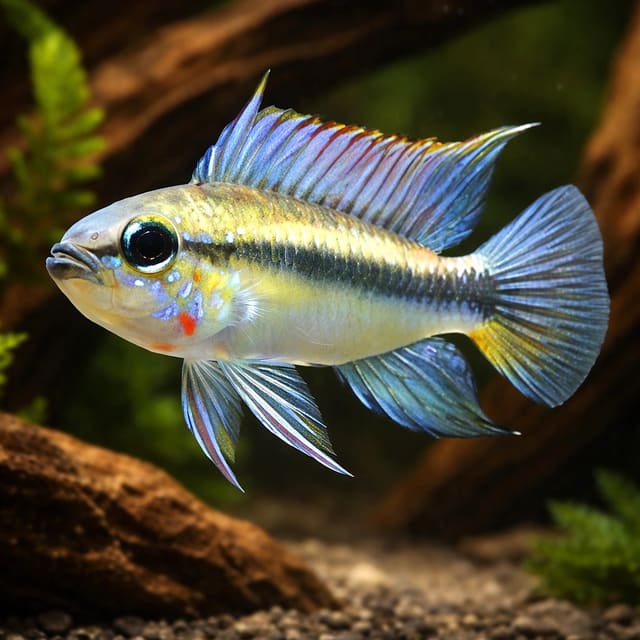
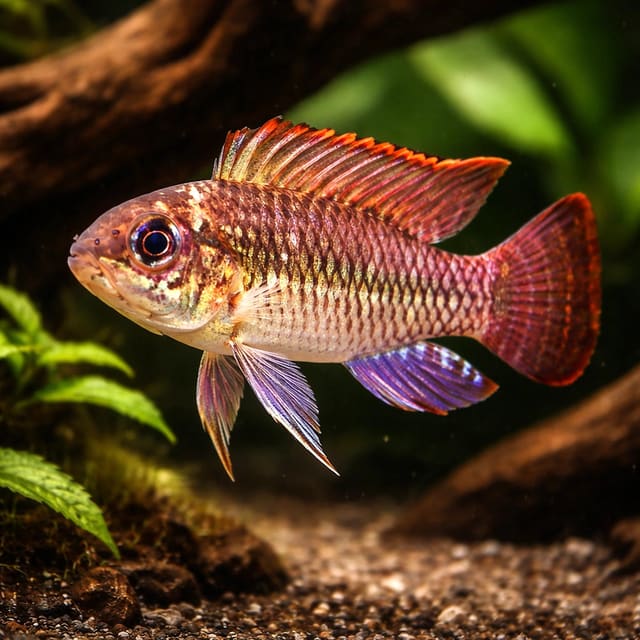
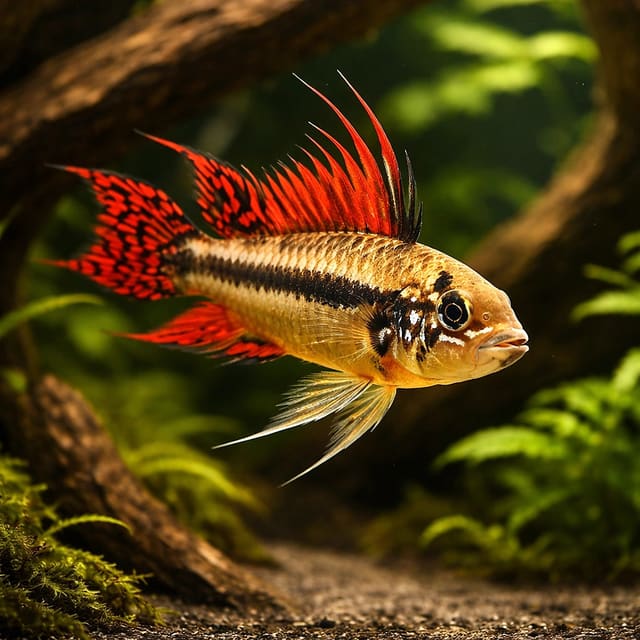
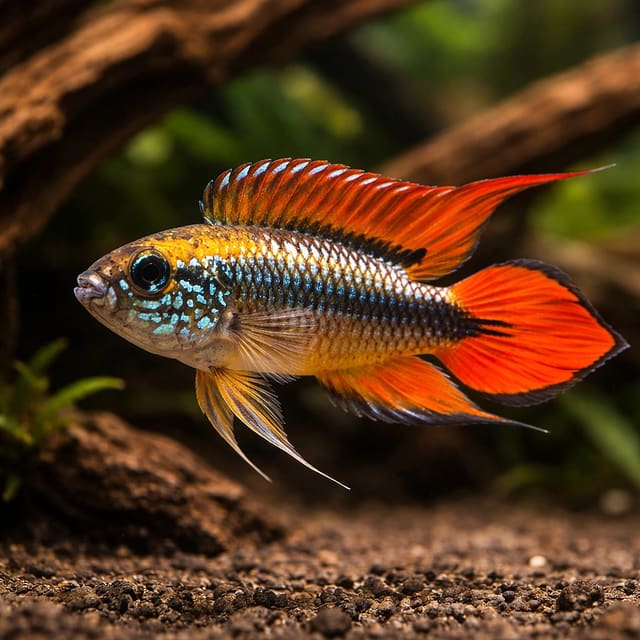
Inca Dwarf Cichlid (Apistogramma baenschi)
20–26°C · pH 4–6.5 · 72L
£31.99

2 × Opal Dwarf Cichlids (Apistogramma sp. “Opal”) are freshwater cichlids from a South American genus whose members mostly feed on tiny animals. They suit a mature, covered aquarium planned for territorial behaviour; OATA’s dwarf-cichlid guidance gives 22–27°C, pH 6.0–8.0 and 4–12°dH. Sold as a pack of two live fish.
Apistogramma sp. “Opal”
2 × Opal Dwarf Cichlids (Apistogramma sp. “Opal”) are freshwater cichlids from a South American genus whose members mostly feed on tiny animals. They suit a mature, covered aquarium planned for territorial behaviour; OATA’s dwarf-cichlid guidance gives 22–27°C, pH 6.0–8.0 and 4–12°dH. Sold as a pack of two live fish.
Cichlids are a family of roughly 1,800 accepted species, not one care type. Before buying, identify the exact species and source, then compare adult measurement, usable tank dimensions, social system, territory, tested water, diet and an exit plan. No family-wide minimum tank, water range or tank-mate list is safe.
Maintain these water conditions for optimal health and vibrant colors
The Opal Dwarf Cichlid (Apistogramma sp. “Opal”) is a freshwater cichlid from South America. It belongs to the family Cichlidae and is best suited to a keeper prepared to provide a mature filtered aquarium, substantial cover and enough room to manage territorial behaviour. This pack contains two fish, but their sexes and relationship are not predetermined. Plan for two individuals that may need separate retreats rather than assuming they will behave as a bonded pair.
WoRMS places Apistogramma as an accepted genus in Cichlidae. The “Opal” label does not identify a particular species within that genus, so allow ample space, cover and separate retreats because exact size, temperament and breeding behaviour can vary.
Wikipedia describes Apistogramma as a large South American genus of dwarf cichlids. Members mostly feed on tiny animals in nature, while breeding behaviour varies with the exact species. Those two points shape the practical plan: offer small foods the fish can readily take, and arrange the aquarium so that either fish can withdraw if breeding-related territoriality develops.
| Suits | Not suited to |
|---|---|
| A mature aquarium with an established biological filter | A new or unfiltered aquarium |
| A layout with plants, caves, wood or other shelters | An exposed layout with few retreats |
| A keeper able to test water every week | A routine that cannot maintain zero ammonia and nitrite |
| A carefully screened community with enough space | Very active or boisterous tankmates |
| A plan that allows for territoriality during breeding | A breeding setup containing animals likely to disturb spawning sites or eat fry |
Do not choose these fish for colour alone. The decisive questions are whether the filter is mature, whether the aquarium can hold stable water, whether two separate sheltered areas can be created and whether every proposed tankmate can cope with a dwarf cichlid becoming territorial.
One purchase supplies a pack of two live Opal Dwarf Cichlids. There is one purchase unit on this page, so plan the aquarium for both fish arriving together. The pack quantity does not establish that the fish are a compatible breeding pair, and it should not be used to infer either animal’s sex.
Sex is guaranteed only when the selected option explicitly states male or female. This 2 × Opal Dwarf Cichlids listing has no sex-guaranteed option.
The exact species has not been identified, so the care advice here follows the genus Apistogramma and its care group.
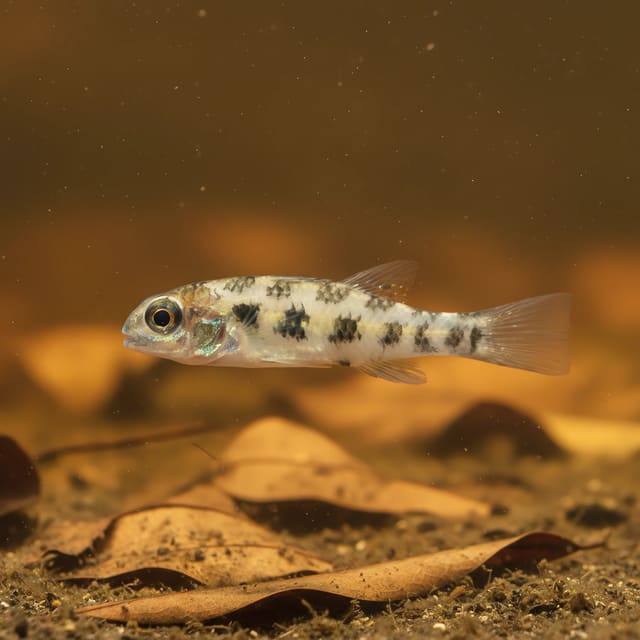
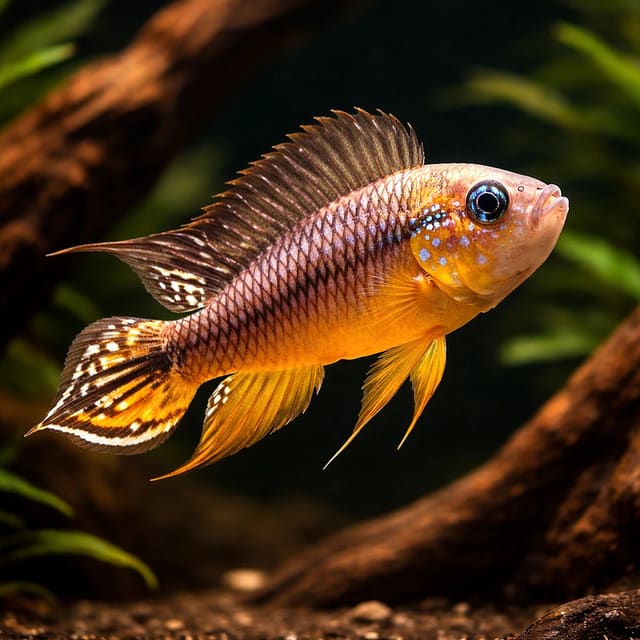
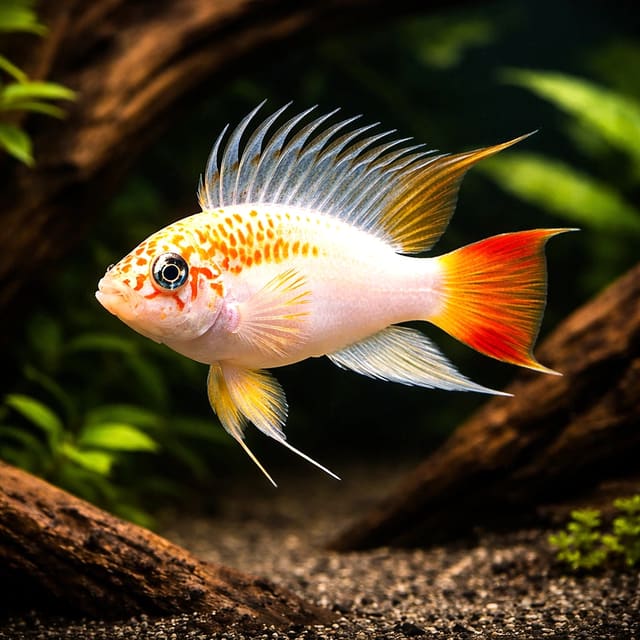
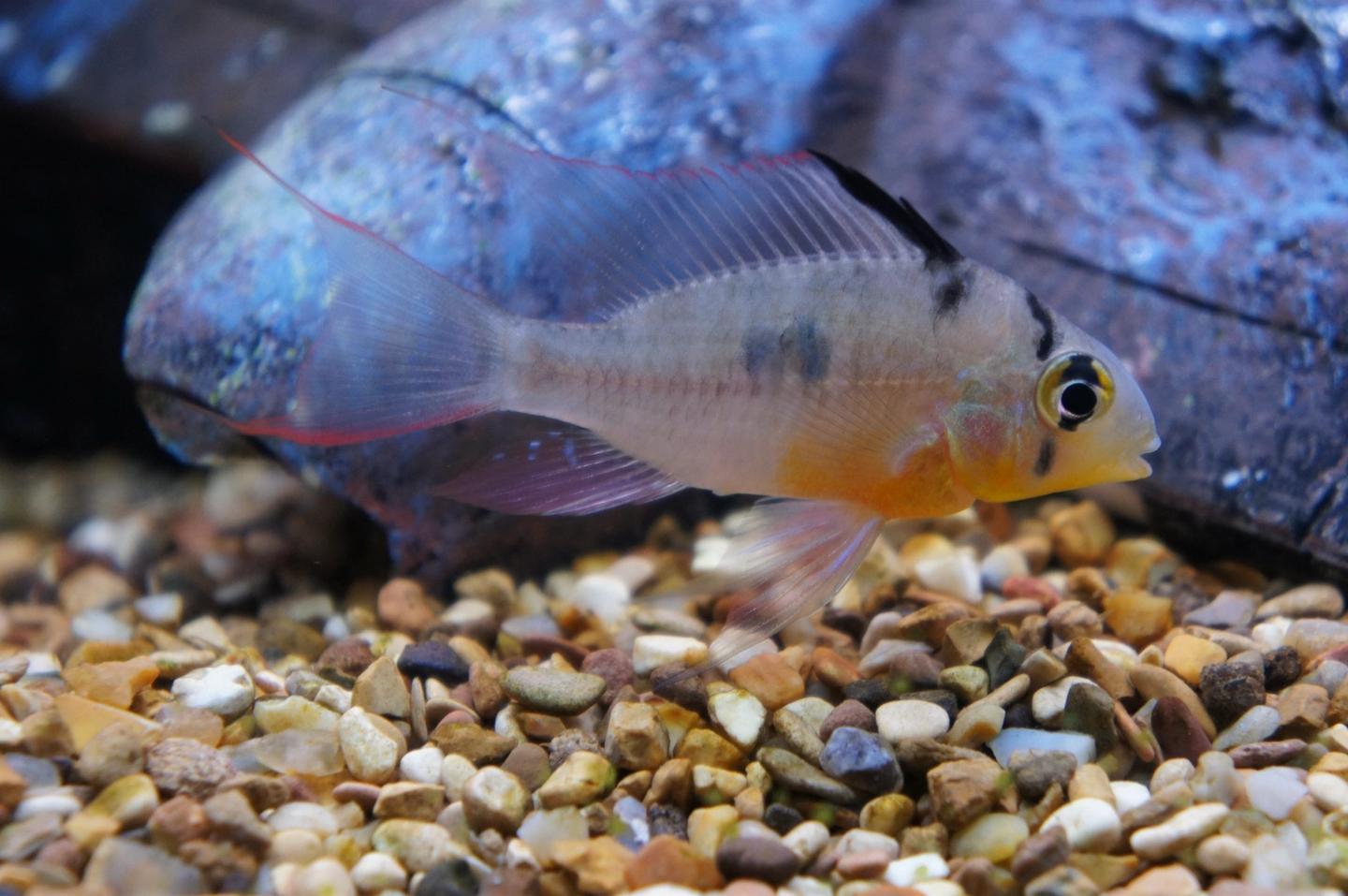
The gallery images are representative of this type of animal rather than photographs of the exact animal supplied, so colours can look slightly different from the live animal.
Keep the aquarium at 22–27°C, pH 6.0–8.0 and general hardness of 4–12°dH. OATA’s dwarf-cichlid sheet gives these as group guidance, alongside carbonate hardness of 3–10°dKH. Match the aquarium to these values before the fish arrive and favour stability within the range over repeated adjustments.
OATA recommends an aquarium of at least 60 litres when just a pair of dwarf cichlids is kept and at least 80 litres when dwarf cichlids are mixed with other fish. This pack is not guaranteed to contain a male and female, so treat 60 litres as a baseline for space planning rather than proof that any two fish will remain compatible. Use the larger community figure when other fish are present, then account for the shape of the aquarium, the placement of cover and the behaviour of every inhabitant.
For physical planning, OATA says the larger dwarf-cichlid species do not exceed 10 cm. Use that group ceiling to reserve swimming and territorial space without assigning it as the adult length of Apistogramma sp. “Opal”. A longer aquarium footprint with separated shelters is more useful than concentrating all décor around one cave.
Arrange the aquarium so that each fish can leave the other’s view. Dwarf cichlids may become territorial, especially when breeding, and OATA notes that even well-settled pairs often chase one another. Cover therefore has a welfare purpose: it gives a pursued fish somewhere to withdraw instead of remaining continuously exposed.
A practical layout might place one sheltered area towards each end, with plants or wood interrupting the direct view between them. The aim is not to manufacture fixed territories or force the fish apart. It is to give each animal choices: move into open water, shelter nearby or cross the aquarium without always passing the other fish’s preferred retreat.
Check the layout from the front and both ends before adding the fish. If you can see straight across every shelter, add or reposition cover. If one ornament creates the only enclosed area, provide another. If a plant or cave blocks routine maintenance, move it so waste can still be siphoned from the surrounding substrate.
Do not assume that a larger volume makes structure unnecessary. More water improves environmental stability, but two fish can still focus their attention on the same shelter. Conversely, do not use dense décor to compensate for inadequate water volume. Space, filtration and cover work together; none replaces the others.
Observe which areas each fish uses after introduction. Occasional movement away from the other fish can be normal, but persistent pursuit, loss of access to food or confinement to one corner calls for immediate action. Add a sight break, rearrange shelters or separate the fish before condition declines. Any rearrangement should preserve swimming room and access to the filter intake.
Use a well-set-up biological filter and mature it before the fish arrive. The RSPCA explains that fish release toxic ammonia, which filter bacteria convert first to nitrite and then to the safer nitrate. A running filter is not automatically a mature filter; the aquarium must have enough established bacteria to process the waste produced by its inhabitants.
Follow our guide to preparing and maturing a first tropical aquarium before committing livestock to a new setup. Check that the planned aquarium can maintain zero ammonia and zero nitrite before these two fish are introduced. OATA warns that stocking too quickly can create new tank syndrome because bacterial capacity has not increased enough to match the extra waste and feeding.
Clear-looking water can still contain ammonia or nitrite, so visual inspection does not replace testing. Likewise, adding bottled products does not remove the need to measure the aquarium’s response. The practical pass condition is straightforward: ammonia must be zero and nitrite must be zero before introduction, with the filter operating continuously.
A larger aquarium can make temperature and water quality more stable, but volume does not replace filtration. OATA states that a filter is essential whatever the aquarium’s size. Position it so water circulates through the aquarium while the fish retain sheltered places. Check that plants, leaves or ornaments cannot obstruct the intake.
Once the fish are present, keep the filter running and increase the aquarium population only slowly. Every added fish and every increase in feeding raises the biological load. Test after changes rather than assuming the established filter will immediately handle an unlimited increase.
Keep the water at 22–27°C, pH 6.0–8.0, general hardness 4–12°dH and carbonate hardness 3–10°dKH. Maintain ammonia at zero mg/l and nitrite at zero mg/l. Nitrate should not exceed 20 mg/l above the normal level in the tap water used for the aquarium.
Measure the aquarium rather than trying to identify suitable water by appearance. Our aquarium water chemistry guide explains what the principal tests mean, while the water matcher can help compare measured values with the care range.
| Test result | Action |
|---|---|
| Temperature below 22°C or above 27°C | Correct the aquarium equipment and return the system to the care range without introducing more fish. |
| pH below 6.0 or above 8.0 | Check the source water and aquarium conditions before moving the value. |
| General hardness outside 4–12°dH | Compare the source water with the aquarium and plan a stable match. |
| Any ammonia reading | Stop increasing livestock or food, test again and address filtration and waste. |
| Any nitrite reading | Treat it as a water-quality problem and check biological filtration. |
| Nitrate rising beyond the stated limit | Review water changes, waste removal, feeding and stocking. |
Record results at least weekly so that a trend becomes visible before the fish show obvious distress. Use the same units each time, and write down the tap-water nitrate alongside the aquarium nitrate because OATA expresses the limit relative to the normal tap-water level.
Stability matters because the group guidance spans a range, not because every point within it should be used in rotation. Choose a workable set of values within the range and maintain them. Do not make repeated pH or hardness adjustments merely to chase a central number.
When replacing water, treat it with tap-water conditioner to remove harmful chlorine or chloramine before it enters the aquarium. Check the temperature and the amount being changed as part of the same routine. Water testing, conditioning and filter care should be treated as one connected maintenance system rather than separate occasional jobs.
Feed once a day, offering only what the two fish can eat within a few minutes. Remove the assumption that a larger portion will improve growth or colour: uneaten food breaks down and releases waste, increasing pressure on the filter and water quality.
Apistogramma mostly feed on tiny animals in nature. For aquarium feeding, OATA recommends a good-quality flake or granule for dwarf cichlids, with small live or frozen foods such as daphnia, brine shrimp or tubifex to add variety. Choose particles the fish can take readily and distribute the ration so both animals have a realistic opportunity to feed.
Variety should come from rotating the supported foods, not from increasing the number of daily meals. A straightforward schedule is a suitably sized good-quality flake or granule as the regular aquarium food, with daphnia, brine shrimp or tubifex included in rotation. Keep every serving within the few-minutes rule.
Watch both fish rather than judging the meal by the faster individual. A territorial fish may feed confidently while the other remains behind cover. In that case, use two feeding points with a sight break between them. Do not continue adding food indefinitely to tempt the reluctant fish, because the excess can worsen the water conditions that also affect appetite.
Reduced intake is a health warning when it differs from the animal’s normal behaviour. Check ammonia, nitrite, temperature and the interaction between the two fish before changing the diet. A food change cannot correct unsuitable water or persistent harassment.
Prepare the mature, heated and covered aquarium before the parcel reaches you. Tropical Fish Co hand-bags live fish in pure oxygen, uses an insulated poly box and adds a heat pack when the weather calls for it. Be present to receive the parcel because live fish must not be left unattended.
These steps preserve a clear record of the sealed parcel, opening and fish in the bag while also following the stated acclimatisation time. Keep the camera running through the sealed-bag inspection even when both fish initially appear well.
Read the current delivery and Live Arrival Guarantee policy before the arrival day. If anything has gone wrong, contact us the same day with the order number and the continuous unboxing video so the issue can be assessed under that policy.
General dwarf-cichlid care starts with checking that ammonia and nitrite are zero and that the aquarium is within 22–27°C, pH 6.0–8.0 and 4–12°dH. Leave all prepared shelters accessible and watch whether each fish can move away from the other. Do not add more livestock while the filter is responding to the new biological load.
Initial hiding should be assessed alongside breathing, swimming and access to cover rather than treated as an isolated sign. One fish choosing a cave is different from one fish being continuously driven into a corner. If pursuit prevents normal movement or feeding, add a sight break or separate the fish.
Keep the first feeding small and within the normal once-daily schedule. Extra food does not help a fish settle and can leave the filter processing unnecessary waste. Observe whether both animals feed, then adjust future distribution rather than increasing the overall ration.
At least once every week, change 25% of the aquarium water and test ammonia and nitrite. Use a siphon to remove solid waste from the gravel or sand, particularly around shelters and feeding areas where debris can collect.
Change 25% of the aquarium water at least once every week. A missed week should not lead to an improvised oversized change without first checking the aquarium. Test, assess and return to a stable maintenance pattern.
Do not run filter media under the tap. Chlorine or chloramine may kill the beneficial bacteria established in the media. If cleaning is needed, rinse the media lightly in aquarium water removed during the partial water change. This preserves more of the bacterial population while clearing material that restricts flow.
Filter cleaning and water changing solve different problems. The water change dilutes dissolved waste and the siphon removes solids; the filter supports bacteria that process ammonia and nitrite. Do not strip the filter excessively because it looks dirty, and do not leave it blocked because the aquarium water appears clear.
Use the weekly record to connect causes and effects. If nitrate climbs, compare feeding, waste removal and livestock load. If ammonia or nitrite appears after filter maintenance, review how the media was handled. If a fish becomes less active at the same time, correct the water-quality issue rather than assuming the behaviour is purely social.
Inspect shelters during maintenance without removing every refuge at once. Keep routes open and remove trapped waste, but preserve enough structure for the two fish to avoid each other. If a major rearrangement is necessary, restore at least two separated sheltered areas before the fish resume normal use of the aquarium.
Learn the normal behaviour and appearance of each fish, then act when either one changes. Individual fish can differ, so the most useful comparison is with that animal’s usual swimming, colour, appetite, breathing and use of cover.
| Change | First response |
|---|---|
| Hanging at the surface, sitting on the bottom or erratic swimming | Test ammonia, nitrite and temperature immediately. |
| Colour becoming darker or paler than normal | Check water quality and whether the fish is being persistently chased. |
| More aggression or hiding than normal | Inspect sight breaks, shelters and access to food. |
| Gill covers moving faster or slower than normal | Test the water and check filter operation. |
| White spots, fluffy growths or loss of fins or scales | Check all water values and seek health guidance. |
| Increase or decrease in body condition | Observe each fish feeding and review the daily portion. |
| Reduced intake or no interest in food | Test water quality before changing foods or increasing the ration. |
Water testing is the first response because dwarf cichlids can be stressed by even small amounts of ammonia or nitrite. A fish showing a behavioural change and a non-zero reading needs the environmental problem addressed promptly. Do not disguise poor water with extra feeding or repeated décor changes.
Social pressure also needs direct attention. If one fish controls all shelter and food, add a sight break, create another retreat and spread the existing ration between separated feeding points. If those changes do not restore access, separate the fish. Waiting for visible injury allows a manageable territorial problem to become a welfare issue.
Inspect both animals daily during the first week and continue checking them at every feed. The daily check should be brief but specific: confirm both fish are present, swimming appropriately, breathing normally and able to reach food or shelter. Compare observations with the weekly test record.
If you are concerned about either fish’s health, test the aquarium and contact us for guidance. Report the measured temperature, pH, ammonia and nitrite alongside the changes you have observed; concrete readings make the next decision more useful than a general description that the fish looks unwell.
Dwarf cichlids can live in a community aquarium when every inhabitant has enough space, but compatibility must be screened for this aquarium rather than treated as a universal list. OATA says shoals of dither fish can give dwarf cichlids a sense of security and are quick enough to move away if territoriality develops.
That guidance supports a type of companion, not a guarantee for every shoaling fish. Check the proposed animals against the Opal Dwarf Cichlids’ water range, the available aquarium volume, their activity level and the amount of cover. Use at least 80 litres as OATA’s community baseline and increase the practical margin when the layout or existing population reduces usable space.
Introduce additional fish slowly so the biological filter can respond to the increased waste and feeding. A socially plausible combination can still fail if the aquarium is stocked too quickly or the filter cannot maintain zero ammonia and nitrite.
Observe the whole aquarium after any addition. If one Opal Dwarf Cichlid hides more, loses access to food or begins sustained pursuit, review the new fish’s activity and the layout. Move cover, reduce social pressure or separate incompatible animals rather than waiting for injury.
Do not use a named-species shortcut when the proposed combination has not been assessed. Ask us to assess the aquarium volume, measured water, current inhabitants and layout before mixing. The honest decision depends on those details because the “Opal” identity does not define one exact species or one fixed temperament.
Plan for territorial behaviour to become stronger if breeding occurs. OATA notes that dwarf cichlids may be territorial, especially when breeding, and that all community tankmates need enough space if this happens. Breeding behaviour within Apistogramma varies with the exact species, so use observation rather than expecting one fixed sequence.
If the aim is to breed the fish, avoid tankmates that might disturb spawning sites or predate on fry. Do not add these animals to a breeding aquarium even after additional compatibility screening. A larger aquarium or extra cave does not remove a companion’s tendency to enter a spawning area or eat fry.
Also avoid very active or boisterous tankmates. Some Apistogramma are quite shy and do not do well with that level of activity. Choose against the behavioural mismatch rather than relying only on body size or the level of the aquarium where another fish normally swims.
Do not label the two fish as a pair simply because they were purchased together. The offer guarantees a pack count, not sexes, bonding or breeding compatibility. Keep both fish only while each can reach food, cover and open water without persistent harassment.
Fin condition should be checked as part of the daily welfare review, but territoriality is the behaviour specifically identified for this group. Respond to actual damaged fins by testing the water, observing interactions and separating the fish responsible where necessary. Do not wait for a general temperament label to settle a visible welfare problem.
A compatible aquarium remains conditional over time. Changes in breeding behaviour, stocking or shelter use can alter a combination that previously appeared calm. Continue the same daily observation and weekly water testing after the initial introduction period.
Plan around OATA’s dwarf-cichlid group ceiling: it says larger species do not exceed 10 cm. Apistogramma sp. “Opal” is identified only to genus, so treat 10 cm as a conservative space-planning reference rather than an adult-size promise for these fish.
OATA recommends at least 60 litres for a pair of dwarf cichlids and at least 80 litres when mixed with other fish. This two-fish pack is not sex-guaranteed, so use those figures as group planning baselines and provide separated shelters.
This pack supplies two fish. Keep both only where each can reach food and separate cover; do not assume they are a bonded pair, and separate them if persistent pursuit prevents normal movement or feeding.
A first-time keeper should choose them only with a mature filtered aquarium, weekly water testing, 25% water changes at least once a week and a plan for territorial behaviour. Ammonia and nitrite must remain at zero mg/l.
Apistogramma mostly feed on tiny animals in nature. OATA recommends good-quality flake or granules with small live or frozen daphnia, brine shrimp or tubifex; feed only what they eat within a few minutes, once a day.
Keep them at 22–27°C and pH 6.0–8.0. OATA’s dwarf-cichlid guidance also gives general hardness of 4–12°dH and carbonate hardness of 3–10°dKH.
Treat territorial chasing as the principal risk, especially if breeding occurs. Provide several shelters and broken sight lines, monitor fin condition and separate fish if pursuit causes damage or prevents access to food and cover.
OATA recommends shoals of dither fish that provide security and can move away from territorial cichlids. Avoid very active or boisterous tankmates and, when breeding is intended, avoid animals that may disturb spawning sites or eat fry.
Tropical Fish Co hand-bags the fish in pure oxygen in an insulated poly box, adding a heat pack when the weather calls for it. Be present, film the sealed parcel opening continuously and float the bag for 20–30 minutes before release.
No reviews for this item yet. Bought one? Honest reviews only, good or bad.
What customers say about ordering from us
I have a small group of long finned mountain minnows. So was delighted to be able to order ten of this variety to increase the genetics in my tank . The ones I recieved are healthy but it’s to early to give a verdict on wether they are of a long finned type since they are small currently.
Gordon Walker · 23 Sept 2026
100% success travel and "installation". Pleased with quality of purchase. The Siamese fighter a bit "shy" so have not yet seen him at his best yet but looking good. Happy customer. GG
George E Garratt · 21 Sept 2026
Reviews of our shop, collected by Judge.me, an independent third-party review collector. Newest first.