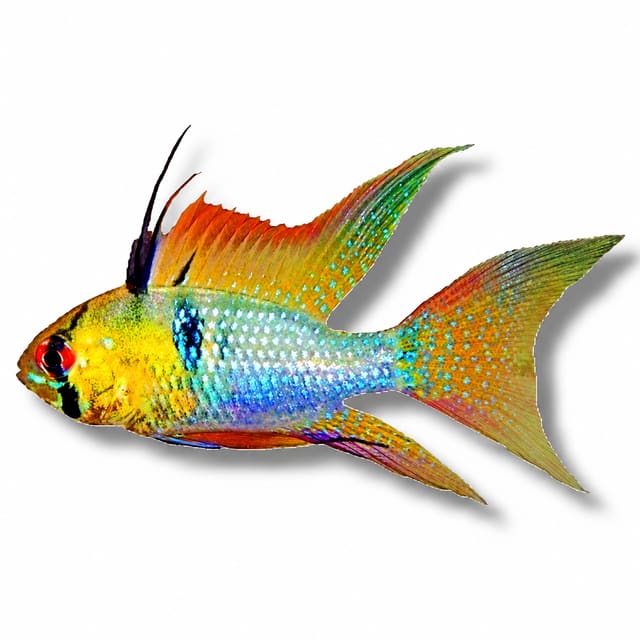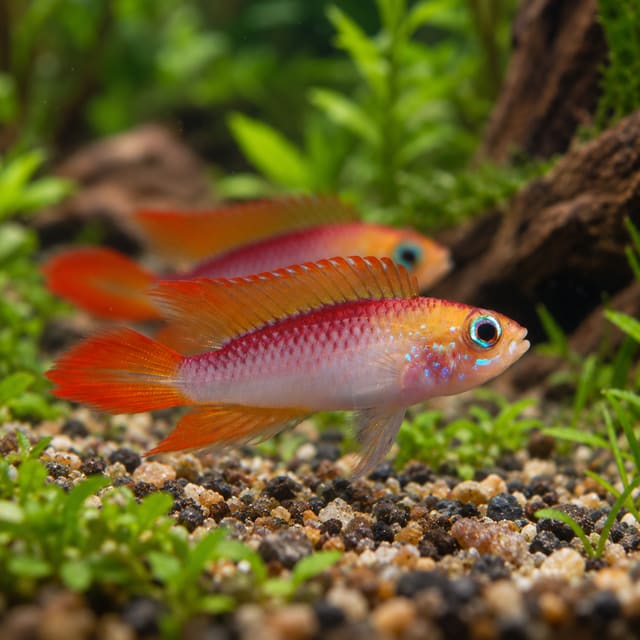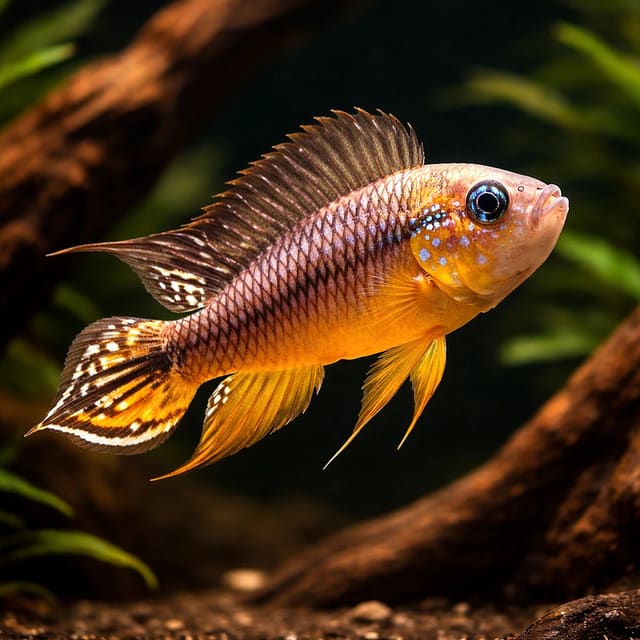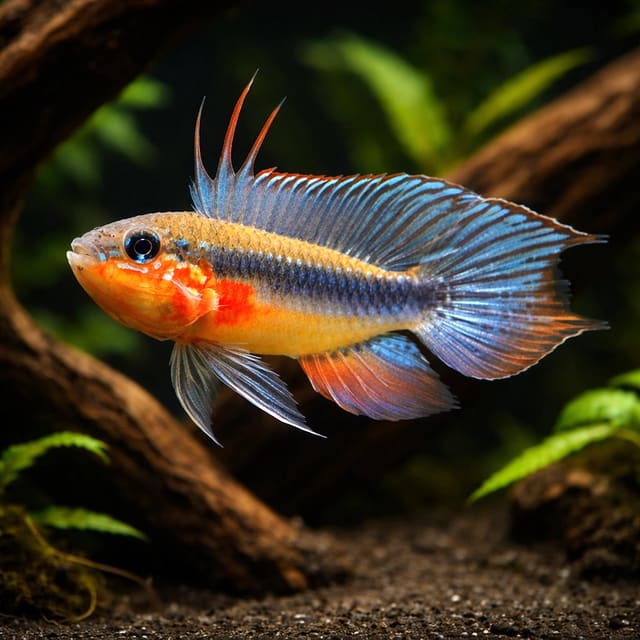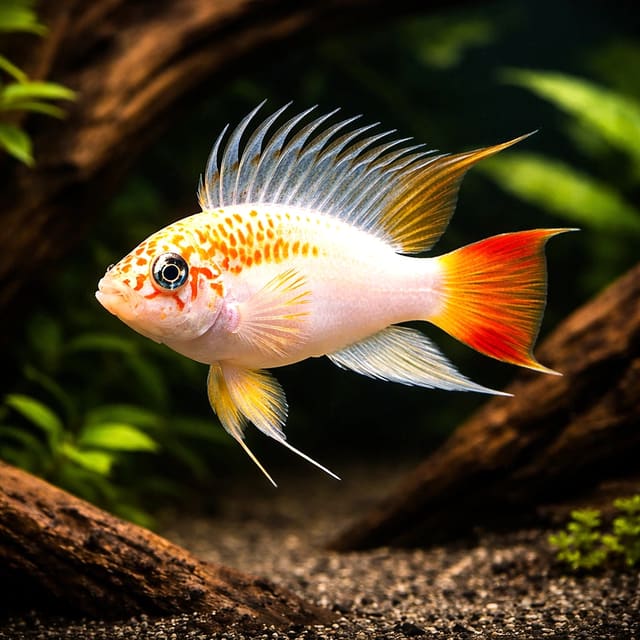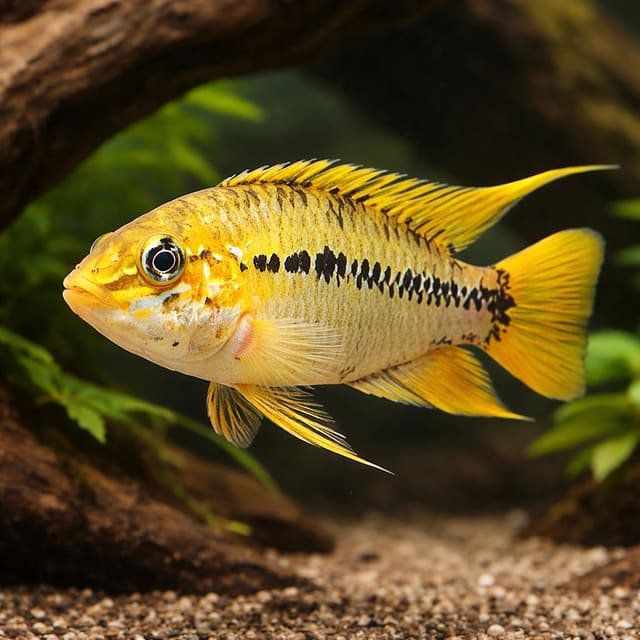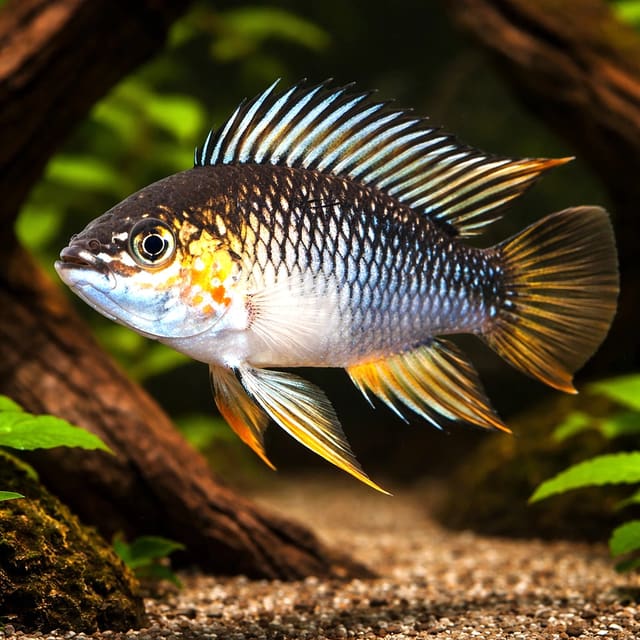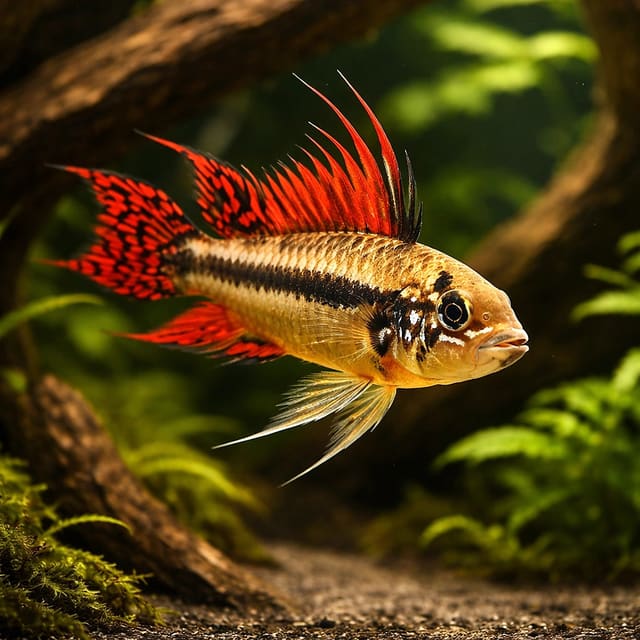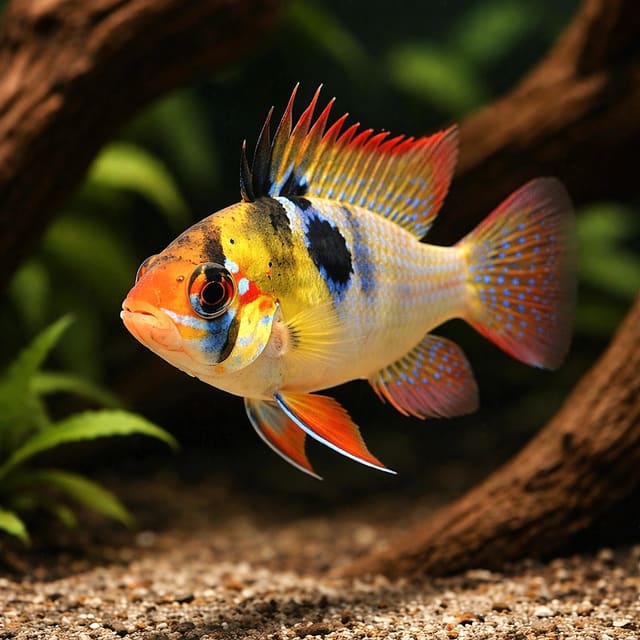
Asia Form Ram Cichlid (Mikrogeophagus ramirezi)
27–30°C · pH 4–7 · 54L
£5.99

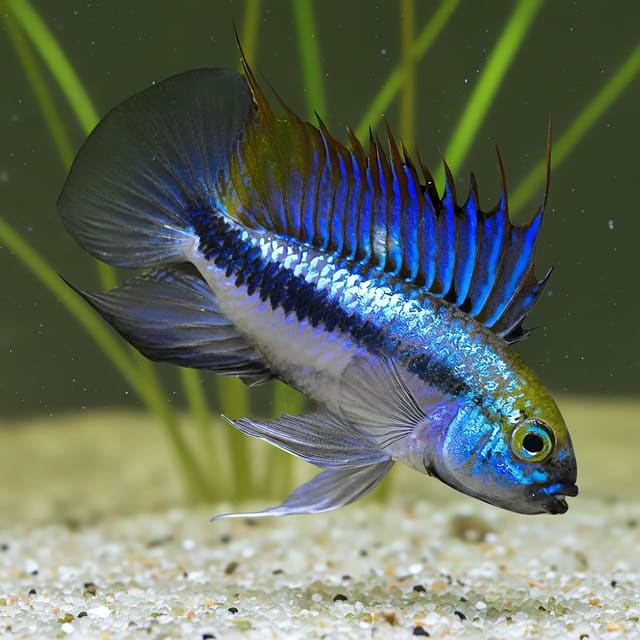
The Abacaxis / Wilhelmi dwarf cichlid (Apistogramma sp. Abacaxis / Wilhelmi) is a freshwater cichlid from South America. It suits an intermediate keeper; OATA’s dwarf-cichlid guidance gives 22–27°C, pH 6.0–8.0 and 4–12 dGH, with at least 60 litres for a pair. Sold individually at a dispatch size of 2.5–3 cm.
Apistogramma sp. Abacaxis / Wilhelmi
Save when buying multiple fish. Each quantity is one fish; sex and pair formation are not guaranteed unless the selected variant explicitly states them.
The Abacaxis / Wilhelmi dwarf cichlid (Apistogramma sp. Abacaxis / Wilhelmi) is a freshwater cichlid from South America. It suits an intermediate keeper; OATA’s dwarf-cichlid guidance gives 22–27°C, pH 6.0–8.0 and 4–12 dGH, with at least 60 litres for a pair. Sold individually at a dispatch size of 2.5–3 cm.
Cichlids are a family of roughly 1,800 accepted species, not one care type. Before buying, identify the exact species and source, then compare adult measurement, usable tank dimensions, social system, territory, tested water, diet and an exit plan. No family-wide minimum tank, water range or tank-mate list is safe.
Maintain these water conditions for optimal health and vibrant colors
The Abacaxis / Wilhelmi dwarf cichlid (Apistogramma sp. Abacaxis / Wilhelmi) is a South American freshwater fish from the cichlid family. WoRMS recognises Apistogramma as a genus within Cichlidae, while this trade label identifies a form at genus level rather than naming a formally accepted species. It is best approached by an intermediate keeper who can prepare a mature, filtered aquarium, measure the water and manage territorial behaviour.
Wikipedia describes Apistogramma as South American dwarf cichlids that mostly feed on tiny animals in nature. Breeding behaviour varies with the exact species, so this fish should not be assigned a detailed breeding pattern from its trade label alone. The useful starting points are its cichlid identity, small-animal feeding biology and the practical dwarf-cichlid care limits below.
| Suits | Not suited to |
|---|---|
| A mature, filtered freshwater aquarium; an intermediate keeper who tests water weekly; layouts with sand or gravel, plants and several shelters; carefully screened community plans with enough space. | An unfiltered or immature aquarium; very active or boisterous companions; a cramped community layout; a keeper who cannot maintain zero ammonia and zero nitrite. |
Choose this fish for the close observation and careful planning involved in keeping a dwarf cichlid, not because its small dispatch length seems to remove the need for space. If you are comparing related aquarium plans, browse our South American cichlid collection and assess each animal against the same water, space and behaviour checks.
Keep the aquarium at 22–27°C, pH 6.0–8.0 and general hardness of 4–12 dGH. Carbonate hardness should be 3–10 dKH. OATA’s dwarf-cichlid sheet sets these as broad group guidance, not a species-specific optimum. Measure your aquarium rather than judging its chemistry by appearance.
Ammonia and nitrite must each remain at zero mg per litre. Keep nitrate from exceeding 20 mg per litre above the normal level in your tap water. For example, if the tap-water reading is 10 mg/l, the aquarium ceiling under this rule is 30 mg/l. Test at least weekly so that a change can be found before behaviour or feeding deteriorates.
Use an aquarium of at least 60 litres if keeping a pair. Use at least 80 litres when mixing dwarf cichlids with other fish. OATA also notes that larger dwarf-cichlid species do not exceed 10 cm; treat that as a group planning ceiling rather than an adult-size claim for this genus-level form. A larger aquarium is useful because temperature and water quality tend to remain more stable.
| Decision | Planning rule |
|---|---|
| Water | 22–27°C, pH 6.0–8.0, 4–12 dGH and 3–10 dKH. |
| Waste control | Zero ammonia, zero nitrite and nitrate no more than 20 mg/l above tap water. |
| Pair plan | At least 60 litres, with plentiful cover. |
| Community plan | At least 80 litres, with room for tank mates if breeding increases territorial behaviour. |
These figures form one connected decision. A suitable temperature does not compensate for ammonia, crowding or insufficient shelter, and a large aquarium still needs a mature working filter.
One purchase supplies one live fish at a dispatch size of 2.5–3 cm. That measurement describes the animal sent, not its eventual adult length. Plan the aquarium with the dwarf-cichlid space guidance, territorial behaviour and group planning ceiling in mind rather than treating dispatch size as a permanent measure.
Sex is guaranteed only when the selected option explicitly states male or female. This Apistogramma sp. Abacaxis / Wilhelmi listing has no sex-guaranteed option.
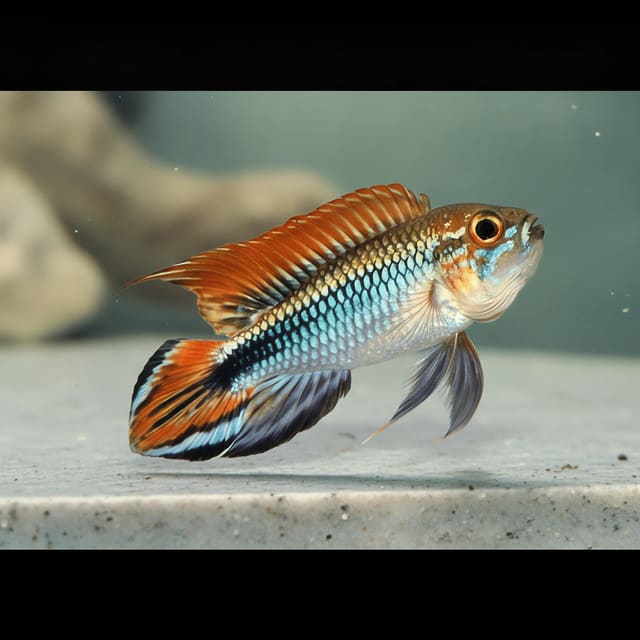
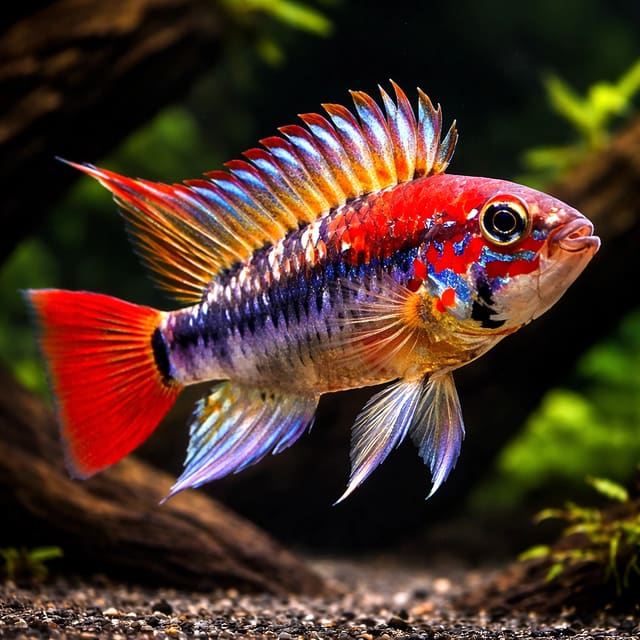
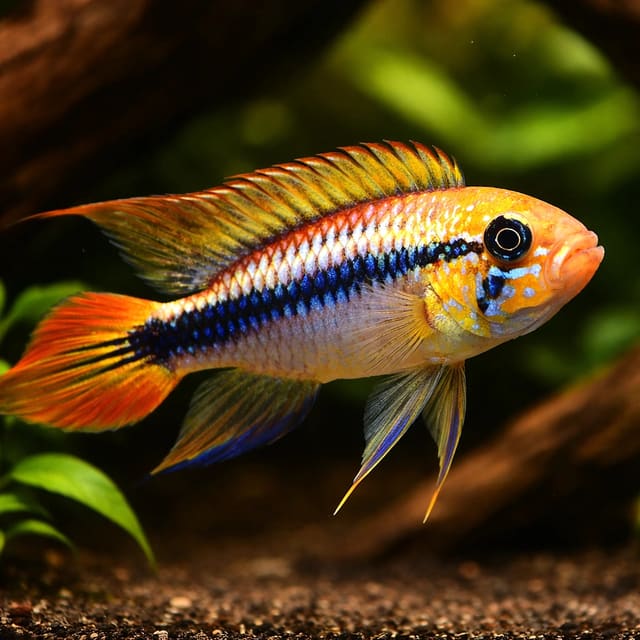
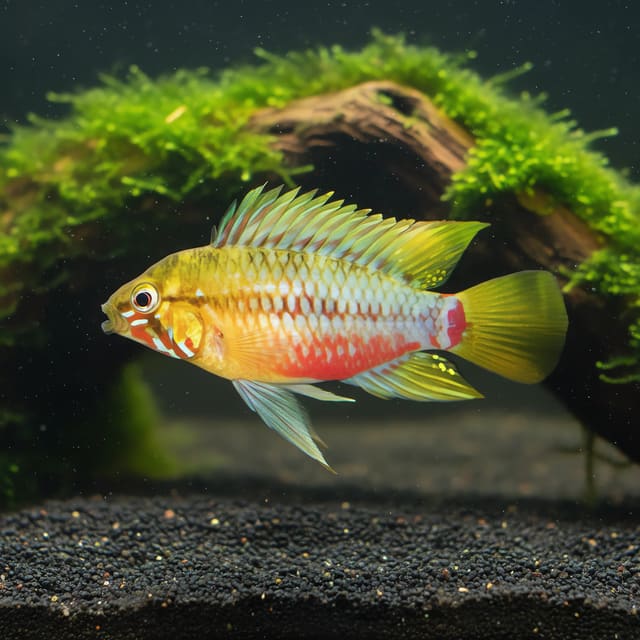
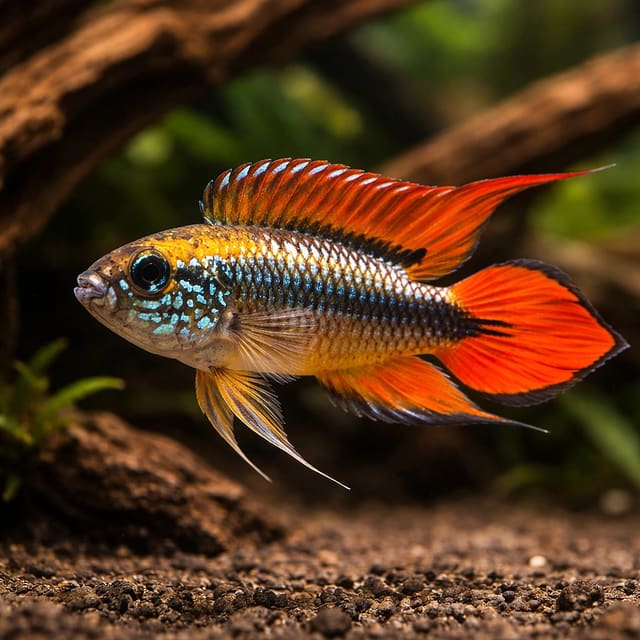
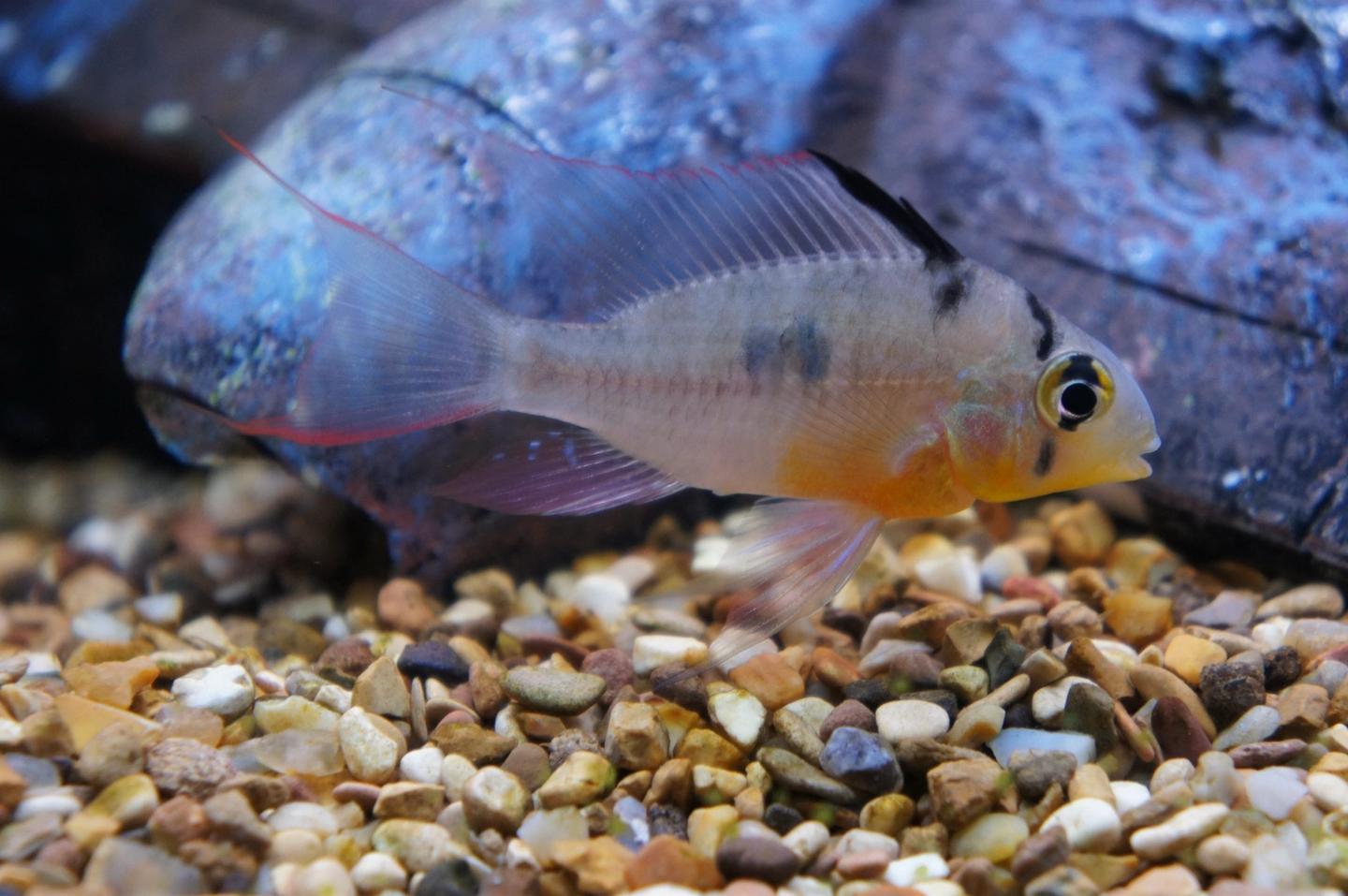
The gallery images are representative of this type of animal rather than photographs of the exact animal supplied, so colours can look slightly different from the live animal.
The fish is sold individually, so any wider stocking plan remains a separate husbandry decision. Build that plan around the aquarium’s measured capacity and the behaviour you observe after introduction.
Keep temperature between 22°C and 27°C, pH between 6.0 and 8.0, general hardness between 4 and 12 dGH, and carbonate hardness between 3 and 10 dKH. Test each value that affects your aquarium instead of relying on labels such as soft or medium. Our aquarium water chemistry guide explains which readings to record, while the water matcher helps compare those measurements with the stated ranges.
A result of 25°C, pH 7.2, 8 dGH and 5 dKH sits inside all four water ranges. It still needs zero ammonia and zero nitrite, because acceptable mineral readings do not make toxic waste safe. Record the complete set so that a later change can be compared with a known baseline.
Nitrate uses a relative ceiling: it must not exceed the normal tap-water level by more than 20 mg/l. Measure the tap supply as well as the aquarium. If the tap level is 5 mg/l, keep the aquarium at or below 25 mg/l; if the tap level is 15 mg/l, keep it at or below 35 mg/l.
| Reading | Required action |
|---|---|
| Ammonia above zero | Treat it as a water-quality problem and review waste load, feeding and filtration. |
| Nitrite above zero | Review the biological filter and do not increase the aquarium population. |
| Nitrate over the relative ceiling | Use the scheduled partial water change and reassess feeding and maintenance. |
| Temperature, pH or hardness outside range | Stabilise the aquarium within the guidance before adding this fish. |
Write down the full set of readings before introduction, then compare it with the next weekly test. For example, a change from zero ammonia and zero nitrite to a measurable result demands action even when temperature and pH remain unchanged. A nitrate rise should be compared with the tap-water baseline rather than with zero, because its limit is relative to that starting value.
Measure at least once each week and use the same units each time. The aim is a repeatable routine in which every important reading can be checked against a clear limit.
Use a well-set-up and maintained filter in every aquarium for this fish. The RSPCA’s aquarium welfare guidance explains that fish release toxic ammonia and that a working biological filter supports bacteria which convert ammonia to nitrite and then to the safer nitrate. A running filter is therefore part of the livestock system, not an optional accessory.
Confirm zero ammonia and zero nitrite before introduction. OATA warns that stocking too quickly can cause new tank syndrome because the established bacterial population may not yet process the increased waste. Add fish slowly and continue testing whenever feeding or the number of animals rises.
Follow our first tropical aquarium guide to prepare and mature the system. The decision to add livestock should rest on water tests and a functioning filter rather than the number of days the aquarium has been running.
| Checkpoint | What to do |
|---|---|
| Before introduction | Confirm the filter is running and ammonia and nitrite are both zero mg/l. |
| After adding livestock | Continue testing while the bacterial population responds to the increased waste. |
| After increasing feeding | Watch ammonia, nitrite and uneaten food rather than assuming the existing routine will cope. |
| When flow declines | Check the filter for blockages and clean the media using removed aquarium water. |
If ammonia or nitrite appears after livestock or feeding increases, stop expanding the stocking plan. Check that the filter is operating, inspect it for blockages and look for uneaten food that is adding waste. Continue testing while the bacterial population adjusts rather than assuming one improved reading has settled the issue.
A filter that still moves water can require attention when its flow declines or its media becomes obstructed. Deal with the blockage without stripping away the bacterial population. Pair that inspection with measured feeding and the scheduled partial water change, because the filter processes waste but does not remove the need for routine maintenance.
Never run filter media under the tap. Rinse it lightly in aquarium water removed during a partial water change, reducing the amount of established bacteria lost. Keep the filter operating effectively while preserving the biological population on which waste processing depends.
Choose as large an aquarium as is reasonable for the plan. Use at least 60 litres for a pair and at least 80 litres when dwarf cichlids are mixed with other fish. The larger volume helps environmental conditions such as temperature and water quality remain more stable, while the extra room gives companions space if territorial behaviour increases.
Use aquarium gravel or sand and add live plants where practical. Plants create cover for shy fish and help divide the visible space. If live planting is not part of the design, use artificial plants and suitable ornaments such as plant pots, model caves, wood and leaf litter. These all serve the supported purpose of giving the fish shelter.
Include several covered places rather than relying on one exposed ornament. OATA notes that even well-settled pairs will often chase each other, making plentiful cover essential. Check that each shelter remains accessible and that decorations cannot block the routine inspection of the fish and filter.
| Plan | Layout decision |
|---|---|
| Pair in a dedicated aquarium | Use at least 60 litres and arrange plentiful shelter throughout the aquarium. |
| Dwarf cichlid community | Use at least 80 litres and preserve open routes for companions to move away. |
| Planted layout | Use live plants as cover alongside sand or gravel and suitable shelters. |
| Unplanted layout | Replace plant cover with artificial plants, caves, wood, leaf litter and suitable ornaments. |
Judge shelter by how the fish use it. A decoration that looks substantial but leaves every animal exposed does not perform the same job as accessible cover. During feeding and routine observation, note whether the dwarf cichlid can enter shelter and whether companions retain room to move away from territorial activity.
Review the layout whenever repeated chasing or increased hiding appears. The first response is to check whether the aquarium still offers enough space and usable cover, then test water because behavioural change can also accompany a water-quality problem.
Feed once a day and offer only what the fish can eat within a few minutes. Apistogramma mostly take tiny animals in nature, while OATA describes aquarium dwarf cichlids as omnivorous. A good-quality flake or granule can form the regular aquarium food, provided the pieces are suitable for a dwarf cichlid to take.
Include small items of live or frozen food such as daphnia, brine shrimp or tubifex. These choices follow the group feeding guidance and fit the genus’s recorded small-animal feeding biology. Rotate them through the feeding plan rather than relying on one food for every meal.
Watch the fish during the entire feed. Food should be consumed within a few minutes. If pieces remain after that period, reduce the next portion rather than adding more. Uneaten food breaks down and releases toxic waste, so portion control directly supports the zero-ammonia and zero-nitrite requirements.
| Feeding decision | Instruction |
|---|---|
| Regular food | Use a good-quality flake or granule in pieces the fish can take. |
| Variety | Add small live or frozen daphnia, brine shrimp or tubifex. |
| Frequency | Feed once a day. |
| Portion | Offer only the amount eaten within a few minutes. |
Use the end of the feeding period as the decision point. If all food is eaten within a few minutes and the fish has clear access to it, keep the portion steady. If food settles beneath cover or remains uneaten, reduce the next portion and remove accumulated waste during maintenance.
When other fish share the aquarium, observe who reaches the food rather than increasing the total amount automatically. A larger portion can leave more waste without ensuring that the shy fish feeds. Check access throughout the meal and keep the once-daily limit and few-minute portion rule intact.
Reduced interest in food is a health or husbandry warning rather than a reason to keep increasing the portion. Test the water, compare behaviour with the fish’s normal pattern and check whether active companions are interfering with feeding.
At least once every week, complete a 25% partial water change. Use a siphon where useful to remove solid waste from the gravel. Treat all replacement tap water with a conditioner that removes chlorine or chloramine before adding it to the aquarium.
Test the water at least weekly for ammonia and nitrite and keep both at zero mg/l. Measure nitrate against the normal tap-water reading and keep the aquarium no more than 20 mg/l above that baseline. Include temperature, pH and hardness in the routine often enough to recognise movement away from the stated ranges.
Check the filter for blockages during maintenance. If cleaning is needed, place some of the removed aquarium water in a clean container and rinse the media lightly in it. Do not run it under the tap because chlorine or chloramine may kill the established bacterial population.
| Weekly task | Completion standard |
|---|---|
| Partial water change | Change 25% at least once during the week. |
| Replacement water | Treat it with tap-water conditioner before it enters the aquarium. |
| Water tests | Record zero ammonia, zero nitrite and nitrate within its relative ceiling. |
| Filter check | Remove blockages and rinse media lightly only in removed aquarium water. |
| Livestock check | Compare swimming, colour, breathing, temperament, appearance and feeding with normal behaviour. |
Keep four consecutive weekly results together so that gradual changes are visible. A repeated nitrate rise towards its relative ceiling calls for a review of feeding, solid waste and the consistency of water changes. Any ammonia or nitrite result above zero requires attention even if the previous weeks were clear.
Use the same maintenance sequence each week: observe the fish, test the water, complete the partial change, treat replacement tap water and inspect the filter. A consistent order reduces the chance of missing a task and links each water result to the work completed that day.
Link maintenance to the feeding routine. A few uneaten pieces can disappear beneath cover, so watch where food lands and use the weekly siphon to remove accumulated solid waste. Steady portions, a mature filter and scheduled water changes work together; none replaces the others.
Before the parcel arrives, confirm that the aquarium is ready, the filter is established, and ammonia and nitrite are both zero. Check temperature, pH and hardness against the dwarf-cichlid guidance. These aquarium checks come from OATA’s introduction advice and should be completed before the delivery procedure begins.
Follow the Tropical Fish Co delivery and Live Arrival Guarantee policy in this order:
The continuous video is required for a Live Arrival Guarantee claim and should show the sealed parcel, the opening and the fish still inside the sealed bag. Keep the order number with the video. The parcel must be received, opened and inspected on the day it arrives.
The fish is hand-bagged in pure oxygen and placed in an insulated poly box, with a heat pack when weather conditions call for one. A licensed live-animal courier carries the parcel. These packing details protect the journey, while the prepared aquarium, measured water and slow acclimatisation govern the transition into the keeper’s system.
Learn the fish’s normal swimming, colour, breathing, temperament, appearance and feeding pattern. Individual fish vary, so a change from the usual pattern is often more useful than a single isolated pose. Inspect the animal during feeding and during routine maintenance without assigning a sex or breeding state from colour alone.
| What you see | What to do first |
|---|---|
| Hanging at the surface, sitting on the bottom or erratic swimming | Test ammonia, nitrite, nitrate and temperature promptly. |
| Colour becoming darker or paler than normal | Check water quality and assess whether territorial pressure has changed. |
| More aggression or hiding than normal | Review space and cover, then compare all water readings with their limits. |
| Gill covers moving faster or slower than normal | Test the water and check that the filter is operating effectively. |
| White spots, fluffy growths, or loss of fins or scales | Record the change and seek livestock health guidance rather than choosing a treatment blindly. |
| Weight change or reduced interest in food | Check feeding access, portion size and water quality. |
Record the time, the behaviour observed and the current water readings. A fish hiding more than normal alongside rising aggression points to a space-and-cover review as well as water tests. Faster or slower gill movement combined with a filter-flow change makes an immediate filter check especially important.
Continue observing after the first corrective action. Compare swimming, breathing and feeding with the fish’s usual pattern at the next normal observation point. Do not add livestock while ammonia or nitrite is measurable or while an unexplained health change continues.
Water testing is the immediate supported response because even small amounts of ammonia or nitrite can stress dwarf cichlids. Keep ammonia and nitrite at zero, restore the maintenance routine if it has slipped and avoid adding more livestock while a water-quality problem is being investigated.
Do not diagnose disease from colour, hiding or appetite alone. Those changes can be tracked clearly, but treatment depends on the complete pattern and the measured aquarium conditions.
Choose shoals of dither fish that share the stated water conditions and have enough room to move away if the dwarf cichlid becomes territorial. OATA describes dither fish as giving dwarf cichlids a sense of security and being quick enough to leave the territory when necessary. This is the only companion type named in the care guidance, so screen the actual candidate rather than treating every small community fish as equivalent.
| Companion decision | Result |
|---|---|
| Shoal of calm dither fish with matching water needs | Suitable after checking aquarium volume, activity and feeding access. |
| Very active or boisterous fish | Avoid because shy Apistogramma may not do well alongside them. |
| Fish that would leave the aquarium crowded | Do not add; every tank mate needs space if territorial behaviour increases. |
| Animal with conflicting water requirements | Choose a different plan rather than compromising either animal’s care range. |
Compatibility remains conditional on the individual aquarium. Shared temperature is only one screen: water chemistry, activity, available space, cover and the breeding plan must all align.
Dwarf cichlids may become territorial, especially when breeding. Make sure every tank mate has enough space if that happens. Use plentiful plant cover, caves, wood, leaf litter or suitable ornaments, because even settled pairs will often chase each other.
If breeding is intended, avoid tank mates that might disturb spawning sites or predate on fry. Keep this condition attached to the breeding plan: it is not a general claim that every companion will disturb the fish, and it is not permission to overlook activity level or crowding outside a breeding setup.
| Situation | Keeper response |
|---|---|
| More chasing than the fish normally shows | Check that cover remains usable, reassess the available space and test the water. |
| A fish hides more than normal | Compare activity in the aquarium, shelter access and all weekly water readings. |
| Community plan below 80 litres | Do not use it for mixing dwarf cichlids with other fish. |
| Breeding plan with fry predators | Avoid those tank mates. |
| Breeding plan with spawning-site disturbance | Avoid those tank mates. |
Do not infer rank, dominance, sex or compatibility from the animal’s dispatch length or gallery colour. Observe how the fish uses the actual aquarium and respond to changes in aggression, hiding, breathing and feeding. The reliable screening rule is simple: shared water conditions, calm activity, sufficient volume, plentiful cover and a breeding plan that protects spawning sites and fry.
OATA notes that larger dwarf-cichlid species reach up to 10 cm. Use that as a broad planning ceiling for this genus-level trade form rather than as its recorded adult length.
OATA’s dwarf-cichlid guidance recommends at least 60 litres for a pair and at least 80 litres when mixing dwarf cichlids with other fish.
Pair keeping is covered by OATA’s guidance as a possible plan in at least 60 litres with plentiful cover. Base any wider stocking plan on aquarium volume, behaviour and territorial space.
We rate it intermediate because the keeper must manage a mature filter, weekly water tests, measured hardness, careful compatibility and possible territorial behaviour.
It mostly takes tiny animals in nature. OATA advises good-quality flake or granule plus small live or frozen daphnia, brine shrimp or tubifex, fed once daily in an amount eaten within a few minutes.
OATA’s dwarf-cichlid group guidance gives 22–27°C, pH 6.0–8.0, general hardness of 4–12 dGH and carbonate hardness of 3–10 dKH.
Its key recorded risk is territorial behaviour, especially during breeding. Provide plentiful cover, allow every tank mate enough space and monitor chasing, hiding and changes in aggression.
OATA recommends shoals of dither fish that share the water conditions and can move away from a territory. Avoid very active or boisterous tank mates and, when breeding is intended, animals that disturb spawning sites or predate fry.
Start filming the sealed parcel before opening it. Open it in one continuous take with the fish visible in the sealed bag, float the bag for 20–30 minutes, and do not pour bag water into the aquarium; contact us the same day with the video and order number if making a Live Arrival Guarantee claim.
No reviews for this item yet. Bought one? Honest reviews only, good or bad.
What customers say about ordering from us
I have a small group of long finned mountain minnows. So was delighted to be able to order ten of this variety to increase the genetics in my tank . The ones I recieved are healthy but it’s to early to give a verdict on wether they are of a long finned type since they are small currently.
Gordon Walker · 23 Sept 2026
100% success travel and "installation". Pleased with quality of purchase. The Siamese fighter a bit "shy" so have not yet seen him at his best yet but looking good. Happy customer. GG
George E Garratt · 21 Sept 2026
Reviews of our shop, collected by Judge.me, an independent third-party review collector. Newest first.