Inca Dwarf Cichlid (Apistogramma baenschi)
20–26°C · pH 4–6.5 · 72L
£31.99

2 × Viejita Dwarf Cichlids II (Apistogramma sp.) are freshwater dwarf cichlids from a South American genus in the family Cichlidae. They suit a mature, structured aquarium; OATA’s dwarf-cichlid guidance gives 22–27°C, pH 6.0–8.0 and 4–12°dH, with at least 60 litres for two fish. Sold as a pack of two fish.
Apistogramma sp.
2 × Viejita Dwarf Cichlids II (Apistogramma sp.) are freshwater dwarf cichlids from a South American genus in the family Cichlidae. They suit a mature, structured aquarium; OATA’s dwarf-cichlid guidance gives 22–27°C, pH 6.0–8.0 and 4–12°dH, with at least 60 litres for two fish. Sold as a pack of two fish.
Cichlids are a family of roughly 1,800 accepted species, not one care type. Before buying, identify the exact species and source, then compare adult measurement, usable tank dimensions, social system, territory, tested water, diet and an exit plan. No family-wide minimum tank, water range or tank-mate list is safe.
Maintain these water conditions for optimal health and vibrant colors
This offer suits a keeper prepared to provide a mature filtered aquarium, test the water every week and organise several retreats for two territorial dwarf cichlids. Their small-group planning size does not remove the need for floor space, shelter and a layout that lets either fish withdraw from the other.
OATA’s dwarf-cichlid sheet gives 22–27°C, pH 6.0–8.0 and 4–12°dH as group guidance rather than a species-specific optimum. Use those values as the working aquarium range, keep them stable and test the aquarium rather than judging water quality by clarity alone.
The same guidance recommends an aquarium of at least 60 litres when just two dwarf cichlids are kept. Use at least 80 litres when mixing them with other fish. These are minimum planning volumes: a larger aquarium gives more room for separated retreats and generally makes temperature and water quality more stable.
OATA says the larger dwarf-cichlid species do not exceed 10 cm. Treat up to 10 cm as a conservative planning reference for this genus-level offer, not as a promised adult length for either fish. Aquarium footprint, cover and territorial separation matter alongside litres because both fish need routes through the layout that do not force repeated close encounters.
| Decision | Working figure |
|---|---|
| Two fish without companions | At least 60 litres |
| Community aquarium | At least 80 litres |
| Temperature | 22–27°C |
| pH | 6.0–8.0 |
| General hardness | 4–12°dH |
| Planning size ceiling | Up to 10 cm |
Before choosing the pack, compare those ranges with water measured from the intended aquarium. Also consider whether the tank can hold several shelters, plants or ornaments and broken sight lines without leaving too little open room for normal swimming.
The most suitable plan is one in which the aquarium is already mature, both fish can retreat and the keeper can maintain zero ammonia, zero nitrite and controlled nitrate. A small tank that only meets the litre figure but lacks cover or stable filtration is not equivalent to a properly structured aquarium.
| Suits | Not suited to |
|---|---|
| Stable aquarium water maintained at 22–27°C and pH 6.0–8.0 | Water outside 22–27°C and pH 6.0–8.0 |
| Calm dither fish kept in a shoal where space and water needs align | When breeding is intended, tank mates likely to disturb spawning sites or predate fry |
This offer supplies two Viejita Dwarf Cichlids II under the scientific label Apistogramma sp. The abbreviation “sp.” identifies the fish to the genus Apistogramma without assigning one particular species. The exact species has not been identified, so the care advice here follows the genus Apistogramma and its care group.
WoRMS places Apistogramma in the cichlid family Cichlidae. A natural-history summary of the genus describes these freshwater dwarf cichlids as South American fish that mostly feed on tiny animals in nature. Breeding behaviour varies with the exact species, so the trade name should not be used to assume a particular courtship or brood-care pattern.
One purchase supplies a pack of two fish. This is a two-animal retail unit rather than a promise that the fish are bonded, compatible breeders or one of each sex. Sex is guaranteed only when the selected option explicitly states male or female. This 2 × Viejita Dwarf Cichlids II listing has no sex-guaranteed option.
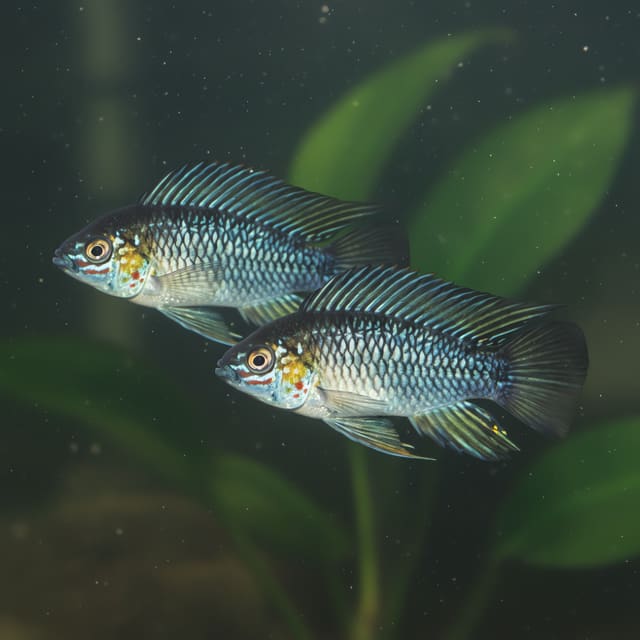
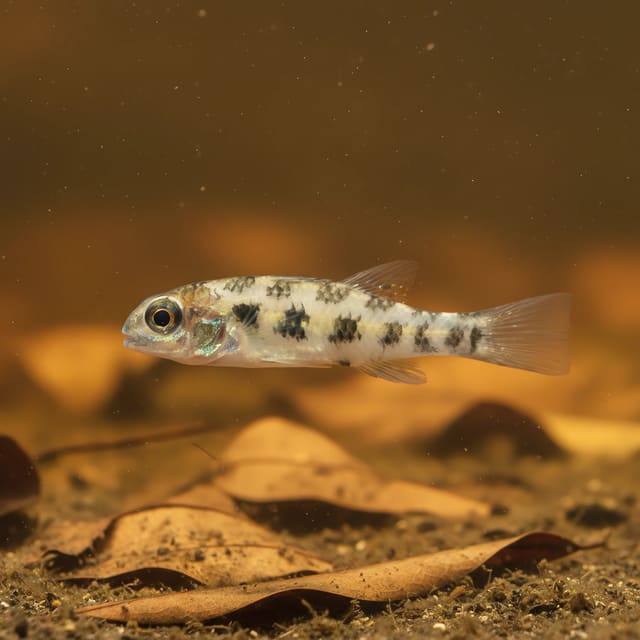
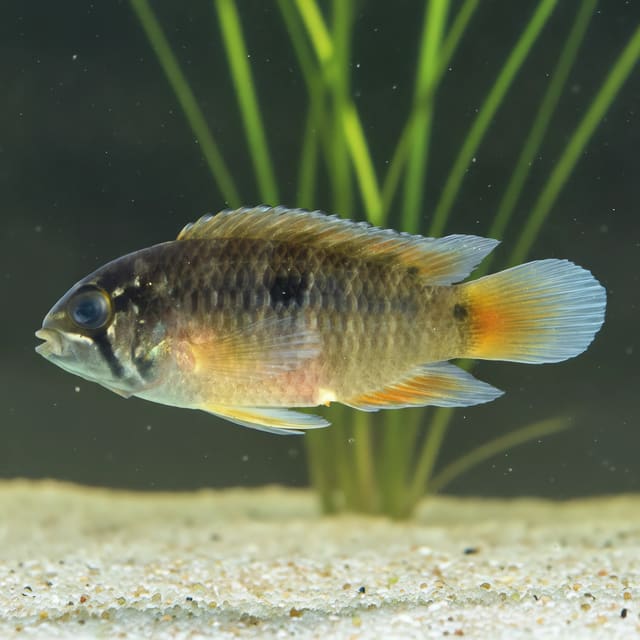
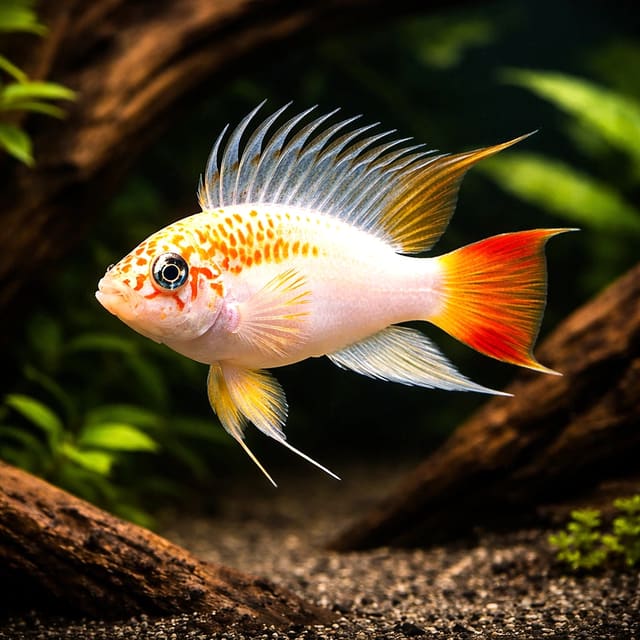
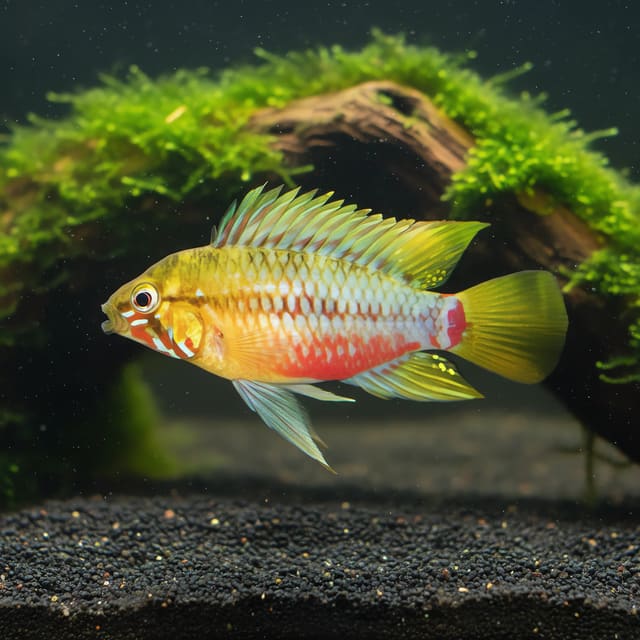
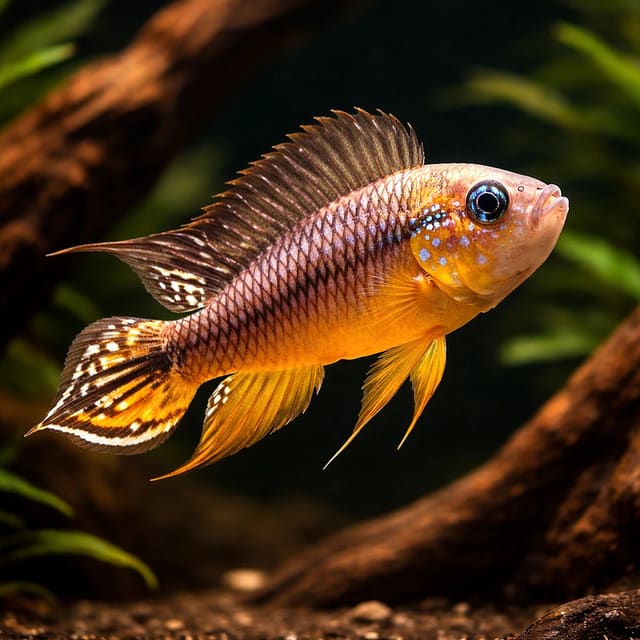
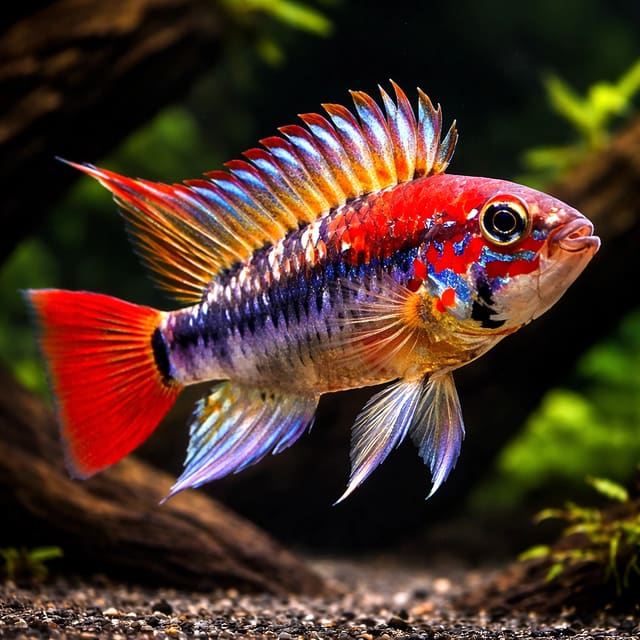
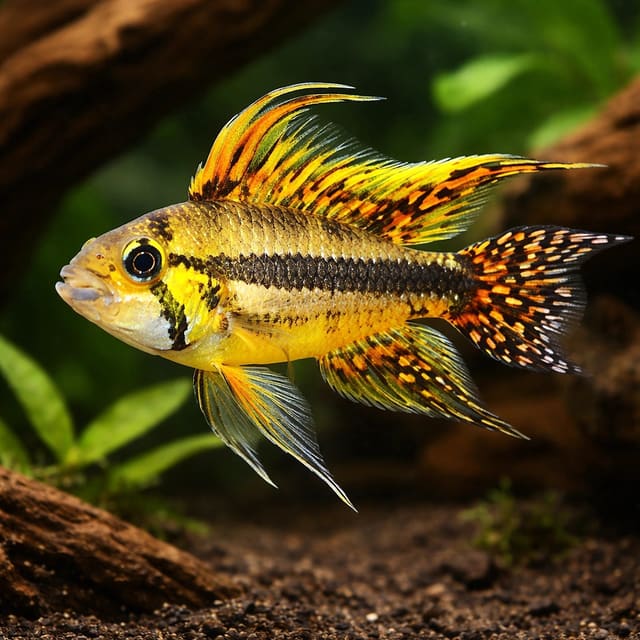
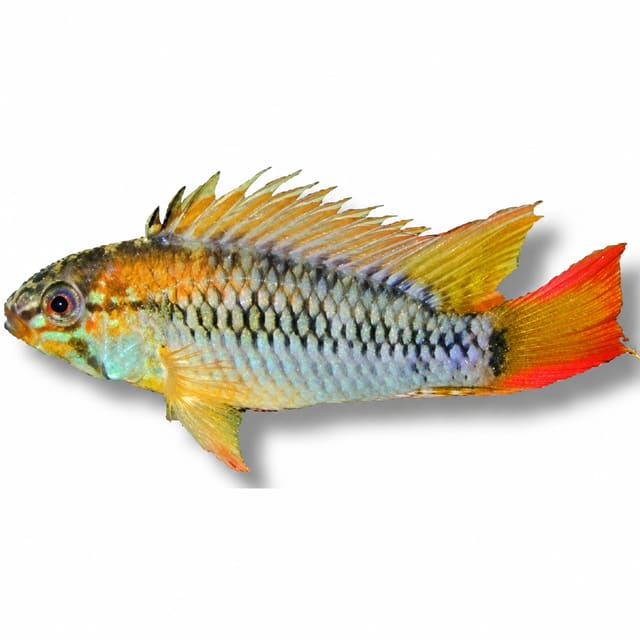
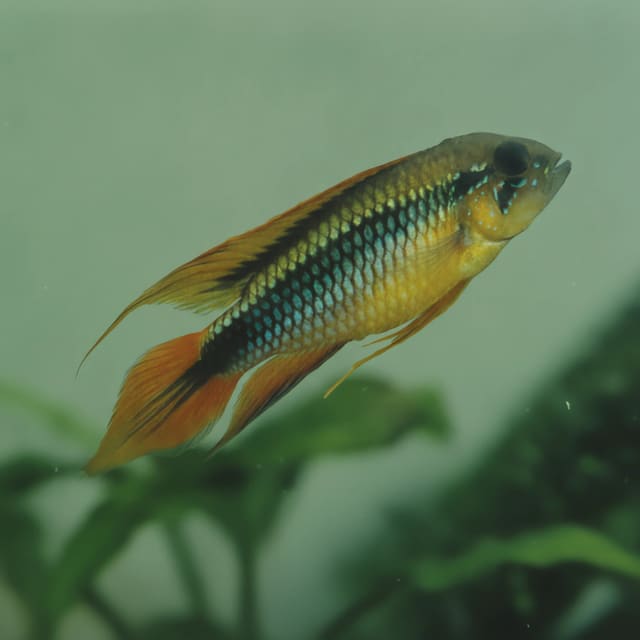
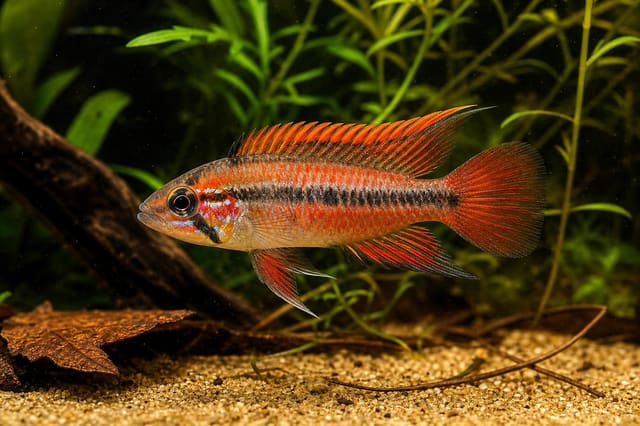
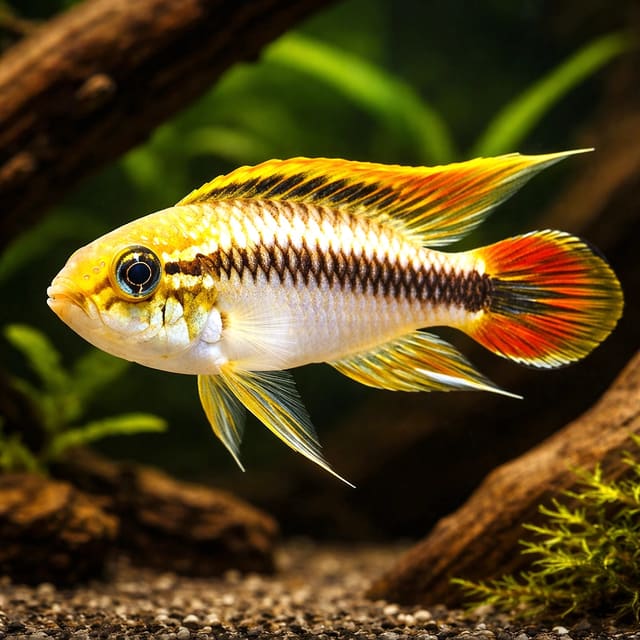
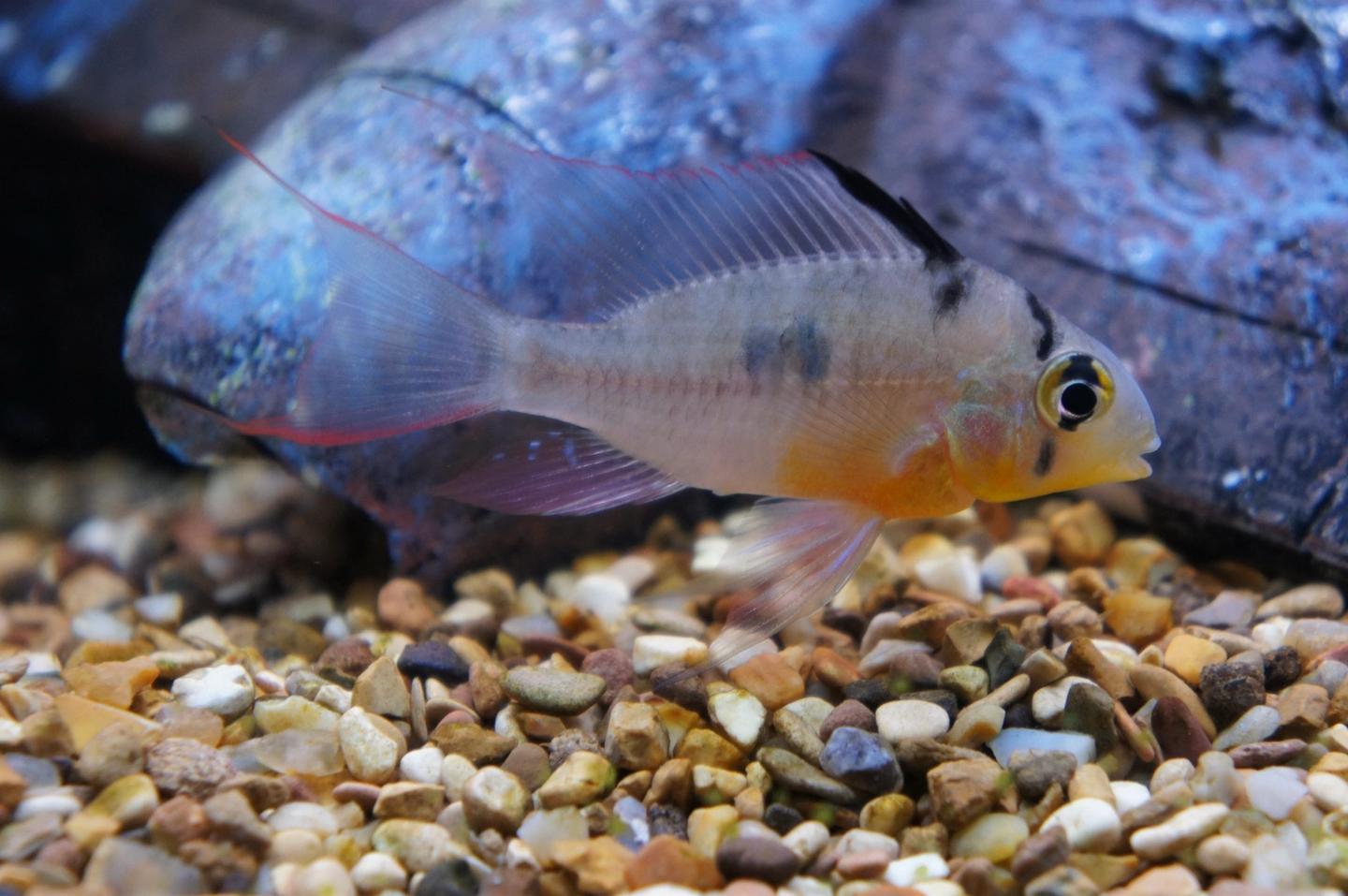
The gallery shows two blue-grey and orange dwarf cichlids with turquoise facial markings, dark side stripes and tall spined dorsal fins above leaf litter. The gallery images are representative of this type of animal rather than photographs of the exact animal supplied, so colours can look slightly different from the live animal.
Prepare the aquarium and establish its biological filter before introducing the fish. If this is your first setup, follow our guide to preparing and maturing a tropical aquarium before choosing livestock. A mature filter contains the beneficial bacteria needed to process the waste produced when two fish and their food are added.
Do not rely on a single shared cave. Dwarf cichlids may become territorial, and even well-settled pairs will often chase one another. Several separated shelters give the pursued fish choices and reduce the chance that one entrance can be guarded while every alternative remains exposed.
Look through the aquarium from each end before the fish arrive. If you can see straight from one side to the other along the bottom, add another visual barrier. Check that neither shelter is a dead end from which a fish cannot leave without passing directly by the other fish.
Keep enough open water around the structures for normal movement and maintenance. A densely decorated tank still needs accessible areas where waste can be siphoned and where both fish can reach food. Secure wood, caves and ornaments so routine cleaning or digging cannot make them shift.
Run the completed setup at the intended temperature and test it before introduction. Add livestock gradually because each increase in fish numbers and feeding requires the filter’s bacterial population to process more waste.
Keep the aquarium between 22 and 27°C, with a pH of 6.0–8.0 and general hardness of 4–12°dH. Choose stable values within those ranges rather than repeatedly altering the water in pursuit of one exact number. Sudden changes can add stress even when both the old and new readings sit inside the working range.
Use our aquarium water chemistry guide to understand temperature, pH, hardness, ammonia, nitrite and nitrate as separate measurements. Then compare the measured aquarium values with the working range using the water matcher.
Test at least once each week. Test again promptly after an unusual event such as missed filter flow, accidental overfeeding or a clear change in either fish’s behaviour. Water can appear clean while dissolved ammonia or nitrite is present, so visual clarity is not a substitute for a test result.
If ammonia or nitrite rises above zero, reduce feeding pressure, check that the filter is running and perform an appropriate conditioned-water change. Do not respond by adding more fish or more food. If nitrate climbs faster than usual, look for uneaten food, trapped waste or a missed water change.
Match replacement water carefully enough to avoid a sudden temperature or chemistry change. Treat tap water with conditioner before it enters the aquarium so chlorine or chloramine does not harm the fish or the beneficial bacteria in the filter.
RSPCA aquarium guidance explains why filtration is vital: fish release toxic ammonia, and a working biological filter supports bacteria that convert ammonia to nitrite and then to the safer nitrate. The filter must remain established and operating; it is not simply a device for making the water look clear.
Do not rinse biological filter media under the tap. Chlorine or chloramine can damage the bacterial population that processes fish waste. When media needs attention, rinse it lightly in aquarium water removed during the partial water change. This clears loose debris while reducing bacterial loss.
If filter output becomes weaker, check for a blocked intake, trapped debris or media that needs a light rinse. Avoid replacing all mature media together. Sudden loss of established bacteria can leave the aquarium unable to process the same amount of waste and food.
Keep the maintenance routine proportionate and regular. A predictable weekly partial change is better than waiting for visible deterioration and then making a disruptive correction. Carry out the 25% weekly change and use test results and waste accumulation to decide whether the aquarium needs closer attention.
During the first month after adding the pack, compare weekly readings, feeding response and filter flow. If nitrate is rising more quickly from week to week, check portion size and trapped food before increasing the maintenance burden. If ammonia or nitrite appears, act immediately because dwarf cichlids can be stressed by even small amounts.
Keep a clear working area around the filter intake and around places where food is offered. This makes it easier to see leftovers, siphon waste and notice a reduction in circulation before water quality declines.
In nature, members of Apistogramma mostly feed on tiny animals. For aquarium feeding, use the dwarf-cichlid routine: offer a good-quality flake or granule as the staple and add small live or frozen foods such as daphnia, brine shrimp or tubifex for variety.
Feed once each day and give only what the fish can finish within a few minutes. Begin with a small amount, watch both fish eat and stop adding food when their response slows. Remove obvious leftovers rather than allowing them to break down in the aquarium.
| What you observe | What to do |
|---|---|
| Food remains after a few minutes | Remove it and reduce the next portion |
| One fish takes most of the food | Place small portions near separate retreats |
| Both fish feed promptly | Keep the same modest routine |
| Interest in food drops | Test water and observe breathing and behaviour |
Territorial behaviour can affect access to food. If one fish repeatedly blocks the other, place small amounts at two separated points with a visual barrier between them. This changes access without increasing the total daily ration.
Live or frozen daphnia, brine shrimp or tubifex can supplement the staple, but variety does not require a second full meal. Count all foods offered that day as part of the same daily allowance. Frozen food should be portioned so that loose particles do not settle throughout the substrate.
Overfeeding adds uneaten organic matter and increases the waste the biological filter must process. That can raise ammonia, nitrite or nitrate and undermine the stable conditions the fish need. A fish approaching the feeding area is not, by itself, a reason to keep adding food beyond what can be eaten within a few minutes.
Watch each animal rather than only the group response. A confident fish may eat while the other remains hidden. Separate feeding points and additional cover are the first practical changes when access, rather than appetite, appears to be the problem.
Arrange for someone to receive the parcel because live fish must not be left unattended. Prepare the aquarium before opening the box: confirm the temperature and check that ammonia and nitrite are at 0 mg/litre.
Follow the current delivery and Live Arrival Guarantee policy when the fish arrive. Start filming before the sealed parcel is opened and continue in one take through opening it and showing the fish inside the sealed bag. Float the bag in the aquarium for 20–30 minutes before releasing the fish. Do not pour transport water from the bag into the aquarium.
Do not combine introduction day with other stocking changes. Adding several fish at once increases waste and gives the filter less time to adjust as feeding rises. OATA advises increasing aquarium populations slowly so the established bacterial population can grow with the additional load.
Look for steady swimming, normal use of cover and regular gill movement. Hiding immediately after transport can occur during settling, but both fish should still be checked individually. Test the water if either fish hangs at the surface, sits on the bottom for a prolonged period or swims erratically.
Offer a modest daily meal and confirm that both animals gain access. Keep the established maintenance schedule rather than making repeated changes to décor and water chemistry. Record temperature, ammonia, nitrite and nitrate so a behavioural change can be compared with an actual water result.
If chasing prevents one fish from leaving cover or reaching food, add or reposition a visual barrier while preserving swimming space. The aim is to create a safer route, not to dismantle the whole aquarium during the settling period.
Dwarf cichlids may become territorial, especially around breeding activity. Even settled pairs will often chase one another, so plan for two fish that may not always choose to share the same part of the aquarium. Several shelters and broken sight lines allow normal withdrawal before an encounter becomes prolonged.
| Behaviour | Practical response |
|---|---|
| Brief chase followed by separation | Confirm both fish retain access to cover and food |
| One fish remains hidden at feeding time | Add a separate feeding point behind a barrier |
| Repeated guarding of one end | Create another route and shelter at the opposite end |
| One fish cannot leave a corner | Rework the layout promptly and reassess the space |
Plants, wood, caves, leaf litter and suitable ornaments can all contribute to shelter. Place cover in separate zones rather than concentrating every retreat into one cluster. The aquarium should let a fish move between protected areas without crossing a completely open bottom.
Do not interpret bright colour, fin shape or behaviour as a sex guarantee. The practical task is the same for any two fish in this pack: provide enough space for each animal to withdraw, then observe whether both continue to swim and feed normally.
If the social pattern becomes tense, first add or reposition one visual barrier and watch the result. Changing the entire layout at once makes it harder to judge which shelter or route solved the problem. Preserve filter operation and water stability while making structural adjustments.
A larger aquarium can provide more opportunities for separated territories, but volume alone does not create security. An open 80-litre tank may offer fewer usable retreats than a carefully structured aquarium of the same volume. Combine adequate litres with purposeful cover and clear escape routes.
Learn the normal behaviour and appearance of both fish after they settle. Changes are easier to recognise when you know how each animal usually swims, feeds, breathes and uses cover. Check the fish daily while feeding and make the weekly water test part of the same observation routine.
If any of these signs appears, test temperature, ammonia, nitrite and nitrate promptly. Confirm that the filter is running and check whether food or waste has accumulated. Water-quality results give an immediate basis for action and should be considered before making assumptions about disease.
Ammonia and nitrite must remain at 0 mg/litre. If either is detectable, reduce feeding pressure, check the filter and change conditioned water while avoiding abrupt shifts in temperature, pH or hardness. Remove uneaten food and confirm that water can circulate around the shelters.
Do not choose medication from one symptom alone. Similar changes in colour, appetite or breathing can accompany poor water quality, social stress or illness. Record the signs, water readings and when the change began, then contact us for health guidance if the fish remains affected.
When only one fish is hiding, also check whether the other is blocking its food or escape route. A water test can be normal while the layout still allows persistent territorial pressure. Address the immediate structural problem and continue observing both animals.
Dwarf cichlids can live in community aquariums, but compatibility depends on space, behaviour and shared water needs. Use at least 80 litres for a mixed aquarium and increase space where the stocking plan or territorial layout requires it. Every fish must have room to move away if the dwarf cichlids become territorial.
OATA recommends shoals of dither fish because their movement may give dwarf cichlids a sense of security and they can move away if territorial behaviour increases. That is a behavioural screening principle rather than a universal list of compatible species. Any candidate still needs matching water requirements, appropriate group numbers and enough room in this particular aquarium.
| Candidate trait | Decision |
|---|---|
| Calm, compatible water needs and room to retreat | Consider after checking the full stocking plan |
| Very active or boisterous | Use caution because shy fish may be stressed |
| Likely to monopolise food | Reconsider or provide demonstrably separate feeding access |
| Likely to disturb spawning sites or eat fry | Avoid when breeding is intended |
Do not use body size alone as a compatibility test. A smaller but relentless fish may create more pressure than a calm companion, while fish using the same sheltered areas may meet repeatedly even in a tank with adequate total volume.
Before combining this pack with an existing community, ask us for a stocking and compatibility assessment. Include the aquarium volume, dimensions, measured water values, filtration, existing fish numbers and how the cover is arranged.
A community that appears calm at first can change if the dwarf cichlids begin breeding activity. Territorial behaviour may increase, and other fish need enough space to leave guarded areas. Build that possibility into the original layout rather than waiting until one fish is repeatedly displaced.
Place caves and dense cover away from the aquarium’s busiest feeding route where practical. Keep alternative paths around wood and plants so another fish does not have to pass one defended entrance to cross the tank. An 80-litre minimum for a community is the starting figure, not permission to fill every zone with livestock.
If breeding is intended, avoid tank mates likely to disturb spawning sites or predate fry. The exact breeding behaviour varies within Apistogramma, so plan around the observable behaviour in the aquarium rather than assuming this trade label follows one species’ pattern.
Introduce fish slowly rather than making several stocking changes together. Each addition increases waste and feeding, requiring the biological filter to support a greater load. Slow additions also make it easier to identify which social combination caused a change.
Compatibility remains conditional throughout the animals’ lives. Growth, territorial behaviour and changes to décor can alter how much usable space each fish has. Review the plan whenever one animal’s access to food, cover or open swimming space changes.
They are two freshwater dwarf cichlids sold under a trade label within the South American genus Apistogramma. “Apistogramma sp.” means the exact species is not assigned.
One purchase supplies a pack of two fish. Plan space and cover for both animals rather than treating the title as a single-fish offer.
Use the dwarf-cichlid planning ceiling of up to 10 cm as an aquarium-planning reference rather than a promised adult size, and choose the aquarium around long-term space for both fish.
Plan at least 60 litres for the two fish, with an essential mature filter, sand or aquarium gravel, plants or ornaments, and several sheltered areas that break sight lines. Use at least 80 litres if mixing them with other fish.
This pack is planned around housing the two together. Give each fish access to cover because even settled pairs will often chase one another, and reassess the layout if one fish cannot leave the other’s territory.
OATA’s dwarf-cichlid guidance gives 22–27°C, pH 6.0–8.0 and 4–12°dH. Keep ammonia and nitrite at 0 mg/litre, and keep nitrate no more than 20 mg/litre above the normal tap-water level.
Feed a good-quality flake or granule once daily, giving only what the fish finish within a few minutes. Small live or frozen daphnia, brine shrimp or tubifex can add variety.
Start filming before opening the sealed parcel and continue in one take through opening it and showing the fish inside the sealed bag. Be present for arrival, float the bag for 20–30 minutes, then release the fish without pouring bag water into the aquarium.
Choose calm companions with matching water needs and enough room to move away from territorial behaviour. Very active or boisterous fish need careful screening; if breeding is intended, avoid fish likely to disturb spawning sites or predate fry.
No reviews for this item yet. Bought one? Honest reviews only, good or bad.
What customers say about ordering from us
I have a small group of long finned mountain minnows. So was delighted to be able to order ten of this variety to increase the genetics in my tank . The ones I recieved are healthy but it’s to early to give a verdict on wether they are of a long finned type since they are small currently.
Gordon Walker · 23 Sept 2026
100% success travel and "installation". Pleased with quality of purchase. The Siamese fighter a bit "shy" so have not yet seen him at his best yet but looking good. Happy customer. GG
George E Garratt · 21 Sept 2026
Reviews of our shop, collected by Judge.me, an independent third-party review collector. Newest first.