Moderate
Cockatoo Dwarf Cichlid Double Red (Apistogramma cacatuoides)
22–29°C · pH 5–6 · 54L
£11.99
The Cockatoo Dwarf Cichlid Orange (Apistogramma cacatuoides) is a freshwater cichlid from the Amazon River basin that reaches 5 cm standard length. It suits keepers prepared for territorial breeding behaviour: a 60 × 30 cm base is acceptable for a single pair, and routine water should be 24–25°C, pH 6.0 and 5–12 dGH, the overlap of FishBase, Seriously Fish and OATA guidance. Sold individually in 3–4 cm and XL sizes.
Adult size is the maximum length this species reaches at full maturity (scientific sources). The livestock you receive will be younger and smaller — pick a size above for the actual shipping size. Product-photo provenance and any image-specific limitations are stated on the listing.
Apistogramma cacatuoides
Save when buying multiple fish. Each quantity is one fish; sex and pair formation are not guaranteed unless the selected variant explicitly states them.
The Cockatoo Dwarf Cichlid Orange (Apistogramma cacatuoides) is a freshwater cichlid from the Amazon River basin that reaches 5 cm standard length. It suits keepers prepared for territorial breeding behaviour: a 60 × 30 cm base is acceptable for a single pair, and routine water should be 24–25°C, pH 6.0 and 5–12 dGH, the overlap of FishBase, Seriously Fish and OATA guidance. Sold individually in 3–4 cm and XL sizes.
Adult size is the maximum length this species reaches at full maturity (scientific sources). The livestock you receive will be younger and smaller — pick a size above for the actual shipping size. Product-photo provenance and any image-specific limitations are stated on the listing.

Cichlids are a family of roughly 1,800 accepted species, not one care type. Before buying, identify the exact species and source, then compare adult measurement, usable tank dimensions, social system, territory, tested water, diet and an exit plan. No family-wide minimum tank, water range or tank-mate list is safe.
Maintain these water conditions for optimal health and vibrant colors
The Cockatoo Dwarf Cichlid Orange (Apistogramma cacatuoides) is a freshwater member of the cichlid family from South America’s Amazon River basin. FishBase records tributaries of the Ucayali, Amazon and Solimões rivers, from the Pachitea River to Tabatinga, and a maximum length of 5 cm standard length. It suits a keeper who can provide a mature, filtered aquarium with caves, shaded cover, measured water chemistry and enough room to manage territorial behaviour.
This is a bottom-associated fish that feeds primarily on benthic invertebrates in nature. Its aquarium should therefore be planned around accessible lower-level cover, a soft sandy substrate and foods that reach the fish where it naturally searches. The orange name identifies the ornamental colour form, while the care plan remains that of Apistogramma cacatuoides.
Do not treat its small adult length as permission to reduce the footprint. Caves form part of its breeding biology, females tend eggs and fry, and territorial behaviour may intensify when breeding. Floor area, visual barriers and separate retreats matter more than empty vertical space.
| Suits | Not suited to |
|---|---|
| A mature, filtered freshwater aquarium | An aquarium without an established biological filter |
| Soft sand, wood, caves and shaded cover | A bare layout without adequate shelter |
| Measured water at 24–25°C and pH 6.0 | Unmeasured or fluctuating water conditions |
| Carefully screened, calm community plans | Very active or boisterous companions |
| A keeper prepared for breeding territoriality | A plan that assumes permanently peaceful behaviour |
One purchase supplies one Cockatoo Dwarf Cichlid Orange. Use the live size selector to choose between the 3–4 cm and XL labels. These are dispatch sizes, so both choices require an aquarium planned around the same adult care, space and compatibility decisions.
The size you select is the size supplied, not the adult size. A larger dispatch grade does not change the recorded adult planning length, the need for caves or the possibility of territorial behaviour. It also must not be used to infer sex or life stage.
Sex is guaranteed only when the selected option explicitly states male or female. This Cockatoo Dwarf Cichlid Orange listing has no sex-guaranteed option. Plan each order as one unsexed fish rather than assuming that two individually purchased animals will form a compatible pair.
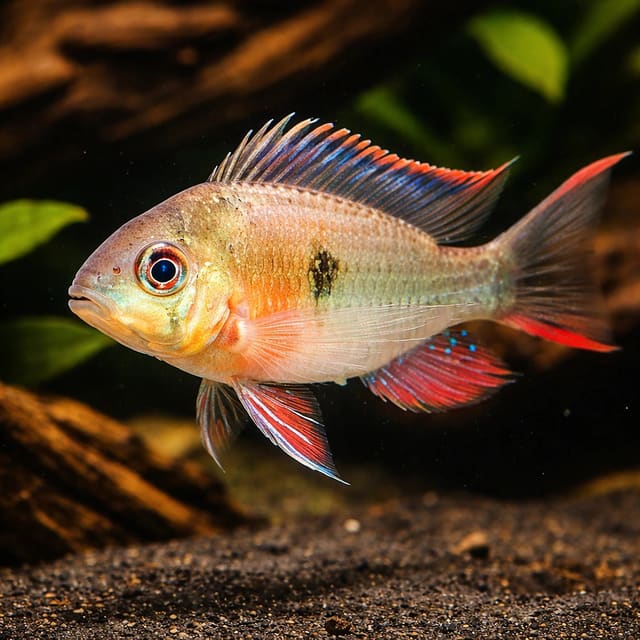
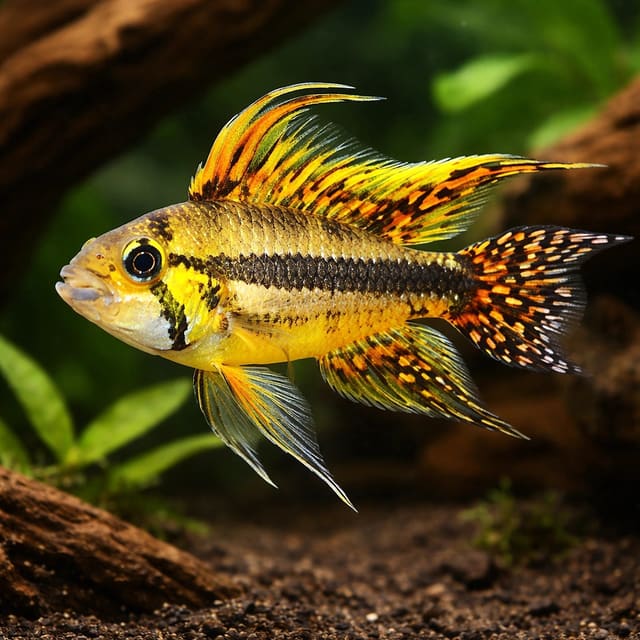
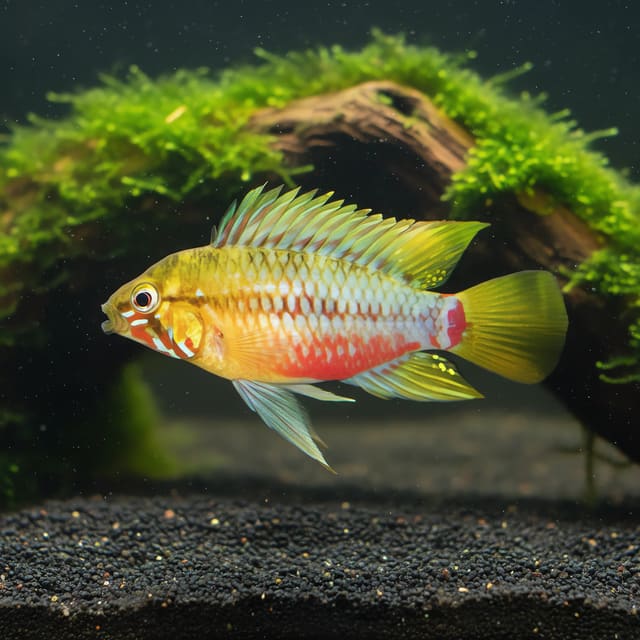
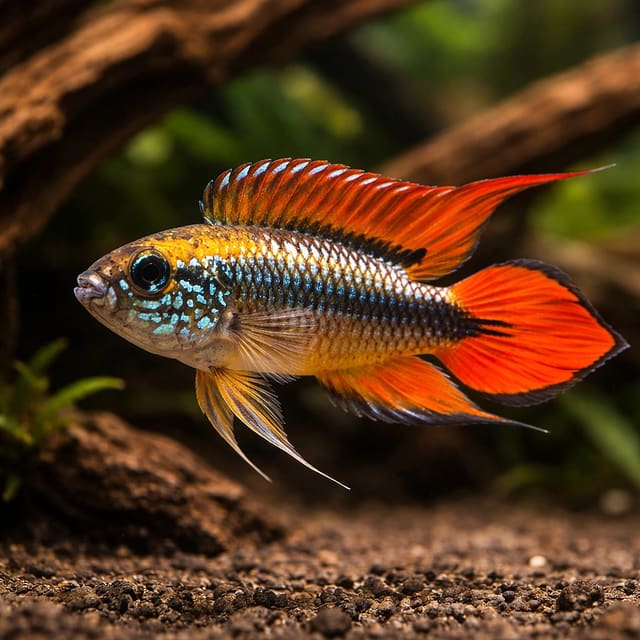
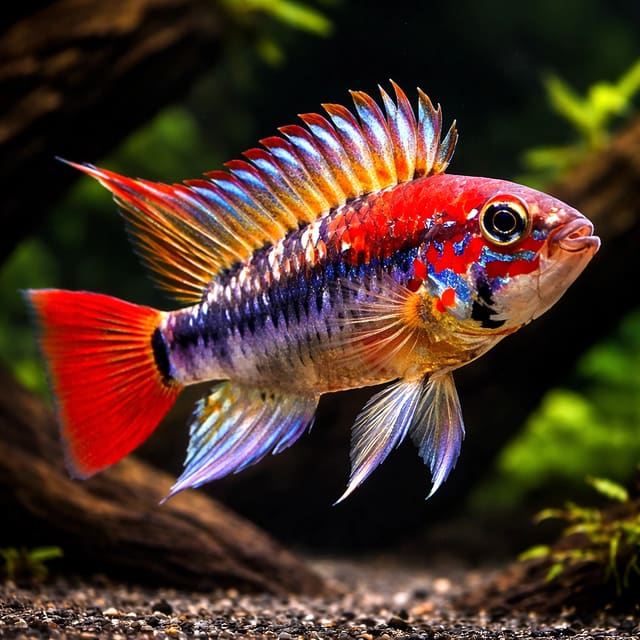
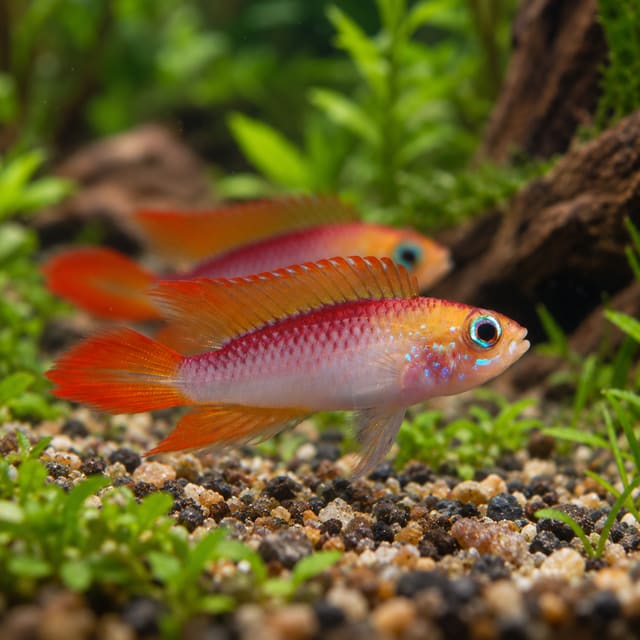
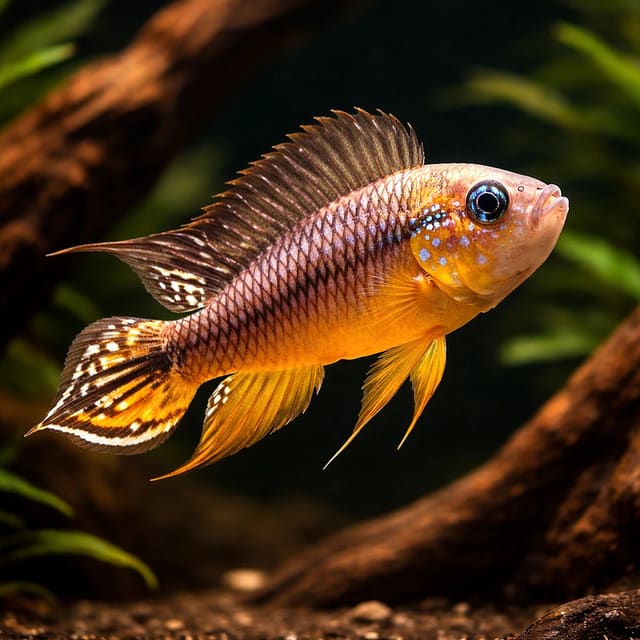
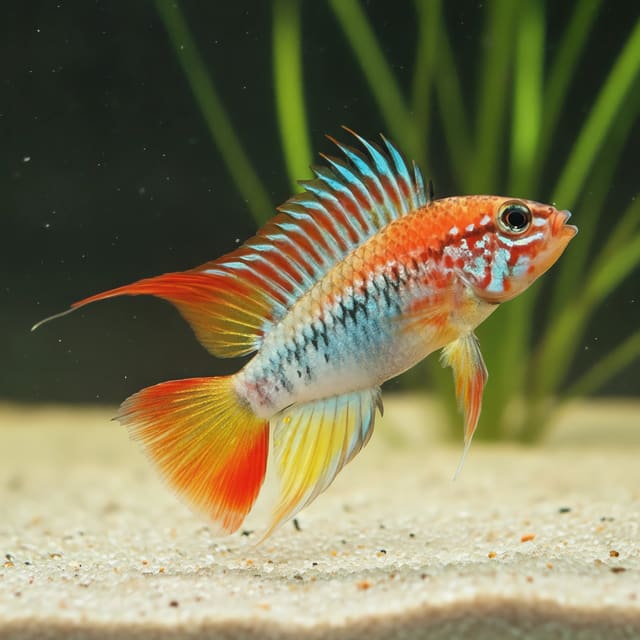
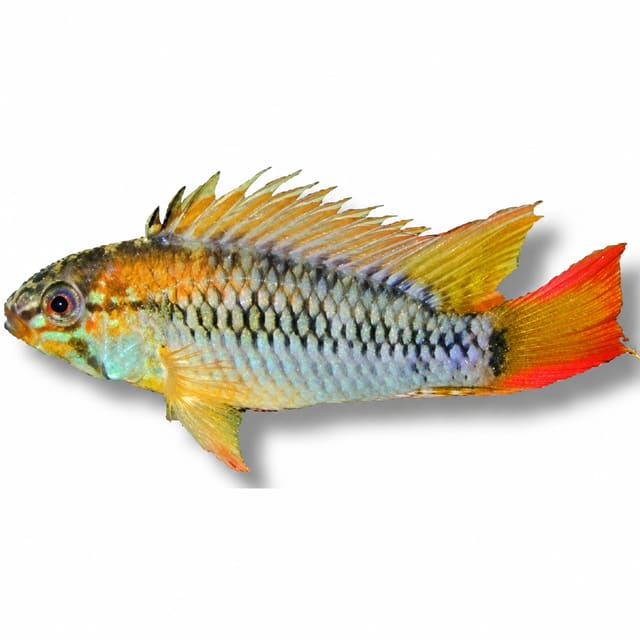
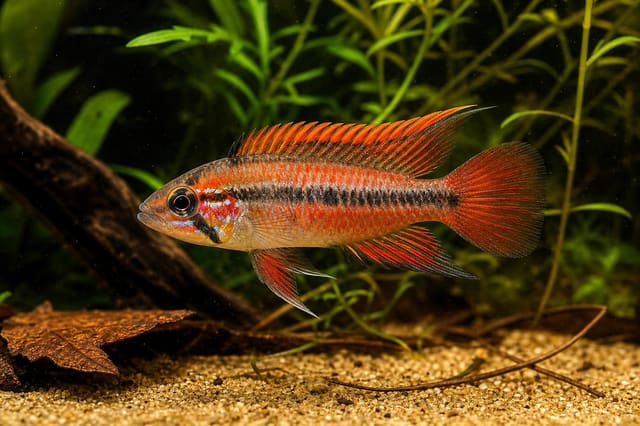
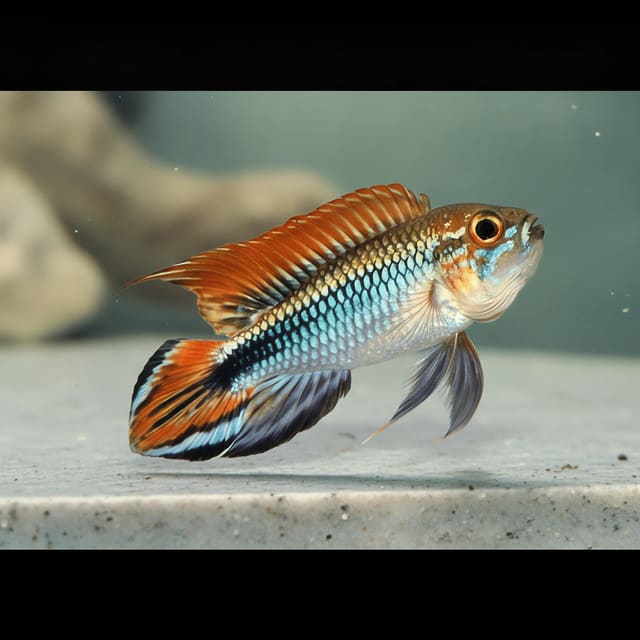
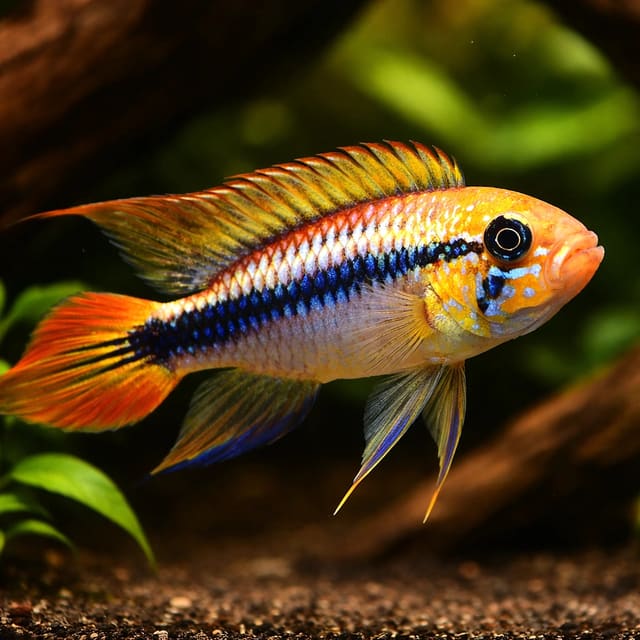
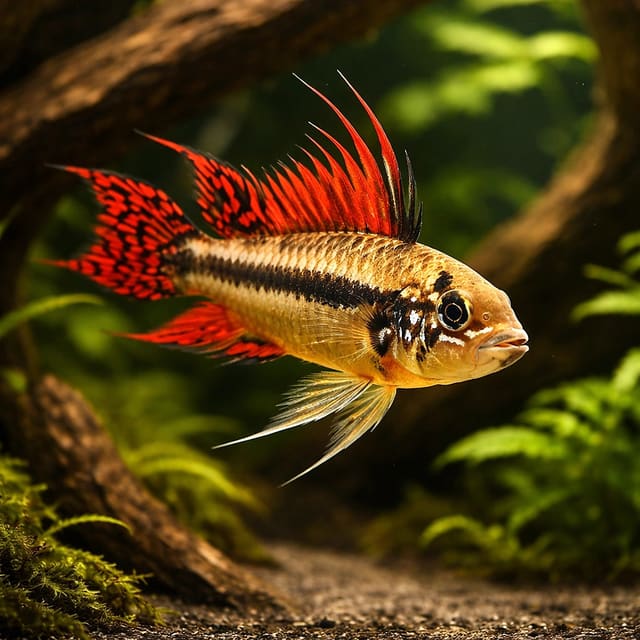
Some gallery images have been digitally enhanced to improve image quality. They show the listed type of animal rather than guaranteeing the exact markings of the individual supplied, so natural colour and pattern can vary. Some scenes show two fish, but the number visible in an image does not change the purchase unit. The gallery illustrates the orange colour form, fin pattern and planted-aquarium context rather than the exact individual sent.
If you are comparing this fish with other regional choices, browse the South American cichlid collection. Compare adult care, territorial behaviour and aquarium footprint before comparing dispatch labels.
Keep routine water at 24–25°C, pH 6.0 and 5–12 dGH. These values are the overlap of FishBase’s environmental record, the Seriously Fish aquarium ranges and OATA’s broad dwarf-cichlid guidance; OATA’s figures are group guidance, not a species-specific optimum.
Use a base measuring at least 60 × 30 cm. Seriously Fish equates that footprint to approximately 54 litres and regards it as acceptable for a single pair, while a group requires larger quarters. OATA recommends at least 60 litres for a pair and at least 80 litres when dwarf cichlids are mixed with other fish. Choose by usable footprint and stocking plan rather than nominal volume alone.
| Decision | Plan |
|---|---|
| Adult length | Plan around 5 cm standard length |
| Single-pair footprint | At least 60 × 30 cm, approximately 54 litres |
| Community volume | At least 80 litres under OATA dwarf-cichlid guidance |
| Routine water | 24–25°C, pH 6.0 and 5–12 dGH |
| Water quality | Zero ammonia and zero nitrite |
| Food | Pelleted dried food plus regular live or frozen invertebrate foods |
| Temperament | Allow for territorial behaviour, especially when breeding |
Decide the complete stocking plan before adding fish. A calm community with sufficient space and cover can work, but the presence of caves and visual barriers does not remove the need to watch interactions. A group must not be fitted into the footprint described for a single pair.
Use a soft sandy substrate with wood roots and branches arranged to create shaded areas, broken sight lines and several caves. Seriously Fish describes this species as flexible about décor when adequate cover and structure are present, so ceramic flowerpots and suitable lengths of plastic piping can also provide useful retreats.
Spread shelters across the footprint rather than clustering every cave in one corner. Separate entrances and visual barriers give fish room to withdraw when another animal approaches. Even well-settled dwarf-cichlid pairs will often chase each other, making access to more than one covered area an important part of the layout.
Dried beech, oak or Ketapang almond leaves can be added for a more natural-looking arrangement. As leaves decompose, microbial colonies can develop and offer a secondary food source for fry. The leaves also release tannins and other compounds. They may be left to break down fully or removed and replaced every few weeks.
Check each ornament for stability before adding the fish. The goal is a structured lower level with usable shelter, not a crowded floor that traps waste or blocks every observation point. Keep at least one clear view into each main refuge so changes in behaviour, condition and feeding can be noticed promptly.
Plan around the FishBase maximum of 5 cm standard length. Seriously Fish lists males at 75 mm and females at 50 mm standard length; treat those sex-linked measurements as additional planning context rather than a way to identify the sex of a dispatched fish. A 3–4 cm or XL dispatch label never changes the adult aquarium plan.
A 60 × 30 cm base, approximately 54 litres, is the species-specific starting footprint described for a single pair. OATA’s dwarf-cichlid advice raises the practical volume to at least 60 litres for a pair and at least 80 litres when mixing dwarf cichlids with other fish. A larger aquarium also makes temperature and water quality more stable.
Do not place a young or smaller dispatched fish in a reduced aquarium on the assumption that it can be moved later. Establish the complete adult footprint, caves and filtration before arrival. Groups require larger quarters than the pair footprint, so group planning needs additional floor area rather than simply adding more shelters to the same tank.
A working filter is essential. The RSPCA explains that biological filtration supports bacteria that convert toxic ammonia to toxic nitrite and then to the safer nitrate. Prepare and mature the aquarium before livestock arrives; our first tropical aquarium guide explains the setup sequence.
For an aquarium around 54 litres, Seriously Fish suggests gentle water movement and a filter rated at 110–160 litres per hour. Position the return so circulation reaches the aquarium without turning the sheltered lower areas into a strong-current environment.
If the room is around 20°C, Seriously Fish suggests roughly 75–100 W of heating for a tank of this size. Choose and control the heater by measured aquarium temperature, keeping the routine target at 24–25°C.
Keep the aquarium at 24–25°C, pH 6.0 and 5–12 dGH. This is the shared intersection of all three named sets of values, giving one routine target that remains inside each of them.
| Reference | Recorded values |
|---|---|
| FishBase | 24–25°C; pH 6.0–8.0; 5–19 dGH |
| Seriously Fish | 22–29°C; pH 5.0–6.0; 0–15 dGH |
| OATA dwarf cichlids | 22–27°C; pH 6.0–8.0; 4–12 dGH |
| Routine target | 24–25°C; pH 6.0; 5–12 dGH |
Measure the aquarium rather than relying on tap-water assumptions. Record temperature, pH and general hardness, then compare them with the target before choosing the fish. Our water chemistry guide explains what the values mean, while the water matcher provides a direct comparison with the stated range.
Ammonia and nitrite should both remain at zero milligrams per litre. OATA recommends testing at least once per week and keeping nitrate from exceeding 20 mg per litre above the normal tap-water level. Its carbonate-hardness range for dwarf cichlids is 3–10 dKH.
If ammonia or nitrite appears, treat the result as a water-quality problem rather than waiting for visible illness. Review stocking pace, uneaten food, filter operation and the aquarium’s biological maturity. Beneficial bacteria must increase as fish numbers and feeding increase, so add livestock slowly and avoid sudden increases in waste production.
Stability is part of the space decision. A larger water volume changes temperature and chemistry more gradually, but it still requires regular testing and maintenance. Keep a dated record so a change in behaviour can be compared with recent temperature, pH, hardness, ammonia, nitrite and nitrate readings.
Base the diet on foods suited to a primarily carnivorous fish that feeds mostly on benthic invertebrates in nature. Seriously Fish recommends live and frozen Artemia, Daphnia and chironomid larvae such as bloodworm on a regular basis. Most specimens also learn to accept dried alternatives, with pellets generally preferred to flakes.
| Food | Use |
|---|---|
| Quality dried pellets | A practical dried food suited to the fish’s small mouth and carnivorous diet |
| Live or frozen Artemia | Regular variety matching the recorded invertebrate diet |
| Live or frozen Daphnia | Regular small invertebrate food |
| Bloodworm | Live, frozen or freeze-dried variety |
| Freeze-dried Artemia | An additional dried invertebrate food |
Feed once a day and give only what the fish can eat within a few minutes, following OATA’s feeding schedule for dwarf cichlids. Watch the food reach the lower part of the aquarium and confirm that the fish obtains a fair share before faster companions remove it.
Use the fish’s response to set the portion. If food remains after a few minutes, reduce the next portion rather than leaving it to break down. Uneaten food adds waste and can contribute to toxic deterioration in water quality.
Variety comes from rotating suitable invertebrate foods, not from increasing the daily amount. Keep the once-daily portion within the few-minute limit even when several food types are offered.
At least once every week, change 25% of the aquarium water. Use a siphon to remove solid waste from accessible areas of the substrate, especially around feeding places, cave entrances and sheltered spots where circulation is gentle.
Treat replacement tap water with a suitable conditioner to remove chlorine or chloramine before adding it to the aquarium. Match the established aquarium plan closely enough to avoid an abrupt change in temperature or water chemistry during routine maintenance.
Chlorine or chloramine can kill beneficial bacteria living in filter media. Cleaning it in removed aquarium water reduces bacterial loss while allowing accumulated debris to be cleared.
At the first weekly service: confirm that food is being eaten within a few minutes, the filter flow remains gentle and unobstructed, and each cave can be inspected without dismantling the whole layout.
Through the first month: compare each weekly water test with the preceding result. Look for a trend rather than judging one number in isolation, and review feeding or stocking pace if nitrate rises or ammonia or nitrite appears.
During later services: remove only the waste and deteriorated material that needs attention. Keep useful cover in place and avoid repeatedly stripping the aquarium of every established surface. Dried leaves may be allowed to break down fully or replaced every few weeks according to the chosen layout.
A consistent routine makes changes easier to identify. Keep the water-change day, portion schedule and test record predictable, then investigate departures from the fish’s usual feeding, swimming, colour, breathing or use of cover.
Observe the fish during feeding and during quiet periods. Healthy fish should have clear, bright eyes, intact scales and undamaged fins, without ulcers or unusual bumps. Swimming and breathing should remain appropriate for the individual’s normal pattern.
| If you see | What to do |
|---|---|
| Hanging at the surface, sitting unusually on the bottom or erratic swimming | Test ammonia, nitrite, nitrate, temperature and pH immediately |
| Faster or slower gill-cover movement | Check water quality and filter operation |
| A darker or paler colour than normal | Compare recent water results and watch interactions |
| More aggression or hiding than normal | Review space, caves, sight lines and breeding behaviour |
| White spots, fluffy growths, damaged fins or lost scales | Record the appearance and test the aquarium water |
| Reduced feeding or changing body condition | Check access to food, portion size and water quality |
Begin with measured water results because dwarf cichlids may be stressed by even small amounts of ammonia or nitrite. Confirm that the filter is running, the flow is not blocked and recent feeding has not left uneaten food behind.
Territorial behaviour must be assessed alongside physical health. Chasing during breeding differs from a fish becoming inactive, breathing abnormally or losing condition, but both require prompt attention to the aquarium plan. Add or rearrange cover only when that can be done without trapping the fish or destabilising essential structures.
If a health change continues after the immediate water and equipment checks, contact us with the test results, a description of the change and clear images where practical. Do not select a treatment solely from a symptom name; accurate water readings and observations make the next decision safer.
Prepare the mature aquarium, working filter, heater, cover and tested water before the parcel reaches you. Someone must be at the delivery address to receive live fish because the parcel cannot be left unattended.
The fish is hand-bagged in pure oxygen and placed in an insulated poly box, with a heat pack when weather conditions call for it. A licensed live-animal courier carries the parcel, and tracking details are sent by email so someone can be ready to receive it.
General settling advice from OATA is to introduce fish only after checking that aquarium ammonia and nitrite are zero. Increase the aquarium population slowly because the beneficial bacteria in the filter must adjust whenever fish numbers and feeding increase.
For a Live Arrival Guarantee claim, contact us on the day the fish arrives with the order number and continuous unboxing video. The recording must begin with the parcel still sealed and show the fish in the sealed bag before release. Keep the recording even when the fish appears well on arrival.
Read the delivery and Live Arrival Guarantee policy before the parcel is due so the receiving, filming, inspection and acclimatisation steps are ready to follow in order.
Plan for territorial behaviour, especially if breeding begins. OATA says dwarf cichlids can live in community aquariums when every tank mate has enough space should the cichlids become territorial. This is a conditional community choice, not a universal peaceful-fish match.
Shoals of dither fish can give dwarf cichlids a sense of security and are quick enough to move away if territorial behaviour starts. Seriously Fish names small Nannostomus species as dither fish for wild examples. It recommends wild examples be kept alone or with small dither fish and says to avoid mixing them with other Apistogramma.
| Screening point | Decision |
|---|---|
| Activity level | Avoid a plan dominated by very active or boisterous fish because shy Apistogramma may not do well with them |
| Space | Give every fish room to withdraw if territorial behaviour starts |
| Cover | Provide caves, shaded areas and broken sight lines before adding companions |
| Feeding | Confirm that food reaches the cichlid before faster fish take it |
| Breeding plan | Avoid fish that may disturb spawning sites or prey on fry |
| Wild-fish plan | Avoid other Apistogramma; use small dither fish such as Nannostomus spp. or keep alone |
Do not transfer a tank-mate claim from another dwarf-cichlid species to this fish. Small size by itself says nothing about activity, feeding competition or response to territorial chasing. Screen the proposed aquarium as a complete combination of footprint, cover, water, feeding position and behaviour.
For a stocking assessment, ask us with the aquarium dimensions, measured water values, existing fish, proposed fish and number of caves. That information allows the plan to be judged without presenting any named companion as safe in every aquarium.
A 60 × 30 cm base is described as acceptable for a single pair, while a group requires larger quarters. OATA recommends at least 60 litres for a pair and at least 80 litres when mixing dwarf cichlids with other fish. Do not place a group into the pair footprint or assume that adding caves alone creates enough territory.
Provide several caves, shaded areas and visual barriers even though only two fish are intended. Even well-settled pairs will often chase each other, and each fish needs a route away from the other. Because fish are sold individually without a sex guarantee, do not assume two purchases will produce a male and female pair.
Start with the larger footprint and at least the 80-litre volume recommended by OATA for mixing dwarf cichlids with other fish. Choose calm companions, retain open escape routes and observe whether the cichlid continues to feed. A fish that hides continuously or loses access to food needs the plan reassessed.
Eggs may be laid on the ceiling of caves or in crevices and cavities. The female tends the eggs and fry and may become highly aggressive after spawning. Seriously Fish notes that the male may need to be removed in a smaller aquarium. Any removal plan therefore needs a suitable mature, filtered space ready before conflict develops.
Avoid tank mates that may disturb spawning sites or prey on fry when breeding is intended. In a community, breeding changes the risk calculation because a previously tolerated area may become a defended territory. Watch cave entrances, feeding access and the routes other fish use through the lower part of the aquarium.
If repeated chasing prevents a fish from feeding or resting, separate the animals rather than waiting for visible injury. Space, cover and observation work together, but no decoration can guarantee that individually selected cichlids will accept one another.
It reaches 5 cm standard length; use that adult figure for space planning rather than the dispatch size.
Use at least a 60 × 30 cm base. Seriously Fish equates this to approximately 54 litres for a single pair; OATA’s dwarf-cichlid guidance recommends at least 60 litres for a pair and at least 80 litres when mixing with other fish.
Seriously Fish accepts a single pair in a 60 × 30 cm footprint and says a group requires larger quarters. Provide several caves and do not fit a group into the pair footprint.
For a beginner, success depends on preparing a mature filtered aquarium, maintaining zero ammonia and nitrite, providing caves and screening every companion for space, activity and territorial behaviour.
Feed suitable dried pellets plus regular live or frozen Artemia, Daphnia and bloodworm. Offer only what it can eat within a few minutes, once a day.
Keep this fish at 24–25°C, pH 6.0 and 5–12 dGH; these values are the overlap of FishBase, Seriously Fish and OATA guidance.
Plan for territorial chasing, especially during breeding. Provide caves, broken sight lines and enough room for every fish to withdraw rather than relying on a permanently peaceful temperament.
Small dither fish such as Nannostomus species are named for wild examples; avoid other Apistogramma with wild examples. In any community, screen companions for calm activity, feeding competition, space and breeding risk.
Start filming the sealed parcel before opening it, continue through opening and show the fish in the sealed bag. The fish is packed in oxygen in an insulated box and carried by a licensed live-animal courier; float the bag for 20–30 minutes before release.
No reviews for this item yet. Bought one? Honest reviews only, good or bad.
What customers say about ordering from us
Easy website plenty of info on fish your buying great to pick a time slot
TRACEY DURRANT · 7 Oct 2026
Got some lovely fish thank you
Kevin Mackie · 7 Oct 2026
Reviews of our shop, collected by Judge.me, an independent third-party review collector. Newest first.