Mikrogeophagus ramirezi
Male and Female Ramirezi Red Gold (Mikrogeophagus ramirezi) - UK
Stunning male and female Ramirezi Red Gold pair with vivid colour and peaceful character. Ideal for warm tropical setups. Order now with fast UK delivery.
Care at a Glance
Premium Quality
Healthy, vibrant fish from trusted suppliers
Expert Care
Detailed care guides and support
Live Arrival Guarantee
Your fish arrives healthy or we'll replace it
Acclimated
Properly quarantined and ready for your tank
Quick Care Guide
Water Parameters
Maintain these water conditions for optimal health and vibrant colors
Why Choose This Fish?
Stunning male and female Ramirezi Red Gold pair with vivid colour and peaceful character. Ideal for warm tropical setups. Order now with fast UK delivery.
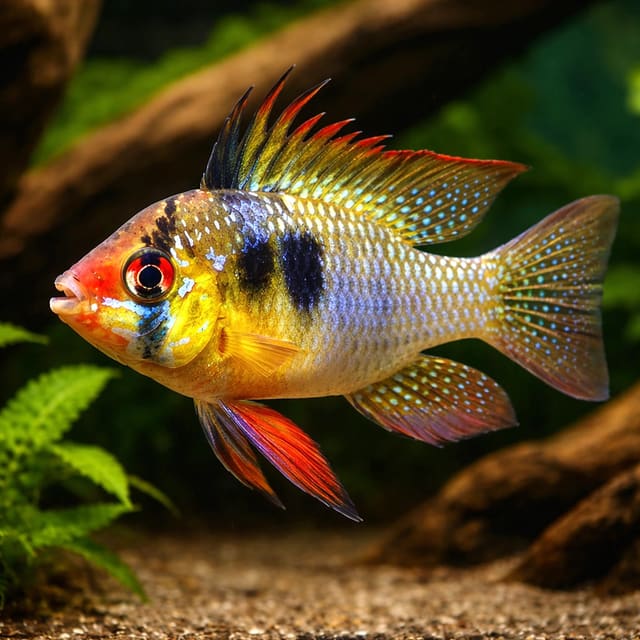
The Red Gold form of Mikrogeophagus ramirezi is one of those fish that makes people stop in front of an aquarium and stare. This male and female pair combines the compact charm of a true dwarf cichlid with warm gold, orange and red tones that glow under planted-tank lighting. Known variously as the German Red Gold Ram, Ram Cichlid Red Gold and Papiliochromis ramirezi Red Gold, this South American species stays relatively small at around 6-7 cm, yet brings the colour impact of much larger cichlids. It is a peaceful dwarf cichlid for community tank setups when kept with the right companions, and many keepers consider it the best ram cichlid colour morph or at least the best ram cichlid colour variant for a warm, heavily planted display.
Originating from the Orinoco basin of Venezuela and Colombia, Mikrogeophagus ramirezi belongs to the family Cichlidae and is prized for its intelligent behaviour, pair bonding and elegant breeding displays. This listing is for a red gold ram cichlid male and female pair, ideal if you want a display pair or a ram cichlid pair for breeding. Their moderate care level reflects one key truth: beautiful Rams reward precision. Stable warm water, low nitrate, soft conditions and a thoughtful ram cichlid tank setup make all the difference. See our detailed photos showing the body shape, finnage and rich metallic tones of this Ramirezi Red Gold pair, and you will understand why it remains a favourite colourful dwarf cichlid UK aquarists seek for refined tropical aquariums.
🔹 Quick Facts
- Scientific Name: Mikrogeophagus ramirezi
- Care Level: Moderate
- Min Tank Size: 60 litres (13+ gallons)
- Temperature: 26-30°C (79-86°F)
- pH Range: 5.5-7.0
- Lifespan: Up to 3 years
- Temperament: Peaceful, lightly territorial when spawning
- Diet: Omnivore
Classification
- Order: Cichliformes
- Family: Cichlidae
- Genus: Mikrogeophagus
Mikrogeophagus ramirezi is one of the best-known South American dwarf cichlids in the hobby. Older hobby literature may refer to it as Papiliochromis ramirezi Red Gold, and many aquarists still use that name. It sits alongside other popular dwarf cichlids such as Apistogramma species and Mikrogeophagus altispinosus, but is distinct for its warmer water needs, smaller size and intense ornamental colour forms including mikrogeophagus ramirezi gold, mikrogeophagus ramirezi electric blue and longfin strains.
Where Do Mikrogeophagus ramirezi Come From? Natural Habitat Explained
The natural home of Mikrogeophagus ramirezi is the Orinoco drainage across Venezuela and Colombia, especially in slow-moving llanos waters, seasonally flooded plains, shallow streams and warm marginal pools. In the wild, these fish inhabit calm areas with fine sediment, leaf litter, submerged roots and scattered aquatic vegetation. This is the true red gold ram habitat template to copy in the aquarium: warm water, low mineral content, gentle flow and plenty of visual structure.
Wild and domestic strains differ in colour intensity, but the underlying needs remain similar. Wild mikrogeophagus ramirezi and mikrogeophagus ramirezi wild forms usually show more subtle earth tones than line-bred aquarium morphs, yet they display the same fascinating cichlid behaviour. In nature they sift tiny food items from the substrate, picking at insect larvae, micro-crustaceans, organic debris and biofilm. That natural feeding style explains why a soft sand base works so well in captivity.
If you have searched mikrogeophagus ramirezi fishbase or seriously fish mikrogeophagus ramirezi, you will have seen how often experienced keepers emphasise warmth and water quality. This is not a fish for cold mixed tropical tanks. The proper Mikrogeophagus ramirezi temperature range is higher than many community fish prefer, which is why species selection matters. Their native waters are often acidic to near neutral, with low dissolved minerals, so keeping within the recommended ram cichlid pH range and ram cichlid water hardness is essential.
Although this ornamental Red Gold strain is captive bred rather than collected from the wild, understanding the species’ roots helps answer common questions such as que es un pez ciclido and tipos de ciclidos americanos. Rams are true New World dwarf cichlids: intelligent, pair-oriented and more nuanced than their small size suggests. For aquarists exploring todo sobre peces de agua dulce, they are one of the finest examples of how habitat-based care improves colour, appetite and confidence.
💡 Expert Tip
Mimicking the natural habitat with warm, soft water, subdued flow, leaf-litter tones and broken lines of sight often reduces stress dramatically. In our experience, Red Gold Rams show stronger colour and more confident feeding when they can move between shaded cover, open sand and broad spawning surfaces.
How to Set Up the Perfect Tank for Mikrogeophagus ramirezi
A successful red gold ram cichlid care guide starts with stability. This species is not difficult because it is aggressive; it is difficult because it reacts quickly to poor water quality and sudden swings. If you want excellent colour, steady feeding and long-term health, build the aquarium around their needs rather than trying to fit them into a generic tropical setup.
Tank Size Requirements
The minimum mikrogeophagus ramirezi tank size for a bonded pair is 60 litres, and that is also a sensible red gold ram tank size for a species-focused pair in a carefully maintained aquarium. For a more relaxed community layout, 75-90 litres is better because it gives more floor area, more stable chemistry and more room for tank mates. Adult mikrogeophagus ramirezi size is usually around 5-7 cm, but despite their small body length they use territory actively around the bottom third of the tank.
A pair can work in a compact aquarium, but if you want a red gold ram for community tank setup with tetras and Corydoras, extra space helps prevent stress during courtship. The best ram cichlid tank setup includes open sand patches, driftwood, broad leaves, caves and sight breaks. This is also what makes them a red gold ram for planted aquarium favourite and a truly stunning dwarf cichlid for planted tank displays.
Water Parameters
Precise ram cichlid water parameters matter. Aim for 26-30°C, with 27-29°C ideal for routine care. That covers the recommended ram cichlid temperature and the wider Mikrogeophagus ramirezi temperature range. Keep pH between 5.5 and 7.0, with soft water at 2-10 dGH. Stable, clean water is more important than chasing the lowest pH possible. For most home aquariums, a pH around 6.2-6.8 and low nitrate is an excellent target.
If your goal is ram cichlid breeding, slightly softer water and temperatures near the upper end of the range often help. Typical ram cichlid breeding temperature sits around 28-30°C, though water quality and conditioning are just as important as heat.
Filtration
Use efficient biological filtration with gentle to moderate flow. Rams dislike being blasted around the tank, so oversized filters should be baffled or directed toward the glass. A mature external filter or a high-quality internal filter works well. Fine mechanical media helps polish the water, but biological stability is the real priority. Avoid neglected filters that trap waste and release dissolved organics back into the system.
Pair this species with a reliable aquarium heater suited to warm-water cichlids. Consistency is everything. Sudden overnight drops can suppress appetite and trigger health issues in sensitive Rams.
Substrate
Fine sand is the best substrate for this species. It supports natural sifting behaviour, protects delicate mouthparts and gives the fish a more secure feel than sharp gravel. A pale beige or natural brown substrate also enhances the warm metallic tones of the Red Gold Ram. Keep the depth around 2-4 cm so debris can be siphoned easily.
Plants & Decor
This fish excels in planted aquariums. Broad-leaved plants such as Amazon swords, Anubias and Cryptocoryne create resting and spawning surfaces, while stems and floating cover soften light. If you enjoy different Ram varieties, compare this pair with the Blue Red Head Ramirezi Papiliochromis Ramirezi, the classic German Blue Ram, or the brighter Mikrogeophagus Ramirezi «Electric Blue» - Papiliochromis. Long-finned forms such as Beautiful Ramirez'S Dwarf Cichlid Long Fin need similarly calm layouts with snag-free decor.
Use driftwood, smooth stones and a few flat pebbles for spawning sites. Leaf litter can be added lightly for a more natural South American look. This is especially effective if you are trying to create a mikrogeophagus ramirezi biotope style aquarium.
Lighting Requirements
Moderate lighting is ideal. Strong light is fine if broken by floating plants or wood shadows. Around 6-8 hours daily works well in new setups, increasing to 8-10 hours in established planted tanks. Under good full-spectrum lighting, the gold body, red face wash and iridescent blue spotting become much more vivid.
🔹 Quick Setup Checklist
- Tank of 60 litres minimum for a pair; 75-90 litres preferred for community setups
- Stable heater set between 27-29°C for routine care
- Soft, slightly acidic to neutral water with low nitrate
- Fine sand substrate for natural foraging
- Broad leaves, wood and flat stones for shelter and spawning
- Gentle filtration with mature biological media
- Planted layout with shaded areas and open feeding zones
💡 Pro Tip
Always cycle the tank for 4-6 weeks before adding Rams. This species often looks fine right up until unstable ammonia, nitrite or nitrate levels start affecting the gills and appetite, so prevention is far easier than treatment.
What Do Mikrogeophagus ramirezi Eat? Complete Feeding Guide
The ideal ram cichlid diet is varied, protein-rich and sized for a small cichlid mouth. In the wild, these fish pick through fine substrate for tiny invertebrates and edible particles. In the aquarium, that means they do best on small, high-quality granules or micro-pellets supported by frozen and live foods. A thoughtful ram cichlid feeding guide keeps colour strong, supports immunity and improves spawning condition.
Staple Foods
Use a quality small cichlid pellet or soft granule as the staple. Feed only what they can finish in 30-60 seconds. Rams are deliberate feeders, not frantic surface fish, so food that sinks slowly works better than large floating pellets. For a newly settled pair, small portions 2 times daily are better than one large meal.
Supplemental Foods
Frozen bloodworm, brine shrimp, daphnia and finely chopped mysis are excellent supplements. These foods help maintain body condition and bring out the warm tones that make many hobbyists call this the best ram cichlid colour variant. Live foods can be useful when conditioning a ram cichlid pair for breeding, but quality frozen foods are usually sufficient for most keepers.
Treats & Special Foods
For conditioning prior to mikrogeophagus ramirezi breeding, increase feeding frequency slightly and rotate frozen brine shrimp, bloodworm and enriched Artemia. This is especially useful if your mikrogeophagus ramirezi male female pair is showing courtship but not spawning. Occasional treats should support health, not replace a balanced staple.
Many aquarists searching for buy red gold ram pair UK, buy red gold ram cichlid UK or buy german red gold ram online UK want to know whether this fish is fussy. The answer is that healthy, settled specimens usually feed eagerly, but they can refuse food in poor conditions. A good appetite is one of the clearest signs that your Mikrogeophagus ramirezi care is on track.
Feeding Frequency & Portion Control
Feed adults twice daily in small portions. Juveniles may need 3 smaller meals. Remove uneaten food promptly. Because this is a warm-water fish, metabolism is fairly high, but overfeeding quickly damages water quality. That matters because ram cichlid lifespan and mikrogeophagus ramirezi lifespan are closely linked to stable, clean conditions.
| Time | Food | Amount |
|---|---|---|
| Morning | Small cichlid granule or micro-pellet | What the pair eats in 30-60 seconds |
| Evening | Frozen brine shrimp, daphnia or bloodworm | Small pinch, fully consumed within 1 minute |
Foods to Avoid
Avoid oversized pellets, fatty mammal-based foods and random community flakes as the sole diet. Also avoid overusing bloodworm as a daily staple. If medicating food or the tank, check ingredients carefully; some treatments are harsh on sensitive fish and may be unsuitable in mixed setups with invertebrates.
⚠️ Feeding Warning
Overfeeding causes ammonia spikes, elevated nitrate and bacterial stress. Rams often suffer from poor water quality long before hardier community fish show symptoms, so feed lightly and maintain regular water changes.
Mikrogeophagus ramirezi Appearance: Colors, Patterns & Varieties
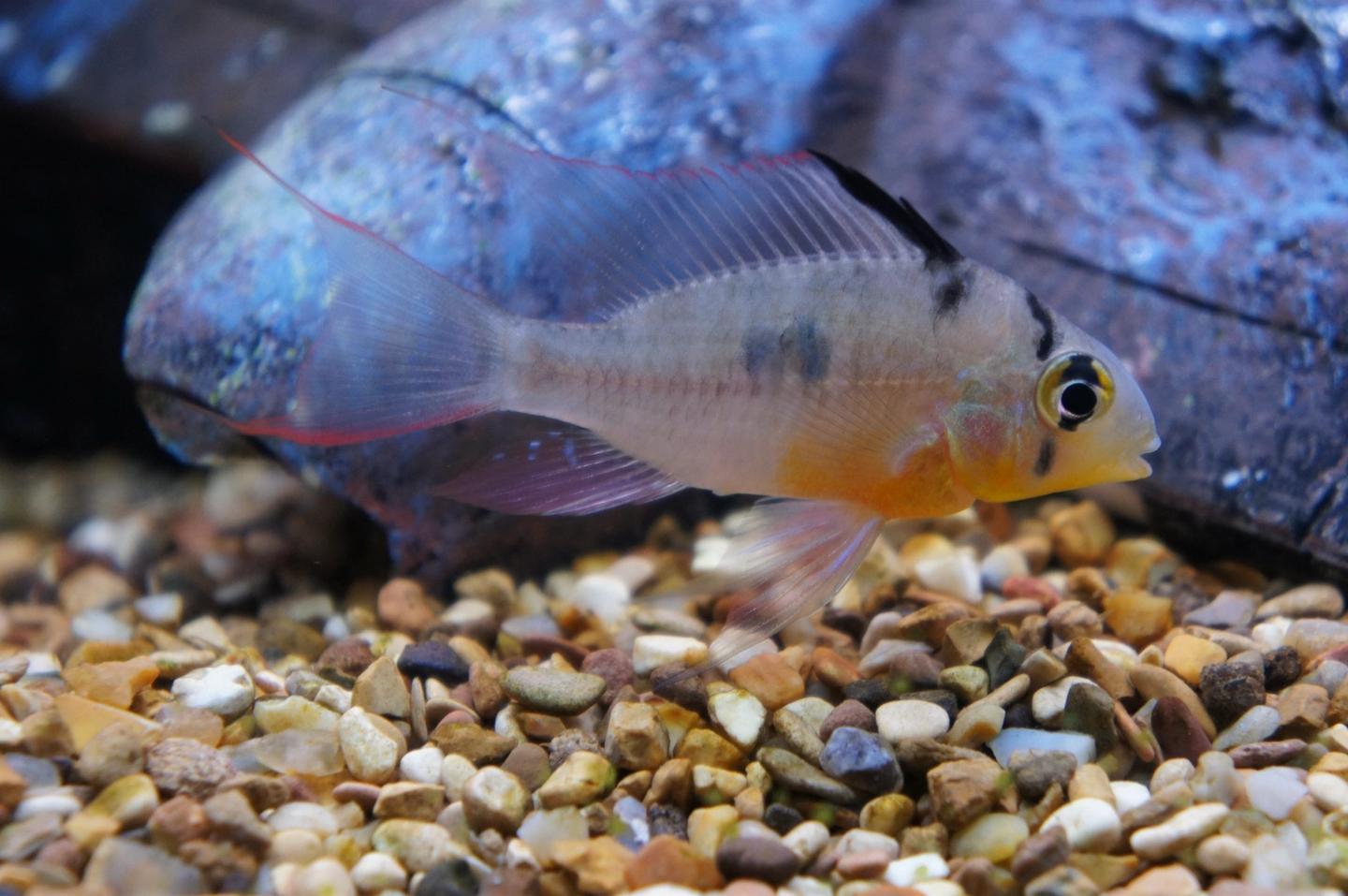
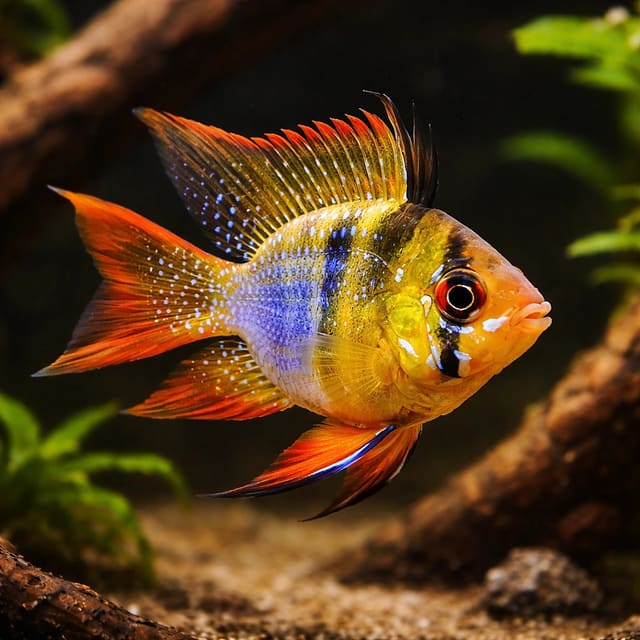
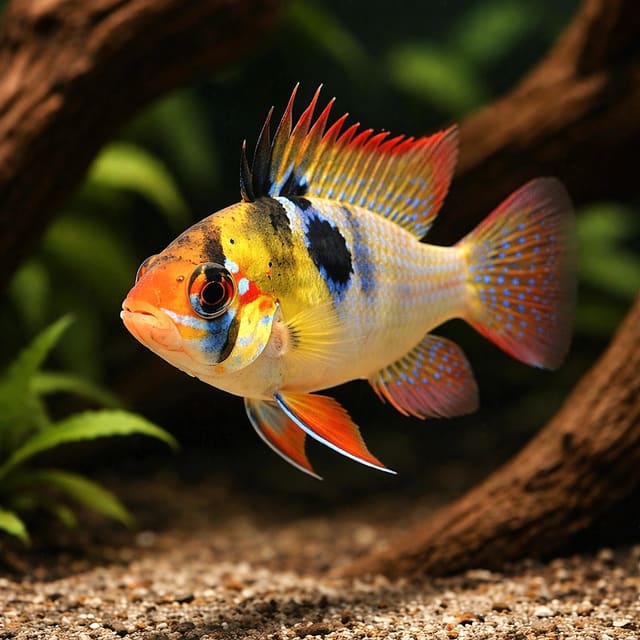
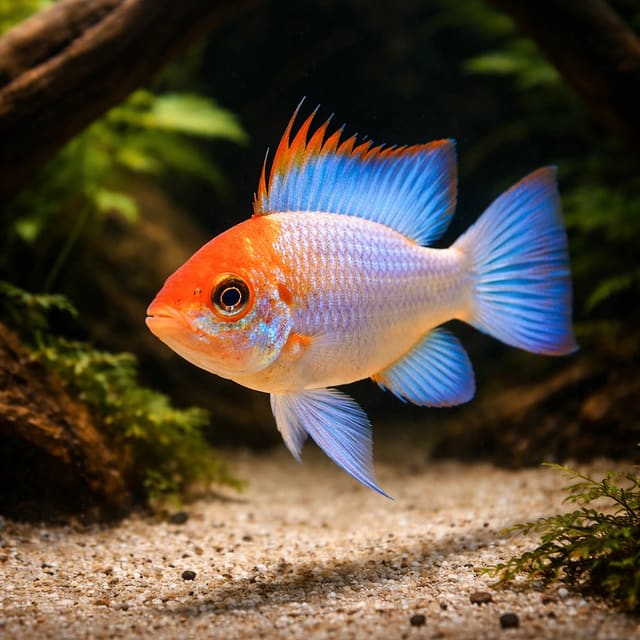
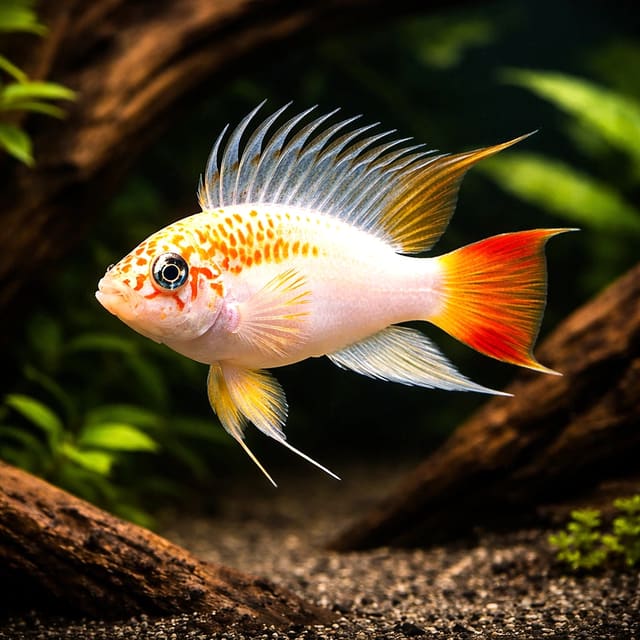
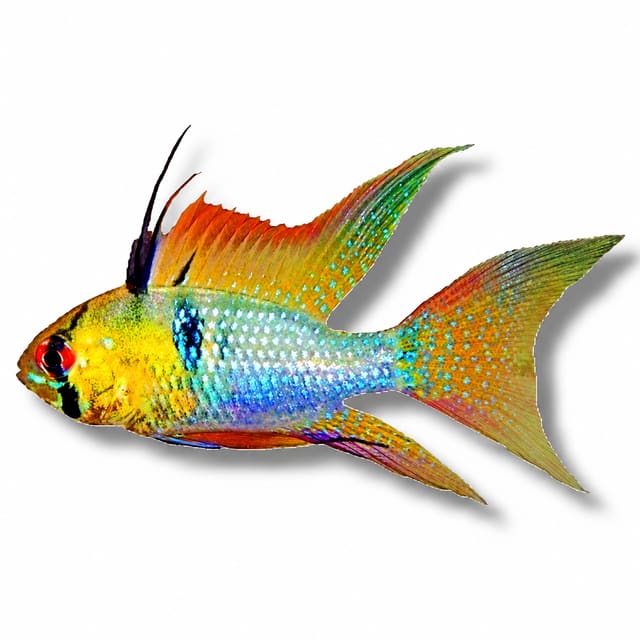
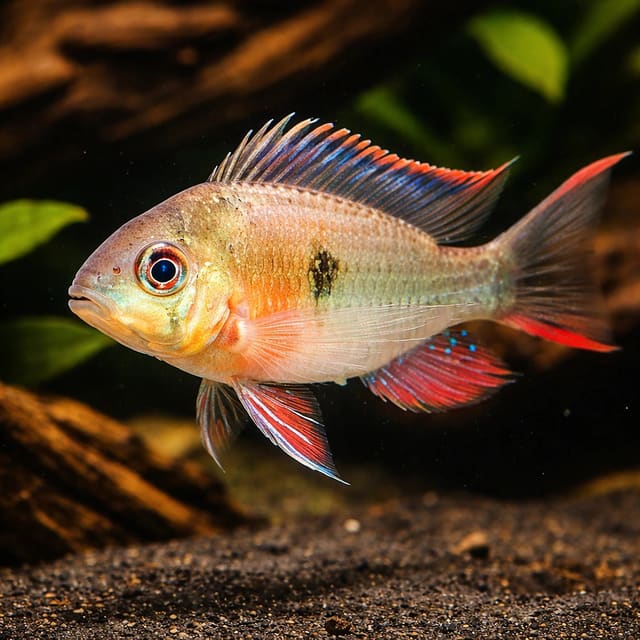
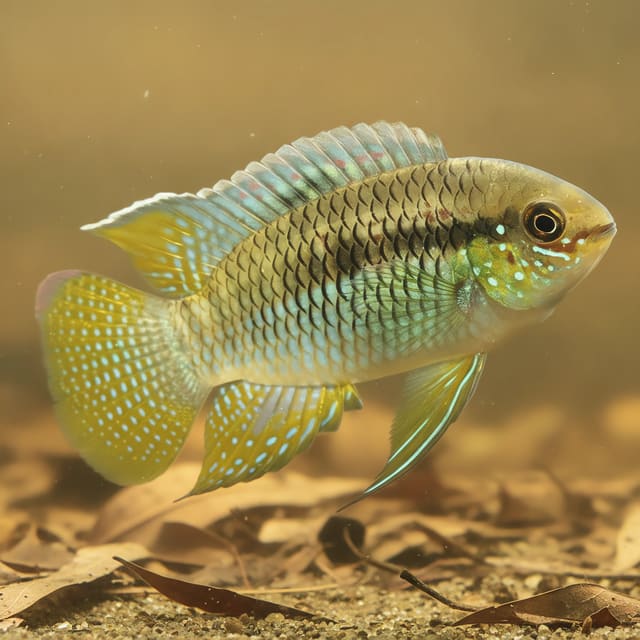
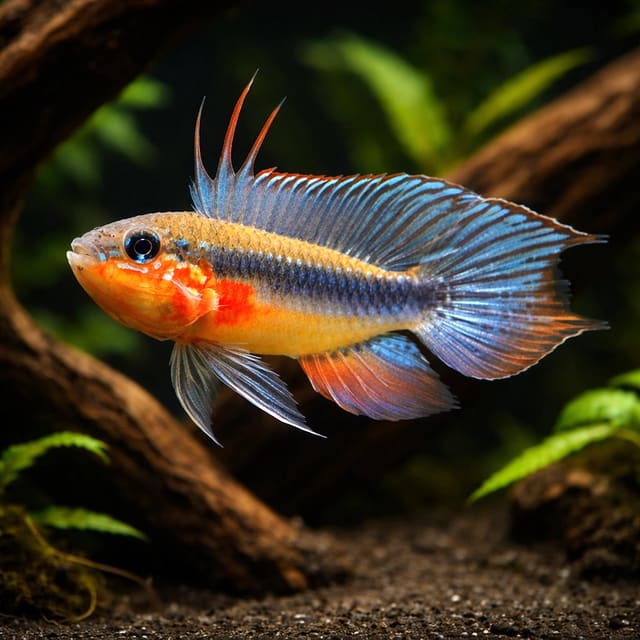
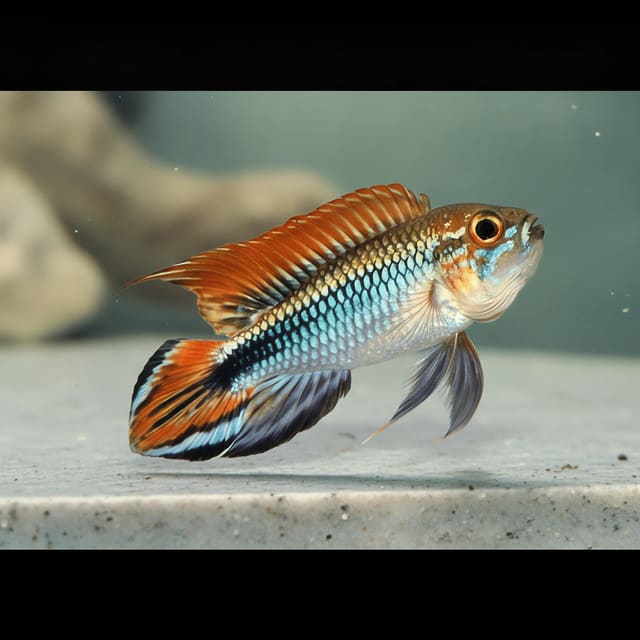
The Red Gold form is a selectively bred colour strain of Mikrogeophagus ramirezi with a warm golden base overlaid by orange to red facial and body tones, plus iridescent blue spotting on the flanks and fins. Typical red gold ram size is around 5-7 cm, with a laterally compressed body, elegant dorsal fin and expressive eye stripe characteristic of the species. In a settled pair, the male often appears slightly larger with longer fin extensions, while the female tends to show a fuller body and, when in condition, a richer pink to reddish belly.
If you have wondered about ramirezi hembra identification, look for the rounder body profile and more pronounced abdominal colour in mature females. Males usually develop more extended dorsal rays and a slightly sharper silhouette. This helps when choosing a red gold ram cichlid male and female pair for display or breeding.
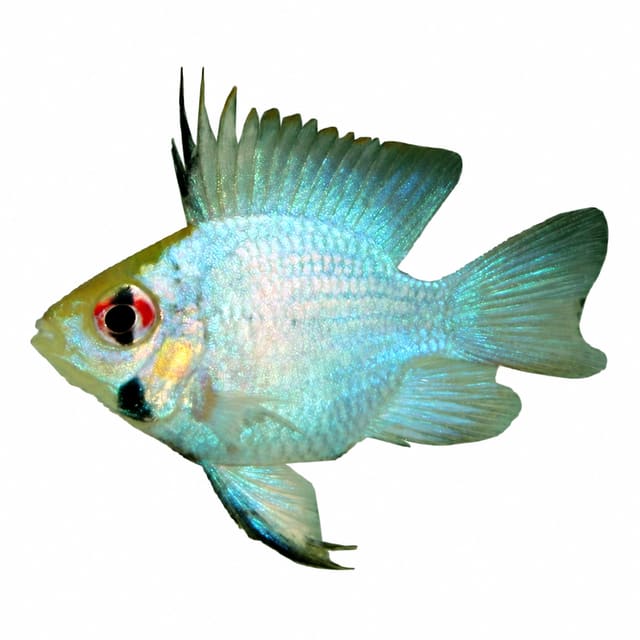
Among hobby strains, you may also encounter mikrogeophagus ramirezi electric blue, mikrogeophagus ramirezi gold, mikrogeophagus ramirezi longfin, balloon forms sometimes called ramirezi balon, and standard blue varieties. The Red Gold stands out for combining warmth, contrast and a more natural body shape than some heavily modified strains. That is why many aquarists consider it the best ram cichlid colour morph for a planted display.
Our photos show the clean finnage, balanced body shape and rich colour contrast that make this pair so attractive in a tropical aquascape. Good diet, dark natural decor and stable warm water all help intensify the metallic sheen and red-gold wash.
What Fish Can Live With Mikrogeophagus ramirezi? Compatibility Guide
Mikrogeophagus ramirezi tank mates should be peaceful, warm-water tolerant and unlikely to outcompete them at feeding time. This species is widely described as a peaceful dwarf cichlid for community tank use, and that is accurate, but only when the community is chosen carefully. Their ram cichlid behaviour is calm, observant and mildly territorial near the bottom, especially when a pair forms or spawns.
Ideal Tank Mates
Small tetras, Corydoras and Otocinclus are classic companions. Soft-water species that enjoy 26-28°C are best. If you like Ram varieties, the Blue Red Head Ramirezi Papiliochromis Ramirezi and Ram Dwarf Cichlid - Mikrogeophagus Ramirezi are close relatives in care terms, though mixing multiple Ram pairs in small tanks is not advised. For keepers comparing forms, Mikrogeophagus Ramirezi «Electric Blue Longfin» - offers a more exaggerated ornamental look.
Questions like pez ramirezi compatibilidad often come down to temperature. Many common community fish prefer cooler water than Rams. Cardinal tetra-type fish, warm-tolerant Corydoras and Otocinclus are much better choices than cool-water species. This is one reason the Red Gold is such a good red gold ram for community tank fish in a South American-style setup.
Species to Avoid
Avoid aggressive cichlids, fin nippers and boisterous species that dominate food. Large Central American cichlids, fast barbs and highly territorial bottom fish can stress Rams badly. Searches for cuerno de flor and other large ornamental cichlids sometimes bring people to dwarf cichlid pages, but Flowerhorn-type fish are completely unsuitable companions. Likewise, while some ask about trichogaster lalius, dwarf gouramis are not ideal in every case because they occupy similar visual space, may prefer slightly different conditions and can add disease risk in mixed sourcing situations.
Community Tank Stocking Examples
In a 60-litre aquarium, keep just the pair with perhaps a small clean-up crew if the setup is mature. In 90 litres, a pair can work with 8-12 small tetras and 6 warm-tolerant Corydoras. In a 120-litre planted aquarium, a pair can be the centrepiece above a peaceful shoal and an algae-control group. This is where the fish truly shines as a colourful dwarf cichlid UK hobbyists use as the focal point of a refined South American aquascape.
Compatibility with Invertebrates
Snails are usually fine. Small shrimp may be ignored in heavily planted tanks, but tiny shrimplets can be eaten. If your aim is guaranteed shrimp safety, choose another centrepiece fish. Rams are still cichlids, even if they are among the gentlest ciclidos enanos in the hobby.
| Species | Compatible? | Notes |
|---|---|---|
| German Blue Ram | ⚠️ Caution | Similar needs, but avoid multiple pairs in small tanks due to territorial tension. |
| Blue Red Head Ramirezi Papiliochromis Ramirezi | ⚠️ Caution | Best compared rather than mixed unless the aquarium is large and structured. |
| Small tetras | ✅ Yes | Excellent dither fish if they tolerate the warm water. |
| Corydoras | ✅ Yes | Choose warm-tolerant species and provide enough floor space. |
| Large aggressive cichlids | ❌ Avoid | Stress, injury and food competition make them unsuitable. |
Common comparison questions include ram cichlid vs apistogramma, apistogramma, red gold ram vs bolivian ram and red gold ram vs german blue ram. In general, Rams need warmer water than many Apistogramma and are often more sensitive to poor conditions, but they are also more openly visible in the aquarium. Compared with mikrogeophagus altispinosus (the Bolivian Ram, often searched as ramirezi boliviano), Red Gold Rams are smaller, brighter and less forgiving of cool or hard water.
💡 Compatibility Tip
Always quarantine new arrivals for 2-4 weeks before adding them to a Ram aquarium. This species is sensitive to parasites and bacterial issues introduced by apparently healthy tank mates, especially in warm water where pathogens can spread quickly.
How to Breed Mikrogeophagus ramirezi: Complete Breeding Guide
Breeding mikrogeophagus ramirezi is very achievable for prepared aquarists, but it is not a beginner project. The species is a substrate spawner, and a settled ram cichlid pair compatibility match is more important than simply placing one male and one female together. This listing provides a mikrogeophagus ramirezi male female pair, which gives you a strong starting point.
Breeding Setup
Use a dedicated 60-litre breeding tank or a calm, mature section of a larger aquarium. Keep water soft and clean, with temperature around 28-30°C, which aligns with standard ram cichlid breeding temperature guidance. Add flat stones, broad leaves or slate for spawning. Gentle filtration and minimal disturbance are essential.
Spawning Behaviour
Condition the pair with a rich, varied diet. As the female ripens, the belly becomes fuller and more colourful. The pair will clean a flat surface, shimmy, circle and defend a small area. This is classic ram cichlid breeding behaviour. Eggs are laid in neat rows and fertilised immediately after. Some young pairs eat their first few spawns; this is common and usually improves with age.
Egg Care & Hatching
At warm temperatures, eggs may hatch in roughly 48-72 hours. Parents may move wrigglers to shallow pits in the substrate. Good water quality is critical because fungus and bacterial losses increase rapidly in unstable conditions. Dim lighting and minimal traffic near the tank help the pair feel secure.
Fry Care & Growth
Once free swimming, fry need tiny foods such as infusoria, vinegar eels or freshly hatched Artemia. Frequent small feeds and daily maintenance are the key to raising numbers. If you are serious about mikrogeophagus ramirezi breeding, be prepared for heavy water-change routines and separate grow-out space.
Common Breeding Challenges
Common problems include infertile eggs, parents eating the spawn, fungal losses and poor fry survival. These are often linked to stress, immaturity, hard water or overfeeding. A true ram cichlid pair for breeding needs privacy, consistency and excellent conditioning. Compared with hardier species, Rams demand more precision but reward it with beautiful parental behaviour.
Advanced Breeding Tip
If a young pair repeatedly eats eggs, leave them together and let them practice rather than separating immediately. In many cases, stable water, lower traffic and a slightly more sheltered spawning site are enough to turn failed early attempts into successful broods.
Mikrogeophagus ramirezi vs Similar Species: Which Should You Choose?
Choosing between Ram varieties and related dwarf cichlids matters because they differ in colour, resilience and water requirements. If you are deciding between Red Gold, blue, Electric Blue or Bolivian forms, think about whether you want maximum colour, easier care or a more natural look.
| Feature | Red Gold Ram | Bolivian Ram |
|---|---|---|
| Max Size | 6-7 cm | 7-9 cm |
| Care Level | Moderate | Moderate-easier |
| Temperature | 26-30°C | 24-28°C |
| Price | £17.42 | Varies |
| Best For | Warm planted display tanks | Mixed community tanks with slightly broader tolerance |
| Feature | Red Gold Ram | Electric Blue Ram |
|---|---|---|
| Colour Style | Gold-red with blue highlights | Solid neon blue emphasis |
| Body Shape | Natural Ram profile | Similar, depending on strain |
| Temperature | 26-30°C | 26-30°C |
| Price | £17.42 | Usually similar or higher |
| Best For | Warm natural-looking planted tanks | High-impact modern colour displays |
When people ask about red gold ram vs electric blue ram or search ramirezi electric blue, the real difference is visual style. Electric Blue strains, including Mikrogeophagus Ramirezi «Electric Blue» - Papiliochromis and Mikrogeophagus Ramirezi «Electric Blue Longfin» -, are strikingly vivid, while the Red Gold has a warmer, more balanced look that suits natural aquascapes beautifully. For aquarists comparing red gold ram vs german blue ram, the Red Gold offers a richer gold-orange palette than the classic German Blue Ram.
If you are comparing with mikrogeophagus altispinosus, often sold as the Bolivian Ram, the Bolivian is generally tougher and more forgiving, but less intensely coloured. If your water is reliably warm and soft, and you want one of the most eye-catching options in the dwarf cichlid UK hobby, the Red Gold is a superb choice. If you want maximum resilience, a Bolivian may be easier. If you want the brightest artificial-looking blue, an Electric Blue form may appeal more.
Common Health Problems in Mikrogeophagus ramirezi & How to Prevent Them
Rams are often described as delicate, but in practice they are sensitive rather than inherently weak. Most health issues trace back to poor acclimation, unstable temperature, excess nitrate, inappropriate tank mates or low-grade chronic stress. This matters because the average ram cichlid lifespan is around 3 years, and good husbandry is what allows them to reach that comfortably.
Signs of a Healthy Ram
A healthy Red Gold Ram should show alert eyes, steady fin carriage, strong feeding response and clear interest in its surroundings. Colour should be rich rather than washed out, and the fish should not clamp fins or hover at the surface. Mild territorial displays between a pair are normal; gasping, darkening and hiding constantly are not.
Common Diseases & Symptoms
Searches for enfermedades del pez ramirezi usually reflect common Ram problems: external parasites, bacterial infections, wasting from internal issues and stress-related susceptibility to opportunistic disease. White spot, skin irritation, fin erosion and unexplained loss of appetite all demand quick action. Because this species is often kept warm, disease progression can be fast.
Some keepers also ask about mikrogeophagus maculicauda, ramirezi holland and regional trade names when trying to identify strains or health lines. Whatever the trade label, the care rule is the same: stable warm water and careful sourcing reduce losses dramatically.
Treatment Options
Start with water testing and a substantial water change if parameters are off. Move sick fish to a hospital tank where practical. Use medications only after identifying the likely cause. Avoid random treatment cocktails. If invertebrates are present, always verify medication safety first.
Prevention Tips
Keep nitrate low, feed a varied diet, quarantine new fish and avoid temperature swings. Warm tanks need good oxygenation, so maintain surface movement without creating harsh current. This species does best in mature aquariums, not newly assembled tanks. In mixed communities, choose companions carefully; not every freshwater cichlid UK or tropical cichlid UK listing belongs in a Ram aquarium.
Quarantine Procedures
A separate heated quarantine tank for 2-4 weeks is strongly recommended. Observe feeding, faeces, respiration and skin condition before introduction. This is especially important if mixing fish from different sources, or if considering species often searched alongside Rams such as trichogaster lalius.
⚠️ Health Warning
NEVER use copper-based medications in aquariums containing shrimp or other sensitive invertebrates. Copper can be lethal even at therapeutic doses intended for fish treatment.
🔹 Quarantine Protocol
- Use a separate heated tank for 2-4 weeks
- Match temperature closely to the display aquarium
- Observe appetite, respiration and faeces daily
- Test ammonia and nitrite frequently
- Only medicate when symptoms or diagnosis justify it
Understanding Mikrogeophagus ramirezi Behavior in the Aquarium
The classic ram cichlid behaviour profile is peaceful, observant and surprisingly interactive. A settled pair will patrol the lower half of the tank, inspect leaves and stones, and often watch activity outside the glass. They are not schooling fish, but they are social within a bonded pair. During spawning, they become more territorial around a chosen site without turning into true tank tyrants.
These Rams are most confident in structured aquariums with cover, warm stable water and calm tank mates. In sparse tanks they may appear shy; in planted layouts they become much bolder. This is part of why they are such a popular South American cichlid UK option for aquascaped displays. They combine cichlid intelligence with a manageable temperament and compact size.
Interesting behaviours include substrate picking, pair displays, colour intensification during courtship and coordinated defense of eggs or fry. If you want to see the species at its best, keep the environment quiet, avoid overstocking and provide broad surfaces for inspection. A healthy pair quickly becomes the centre of attention in the aquarium.
Why Buy from Tropical Fish Co?
This listing is specifically for a red gold ram cichlid male and female pair, selected for hobbyists who want a genuine display pair rather than a random assortment. With Rams, that matters. A balanced pair gives you better behaviour, better presentation and a stronger chance of successful acclimation than mixing mismatched fish later. For aquarists searching Mikrogeophagus ramirezi for sale, mikrogeophagus ramirezi for sale UK, mikrogeophagus ramirezi red gold for sale UK, ramirezi red gold for sale UK or ram cichlid pair for sale UK, this product is designed to remove the guesswork.
Before dispatch, fish are observed for feeding response, body condition and general stability in warm, species-appropriate water. Rams do not benefit from rushed handling, so careful packing is essential. Orders are sent with tracked delivery in insulated packaging, with heat packs in winter when conditions require them. Each fish bag is packed to reduce sloshing stress and maintain temperature consistency during transit.
Because this is a specialist pair dwarf cichlid UK product rather than a generic mixed tropical listing, the care advice is also species-specific. You are not just buying a dwarf cichlid UK fish; you are buying a warm-water South American pair that needs exact ram cichlid water parameters, careful acclimation and a mature setup. If you are deciding whether to buy red gold ram cichlid UK, red gold dwarf cichlid buy UK or check the current red gold ram cichlid price UK and ramirezi red gold price UK, the value lies in receiving a properly prepared pair with clear care guidance.
Order your Mikrogeophagus ramirezi Red Gold pair with confidence if you want a standout freshwater cichlid UK centrepiece for a warm planted aquarium.
Why Choose Tropical Fish Co for Red Gold Rams
- Male and female pair selected for balanced presentation and compatibility
- Observed in warm Ram-appropriate conditions before dispatch
- Insulated, tracked packing methods designed specifically for sensitive dwarf cichlids
You Might Also Like
If you enjoy the Red Gold form, compare it with the classic German Blue Ram for a more traditional colour pattern, or the Blue Red Head Ramirezi Papiliochromis Ramirezi for another striking Mikrogeophagus ramirezi variation. For a brighter modern look, the Mikrogeophagus Ramirezi «Electric Blue» - Papiliochromis and Electric Blue Longfin Ram are excellent alternatives. If you prefer elegant finnage, Beautiful Ramirez'S Dwarf Cichlid Long Fin offers the same species in a flowing longfin form. You can also browse our wider dwarf cichlid collection to compare other peaceful South American centrepiece fish for warm planted aquariums.
You Might Also Like


Striped Kribensis Dehane - Tropical Fish for Sale UK

Apisto Agassizii (Apistogramma agassizii) - UK

Apistogramma Elizabethae - Rare Dwarf Cichlid | UK

Apistogramma Fire Red Agassiz Dwarf Cichlid - UK

Turkana Jewel Cichlid (Hemichromis exsul) - UK

Blue Red Head Ramirezi Dwarf Cichlid - UK

Apistogramma Panduro - Moderate Care | UK
Popular Right Now

Yellow Vampire Crab (Geosesarma sp.) - UK

Aulonocara sp. 'Firefish' - Tropical Fish for Sale UK

Yellow Lepturus Cichlid - UK

Endler Gold Guppy Breeding (Poecilia wingei) - UK

X Neon Green Rasbora - UK

Rasbora Heteromorpha (Trigonostigma heteromorpha) - UK