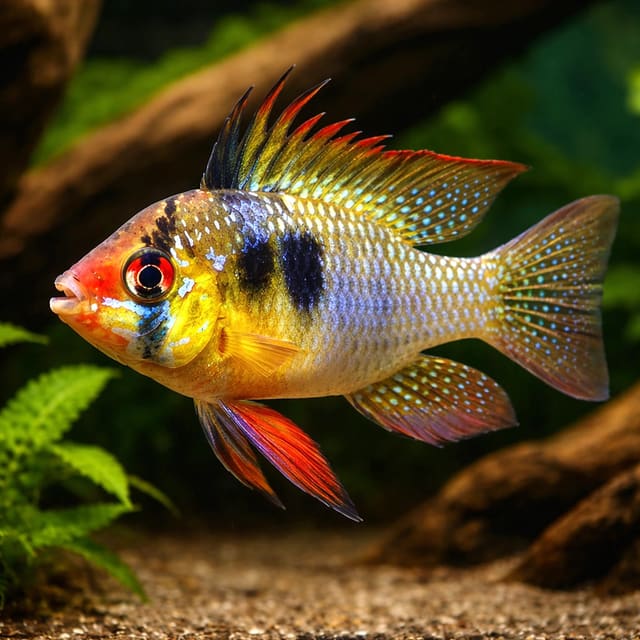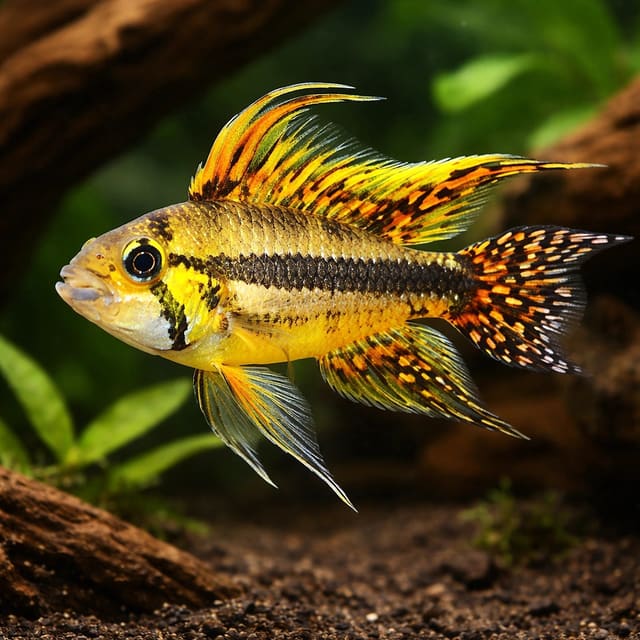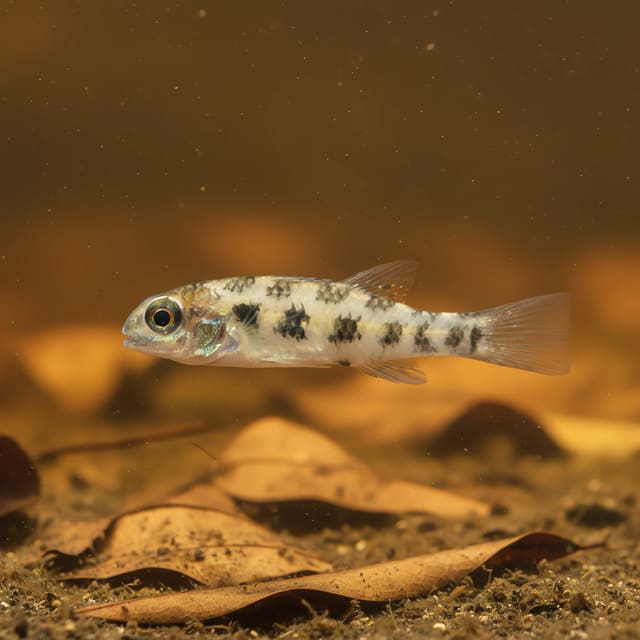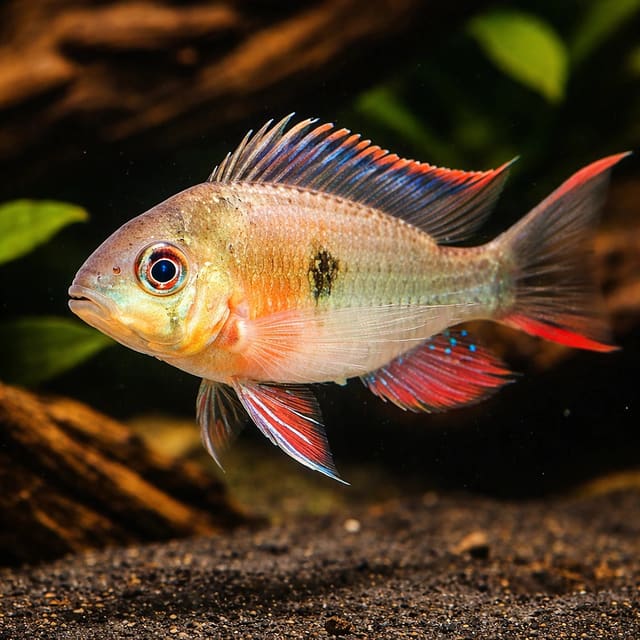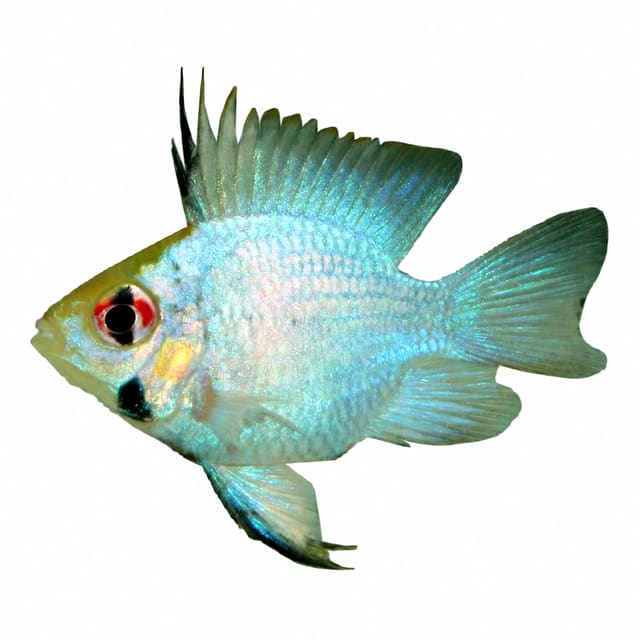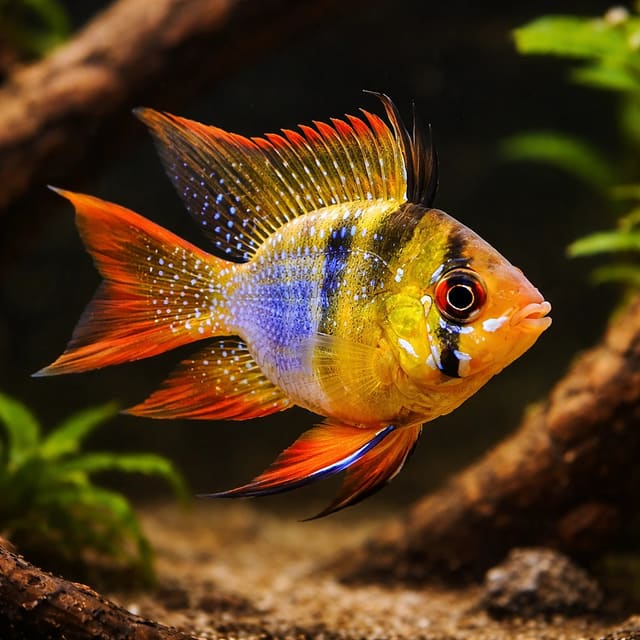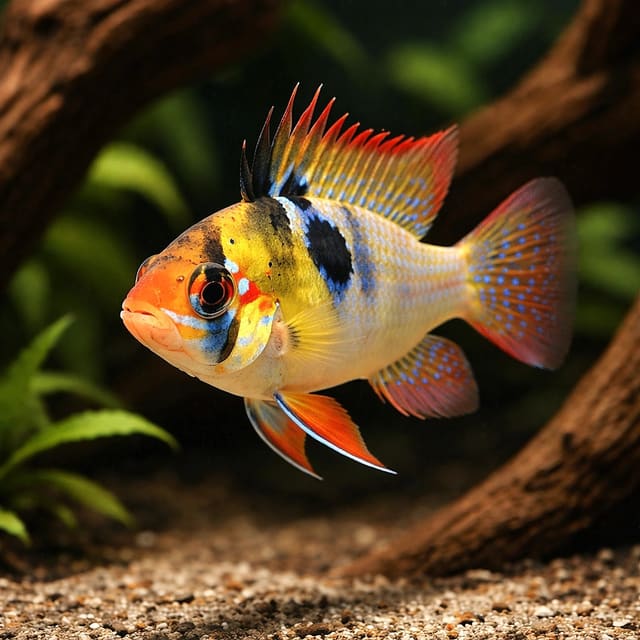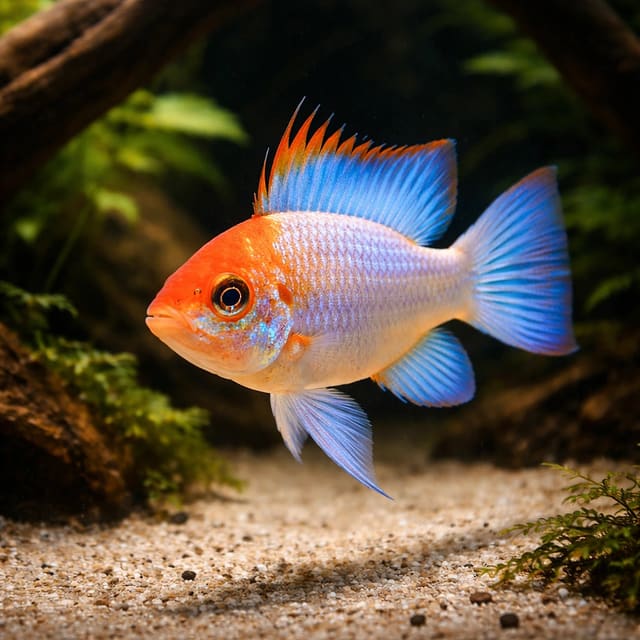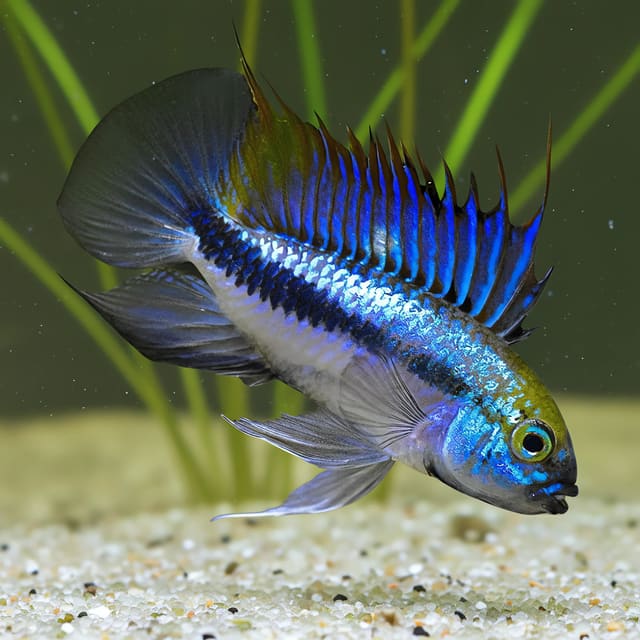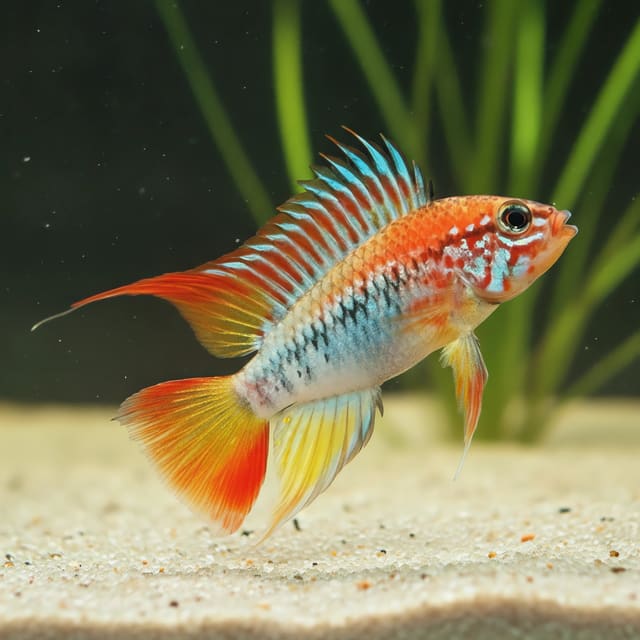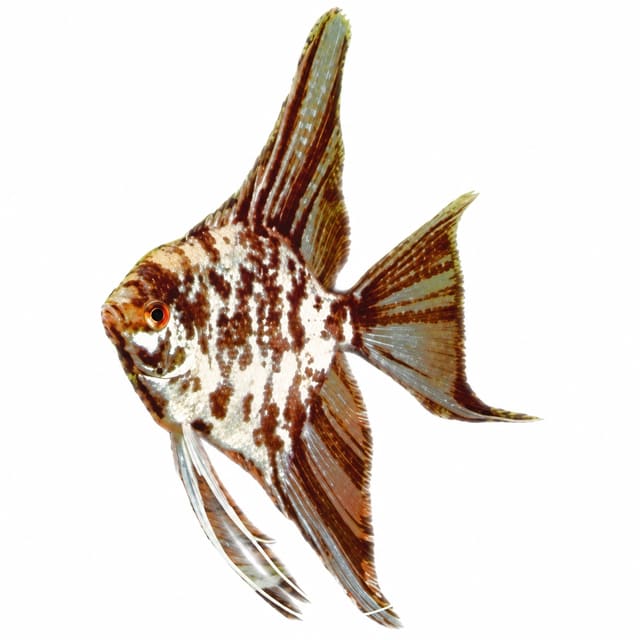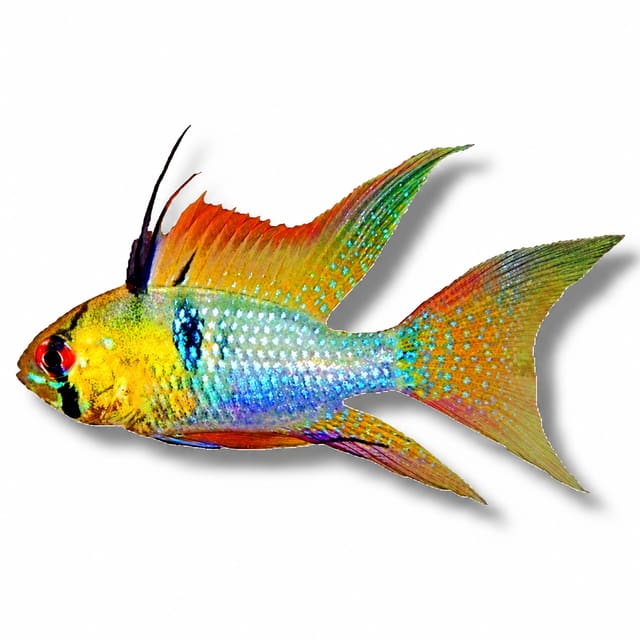
Longfin Ram Cichlid (Mikrogeophagus ramirezi)
27–30°C · pH 4–7 · 54L
From £6.99Some sizes on sale
Photo coming soon
The size, price and care details on this page are for this listing.
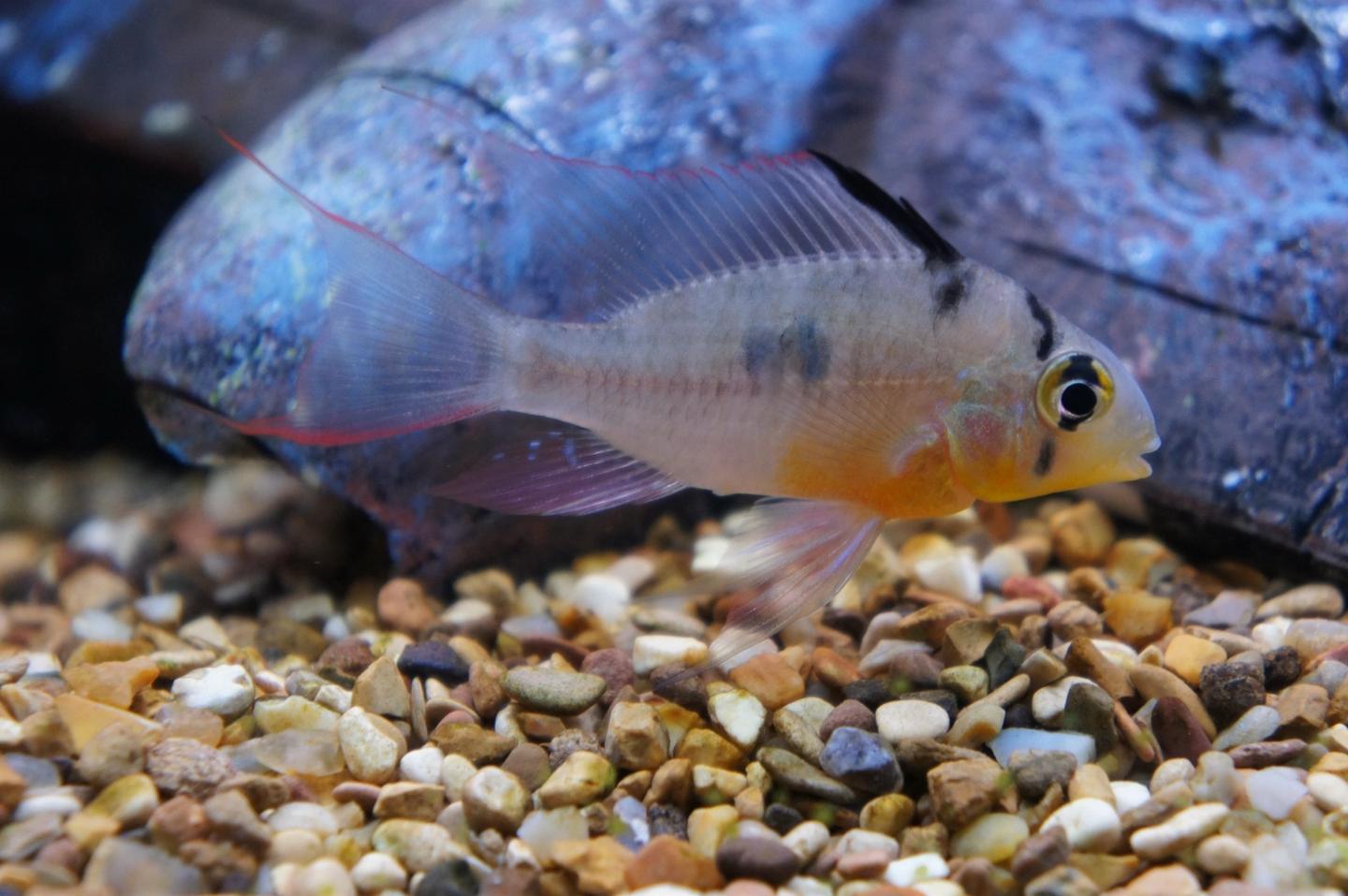
A gold, long-finned (l.f.) form of the ram cichlid, Mikrogeophagus ramirezi, formerly listed as Papiliochromis. Sold as one fish, sex not specified. A small, warm-water dwarf cichlid for a mature, soft-water tank at 27-30 °C with calm tetras; bred strains need careful, steady care.
Adult size is the maximum length this species reaches at full maturity (scientific sources). The livestock you receive will be younger and smaller. Product-photo provenance and any image-specific limitations are stated on the listing.
Mikrogeophagus ramirezi
A gold, long-finned (l.f.) form of the ram cichlid, Mikrogeophagus ramirezi, formerly listed as Papiliochromis. Sold as one fish, sex not specified. A small, warm-water dwarf cichlid for a mature, soft-water tank at 27-30 °C with calm tetras; bred strains need careful, steady care.
Adult size is the maximum length this species reaches at full maturity (scientific sources). The livestock you receive will be younger and smaller. Product-photo provenance and any image-specific limitations are stated on the listing.
Cichlids are a family of roughly 1,800 accepted species, not one care type. Before buying, identify the exact species and source, then compare adult measurement, usable tank dimensions, social system, territory, tested water, diet and an exit plan. No family-wide minimum tank, water range or tank-mate list is safe.
Maintain these water conditions for optimal health and vibrant colors
The name on this listing is written in trade shorthand, so it is worth unpacking. "Ramirez' Dwarf Cichlid" is one of the English names for Mikrogeophagus ramirezi, the small South American cichlid most fishkeepers simply call the ram. "Gold" is the colour form. "l.f." stands for long-finned, a form bred for extended fins. Put together, this is a golden ramirezi with long fins: the same species as the wild ram, in a colour and finnage produced in captivity.
Each unit is one fish. The listing does not give a dispatch size and does not sell a particular sex, so we can't promise a male or a female, and two fish ordered together are not guaranteed to be a pair. The sexing notes further down will help you work out what you have as the fish mature.
Older stock lists, ours included, called this fish Papiliochromis ramirezi. FishBase now gives the accepted name as Mikrogeophagus ramirezi (Myers & Harry, 1948), with Papiliochromis ramirezi and the original Apistogramma ramirezi listed as synonyms. Wikipedia notes that since its description in 1948 the species has been moved between several genera, among them Microgeophagus, Papiliochromis, Pseudoapistogramma and Pseudogeophagus. Seriously Fish explains that Kullander settled the argument over Mikrogeophagus versus Papiliochromis in 2011. We have updated the name in brackets to match; the fish itself is the same.
The common name honours Manuel Ramirez, who Wikipedia records as an early collector and importer of the species for the aquarium trade. Other names you will see for the same species include ram, blue ram, German blue ram, butterfly cichlid and dwarf butterfly cichlid. Some of those are colour-form names; all of them belong to the one species.
Rams have a reputation, and it is earned. Seriously Fish does not recommend the species for the general community aquarium, because it needs very clean water and does not compete well with livelier fish, and it says rams should never go into a new or biologically immature tank. If you have a mature, warm, soft-water aquarium with calm companions, a gold long-finned ram is a lovely fish to watch. If your tank was set up last month, wait.
Before you order, run through this list:
Every ram in the shops descends from fish collected in the Orinoco basin, but the gold long-finned form is a long way from that wild fish. Wikipedia lists the captive-bred varieties of the species as gold rams (xanthic forms), electric blue, high-bodied "balloon" forms and long-finned varieties. Seriously Fish's list of commercial strains includes gold, long-finned in both blue and gold, electric or neon blue, super neon blue gold, pearl and balloon.
Xanthic means the yellow pigments dominate. A gold ram keeps the ram's shape and fin layout, with its body colour shifted towards yellow and gold. Long-finned means the fins have been selected to grow longer than in the wild type. Wikipedia and Seriously Fish both describe long-finned rams as a separate bred variety; neither gives a measurement for how much longer the fins grow, so we won't either.
Both sources are frank about the cost of this selective breeding. Wikipedia says the bred varieties suffer from lower fertility, health problems or reduced brood care compared with wild-type fish. Seriously Fish goes further: it describes the artificially reared forms as tending to be genetically weak, susceptible to disease, shorter-lived and poor breeders, and it names gold, balloon and long-finned among the strains concerned. It also notes that commercial strains are usually grown on with dried foods high in protein and colour-enhancing pigments to speed growth.
We would rather you heard that from us before buying than found it out later. What it means in practice is simple: a gold long-finned ram needs the best version of ram care, not a relaxed version. Warm, clean, stable water, a mature filter, calm tank mates and a varied diet give a bred fish its best chance. Seriously Fish also points out the other side of the coin. Wild fish are of superior genetic stock, but they are more demanding in water conditions and diet and suited, in its view, only to experienced keepers. Neither choice is effortless.
If you came here comparing colour forms, we also list the Longfin Ram Cichlid, the Black Ram Cichlid and the electric blue gold head ram. All are the same species, so the water and feeding advice on this page applies to them too. Bear in mind that males do not tolerate other males, so mixing forms in one small tank is not a free choice.
FishBase gives the natural range of M. ramirezi as the Orinoco River basin, in the llanos of Venezuela and Colombia. Wikipedia describes the Llanos as a vast tropical grassland plain east of the Andes, covering about 375,800 square kilometres, with the Orinoco running west to east through it and forming part of the border between the two countries. The landscape is a mix of open grassland, savannah dotted with trees, and strips of gallery forest along the rivers and streams.
The seasons there are sharply divided. Wikipedia puts the rainy season from April to November and the dry season from December to March, with parts of the plain flooding up to a metre deep in the rains. The mean annual temperature is 27 °C. Seriously Fish describes the same region as having distinct wet and dry seasons, high temperatures all year and seasonally flooded plains and forests.
Wikipedia describes the ram's natural habitat as warm, acidic water courses, giving 25.5 to 29.5 °C and pH 5.2 to 6.7. The water is generally slow-flowing and low in dissolved minerals, and it ranges from clear to darkly stained with tannins. That one sentence explains most of what a ram wants in an aquarium: warmth, softness, gentle flow and clean water.
For aquarium purposes the seasonal swings matter less than the constants. The water is warm all year, and the streams that drain the plains carry few minerals. Wikipedia's habitat range of 25.5 to 29.5 °C sits around the region's 27 °C annual mean, which is why the aquarium figures for this species start so high.
FishBase lists the species as benthopelagic, meaning it lives near the bottom but also uses the water just above it, and records it as Least Concern on the IUCN Red List, from an assessment in October 2020. FishBase also notes the species has been used in behavioural studies, which tells you something about how much there is to watch in a settled pair.
The ram is small. FishBase gives a maximum of 4.2 cm standard length, Seriously Fish gives 40 mm standard length, and Wikipedia puts the species at 34 to 40 mm, with males slightly larger than females. Standard length runs from the snout to the base of the tail and leaves out the tail fin. On a long-finned fish the fins add plenty of visual size, but the body itself stays within those figures. Plan around a body of about 4 cm.
Seriously Fish describes males as larger, with more extended fins and more intense colour. Most females have a pinkish patch on the belly that males lack.
Those sexing notes describe the species in general. In a strain bred for long fins, compare your fish with each other rather than against a picture of a wild ram, and lean on body size and the belly patch as well as fin length. If you buy a single fish, you will find out its sex as it matures; if you buy several, expect that the mix is down to chance.
Seriously Fish notes that juveniles are gregarious, while adults form pairs. Wikipedia adds that rams form monogamous pairs before spawning and that males do not tolerate other males. A group of young fish can therefore look peaceful in a shop tank and become a very different proposition once they mature and pair off.
Seriously Fish gives a tank base of 60 × 30 cm, roughly 54 litres, as the minimum. FishBase's aquarium note agrees on a minimum tank length of 60 cm and recommends keeping the species in pairs. Treat that as the floor for a pair, with companions needing room on top. If you want to keep more than one pair, think much bigger: Seriously Fish says each breeding pair commands a territory a couple of feet across.
Choose soft sand. Seriously Fish calls the species benthophagous, a bottom feeder that normally takes mouthfuls of substrate to sift food from it. Sharp gravel is hard on a fish that feeds that way. Sand colour is a matter of taste, though a darker sand makes a gold fish stand out more than a white one.
Seriously Fish suggests wood roots, caves and flat rocks, with ceramic flowerpots as an acceptable alternative, and plenty of shady spots. The flat rocks matter more than they look: rams lay their eggs on a solid surface, and a smooth stone on open sand is a natural spawning site. Put a couple in places where the pair can be seen from the front glass, and you will have a better view of any spawning.
Leaf litter is worth adding. Seriously Fish says it helps by supporting beneficial microbe colonies and releasing tannins, which suits a fish from tannin-stained water. Dried leaves sold for aquariums are the safe way to do it; replace them as they break down.
Here is one way to set out the minimum-sized tank for a pair. Spread a few centimetres of soft sand across the floor. Set one or two smooth, flat stones on the sand in the front third, a little apart, where you can see them from the front glass. Run a piece of branching wood from one back corner, and tuck a ceramic flowerpot on its side underneath it as a cave. Plant the back and one end, scatter a handful of dried leaves near the wood, and let a few floating plants shade part of the surface. That leaves open sand at the front for sifting, cover at the back for retreat, and spawning stones in view.
The same layout works for a single ram. It does not stretch to two pairs. If each breeding pair commands a territory a couple of feet across, as Seriously Fish says, each pair needs roughly the length of a 60 cm tank to itself.
Plants give the shade the species likes and help keep the water clean. Floating plants soften strong lighting, and tall stems or wood can break up the tank so a second male, or a nervous female, can get out of view. Seriously Fish says filtration should not be very strong. A long-finned fish has more fin to drag through moving water, so keep the outlet gentle, aim it along the back glass and give the fish quiet water near the front.
A ram's water needs to be warm, soft and very clean, and above all it needs to stay that way. Here is what the sources say:
| Source | Temperature | pH | Hardness |
|---|---|---|---|
| FishBase | 27–30 °C | 5.0–6.0 | dH 5–12 |
| Seriously Fish | 27–30 °C | 4.0–7.0 | 1–10 dGH |
| Wikipedia (natural habitat) | 25.5–29.5 °C | 5.2–6.7 | Low in dissolved minerals |
The care box on this page follows FishBase: 27 to 30 °C, pH 5.0 to 6.0 and 5 to 12 dGH. Seriously Fish's wider pH band of 4.0 to 7.0 shows how much variation the species can be kept in, but we would aim for the middle of the overlap, around pH 6, and not push towards either extreme.
FishBase and Seriously Fish both start their range at 27 °C, and the Llanos itself averages 27 °C through the year. That has knock-on effects for everything else in the tank. Not every tropical fish shares that range, so check that each companion's own range reaches 27 to 30 °C rather than assuming any tropical fish will do. Use a reliable heater with a guard, check the thermometer every day, and in summer keep an eye on the top end so the tank doesn't climb past 30 °C.
Seriously Fish's two rules here are worth taking literally. First, rams should never go into a new or biologically immature aquarium. Let the tank run and carry other fish for some months first. Second, it recommends regular water changes of 10 to 15% rather than very large ones, so the chemistry doesn't swing. OATA's dwarf cichlid care sheet sets the targets for that routine: ammonia and nitrite at zero and nitrate no more than 20 mg per litre above your tap water level, with water tests once a week.
Note that OATA's sheet suggests 25% weekly for dwarf cichlids as a group, while Seriously Fish prefers smaller, more frequent changes for rams. The two fit together if you think in terms of total volume per week: two changes of 10 to 15% give roughly the same freshening as one larger change, with half the jolt to the fish.
Small, regular changes are easiest when the new water is ready before you need it. Fill a clean container the day before, condition it, warm it to tank temperature with a spare heater, and check that its pH and hardness match the aquarium. Cold or mismatched water, even in small amounts, is the sort of sudden change that Seriously Fish's advice on small, regular water changes is meant to avoid. A notebook by the tank helps: date, temperature, pH, KH, nitrate and how much water you changed. After a few weeks you'll see your tank's normal pattern, and anything unusual stands out.
Test pH, GH and KH before you buy. If your tap water sits well above the hardness and pH ranges above, plan on reverse osmosis water, either blended with tap water or remineralised to a fixed recipe, and match every batch to the tank before it goes in. Soft water holds little buffer, so test pH and KH on the same day each week and note the results; a slow downward drift is easier to correct early.
Watch a ram feed and you will see why the substrate matters. Seriously Fish describes the species as benthophagous, taking mouthfuls of sand and sifting food from it. In the aquarium the same habit means food that lands on the bottom gets found, while food that floats or is snatched in midwater by faster fish often doesn't reach the ram at all.
In practice a rotation might run frozen bloodworm on two days, frozen Artemia on two, Daphnia on one and a sinking dried food on the other two, with live grindal worm as a treat if you keep a culture going.
Thaw frozen food in a cup of tank water and drop it close to the sand where the rams are working. If you keep fast midwater fish such as tetras with them, feed those first at the surface and the rams a moment later near the bottom.
OATA's guidance for dwarf cichlids is to feed only what the fish will eat in a few minutes, once a day. At 27 to 30 °C, uneaten food spoils quickly and fouls the water, and rams are fish that need clean water above almost anything else. Siphon out leftovers rather than leaving them in the sand. If you prefer two small feeds a day, split the same amount.
Given Seriously Fish's note that commercial strains are often raised on rich dried foods to speed their growth, a newly arrived gold ram may be used to pellets and slow to take frozen food. Keep offering small portions of frozen food alongside a familiar sinking food until it accepts them.
Rams are peaceful fish with a short list of exceptions. Wikipedia says males do not tolerate other males, and Seriously Fish describes a breeding pair claiming a territory a couple of feet across. Outside the breeding pair, the bigger issue is the other way round: rams are easily pushed aside. Seriously Fish advises against the general community aquarium partly because rams do not compete well, and says to avoid territorial or aggressive fishes, including most other cichlids.
Seriously Fish suggests peaceful characins that swim in open water, and names the cardinal tetra, Paracheirodon axelrodi, and the green neon tetra, P. simulans, as examples. Both occupy the middle of the tank and leave the bottom to the rams. Whatever you choose must also be happy at 27 to 30 °C and in soft water, so check each companion's own range before you buy it.
FishBase's aquarium note recommends keeping rams in pairs, and that is the arrangement most keepers aim for: a male and a female with their own patch of sand. Because this listing does not sell a set sex, two fish may not give you that. If you end up with two males, a 60 cm tank is not big enough for both; plan for a larger tank, a divider or rehoming one. A single ram can be kept with suitable companions, though you'll miss the pair behaviour that makes the species so watchable.
Rams are biparental substrate spawners, according to Seriously Fish, and Wikipedia describes them forming monogamous pairs before spawning and sharing brood care. FishBase's account emphasises the female, noting that she cares for the eggs and larvae, while Seriously Fish says both sexes guard the brood. You may see either pattern; what matters is giving the pair peace and space.
The eggs are normally laid on a solid surface, such as a flat rock, a piece of driftwood, a broad plant leaf or even the aquarium glass, according to Seriously Fish. Wikipedia describes the eggs as small and adhesive, 0.9 to 1.5 mm across, and gives a typical clutch of 150 to 300 eggs, with clutches of up to 500 reported.
Wikipedia says the eggs hatch in about 40 hours at 29 °C, and the larvae are not free-swimming for another five days. Seriously Fish gives two to three days for incubation followed by about five more days during which the fry stay largely immobile. Once they swim, Seriously Fish recommends microworm, infusoria and other microscopic foods to start, then newly hatched Artemia nauplii.
You don't need a separate tank to see a pair spawn, but one makes raising fry much easier. A small tank with a thin layer of sand, a flat stone, a sponge filter and water drawn from the main tank lets you move eggs or a pair without a shock to the chemistry, and keeps the fry away from other fish. Keep it within the same 27 to 30 °C range and change small amounts of water often. Wikipedia's hatching figure of about 40 hours is given at 29 °C, and Seriously Fish gives two to three days, so a spawn on Monday will usually have hatched by midweek.
Fry feeding needs planning. The fry need microscopic food first, so start the infusoria or microworm culture a week or two before you expect a spawn. Feed small amounts several times a day, siphon the leftovers carefully, and move on to Artemia nauplii as Seriously Fish suggests once the fry can take them.
Here the strain matters. Wikipedia notes that bred varieties can show lower fertility and reduced brood care compared with wild-type rams, and Seriously Fish describes the commercial strains as poor breeders. So a pair of gold long-finned rams may spawn without managing to raise fry. That isn't a reason not to try. It is a reason to keep conditions steady, keep the tank quiet, and keep a culture of microworm or infusoria ready before you need it.
If you do raise fry, the advice on water quality applies doubly. Small, regular water changes, careful feeding and a gentle filter intake covered with sponge give the young the best start.
Before you order, make sure the aquarium is fully ready: filter mature and running, water tested, and the temperature already steady between 27 and 30 °C. Someone needs to be at the delivery address to receive the parcel, because live fish can't be left unattended. Please read our delivery and live-arrival information before you buy.
Your ram travels in an oxygen-filled bag inside insulated packaging, with heat packs when the weather calls for them, and goes by a tracked courier licensed to carry live animals. You'll get the confirmed delivery date and tracking details by email.
Begin filming before you open the parcel, while it is still sealed, and keep the video running as you open it and show the fish in its unopened bag. If a fish arrives dead, dying or clearly in poor condition, email hello@tropicalfishco.co.uk on the day of delivery with your order number and that continuous video. Photos alone don't meet the policy. Subject to the guarantee terms, the affected fish is then replaced with your next order or refunded.
Keep the lights low for the rest of the day and watch the fish's breathing, appetite and behaviour over the following week. Let the new fish find its own spot; there is no need to coax it out. Offer a small amount of food the next day, near the sand, and remove what isn't eaten.
If you have a spare tank, a fortnight in quarantine at the same temperature and chemistry is a sensible precaution before a new ram joins established fish. It also gives you a quiet place to get the fish eating frozen food.
A healthy, settled ram is easy to recognise once you know it: it moves about the lower half of the tank sifting sand, holds its fins open rather than clamped, comes to food readily and keeps a steady colour from day to day.
OATA's care sheet lists what to keep an eye on in dwarf cichlids: changes in swimming, colour, temperament, breathing, appearance and feeding. With rams, Seriously Fish describes one warning sign in particular. When conditions deteriorate the species becomes prone to a problem resembling head and lateral line erosion, seen as small pits where the flesh erodes around the pores on the head and along the flank. If you see pitting, clamped fins, or a fish that stops sifting the sand, test the water before anything else and correct the cause. OATA also recommends rinsing filter media in old tank water during a partial water change, never under the tap.
Everything on this page was checked against these sources:
No reviews for this item yet. Bought one? Honest reviews only, good or bad.
What customers say about ordering from us
Easy website plenty of info on fish your buying great to pick a time slot
TRACEY DURRANT · 7 Oct 2026
Got some lovely fish thank you
Kevin Mackie · 7 Oct 2026
Reviews of our shop, collected by Judge.me, an independent third-party review collector. Newest first.